

|
시장보고서
상품코드
2045671
재사용 바이오리액터 시장 기회, 성장요인, 업계 동향 분석 및 예측(2026-2035년)Reusable Bioreactors Market Opportunity, Growth Drivers, Industry Trend Analysis, and Forecast 2026 - 2035 |
||||||

세계의 재사용 바이오리액터 시장은 2025년에 96억 달러로 평가되었고 CAGR 9.9%로 성장하여 2035년까지 247억 달러에 이를 것으로 예측됩니다.
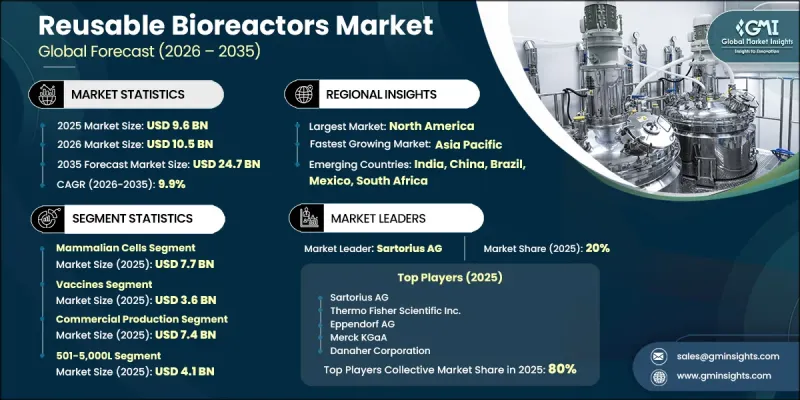
재사용 바이오리액터 산업의 확대는 제약 및 생명공학 분야의 지속적인 성장, 맞춤형 의료에 대한 수요 증가, 바이오프로세스 기술의 지속적인 발전으로 강력하게 뒷받침되고 있습니다. 바이오 의약품 생산 및 첨단 치료제 개발에 대한 투자가 증가함에 따라, 제조업체들은 대규모 상업적 생산을 지원할 수 있는 고효율 및 내구성이 뛰어난 바이오리액터 시스템의 도입을 촉진하고 있습니다. 세포 기반 연구, 재생 의학 및 첨단 치료제 제조의 발전으로 생명공학의 상황은 빠르게 진화하고 있으며, 이는 재사용 가능한 바이오리액터 기술에 대한 수요를 더욱 강화시키고 있습니다. 이러한 시스템은 대량 생산 환경에서 장기적인 운영 신뢰성, 공정 안정성 및 비용 효율성 향상을 제공한다는 점에서 큰 주목을 받고 있습니다. 또한, 자동화, 모니터링 시스템, 통합 세척 및 살균 기능의 기술 발전으로 재사용 바이오리액터의 전반적인 기능성과 수명이 향상되고 있습니다. 규제 준수, 생산 일관성, 확장 가능한 제조 인프라에 대한 관심이 높아짐에 따라 재사용 가능한 바이오리액터 시장은 현대 바이오의약품 제조 시설에서 필수적인 요소로 자리매김하고 있습니다.
| 시장 범위 | |
|---|---|
| 시작 연도 | 2025년 |
| 예측 기간 | 2026-2035년 |
| 시작 연도 시장 규모 | 96억 달러 |
| 예측 시장 규모 | 247억 달러 |
| CAGR | 9.9% |
재사용 가능한 바이오리액터는 정확한 공정 관리, 반복되는 생산 사이클에서의 내구성, 엄격한 검증 및 규제 기준 준수 등 다양한 운영상의 이점을 제공합니다. 바이오의약품 제조업체들이 상업적 규모의 운영과 첨단 치료제 파이프라인을 지원하기 위해 생산 능력을 계속 확장하고 있는 가운데, 재사용 가능한 바이오리액터 시스템은 제품의 무결성을 유지하고 일관된 제조 결과를 보장하는 데 있어 필수적입니다. 공정 자동화 및 통합 멸균 기술의 지속적인 발전은 제조업체가 효율성을 개선하고 가동 중지 시간을 줄이는 동시에 가동 중지 시간을 줄이는 데 도움이되었습니다. 전 세계 바이오의약품 제조 시설에 대한 투자 증가는 대용량 및 비용 중심의 생산 환경에서 재사용 가능한 바이오리액터 시스템의 도입을 더욱 촉진할 것으로 예측됩니다.
2025년 포유류 세포 부문은 77억 달러 시장 규모를 기록했습니다. 포유류 세포 배양은 치료제 생산에 필요한 고도로 정교한 세포 공정을 지원할 수 있기 때문에 첨단 생물학적 제제 생산에 있어 매우 중요한 역할을 하고 있습니다. 이러한 세포배양은 안정적인 온도 수준, 산소 조절, 영양 균형 유지, pH 관리 등 엄격하게 관리된 생산 조건이 요구됩니다. 재사용 가능한 바이오리액터는 여러 번의 가동 주기에 걸쳐 일관된 생산 품질을 유지할 수 있는 고도로 제어되고 반복 가능한 처리 환경을 제공하기 때문에 이러한 응용 분야에서 널리 선호되고 있습니다. 공정 정확도와 운영 안정성을 유지할 수 있는 능력은 포유류 세포 기반 제조 업무에 대한 도입을 강력하게 추진하고 있습니다.
2025년 백신 부문 시장 규모는 36억 달러에 달했습니다. 백신 제조는 통제된 배양 환경과 신뢰할 수 있는 생산의 일관성을 필요로 하는 복잡한 생물학적 제조 공정에 크게 의존하고 있습니다. 재사용 가능한 바이오리액터 시스템은 반복적인 생산 사이클을 통해 중요한 운영 파라미터를 정밀하게 제어하면서 대규모 세포 배양을 지원할 수 있기 때문에 백신 생산에 널리 활용되고 있습니다. 질병 예방에 대한 전 세계적인 관심 증가와 예방접종 이니셔티브의 확대는 이 부문 수요를 지속적으로 뒷받침하고 있습니다. 첨단 백신 개발 기술에 대한 투자 확대와 헬스케어에 대한 인식이 높아짐에 따라 예측 기간 동안 재사용 바이오리액터 산업에서 백신 부문의 입지는 더욱 강화될 것으로 예측됩니다.
2025년 기준 북미 재사용형 바이오리액터 시장은 38.9%의 점유율을 차지했습니다. 미국 및 캐나다 전역의 제약 및 생명공학 산업이 확대됨에 따라 이 지역 시장 성장세가 지속될 것으로 예측됩니다. 반복적인 대량 생산에 대응할 수 있는 내구성 있고 검증된 제조 시스템에 대한 수요 증가는 이 지역 시장 확대에 크게 기여하고 있습니다. 재사용형 바이오리액터는 대규모 치료제 생산 및 첨단 치료제 개발에 초점을 맞춘 바이오의약품 생산 공정에 점점 더 많이 통합되고 있습니다. 또한, 이 지역 시장은 바이오의약품 인프라에 대한 투자 확대, 복잡한 생물학적 제제에 대한 관심 증가, 고효율 및 확장성 높은 생산 시스템을 필요로 하는 맞춤형 의료 접근법의 확산으로 인해 수혜를 받고 있습니다.
자주 묻는 질문
목차
제1장 조사 방법과 범위
제2장 주요 요약
제3장 업계 인사이트
제4장 경쟁 구도
제5장 시장 추산 및 예측 : 셀별, 2022-2035년
제6장 시장 추산 및 예측 : 분자별, 2022-2035년
제7장 시장 추산 및 예측 : 사용법별, 2022-2035년
제8장 시장 추산 및 예측 : 소재별, 2022-2035년
제9장 시장 추산 및 예측 : 사이즈별, 2022-2035년
제10장 시장 추산 및 예측 : 최종 용도별, 2022-2035년
제11장 시장 추산 및 예측 : 지역별, 2022-2035년
제12장 기업 개요
JHS 26.06.11The Global Reusable Bioreactors Market was valued at USD 9.6 billion in 2025 and is estimated to grow at a CAGR of 9.9% to reach USD 24.7 billion by 2035.
Expansion across the reusable bioreactors industry is strongly supported by the continuous growth of the pharmaceutical and biotechnology sectors, rising demand for personalized therapies, and ongoing advancements in bioprocessing technologies. Increasing investments in biologics production and advanced therapeutic development are encouraging manufacturers to adopt highly efficient and durable bioreactor systems capable of supporting large-scale commercial operations. The biotechnology landscape is evolving rapidly due to progress in cell-based research, regenerative medicine, and advanced therapeutic manufacturing, which continues to strengthen demand for reusable bioreactor technologies. These systems are gaining significant traction because they provide long-term operational reliability, process stability, and improved cost efficiency for large-volume production environments. In addition, technological enhancements in automation, monitoring systems, and integrated cleaning and sterilization capabilities are improving the overall functionality and lifespan of reusable bioreactors. Growing emphasis on regulatory compliance, production consistency, and scalable manufacturing infrastructure is further positioning the reusable bioreactors market as a vital component of modern biopharmaceutical production facilities.
| Market Scope | |
|---|---|
| Start Year | 2025 |
| Forecast Year | 2026-2035 |
| Start Value | $9.6 Billion |
| Forecast Value | $24.7 Billion |
| CAGR | 9.9% |
Reusable bioreactors deliver multiple operational advantages, including accurate process management, durability across repeated production cycles, and compatibility with strict validation and regulatory standards. As biopharmaceutical manufacturers continue expanding production capacities to support commercial-scale operations and advanced therapeutic pipelines, reusable bioreactor systems remain essential for maintaining product integrity and ensuring consistent manufacturing outcomes. Continuous developments in process automation and integrated sterilization technologies are also helping manufacturers improve efficiency while reducing operational downtime. Increasing investments in biologics manufacturing facilities worldwide are expected to further reinforce the adoption of reusable bioreactor systems in high-capacity and cost-sensitive production settings.
The mammalian cells segment generated USD 7.7 billion in 2025. Mammalian cell cultures play a critical role in the production of advanced biologic therapies due to their ability to support highly sophisticated cellular processes required for therapeutic manufacturing. These cell cultures require tightly regulated production conditions, including stable temperature levels, oxygen control, nutrient balance, and pH management. Reusable bioreactors are widely preferred for these applications because they provide highly controlled and repeatable processing environments capable of supporting consistent production quality over multiple operational cycles. Their ability to maintain process precision and operational stability continues to drive strong adoption within mammalian cell-based manufacturing operations.
The vaccines segment accounted for USD 3.6 billion in 2025. Vaccine manufacturing relies heavily on complex biological production processes that require controlled cultivation environments and reliable production consistency. Reusable bioreactor systems are extensively utilized in vaccine manufacturing due to their ability to support large-scale cell cultivation while maintaining precise control over critical operational parameters throughout repeated manufacturing cycles. Strong global focus on disease prevention and expanding immunization initiatives continue to support demand within this segment. Increasing investment in advanced vaccine development technologies and growing healthcare awareness are expected to further strengthen the position of the vaccines segment within the reusable bioreactors industry over the forecast period.
North America Reusable Bioreactors Market represented 38.9% share in 2025. The region continues to witness strong market growth due to the expanding pharmaceutical and biotechnology industries across the United States and Canada. Rising demand for durable and validated manufacturing systems capable of supporting repeated high-volume production is contributing significantly to regional market expansion. Reusable bioreactors are increasingly being integrated into biologics manufacturing operations focused on large-scale therapeutic production and advanced treatment development. The regional market is also benefiting from growing investments in biopharmaceutical infrastructure, increasing focus on complex biologic therapies, and rising adoption of personalized medicine approaches that require highly efficient and scalable production systems.
Key companies operating in the Global Reusable Bioreactors Market include Bbi-biotech, Danaher Corporation, Eppendorf Group, Esco Micro Pte. Ltd., GEA Group Aktiengesellschaft, Getinge AB, Infors AG, Merck KGaA, Sartorius AG, Thermo Fisher Scientific Inc., PBS Biotech, Inc., and Cellexus International Ltd. Companies operating in the reusable bioreactors industry are implementing several strategic initiatives to strengthen their competitive position and expand their global presence. Major market participants are focusing on technological innovation by developing advanced automation systems, enhanced monitoring solutions, and more efficient sterilization technologies to improve operational productivity and system performance. Many companies are also investing in research and development activities aimed at increasing scalability, process consistency, and regulatory compliance across biologics manufacturing operations. Strategic collaborations, facility expansions, and partnerships with pharmaceutical and biotechnology firms are helping manufacturers strengthen distribution networks and broaden customer reach. In addition, organizations are prioritizing customized bioprocessing solutions and expanding manufacturing capacities to address rising global demand for biologics, vaccines, and advanced therapeutic products within the reusable bioreactors market.
Table of Contents
Chapter 1 Methodology and Scope
- 1.1 Research approach
- 1.2 Quality commitments
- 1.2.1 GMI AI policy & data integrity commitment
- 1.2.1.1 Source consistency protocol
- 1.2.1 GMI AI policy & data integrity commitment
- 1.3 Research trail & confidence scoring
- 1.3.1 Research trail components
- 1.3.2 Scoring components
- 1.4 Data collection
- 1.4.1 Partial list of primary sources
- 1.5 Data mining sources
- 1.5.1 Paid sources
- 1.5.1.1 Sources, by region
- 1.5.1 Paid sources
- 1.6 Base estimates and calculations
- 1.6.1 Base year calculation for any one approach
- 1.7 Forecast model
- 1.7.1 Quantified market impact analysis
- 1.7.1.1 Mathematical impact of growth parameters on forecast
- 1.7.1 Quantified market impact analysis
- 1.8 Research transparency addendum
- 1.8.1 Source attribution framework
- 1.8.2 Quality assurance metrics
- 1.8.3 Our commitment to trust
Chapter 2 Executive Summary
- 2.1 Industry 360° synopsis
- 2.2 Key market trends
- 2.2.1 Regional trends
- 2.2.2 Cell trends
- 2.2.3 Molecule trends
- 2.2.4 Usage trends
- 2.2.5 Material trends
- 2.2.6 Size trends
- 2.2.7 End use trends
- 2.3 CXO perspectives: Strategic imperatives
Chapter 3 Industry Insights
- 3.1 Industry ecosystem analysis
- 3.2 Industry impact forces
- 3.2.1 Growth drivers
- 3.2.1.1 Growing pharmaceutical and biotechnology industry
- 3.2.1.2 Technological advancements in bioreactors
- 3.2.1.3 Growing focus on orphan drug development
- 3.2.1.4 Rising demand for personalized medicines
- 3.2.2 Industry pitfalls and challenges
- 3.2.2.1 Low capacity of single-use bioreactors
- 3.2.2.2 Concerns regarding extractables and/or leachables
- 3.2.3 Market opportunities
- 3.2.3.1 Precision fermentation for novel healthcare applications
- 3.2.1 Growth drivers
- 3.3 Growth potential analysis
- 3.4 Regulatory landscape
- 3.4.1 North America
- 3.4.2 Europe
- 3.4.3 Asia Pacific
- 3.4.4 Latin America
- 3.4.5 Middle East and Africa
- 3.5 Technological advancements
- 3.5.1 Current technological trends
- 3.5.2 Emerging technologies
- 3.6 Pricing trend analysis
- 3.7 Patent analysis
- 3.8 Future market trends
- 3.9 Impact of AI and Generative AI on the market
- 3.10 Porter's analysis
- 3.11 PESTEL analysis
Chapter 4 Competitive Landscape, 2024
- 4.1 Introduction
- 4.2 Company market share analysis
- 4.3 Company matrix analysis
- 4.4 Competitive analysis of major market players
- 4.5 Competitive positioning matrix
- 4.6 Key developments
- 4.6.1 Mergers and acquisitions
- 4.6.2 Partnerships and collaborations
- 4.6.3 New product launches
- 4.6.4 Expansion plans
Chapter 5 Market Estimates and Forecast, By Cell, 2022 - 2035 ($ Mn)
- 5.1 Key trends
- 5.2 Mammalian cells
- 5.3 Bacterial cells
- 5.4 Yeast cells
- 5.5 Other cells
Chapter 6 Market Estimates and Forecast, By Molecule, 2022 - 2035 ($ Mn)
- 6.1 Key trends
- 6.2 Monoclonal antibodies
- 6.3 Vaccines
- 6.4 Recombinant proteins
- 6.5 Stem cells
- 6.6 Gene therapy
- 6.7 Other molecules
Chapter 7 Market Estimates and Forecast, By Usage, 2022 - 2035 ($ Mn)
- 7.1 Key trends
- 7.2 Developmental, pre-clinical & clinical
- 7.3 Commercial production
Chapter 8 Market Estimates and Forecast, By Materials, 2022 - 2035 ($ Mn)
- 8.1 Key trends
- 8.2 Stainless steel
- 8.3 Glass
Chapter 9 Market Estimates and Forecast, By Size, 2022 - 2035 ($ Mn)
- 9.1 Key trends
- 9.2 Less than 500 L
- 9.3 501-5,000 L
- 9.4 More than 5,000 L
Chapter 10 Market Estimates and Forecast, By End Use, 2022 - 2035 ($ Mn)
- 10.1 Key trends
- 10.2 R&D organizations
- 10.3 Biopharma manufacturers
- 10.4 Contract manufacturing organizations (CMOs)
Chapter 11 Market Estimates and Forecast, By Region, 2022 - 2035 ($ Mn)
- 11.1 Key trends
- 11.2 North America
- 11.2.1 U.S.
- 11.2.2 Canada
- 11.3 Europe
- 11.3.1 Germany
- 11.3.2 UK
- 11.3.3 France
- 11.3.4 Spain
- 11.3.5 Italy
- 11.3.6 Netherlands
- 11.4 Asia Pacific
- 11.4.1 China
- 11.4.2 India
- 11.4.3 Japan
- 11.4.4 Australia
- 11.4.5 South Korea
- 11.5 Latin America
- 11.5.1 Brazil
- 11.5.2 Mexico
- 11.5.3 Argentina
- 11.6 Middle East and Africa
- 11.6.1 Saudi Arabia
- 11.6.2 South Africa
- 11.6.3 UAE
Chapter 12 Company Profiles
- 12.1 Global players
- 12.1.1 Danaher Corporation
- 12.1.2 Eppendorf Group
- 12.1.3 GEA Group Aktiengesellschaft
- 12.1.4 Getinge AB
- 12.1.5 Merck KGaA
- 12.1.6 Sartorius AG
- 12.1.7 Thermo Fisher Scientific Inc.
- 12.2 Regional players
- 12.2.1 Cellexus International Ltd.
- 12.2.2 Esco Micro Pte. Ltd.
- 12.2.3 Infors AG
- 12.3 Emerging players
- 12.3.1 Bbi-biotech
- 12.3.2 PBS Biotech, Inc.


