

|
시장보고서
상품코드
2083288
식품 병원균 검사 시장 비즈니스 기회, 성장요인, 업계 동향 분석 및 예측(2026-2035년)Food Pathogen Testing Market Opportunity, Growth Drivers, Industry Trend Analysis, and Forecast 2026 - 2035 |
||||||

세계의 식품 병원균 검사 시장은 2025년에 62억 달러로 평가되었고, CAGR 7.7%로 성장하여 2035년까지 130억 달러에 달할 것으로 추정되고 있습니다.
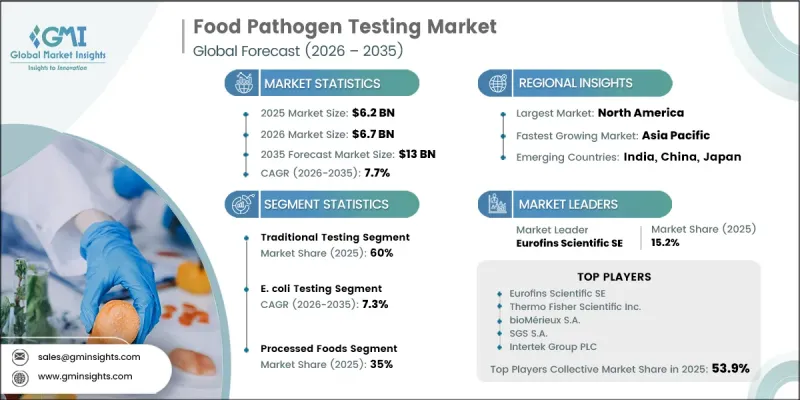
이 시장은 식품 안전에 대한 규제 당국의 관심이 높아지고, 식중독에 대한 우려가 커지며, 첨단 검출 기술의 도입이 확대됨에 따라 꾸준한 성장을 이루고 있습니다. 식품 오염 위험이 전 세계적으로 지속적인 영향을 미치고 있는 만큼, 식품 제조업체, 소매업체 및 규제 당국은 검사 절차를 강화하고 안전 기준을 개선하기 위해 노력하고 있습니다. 식품 업계가 더욱 신속하고 정확하며 효율적인 검출 방식으로 전환함에 따라, 최신 병원체 검사 솔루션의 중요성은 점점 더 커지고 있습니다. 기존의 실험실 기반 검사에서 첨단 분자진단 및 신속 검출 플랫폼으로의 전환을 통해 잠재적 위험 요인을 신속하게 파악할 수 있게 되면서, 식품 안전 관리 업무는 혁신을 이루고 있습니다. 또한, 식품 제조업체들은 공급망의 투명성을 높이고, 오염 위험을 줄이며, 소비자의 신뢰를 유지하기 위해 검사 프로그램에 대한 투자를 확대되고 있습니다. 첨단 진단 기술의 도입은 실시간 모니터링 기능을 뒷받침하며, 조직이 점점 더 엄격해지는 식품 안전 요건을 충족하는 데 기여하고 있습니다. 소규모 사업자에게는 여전히 높은 설비 비용이 과제로 남아 있지만, 지속적인 기술 개발과 신뢰성이 높은 식품 안전 솔루션에 대한 수요 증가가 시장 확대를 뒷받침할 것으로 예측됩니다.
| 시장 범위 | |
|---|---|
| 개시 연도 | 2025년 |
| 예측 기간 | 2026-2035년 |
| 초기 시장 규모 | 62억 달러 |
| 예측액 | 130억 달러 |
| CAGR | 7.7% |
식품 생산 환경에서 기업들이 보다 신속하고 통합적인 검사 방식으로 전환함에 따라, 식품 병원체 검출 과정은 큰 변화를 겪고 있습니다. 첨단 분자 기술, 자동화된 검사 플랫폼 및 고감도 검출 시스템의 도입이 확대됨에 따라 미생물 위험을 보다 효율적으로 파악하는 능력이 향상되고 있습니다. 식품 제조업체와 소매업체들은 규제상의 의무를 이행할 뿐만 아니라, 품질 관리 프로그램을 강화하고 업무상 위험을 줄이기 위해서도 병원체 검사 솔루션에 투자하고 있습니다.
기존 검사 기법 부문은 규제 검증, 인증 절차 및 규정 준수와 관련된 분야에서 확고한 역할을 수행하고 있어, 2025년에는 60%의 시장 점유율을 차지했습니다. 배양법에 기반한 접근 방식과 확립된 면역학적 검사 기법은 식품 안전 체계 내에서 신뢰성, 수용성 및 타당성이 인정받고 있으므로, 계속해서 널리 활용되고 있습니다. 이러한 기법들은 공식적인 확인이나 품질 보증의 목적으로 문서화되고 표준화된 검사 절차가 요구되는 상황에서 여전히 중요한 위치를 차지하고 있습니다.
가공식품 부문은 2025년에 35%의 시장 점유율을 차지했으며, 2035년까지 연평균 성장률(CAGR) 7.4%로 성장할 것으로 전망됩니다. 이 부문의 성장은 포장 식품 공급망의 복잡성에 힘입어 이루어지고 있습니다. 이곳에서는 여러 가지 원재료와 가공 단계가 존재하기 때문에 효과적인 병원체 모니터링의 중요성이 커지고 있습니다. 식품 제조업체들은 제품의 안전성을 유지하고, 규정 준수를 강화하며, 생산 및 유통 네트워크 전반에 걸친 오염 위험을 최소화하기 위해 검사 절차에 더욱 중점을 두고 있습니다.
북미의 식품 병원균 검사 시장은 2025년에 35%의 점유율을 차지했으며, 2035년까지 연평균 성장률(CAGR) 6.8%로 성장할 것으로 전망됩니다. 이 지역 시장 성장은 엄격한 식품 안전 규제, 첨단 검사 인프라, 그리고 최신 검출 기술의 높은 보급률에 힘입어 이루어지고 있습니다. 확립된 식품 제조 네트워크의 존재와 품질 보증 시스템에 대한 투자 확대가 병원체 검사 솔루션에 대한 수요를 더욱 부추기고 있습니다. 이 지역은 규제 준수, 식품 안전 혁신, 그리고 첨단 검사 역량에 중점을 두고 있어 계속해서 확고한 입지를 유지하고 있습니다.
자주 묻는 질문
목차
제1장 조사 방법과 범위
제2장 주요 요약
제3장 업계 인사이트
제4장 경쟁 구도
제5장 시장 추산 및 예측 : 기술별, 2022년-2035년
제6장 시장 추산 및 예측 : 병원체 유형별, 2022년-2035년
제7장 시장 추산 및 예측 : 식품 유형별, 2022년-2035년
제8장 시장 추산 및 예측 : 최종사용자별, 2022년-2035년
제9장 시장 추산 및 예측 : 지역별, 2022년-2035년
제10장 기업 개요
LSH 26.07.14The Global Food Pathogen Testing Market was valued at USD 6.2 billion in 2025 and is estimated to grow at a CAGR of 7.7% to reach USD 13 billion by 2035.
The market is experiencing consistent growth due to increasing regulatory focus on food safety, rising concerns regarding foodborne illnesses, and the growing adoption of advanced detection technologies. The continued global impact of food contamination risks is encouraging food producers, retailers, and regulatory bodies to strengthen testing procedures and improve safety standards. Modern pathogen testing solutions are becoming increasingly important as the food industry moves toward faster, more accurate, and more efficient detection methods. The shift from conventional laboratory-based testing toward advanced molecular and rapid detection platforms is transforming food safety operations by enabling quicker identification of potential hazards. Food manufacturers are also increasing investments in testing programs to improve supply chain transparency, reduce contamination risks, and maintain consumer confidence. The adoption of advanced diagnostic technologies is supporting real-time monitoring capabilities and helping organizations meet increasingly strict food safety requirements. Although high equipment costs remain a challenge for smaller operators, ongoing technological development and rising demand for reliable food safety solutions are expected to support market expansion.
| Market Scope | |
|---|---|
| Start Year | 2025 |
| Forecast Year | 2026-2035 |
| Start Value | $6.2 Billion |
| Forecast Value | $13 Billion |
| CAGR | 7.7% |
Food pathogen detection processes are undergoing significant transformation as companies move toward faster and more integrated testing approaches within food production environments. The increasing adoption of advanced molecular technologies, automated testing platforms, and highly sensitive detection systems is improving the ability to identify microbial risks more efficiently. Food manufacturers and retailers are investing in pathogen testing solutions not only to meet regulatory obligations but also to strengthen quality control programs and reduce operational risks.
The traditional testing methods segment accounted for 60% share in 2025, owing to their established role in regulatory verification, certification processes, and compliance-based applications. Culture-based approaches and established immunological testing methods continue to be widely used because of their reliability, acceptance, and validation within food safety frameworks. These methods remain important where documented and standardized testing procedures are required for official confirmation and quality assurance purposes.
The processed foods segment held a 35% share in 2025 and is projected to grow at a CAGR of 7.4% through 2035. Growth in this segment is supported by the complexity of packaged food supply chains, where multiple ingredients and processing stages increase the importance of effective pathogen monitoring. Food manufacturers are placing greater emphasis on testing procedures to maintain product safety, improve compliance, and minimize contamination risks throughout production and distribution networks.
North America Food Pathogen Testing Market held a 35% share in 2025, growing at a CAGR of 6.8% through 2035. The region's market growth is supported by strong food safety regulations, advanced testing infrastructure, and high adoption of modern detection technologies. The presence of established food manufacturing networks and increasing investments in quality assurance systems are further strengthening demand for pathogen testing solutions. The region continues to maintain a strong position due to its focus on regulatory compliance, food safety innovation, and advanced laboratory capabilities.
Major companies operating in the global food pathogen testing market include Eurofins Scientific SE, Thermo Fisher Scientific Inc., bioMerieux S.A., Neogen Corporation, SGS S.A., Intertek Group PLC., Bureau Veritas S.A., Bio-Rad Laboratories, Inc., Merieux NutriSciences, Merck KGaA, 3M Food Safety, ALS Limited, AsureQuality Ltd, Hygiena LLC, and Romer Labs. Companies operating in the food pathogen testing market are adopting various strategies to strengthen their competitive position and expand their industry presence. Market participants are focusing on product innovation by developing faster, more accurate, and automated testing solutions to address evolving food safety requirements. Businesses are investing in research and development to improve molecular detection technologies, digital testing platforms, and laboratory efficiency. Strategic partnerships, acquisitions, and expansion of testing service networks are helping companies increase market reach and enhance customer support capabilities. Companies are also emphasizing customized testing solutions, regulatory compliance services, and integrated food safety management systems.
Table of Contents
Chapter 1 Methodology & Scope
- 1.1 Market scope and definition
- 1.2 Research design
- 1.2.1 Research approach
- 1.2.2 Data collection methods
- 1.3 Data mining sources
- 1.3.1 Global
- 1.3.2 Regional/Country
- 1.4 Base estimates and calculations
- 1.4.1 Base year calculation
- 1.4.2 Key trends for market estimation
- 1.5 Primary research and validation
- 1.5.1 Primary sources
- 1.6 Forecast model
- 1.7 Research assumptions and limitations
Chapter 2 Executive Summary
- 2.1 Industry 360° synopsis
- 2.2 Key market trends
- 2.2.1 Technology
- 2.2.2 Pathogen type
- 2.2.3 Food type
- 2.2.4 End user
- 2.2.5 Regional
- 2.3 TAM Analysis, 2026-2035
- 2.4 CXO perspectives: Strategic imperatives
- 2.5 Future outlook and strategic recommendations
Chapter 3 Industry Insights
- 3.1 Industry ecosystem analysis
- 3.1.1 Supplier landscape
- 3.1.2 Profit margin
- 3.1.3 Value addition at each stage
- 3.1.4 Factor affecting the value chain
- 3.1.5 Disruptions
- 3.2 Industry impact forces
- 3.2.1 Growth drivers
- 3.2.1.1 Increasing food safety regulations globally
- 3.2.1.2 Rising incidence of foodborne illnesses
- 3.2.1.3 Demand for rapid testing technologies
- 3.2.2 Industry pitfalls and challenges
- 3.2.2.1 High cost of advanced detection systems
- 3.2.2.2 Limited skilled workforce in testing laboratories
- 3.2.3 Market opportunities
- 3.2.3.1 Adoption of advanced molecular diagnostics
- 3.2.3.2 Expansion in emerging food processing markets
- 3.2.3.3 Integration of automation in testing labs
- 3.2.1 Growth drivers
- 3.3 Growth potential analysis
- 3.4 Regulatory landscape
- 3.4.1 North America
- 3.4.2 Europe
- 3.4.3 Asia Pacific
- 3.4.4 Latin America
- 3.4.5 Middle East & Africa
- 3.5 Porter's analysis
- 3.6 PESTEL analysis
- 3.7 Technology and innovation landscape
- 3.7.1 Current technological trends
- 3.7.2 Emerging technologies
- 3.8 Price trends
- 3.8.1 By region
- 3.8.2 By technology
- 3.9 Future market trends
- 3.10 Patent landscape
- 3.11 Trade statistics (HS code)
- 3.11.1 Major importing countries
- 3.11.2 Major exporting countries
- 3.12 Sustainability and environmental aspects
- 3.12.1 Sustainable practices
- 3.12.2 Waste reduction strategies
- 3.12.3 Energy efficiency in production
- 3.12.4 Eco-friendly initiatives
- 3.13 Carbon footprint consideration
Chapter 4 Competitive Landscape, 2025
- 4.1 Introduction
- 4.2 Company market share analysis
- 4.2.1 By region
- 4.2.1.1 North America
- 4.2.1.2 Europe
- 4.2.1.3 Asia Pacific
- 4.2.1.4 LATAM
- 4.2.1.5 MEA
- 4.2.1 By region
- 4.3 Company matrix analysis
- 4.4 Competitive analysis of major market players
- 4.5 Competitive positioning matrix
- 4.6 Key developments
- 4.6.1 Mergers & acquisitions
- 4.6.2 Partnerships & collaborations
- 4.6.3 New product launches
- 4.6.4 Expansion plans
Chapter 5 Market Estimates and Forecast, By Technology, 2022-2035 (USD Million) (Kilo Tons)
- 5.1 Key trends
- 5.2 Rapid testing
- 5.3 Traditional testing
Chapter 6 Market Estimates and Forecast, By Pathogen type, 2022-2035 (USD Million) (Kilo Tons)
- 6.1 Key trends
- 6.2 E. coli
- 6.3 Salmonella
- 6.4 Listeria
- 6.5 Campylobacter
- 6.6 Others
Chapter 7 Market Estimates and Forecast, By Food type, 2022-2035 (USD Million) (Kilo Tons)
- 7.1 Key trends
- 7.2 Meat & poultry
- 7.3 Dairy products
- 7.4 Processed foods
- 7.5 Fruits & vegetables
- 7.6 Cereals & grains
- 7.7 Others
Chapter 8 Market Estimates and Forecast, By End user, 2022-2035 (USD Million) (Kilo Tons)
- 8.1 Key trends
- 8.2 Food manufacturers & processors
- 8.3 Independent testing laboratories
- 8.4 Retailers & foodservice
- 8.5 Others
Chapter 9 Market Estimates and Forecast, By Region, 2022-2035 (USD Million) (Kilo Tons)
- 9.1 Key trends
- 9.2 North America
- 9.2.1 U.S.
- 9.2.2 Canada
- 9.3 Europe
- 9.3.1 Germany
- 9.3.2 UK
- 9.3.3 France
- 9.3.4 Spain
- 9.3.5 Italy
- 9.3.6 Rest of Europe
- 9.4 Asia Pacific
- 9.4.1 China
- 9.4.2 India
- 9.4.3 Japan
- 9.4.4 Australia
- 9.4.5 South Korea
- 9.4.6 Rest of Asia Pacific
- 9.5 Latin America
- 9.5.1 Brazil
- 9.5.2 Mexico
- 9.5.3 Argentina
- 9.5.4 Rest of Latin America
- 9.6 Middle East and Africa
- 9.6.1 Saudi Arabia
- 9.6.2 South Africa
- 9.6.3 UAE
- 9.6.4 Rest of Middle East and Africa
Chapter 10 Company Profiles
- 10.1 Thermo Fisher Scientific Inc.
- 10.2 bioMerieux S.A.
- 10.3 Eurofins Scientific SE
- 10.4 SGS S.A.
- 10.5 Intertek Group PLC
- 10.6 Bureau Veritas S.A.
- 10.7 Merieux NutriSciences
- 10.8 Neogen Corporation
- 10.9 Bio-Rad Laboratories, Inc.
- 10.10 Merck KGaA
- 10.11 3M Food Safety
- 10.12 ALS Limited
- 10.13 AsureQuality Ltd
- 10.14 Hygiena LLC
- 10.15 Romer Labs


