|
시장보고서
상품코드
2119303
식품 병원균 검사 : 시장 점유율 분석, 업계 동향 및 통계, 성장 예측(2026-2031년)Food Pathogen Testing - Market Share Analysis, Industry Trends & Statistics, Growth Forecasts (2026 - 2031) |
||||||
 Mordor Intelligence
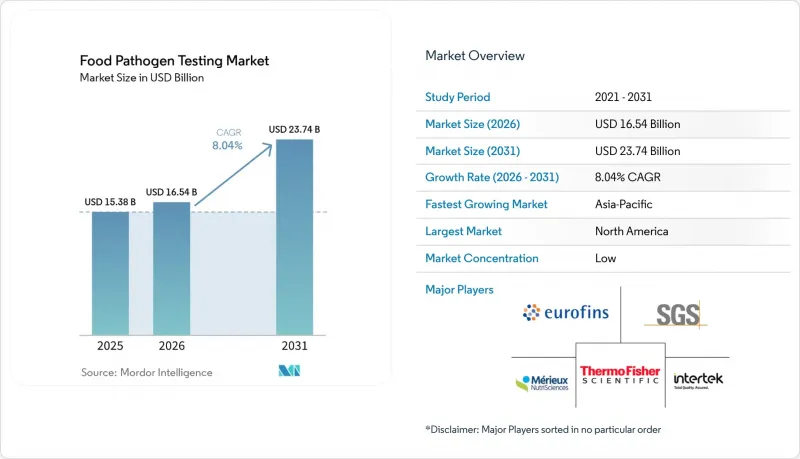
Mordor Intelligence에 의하면, 식품 병원균 검사 시장 규모는 2025년 153억 8,000만 달러로 평가되었습니다. 2026년에는 165억 4,000만 달러로 확대되어 2031년까지 237억 4,000만 달러에 이를 것으로 예상되고 2026년부터 2031년에 걸쳐 CAGR 8.04%로 성장할 전망입니다.
본 보고서는 유형별(살모넬라균, 대장균, 리스테리아균, 기타 병원체), 식품 유형별(육류·가금류, 유제품, 과일 및 채소 등),기술(중합효소 연쇄반응, 면역 분석법, 크로마토그래피 등), 지역(북미, 유럽, 아시아태평양, 남미, 중동 및 아프리카)별로 분류되어 있습니다. 시장 전망은 금액(미 달러) 기준으로 제시되어 있습니다.
세계의 식품 병원균 검사 시장 동향 및 인사이트
증가하는 식중독 부담이 검사 수요의 지속적인 확대를 뒷받침하고 있습니다.
WHO 보고서에 따르면, 2026년에는 연간 8억 6,600만 건의 식중독 사례가 발생할 것이며, 생산성 손실은 3,100억 달러에 달할 것으로 예측됩니다. 이는 식품 가공업체가 검사 프로그램을 강화해야 할 경제적 이유가 됩니다. 살모넬라균은 전 세계적으로 연간 2억 건에서 10억 건의 사례를 유발하며, 추정 15만 5,000명의 사망 원인이 되고 있으며, 그중 85.00%는 오염된 식품과 관련이 있습니다. FoodNet 시스템에 따르면, 2024년 미국 전역의 감시 거점에서 실험실을 통해 확인된 장 감염증은 2만 4,624건을 기록했습니다. 입원율은 2016년부터 2018년의 기준치에 비해 여전히 높은 수준을 유지하고 있어, 이에 따라 환경 모니터링 및 검증 검사 확충에 대한 압박이 지속되고 있습니다. 아프리카와 동남아시아는 전 세계 식중독의 4분의 3 가까이를 차지하고 있으며, 검사 시설 인프라가 정비됨에 따라 검사 능력에 대한 큰 수요가 발생하고 있습니다.
검사 워크플로우를 혁신하는 신속 검사 기술
배양법에서 분자 검출법으로의 전환에 따라 식품 병원균 검사 시장의 실험실 워크플로가 변화하고 있습니다. 자동화된 PCR 워크플로우를 통해 검체 접수부터 결과 보고까지 4시간 이내에 완료할 수 있으며, 중저가 실시간 PCR 장비는 4만 달러 미만으로 구입할 수 있습니다. 이러한 상황으로 인해 지역 위탁 검사 기관은 기존 플랫폼보다 낮은 설비 투자로 분자진단을 활용할 수 있게 되었습니다. 서모피셔 사이언티피크는 2026년 7월에 ‘InstaFlux’를 출시했습니다. 이 시스템은 중량 측정을 통한 분주 기능과 검사 정보 시스템(LIS)과 연동 가능한 디지털 감사 추적 기능을 갖추고 있으며, 30분 이내에 배양 배지를 조제할 수 있습니다. 2026년에 수행된 80건의 연구를 검토한 결과, 나노포어 플랫폼은 24시간 이내에 병원체를 동정할 수 있으며, 종 수준의 정확도는 95.00%-98.00%,항생제 내성 유전자의 민감도는 90.00% 이상이며, 검체당 비용은 50-200달러인 반면, 기존의 전체 유전체 시퀀싱은 300.00-800달러가 소요됩니다.
가격에 민감한 시장에서 도입을 저해하는 높은 설비 투자 및 운영 비용
높은 설비 투자 및 운영 비용이 가격에 민감한 시장에서 첨단 검사 기술의 도입을 제한하고 있습니다. 분자진단 플랫폼에는 장비 투자, 시약비, 유지보수 계약, 전문가에 의한 교정 및 생물정보학 지원이 필요합니다. 2025년 연구에 따르면, 도입 초기 단계에서 검체당 전체 유전체 시퀀싱 비용은 기존의 타이핑법을 상회하는 것으로 밝혀졌습니다. 비용 균형이 달성되는 것은 플랫폼으로의 전환이 완전히 완료되고, 혈청형 동정이나 항생제 내성 특성 평가 등 여러 목적으로 활용되기 시작한 이후가 될 것입니다. 투자액이 적으면 집단 감염 감시 체계가 약화되고, 그 결과 규제 강화의 근거가 되는 실증 데이터가 부족해져 남미와 사하라 이남 아프리카의 검사실 구축이 지연될 가능성이 있습니다.
부문별 분석
2025년 식품 병원균 검사 시장 규모 중 살모넬라균은 유형별 점유율 43.28%를 차지했습니다. 이러한 위상은 가금류, 육류, 계란의 전체 공급망에 걸친 광범위한 검사 요건을 반영합니다. 식품안전검사국(FSIS)은 2025년 4월부터 2026년 4월까지의 주기 동안 어린 닭 도체, 다진 가금류 고기 및 생 닭고기 부위를 대상으로 한 살모넬라균 검증 검사를 계속했습니다. 이 프로그램을 통해 도축, 가공 및 2차 가공 각 공정에서 검사 수요가 유지되고 있습니다. 2025년 초, 식품안전검사국이 제안한 생가금류 관련 프레임워크에는 통계적 공정 관리(SPC)를 통한 모니터링 요건이 포함되어 있었습니다. 이 내용이 최종 확정되면 개별 시설의 검사 빈도가 높아질 것입니다. 또한 살모넬라균 검사는 집단 감염 조사 및 공급업체 검증에서도 여전히 핵심적인 역할을 수행하고 있습니다. 이러한 요건들이 식품 병원균 검사 시장에서 해당 균의 매출 1위 위치를 뒷받침하고 있습니다.
대장균(E. coli)은 2026년부터 2031년에 걸쳐 유형별 가장 높은 연평균 성장률(CAGR)인 9.55%를 나타낼 것으로 예측됩니다. 검사 수요는 유제품, 신선 농산물 및 육류 분야에서 발생하고 있습니다. 식품의약국(FDA)이 ‘농산물 안전 규정(Produce Safety Rule)’에 따라 마련 중인 수확 전 농업용수에 관한 요건도 이러한 수요를 뒷받침하고 있습니다. 리스테리아 및 기타 병원체가 나머지 유형별 매출을 차지하고 있습니다. 2026년 6월, 소프트 치즈와 관련된 여러 주에 걸친 리스테리아 집단 감염이 발생하여 1명이 사망하고 7명이 입원했습니다. 이 사건은 유제품 시설에서 리스테리아에 대한 지속적인 환경 모니터링의 필요성을 다시금 부각시켰습니다. 검사 프로그램에서는 원재료, 설비 표면, 완제품에 걸친 개별적인 위험 요인에 대처할 필요성이 점점 더 커지고 있습니다. 이에 따라 주요 대상 범주를 넘어선, 보다 광범위한 병원체 패널에 대한 수요가 증가하고 있습니다.
지역별 분석
2025년, 북미는 식품 병원균 검사 시장의 41.36%를 차지했습니다. 이 지역의 위상은 ‘식품안전현대화법(FSMA)’에 기반한 예방적 관리 조치와 식품안전검사국(FSIS)의 광범위한 검증 프로그램에 의해 뒷받침되고 있습니다. 미국은 이 지역의 매출 대부분을 차지하고 있으며, 2026년까지 가금류 및 육류 가공 시설에서 살모넬라균 검증 검사가 활발히 진행되고 있습니다. 2026년 유제품 업계에서 발생한 대장균 및 리스테리아균 사례를 계기로, 영향을 받은 생산자들 사이에서는 환경 모니터링이 강화되고 있습니다. SGS는 2026년 3월 머레이 브라운 연구소를 인수하여 북미의 PCR 및 첨단 미생물 검출 역량을 확대했습니다.
유럽은 두 번째로 큰 규모를 자랑하는 지역으로, 독일, 영국, 프랑스, 이탈리아, 네덜란드가 주요 시장입니다. 수요는 대규모 식품 가공 활동과 규정(EC) 2073/2005에 기반한 통일된 미생물학적 기준에 의해 뒷받침되고 있습니다. 유럽연합 집행위원회 시행규칙(EU) 2025/179에 따르면, 2026년 8월 23일부터 4가지 주요 병원체에 대해 집단 감염의 원인이 된 분리주의 전체 유전체 시퀀싱이 의무화됩니다. 각국의 참조 연구소는 2028년 중반까지 이 업무에 관한 ISO/IEC 17025 : 2017 인증을 취득해야 합니다. 유로핀스 아그로 테스팅(Eurofins Agro Testing)은 2026년 6월 체코 공화국의 라보라토르 포스트로프티(Laborator Postropti) 인수를 완료했습니다. 브라질과 아르헨티나는 육류, 대두, 수산 양식 수출 인증을 통해 남미 지역 수요를 주도하고 있습니다. 바이오메리유(BioMerieux)는 2025년 1월 브라질의 네오프로스펙타(NeoProspecta)를 인수하여 라틴아메리카에서의 데이터 및 유전체학 관련 서비스 제공 체계를 강화했습니다. 멜류 뉴트리사이언스(Mellu NutriScience)도 뷰로베리타스(Bureau Veritas)의 식품 검사 사업을 인수함으로써 사업 기반을 확대했습니다.
아시아태평양은 2026년부터 2031년까지 연평균 성장률(CAGR) 9.57%를 나타낼 것으로 예측됩니다. 중국, 인도, 베트남, 인도네시아에서는 성숙한 배양법에 기반한 시스템을 주로 대체하기보다는 새로운 검사 인프라에 분자생물학적 기법이 도입되고 있습니다. 중국의 GB/T 27405-2026 및 GB/T 27403-2026은 실험실 품질 관리 및 분자생물학적 검사에 관한 국가적 프레임워크를 규정하고 있습니다. 인도의 FSSAI 개정법은 2026년 12월에 시행되어 제조업체, 수입업체, 수산 가공업체에 대한 집중적인 조달 수요를 창출할 것입니다. 중동 및 아프리카는 규모가 가장 작은 지역이지만, 아랍에미리트(UAE)와 사우디아라비아는 주요 식품 수입국으로서 제도적인 수요를 유지하고 있습니다. 아프리카의 식중독 부담이 크다는 사실은 검사 수요와 이용 가능한 검사 능력 사이에 여전히 격차가 존재함을 보여줍니다. 검사 시설에 대한 투자와 식품 안전 지원을 통해 향후 이러한 격차를 줄일 수 있을 것으로 보입니다.
기타 혜택 :
- 엑셀 형식 시장 예측(ME) 시트
- 3개월간의 애널리스트 지원
자주 묻는 질문
목차
제1장 서론
제2장 조사 방법
제3장 개요
제4장 시장 구도
제5장 시장 규모 및 성장 예측
제6장 경쟁 구도
제7장 시장 기회 및 향후 전망
KTH 26.09.02According to Mordor Intelligence, the food pathogen testing market size is expected to increase from USD 15.38 billion in 2025 to USD 16.54 billion in 2026 and reach USD 23.74 billion by 2031, growing at a CAGR of 8.04% over 2026-2031.
This report is Segmented by Type (Salmonella, E. Coli, Listeria, and Other Pathogens), Food Type (Meat and Poultry, Dairy Products, Fruits and Vegetables, and More), Technology (Polymerase Chain Reaction, Immunoassay-Based, Chromatography, and More), and Geography (North America, Europe, Asia-Pacific, South America, and the Middle East and Africa). Market Forecasts are Provided in Terms of Value (USD).
Global Food Pathogen Testing Market Trends and Insights
Escalating Foodborne Disease Burden Sustaining Persistent Testing Demand
WHO reported 866 million foodborne illness episodes each year and USD 310 billion in productivity losses in 2026, which gives food processors an economic reason to strengthen testing programs. Salmonella causes 200 million to 1 billion cases globally and an estimated 155,000 deaths each year, with 85.00% of cases linked to contaminated food. The FoodNet system recorded 24,624 laboratory-confirmed enteric infections across United States surveillance sites in 2024. Hospitalization rates remained elevated against the 2016-2018 reference baseline, which maintains pressure for more environmental monitoring and verification testing. Africa and South-East Asia account for nearly three-quarters of global foodborne illnesses, leaving a substantial need for testing capacity as laboratory infrastructure develops
Rapid Testing Technologies Reshaping Laboratory Workflows
The shift from culture-based methods to molecular detection is changing laboratory workflows in the Food pathogen testing market. Automated PCR workflows can provide sample-to-answer results in under 4 hours, while mid-range real-time PCR instruments are available below USD 40,000.00. These conditions allow regional contract laboratories to use molecular diagnostics with lower capital requirements than earlier platforms. Thermo Fisher Scientific launched InstaFlux in July 2026, and the system prepares enrichment media in under 30 minutes with gravimetric dispensing and digital audit trails that can connect with laboratory information systems. A 2026 review of 80 studies found that nanopore platforms can identify pathogens in under 24 hours with 95.00%-98.00% species-level accuracy, more than 90.00% antimicrobial-resistance gene sensitivity, and per-sample costs of USD 50.00-USD 200.00, compared with USD 300.00-USD 800.00 for conventional whole-genome sequencing.
High Capital and Operating Costs Limiting Adoption in Price-Sensitive Markets
High capital and operating costs limit adoption of advanced testing technologies in price-sensitive markets. Molecular platforms require instrument investment, reagent spending, maintenance contracts, specialist calibration, and bioinformatics support. A 2025 study found that whole-genome sequencing costs per sample exceed traditional typing methods during initial implementation. Cost parity occurs only when platforms are fully transitioned and used for several purposes, including serotyping and antimicrobial-resistance characterization. Lower investment reduces outbreak surveillance, which can weaken the documented basis for tighter regulations and slow laboratory development in South America and sub-Saharan Africa.
Other drivers and restraints analyzed in the detailed report include:
- Preventive Food Safety Systems Driving Environmental Monitoring Volumes
- Food Processing Sector Expansion in Emerging Markets Opening New Testing Volumes
- Lack of Standardization Impeding Cross-Border Testing Recognition
For complete list of drivers and restraints, kindly check the Table Of Contents.
Segment Analysis
Salmonella held 43.28% of the Food pathogen testing market size by type in 2025. Its position reflects broad testing requirements across poultry, meat, and egg supply chains. The Food Safety and Inspection Service continued Salmonella verification testing across young chicken carcasses, comminuted poultry, and raw chicken parts through the April 2025-April 2026 cycle. This program maintains testing demand through slaughter, processing, and further-processing operations. The proposed Food Safety and Inspection Service framework for raw poultry included statistical process control monitoring requirements in early 2025. If finalized, this framework would raise testing frequency at individual establishments. Salmonella testing also remains central to outbreak investigation and supplier verification. These requirements support its leading revenue position in the Food pathogen testing market.
E. coli is forecast to record the highest type-level CAGR of 9.55% from 2026 to 2031. Testing demand comes from dairy, produce, and meat channels. The Food and Drug Administration's evolving pre-harvest agricultural water requirements under the Produce Safety Rule add to this demand. Listeria and other pathogens account for the remaining type revenue. A multistate Listeria outbreak linked to soft cheese in June 2026 caused 1 death and 7 hospitalizations. The event reinforced the case for continuous environmental Listeria monitoring in dairy facilities. Testing programs increasingly need to address distinct risks across raw materials, equipment surfaces, and finished products. This supports a broader pathogen panel beyond the largest target category.
Complete Report Scope:
- By Type
- Salmonella
- E-Coli
- Listeria
- Other Pathogens
- By Food Type
- Food
- Meat and Poultry
- Dairy Products
- Fruits and Vegetables
- Processed Food
- Crops
- Other Foods (Spices, Infant Formula)
- Pet Food and Animal Feed
- Food
- By Technology
- Polymerase Chain Reaction
- Immunoassay-based
- Chromatography and Spectrometry
- Others
- By Geography
- North America
- United States
- Canada
- Mexico
- Rest of North America
- Europe
- Germany
- United Kingdom
- France
- Italy
- Spain
- Netherlands
- Sweden
- Poland
- Belgium
- Rest of Europe
- Asia-Pacific
- China
- India
- Japan
- Australia
- South Korea
- Vietnam
- Indonesia
- Rest of Asia-Pacific
- South America
- Brazil
- Argentina
- Chile
- Peru
- Colombia
- Rest of South America
- Middle East and Africa
- United Arab Emirates
- Saudi Arabia
- South Africa
- Nigeria
- Rest of Middle East and Africa
- North America
Geography Analysis
North America held 41.36% of the Food pathogen testing market share in 2025. The region's position is supported by Food Safety Modernization Act preventive controls and extensive Food Safety and Inspection Service verification programs. The United States accounts for most regional revenue, with active Salmonella verification testing across poultry and meat establishments through 2026. E. coli and Listeria events in dairy during 2026 are increasing environmental monitoring among affected producers. SGS acquired Murray-Brown Laboratories in March 2026, expanding its North American PCR and advanced microbial detection capabilities.
Europe is the second-largest regional area, led by Germany, the United Kingdom, France, Italy, and the Netherlands. Demand is supported by major food processing activity and harmonized microbiological criteria under Regulation (EC) 2073/2005. Commission Implementing Regulation (EU) 2025/179 requires whole-genome sequencing of outbreak isolates for 4 key pathogens from August 23, 2026. National Reference Laboratories must obtain ISO/IEC 17025:2017 accreditation for this work by mid-2028. Eurofins Agro Testing completed the acquisition of Laborator Postoloprty in the Czech Republic in June 2026. Brazil and Argentina drive South American demand through meat, soy, and aquaculture export certification. bioMerieux acquired Neoprospecta in Brazil in January 2025, strengthening its data and genomics offering in Latin America. Merieux NutriSciences also expanded its footprint through the acquisition of Bureau Veritas food testing activities.
Asia-Pacific is forecast to grow at a 9.57% CAGR from 2026 to 2031. China, India, Vietnam, and Indonesia are adopting molecular methods on new testing infrastructure rather than primarily replacing mature culture-based systems. China's GB/T 27405-2026 and GB/T 27403-2026 create national frameworks for laboratory quality control and molecular biological testing. India's FSSAI amendment takes effect in December 2026 and creates a concentrated procurement need for manufacturers, importers, and seafood processors. Middle East and Africa is the smallest regional area, but the United Arab Emirates and Saudi Arabia maintain institutional demand as major food importers. Africa's large foodborne disease burden points to a continuing gap between testing needs and available laboratory capacity. Laboratory investment and food-safety assistance could help narrow this gap over time.
- Eurofins Scientific
- SGS S.A.
- Merieux NutriSciences
- Intertek Group plc
- Neogen Corporation
- Thermo Fisher Scientific Inc.
- Bio-Rad Laboratories, Inc.
- bioMerieux S.A.
- QIAGEN N.V.
- 3M Company
- ALS Limited
- Bureau Veritas S.A.
- TUV SUD AG
- Charm Sciences, Inc.
- Romer Labs
- Hygiena LLC
- Microbac Laboratories, Inc.
- AsureQuality Limited
- Tentamus Group GmbH
- Certified Group
- Element Materials Technology Group
Additional Benefits:
- The market estimate (ME) sheet in Excel format
- 3 months of analyst support
TABLE OF CONTENTS
1 INTRODUCTION
- 1.1 Study Assumptions and Market Definition
- 1.2 Scope of the Study
2 RESEARCH METHODOLOGY
3 EXECUTIVE SUMMARY
4 MARKET LANDSCAPE
- 4.1 Market Overview
- 4.2 Market Drivers
- 4.2.1 Increasing Incidence of Foodborne Diseases
- 4.2.2 Growing Demand for Food Safety and Quality
- 4.2.3 Increasing Adoption of Rapid Testing Technologies
- 4.2.4 Growing Emphasis on Preventive Food Safety Systems
- 4.2.5 Expansion of Food Processing Industries in Emerging Markets
- 4.2.6 Stringent Food Safety and Government Regulations on Pathogen Testing
- 4.3 Market Restraints
- 4.3.1 High Cost of Advanced Testing Technologies
- 4.3.2 Long Testing and Confirmation Procedures
- 4.3.3 Lack of Standardization Across Countries
- 4.3.4 Complexity of Food Matrices
- 4.4 Supply Chain Analysis
- 4.5 Regulatory Landscape
- 4.6 Technological Outlook
- 4.7 Porter's Five Forces
- 4.7.1 Bargaining Power of Suppliers
- 4.7.2 Bargaining Power of Buyers
- 4.7.3 Threat of New Entrants
- 4.7.4 Threat of Substitutes
- 4.7.5 Competitive Rivalry
5 MARKET SIZE AND GROWTH FORECASTS (VALUE)
- 5.1 By Type
- 5.1.1 Salmonella
- 5.1.2 E-Coli
- 5.1.3 Listeria
- 5.1.4 Other Pathogens
- 5.2 By Food Type
- 5.2.1 Food
- 5.2.1.1 Meat and Poultry
- 5.2.1.2 Dairy Products
- 5.2.1.3 Fruits and Vegetables
- 5.2.1.4 Processed Food
- 5.2.1.5 Crops
- 5.2.1.6 Other Foods (Spices, Infant Formula)
- 5.2.2 Pet Food and Animal Feed
- 5.2.1 Food
- 5.3 By Technology
- 5.3.1 Polymerase Chain Reaction
- 5.3.2 Immunoassay-based
- 5.3.3 Chromatography and Spectrometry
- 5.3.4 Others
- 5.4 By Geography
- 5.4.1 North America
- 5.4.1.1 United States
- 5.4.1.2 Canada
- 5.4.1.3 Mexico
- 5.4.1.4 Rest of North America
- 5.4.2 Europe
- 5.4.2.1 Germany
- 5.4.2.2 United Kingdom
- 5.4.2.3 France
- 5.4.2.4 Italy
- 5.4.2.5 Spain
- 5.4.2.6 Netherlands
- 5.4.2.7 Sweden
- 5.4.2.8 Poland
- 5.4.2.9 Belgium
- 5.4.2.10 Rest of Europe
- 5.4.3 Asia-Pacific
- 5.4.3.1 China
- 5.4.3.2 India
- 5.4.3.3 Japan
- 5.4.3.4 Australia
- 5.4.3.5 South Korea
- 5.4.3.6 Vietnam
- 5.4.3.7 Indonesia
- 5.4.3.8 Rest of Asia-Pacific
- 5.4.4 South America
- 5.4.4.1 Brazil
- 5.4.4.2 Argentina
- 5.4.4.3 Chile
- 5.4.4.4 Peru
- 5.4.4.5 Colombia
- 5.4.4.6 Rest of South America
- 5.4.5 Middle East and Africa
- 5.4.5.1 United Arab Emirates
- 5.4.5.2 Saudi Arabia
- 5.4.5.3 South Africa
- 5.4.5.4 Nigeria
- 5.4.5.5 Rest of Middle East and Africa
- 5.4.1 North America
6 COMPETITIVE LANDSCAPE
- 6.1 Market Concentration
- 6.2 Strategic Moves
- 6.3 Market Ranking Analysis
- 6.4 Company Profiles (Includes Global-level Overview, Market-level Overview, Core Segments, Financials, Strategic Info, Market Rank/Share, Products & Services, Recent Developments)
- 6.4.1 Eurofins Scientific
- 6.4.2 SGS S.A.
- 6.4.3 Merieux NutriSciences
- 6.4.4 Intertek Group plc
- 6.4.5 Neogen Corporation
- 6.4.6 Thermo Fisher Scientific Inc.
- 6.4.7 Bio-Rad Laboratories, Inc.
- 6.4.8 bioMerieux S.A.
- 6.4.9 QIAGEN N.V.
- 6.4.10 3M Company
- 6.4.11 ALS Limited
- 6.4.12 Bureau Veritas S.A.
- 6.4.13 TUV SUD AG
- 6.4.14 Charm Sciences, Inc.
- 6.4.15 Romer Labs
- 6.4.16 Hygiena LLC
- 6.4.17 Microbac Laboratories, Inc.
- 6.4.18 AsureQuality Limited
- 6.4.19 Tentamus Group GmbH
- 6.4.20 Certified Group
- 6.4.21 Element Materials Technology Group