

|
시장보고서
상품코드
2101948
특수 비료 시장 기회, 성장 촉진요인, 업계 동향 분석 및 예측(2026-2035년)Specialty Fertilizers Market Opportunity, Growth Drivers, Industry Trend Analysis, and Forecast 2026 - 2035 |
||||||

세계의 특수 비료 시장은 2025년에 235억 달러 규모에 달하고, CAGR 7.8%로 성장하여 2035년까지 499억 달러에 달할 것으로 추정됩니다.
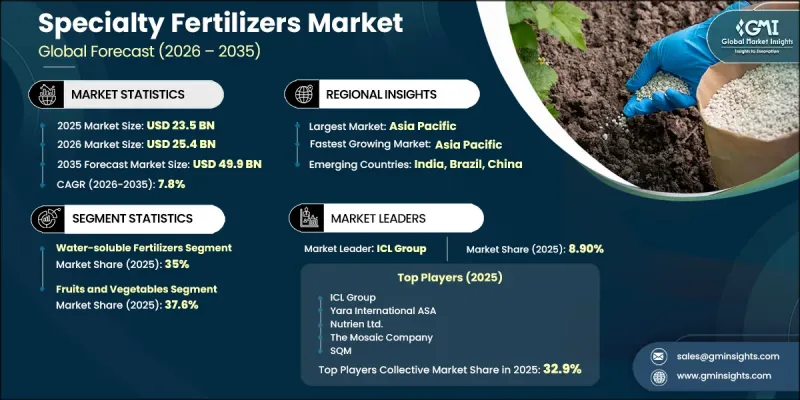
시장 확대의 원동력은 정밀 영양 관리 솔루션의 도입 확대와 선진국 및 개발도상국의 농업 경제권에서 고부가가치 작물 재배가 지속적으로 증가하고 있는 점입니다. 토양 품질 저하, 수자원 제약, 환경 규제 강화에 대한 우려가 커짐에 따라 생산자들은 기존의 비료 시비 방식에서 효율을 높이고 손실을 줄이는 첨단 영양분 공급 기술로 전환하고 있습니다. 정밀 농업 기술, 디지털 농업 플랫폼, 비료 시비 및 관개 시스템, 스마트 관개 네트워크의 도입 확대는 표적화된 영양분 공급을 목적으로 하는 특수 비료에 대한 수요를 지속적으로 뒷받침하고 있습니다. 농업 생산자들이 환경에 미치는 영향을 최소화하면서 작물의 생산성을 극대화하는 데 주력하는 가운데, 고효율 비료 배합에 대한 수요는 계속해서 강해지고 있습니다. 또한, 이 업계는 생산자들이 수확량 증대, 작물 품질 개선, 영양소 이용 효율 최적화를 우선시하는 품질 중심의 작물 영양 관리로 지속적으로 전환하고 있는 점에서도 혜택을 보고 있습니다. 이러한 장기적인 구조적 변화로 인해, 예측 기간 동안 특수 비료에 대한 꾸준한 투자가 유지될 뿐만 아니라, 전 세계 현대 농업 시스템에서 특수 비료의 보급이 더욱 촉진될 것으로 전망됩니다.
| 시장 범위 | |
|---|---|
| 시작 연도 | 2025년 |
| 예측 기간 | 2026-2035년 |
| 시작 시점 시장 규모 | 235억 달러 |
| 예측액 | 499억 달러 |
| CAGR | 7.8% |
2025년, 수용성 비료 부문은 시장 점유율의 35%를 차지했습니다. 이 부문은 현대적인 관개 시스템 및 정밀한 영양분 공급 기법과의 친화성 덕분에 계속해서 전 세계 수요를 주도하고 있습니다. 상업 농업에서 비료 관개 기술의 채택이 확대됨에 따라, 효율적인 영양분 흡수와 정확한 시비 시기를 가능하게 하는 완전 수용성 비료 제제의 사용이 증가하고 있습니다. 고부가가치 작물의 재배 확대 또한, 생산자들이 영양소 관리와 작물의 수확량 및 품질에 대한 통제력을 점점 더 요구함에 따라 이러한 제품에 대한 수요를 더욱 부추기고 있습니다.
2025년, 과일·채소 부문은 37.6%의 점유율을 차지하며 최대 용도 카테고리가 되었습니다. 이 시장에서 주도적인 지위는 상업적인 과일·채소 생산에 수반되는 높은 영양 요구 사항과 품질 기준에 의해 뒷받침되고 있습니다. 생산자들은 안정적인 수확량을 유지하면서 생산성, 작물 품질 및 양분 이용 효율을 향상시키기 위해 첨단 비료 시비 프로그램을 지속적으로 도입하고 있습니다. 정밀 관개 시스템, 영양소 모니터링 기술 및 전문적인 작물 관리 기법에 대한 투자 증가는 이 용도 부문 전체에서 특수 비료 소비를 지속적으로 촉진하고 있습니다.
2025년, 북미 특수 비료 시장은 26%의 점유율을 차지했습니다. 미국은 정밀 농업 기술과 첨단 작물 영양 관리 기법의 광범위한 도입에 힘입어 지역별 최대 점유율을 계속 유지하고 있습니다. 효율적인 영양분 공급 시스템이 필요한 특산 작물의 생산 확대에 더해, 줄 작물의 대규모 재배가 맞물리면서 수요는 더욱 강해지고 있습니다. 제어 방출형 비료 기술, 정밀 시비 장비 및 절수형 농업 기법에 대한 지속적인 투자를 통해 예측 기간 동안 해당 지역의 시장 성장이 유지될 것으로 전망됩니다.
자주 묻는 질문
목차
제1장 조사 방법과 범위
제2장 주요 요약
제3장 업계 인사이트
제4장 경쟁 구도
제5장 시장 추정 및 예측 : 제품 유형/기술별, 2022-2035년
제6장 시장 추정 및 예측 : 작물 유형별, 2022-2035년
제7장 시장 추정 및 예측 : 적용 방법별, 2022-2035년
제8장 시장 추정 및 예측 : 형태별, 2022-2035년
제9장 시장 추정 및 예측 : 지역별, 2022-2035년
제10장 기업 개요
KSM 26.08.05The Global Specialty Fertilizers Market was valued at USD 23.5 billion in 2025 and is estimated to grow at a CAGR of 7.8% to reach USD 49.9 billion by 2035.
Market expansion is driven by the increasing adoption of precision nutrient management solutions and the continuous growth of high-value crop cultivation across both developed and developing agricultural economies. Rising concerns regarding declining soil quality, limited water availability, and stricter environmental regulations are encouraging growers to replace conventional fertilizer application methods with advanced nutrient delivery technologies that improve efficiency and reduce losses. The increasing deployment of precision farming technologies, digital agriculture platforms, fertigation systems, and smart irrigation networks continues to support demand for specialty fertilizers designed for targeted nutrient application. As agricultural producers focus on maximizing crop productivity while minimizing environmental impact, demand for high-efficiency fertilizer formulations continues to strengthen. The industry is also benefiting from the ongoing transition toward quality-focused crop nutrition, where growers prioritize higher yields, improved crop quality, and optimized nutrient utilization. These long-term structural changes are expected to sustain steady investment in specialty fertilizers throughout the forecast period while supporting broader adoption across modern farming systems worldwide.
| Market Scope | |
|---|---|
| Start Year | 2025 |
| Forecast Year | 2026-2035 |
| Start Value | $23.5 Billion |
| Forecast Value | $49.9 Billion |
| CAGR | 7.8% |
The water-soluble fertilizers segment held 35% share in 2025. The segment continues to lead global demand due to its compatibility with modern irrigation systems and precision nutrient delivery practices. The growing adoption of fertigation techniques across commercial agriculture has increased the use of fully soluble fertilizer formulations that enable efficient nutrient absorption and precise application timing. Rising cultivation of high-value crops further supports demand for these products as growers increasingly seek greater control over nutrient management and crop performance.
The fruits and vegetables segment accounted for 37.6% share in 2025, making it the largest application category. Market leadership is supported by the high nutritional requirements and quality standards associated with commercial fruit and vegetable production. Producers continue to adopt advanced fertilizer programs to improve productivity, crop quality, and nutrient efficiency while maintaining consistent yields. Increasing investment in precision irrigation systems, nutrient monitoring technologies, and specialized crop management practices continues to reinforce specialty fertilizer consumption across this application segment.
North America Specialty Fertilizers Market held 26% share in 2025. The United States continues to account for the largest regional share, supported by widespread adoption of precision agriculture technologies and advanced crop nutrition practices. Demand is further strengthened by large-scale cultivation of row crops alongside the expanding production of specialty crops requiring efficient nutrient delivery systems. Continued investment in controlled nutrient-release technologies, precision application equipment, and water-efficient farming practices is expected to sustain regional market growth throughout the forecast period.
Major companies operating in the global specialty fertilizers market include AgroLiquid, EuroChem Group, Yara International ASA, Nutrien Ltd., CF Industries Holdings, Wilbur-Ellis Agribusiness, Haifa Group, Coromandel International, The Mosaic Company, ICL Group, Sociedad Quimica y Minera (SQM), Sinochem Fertilizer, Grupa Azoty SA, Compo Expert GmbH, and Valagro SpA. Companies operating in the specialty fertilizers market are strengthening their competitive position by investing heavily in product innovation, precision agriculture technologies, and sustainable nutrient solutions. Manufacturers are expanding their portfolios with controlled-release, water-soluble, and micronutrient-based fertilizers to meet evolving agricultural requirements. Strategic partnerships with distributors, agritech companies, and farming cooperatives are helping improve market reach and customer engagement. Businesses are also increasing production capacity and expanding manufacturing facilities to support rising global demand. Investments in digital farming platforms, precision application technologies, and customized crop nutrition programs enable companies to deliver greater value to growers.
Table of Contents
Chapter 1 Methodology & Scope
- 1.1 Market scope and definition
- 1.2 Research design
- 1.2.1 Research approach
- 1.2.2 Data collection methods
- 1.3 Data mining sources
- 1.3.1 Global
- 1.3.2 Regional/Country
- 1.4 Base estimates and calculations
- 1.4.1 Base year calculation
- 1.4.2 Key trends for market estimation
- 1.5 Primary research and validation
- 1.5.1 Primary sources
- 1.6 Forecast model
- 1.7 Research assumptions and limitations
Chapter 2 Executive Summary
- 2.1 Industry 360° synopsis
- 2.2 Key market trends
- 2.2.1 Regional
- 2.2.2 Product Type / Technology
- 2.2.3 Crop Type
- 2.2.4 Application Method
- 2.2.5 Form
- 2.3 TAM Analysis, 2026-2035
- 2.4 CXO perspectives: Strategic imperatives
- 2.4.1 Executive decision points
Chapter 3 Industry Insights
- 3.1 Industry ecosystem analysis
- 3.1.1 Supplier landscape
- 3.1.2 Profit margin
- 3.1.3 Value addition at each stage
- 3.1.4 Factor affecting the value chain
- 3.1.5 Disruptions
- 3.2 Industry impact forces
- 3.2.1 Growth drivers
- 3.2.2 Industry pitfalls and challenges
- 3.2.3 Market opportunities
- 3.3 Growth potential analysis
- 3.4 Regulatory landscape
- 3.4.1 North America
- 3.4.2 Europe
- 3.4.3 Asia Pacific
- 3.4.4 Latin America
- 3.4.5 Middle East & Africa
- 3.5 Porter’s analysis
- 3.6 PESTEL analysis
- 3.7 Price trends
- 3.7.1 By region
- 3.7.2 By type
- 3.8 Future market trends
- 3.9 Technology and Innovation landscape
- 3.9.1 Current technological trends
- 3.9.2 Emerging technologies
- 3.10 Patent Landscape
- 3.11 Trade statistics (HS code)
- 3.11.1 Major importing countries
- 3.11.2 Major exporting countries
- 3.12 Sustainability and environmental aspects
- 3.12.1 Sustainable practices
- 3.12.2 Waste reduction strategies
- 3.12.3 Energy efficiency in production
- 3.12.4 Eco-friendly initiatives
- 3.13 Carbon footprint consideration
Chapter 4 Competitive Landscape, 2025
- 4.1 Introduction
- 4.2 Company market share analysis
- 4.2.1 By region
- 4.2.1.1 North America
- 4.2.1.2 Europe
- 4.2.1.3 Asia Pacific
- 4.2.1.4 LATAM
- 4.2.1.5 MEA
- 4.2.1 By region
- 4.3 Company matrix analysis
- 4.4 Competitive analysis of major market players
- 4.5 Competitive positioning matrix
- 4.6 Key developments
- 4.6.1 Mergers & acquisitions
- 4.6.2 Partnerships & collaborations
- 4.6.3 New Product Launches
- 4.6.4 Expansion Plans
Chapter 5 Market Estimates and Forecast, By Product Type / Technology, 2022–2035 (USD Billion)
- 5.1 Key trends
- 5.2 Water-Soluble Fertilizers
- 5.3 Micronutrient Fertilizers
- 5.4 Controlled-Release Fertilizers (CRF)
- 5.5 Slow-Release Fertilizers (SRF)
- 5.6 Inhibitor-Based Fertilizers (Urease & Nitrification)
- 5.7 Liquid Fertilizers
Chapter 6 Market Estimates and Forecast, By Crop Type, 2022–2035 (USD Billion)
- 6.1 Key trends
- 6.2 Fruits & Vegetables
- 6.3 Cereals & Grains
- 6.4 Oilseeds & Pulses
- 6.5 Turf & Ornamentals
- 6.6 Other Crops
Chapter 7 Market Estimates and Forecast, By Application Method, 2022–2035 (USD Billion)
- 7.1 Key trends
- 7.2 Fertigation
- 7.3 Foliar Application
- 7.4 Soil Application
Chapter 8 Market Estimates and Forecast, By Form, 2022–2035 (USD Billion)
- 8.1 Key trends
- 8.2 Dry
- 8.3 Liquid
Chapter 9 Market Estimates and Forecast, By Region, 2022–2035 (USD Billion)
- 9.1 Key trends
- 9.2 North America
- 9.2.1 U.S.
- 9.2.2 Canada
- 9.3 Europe
- 9.3.1 Germany
- 9.3.2 UK
- 9.3.3 France
- 9.3.4 Spain
- 9.3.5 Italy
- 9.3.6 Rest of Europe
- 9.4 Asia Pacific
- 9.4.1 China
- 9.4.2 India
- 9.4.3 Japan
- 9.4.4 Australia
- 9.4.5 South Korea
- 9.4.6 Rest of Asia Pacific
- 9.5 Latin America
- 9.5.1 Brazil
- 9.5.2 Mexico
- 9.5.3 Argentina
- 9.5.4 Rest of Latin America
- 9.6 Middle East and Africa
- 9.6.1 Saudi Arabia
- 9.6.2 South Africa
- 9.6.3 UAE
- 9.6.4 Rest of Middle East and Africa
Chapter 10 Company Profiles
- 10.1 ICL Group
- 10.2 Yara International ASA
- 10.3 Nutrien Ltd.
- 10.4 The Mosaic Company
- 10.5 Sociedad Quimica y Minera (SQM)
- 10.6 CF Industries Holdings
- 10.7 EuroChem Group
- 10.8 Coromandel International
- 10.9 Sinochem Fertilizer
- 10.10 Grupa Azoty SA
- 10.11 Wilbur-Ellis Agribusiness
- 10.12 Haifa Group
- 10.13 Compo Expert GmbH
- 10.14 Valagro SpA (Syngenta Group)
- 10.15 AgroLiquid


