

|
시장보고서
상품코드
2100727
유럽의 특수 비료 시장 : 시장 점유율 분석, 업계 동향 및 통계, 성장 예측(2026-2031년)Europe Specialty Fertilizers - Market Share Analysis, Industry Trends & Statistics, Growth Forecasts (2026 - 2031) |
||||||
 Mordor Intelligence
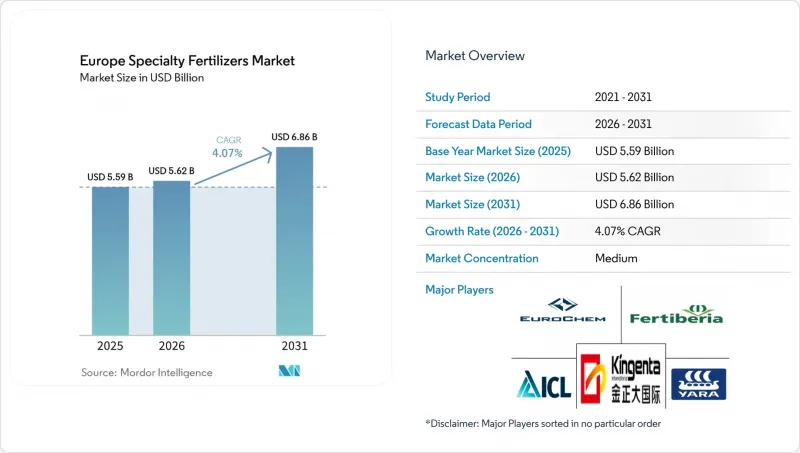
Mordor Intelligence에 의하면, 유럽의 특수 비료 시장 규모는 2025년 55억 9,000만 달러로 평가되었고, 2026년에는 56억 2,000만 달러로 확대될 것으로 추정되고, 2026-2031년 CAGR 4.07%로 성장을 지속할 것으로 전망되며, 2031년에는 68억 6,000만 달러에 이를 것으로 예측됩니다.
본 보고서는 특수 비료 유형별(CRF, 액체 비료, SRF 등), 시용 방법별(비료 관개, 엽면 시비, 토양 시비), 작물 유형별(밭작물, 원예작물 등) 및 지역별(프랑스, 독일, 이탈리아, 네덜란드 등)로 분류되어 있습니다. 시장 전망은 금액 및 수량 기준으로 제시되어 있습니다.
유럽의 특수 비료 시장 동향 및 인사이트
보호재배 면적의 확대
현재 네덜란드에서는 10,500헥타르, 스페인에서는 64,000헥타르가 보호재배 용지로 활용되고 있으며, 수출 지향적인 채소 수요를 배경으로 2024년에는 15%의 확대가 예상됩니다. 이러한 확장을 주도하고 있는 것은 무토양 재배 시스템이며, 이 시스템에서는 영양분의 고착을 방지하는 수용성 또는 피복성 복합 비료가 필요합니다. 북유럽 국가들에서는 식량 안보 향상을 위해 온실 생산 능력을 강화하고 있으며, 이에 따라 pH 균형이 조정된 특수 비료에 대한 수요가 지속되고 있습니다. 액체 제품은 폐쇄형 순환 시스템에 적합하여 생산자가 배수량을 최소화하는 데 도움이 되고 있습니다. 따라서 온실 운영자들이 연중 영양 관리 프로그램을 표준화해 나감에 따라, 유럽의 특수 비료 시장은 판매량을 확대되고 있습니다.
비료 관개 시스템 도입 급증
지중해 지역 농장에서는 물 부족에 직면한 스페인의 올리브 농장과 이탈리아의 포도원을 필두로, 2024년에 연간 25%의 속도로 비료 관개 시스템이 도입되었습니다. 통합된 센서를 통해 가변율 시비가 실현되어, 수확량을 유지하면서 비료 사용량을 30-40% 절감할 수 있게 되었습니다. 독일과 프랑스의 밭작물 농가들도 질산염 지침의 제한치를 준수하기 위해 점적 관개용 또는 피벗식 인젝터를 설치하고 있습니다. 비료 관개 시스템 도입이 확대됨에 따라 구매자들의 관심은 액체 비료나 완전 용해성 분말 비료로 쏠리고 있으며, 이는 유럽 특수 비료 시장의 성장세를 뒷받침하고 있습니다.
동유럽의 경작지 축소
폴란드에서는 2024년에 18만 헥타르가 경작지에서 제외된 반면, 우크라이나 농지는 노동력 부족과 인프라 손상에 직면했습니다. 농업의 통합으로 인해 특수 비료를 채택하는 자본 집약형 경영이 유리해지고 있지만, 대상 총 면적은 감소하고 있어 총 수요를 억제하고 있습니다. 대규모 농장이 유럽 특수 비료 시장을 지탱하고 있지만, 지역별 판매량에 대한 역풍은 여전히 지속되고 있습니다. 이러한 과제가 있음에도 불구하고, 대규모 농장의 특수 비료 도입이 시장 안정화에 기여할 가능성이 있습니다.
부문 분석
액체 비료는 점적 관개에 적합하고 균일한 살포가 가능하다는 점 때문에 2025년에는 유럽 특수 비료 시장 점유율의 34.6%를 차지했습니다. 생산자들은 특히 온실 채소의 경우, 식물에 의한 신속한 흡수 및 노동력 절감을 중시하고 있습니다. 영양소 이용 효율을 평가하는 ‘농장에서 식탁까지(Farm to Fork)’ 전략의 규정에 힘입어, CRF 제품군은 2031년까지 연평균 성장률(CAGR) 6.2%를 기록할 전망입니다. 폴리머 코팅 요소 및 유황 코팅 요소를 통해 시비 간격이 120일로 연장됨에 따라, 유럽 특수 비료 시장에서 CRF 제품 시장 규모는 확대될 것으로 예측됩니다.
네덜란드와 벨기에에서는 수경 재배 바질, 오이, 딸기 시스템에서 수용성 결정체가 주류를 이루고 있는 반면, 서방형 과립은 틈새 시장인 잔디 및 관상용 식물 사용자들에게 계속해서 지지를 받고 있습니다. 아연, 붕소, 철을 포함한 미량 영양소 블렌드에는 현재 스트레스 완화를 위한 생물촉진제가 결합되어 있으며, 이러한 동향은 기후 패턴의 변화와 일치합니다. 새로운 캡슐화 기술에 관한 특허 출원 건수는 2024년에 15% 증가하여 혁신의 깊이를 입증하고 있습니다.
기타 혜택 :
- 엑셀 형식 시장 예측(ME) 시트
- 3개월간의 애널리스트 지원
자주 묻는 질문
목차
제1장 서론
제2장 개 보고서의 내용
제3장 주요 요약 및 주요 조사 결과
제4장 주요 업계 동향
제5장 시장 세분화
제6장 경쟁 구도
제7장 비료 업계 CEO가 직면하는 중요 전략적 과제
AJY 26.08.12According to Mordor Intelligence, the Europe specialty fertilizers market size is projected to grow from USD 5.59 billion in 2025 to USD 5.62 billion in 2026 and is forecast to reach USD 6.86 billion by 2031 at 4.07% CAGR over 2026 to 2031.
This report is Segmented by Specialty Type (CRF, Liquid Fertilizer, SRF, and More), Application Mode (Fertigation, Foliar, and Soil), Crop Type (Field Crops, Horticultural Crops, and More), and Geography (France, Germany, Italy, Netherlands, and More). The Market Forecasts are Provided in Terms of Value (USD) and Volume (Metric Tons).
Europe Specialty Fertilizers Market Trends and Insights
Growth in Protected-Cultivation Acreage
Protected growing sites now cover 10,500 hectares in the Netherlands and 64,000 hectares in Spain, advancing 15% in 2024 on export-oriented vegetable demand. Soilless systems dominate these expansions and require water-soluble or controlled-release blends that prevent nutrient lockup. Nordic countries add greenhouse capacity to improve food security, sustaining consumption of pH-balanced specialty fertilizers. Liquid products suit closed-loop recirculating systems, helping growers minimize discharge. The European specialty fertilizer market, therefore, captures volume as greenhouse operators standardize year-round nutrition programs.
Surge in Fertigation System Installations
Mediterranean farms installed fertigation at a 25% annual pace in 2024, led by Spanish olive groves and Italian vineyards facing water scarcity. Integrated sensors now trigger variable-rate dosing that can trim fertilizer use by 30-40% while maintaining yield. German and French field-crop producers also attach drip or pivot injectors to comply with nitrate-directive limits. Fertigation readiness steers buyers toward liquid and fully soluble powders, reinforcing the Europe specialty fertilizer market trajectory.
Shrinking Arable Land in Eastern Europe
Poland removed 180,000 hectares from cultivation in 2024, while Ukrainian fields faced labor shortages and infrastructure damage. Consolidation favors capital-intensive operations that adopt specialty inputs, yet total addressable hectares decline, trimming aggregate demand. Larger farms cushion the Europe specialty fertilizer market, but regional volume headwinds persist. Despite these challenges, the adoption of specialty inputs by larger farms may help stabilize the market.
Other drivers and restraints analyzed in the detailed report include:
- EU Farm to Fork Sustainability Targets
- Recovery of Horticulture Exports Post-Brexit
- Slow Digital-ag Adoption Among Smallholders
For complete list of drivers and restraints, kindly check the Table Of Contents.
Segment Analysis
Liquid fertilizers commanded 34.6% of the Europe specialty fertilizers market share in 2025 due to drip-ready compatibility and uniform distribution. Growers value rapid plant uptake and lower labor needs, especially in greenhouse vegetables. Controlled-release lines post 6.2% CAGR to 2031, lifted by Farm to Fork rules that reward nutrient-use efficiency. The Europe specialty fertilizers market size for controlled-release options is forecast to widen as polymer-coated urea and sulfur-coated urea stretch feeding intervals to 120 days.
Water-soluble crystals dominate hydroponic basil, cucumber, and strawberry systems in the Netherlands and Belgium, while slow-release granules retain niche turf and ornamental users. Micronutrient blends with zinc, boron, and iron now bundle biostimulants for stress mitigation, a trend aligned with shifting climate patterns. Patent activity for novel encapsulation rose 15% in 2024, underscoring innovation depth. s
Complete Report Scope:
- Speciality Type
- CRF
- Polymer Coated
- Polymer-Sulfur Coated
- Others
- Liquid Fertilizer
- SRF
- Water Soluble
- CRF
- Application Mode
- Fertigation
- Foliar
- Soil
- Crop Type
- Field Crops
- Horticultural Crops
- Turf & Ornamental
- Country
- France
- Germany
- Italy
- Netherlands
- Russia
- Spain
- Ukraine
- United Kingdom
- Rest of Europe
List of Companies Covered in this Report:
- Akcine bendrove "Achema"
- AGLUKON Spezialdunger GmbH & Co. KG.
- EuroChem Group AG.
- FERTIBERIA, S.A.
- Grupa Azoty S.A. (Compo Expert)
- ICL Group Ltd
- Kingenta Ecological Engineering Group Co., Ltd.
- Petrokemija DD Fertilizer Factory
- Sociedad Quimica y Minera de Chile SA
- Yara International ASA
- Borealis L.A.T.
- Timac Agro
- Haifa Group
- PhosAgro
- Uralchem
Additional Benefits:
- The market estimate (ME) sheet in Excel format
- 3 months of analyst support
TABLE OF CONTENTS
1 INTRODUCTION
- 1.1 Study Assumptions and Market Definition
- 1.2 Scope of the Studies
- 1.3 Research Methodology
2 REPORT OFFERS
3 EXECUTIVE SUMMARY AND KEY FINDINGS
4 KEY INDUSTRY TRENDS
- 4.1 Acreage of Major Crop Types
- 4.1.1 Field Crops
- 4.1.2 Horticultural Crops
- 4.2 Average Nutrient Application Rates
- 4.2.1 Micronutrients
- 4.2.1.1 Field Crops
- 4.2.1.2 Horticultural Crops
- 4.2.2 Primary Nutrients
- 4.2.2.1 Field Crops
- 4.2.2.2 Horticultural Crops
- 4.2.3 Secondary Macronutrients
- 4.2.3.1 Field Crops
- 4.2.3.2 Horticultural Crops
- 4.2.1 Micronutrients
- 4.3 Agricultural Land Equipped For Irrigation
- 4.4 Regulatory Framework
- 4.5 Value Chain and Distribution Channel Analysis
- 4.6 Market Drivers
- 4.6.1 Growth in protected-cultivation acreage
- 4.6.2 Surge in fertigation system installations
- 4.6.3 EU Farm to Fork sustainability targets
- 4.6.4 Recovery of horticulture exports post-Brexit
- 4.6.5 Scale-up of green-ammonia hubs
- 4.6.6 On-farm carbon-credit monetization pilots
- 4.7 Market Restraints
- 4.7.1 Shrinking arable land in Eastern Europe
- 4.7.2 Volatility in natural-gas derived feedstocks
- 4.7.3 Stringent cadmium limits in EU fertilizer law
- 4.7.4 Slow digital-ag adoption among smallholders
5 MARKET SEGMENTATION (VALUE AND VOLUME)
- 5.1 Speciality Type
- 5.1.1 CRF
- 5.1.1.1 Polymer Coated
- 5.1.1.2 Polymer-Sulfur Coated
- 5.1.1.3 Others
- 5.1.2 Liquid Fertilizer
- 5.1.3 SRF
- 5.1.4 Water Soluble
- 5.1.1 CRF
- 5.2 Application Mode
- 5.2.1 Fertigation
- 5.2.2 Foliar
- 5.2.3 Soil
- 5.3 Crop Type
- 5.3.1 Field Crops
- 5.3.2 Horticultural Crops
- 5.3.3 Turf & Ornamental
- 5.4 Country
- 5.4.1 France
- 5.4.2 Germany
- 5.4.3 Italy
- 5.4.4 Netherlands
- 5.4.5 Russia
- 5.4.6 Spain
- 5.4.7 Ukraine
- 5.4.8 United Kingdom
- 5.4.9 Rest of Europe
6 COMPETITIVE LANDSCAPE
- 6.1 Key Strategic Moves
- 6.2 Market Share Analysis
- 6.3 Company Landscape
- 6.4 Company Profiles (Includes Global Level Overview, Market Level Overview, Core Business Segments, Financials, Key Information, Market Rank, Market Share, Products and Services, and Analysis of Recent Developments)
- 6.4.1 Akcine bendrove "Achema"
- 6.4.2 AGLUKON Spezialdunger GmbH & Co. KG.
- 6.4.3 EuroChem Group AG.
- 6.4.4 FERTIBERIA, S.A.
- 6.4.5 Grupa Azoty S.A. (Compo Expert)
- 6.4.6 ICL Group Ltd
- 6.4.7 Kingenta Ecological Engineering Group Co., Ltd.
- 6.4.8 Petrokemija DD Fertilizer Factory
- 6.4.9 Sociedad Quimica y Minera de Chile SA
- 6.4.10 Yara International ASA
- 6.4.11 Borealis L.A.T.
- 6.4.12 Timac Agro
- 6.4.13 Haifa Group
- 6.4.14 PhosAgro
- 6.4.15 Uralchem


