

|
시장보고서
상품코드
2073594
미국의 특수 비료 : 시장 점유율 분석, 업계 동향 및 통계, 성장 예측(2026-2031년)United States Specialty Fertilizer - Market Share Analysis, Industry Trends & Statistics, Growth Forecasts (2026 - 2031) |
||||||
 Mordor Intelligence
Mordor Intelligence에 의하면, 미국의 특수 비료 시장 규모는 2025년 42억 1,000만 달러로 평가되었습니다. 2026년에는 43억 2,000만 달러로 확대되어 2026년부터 2031년에 걸쳐 CAGR 4.21%로 성장을 지속하여, 2031년에는 53억 1,000만 달러에 이를 것으로 예측됩니다.
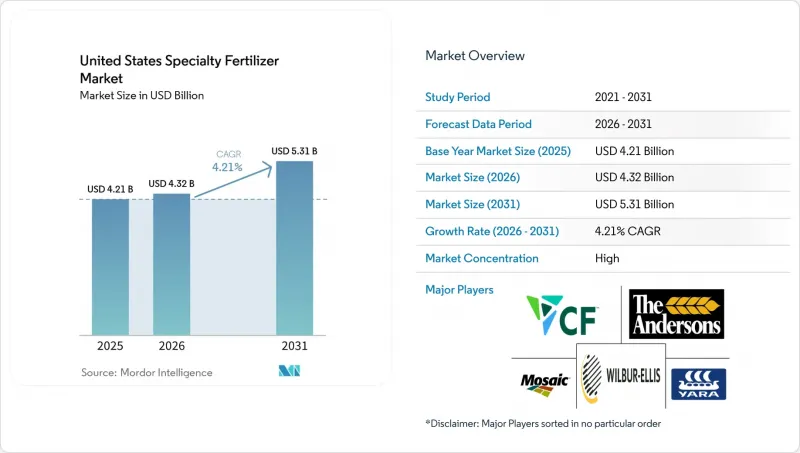
본 보고서는 특수 비료의 유형(CRF, 액체 비료 등), 시용 방법(비료 관개, 엽면 시비 등), 작물의 유형(밭작물, 원예작물 등)별로 분류되어 있습니다. 시장 전망은 금액(달러) 및 수량(미터톤) 단위로 제시되어 있습니다.
미국의 특수 비료 시장 동향 및 인사이트
정밀 농업의 도입이 고효율 투입 자재에 대한 수요를 가속화하고 있습니다.
2024년에는 주요 주의 옥수수 및 대두 재배 면적의 75%에서 GPS 기반 가변 시비율 시스템이 도입되었으며, 영양분의 방출을 작물의 흡수량에 연동시키는 비료의 도입이 촉진되었습니다. 농가들은 수확량 감소 없이 시비량을 10-15% 줄일 수 있었으며, 이를 통해 특수 비료의 높은 가격 부담이 상쇄되고 있습니다. 농지 센서, NDVI 이미지, 토양 전도도 매핑을 통해 얻은 데이터를 바탕으로, 안정화 처리, 폴리머 코팅 및 억제제가 강화된 제제를 권장하는 실시간 시비 처방이 생성됩니다. 인공지능(AI)을 활용한 의사결정 도구는 90일 동안 영양소 공급을 단계적으로 조절할 수 있는 프로그램 제어형 방출 과립과 결합되어 있습니다. 이러한 기술들이 결합되어, 고부가가치 농지에서 특수 비료 등 고품질 투입 자재에 대한 장기적인 수요를 뒷받침하고 있습니다.
영양염 유출에 관한 환경 규제는 서방형 및 수용성 제품의 사용을 권장하고 있습니다.
체서피크만 및 기타 수질 악화가 우려되는 유역에서 미국 환경보호청(EPA)의 "총 최대 일일 부하량(TMDL)"이 프로그램에서는 2025년까지 질소 배출량을 25% 감축할 것을 요구했습니다. 이 규정을 준수함에 따라 생산자들은 폴리머 코팅 요소나 이중 억제제가 함유된 비료 등, 토양 내 영양분을 유지하는 제품으로 전환해야 하는 상황에 놓여 있습니다. 중서부 일부 주에서는 자발적인 비용 분담 인센티브를 확대하고 있으며, 수질 크레딧 거래 프로그램을 통해 농가들은 고효율 비료 사용을 통해 달성한 영양소 감축분을 수익으로 전환할 수 있게 되었습니다. 이러한 추세는 제3자 기관의 데이터를 활용해 손실 감축 효과를 입증할 수 있는 공급업체에 유리하게 작용하고 있습니다.
일반 비료와의 가격 차이
특수 비료는 일반 NPK 비료보다 20%-40% 비싸기 때문에 옥수수 가격이 부셸당 4.50달러, 대두 가격이 12달러 아래로 떨어지면 생산자들은 도입을 미루는 경향이 있습니다. 일반 작물 생산 시스템의 이익률은 평균 5%-10%에 불과하기 때문에 생산자들은 여전히 투입 비용에 매우 민감합니다. 지역별 운임에 따라 가격 차이는 더욱 벌어지며, 외진 지역에서는 가격 프리미엄이 최대 50%에 달하기도 합니다. 그러나 범용형 방출 조절 비료 제품군을 도입한 지역의 혼합 업체들은 물류 여건이 좋은 지역에서 가격 프리미엄을 약 15%까지 낮추고 있습니다. 그렇긴 하지만, 브랜드를 보유한 공급업체들은 우수한 농업 서비스와 기술 지원을 통해 계속해서 차별화를 꾀하고 있습니다.
부문별 분석
2025년, 액체 비료는 미국의 특수 비료 시장에서 38.7%라는 가장 높은 점유율을 차지했습니다. 이러한 비료는 생육기 동안 질소 추가 시비나 미량 원소의 신속한 보충을 위해 생산자들에게 선호되고 있습니다. 또한, 수용성 비료는 신속한 용해와 정확한 투여 능력이 필수적인 시비 관개 및 제어 환경 시스템에서 여전히 중요한 역할을 하고 있습니다. 서방형 유기·무기 혼합 비료 역시 잔디 관리에서 여전히 중요한 위치를 차지하고 있으며, 장기간에 걸친 영양분 공급을 통해 유지 관리 부담을 줄이는 데 기여하고 있습니다.
방출 조절 비료는 2031년까지 연평균 성장률(CAGR)이 6.8%를 나타낼 것으로 예측되며, 특수 비료 중 가장 빠르게 성장할 것으로 전망됩니다. 이러한 성장은 영양소 공급 기간을 90-120일간 연장할 수 있는 기술의 도입을 촉진하는 유출 규제에 힘입어 이루어지고 있습니다. 각 제조업체들은 단일 입상 비료에 여러 가지 방출 메커니즘을 통합하는 것을 점점 더 적극적으로 추진하고 있으며, 이를 통해 시즌 초반에는 수용성 질소가 방출되고, 그 후에는 온도에 따라 영양분을 공급할 수 있게 됩니다. 코팅 기술의 발전은 물론, 농업적·경제적 이점을 입증한 포장 시험 결과까지 더해져, 미국의 특수 비료 시장 전반에서 방출 조절 비료의 채택이 더욱 확대되고 있습니다.
기타 혜택 :
- 엑셀 형식 시장 예측(ME) 시트
- 3개월간의 애널리스트 지원
자주 묻는 질문
목차
제1장 서론
제2장 주요 요약 및 주요 조사 결과
제3장 보고서의 내용
제4장 주요 업계 동향
제5장 시장 규모 및 성장 예측
제6장 경쟁 구도
제7장 비료 업계 CEO가 직면하는 중요 전략적 과제
KTH 26.07.07According to Mordor Intelligence, the united states specialty fertilizer market size is projected to grow from USD 4.21 billion in 2025 to USD 4.32 billion in 2026 and is forecast to reach USD 5.31 billion by 2031 at 4.21% CAGR over 2026-2031.
This report is Segmented by Specialty Type (CRF, Liquid Fertilizer, and More), Application Mode (Fertigation, Foliar, and More), and Crop Type (Field Crops, Horticultural Crops, and More). The Market Forecasts are Provided in Terms of Value (USD) and Volume (Metric Tons).
United States Specialty Fertilizer Market Trends and Insights
Precision Agriculture Adoption Accelerates Demand for High-Efficiency Inputs
Seventy-five percent of corn and soybean acres in leading states used GPS-enabled variable-rate systems in 2024, opening the door for fertilizers that synchronize nutrient release with crop uptake. Growers see 10-15% reductions in application rates without yield loss, which offsets specialty fertilizer premiums. Field sensors, NDVI imagery, and soil conductivity mapping feed real-time prescriptions that lean toward stabilized, polymer-coated, and inhibitor-enhanced formulations. Artificial-intelligence decision tools are now pairing with programmable-release granules able to stagger nutrient availability across a 90-day window. Together, these technologies anchor long-term demand for premium inputs such as specialty fertilizers on high-value acres .
Environmental Rules on Nutrient Runoff Favor Controlled-Release and Soluble Products
Environmental Protection Agency (EPA) total Maximum Daily Load programs in the Chesapeake Bay and other impaired watersheds require a 25% nitrogen reduction by 2025. Compliance pushes growers to products that keep nutrients in the soil profile, such as polymer-coated urea and dual-inhibitor blends. Several Midwest states have expanded voluntary cost-share incentives, while water-quality credit trading programs allow farmers to monetize nutrient savings achieved through the use of enhanced-efficiency fertilizers. The trend favors suppliers able to validate loss reductions with third-party data.
Price Premium Versus Commodity Fertilizers
Specialty fertilizer grades cost 20%-40% more than bulk NPK, leading growers to delay adoption when crop prices fall below USD 4.50 per bushel for corn and USD 12.00 per bushel for soybeans. With margins in commodity systems averaging only 5%-10%, producers remain highly sensitive to input costs. Regional freight charges further widen the price gap, pushing premiums to as high as 50% in remote areas. However, regional blenders introducing generic controlled-release lines have reduced premiums to around 15% where logistics are favorable, though branded suppliers continue to differentiate through superior agronomic service and technical support.
Other drivers and restraints analyzed in the detailed report include:
- Turf and Ornamental Boom Drives Specialty Usage
- Drip, CEA and Vertical-Farm Buildout Needs Soluble, Ultra-Clean Nutrition
- Pending Microplastic Bans on Polymer Coatings
For complete list of drivers and restraints, kindly check the Table Of Contents.
Segment Analysis
Liquid fertilizers held the largest United States specialty fertilizer market share at 38.7% in 2025. These fertilizers are preferred by growers for in-season nitrogen top-dress applications and rapid micronutrient correction. Additionally, water-soluble fertilizers maintain a significant role in fertigation and controlled-environment systems, where their fast dissolution and precise dosing capabilities are essential. Slow-release organo-mineral blends also remain important in turf care, as their extended nutrient availability helps reduce maintenance needs.
Controlled-release fertilizers are anticipated to be the fastest-growing specialty fertilizer type, with a projected CAGR of 6.8% through 2031. This growth is driven by runoff regulations that promote nutrient-delivery technologies capable of extending nutrient availability for 90-120 days. Manufacturers are increasingly incorporating multiple release mechanisms within single granules, enabling early-season soluble nitrogen release followed by temperature-responsive nutrient delivery. Advances in coating technologies, coupled with field trials demonstrating both agronomic and economic benefits, are fostering wider adoption of controlled-release fertilizers across the United States specialty fertilizer market.
Complete Report Scope:
- Speciality Type
- CRF
- Polymer Coated
- Polymer-Sulfur Coated
- Others
- Liquid Fertilizer
- SRF
- Water Soluble
- CRF
- Application Mode
- Fertigation
- Foliar
- Soil
- Crop Type
- Field Crops
- Horticultural Crops
- Turf & Ornamental
List of Companies Covered in this Report:
- Nutrien Ltd.
- The Mosaic Company
- CF Industries Holdings Inc.
- Koch Fertilizer LLC (Koch Industries Inc.)
- Yara International ASA
- ICL Group Ltd.
- Haifa Chemicals Ltd. (Trance-Chem Ltd.)
- Sociedad Qumica y Minera de Chile S.A.
- Wilbur-Ellis Company LLC
- The Andersons Inc.
- J.R. Simplot Company
- Helena Agri-Enterprises LLC (Marubeni Corporation)
- The Scotts Miracle-Gro Company
- COMPO EXPERT GmbH (Grupa Azoty S.A.)
- Agro-Culture Liquid Fertilizers, Inc.
Additional Benefits:
- The market estimate (ME) sheet in Excel format
- 3 months of analyst support
TABLE OF CONTENTS
1 INTRODUCTION
- 1.1 Study Assumptions & Market Definition
- 1.2 Scope of the Study
- 1.3 Research Methodology
2 EXECUTIVE SUMMARY & KEY FINDINGS
3 REPORT OFFERS
4 KEY INDUSTRY TRENDS
- 4.1 Acreage Of Major Crop Types
- 4.1.1 Field Crops
- 4.1.2 Horticultural Crops
- 4.2 Average Nutrient Application Rates
- 4.2.1 Micronutrients
- 4.2.1.1 Field Crops
- 4.2.1.2 Horticultural Crops
- 4.2.2 Primary Nutrients
- 4.2.2.1 Field Crops
- 4.2.2.2 Horticultural Crops
- 4.2.3 Secondary Macronutrients
- 4.2.3.1 Field Crops
- 4.2.3.2 Horticultural Crops
- 4.2.1 Micronutrients
- 4.3 Agricultural Land Equipped For Irrigation
- 4.4 Regulatory Framework
- 4.5 Value Chain & Distribution Channel Analysis
- 4.6 Market Drivers
- 4.6.1 Precision-ag adoption accelerates demand for high-efficiency inputs
- 4.6.2 Environmental rules on nutrient runoff favor controlled-release and soluble products
- 4.6.3 Micro-irrigation expansion boosts fertigation-grade fertilizers
- 4.6.4 Turf-and-ornamental boom drives specialty usage
- 4.6.5 Food-retailer carbon scoring rewards low-loss nitrogen technologies
- 4.6.6 Drip, CEA/vertical-farm build-out needs soluble, ultra-clean nutrition
- 4.7 Market Restraints
- 4.7.1 Price premium versus commodity fertilizers
- 4.7.2 Ammonia and natural-gas price volatility
- 4.7.3 Pending micro-plastic bans on polymer coatings
- 4.7.4 Canada potash-tariff risk inflates potassium specialties
5 MARKET SIZE AND GROWTH FORECASTS (VALUE AND VOLUME)
- 5.1 Speciality Type
- 5.1.1 CRF
- 5.1.1.1 Polymer Coated
- 5.1.1.2 Polymer-Sulfur Coated
- 5.1.1.3 Others
- 5.1.2 Liquid Fertilizer
- 5.1.3 SRF
- 5.1.4 Water Soluble
- 5.1.1 CRF
- 5.2 Application Mode
- 5.2.1 Fertigation
- 5.2.2 Foliar
- 5.2.3 Soil
- 5.3 Crop Type
- 5.3.1 Field Crops
- 5.3.2 Horticultural Crops
- 5.3.3 Turf & Ornamental
6 COMPETITIVE LANDSCAPE
- 6.1 Key Strategic Moves
- 6.2 Market Share Analysis
- 6.3 Company Landscape
- 6.4 Company Profiles (Includes Global Level Overview, Market Level Overview, Core Business Segments, Financials, Headcount, Key Information, Market Rank, Market Share, Products and Services, and Analysis of Recent Developments)
- 6.4.1 Nutrien Ltd.
- 6.4.2 The Mosaic Company
- 6.4.3 CF Industries Holdings Inc.
- 6.4.4 Koch Fertilizer LLC (Koch Industries Inc.)
- 6.4.5 Yara International ASA
- 6.4.6 ICL Group Ltd.
- 6.4.7 Haifa Chemicals Ltd. (Trance-Chem Ltd.)
- 6.4.8 Sociedad Qumica y Minera de Chile S.A.
- 6.4.9 Wilbur-Ellis Company LLC
- 6.4.10 The Andersons Inc.
- 6.4.11 J.R. Simplot Company
- 6.4.12 Helena Agri-Enterprises LLC (Marubeni Corporation)
- 6.4.13 The Scotts Miracle-Gro Company
- 6.4.14 COMPO EXPERT GmbH (Grupa Azoty S.A.)
- 6.4.15 Agro-Culture Liquid Fertilizers, Inc.


