

|
시장보고서
상품코드
2109265
스프링클러 관개 시스템 시장 : 시장 기회, 성장요인, 업계 동향 분석 및 예측(2026-2035년)Sprinkler Irrigation System Market Opportunity, Growth Drivers, Industry Trend Analysis, and Forecast 2026 - 2035 |
||||||

세계의 스프링클러 관개 시스템 시장은 2025년에 39억 달러로 평가되었고, CAGR 7.4%로 성장할 전망이며, 2035년까지 78억 달러에 이를 것으로 추정되고 있습니다.
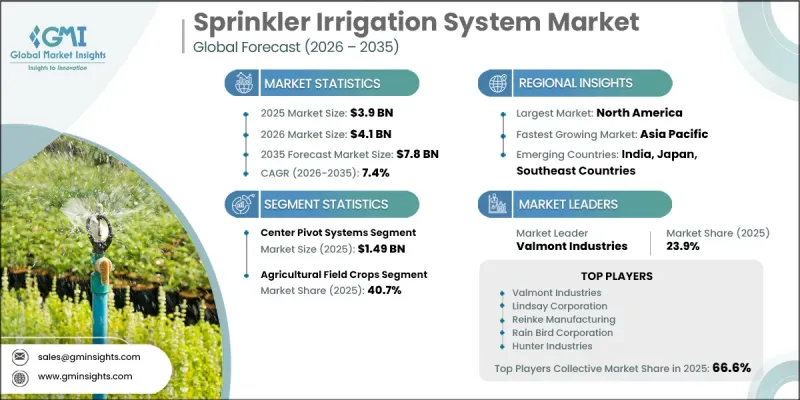
물 부족의 심화, 기후 조건의 변화, 지하수 자원의 고갈, 그리고 관개 농지의 지속적인 증가로 인해 기존의 관개 방식에서 보다 효율적인 스프링클러 관개 시스템으로의 전환이 촉진되며 시장이 확대되고 있습니다. 물 절약에 대한 인식 제고와 농업 생산성 향상의 필요성이 시장 확산을 더욱 가속화하고 있습니다. 동시에 정밀 농업의 도입이 진행됨에 따라, 효율적인 자원 관리를 지원하면서 정확한 배수를 가능하게 하는 첨단 관개 기술에 대한 수요가 높아지고 있습니다. 농가들의 디지털 농업 인프라에 대한 투자가 증가하고 있으며, 이는 지능형 관개 컨트롤러, 커넥티드 모니터링 솔루션 및 클라우드 기반 관개 관리 플랫폼의 도입을 뒷받침하고 있습니다. 그 결과, 스프링클러 관개 시스템은 기존의 관개 설비라는 틀을 넘어, 커넥티드 농업 생태계의 필수적인 일부로 자리 잡고 있습니다. 현재 구매 결정 요인은 관개 성능뿐만 아니라, 보다 광범위한 농장 관리 소프트웨어 및 디지털 농업 플랫폼과의 호환성에도 좌우되고 있으며, 이를 통해 생산자는 업무 효율 향상, 물 사용량 최적화, 그리고 장기적인 작물 관리를 강화할 수 있게 되었습니다.
| 시장 범위 | |
|---|---|
| 개시 연도 | 2025년 |
| 예측 기간 | 2026-2035년 |
| 초기 시장 규모 | 39억 달러 |
| 예측액 | 78억 달러 |
| CAGR | 7.4% |
센터 피벗 시스템 부문은 2025년에 14억 9,000만 달러의 매출을 기록한 것으로 평가되었으며, 2026-2035년 연평균 성장률(CAGR) 6.9%로 성장할 것으로 전망됩니다. 효율적인 대규모 관개 솔루션에 대한 지속적인 수요와 더불어, 상업 농업 경영에서의 도입 확대가 예측 기간 동안 해당 부문의 꾸준한 성장을 뒷받침하고 있습니다.
조경, 잔디 및 비농업 부문은 2025년에 34.5%의 점유율을 차지한 것으로 평가되었으며, 2035년까지 37.3%에 도달할 것으로 전망됩니다. 이러한 성장은 효율적이고 신뢰할 수 있는 관개 솔루션을 필요로 하는 상업, 지자체 및 기타 비농업 환경에서 수요가 지속적으로 증가하고 있음을 반영하며, 스프링클러 관개 시스템 시장이 기존의 농업 용도를 넘어 다각화되고 있음을 보여줍니다.
북미 스프링클러 관개 시스템 시장은 2025년에 12억 3,000만 달러 규모를 기록했습니다. 이 지역은 광대한 관개 농지와 효율적인 물 관리 기술에 대한 지속적인 투자에 힘입어, 대규모 농업 경영에서 스프링클러 관개 인프라가 널리 도입됨에 따라 계속해서 주도적인 위치를 유지하고 있습니다. 농업 관개 방식의 지속적인 현대화와 첨단 관개 설비의 도입이 해당 지역 전체 시장 성장을 지속적으로 견인하고 있습니다.
자주 묻는 질문
목차
제1장 조사 방법과 범위
제2장 주요 요약
제3장 업계 인사이트
제4장 경쟁 구도
제5장 시장 추산 및 예측 : 시스템 유형별(2022-2035년)
제6장 시장 추산 및 예측 : 컴포넌트별(2022-2035년)
제7장 시장 추산 및 예측 : 용도별(2022-2035년)
제8장 시장 추산 및 예측 : 모빌리티별(2022-2035년)
제9장 시장 추산 및 예측 : 필드 사이즈별(2022-2035년)
제10장 시장 추산 및 예측 : 최종 사용자별(2022-2035년)
제11장 시장 추산 및 예측 : 지역별(2022-2035년)
제12장 기업 개요
AJY 26.08.18The Global Sprinkle Irrigation System Market was valued at USD 3.9 billion in 2025 and is estimated to grow at a CAGR of 7.4% to reach USD 7.8 billion by 2035.
The market is expanding as growing water scarcity, changing climate conditions, depletion of groundwater resources, and the continuous increase in irrigated farmland encourage the transition from conventional irrigation methods to more efficient sprinkler irrigation systems. Rising awareness of water conservation and the need to improve agricultural productivity are further accelerating market adoption. At the same time, the growing implementation of precision agriculture is increasing demand for advanced irrigation technologies capable of delivering accurate water distribution while supporting efficient resource management. Farmers are increasingly investing in digital farm infrastructure, which is driving the adoption of intelligent irrigation controllers, connected monitoring solutions, and cloud-based irrigation management platforms. As a result, sprinkler irrigation systems are evolving beyond traditional irrigation equipment and becoming an integral part of connected agricultural ecosystems. Purchasing decisions are now influenced not only by irrigation performance but also by compatibility with broader farm management software and digital agriculture platforms, enabling growers to improve operational efficiency, optimize water usage, and enhance long-term crop management.
| Market Scope | |
|---|---|
| Start Year | 2025 |
| Forecast Year | 2026-2035 |
| Start Value | $3.9 Billion |
| Forecast Value | $7.8 Billion |
| CAGR | 7.4% |
The center pivot systems segment generated USD 1.49 billion in 2025 and is expected to grow at a CAGR of 6.9% between 2026 and 2035. Continued demand for efficient large-scale irrigation solutions, along with increasing adoption across commercial farming operations, is supporting the steady growth of this segment throughout the forecast period.
The landscape, turf, and non-agricultural segment held a 34.5% share in 2025 and is forecast to reach 37.3% by 2035. This growth reflects the increasing diversification of the Sprinkle Irrigation System Market beyond traditional agricultural applications, as demand continues to rise across commercial, municipal, and other non-farming environments that require efficient and reliable irrigation solutions.
North America Sprinkle Irrigation System Market captured USD 1.23 billion in 2025. The region continues to maintain its leadership position due to the extensive deployment of sprinkler irrigation infrastructure across large agricultural operations, supported by significant irrigated farmland and continued investment in efficient water management technologies. Ongoing modernization of agricultural irrigation practices and the adoption of advanced irrigation equipment continue to reinforce market growth throughout the region.
Key companies operating in the global sprinkle irrigation system market include Valmont Industries, Inc., Lindsay Corporation, Rain Bird Corporation, The Toro Company, Hunter Industries, Reinke Manufacturing Co., Inc., T-L Irrigation Company, Alkhorayef Industries / Pierce Corporation, RAESA, Bauer GmbH, Grupo Fockink, Irrifrance Groupe, Ocmis Irrigazione S.p.A., Rainfine (Dalian) Irrigation Co., Ltd., Irrigreen, Deem Irrigation Systems, IDEM Irrigation, and FarmHQ. Companies participating in the global sprinkle irrigation system market are strengthening their market presence by expanding product portfolios, investing in advanced irrigation technologies, and enhancing smart irrigation capabilities. Manufacturers are focusing on developing connected irrigation systems with improved automation, remote monitoring, and efficient water management features to meet evolving customer requirements. Strategic partnerships with distributors, agricultural technology providers, and channel partners are helping companies expand their geographic reach and strengthen customer engagement. Businesses are also increasing investments in research and development to improve system efficiency, durability, and operational performance. In addition, companies are expanding manufacturing capacity, improving after-sales support, and strengthening service networks to enhance customer satisfaction.
Table of Contents
Chapter 1 Methodology & Scope
- 1.1 Research approach
- 1.2 Quality Commitments
- 1.2.1 GMI AI policy & data integrity commitment
- 1.2.1.1 Source consistency protocol
- 1.2.1 GMI AI policy & data integrity commitment
- 1.3 Research Trail & Confidence Scoring
- 1.3.1 Research Trail Components
- 1.3.2 Scoring Components
- 1.4 Data Collection
- 1.4.1 Partial list of primary sources
- 1.5 Data mining sources
- 1.5.1 Paid sources
- 1.5.1.1 Sources, by region
- 1.5.1 Paid sources
- 1.6 Base estimates and calculations
- 1.6.1 Base year calculation for any one approach
- 1.7 Forecast model
- 1.7.1 Quantified market impact analysis
- 1.7.1.1 Mathematical impact of growth parameters on forecast
- 1.7.1 Quantified market impact analysis
- 1.8 Research transparency addendum
- 1.8.1 Source attribution framework
- 1.8.2 Quality assurance metrics
- 1.8.2.1 Our commitment to trust
Chapter 2 Executive Summary
- 2.1 Industry 360° synopsis, 2022 – 2035
- 2.2 Key market trends
- 2.2.1 Region
- 2.2.2 System Type
- 2.2.3 Component
- 2.2.4 Application
- 2.2.5 Mobility
- 2.2.6 Field Size
- 2.2.7 End-user
Chapter 3 Industry Insights
- 3.1 Industry ecosystem analysis
- 3.2 Supply chain analysis
- 3.2.1 Key Raw Materials & Component Sourcing
- 3.2.2 Supply Chain Vulnerabilities & Concentration Risks
- 3.2.3 Nearshoring & Vertical Integration Trends Among System Manufacturers
- 3.3 Industry Impact Forces
- 3.3.1 Market drivers
- 3.3.1.1 Rising Global Water Scarcity & Need for Efficient Irrigation
- 3.3.1.2 Government Subsidies & Irrigation Modernization Programs
- 3.3.1.3 Expansion of Agricultural Land Under Cultivation in Emerging Economies
- 3.3.1.4 Growing Adoption of Precision Agriculture & Smart Farming Practices
- 3.3.2 Market restraints
- 3.3.2.1 High Initial Capital Investment & Installation Costs
- 3.3.2.2 Lack of Technical Knowledge & Skilled Workforce in Rural Areas
- 3.3.2.3 Vulnerability to Uneven Water Distribution in Wind Conditions
- 3.3.3 Market opportunities
- 3.3.3.1 Untapped Irrigation Potential in Sub-Saharan Africa & South Asia
- 3.3.3.2 Integration of IoT & Remote Sensing for Automated Water Management
- 3.3.3.3 Expansion in Non-Agricultural Applications (Golf, Sports, Greenhouses)
- 3.3.3.4 Retrofit & Upgrade Demand in Aging Irrigation Infrastructure
- 3.3.1 Market drivers
- 3.4 Growth potential analysis
- 3.5 Technology & innovation landscape
- 3.5.1 Smart Irrigation & IoT-Enabled Control Systems
- 3.5.2 Precision Sprinkler Nozzle & Pressure Regulation Advances
- 3.5.3 Solar-Powered & Energy-Efficient Pump Technologies
- 3.5.4 Variable Rate Irrigation (VRI) & GPS Integration
- 3.6 Regulatory framework
- 3.6.1 Water Use Efficiency Mandates & Irrigation Regulations by Region
- 3.6.2 Government Subsidy & Incentive Programs (PMKSY, USDA EQIP, EU CAP)
- 3.6.3 Environmental Compliance & Water Conservation Standards
- 3.7 Future market trends
- 3.8 Pricing analysis (driven by primary research)
- 3.8.1 Historical Price Trend Analysis (Driven by Primary Research)
- 3.8.2 Pricing Strategy by Player Type (Premium / Value / Cost-plus) (Driven by Primary Research)
- 3.9 Trade data analysis (HS Code - 84249000) (driven by primary research)
- 3.9.1 Import/Export Volume & Value Trends by System Type & Component (Driven by Primary Research)
- 3.9.2 Key Trade Corridors & Tariff Impact on Irrigation Equipment (Driven by Primary Research)
- 3.10 Impact of AI & generative AI on the market
- 3.10.1 AI-Driven Disruption of Traditional Irrigation Management Models
- 3.10.2 GenAI Use Cases & Adoption Roadmap by Segment (Field Crops, Landscape, Greenhouse)
- 3.10.3 Risks, Limitations & Regulatory Considerations for AI in Irrigation
- 3.11 Porter’s analysis
- 3.12 PESTEL analysis
Chapter 4 Competitive Landscape, 2025
- 4.1 Introduction
- 4.2 Company market share analysis
- 4.2.1 By Region
- 4.2.1.1 North America
- 4.2.1.2 Europe
- 4.2.1.3 Asia Pacific
- 4.2.1.4 Latin America
- 4.2.1.5 Middle East and Africa
- 4.2.1 By Region
- 4.3 Company matrix analysis
- 4.4 Competitive analysis of major market players
- 4.5 Competitive positioning matrix
- 4.6 Key developments
- 4.6.1 Mergers & acquisitions
- 4.6.2 Partnerships & collaborations
- 4.6.3 New product launches
- 4.6.4 Expansion plans
Chapter 5 Market Estimates and Forecast, By System Type, 2022 - 2035 (USD Billion) (thousand Units)
- 5.1 Key Trends
- 5.2 Center Pivot Systems
- 5.2.1 Single-Span
- 5.2.2 Multi-Span
- 5.2.3 Corner Arm Systems
- 5.3 Lateral Move (Linear) Systems
- 5.3.1 Hard Hose Lateral Move
- 5.3.2 Soft Hose Lateral Move
- 5.4 Solid Set Sprinkler Systems
- 5.4.1 Above-Ground Solid Set
- 5.4.2 Under-Ground (Pop-Up) Solid Set
- 5.5 Portable & Traveling Systems
- 5.5.1 Big Gun / Rain Gun Systems
- 5.5.2 Hand-Move Pipe Systems
- 5.5.3 Side-Roll Systems
- 5.6 Others
Chapter 6 Market Estimates and Forecast, By Component, 2022 - 2035 (USD Billion) (thousand Units)
- 6.1 Key Trends
- 6.2 Sprinkler Heads
- 6.2.1 Rotary/Impact Heads
- 6.2.2 Pop-Up Spray Heads
- 6.2.3 Micro-Spray & Wobbler Heads
- 6.3 Pipes & Fittings
- 6.3.1 Aluminum Pipes
- 6.3.2 PVC Pipes
- 6.3.3 HDPE Pipes
- 6.3.4 Fittings & Couplers
- 6.4 Pumps
- 6.4.1 Electric Pumps
- 6.4.2 Diesel/Engine-Driven Pumps
- 6.4.3 Solar-Powered Pumps
- 6.5 Control Units & Automation
- 6.5.1 Mechanical Controllers & Timers
- 6.5.2 Smart/IoT-Enabled Controllers
- 6.5.3 Weather-Based & Sensor-Driven Controllers
- 6.6 Valves
- 6.6.1 Solenoid Valves
- 6.6.2 Pressure Regulating Valves
- 6.6.3 Check Valves & Gate Valves
- 6.7 Others (Filters, Fertigation Injectors, Accessories)
Chapter 7 Market Estimates and Forecast, By Application, 2022 - 2035 (USD Billion) (thousand Units)
- 7.1 Key Trends
- 7.2 Agricultural Crop
- 7.2.1 Cereals & Grains
- 7.2.2 Oilseeds & Pulses
- 7.2.3 Sugar Crops
- 7.3 Agricultural Fruit and Vegetable
- 7.3.1 Fruits & Orchard Crops
- 7.3.2 Vegetables & Leafy Greens
- 7.4 Landscape & Turf
- 7.4.1 Commercial Landscaping
- 7.4.2 Public Parks & Municipal Green Spaces
- 7.5 Golf Courses & Sports Grounds
- 7.5.1 Private Golf Courses
- 7.5.2 Public Golf Courses
- 7.5.3 Athletic Fields & Race Courses
- 7.6 Greenhouse & Controlled Environment Agriculture (CEA)
- 7.6.1 Flower & Ornamental Cultivation
- 7.6.2 Vegetable & Specialty Crop Greenhouse
- 7.7 Residential Lawns & Gardens
- 7.8 Others
Chapter 8 Market Estimates and Forecast, By Mobility, 2022 - 2035 (USD Billion) (thousand Units)
- 8.1 Key Trends
- 8.2 Stationary Systems
- 8.2.1 Permanent In-Ground Installations
- 8.2.2 Semi-Permanent Above-Ground Installations
- 8.3 Towable/Mobile Systems
- 8.3.1 Towable Center Pivot & Linear Systems
- 8.3.2 Portable Reel & Traveling Gun Systems
Chapter 9 Market Estimates and Forecast, By Field Size, 2022 - 2035 (USD Billion) (thousand Units)
- 9.1 Key Trends
- 9.2 Small Fields (Below 5 Hectares)
- 9.3 Medium Fields (5–25 Hectares)
- 9.4 Large Fields (Above 25 Hectares)
Chapter 10 Market Estimates and Forecast, By End-user, 2022 - 2035 (USD Billion) (thousand Units)
- 10.1 Key Trends
- 10.2 Individual Farmers & Smallholders
- 10.3 Commercial Farms & Agribusinesses
- 10.4 Agricultural Cooperatives
- 10.5 Government & Institutional (Irrigation Departments, Municipalities)
- 10.6 Landscape Contractors & Facility Management Companies
- 10.7 Others
Chapter 11 Market Estimates & Forecast, By Region, 2022 – 2035, (USD Billion) (thousand Units)
- 11.1 Key trends
- 11.2 North America
- 11.2.1 U.S.
- 11.2.2 Canada
- 11.3 Europe
- 11.3.1 Germany
- 11.3.2 U.K.
- 11.3.3 France
- 11.3.4 Italy
- 11.3.5 Spain
- 11.4 Asia Pacific
- 11.4.1 China
- 11.4.2 India
- 11.4.3 Japan
- 11.4.4 South Korea
- 11.4.5 Australia
- 11.5 Latin America
- 11.5.1 Brazil
- 11.5.2 Mexico
- 11.5.3 Argentina
- 11.6 MEA
- 11.6.1 UAE
- 11.6.2 Saudi Arabia
- 11.6.3 South Africa
Chapter 12 Company Profiles
- 12.1 Global Leader
- 12.1.1 Valmont Industries, Inc.
- 12.1.2 Lindsay Corporation
- 12.1.3 Rain Bird Corporation
- 12.1.4 The Toro Company
- 12.1.5 Hunter Industries
- 12.1.6 Reinke Manufacturing Co., Inc.
- 12.1.7 T-L Irrigation Company
- 12.2 Regional Players
- 12.2.1 Alkhorayef Industries / Pierce Corporation
- 12.2.2 RAESA
- 12.2.3 Bauer GmbH
- 12.2.4 Grupo Fockink
- 12.2.5 Irrifrance Groupe
- 12.2.6 Ocmis Irrigazione S.p.A.
- 12.2.7 Rainfine (Dalian) Irrigation Co., Ltd.
- 12.3 Emerging Players
- 12.3.1 Irrigreen
- 12.3.2 Deem Irrigation Systems
- 12.3.3 IDEM Irrigation
- 12.3.4 FarmHQ


