

|
시장보고서
상품코드
2113415
독일의 농업용 관개 기계 : 시장 점유율 분석, 업계 동향과 통계, 성장 예측(2026-2031년)Germany Agricultural Irrigation Machinery - Market Share Analysis, Industry Trends & Statistics, Growth Forecasts (2026 - 2031) |
||||||
 Mordor Intelligence
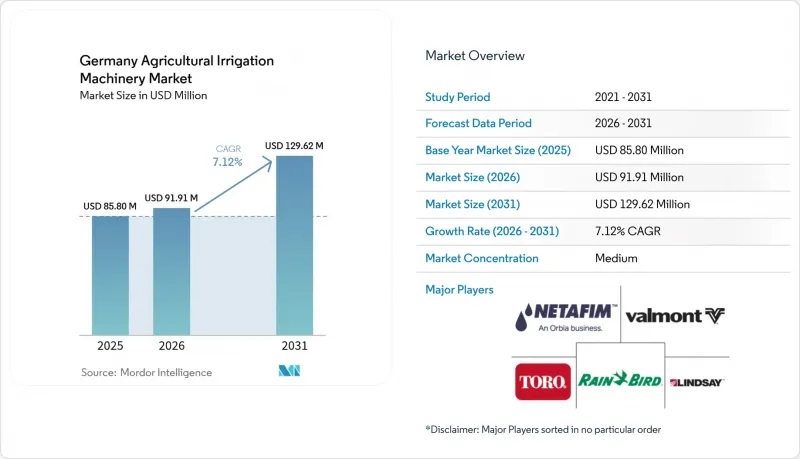
Mordor Intelligence에 따르면 독일의 농업용 관개 기계 시장 규모는 2026년에 9,191만 달러로 추정되며, 2025년 8,580만 달러에서 확대되어 2031년에는 1억 2,962만 달러에 달할 것으로 예측됩니다.
2026년부터 2031년까지의 연평균 성장률(CAGR)은 7.12%에 달할 것으로 전망됩니다.
본 보고서는 관개 방식(스프링클러 관개 및 점적 관개), 작물 종류(밭작물, 과수·포도원 등), 동력원(전기, 디젤, 태양광), 자동화 수준(수동, 반자동 등)별로 분류되어 있습니다. 시장 전망은 금액(달러) 기준으로 제시됩니다.
독일 농업용 관개 기계 시장의 동향 및 인사이트
기후 스마트형 보조금 프로그램
2027년까지 연방 및 주 공동 농업 정책(CAP) 기금에서 자원 효율이 높은 설비에 대해 연간 약 62억 유로(67억 달러)가 배정되어 있으며, 2028년부터 2032년까지도 유사한 배분이 제안되어 있습니다. ‘Agrarumwelt und KlimamaBnahmen(농업 환경·기후 대책)’의 틀 하에서는 점적 관개 설비의 설치가 우선적으로 평가되므로, 스프링클러 교체에 대한 승인률은 하락하고 있습니다. 현재 보조금을 받기 위해서는 물 사용량 데이터를 전송할 수 있는 농장 내 텔레매틱스 시스템 도입이 필수이며, 이에 따라 Netafim GrowSphere나 John Deere Operations Center 등의 시스템과 호환되는 IoT 대응 컨트롤러의 도입이 촉진되고 있습니다. 바이에른주와 노르트라인-베스트팔렌주에서는 최대 60%의 공동 자금 조달 비율로 인해 기후 적응 신청 승인 건수가 전국 평균의 3배 이상에 달합니다. 반면 작센주에서는 그 비율이 35%를 넘는 경우가 거의 없습니다. 또한, 보조금 이월 규정에 따라 생산자는 보조금과 KfW의 저금리 대출을 결합할 수 있으며, 이를 통해 투자 회수 기간을 4년 미만으로 단축할 수 있습니다. 많은 농업 후계자들이 디지털 규정 준수를 표준적인 비즈니스 관행으로 간주하고 있기 때문에 보조금 제도는 면적 기반이 아닌 실적 연동형으로 유지될 것으로 예상됩니다.
온실 원예 클러스터의 확대
독일에서는 토마토 생산량의 12.5%, 오이의 10.4%, 피망의 3.9%를 자국에서 생산하고 있으며, 국내 수요는 여전히 수입량을 상회하고 있습니다. 이에 대응하여 투자자들은 노르트라인-베스트팔렌주와 바이에른주의 물류 허브 인근에 수 헥타르 규모의 온실을 건설하고 있습니다. 이러한 시설에서는 밀폐형 수경재배 시스템, 지하 점적 관개, 센서 제어에 의한 시비 및 관개와 같은 첨단 기술을 활용하여 인력과 물의 효율화를 도모하고 있습니다. 독일농업협회가 실시한 조사에 따르면, 지중 점적 관개와 태양광발전 펌프를 결합함으로써 5년 연속 재배 시즌 동안 안정적인 수확량을 유지하면서 물 사용량을 35% 절감할 수 있음이 입증되었습니다. 건설업체들은 난방·환기·공조(HVAC) 열회수 시스템을 도입하고, 응축수를 관개용수로 재활용함으로써 담수 소비량을 추가로 8-10% 절감하고 있습니다. 온실 관개는 자본 집약적인 특성을 가지고 있기 때문에 운영자는 시스템 가동 시간을 확보하기 위해 구독형 서비스 계약에 의존하는 경우가 많으며, 그 결과 OEM(주문자 상표 생산) 제조업체의 소프트웨어 업데이트에 대한 안정적인 고객이 되고 있습니다.
농장 내 우물 허가를 취득하는 데 오랜 시간이 소요됩니다
바덴뷔르템베르크주에서는 연간 5,000세제곱미터를 초과하는 농업용수 취수에 환경영향평가가 필요합니다. 이 과정에는 대수층 모델링, 수위 저하 예측 및 생태학적 조사가 포함됩니다. 처리 기간은 6개월에서 18개월에 달하며, 자본 투자가 지연됨에 따라 생산자들은 물 이용권 임대나 고액의 지자체 급수 등 대안을 검토할 수밖에 없습니다. 관개 활동은 해당 주가 부과하는 1입방미터당 0.051유로(0.055달러)의 지하수 사용료 적용 대상에서 제외되지만, 소규모 생산자들은 서류 절차를 관리하기 위해 컨설턴트를 고용함으로써 추가 비용이 발생하는 경우가 많아 프로젝트 비용이 약 10% 증가하게 됩니다. 유사한 과제는 지하수 사용료가 1입방미터당 0.06유로(0.065달러)로 정해져 있는 라인란트-팔츠주에서도 볼 수 있습니다. 절수 대책을 통한 상쇄 조치를 통해 이 사용료를 절반으로 줄일 수 있습니다. ‘큐렌타’나 ‘노르트하йде’와 같은 재판 판결을 통해 생태계 유량을 보호하기 위한 더 엄격한 규제가 확립되었습니다. 그 결과, 우물 허가 취득은 앞으로 점점 더 엄격해질 것으로 예상됩니다.
부문 분석
2025년 현재, 독일 농업용 관개 기계 시장에서 점적 관개가 54.12%의 점유율을 차지하고 있으며, 2031년까지 연평균 성장률(CAGR) 11.68%로 성장할 것으로 예측됩니다. 이러한 성장은 노르트라인베스트팔렌주와 바이에른주의 온실 원예 클러스터 내 기존 인프라 개보수,및 물 부족 지역 농가의 지하 점적 관개 시스템 도입(지하수 취수 제한 준수를 위해)에 힘입어, 스프링클러 시스템의 성장률을 상회할 전망입니다. 이 부문의 확대는 절수형 기술을 우선시하는 기후 변화 대응형 보조금 프로그램에 의해 뒷받침되고 있습니다. 2024년 국제 농업·원예 기계 박람회(EIMA)에서 발표된 네타핌(Netafim)사의 ‘GrowSphere’ 운영체제는 점적 관개 하드웨어에 비료 관개 제어, 토양 수분 피드백,및 농업 의사결정 지원 기능을 통합하고 있어, 생산자들을 다년간의 서비스 계약으로 묶는 통합형 솔루션으로의 업계 전환을 여실히 보여주고 있습니다.
이동식 릴 장착 시스템이나 센터 피벗 설비를 포함한 스프링클러 관개는 감자, 사탕무, 곡물 등의 밭작물 재배에 여전히 널리 이용되고 있습니다. 독일의 관개 면적 56만 헥타르 중 48%를 차지하는 니더작센주에서는 초기 비용이 낮고 임대 농지 간 이동이 용이하기 때문에 주로 스프링클러가 이용되고 있습니다. 스프링클러 시스템 도입에는 2024년 4월 산업용 사용자를 대상으로 킬로와트시당 20.16센트에 달한 전기 요금 인상과, 스프링클러 시스템에 따른 과잉 살포로 악화되는 질산염 침출을 줄이기 위한 규제 조치와 같은 과제가 있습니다.
채소 및 보호 재배 작물은 독일 농업용 관개 기계 시장 규모의 37.74%를 차지하고 있으며, 2031년까지 연평균 성장률(CAGR) 11.26%로 성장할 것으로 예측됩니다. 이러한 성장은 독일의 구조적인 채소 부족과 노르트라인베스트팔렌주 및 바이에른주에 온실 재배 클러스터가 집중되어 있는 상황을 반영합니다. 이 지역에서는 기후 제어형 생산에 점적 관개의 사용이 의무화되어 있습니다. 온실 운영자들은 심각한 인력 부족에 직면해 있으며, 농업 종사자 수는 2024년까지 7% 감소하여 87만 6,000명에 달할 것으로 예측됩니다. 그 결과, 영양분 공급, pH 조절, 토양 수분 피드백을 통합한 완전 자동 비료 관개 플랫폼이 사업의 지속가능성을 위해 필수적입니다. 보호 재배 작물의 관개 수요는 토마토, 오이, 피망이 주를 이루며, 각각의 자급률은 12.5%, 10.4%, 3.9%를 기록할 것으로 예상됩니다. 이러한 낮은 자급률은 국내 생산능력 확대를 위한 구조적인 인센티브를 창출하고 있으며, 네타핌(Netafim), 리불리스(Rivulis), 이리텍(Irritec)과 같은 고급 점적 관개 시스템 공급업체에 혜택을 주고 있습니다.
주로 바덴뷔르템베르크주, 라인란트팔츠주, 바이에른주에 위치한 과수원이나 포도밭에서는 점적 관개 및 마이크로 스프링클러 시스템의 도입이 점점 더 확대되고 있습니다. 이러한 시스템은 동결 방지, 비료 관개 정확도, 그리고 높은 물 이용 효율로 높이 평가받고 있습니다. 디아(Deere)사의 LiDAR(라이더) 기반 센싱 기술인 ‘Smart Apply’는 소노마 카운티에서 실시된 시범 시험을 통해 농약 및 물 사용량을 28% 절감한 것으로 입증되었으며, 이 성과는 독일의 포도 재배 지역에서도 주목을 받고 있습니다.
잔디·관상용 식물 부문은 지자체 조경, 스포츠 시설, 묘목 재배 사업에 의해 주도되는 틈새 시장이며, 수요는 도시 지역에 집중되어 있습니다. 이 부문에서는 정확한 관수 범위와 유지 관리가 간편하다는 장점 덕분에 주로 회전식 스프링클러나 점적 테이프가 사용되고 있습니다.
기타 혜택:
- 엑셀 형식의 시장 예측(ME) 시트
- 3개월간의 애널리스트 지원
자주 묻는 질문
목차
제1장 소개
제2장 조사 방법
제3장 주요 요약
제4장 시장 구도
제5장 시장 규모와 성장 예측
제6장 경쟁 구도
제7장 시장 기회와 향후 전망
KSM 26.08.25According to Mordor Intelligence, Germany agricultural irrigation machinery market size in 2026 is estimated at USD 91.91 million, growing from 2025 value of USD 85.80 million with 2031 projections showing USD 129.62 million, growing at 7.12% CAGR over 2026-2031.
This report is Segmented by Irrigation Type (Sprinkler Irrigation and Drip Irrigation), by Crop Type (Field Crops, Fruits and Vineyards, and More), by Power Source (Electric, Diesel, and Solar), and by Automation Level (Manual, Semi-Automatic, and More). The Market Forecasts are Provided in Terms of Value (USD).
Germany Agricultural Irrigation Machinery Market Trends and Insights
Climate-Smart Subsidy Programs
Approximately EUR 6.2 billion (USD 6.7 billion) in federal and state Common Agricultural Policy funding is allocated annually to resource-efficient equipment through 2027, with similar allocations proposed for 2028-2032. Under the Agrarumwelt und KlimamaBnahmen framework, drip installations receive priority scoring, leading to a decline in approval rates for sprinkler upgrades. Subsidies now require on-farm telematics capable of transmitting water-use data, driving the adoption of IoT-ready controllers that are compatible with systems such as Netafim GrowSphere and the John Deere Operations Center. Bavaria and North Rhine-Westphalia approve over three times the national average of climate-adaptation applications due to co-financing rates of up to 60%, compared to Saxony, where rates rarely exceed 35%. Subsidy rollover provisions also allow growers to combine grants with low-interest KfW loans, reducing payback periods to less than four years. As many farm successors consider digital compliance a standard business practice, subsidy structures are projected to remain performance-linked rather than area-based.
Expansion of Greenhouse Horticulture Clusters
Germany produces 12.5% of its tomatoes, 10.4% of its cucumbers, and 3.9% of its peppers, while domestic demand continues to outpace imports. In response, investors are constructing multi-hectare greenhouses near logistics hubs in North Rhine-Westphalia and Bavaria. These facilities utilize advanced technologies, including closed hydroponic systems, subsurface drip laterals, and sensor-guided fertigation, to enhance labor and water efficiency. Research conducted by the German Agricultural Society has demonstrated that combining underground drip irrigation with solar-powered pumps reduces water usage by 35% while maintaining consistent yields over five consecutive growing seasons. Builders incorporate heating, ventilation, and air conditioning (HVAC) heat-recovery systems to recycle condensation for irrigation, further reducing freshwater consumption by 8-10%. Given the capital-intensive nature of greenhouse irrigation, operators often rely on subscription-based service contracts to ensure system uptime, making them consistent customers for original equipment manufacturer (OEM) software updates.
Lengthy Permitting for On-Farm Wells
In Baden-Wurttemberg, agricultural water extraction exceeding 5,000 cubic meters annually requires an environmental impact assessment. This process involves aquifer modeling, drawdown projections, and ecological studies. The processing time ranges from six to eighteen months, delaying capital investments and leading growers to explore alternatives such as rented water rights or costly municipal supplies. While irrigation activities are exempt from the state's EUR 0.051 (USD 0.055) per cubic meter groundwater fee, small growers often incur additional costs by hiring consultants to manage the paperwork, increasing project expenses by approximately 10%. Similar challenges are observed in Rhineland-Palatinate, where groundwater usage is charged at EUR 0.06 (USD 0.065) per cubic meter. Conservation offsets can reduce this fee by half. Legal rulings, such as the Currenta and Nordheide cases, have established stricter regulations to protect ecological flows. As a result, obtaining well approvals is projected to become increasingly stringent.
Other drivers and restraints analyzed in the detailed report include:
- Aging Farm Labor Force Driving Automation
- Rising Groundwater Salinity in North German Plains
- Supply Chain Dependence on Imported Microchips
For complete list of drivers and restraints, kindly check the Table Of Contents.
Segment Analysis
Drip irrigation accounted for 54.12% of the Germany agricultural irrigation machinery market share in 2025 and is projected to grow at a CAGR of 11.68% through 2031. This growth is set to surpass that of sprinkler systems, driven by the retrofitting of legacy infrastructure in greenhouse horticulture clusters in North Rhine-Westphalia and Bavaria, as well as the adoption of subsurface drip systems by field-crop growers in water-stressed regions to comply with groundwater extraction limits. The segment's expansion is supported by climate-smart subsidy programs that prioritize water-efficient technologies. Netafim's GrowSphere operating system, introduced at the International Exposition of Machinery for Agriculture and Gardening (EIMA) 2024, integrates drip hardware with fertigation control, soil-moisture feedback, and agronomic decision support, highlighting the industry's shift toward bundled solutions that secure growers into multi-year service agreements.
Sprinkler irrigation, including mobile reel-mounted systems and center-pivot installations, remains widely used for field crops such as potatoes, sugar beets, and cereals. Lower Saxony, which accounts for 48% of Germany's 560,000 hectares of irrigated land, predominantly utilizes sprinklers due to their lower initial costs and ease of relocation across rental parcels. The adoption of sprinkler systems faces challenges from increasing electricity tariffs, which reached 20.16 cents per kilowatt-hour for industrial users in April 2024, and regulatory measures aimed at reducing nitrate leaching, a problem exacerbated by over-application associated with sprinkler systems.
Vegetables and protected crops accounted for 37.74% of the German agricultural irrigation machinery market size and are projected to grow at a CAGR of 11.26% through 2031. This growth reflects Germany's structural vegetable deficit and the concentration of greenhouse clusters in North Rhine-Westphalia and Bavaria, where the use of drip irrigation is mandatory for climate-controlled production. Greenhouse operators are facing significant labor shortages, with agricultural employment projected to decline by 7% to 876,000 workers in 2024. As a result, fully automated fertigation platforms that integrate nutrient dosing, pH adjustment, and soil-moisture feedback have become essential for operational sustainability. Tomatoes, cucumbers, and peppers dominate the demand for protected-crop irrigation, with self-sufficiency rates of 12.5%, 10.4%, and 3.9%, respectively. These low self-sufficiency rates create a structural incentive for domestic capacity expansion, benefiting premium drip irrigation suppliers such as Netafim, Rivulis, and Irritec.
Fruits and vineyards, primarily located in Baden-Wurttemberg, Rhineland-Palatinate, and Bavaria, are increasingly adopting drip and micro-sprinkler systems. These systems are valued for their frost protection, fertigation precision, and water-use efficiency. Deere's Smart Apply LiDAR-based sensing technology has demonstrated a 28% reduction in chemical and water usage during pilot trials in Sonoma County, a result that has garnered interest from German viticulture regions.
The turf and ornamentals segment represents a niche market driven by municipal landscaping, sports facilities, and nursery operations, with demand concentrated in urban centers. This segment predominantly utilizes rotator sprinklers and drip tape, which offer precise coverage and low maintenance requirements.
Complete Report Scope:
- By Irrigation Type
- Sprinkler Irrigation
- Pumping Unit
- Tubing
- Coupler
- Spray / Sprinkler Heads
- Other Components
- Drip Irrigation
- Valves
- Back-flow Preventers
- Pressure Regulators
- Fittings and Accessories
- Filters
- Emitters
- Mainline
- Sub-main
- Other Components
- Sprinkler Irrigation
- By Crop Type
- Field Crops
- Fruits and Vineyards
- Vegetables and Protected Crops
- Turf and Ornamentals
- By Power Source
- Electric
- Diesel
- Solar
- By Automation Level
- Manual
- Semi-automatic
- Fully Automatic / Smart
List of Companies Covered in this Report:
- Netafim Limited (An Orbia Business)
- Valmont Industries, Inc.
- Rain Bird Corporation
- The Toro Company
- Nelson Irrigation Corporation
- Irritec S.p.A.
- Ocmis Irrigazione S.p.A. (Farmfront Group)
- Jain Irrigation Systems Ltd. (Rivulis Irrigation Ltd.)
- Bauer GmbH
- Lindsay Corporation
- Deere & Company
- TECO Electric & Machinery Co., Ltd.
Additional Benefits:
- The market estimate (ME) sheet in Excel format
- 3 months of analyst support
TABLE OF CONTENTS
1 Introduction
- 1.1 Study Assumptions and Market Definition
- 1.2 Scope of the Study
2 Research Methodology
3 Executive Summary
4 Market Landscape
- 4.1 Market Overview
- 4.2 Market Drivers
- 4.2.1 Climate-smart subsidy programs
- 4.2.2 Rising groundwater salinity in North German plains
- 4.2.3 Expansion of greenhouse horticulture clusters
- 4.2.4 Adoption of solar-powered pump retrofits
- 4.2.5 Aging farm labor force driving automation
- 4.2.6 Growth of carbon-credit funded irrigation projects
- 4.3 Market Restraints
- 4.3.1 Lengthy permitting for on-farm wells
- 4.3.2 Preference for leased versus owned machinery
- 4.3.3 Volatility of electricity tariffs
- 4.3.4 Supply chain dependence on imported microchips
- 4.4 Regulatory Landscape
- 4.5 Technological Outlook
- 4.6 Porter's Five Forces Analysis
- 4.6.1 Threat of New Entrants
- 4.6.2 Bargaining Power of Buyers
- 4.6.3 Bargaining Power of Suppliers
- 4.6.4 Threat of Substitutes
- 4.6.5 Intensity of Competitive Rivalry
5 Market Size and Growth Forecasts (Value)
- 5.1 By Irrigation Type
- 5.1.1 Sprinkler Irrigation
- 5.1.1.1 Pumping Unit
- 5.1.1.2 Tubing
- 5.1.1.3 Coupler
- 5.1.1.4 Spray / Sprinkler Heads
- 5.1.1.5 Other Components
- 5.1.2 Drip Irrigation
- 5.1.2.1 Valves
- 5.1.2.2 Back-flow Preventers
- 5.1.2.3 Pressure Regulators
- 5.1.2.4 Fittings and Accessories
- 5.1.2.5 Filters
- 5.1.2.6 Emitters
- 5.1.2.7 Mainline
- 5.1.2.8 Sub-main
- 5.1.2.9 Other Components
- 5.1.1 Sprinkler Irrigation
- 5.2 By Crop Type
- 5.2.1 Field Crops
- 5.2.2 Fruits and Vineyards
- 5.2.3 Vegetables and Protected Crops
- 5.2.4 Turf and Ornamentals
- 5.3 By Power Source
- 5.3.1 Electric
- 5.3.2 Diesel
- 5.3.3 Solar
- 5.4 By Automation Level
- 5.4.1 Manual
- 5.4.2 Semi-automatic
- 5.4.3 Fully Automatic / Smart
6 Competitive Landscape
- 6.1 Market Concentration
- 6.2 Strategic Moves
- 6.3 Market Share Analysis
- 6.4 Company Profiles (Includes Global-Level Overview, Market-Level Overview, Core Segments, Financials as Available, Strategic Information, Market Rank/Share for Key Companies, Products and Services, and Recent Developments)
- 6.4.1 Netafim Limited (An Orbia Business)
- 6.4.2 Valmont Industries, Inc.
- 6.4.3 Rain Bird Corporation
- 6.4.4 The Toro Company
- 6.4.5 Nelson Irrigation Corporation
- 6.4.6 Irritec S.p.A.
- 6.4.7 Ocmis Irrigazione S.p.A. (Farmfront Group)
- 6.4.8 Jain Irrigation Systems Ltd. (Rivulis Irrigation Ltd.)
- 6.4.9 Bauer GmbH
- 6.4.10 Lindsay Corporation
- 6.4.11 Deere & Company
- 6.4.12 TECO Electric & Machinery Co., Ltd.


