
|
시장보고서
상품코드
2086834
배터리 에너지 저장 시스템(BESS) TIC 시장 : 서비스 유형별, 배터리 유형별, 제공 방식별, 조달 유형별, 최종사용자별, 지역별 - 세계 예측(-2032년)Battery Energy Storage System (BESS) TIC Market by Testing, Inspection, Certification, Technical Due Diligence, Lithium-ion, Sodium-ion, BESS Manufacturers, Utilities, EPC Contractors, Project Developers, and Region - Global Forecast to 2032 |
||||||

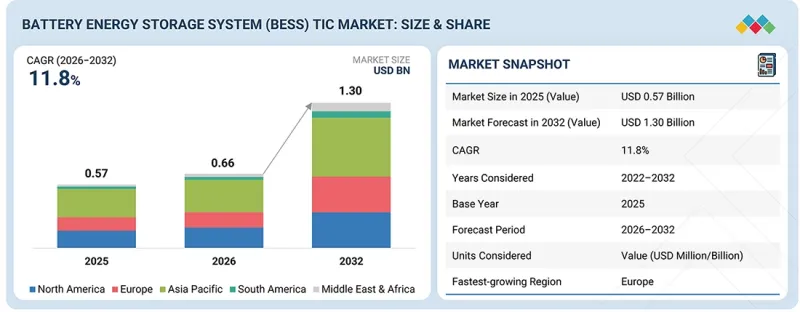
세계의 배터리 에너지 저장 시스템(BESS) 시험, 검사, 인증(TIC) 시장 규모는 2026년에 6억 6,000만 달러로 추정되며, 2032년까지 13억 달러에 달할 것으로 예측됩니다.
2026년부터 2032년까지의 기간 동안 연평균 성장률(CAGR)은 11.8%에 달할 것으로 전망됩니다.
| 조사 범위 | |
|---|---|
| 조사 대상 기간 | 2021-2032년 |
| 기준 연도 | 2025년 |
| 예측 기간 | 2026-2032년 |
| 대상 단위 | 금액(10억 달러) |
| 부문 | 서비스 유형별, 배터리 유형별, 제공 방식별, 조달 유형별, 최종사용자별, 지역별 |
| 대상 지역 | 북미, 유럽, 아시아태평양, 기타 지역 |
이러한 성장은 유틸리티급 프로젝트 및 재생에너지·에너지 저장 프로젝트의 확대, 배터리 안전성, 열 폭주 방지, 화재 위험 평가, 전력망 규정 준수, 그리고 시운전 검증에 대한 요건의 강화에 힘입어 이루어지고 있습니다. 또한, 독립적인 인증, 공장 및 현장에서의 인수 시험, 기술 실사, 수명 주기 보증에 대한 수요도 증가하고 있습니다. 그러나 표준화된 BESS 플랫폼의 부재, OEM의 내부 시험 역량 부족, 그리고 국가별로 제각각인 안전 및 전력망 요건 등이 여전히 시장 성장의 걸림돌로 작용하고 있습니다.
"나트륨 이온 배터리는 상용화 진전과 검증 수요의 변화에 힘입어 BESS TIC 시장에서 가장 빠르게 성장하는 배터리 유형이 될 것으로 전망됩니다."
제조사와 프로젝트 개발자들이 고정형 에너지 저장 용도를 위한 리튬이온 시스템의 대안을 모색하는 가운데, 나트륨이온 배터리는 BESS TIC 시장에서 가장 높은 성장률을 기록할 것으로 예상됩니다. 이 분야는 여전히 상용화 초기 단계에 있지만, 제품 개발이 활발해지고 시범 운영 단계에서 상용화 단계로의 전환이 진행됨에 따라, 배터리의 안전성, 전기적 성능, 환경, 열 및 수명 주기와 관련된 검증 서비스에 대한 수요가 증가하고 있습니다. 또한, 나트륨 이온 시스템의 경우, 셀의 화학 조성, 배터리 관리 시스템, 랙 구성 및 작동 매개변수가 발전함에 따라 별도의 시험 및 인증이 필요합니다. 이로 인해 배터리 시험, 인증 및 시스템 통합 분야에서 전문 역량을 갖춘 TIC 제공업체들에게 큰 성장 기회가 열리고 있습니다.
"전력회사는 그리드 규모의 에너지 저장 시스템 도입 및 장기적인 자산 운용에서의 역할을 바탕으로, BESS TIC 시장에서 가장 큰 점유율을 차지하고 있습니다."
전력회사는 재생에너지 통합, 계통 균형 조정, 피크 부하 관리 및 신뢰성 확보를 목적으로 대규모 계통연계형 BESS 프로젝트를 조달, 소유, 운영 또는 위탁하고 있으므로, 가장 큰 최종사용자 그룹을 형성하고 있습니다. 이러한 프로젝트에서는 공급업체 적격성 평가, 공장 입고 검사, 현장 입고 검사, 시운전, 화재 안전 평가, 계통 규정 검증 및 정기적인 운영 검증을 아우르는 보증이 요구됩니다. 또한, 전력 회사는 계통 운영 사업자, 규제 당국, 금융 기관, 보험사 및 지역 인가 당국으로부터 엄격한 감시를 받고 있으며, 자산의 전체 수명 주기에 걸쳐 독립적인 문서화 및 제3자에 의한 기술적 보증의 필요성이 높아지고 있습니다.
"인도는 재생에너지 도입 확대와 유틸리티 규모의 에너지 저장 활동 활성화에 힘입어, 아시아태평양에서 가장 빠르게 성장하는 BESS TIC 시장이 될 것으로 전망됩니다."
재생에너지의 확대, 전력계통 유연성에 대한 요구 사항, 그리고 에너지 저장장치 조달로 인해 배터리 저장 프로젝트에 대한 수요가 가속화되고 있어, 인도는 아시아태평양의 BESS TIC 시장에서 가장 높은 성장률을 기록할 것으로 예상됩니다. 이 발전 중인 시장에서는 시스템 안전성 시험, 화재 위험 평가, 계통연계 조사, 시운전 검증, 그리고 새로운 BESS 구성에 대한 인증에 대한 추가적인 지원이 요구되고 있습니다. 전력 회사, 개발사, EPC 시공사, 시스템 통합업체가 에너지 저장 시스템 도입을 확대함에 따라, 독립적인 시험, 검사, 인증 및 기술 실사 서비스에 대한 수요가 급속히 증가할 것으로 예상됩니다.
배터리 에너지 저장 시스템(BESS)의 시험, 검사, 인증(TIC) 시장에는 UL Solutions(미국), Intertek Group plc(영국), TUV Rheinland(독일), TUV SUD(독일), DNV(노르웨이), CSA Group(캐나다), Bureau Veritas(프랑스), SGS SA(스위스), DEKRA(독일), VDE Testing and Certification Institute(독일), CESI S.p.A./KEMA Labs(이탈리아), Element Materials Technology(영국), Applus+ Laboratories(스페인), Eurofins Scientific(룩셈부르크), Kiwa(네덜란드) 등 세계적으로 입지를 다진 업체들이 포함되어 있습니다. 본 조사에서는 이러한 기업들을 대상으로 BESS 안전성 시험, 열폭주 및 화재 위험 평가, 제품·시스템 인증, 계통 적합성 검증, 공장 및 현장 검사, FAT/SAT, 시운전 지원, 기술 실사, 수명 주기 보증 능력 등을 포괄하는 상세한 경쟁사 평가를 제공합니다.
조사 범위
본 보고서에서는 BESS의 TIC 시장을 서비스 유형, 조달 방식, 배터리 유형, 제공 방식, 최종사용자 및 지역별로 분류하고 있습니다. 또한, 배터리 및 시스템 인증부터 공장 입고 검사, 현장 시운전, 계통연계, 운용 검증에 이르기까지 BESS의 전체 수명 주기에 걸친 시험, 검사, 인증 및 기타 서비스를 포괄하고 있습니다. 본 보고서에서는 북미, 유럽, 아시아태평양, 남미, 중동 및 아프리카에 걸친 상세한 분석과 더불어, 주요 BESS 시장에 대한 국가별 평가를 제공합니다. 또한, 시장의 촉진요인, 억제요인, 기회, 과제, BESS의 안전성 및 화재 관련 규제, 계통연계 규격 및 인증 요건, 조달 관행, 밸류체인 동향, 경쟁 전략, 그리고 전 세계 BESS TIC 생태계의 최근 동향에 대해서도 분석하고 있습니다.
본 보고서를 구매할 때의 주요 이점
- 주요 촉진요인 분석(유틸리티 규모 및 재생에너지+에너지 저장 시스템의 도입 확대에 따라 배터리 안전 시험, 열 폭주 평가, 화재 위험 평가, 그리드 코드 준수, FAT/SAT에 대한 수요가 증가하고 있음; 규제 당국, 전력 회사, 금융 기관, 보험사, 승인 기관의 감시 강화가 독립적인 기술적 보증을 촉진하고 있음; 셀, 모듈, 랙, PCS, BMS, EMS, 소화 시스템 및 계통 인터페이스에 걸친 BESS 시스템의 복잡화), 제약요인(표준화된 컨테이너형 BESS 플랫폼 및 사전 인증된 구성요소별 반복 시험 요건의 감소; 주요 OEM, EPC, 전력회사의 사내 품질 관리 및 시운전 역량; 국가별 방화 기준, 계통 규격, 인증 절차의 차이로 인한 납품의 복잡화), 기회(시스템 및 계통 적합성 인증, 대규모 화재 시험, 배터리 추적성, 연결형 BMS 및 EMS 플랫폼의 사이버 보안 평가, 기술 실사, 수명 주기 전반에 걸친 안전성 및 성능 보증을 통한 고부가가치 서비스 창출; 통합된 시험·검사·인증·시운전 패키지를 통해 교차 판매 및 다년 계약이 가능해집니다; 원격 검사, 디지털 문서화 및 예측형 자산 보증 도구를 통해 처리 시간과 확장성이 향상됩니다; 전문 연구소, 파트너십 및 현지 규정 준수 대응 역량을 통한 신흥 BESS 시장 진출), 그리고 과제(안전 및 계통 요건의 불일치로 인한 재시험, 문서화 및 서비스 제공 비용 증가; 여러 거점에 걸친 BESS 프로젝트 및 원격 보증 워크플로우 전반에 걸친 일관된 기술적 품질과 데이터 일관성 유지)가 BESS TIC 시장의 성장에 영향을 미치고 있습니다.
- 솔루션/서비스 개발/혁신 : 열 폭주 시험, 대규모 화재 평가, 배터리 및 시스템 인증, 계통 성능 검증, 배터리 패스포트 및 추적성 지원, 사이버 보안 보증, 원격 검사, 수명 주기 성능 검증 등, 신흥 BESS TIC 서비스에 대한 상세한 인사이트.
- 시장 개발 : 북미, 유럽, 아시아태평양, 남미, 중동 및 아프리카의 고성장 BESS TIC 시장에 대한 종합적인 정보. 여기에는 프로젝트 전개, 규제 동향, 제3자 보증 수요 및 국가별 비즈니스 기회가 포함됩니다.
- 시장의 다양화 : BESS TIC 생태계 전반에 걸친 배터리 화학 조성, 제공 모델, 최종사용자, 아웃소싱 기회, 신흥 서비스 라인 및 전략적 파트너십에 관한 광범위한 정보.
- 경쟁사 평가 : UL Solutions, Intertek, TUV Rheinland, TUV SUD, DNV, CSA Group, Bureau Veritas, SGS, DEKRA, VDE 등 주요 공급업체에 대해 서비스 역량, 시장 전략, 파트너십, 실험실 인프라 및 BESS에 특화된 서비스 제공 내용에 대한 상세한 평가를 실시합니다.
자주 묻는 질문
목차
제1장 소개
제2장 주요 요약
제3장 주요 인사이트
제4장 시장 개요
제5장 업계 동향
제6장 기술 진보, 특허, 혁신, 그리고 향후 응용
제7장 규제 상황
제8장 고객 상황과 구매 행동
제9장 배터리 에너지 저장 시스템(BESS) TIC 시장(서비스 유형별)
제10장 배터리 에너지 저장 시스템(BESS) TIC 시장(배터리 유형별)
제11장 배터리 에너지 저장 시스템(BESS) TIC 시장(제공 방식별)
제12장 배터리 에너지 저장 시스템(BESS) TIC 시장(조달 유형별)
제13장 배터리 에너지 저장 시스템(BESS) TIC 시장(최종사용자별)
제14장 배터리 에너지 저장 시스템(BESS) TIC 시장(지역별)
제15장 경쟁 구도
제16장 기업 개요
제17장 조사 방법
제18장 부록
KSM 26.07.20The global Battery Energy Storage System (BESS) Testing, Inspection, and Certification (TIC) market is estimated at USD 0.66 billion in 2026 and is projected to reach USD 1.30 billion by 2032, registering a CAGR of 11.8% during 2026-2032.
| Scope of the Report | |
|---|---|
| Years Considered for the Study | 2021-2032 |
| Base Year | 2025 |
| Forecast Period | 2026-2032 |
| Units Considered | Value (USD Billion) |
| Segments | By Source Type, Application and Region |
| Regions covered | North America, Europe, APAC, RoW |
Growth is supported by expanding utility-scale and renewable-plus-storage projects, stricter requirements for battery safety, thermal-runaway prevention, fire-risk assessment, grid-code compliance, and commissioning validation. Demand is also rising for independent certification, factory and site acceptance testing, technical due diligence, and lifecycle assurance. However, standardized BESS platforms, internal OEM testing capabilities, and fragmented country-level safety and grid requirements remain key market restraints.
"Sodium-ion batteries are projected to be the fastest-growing battery type in the BESS TIC market, supported by emerging commercial deployment and evolving validation needs."
Sodium-ion batteries are expected to register the highest growth in the BESS TIC market as manufacturers and project developers explore alternatives to lithium-ion systems for stationary storage applications. Although the segment remains at an early stage of commercial adoption, increasing product development and pilot-to-commercial deployment are generating demand for battery safety, electrical performance, environmental, thermal, and lifecycle validation services. Sodium-ion systems also require independent testing and certification as cell chemistries, battery-management systems, rack configurations, and operating parameters evolve. This creates a high-growth opportunity for TIC providers with specialist capabilities in battery testing, certification, and system integration.
"Utilities account for the largest share of the BESS TIC market, driven by their role in grid-scale storage deployment and long-term asset operation."
Utilities are the largest end-user group, as they procure, own, operate, or contract for large grid-connected BESS projects for renewable integration, grid balancing, peak management, and reliability support. Their projects require assurance across supplier qualification, factory acceptance, site acceptance, commissioning, fire safety assessment, grid code validation, and periodic operational verification. Utilities also face high scrutiny from grid operators, regulators, lenders, insurers, and local approval authorities, increasing the need for independent documentation and third-party technical assurance throughout the asset lifecycle.
"India is projected to be the fastest-growing BESS TIC market within Asia Pacific, supported by expanding renewable integration and utility-scale storage activity."
India is expected to record the highest growth in the Asia Pacific BESS TIC market as renewable energy expansion, grid-flexibility requirements, and energy storage procurement accelerate demand for battery storage projects. The developing market requires greater support for system safety testing, fire risk assessment, grid integration studies, commissioning validation, and certification of new BESS configurations. As utilities, developers, EPC contractors, and system integrators scale storage deployment, demand for independent testing, inspection, certification, and technical due diligence services is expected to increase rapidly.
Breakdown of primaries
A variety of executives from key organizations operating in the testing, inspection, and certification (TIC) market were interviewed in-depth, including CEOs, marketing directors, and innovation and technology directors.
- By Company Type: Tier 1 -30%, Tier 2 - 50%, and Tier 3 - 20%
- By Designation: C-level Executives - 25%, Directors - 30%, and Others - 40%
- By Region: North America - 35%, Europe - 30%, Asia Pacific - 25%, and RoW - 10%
The Battery Energy Storage System (BESS) Testing, Inspection, and Certification (TIC) market includes globally established providers such as UL Solutions (US), Intertek Group plc (UK), TUV Rheinland (Germany), TUV SUD (Germany), DNV (Norway), CSA Group (Canada), Bureau Veritas (France), SGS SA (Switzerland), DEKRA (Germany), VDE Testing and Certification Institute (Germany), CESI S.p.A./KEMA Labs (Italy), Element Materials Technology (UK), Applus+ Laboratories (Spain), Eurofins Scientific (Luxembourg), and Kiwa (Netherlands). The study provides an in-depth competitive assessment of these companies, covering BESS safety testing, thermal-runaway and fire-risk assessment, product and system certification, grid-compliance validation, factory and site inspection, FAT/SAT, commissioning support, technical due diligence, and lifecycle assurance capabilities.
Study Coverage
The report segments the BESS TIC market by service type, sourcing type, battery type, delivery mode, end user, and region. It covers Testing, Inspection, Certification, and Other Services across the BESS lifecycle, from battery and system qualification through factory acceptance, site commissioning, grid connection, and operational verification. The report provides detailed analysis across North America, Europe, Asia Pacific, South America, and the Middle East & Africa, along with country-level assessment for key BESS markets. It also examines market drivers, restraints, opportunities, and challenges; BESS safety and fire regulations; grid-code and certification requirements; sourcing practices; value-chain dynamics; competitive strategies; and recent developments across the global BESS TIC ecosystem.
Key Benefits of Buying the Report
- Analysis of key drivers (utility-scale and renewable-plus-storage deployment increasing demand for battery safety testing, thermal-runaway assessment, fire-risk evaluation, grid-code compliance, and FAT/SAT; increasing scrutiny from regulators, utilities, lenders, insurers, and approval authorities driving independent technical assurance; rising BESS system complexity across cells, modules, racks, PCS, BMS, EMS, fire-suppression systems, and grid interfaces), restraints (standardized containerized BESS platforms and pre-certified components reducing repeat testing requirements; in-house quality-control and commissioning capabilities among large OEMs, EPCs, and utilities; country-specific fire codes, grid standards, and certification pathways increasing delivery complexity), opportunities (system and grid-compliance certification, large-scale fire testing, battery traceability, cybersecurity assessment for connected BMS and EMS platforms, technical due diligence, lifecycle safety, and performance assurance creating high-value service pools; integrated testing-inspection-certification-commissioning packages enabling cross-sell and multi-year contracts; remote inspection, digital documentation, and predictive asset-assurance tools improving turnaround and scalability; expansion into emerging BESS markets through specialist laboratories, partnerships, and local compliance capabilities), and challenges (fragmented safety and grid requirements increasing re-testing, documentation, and cost-to-serve; maintaining consistent technical quality and data integrity across multi-site BESS projects and remote assurance workflows) influencing the growth of the BESS TIC market.
- Solution/Service Development/Innovation: Detailed insights on emerging BESS TIC services, including thermal-runaway testing, large-scale fire assessment, battery and system certification, grid-performance validation, battery passport and traceability support, cybersecurity assurance, remote inspection, and lifecycle performance verification.
- Market Development: Comprehensive information on high-growth BESS TIC markets across North America, Europe, Asia Pacific, South America, and the Middle East & Africa, covering project deployment, regulatory developments, third-party assurance demand, and country-level opportunities.
- Market Diversification: Extensive information on battery chemistries, delivery models, end users, outsourcing opportunities, emerging service lines, and strategic partnerships across the BESS TIC ecosystem.
- Competitive Assessment: In-depth assessment of service capabilities, market strategies, partnerships, laboratory infrastructure, and BESS-specific offerings of leading providers such as UL Solutions, Intertek, TUV Rheinland, TUV SUD, DNV, CSA Group, Bureau Veritas, SGS, DEKRA, and VDE.
TABLE OF CONTENTS
1 INTRODUCTION
- 1.1 STUDY OBJECTIVES
- 1.2 MARKET DEFINITION
- 1.3 STUDY SCOPE
- 1.3.1 MARKETS COVERED AND REGIONAL SCOPE
- 1.3.2 INCLUSIONS AND EXCLUSIONS
- 1.3.3 YEARS CONSIDERED
- 1.4 CURRENCY CONSIDERED
- 1.5 LIMITATIONS
- 1.6 STAKEHOLDERS
2 EXECUTIVE SUMMARY
- 2.1 MARKET HIGHLIGHTS AND KEY INSIGHTS
- 2.2 KEY MARKET PARTICIPANTS: MAPPING OF STRATEGIC DEVELOPMENTS
- 2.3 DISRUPTIVE TRENDS IN BATTERY ENERGY STORAGE SYSTEM (BESS) TIC MARKET
- 2.4 HIGH-GROWTH SEGMENTS & EMERGING FRONTIERS
- 2.5 REGIONAL SNAPSHOT: MARKET SIZE, GROWTH RATE, AND FORECAST
3 PREMIUM INSIGHTS
- 3.1 ATTRACTIVE OPPORTUNITIES FOR PLAYERS IN BATTERY ENERGY STORAGE SYSTEM (BESS) TIC MARKET
- 3.2 BATTERY ENERGY STORAGE SYSTEM (BESS) TIC MARKET, BY DELIVERY MODE
- 3.3 BATTERY ENERGY STORAGE SYSTEM (BESS) TIC MARKET, BY TESTING TYPE
- 3.4 BATTERY ENERGY STORAGE SYSTEM (BESS) TIC MARKET, BY REGION
4 MARKET OVERVIEW
- 4.1 INTRODUCTION
- 4.2 MARKET DYNAMICS
- 4.2.1 DRIVERS
- 4.2.1.1 Accelerating BESS Deployment and Larger Project Configurations Will Expand Project-phase TIC Demand
- 4.2.1.2 Renewable-energy Integration and Grid-flexibility Needs Will Increase Demand for System-level Performance Validation
- 4.2.1.3 Safety Risks Related to Thermal Runaway, Fire Propagation, and System Failure Will Strengthen Independent Assurance Requirements
- 4.2.1.4 Battery Regulation, Sustainability Disclosure, and Traceability Requirements Will Broaden TIC Scope Beyond Conventional Safety Testing
- 4.2.2 RESTRAINTS
- 4.2.2.1 High assurance cost and qualification lead times may limit discretionary third-party TIC spend
- 4.2.2.2 Growing In-house validation capability among major battery oems and integrators may reduce outsourced routine testing
- 4.2.3 OPPORTUNITIES
- 4.2.3.1 Post-commissioning performance verification and lifecycle assurance will create recurring tic revenue streams
- 4.2.3.2 Second-life battery qualification will create specialized testing, inspection, and traceability opportunity
- 4.2.3.3 Lender, insurer, and investor due diligence will increase demand for independent BESS risk assurance
- 4.2.4 CHALLENGES
- 4.2.4.1 Fragmented permitting, safety, and grid-connection requirements will limit standardized multi-country TIC delivery
- 4.2.4.2 Rapid technology evolution and system-level integration will increase capability, investment, and talent requirements for TIC providers
- 4.2.1 DRIVERS
- 4.3 UNMET NEEDS AND WHITE SPACES
- 4.3.1 UNMET NEEDS IN THE BESS TIC MARKET
- 4.3.2 WHITE SPACE OPPORTUNITIES
- 4.4 INTERCONNECTED MARKETS AND CROSS-SECTOR OPPORTUNITIES
- 4.4.1 INTERCONNECTED MARKETS
- 4.4.2 CROSS-SECTOR OPPORTUNITIES
- 4.5 STRATEGIC MOVES BY TIER 1/2/3 PLAYERS
- 4.5.1 TIER 1 PLAYERS: END-TO-END BESS ASSURANCE PLATFORMS, GLOBAL EXPANSION, AND DIGITAL INTEGRATION
- 4.5.2 TIER 2 PLAYERS: TECHNICAL SPECIALIZATION, FASTER CUSTOMIZATION, AND REGIONAL EXPANSION
- 4.5.3 TIER 3 PLAYERS: LOCAL COMPLIANCE, NICHE FIELD SERVICES, AND SERVICE-LED DIFFERENTIATION
5 INDUSTRY TRENDS
- 5.1 PORTER'S FIVE FORCES ANALYSIS
- 5.1.1 INTENSITY OF COMPETITIVE RIVALRY
- 5.1.2 BARGAINING POWER OF BUYERS
- 5.1.3 BARGAINING POWER OF SUPPLIERS
- 5.1.4 THREAT OF NEW ENTRANTS
- 5.1.5 THREAT OF SUBSTITUTES
- 5.2 MACROECONOMIC OUTLOOK
- 5.2.1 INTRODUCTION
- 5.2.2 GDP TRENDS AND FORECAST
- 5.2.3 TRENDS IN RENEWABLE ENERGY AND GRID-FLEXIBILITY INDUSTRY
- 5.2.4 TRENDS IN BATTERY MANUFACTURING AND ELECTRIC MOBILITY INDUSTRY
- 5.3 SUPPLY CHAIN ANALYSIS
- 5.4 ECOSYSTEM ANALYSIS
- 5.5 KEY CONFERENCES AND EVENTS, 2026-2027
- 5.6 TRENDS/DISRUPTIONS IMPACTING CUSTOMER BUSINESS
- 5.7 CASE STUDY ANALYSIS
- 5.7.1 KIWA PI BERLIN PROVIDED MULTI-COUNTRY QUALITY ASSURANCE FOR SONNEDIX'S 2.7 GWH BESS PORTFOLIO
- 5.7.2 INTERTEK SUPPORTED RISEN ENERGY'S EFLEX BESS MARKET-ACCESS CERTIFICATION
- 5.7.3 TUV SUD CERTIFIED EAST GROUP'S COMMERCIAL AND INDUSTRIAL BESS
- 5.7.4 UL SOLUTIONS CERTIFIED ABB'S HIPERGUARD FOR DATA-CENTER ENERGY STORAGE APPLICATIONS
- 5.7.5 DNV CONDUCTED TECHNICAL DUE DILIGENCE FOR A 1.6 GWH GERMAN BESS PORTFOLIO TRANSACTION
- 5.8 IMPACT OF US TARIFFS - BESS TIC MARKET
- 5.8.1 INTRODUCTION
- 5.8.2 KEY TARIFF RATES
- 5.8.3 PRICE IMPACT ANALYSIS
- 5.8.4 IMPACT ON COUNTRIES/REGIONS
- 5.8.4.1 US
- 5.8.4.2 Europe
- 5.8.4.3 Asia Pacific
- 5.8.5 IMPACT ON BESS END-USE INDUSTRIES
6 TECHNOLOGICAL ADVANCEMENTS, PATENTS, INNOVATIONS, AND FUTURE APPLICATIONS
- 6.1 KEY EMERGING TECHNOLOGIES
- 6.1.1 ADVANCED BATTERY SAFETY AND THERMAL-RUNAWAY TESTING
- 6.1.2 GRID-INTEGRATION AND POWER-PERFORMANCE VALIDATION TECHNOLOGIES
- 6.1.3 DIGITAL MONITORING, PREDICTIVE ANALYTICS, AND BATTERY TRACEABILITY PLATFORMS
- 6.2 COMPLEMENTARY TECHNOLOGIES
- 6.2.1 AI-ENABLED BATTERY ANALYTICS
- 6.2.2 DIGITAL TWIN AND SIMULATION PLATFORMS
- 6.3 ADJACENT TECHNOLOGIES
- 6.3.1 FIRE DETECTION, SUPPRESSION, AND GAS MONITORING SYSTEMS
- 6.3.2 BATTERY RECYCLING AND SECOND-LIFE QUALIFICATION TECHNOLOGIES
- 6.4 TECHNOLOGY/PRODUCT ROADMAP
- 6.5 PATENT ANALYSIS
- 6.6 FUTURE APPLICATIONS
- 6.7 IMPACT OF AI/GEN AI ON BESS TIC MARKET
- 6.7.1 TOP USE CASES AND MARKET POTENTIAL
- 6.7.2 BEST PRACTICES FOLLOWED BY BESS TIC PROVIDERS AND MARKET PARTICIPANTS
- 6.7.3 CASE STUDIES RELATED TO AI IMPLEMENTATION IN BESS TIC MARKET
- 6.7.4 INTERCONNECTED ECOSYSTEM AND IMPACT ON MARKET PLAYERS
- 6.7.5 CLIENTS' READINESS TO ADOPT AI-INTEGRATED BESS TIC SOLUTIONS
7 REGULATORY LANDSCAPE
- 7.1 REGIONAL REGULATIONS AND COMPLIANCE
- 7.1.1 REGULATORY BODIES, GOVERNMENT AGENCIES, AND OTHER ORGANIZATIONS
- 7.1.2 INDUSTRY STANDARDS
8 CUSTOMER LANDSCAPE & BUYER BEHAVIOR
- 8.1 DECISION-MAKING PROCESS
- 8.2 KEY STAKEHOLDERS IN BUYING PROCESS AND THEIR EVALUATION CRITERIA
- 8.2.1 KEY STAKEHOLDERS IN BUYING PROCESS
- 8.2.2 BUYING CRITERIA
- 8.3 ADOPTION BARRIERS & INTERNAL CHALLENGES
- 8.4 UNMET NEEDS FROM VARIOUS END-USE INDUSTRIES
- 8.5 MARKET PROFITABILITY
9 BATTERY ENERGY STORAGE SYSTEM (BESS) TIC MARKET, BY SERVICE TYPE
- 9.1 INTRODUCTION
- 9.2 TESTING SERVICES
- 9.2.1 EXPANDING UTILITY-SCALE DEPLOYMENT, THERMAL-RUNAWAY SAFETY SCRUTINY, AND GRID-INTEGRATION REQUIREMENTS CONSOLIDATE TESTING AS CORE BESS TIC SERVICE
- 9.2.2 SAFETY TESTING
- 9.2.2.1 Thermal-runaway propagation, fire-hazard mitigation, and multi-level system validation increase safety-testing intensity
- 9.2.3 PERFORMANCE TESTING
- 9.2.3.1 Application-specific duty cycles, degradation verification, and performance-guarantee assurance drive BESS performance-testing demand
- 9.2.4 ENVIRONMENTAL TESTING
- 9.2.4.1 Climate resilience, thermal-management reliability, and outdoor enclosure durability increase environmental-testing requirements for bess
- 9.2.5 ELECTRICAL TESTING
- 9.2.5.1 High-voltage BESS architectures, inverter-based grid interfaces, and protection-coordination requirements elevate electrical-testing demand
- 9.2.6 EMC TESTING
- 9.2.6.1 Power-electronics density, high-frequency switching, and digital control interoperability increase emc-testing requirements across BESS deployments
- 9.2.7 ACCEPTANCE & COMMISSIONING TESTING
- 9.2.7.1 Site-level functional verification, multi-vendor integration, and commercial-operation readiness make acceptance & commissioning testing critical BESS deployment requirement
- 9.2.8 OTHER TESTING SERVICES
- 9.2.8.1 Transport compliance, mechanical robustness, software assurance, and failure-analysis requirements create specialist BESS testing opportunities
- 9.3 INSPECTION SERVICES
- 9.3.1 MULTI-VENDOR PROJECT EXECUTION, SITE-QUALITY ASSURANCE, AND LIFECYCLE SAFETY OVERSIGHT EXPAND ROLE OF INSPECTION SERVICES IN BESS DEPLOYMENT
- 9.3.2 FACTORY & MANUFACTURING INSPECTION
- 9.3.2.1 Multi-supplier quality governance, factory acceptance witnessing, and traceable production controls drive BESS manufacturing-inspection demand
- 9.3.3 INSTALLATION & COMMISSIONING INSPECTION
- 9.3.3.1 Site-configuration verification, multi-vendor interface control, and grid-readiness assessment expand installation-stage BESS inspection needs
- 9.3.4 OPERATIONAL & PERIODIC SAFETY INSPECTION
- 9.3.4.1 Preventive condition assessment, safety-system verification, and asset-life management create recurring BESS inspection demand
- 9.3.5 OTHER INSPECTION SERVICES
- 9.3.5.1 Post-modification review, field evaluation, damage assessment, and incident-led inspection create specialized BESS assurance opportunities
- 9.4 CERTIFICATION
- 9.4.1 MARKET-ACCESS REQUIREMENTS, SYSTEM-LEVEL SAFETY ASSURANCE, AND GRID-CONNECTION APPROVALS ACCELERATE CERTIFICATION DEMAND ACROSS BESS VALUE CHAIN
- 9.4.2 PRODUCT CERTIFICATION
- 9.4.2.1 Component-level conformity, supplier qualification, and cross-border market access make product certification foundational BESS requirement
- 9.4.3 SYSTEM CERTIFICATION
- 9.4.3.1 Integrated BESS architectures, multi-component interfaces, and configuration-level risk drive system-certification demand
- 9.4.4 GRID-COMPLIANCE CERTIFICATION
- 9.4.4.1 Inverter-based grid support, interconnection performance, and utility acceptance requirements expand grid-compliance certification needs
- 9.4.5 SAFETY CERTIFICATION
- 9.4.5.1 Thermal-runaway risk, fire-protection expectations, and authority-approval requirements accelerate BESS safety certification
- 9.4.6 ENVIRONMENTAL CERTIFICATION
- 9.4.6.1 Battery-lifecycle accountability, sustainability disclosures, and traceability requirements strengthen environmental-certification demand
- 9.4.7 OTHER CERTIFICATION SERVICES
- 9.4.7.1 Cybersecurity assurance, digital-control conformity, and management-system certification create specialized BESS certification opportunities
- 9.5 OTHER SERVICE TYPES
- 9.5.1 PROJECT BANKABILITY, OPERATIONAL READINESS, AND LIFECYCLE RISK GOVERNANCE CREATE ADVISORY-LED ASSURANCE DEMAND ACROSS BESS ECOSYSTEM
- 9.5.2 ADVISORY & TECHNICAL DUE DILIGENCE
- 9.5.2.1 Project bankability, technology-selection risk, and multi-party system integration increase demand for independent BESS technical due diligence
- 9.5.3 TRAINING & BUSINESS ASSURANCE
- 9.5.3.1 Operational competence, emergency-response readiness, and documented safety governance expand BESS training and business-assurance requirements
10 BATTERY ENERGY STORAGE SYSTEM (BESS) TIC MARKET, BY BATTERY TYPE
- 10.1 INTRODUCTION
- 10.2 LITHIUM-ION BATTERIES
- 10.2.1 LFP-LED DEPLOYMENT SCALE, THERMAL-RUNAWAY RISK, AND SYSTEM-INTEGRATION COMPLEXITY MAKE LITHIUM-ION BATTERIES PRIMARY BESS TIC DEMAND BASE
- 10.3 LEAD-ACID BATTERIES
- 10.3.1 ESTABLISHED BACKUP-POWER FLEETS, FLOAT-CHARGE RELIABILITY, AND MAINTENANCE-LED ASSURANCE SUSTAIN TIC DEMAND FOR LEAD-ACID BATTERIES
- 10.4 SODIUM-ION BATTERIES
- 10.4.1 EMERGING COMMERCIAL SCALE-UP, ALTERNATIVE-MATERIAL ADVANTAGES, AND FIRST-TIME QUALIFICATION NEEDS ACCELERATE SODIUM-ION BESS TIC DEMAND
- 10.5 FLOW BATTERIES
- 10.5.1 LONG-DURATION STORAGE REQUIREMENTS, LIQUID-ELECTROLYTE ARCHITECTURES, AND BALANCE-OF-PLANT COMPLEXITY DRIVE SPECIALIZED FLOW-BATTERY TIC DEMAND
- 10.6 OTHER BATTERY TYPES
- 10.6.1 EMERGING NON-LITHIUM CHEMISTRIES, LONG-DURATION STORAGE INNOVATION, AND EARLY-STAGE TECHNOLOGY QUALIFICATION CREATE SELECTIVE HIGH-INTENSITY TIC DEMAND
11 BATTERY ENERGY STORAGE SYSTEM (BESS) TIC MARKET, BY DELIVERY MODE
- 11.1 INTRODUCTION
- 11.2 ON-SITE DELIVERY
- 11.2.1 SITE-LEVEL INSTALLATION VERIFICATION, COMMISSIONING WITNESSING, AND PHYSICAL SAFETY ASSURANCE SUSTAIN ON-SITE BESS TIC DELIVERY
- 11.3 REMOTE DELIVERY
- 11.3.1 DIGITAL ASSET MONITORING, ALARM ANALYTICS, AND DOCUMENT-BASED ASSURANCE EXPAND REMOTE BESS TIC DELIVERY
- 11.4 HYBRID DELIVERY
- 11.4.1 COMBINING FIELD ASSURANCE WITH DIGITAL PERFORMANCE INTELLIGENCE ACCELERATES HYBRID BESS TIC DELIVERY
- 11.5 LABORATORY DELIVERY
- 11.5.1 CONTROLLED SAFETY, PERFORMANCE, ENVIRONMENTAL, AND GRID-SIMULATION TESTING MAKES LABORATORY DELIVERY FOUNDATION OF BESS TECHNICAL VALIDATION
12 BATTERY ENERGY STORAGE SYSTEM (BESS) TIC MARKET, BY SOURCING TYPE
- 12.1 INTRODUCTION
- 12.2 IN-HOUSE
- 12.2.1 PROPRIETARY BATTERY DESIGN, MANUFACTURING-QUALITY CONTROL, AND REAL-TIME ASSET OVERSIGHT SUSTAIN IN-HOUSE BESS TIC ACTIVITY
- 12.3 OUTSOURCED
- 12.3.1 ACCREDITED SAFETY INFRASTRUCTURE, INDEPENDENT CONFORMITY EVIDENCE, AND MULTI-LOCATION PROJECT EXECUTION CONSOLIDATE OUTSOURCED SERVICES AS LEADING BESS TIC SOURCING MODEL
13 BATTERY ENERGY STORAGE SYSTEM (BESS) TIC MARKET, BY END USER
- 13.1 INTRODUCTION
- 13.2 BESS MANUFACTURERS
- 13.2.1 PRODUCT-QUALIFICATION CYCLES, FACTORY QUALITY CONTROL, AND GLOBAL MARKET-ACCESS REQUIREMENTS SUSTAIN TIC DEMAND FROM BESS MANUFACTURERS
- 13.3 UTILITIES
- 13.3.1 GRID-RELIABILITY OBLIGATIONS, INTERCONNECTION ASSURANCE, AND LONG-TERM ASSET OVERSIGHT MAKE UTILITIES LEADING BESS TIC END-USER GROUP
- 13.4 EPC CONTRACTORS
- 13.4.1 MULTI-VENDOR INTEGRATION, CONSTRUCTION QUALITY RISK, AND COMMISSIONING ACCOUNTABILITY DRIVE EPC-LED BESS TIC PROCUREMENT
- 13.5 PROJECT DEVELOPERS
- 13.5.1 EXPANDING PROJECT PIPELINES, BANKABILITY REQUIREMENTS, AND PERMITTING RISK MAKE PROJECT DEVELOPERS FASTEST-GROWING BESS TIC END-USER GROUP
- 13.6 GOVERNMENTS
- 13.6.1 PUBLIC PROCUREMENT, RESILIENCE PROGRAMS, AND REGULATORY OVERSIGHT SUSTAIN GOVERNMENT-LED BESS TIC REQUIREMENTS
- 13.7 OTHERS
- 13.7.1 C&I ENERGY MANAGEMENT, DATA-CENTER RESILIENCE, TELECOM BACKUP, AND MICROGRID DEPLOYMENT BROADEN BESS TIC DEMAND BEYOND CORE MARKET PARTICIPANTS
14 BATTERY ENERGY STORAGE SYSTEM (BESS) TIC MARKET, BY REGION
- 14.1 INTRODUCTION
- 14.2 NORTH AMERICA
- 14.2.1 US
- 14.2.1.1 Utility-scale storage expansion, inverter-based grid services, and safety-critical project approvals drive us BESS tic market
- 14.2.2 CANADA
- 14.2.2.1 Clean-electricity investment, provincial storage procurement, and cold-climate asset requirements support Canada's BESS tic market
- 14.2.3 MEXICO
- 14.2.3.1 Formalized storage-integration rules, grid-connection requirements, and EPC-led project execution create developing BESS tic opportunity
- 14.2.1 US
- 14.3 EUROPE
- 14.3.1 GERMANY
- 14.3.1.1 Residential storage scale, utility-scale BESS acceleration, and distribution-grid constraints drive multi-layered tic demand
- 14.3.2 UK
- 14.3.2.1 Merchant BESS deployment, balancing-market participation, and fire-safety governance support a mature UK tic market
- 14.3.3 FRANCE
- 14.3.3.1 Grid-flexibility requirements, renewable-deployment expansion, and system-integration needs create growing BESS tic market
- 14.3.4 ITALY
- 14.3.4.1 Macse procurement, distributed storage penetration, and renewable-integration requirements expand Italy's BESS tic needs
- 14.3.5 SPAIN
- 14.3.5.1 Solar-led flexibility requirements, storage-policy support, and grid-resilience priorities accelerate spain's BESS tic market
- 14.3.6 POLAND
- 14.3.6.1 Coal-to-renewable transition, large-scale storage investment, and grid-modernization needs make Poland a high-growth BESS tic market
- 14.3.7 NETHERLANDS
- 14.3.7.1 Grid congestion, flexible-connection models, and renewable balancing requirements define dutch BESS tic market
- 14.3.8 SWEDEN
- 14.3.8.1 Ancillary-service prequalification, Nordic frequency support, and battery-value-chain development shape Sweden's BESS tic requirements
- 14.3.9 FINLAND
- 14.3.9.1 Wind-power volatility, grid-connection scrutiny, and stringent storage grid codes drive finland's BESS tic demand
- 14.3.10 CZECH REPUBLIC
- 14.3.10.1 Standalone BESS liberalisation, domestic battery-industry development, and flexibility-market integration accelerate tic demand
- 14.3.11 REST OF EUROPE
- 14.3.1 GERMANY
- 14.4 ASIA PACIFIC
- 14.4.1 CHINA
- 14.4.1.1 Dominant battery manufacturing, record utility-scale deployment, and export-oriented quality requirements make China the core APAC BESS tic market
- 14.4.2 JAPAN
- 14.4.2.1 Resilience-oriented storage deployment, renewable-integration requirements, and high-reliability system design support Japan's BESS tic demand
- 14.4.3 SOUTH KOREA
- 14.4.3.1 Battery-export capability, ess safety lessons, and flexibility-market development shape south Korea's BESS tic requirements
- 14.4.4 INDIA
- 14.4.4.1 Policy-led storage procurement, renewable-integration needs, and domestic battery-manufacturing ambitions make India fastest-growing APAC BESS tic market
- 14.4.5 AUSTRALIA
- 14.4.5.1 Utility-scale renewable integration, high residential battery adoption, and Nem reform drive Australia's multi-segment BESS tic market
- 14.4.6 REST OF ASIA PACIFIC
- 14.4.1 CHINA
- 14.5 SOUTH AMERICA
- 14.5.1 BRAZIL
- 14.5.1.1 Renewable curtailment, distributed-solar expansion, and emerging storage-market structures drive BESS tic demand in Brazil
- 14.5.2 CHILE
- 14.5.2.1 Solar-curtailment management, large standalone BESS deployment, and northern grid constraints make Chile leading south American BESS tic market
- 14.5.3 ARGENTINA
- 14.5.3.1 Amba reliability procurement, four-hour storage requirements, and transmission-constraint management accelerate Argentina's BESS tic market
- 14.5.4 COLOMBIA
- 14.5.4.1 Grid-reliability requirements, renewable diversification, and evolving BESS regulation support developing tic market in Colombia
- 14.5.5 REST OF SOUTH AMERICA
- 14.5.1 BRAZIL
- 14.6 MIDDLE EAST & AFRICA
- 14.6.1 GCC COUNTRIES
- 14.6.1.1 Giga-scale solar-plus-storage procurement, 24/7 clean-power targets, and extreme-climate operating conditions accelerate BESS tic demand across Gac
- 14.6.2 SOUTH AFRICA
- 14.6.2.1 Grid-stability requirements, Eskom-led BESS procurement, and renewable-integration needs support south Africa's operational-assurance-led tic market
- 14.6.3 REST OF MIDDLE EAST & AFRICA
- 14.6.1 GCC COUNTRIES
15 COMPETITIVE LANDSCAPE
- 15.1 OVERVIEW
- 15.2 KEY PLAYER STRATEGIES/RIGHT TO WIN, 2021-2026
- 15.3 REVENUE ANALYSIS, 2021-2025
- 15.4 MARKET SHARE ANALYSIS, 2025
- 15.5 COMPANY VALUATION AND FINANCIAL METRICS
- 15.6 PRODUCT COMPARISON
- 15.7 COMPANY EVALUATION MATRIX: KEY PLAYERS, 2025
- 15.7.1 STARS
- 15.7.2 PERVASIVE PLAYERS
- 15.7.3 EMERGING LEADERS
- 15.7.4 PARTICIPANTS
- 15.7.5 COMPANY FOOTPRINT: KEY PLAYERS, 2025
- 15.7.5.1 Company footprint
- 15.7.5.2 Regional footprint
- 15.7.5.3 Sourcing type footprint
- 15.7.5.4 Service type footprint
- 15.7.5.5 End User footprint
- 15.8 COMPANY EVALUATION MATRIX: STARTUPS/SMES, 2025
- 15.8.1 PROGRESSIVE COMPANIES
- 15.8.2 RESPONSIVE COMPANIES
- 15.8.3 DYNAMIC COMPANIES
- 15.8.4 STARTING BLOCKS
- 15.8.5 COMPETITIVE BENCHMARKING: STARTUPS/SMES, 2025
- 15.8.5.1 Detailed list of key startups/SMEs
- 15.8.5.2 Competitive benchmarking of key startups/SMEs
- 15.9 COMPETITIVE SCENARIO
- 15.9.1 PRODUCT/SOLUTION/SERVICE LAUNCHES
- 15.9.2 DEALS
- 15.9.3 EXPANSIONS
- 15.9.4 OTHER DEVELOPMENTS
16 COMPANY PROFILES
- 16.1 KEY PLAYERS
- 16.1.1 UL SOLUTIONS
- 16.1.1.1 Business overview
- 16.1.1.2 Products/Solutions/Services offered
- 16.1.1.3 Recent developments
- 16.1.1.3.1 Product/Solution/Service launches
- 16.1.1.3.2 Deals
- 16.1.1.3.3 Expansions
- 16.1.1.4 MnM view
- 16.1.1.4.1 Key strengths
- 16.1.1.4.2 Strategic choices
- 16.1.1.4.3 Weaknesses/Competitive threats
- 16.1.2 INTERTEK GROUP PLC
- 16.1.2.1 Business overview
- 16.1.2.2 Products/Solutions/Services offered
- 16.1.2.3 Recent developments
- 16.1.2.3.1 Product/Solution/Service launches
- 16.1.2.3.2 Deals
- 16.1.2.3.3 Expansions
- 16.1.2.4 MnM view
- 16.1.2.4.1 Key strengths
- 16.1.2.4.2 Strategic choices
- 16.1.2.4.3 Weaknesses/Competitive threats
- 16.1.3 TUV RHEINLAND
- 16.1.3.1 Business overview
- 16.1.3.2 Products/Solutions/Services offered
- 16.1.3.3 Recent developments
- 16.1.3.3.1 Product/Solution/Service launches
- 16.1.3.3.2 Deals
- 16.1.3.3.3 Expansions
- 16.1.3.4 MnM view
- 16.1.3.4.1 Key strengths
- 16.1.3.4.2 Strategic choices
- 16.1.3.4.3 Weaknesses/Competitive threats
- 16.1.4 TUV SUD
- 16.1.4.1 Business overview
- 16.1.4.2 Products/Solutions/Services offered
- 16.1.4.3 Recent developments
- 16.1.4.3.1 Product/Solution/Service launches
- 16.1.4.3.2 Deals
- 16.1.4.3.3 Expansions
- 16.1.4.3.4 Other developments
- 16.1.4.4 MnM view
- 16.1.4.4.1 Key strengths
- 16.1.4.4.2 Strategic choices
- 16.1.4.4.3 Weaknesses/Competitive threats
- 16.1.5 DNV
- 16.1.5.1 Business overview
- 16.1.5.2 Products/Solutions/Services offered
- 16.1.5.3 Recent developments
- 16.1.5.3.1 Deals
- 16.1.5.3.2 Expansions
- 16.1.5.3.3 Other developments
- 16.1.5.4 MnM view
- 16.1.5.4.1 Key strengths
- 16.1.5.4.2 Strategic choices
- 16.1.5.4.3 Weaknesses/Competitive threats
- 16.1.6 SGS SA
- 16.1.6.1 Business overview
- 16.1.6.2 Products/Solutions/Services offered
- 16.1.6.3 Recent developments
- 16.1.6.3.1 Product/Solution/Service launches
- 16.1.6.3.2 Deals
- 16.1.6.3.3 Expansions
- 16.1.6.3.4 Other developments
- 16.1.7 BUREAU VERITAS
- 16.1.7.1 Business overview
- 16.1.7.2 Products/Solutions/Services offered
- 16.1.7.3 Recent developments
- 16.1.7.3.1 Product/Solution/Service launches
- 16.1.7.3.2 Deals
- 16.1.7.3.3 Expansions
- 16.1.7.3.4 Other developments
- 16.1.8 DEKRA
- 16.1.8.1 Business overview
- 16.1.8.2 Products/Solutions/Services offered
- 16.1.8.3 Recent developments
- 16.1.8.3.1 Product/Solution/Service launches
- 16.1.8.3.2 Deals
- 16.1.8.3.3 Expansions
- 16.1.8.3.4 Other developments
- 16.1.9 TUV NORD GROUP
- 16.1.9.1 Business overview
- 16.1.9.2 Products/Solutions/Services offered
- 16.1.9.3 Recent developments
- 16.1.9.3.1 Deals
- 16.1.9.3.2 Expansions
- 16.1.10 CSA GROUP
- 16.1.10.1 Business overview
- 16.1.10.2 Products/Solutions/Services offered
- 16.1.10.3 Recent developments
- 16.1.10.3.1 Expansions
- 16.1.10.3.2 Other developments
- 16.1.1 UL SOLUTIONS
- 16.2 OTHER PLAYERS
- 16.2.1 KIWA
- 16.2.2 CESI S.P.A. / KEMA LABS
- 16.2.3 RINA S.P.A.
- 16.2.4 VDE GROUP
- 16.2.5 ELEMENT MATERIALS TECHNOLOGY
- 16.2.6 APPLUS+ LABORATORIES
- 16.2.7 CHINA QUALITY CERTIFICATION CENTRE
- 16.2.8 CENTRE TESTING INTERNATIONAL GROUP
- 16.2.9 CHINA CERTIFICATION & INSPECTION GROUP
- 16.2.10 KOREA CONFORMITY LABORATORIES
- 16.2.11 KOREA TESTING CERTIFICATION
- 16.2.12 KOREA TESTING LABORATORY
- 16.2.13 CENTRAL POWER RESEARCH INSTITUTE
- 16.2.14 JAPAN QUALITY ASSURANCE ORGANIZATION
17 RESEARCH METHODOLOGY
- 17.1 RESEARCH DATA
- 17.1.1 SECONDARY DATA
- 17.1.1.1 Major secondary sources
- 17.1.1.2 Key data from secondary sources
- 17.1.2 PRIMARY DATA
- 17.1.2.1 List of primary interview participants
- 17.1.2.2 Key data from primary sources
- 17.1.2.3 Key industry insights
- 17.1.2.4 Breakdown of primaries
- 17.1.3 SECONDARY AND PRIMARY RESEARCH
- 17.1.1 SECONDARY DATA
- 17.2 MARKET SIZE ESTIMATION
- 17.2.1 BOTTOM-UP APPROACH
- 17.2.1.1 Approach to estimate market size using bottom-up analysis
- 17.2.2 TOP-DOWN APPROACH
- 17.2.2.1 Approach to estimate market size using top-down analysis
- 17.2.1 BOTTOM-UP APPROACH
- 17.3 DATA TRIANGULATION
- 17.4 RESEARCH ASSUMPTIONS
- 17.5 RESEARCH LIMITATIONS
- 17.6 RISK ANALYSIS
18 APPENDIX
- 18.1 INSIGHTS FROM INDUSTRY EXPERTS
- 18.2 DISCUSSION GUIDE
- 18.3 KNOWLEDGESTORE: MARKETSANDMARKETS' SUBSCRIPTION PORTAL
- 18.4 CUSTOMIZATION OPTIONS
- 18.5 RELATED REPORTS
- 18.6 AUTHOR DETAILS


