|
시장보고서
상품코드
2124438
중동 및 아프리카의 배터리 에너지 저장 시스템(BESS) 시장 : 점유율 분석, 업계 동향과 통계, 성장 예측(2026-2031년)Middle East And Africa Battery Energy Storage System (BESS) - Market Share Analysis, Industry Trends & Statistics, Growth Forecasts (2026 - 2031) |
||||||
 Mordor Intelligence
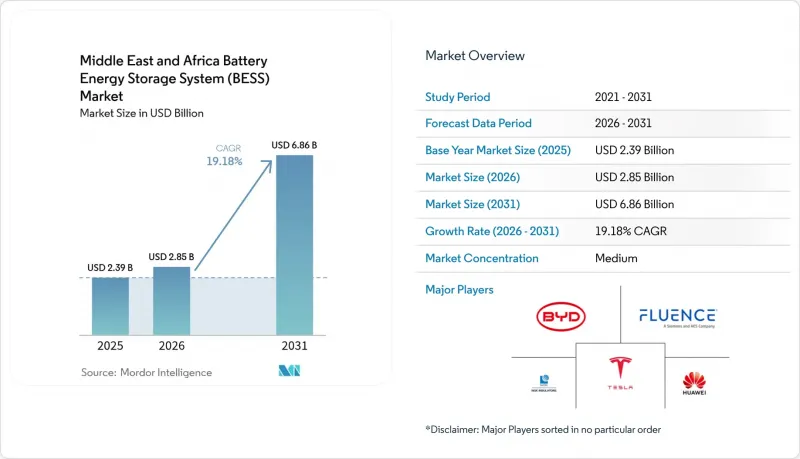
Mordor Intelligence에 의하면, 2026년 중동 및 아프리카 배터리 에너지 저장 시스템(BESS) 시장 규모는 28억 5,000만 달러로 추정되며, 2025년 23억 9,000만 달러에서 성장하여 2031년에는 68억 6,000만 달러에 이를 것으로 예측됩니다.
2026년부터 2031년까지의 연평균 성장률(CAGR)은 19.18%가 될 것으로 전망됩니다.
본 보고서는 배터리 유형(리튬이온, 플로우 배터리 등), 연결 유형(계통 연계형·독립형),구성 요소(배터리 팩·랙, 에너지 관리 소프트웨어 등), 에너지 용량 범위(10-100 MWh, 100-500 MWh 등), 최종 사용자용도(전력 회사 등), 지역(사우디아라비아, 아랍에미리트, 카타르 등)별로 분류되어 있습니다.
중동 및 아프리카 배터리 에너지 저장 시스템(BESS) 시장 동향 및 인사이트
전력사 규모의 태양광·풍력 발전의 급속한 확대
사우디아라비아, 아랍에미리트, 이집트, 남아프리카공화국에서는 신규 태양광 발전 입찰에 모두 4시간의 저장 용량을, 풍력 발전 입찰에 모두 2시간의 저장 용량을 포함하고 있어 배터리는 시장 진입의 필수 요건이 되었습니다. ACWA Power 및 Masdar와 같은 개발업체들은 2027년 이전에 예정된 프로젝트를 위해 12 GWh 이상의 인산철 리튬 배터리를 사전 주문하고 있습니다. 이집트의 1 GW 규모 태양광 발전 계획에서는 수에즈 운하 경제특구 내 발전 제한을 회피하기 위해 200 MWh의 저장 설비가 결합되어 있습니다. 남아프리카공화국의 최근 IPP(독립 발전 사업자) 입찰에서는 에스쿰(Escom)사의 석탄 화력 발전소보다 낮은 요금으로 1.2 GW의 배터리 저장 용량이 배정되어, 경쟁에서의 대등성이 입증되었습니다. 현재 계통 조사에서는 발전과 에너지 저장을 일체화하여 평가하게 됨에 따라, 프로젝트의 평균 리드타임이 2년 가까이 단축되어 수익 창출이 가속화되고 있습니다.
국가 송전망 안정성에 관한 의무
사우디아라비아와 UAE의 규제 당국은 현재 에너지 저장을 필수적인 인프라로 간주하여, 계통 운영자에게 일정량의 조달을 의무화하는 지침을 내렸으며, 이를 준수하지 않을 경우 금전적 제재가 부과됩니다. 사우디아라비아는 2027년까지 26GWh를 의무화한 반면, UAE는 발전 조정과 무관하게 용량료가 지급되는 19 GWh 규모의 체계에 합의했습니다. 다년 계약은 거래 비용을 절감하고 대출 기관에 예측 가능한 현금 흐름을 제공하기 때문에 SOFR 금리에 비해 200-250 베이시스 포인트의 스프레드가 발생하고 있습니다. 카타르는 걸프 지역 최초의 독립형 400 MWh 입찰을 시작하며, 부가 서비스를 통해 수익을 창출하는 상인형 에너지 저장 모델로의 전환을 시사하고 있습니다. IEC 62933에 대한 엄격한 준수 요건으로 인해 인증된 하드웨어를 보유하지 않은 소규모 공급업체가 배제되고, 진입 장벽이 높아지면서 Tier 1 통합업체들 사이에 시장 점유율이 집중되고 있습니다.
지체되고 있는 배전망의 디지털화
나이지리아 배전 피더의 불과 38%, 탄자니아 변전소의 12%만이 감시 제어 및 데이터 수집(SCADA) 링크를 갖추고 있어, 배터리를 통한 주파수 및 전압 서비스 제공이 저해되고 있습니다. 케냐 파워(Kenya Power)는 수동 출력 지시에 의존하고 있어 지연이 발생하고 있으며, 에너지 저장 사업자들은 수익을 확보하기 위해 시스템 용량을 최대 30%까지 과잉 설정할 수밖에 없는 상황에 처해 있습니다. 에스콤(Eskom)은 2024년에 12억 달러 규모의 송전망 현대화 프로젝트를 시작했으나, 법적 분쟁으로 인해 400만 대의 스마트 계량기 도입이 지연되고 있습니다. 실시간 데이터가 없으면 전력 사업자는 급격한 출력 변동에 대응할 수 있는 용량을 충분히 평가할 수 없으며, 그 결과 부가 서비스 시장이 미성숙한 상태로 남아 있습니다. 이러한 디지털 격차는 발전의 확실성이 낮은 경우 예측 현금 흐름을 할인해 버리는 투자자들을 멀어지게 하고 있습니다.
부문 분석
리튬 이온 배터리는 급격한 비용 하락과 성숙한 공급망에 힘입어 2025년 중동 및 아프리카의 배터리 에너지 저장 시스템 시장에서 79.82%의 점유율을 차지하며 여전히 지배적인 위치를 유지하고 있습니다. 그러나 전력 회사들이 일일 차익 거래 및 계절적 전력 이동을 위해 8-12시간의 방전 지속 시간을 요구하는 가운데, 흐름형 배터리는 2031년까지 연평균 성장률(CAGR) 28.25%로 급속히 확대되고 있습니다. 에스콤(Eskom)의 200 MWh 규모 바나듐 레독스 계약은 2만 사이클의 수명이 가진 매력을 부각시키고 있으며, 이를 통해 균등화 저장 비용이 절감됩니다.
비용 격차는 점차 줄어들고 있습니다. 사우디아라비아의 입찰에서 LFP 가격이 89달러/kWh로 책정되었는데, 이는 흐름형 배터리의 입찰 가격보다 불과 30% 낮은 수준이었기 때문에 개발사들은 화학 계열의 다각화를 재검토하고 있습니다. 납축전지는 통신용 백업 분야에서 여전히 일정한 입지를 유지하고 있지만, 모로코와 이집트에서 진행 중인 나트륨 이온 전지 시범 사업은 향후 저비용 대체안이 될 가능성을 시사하고 있습니다. 열 폭주에 대한 우려로 인해 니켈을 다량 함유한 화학계 배터리 시장 점유율은 계속해서 하락하고 있으며, 마이크로그리드에서 1초 미만의 응답 속도를 실현하기 위해 하이브리드 슈퍼커패시터에 대한 시험이 진행되고 있습니다.
2025년 도입량의 73.65%를 계통 연계형 설비가 차지하고 있으며, 이는 주로 주파수 조정 및 용량 확보를 담당하는 사우디아라비아와 UAE의 대규모 계약이 주도하고 있습니다. 한편, Off-grid 시스템은 아프리카의 광업 기업들이 디젤 발전을 태양광 발전과 에너지 저장을 결합한 하이브리드 시스템으로 대체하는 추세에 힘입어 연평균 성장률(CAGR) 26.1%로 확대될 것으로 예측됩니다. 이 하이브리드 시스템에서는 균등화 발전 원가(LCOE)가 0.10달러/kWh 미만을 실현하고 있습니다.
시바니에 스틸워터사의 50 MWh 규모 도입을 통해 연간 1,800만 리터의 디젤 연료가 절약되고 있으며, 이는 운영상의 이점을 여실히 보여주고 있습니다. 잠비아의 칸산시 구리 프로젝트에서는 100 MW 규모의 태양광 발전과 40 MWh 규모의 에너지 저장 시스템을 결합하여 2026년까지 완전한 에너지 자급을 실현할 예정입니다. 케냐 농촌 지역의 마이크로그리드와 남아프리카공화국의 상업 및 산업(C&I)용 하이브리드 시스템은 정전이 빈번한 지역의 회복탄력성을 강화하고 있습니다.
기타 혜택:
- 엑셀 형식 시장 예측(ME) 시트
- 3개월간의 애널리스트 지원
자주 묻는 질문
목차
제1장 서론
제2장 조사 방법
제3장 주요 요약
제4장 시장 구도
제5장 시장 규모와 성장 예측
제6장 경쟁 구도
제7장 시장 기회와 향후 전망
JHS 26.09.11According to Mordor Intelligence, the Middle East and Africa battery energy storage system market size in 2026 is estimated at USD 2.85 billion, growing from 2025 value of USD 2.39 billion with 2031 projections showing USD 6.86 billion, growing at 19.18% CAGR over 2026-2031.
This report is Segmented by Battery Type (Lithium-Ion, Flow Batter, and More), Connection Type (On-Grid and Off-Grid), Component (Battery Pack and Racks, Energy Management Software, and More), Energy Capacity Range (10 To 100 MWh, 100 To 500 MWh, and More), End-User Application (Utility, and More), and Geography (Saudi Arabia, United Arab Emirates, Qatar, and More).
Middle East And Africa Battery Energy Storage System (BESS) Market Trends and Insights
Rapid Utility-Scale Solar and Wind Build-Outs
Saudi Arabia, the United Arab Emirates, Egypt, and South Africa are embedding four-hour storage into every new solar tender and two-hour storage into all wind solicitations, making batteries a mandatory cost of entry. Developers such as ACWA Power and Masdar have pre-ordered more than 12 GWh of lithium-iron-phosphate cells for projects scheduled before 2027. Egypt's 1 GW solar pipeline pairs 200 MWh of storage to avoid curtailment in the Suez Canal Economic Zone. South Africa's latest IPP round allocated 1.2 GW of battery capacity at tariffs that undercut Eskom's coal fleet, demonstrating competitive parity. Because grid studies now evaluate generation and storage together, average project lead times have fallen by nearly two years, accelerating revenue realization.
National Grid-Stability Mandates
Regulators in Saudi Arabia and the UAE now treat storage as essential infrastructure, issuing directives that require the grid operator to procure fixed volumes or face financial penalties. Saudi Arabia mandated 26 GWh by 2027, while the UAE agreed to a 19 GWh framework that earns capacity payments independent of energy dispatch. Multi-year contracts reduce transaction costs and provide lenders with predictable cash flows, resulting in spreads of 200-250 basis points over the SOFR rate. Qatar has launched the Gulf's first standalone 400 MWh tender, signaling a shift toward merchant storage models that monetize ancillary services. Strict IEC 62933 compliance rules filter out smaller suppliers that lack certified hardware, raising entry barriers and consolidating market share among tier-one integrators.
Lagging Distribution-Network Digitalization
Only 38% of Nigeria's distribution feeders and 12% of Tanzanian substations have supervisory control and data acquisition links, preventing batteries from delivering frequency and voltage services. Kenya Power relies on manual dispatch instructions, creating latency that forces storage operators to oversize systems by up to 30% to capture revenue. Eskom initiated a USD 1.2 billion grid modernization project in 2024, but legal disputes have slowed the rollout of four million smart meters. Without real-time data, utilities cannot fully value fast-ramping capacity, resulting in shallow ancillary-service markets. The digital gap deters investors who discount projected cash flows when dispatch certainty is low.
Other drivers and restraints analyzed in the detailed report include:
- Falling LFP Battery Prices Below USD 100/kWh
- Oil-Exporting Nations' Decarbonization Funds
- Policy Uncertainty in Several African States
For complete list of drivers and restraints, kindly check the Table Of Contents.
Segment Analysis
Lithium-ion chemistries remained dominant with an 79.82% share of the Middle East and Africa battery energy storage system market in 2025, thanks to rapid cost decline and mature supply chains. Flow batteries, however, are racing ahead at 28.25% CAGR through 2031 as utilities seek 8- to 12-hour discharge durations for daily arbitrage and seasonal shifting. Eskom's 200 MWh vanadium redox contract highlights the appeal of 20,000-cycle lifetimes, which reduce levelized storage costs.
Cost spreads are narrowing: Saudi tenders priced LFP at USD 89/kWh, only 30% below flow bids, prompting developers to reconsider chemistry diversification. Lead-acid retains a foothold in telecom backup, while sodium-ion pilots in Morocco and Egypt signal a future low-cost alternative. Thermal-runaway concerns continue to erode nickel-rich chemistries, and hybrid supercapacitors are being trialed for sub-second response in microgrids.
On-grid installations accounted for 73.65% of 2025 deployments, primarily driven by large contracts in Saudi Arabia and the UAE, which supply frequency regulation and capacity firming. Yet, off-grid systems are forecast to expand at a 26.1% CAGR, driven by African mining firms replacing diesel with solar-plus-storage hybrids that achieve a levelized cost of less than USD 0.10/kWh.
Sibanye-Stillwater's 50 MWh roll-out saves 18 million liters of diesel annually, illustrating the operational upside. Zambia's Kansanshi copper project will pair 100 MW of solar power with 40 MWh of storage to achieve full energy autonomy by 2026. Rural microgrids in Kenya and hybrid commercial and industrial (C&I) systems in South Africa enhance resilience in areas where grid outages are prevalent.
Complete Report Scope:
- By Battery Type
- Lithium-ion (Lithium Iron Phosphate (LFP), Nickel-Manganese-Cobalt (NMC), Lithium Titanate (LTO))
- Lead-acid
- Flow Battery (Vanadium Redox, Zinc-Bromine)
- Sodium-ion
- Other Battery Technologies (NiCd, Hybrid Super-capacitors)
- By Connection Type
- On-Grid (Utility Interconnected)
- Off-Grid (Micro-Grid, Hybrid)
- By Component
- Battery Pack and Racks
- Power Conversion System (PCS)
- Energy Management Software (EMS)
- Balance-of-Plant and Services
- By Energy Capacity Range
- Below 10 MWh
- 10 to 100 MWh
- 100 to 500 MWh
- Above 500 MWh
- By End-user Application
- Utility
- Commercial and Industrial
- Residential
- By Geography
- Saudi Arabia
- United Arab Emirates
- Qatar
- South Africa
- Egypt
- Kenya
- Rest of Middle East and Africa
List of Companies Covered in this Report:
- Tesla Inc.
- Huawei Digital Power
- Fluence Energy Inc.
- NGK Insulators Ltd.
- BYD Co. Ltd.
- Eaton Corporation plc
- Schneider Electric SE
- Siemens Energy AG
- Sungrow Power Supply Co.
- ABB Ltd.
- Wartsila Oyj
- Saft Groupe SA
- Aggreko Ltd.
- Eskom Holdings SOC Ltd.
- Philadelphia Solar Ltd.
- VanadiumCorp Resource Inc.
- Sumitomo Corporation
- Contemporary Amperex Technology (CATL)
- AlphaESS Co. Ltd.
- Desert Technologies (SA)
Additional Benefits:
- The market estimate (ME) sheet in Excel format
- 3 months of analyst support
TABLE OF CONTENTS
1 Introduction
- 1.1 Study Assumptions & Market Definition
- 1.2 Scope of the Study
2 Research Methodology
3 Executive Summary
4 Market Landscape
- 4.1 Market Overview
- 4.2 Market Drivers
- 4.2.1 Rapid utility-scale solar & wind build-outs
- 4.2.2 National grid-stability mandates (e.g., UAE, KSA)
- 4.2.3 Falling LFP battery prices below USD 100/kWh (2025)
- 4.2.4 Oil-exporting nations' decarbonization funds
- 4.2.5 Mining-site hybrid-power economics in Africa
- 4.2.6 Data-center power-quality requirements
- 4.3 Market Restraints
- 4.3.1 Lagging distribution-network digitalization
- 4.3.2 Policy uncertainty in several African states
- 4.3.3 Limited local battery-grade raw-material refining
- 4.3.4 High sovereign-risk financing costs
- 4.4 Supply-Chain Analysis
- 4.5 Regulatory Landscape
- 4.6 Technological Outlook
- 4.7 Porter's Five Forces
- 4.7.1 Threat of New Entrants
- 4.7.2 Bargaining Power of Suppliers
- 4.7.3 Bargaining Power of Buyers
- 4.7.4 Threat of Substitutes
- 4.7.5 Competitive Rivalry
- 4.8 Investment Analysis
5 Market Size & Growth Forecasts
- 5.1 By Battery Type
- 5.1.1 Lithium-ion (Lithium Iron Phosphate (LFP), Nickel-Manganese-Cobalt (NMC), Lithium Titanate (LTO))
- 5.1.2 Lead-acid
- 5.1.3 Flow Battery (Vanadium Redox, Zinc-Bromine)
- 5.1.4 Sodium-ion
- 5.1.5 Other Battery Technologies (NiCd, Hybrid Super-capacitors)
- 5.2 By Connection Type
- 5.2.1 On-Grid (Utility Interconnected)
- 5.2.2 Off-Grid (Micro-Grid, Hybrid)
- 5.3 By Component
- 5.3.1 Battery Pack and Racks
- 5.3.2 Power Conversion System (PCS)
- 5.3.3 Energy Management Software (EMS)
- 5.3.4 Balance-of-Plant and Services
- 5.4 By Energy Capacity Range
- 5.4.1 Below 10 MWh
- 5.4.2 10 to 100 MWh
- 5.4.3 100 to 500 MWh
- 5.4.4 Above 500 MWh
- 5.5 By End-user Application
- 5.5.1 Utility
- 5.5.2 Commercial and Industrial
- 5.5.3 Residential
- 5.6 By Geography
- 5.6.1 Saudi Arabia
- 5.6.2 United Arab Emirates
- 5.6.3 Qatar
- 5.6.4 South Africa
- 5.6.5 Egypt
- 5.6.6 Kenya
- 5.6.7 Rest of Middle East and Africa
6 Competitive Landscape
- 6.1 Market Concentration
- 6.2 Strategic Moves (M&A, Partnerships, PPAs)
- 6.3 Market Share Analysis (Market Rank/Share for key companies)
- 6.4 Company Profiles (includes Global level Overview, Market level overview, Core Segments, Financials as available, Strategic Information, Products & Services, and Recent Developments)
- 6.4.1 Tesla Inc.
- 6.4.2 Huawei Digital Power
- 6.4.3 Fluence Energy Inc.
- 6.4.4 NGK Insulators Ltd.
- 6.4.5 BYD Co. Ltd.
- 6.4.6 Eaton Corporation plc
- 6.4.7 Schneider Electric SE
- 6.4.8 Siemens Energy AG
- 6.4.9 Sungrow Power Supply Co.
- 6.4.10 ABB Ltd.
- 6.4.11 Wartsila Oyj
- 6.4.12 Saft Groupe SA
- 6.4.13 Aggreko Ltd.
- 6.4.14 Eskom Holdings SOC Ltd.
- 6.4.15 Philadelphia Solar Ltd.
- 6.4.16 VanadiumCorp Resource Inc.
- 6.4.17 Sumitomo Corporation
- 6.4.18 Contemporary Amperex Technology (CATL)
- 6.4.19 AlphaESS Co. Ltd.
- 6.4.20 Desert Technologies (SA)
7 Market Opportunities & Future Outlook
- 7.1 White-Space & Unmet-Need Assessment