

|
시장보고서
상품코드
2144546
바이오 농약 시장 예측(-2031년) : 유형, 작물 유형, 제형, 원료, 시용 방법, 지역별Biopesticides Market By Type (Bioinsecticides, Biofungicides, Bionematicides), Crop Type (Cereals & Grains, Oilseeds & Pulses), Formulation (Liquid, Dry), Source (Microbials, Biochemicals), Mode of Application, and Region - Global Forecast To 2031 |
||||||

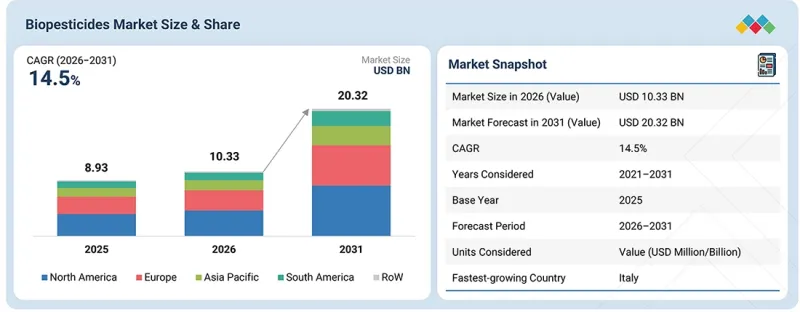
세계의 바이오 농약 시장은 2026년에 103억 3,000만 달러로 추계되고 있으며, 2031년까지 CAGR 14.5%로 203억 2,000만 달러에 달할 것으로 예측됩니다.
바이오 농약 업계에서의 AI 도입은 제품 개발을 혁신하고, 해충 방제 효과를 높이며, 시장 전략을 최적화하고 있습니다. FMC 코퍼레이션과 같은 기업은 AI를 활용하여 새로운 바이오 농약을 신속하게 발굴하고 상용화하고 있습니다.
| 조사 범위 | |
|---|---|
| 조사 대상 기간 | 2026-2031년 |
| 기준 연도 | 2025 |
| 예측 기간 | 2026-2031년 |
| 산정 단위 | 금액(달러) 및 수량(미터톤) |
| 부문 | 유형, 작물 유형, 시용 방법, 원료, 제형 및 지역 |
| 대상 지역 | 북미, 유럽, 아시아태평양, 남미, 기타 지역 |
2024년 5월, FMC 코퍼레이션은 신약 개발 프로세스 확대를 위한 전략적 노력의 일환으로, 저분자 신약 개발 분야를 선도하는 AI 솔루션 기업인 옵티브리움(Optibrium)과의 제휴를 발표했습니다. 옵티브리움의 ‘Augmented Chemistry’ AI 기술과 결합함으로써 유망한 화합물의 발견을 가속화하고, 농가를 위한 새로운 지속가능한 솔루션 개발 과정에서 해당 화합물의 특성을 최적화할 수 있게 됩니다. AI가 지속가능한 제품 개발에서 계속해서 중요한 역할을 수행함에 따라 바이오 농약 시장은 놀라운 성장과 혁신의 길을 걷게 될 것입니다.
바이오 농약 시장의 기회와 변화: 지속가능한 농업으로의 전환이 진행됨에 따라 바이오 농약은 농가와 제조사 모두에게 큰 비즈니스 기회를 제공하고 있습니다. 농가의 경우, 바이오 농약 사용은 화학 농약에 대한 의존도를 낮추고, 작물의 품질을 향상시키며, 친환경 제품을 찾는 소비자의 수요에 부응할 수 있으므로 수익성 향상과 시장 접근성 확대로 이어집니다. 제조업체의 경우, 수요가 증가하고 있는 지속가능한 농자재에 대한 전 세계적 수요가 제품 포트폴리오 확대, 연구개발 투자, 전략적 제휴의 기회를 제공한다는 점에서 이러한 추세로부터 혜택을 받고 있습니다. 따라서 이 신흥 시장의 전망은 밝으며, 농업 공급망 전반에 걸쳐 장기적인 지속가능성과 성장으로 이어질 것입니다. 바이오 농약 시장은 기술 발전, 규제 변화, 그리고 변화하는 소비자 선호도에 힘입어 큰 변혁의 물결에 직면해 있습니다. 바이오 농약 시장의 주요 변혁에는 다음과 같은 것이 있습니다. :
- AI를 활용한 신제품 개발: 인공지능(AI)과 기계학습을 통해 바이오 농약에 포함된 유효 성분의 규명 및 최적화가 가속화되고 있으며, 이는 신속하고 효율적인 제품 개발에 기여하고 있습니다.
- 첨단 전달 기술: 마이크로캡슐화 및 서방형 제제와 같은 혁신 기술을 통해 바이오 농약의 효율과 내구성이 향상되어 성능이 개선되고 있습니다.
- 정밀 살포 기술: 드론, 스마트 센서, GPS 기반 툴을 통합함으로써 바이오 농약의 정확하고 효율적인 살포가 가능해져, 제품의 낭비를 줄이고 있습니다.
"바이오 농약 시장에서 생물 살충제는 유형별 부문 중 주요 부문를 차지하고 있습니다."
생물성 살충제는 다른 많은 유익한 생물에게는 무독성이면서도 매우 광범위한 해충을 대상으로 할 수 있는 잠재력을 지니고 있으며, 바이오 농약 시장의 제품 유형별 부문에서 큰 점유율을 차지하고 있습니다. 여기에는 천연 유래 바이오 농약, 세균, 균류, 식물 추출물 등이 포함되며, 이들은 무해한 것으로 보고되어 화학 살충제의 대체재로 기능합니다. 합성 화학 물질로 인한 농약 내성 문제와 환경 및 인체 건강에 미치는 유해한 영향에 대한 인식이 높아지는 가운데, 생물성 살충제는 통합 해충 관리(IPM)에서 선호되는 선택지 중 하나로 부상해 왔습니다. 다양한 작물, 특히 고부가가치 과일과 채소의 생산에서 지속가능한 해충 방제를 실현할 수 있는 그 적합성이 생물학적 농약 시장의 주도적인 위치를 지원하고 있습니다.
"제형 부문에서는 액체 제형이 가장 큰 점유율을 차지하고 있습니다."
액체 제제는 그 폭넓은 용도와 범용성 덕분에 생물농약 시장에서 가장 큰 점유율을 차지하고 있습니다. 적용이 용이하고 광대한 농지를 효율적으로 커버할 수 있으며, 선호되고 있습니다. 액체 바이오 농약은 유효 성분 함량이 높고, 살포시 드리프트(비산)를 방지하므로 상업용 제제에 필수적인 특성을 갖추고 있습니다. Rovensa Next사는 2024년 6월, 브라질에서 ‘Milarum’이라는 새로운 생물 살균제를 출시했습니다. FMC India는 2023년 8월에 생물 살균제 ‘ENTAZIA’를 출시했습니다. 두 제품 모두 액제이며, 그 용도에 더욱 폭넓은 범용성과 부가가치를 제공하고 있습니다.
전 세계 바이오 농약 시장에서 사업을 운영하는 주요 기업의 최고경영자(CEO), 이사 및 기타 임원을 대상으로 상세한 인터뷰를 시행했습니다. :
- 기업 규모별: Tier 1-25%, Tier 2-45%, Tier 3-30%
- 직책별: 이사-20%, 매니저-50%, 간부-30%
- 지역별: 북미-25%, 유럽-30%, 아시아태평양-20%, 남미-15%, 기타 중동 및 아프리카-10%
조사 범위
본 조사 보고서에서는 전 세계 바이오 농약 시장을 유형(화학계 및 생물계), 작용 기전(접촉형 및 계통형), 제형(액체 및 건조제), 시용 방법(엽면 살포, 종자 처리, 토양 처리), 작물 유형 및 지역별로 분류하고 있습니다. 조사 범위에는 시장 성장에 영향을 미치는 주요 요인(촉진요인, 제약 요인, 과제 및 기회 등)에 대한 상세한 정보가 포함되어 있습니다. 주요 업계 플레이어에 대한 상세한 분석을 통해 사업 개요, 솔루션 및 서비스, 주요 전략, 계약, 파트너십, 합의 사항에 대한 인사이트를 제공합니다. 신제품 및 서비스 출시, 합병 및 인수, 그리고 전 세계 바이오 농약 시장과 관련된 최근 동향도 다루고 있습니다. 또한 시장 생태계에 진입하는 신생 기업에 대한 경쟁 분석도 이 보고서에 포함되어 있습니다.
이 보고서를 구매해야 하는 이유
이 보고서는 바이오 농약 시장 전체 및 각 하위 부문의 매출에 대한 가장 정확한 추정치를 제공함으로써, 이 시장의 시장 선도 기업과 신규 진입 기업을 지원합니다. 이 보고서는 이해관계자가 경쟁 구도를 이해하고, 자사의 비즈니스를 더 유리한 위치에 놓으며, 적절한 시장 진입 전략을 수립하기 위한 추가적인 인사이트를 얻는 데 도움이 됩니다. 또한 이 보고서는 이해관계자가 시장 동향을 파악할 수 있도록 지원하며, 주요 시장 촉진요인, 억제요인, 과제 및 기회에 대한 정보를 제공합니다.
이 보고서는 다음 사항에 대한 인사이트를 제공합니다. :
1. 유형, 작용 기전, 제형, 시용 방법, 작물 유형에 걸친 상세한 세분화: 주요 촉진요인(과일·채소 수출 증가, 화학 농약 사용 금지 및 정부 기관의 계몽 프로그램, 유기농 식품 판매 증가), 제약 요인(생물 유래 제품 사용에 따른 기술적 한계 및 효과가 느리고 변동하기 쉬운 점), 기회(주요 기업의 미생물 연구 진전 및 통합 해충 관리(IPM) 기법의 도입과 보급),과제(합성 농약에 비해 높은 바이오 농약의 비용, 그리고 농가의 인식 및 기술적 지식 부족)에 관한 분석.
2. 신흥 시장에 초점을 맞춘 지역별 인사이트: 이 보고서는 국가 및 지역별 분석을 제공하며, 아시아태평양, 북미, 유럽, 남미 등 급성장 시장의 기회를 중점적으로 다루고 있습니다. 지역별 규제 체계, 주요 수요 요인, 투자 동향을 조사했으며, 사업 확장 및 현지화 전략을 추구하는 기업에게 중요한 지침이 될 것입니다.
3. 경쟁 정보 및 혁신 동향: 주요 시장 참여 기업에 대해 상세히 소개하고 있습니다. 이 보고서는 신제품 출시, 합병·인수, 시설 확장, 연구개발(R&D) 활동 등 최근 동향을 포괄적으로 다루고 있으며, 사용자가 경쟁사와의 비교 평가를 수행하고 새로운 혁신 동향을 파악하는 데 도움이 됩니다.
4. 데이터베이스 조사 기법에 따른 수요 예측: 2030년까지 시장 규모 및 성장 예측은 탑다운(top-down) 및 바텀업(bottom-up) 접근법을 결합하여 수립되었으며, 업계 전문가, 업계 단체 및 정부의 공식 데이터를 통해 검증되었습니다. 이러한 인사이트는 전 세계 바이오 농약 부문의 투자 계획 수립 및 시장 기회 평가를 위한 신뢰할 수 있는 지침이 됩니다.
자주 묻는 질문
목차
제1장 서론
제2장 요약
제3장 주요 인사이트
- 바이오 농약 시장에서 사업자에게 매력적인 기회
- 바이오 농약 시장: 원료별·지역별
- 바이오 농약 시장: 제형별
- 바이오 농약 시장: 유형별
- 바이오 농약 시장: 작물 유형별
- 바이오 농약 시장: 시용 방법별
- 바이오 농약 시장: 지역별
제4장 시장 개요
- 시장 역학
- 촉진요인
- 억제요인
- 기회
- 과제
- 미충족 수요와 미개발 분야
- 바이오 농약 시장의 미충족 수요
- 미개발 시장의 기회
- 상호 연관된 시장 및 부문 간 기회
- 부문 간 기회
- 새로운 비즈니스 모델과 생태계의 변화
- Tier 1/2/3 주요 기업의 전략적 움직임
제5장 업계 동향
- Porter's Five Forces 분석
- 신규 진입자의 위협
- 대체품의 위협
- 공급업체의 협상력
- 구매자의 협상력
- 경쟁 기업 간의 적대적 관계
- 거시경제 전망
- 유기농업 실천의 확대
- 해충 피해 대책으로서의 농약 사용 현황
- 밸류체인 분석
- 원자재 및 생물 유래 자재 공급업체
- 생물학적 연구개발 및 유효 성분 개발 기업
- 바이오 농약 제조사 및 제제 제조사
- 유통·서비스 네트워크
- 최종사용자
- 애프터서비스 및 기술 서비스 제공업체
- 생태계 분석
- 수요 측면
- 공급 측면
- 가격 분석
- 주요 기업의 바이오 농약 가격대(유형별, 2025년)
- 바이오 농약의 평균 판매 가격 동향(지역별, 2023-2025년)
- 바이오 농약의 평균 판매 가격 동향(유형별, 2023-2025년)
- 무역 분석
- 수출 시나리오(HS 코드 3808)
- 수입 시나리오(HS 코드 3808)
- 주요 회의 및 행사(2026년)
- 투자 및 자금 조달 시나리오
- 고객의 비즈니스에 영향을 미치는 동향/파괴적 변화
- 사례 연구 분석
- CORTEVA AGRISCIENCE: 미생물성 살충제 ‘골트레보’ 출시
- FMC: 페로몬 제제 ‘소페로 폴’ 등록
- BIOWORKS: ‘프린시플 WP’ 생물학적 살충제 출시
- 미국 관세의 영향 - 바이오 농약 시장
- 가격에 미치는 영향 분석
- 주요 관세율
- 국가·지역별 영향
- 최종 용도 산업에 미치는 영향
제6장 기술 발전, AI의 영향, 특허, 혁신 및 향후 응용
- 주요 신규 기술
- 미생물 컨소시엄과 차세대 미생물 균주
- 정밀한 제형화 및 인캡슐레이션
- RNA 기반 바이오 농약
- 보완 기술
- 정밀농업 및 디지털 해충 모니터링
- 생물학적 종자 처리 및 종자 코팅
- 스마트 살포 및 자율 살포
- 관련 기술
- 바이오 자극제 및 미생물 유래 바이오 자극제
- 생물 유래 비료 및 미생물성 토양 개량제
- 생물학적 방제를 기반으로 한 종합 해충 관리 플랫폼
- 기술·제품 로드맵
- 단기(2025-2027년) | 기반 구축 및 초기 상용화
- 중기(2027-2030년) | 확대 및 표준화
- 장기(2030-2035년 이후) | 대규모 상용화 및 업계 혁신
- 특허 분석
- 미래 응용
- 생성형 AI가 바이오 농약 시장에 미치는 영향
- 주요 활용 사례 및 시장 잠재력
- 바이오 농약 시장에서 OEM 기업이 실천하고 있는 베스트 프랙티스
- 바이오 농약 시장용 생성형 AI 도입에 관한 사례 연구
- 상호 연계된 생태계와 시장 관계자에 미치는 영향
- 생성형 AI를 통합한 바이오 농약 솔루션 도입에 대한 고객의 준비 현황
- 성공 사례 및 실제 사회에서의 응용 사례
제7장 규제 현황과 지속가능성을 위한 노력
- 지역별 규제 및 규정 준수
- 업계 기준
- 지속가능성을 위한 노력
- 규제 정책이 지속가능성 노력에 미치는 영향
- 인증, 라벨링 및 환경 기준
제8장 고객 동향과 구매 행동
- 의사결정 과정
- 구매 과정에 관여하는 주요 이해관계자와 그 평가 기준
- 구매 과정의 주요 이해관계자
- 구매 기준
- 도입 장벽 및 사내 과제
- 각종 최종 용도 산업에서의 미충족 수요
- 상업 농업
- 농업 협동조합
- 농업 관련 기업 및 계약 재배 농가
- 농장 및 원예 생산자
- 유기농 농업
- 시장의 수익성
제9장 바이오 농약 시장: 유형별
- 생물 유래 살충제
- 생물 유래 살균제
- 생물 선충 방제제
- 생물 제초제
- 기타 바이오 농약
제10장 바이오 농약 시장: 원료별
- 미생물계
- 생화학 물질
- 유익한 곤충
제11장 바이오 농약 시장: 제형별
- 액체
- 건조제
제12장 바이오 농약 시장: 시용 방법별
- 종자 처리
- 토양 처리
- 엽면 살포
- 기타 시용 방법
제13장 바이오 농약 시장: 작물 유형별
- 곡물
- 지방종자·두류
- 과일·채소
- 기타 작물 유형
제14장 바이오 농약 시장: 지역별
- 북미
- 미국
- 캐나다
- 멕시코
- 유럽
- 프랑스
- 독일
- 스페인
- 이탈리아
- 영국
- 기타 유럽
- 아시아태평양
- 중국
- 인도
- 일본
- 호주
- 기타 아시아태평양
- 남미
- 브라질
- 아르헨티나
- 기타 남미
- 기타 지역
- 아프리카
- 중동
제15장 경쟁 현황
- 개요
- 주요 진입 기업의 전략/강점, 2023-2026년
- 수익 분석, 2021-2025년
- 시장 점유율 분석(2025년)
- 기업 평가 매트릭스: 주요 기업, 2025년
- 기업 평가 매트릭스: 스타트업/중소기업, 2025년
- 선도적인 기업
- 대응력이 뛰어난 기업
- 역동적인 기업
- 출발점
- 경쟁사 벤치마킹: 스타트업/중소기업, 2025년
- 기업 가치 평가 및 재무 지표
- 브랜드·제품·서비스 비교
- 경쟁 시나리오
- 제품 출시
- 거래
- 사업 확장
제16장 기업 개요
- 주요 기업
- BASF
- BAYER AG
- CORTEVA
- SYNGENTA GROUP
- FMC CORPORATION
- UPL
- SUMITOMO CHEMICAL CO., LTD.
- NUFARM
- NOVOZYMES A/S
- BIOCERES CROP SOLUTIONS
- KOPPERT
- CERTIS USA L.L.C.
- GOWAN COMPANY
- BIOBEST
- LALLEMAND INC.
- 기타 기업(중소기업·스타트업)
- IPL BIOLOGICALS
- ROVENSA NEXT
- BIOCONTROL TECHNOLOGIES S.L
- AGRILIFE(INDIA)PRIVATE LIMITED
- STK BIO-AG TECHNOLOGIES
- KAY BEE BIO ORGANICS PVT. LTD.
- ANDERMATT GROUP AG
- GENICA
- SEIPASA, S.A.
- BOTANOHEALTH LTD.
제17장 조사 방법론
제18장 인접 시장 및 관련 시장
- 본 조사의 한계
- 농업 생물학적 시장
- 시장의 정의
- 시장 개요
- 바이오래셔널 농약 시장
- 시장의 정의
- 시장 개요
- 생물학적 방제 시장
- 시장 정의
- 시장 개요
제19장 부록
KSA 26.10.15The global biopesticides market is estimated at USD 10.33 billion in 2026 and is projected to reach USD 20.32 billion by 2031, at a CAGR of 14.5%. The adoption of AI in the biopesticides industry is transforming product development, enhancing pest control effectiveness, and optimizing market strategies. Companies, such as FMC Corporation, are using AI to rapidly discover and commercialize new biopesticides.
| Scope of the Report | |
|---|---|
| Years Considered for the Study | 2026-2031 |
| Base Year | 2025 |
| Forecast Period | 2026-2031 |
| Units Considered | Value (USD) and Volume (Metric Tons) |
| Segments | Type, Crop Type, Mode of Application, Source, Formulation, and Region |
| Regions covered | North America, Europe, Asia Pacific, South America, RoW |
In May 2024, FMC Corporation announced a collaboration with Optibrium, the lead AI solutions company for small molecule discovery, as part of its strategic move to expand its discovery process. Coupled with Optibrium's Augmented Chemistry AI technologies, this will speed up the discovery of promising compounds and optimize their properties in the development of new sustainable solutions for growers. As AI continues to play a critical role in sustainable product development, it positions the biopesticides market for significant growth and innovation.
Opportunities and disruption in the biopesticides market: Biopesticides offer significant business opportunities for both farmers and manufacturers, driven by the increasing shift toward sustainable agriculture. For the farmer, the use of biopesticides can reduce dependency on chemical pesticides, improve crop quality, and meet consumers' demand for eco-friendly products, thus opening improved profitability and access to markets. Manufacturers benefit from this trend in that the global demand for sustainable agricultural inputs, which is increasing in demand, provides opportunities to expand product portfolios, invest in R&D, and tie up strategic alliances. Thus, the prospects of this emerging market landscape are promising and lead to long-term sustainability and growth across the agricultural supply chain. The biopesticides market is experiencing significant disruptions driven by technological advancements, regulatory changes, and evolving consumer preferences. Some of the key disruptions in the biopesticides market include:
- AI-driven product discovery: Artificial intelligence (AI) and machine learning are accelerating the identification and optimization of active compounds in biopesticides, which helps in fast and efficient product development.
- Advanced delivery technologies: Innovations like microencapsulation and controlled-release formulations improve the performance of biopesticides by enhancing their efficiency and durability.
- Precision application technologies: The integration of drones, smart sensors, and GPS-based tools helps in accurate and efficient application of biopesticides, hence reducing the wastage of product.
"Bioinsecticides stood as the major segment within the type segment of the biopesticides market."
Bioinsecticides hold a major share in the segment type of the biopesticides market because of their potential to target an enormous range of insect pests while remaining nontoxic to many other beneficial organisms. These include biopesticides emanating from natural sources, bacteria, fungi, and plant extracts that are reportedly harmless and serve as alternatives for chemical insecticides. Due to increasing awareness of pesticide resistance and lethal effects on the environment and human health from synthetic chemicals, bioinsecticides have emerged among the favored options for integrated pest management. Its aptitude for sustainable pest control delivery across different crops, especially high-value fruit and vegetable production, sustained the leading edge in the biopesticides market.
"Within the formulation segment, liquid formulation holds the highest share."
Liquid formulation holds the maximum share in the biopesticides market due to its wide usage and versatility. They are preferred for the ease of application and better coverage of large acres. Liquid biopesticides provide a high active content, which is required in commercial formulation as they aid with spray drifting. Rovensa Next launched a new biofungicide named Milarum in Brazil in June 2024. FMC India introduced ENTAZIA biofungicide in August 2023. Both are liquid products in form, bringing extra versatility and value to their applications.
In-depth interviews were conducted with chief executive officers (CEOs), directors, and other executives from various key organizations operating in the global biopesticides market:
- By Company Type: Tier 1 - 25%, Tier 2 - 45%, and Tier 3 - 30%
- By Designation: Directors - 20%, Managers - 50%, Executives - 30%
- By Region: North America - 25%, Europe - 30%, Asia Pacific - 20%, South America - 15%, and Rest of the World (Middle East and Africa) - 10%
Prominent companies in the market include Corteva Agriscience (US), Valent BioSciences (SA), BASF (Germany), Bayer CropScience (Germany), Syngenta Group (Switzerland), FMC Corporation (US), UPL (India), Marrone Bio Innovations (USA), Certis Biologicals (US), Koppert Biological Systems (Netherlands), AgBiome (US), Novonesis (Denmark), Lallemand Plant Care (Canada), BioWorks Inc. (US), and Andermatt Group AG (Switzerland).
Research Coverage
This research report categorizes the global biopesticides market by type (chemical and biological), mode of action (contact and systemic), formulation (liquid and dry), mode of application (foliar spray, seed treatment, and soil treatment), crop type, and region. The scope of the report covers detailed information regarding the major factors, such as drivers, restraints, challenges, and opportunities, influencing the growth of the market. A detailed analysis of the key industry players has been done to provide insights into their business overview, solutions and services, key strategies, contracts, partnerships, and agreements. New product & service launches, mergers and acquisitions, and recent developments associated with the global biopesticides market. Competitive analysis of upcoming startups in the market ecosystem is covered in this report.
Reasons To Buy This Report
The report will help the market leaders/new entrants in this market with information on the closest approximations of the revenue numbers for the overall biopesticides market and the subsegments. This report will help stakeholders understand the competitive landscape and gain more insights to position their businesses better and plan suitable go-to-market strategies. The report also helps stakeholders understand the pulse of the market and provides them with information on key market drivers, restraints, challenges, and opportunities.
The report provides insights into the following pointers:
1. In-depth Segmentation across Type, Mode of action, Formulation, Mode of Application, and Crop Type: Analysis of key drivers (increase in exports of fruits & vegetables, chemical pesticide bans and awareness programs by government agencies, and increase in organic food sales) restraints (technological limitations to use biological products and slow and variable performance) opportunities (advancements in microbial research by key players and adaption and increase in IPM practices) and challenges (high cost of biopesticides compared to synthetic pesticides and lack of awareness and technical knowledge among farmers).
2. Region-specific Insights with Focus on Emerging Markets: The report provides country- and region-specific analysis, emphasizing opportunities in rapidly growing markets such as Asia Pacific and North America, Europe, and South America. It explores regional regulatory frameworks, key demand drivers, and investment trends, serving as a critical guide for companies pursuing expansion or localization strategies.
3. Competitive Intelligence and Innovation Landscape: Leading market participants, including Corteva Agriscience (US), Bayer CropScience (Germany), Syngenta Group (Switzerland), Koppert Biological Systems (Netherlands), and Valent BioSciences (SA), are profiled in detail. The report covers recent developments such as new product launches, mergers & acquisitions, facility expansions, and R&D initiatives, helping users benchmark competitors and monitor emerging innovation trends.
4. Demand Forecasts Backed by Data-driven Methodologies: Market sizing and growth projections through 2030 are developed using a combination of top-down and bottom-up approaches, validated by industry experts, trade associations, and official government data. These insights provide reliable guidance for investment planning and market opportunity assessment in the global biopesticides sector.
TABLE OF CONTENTS
1 INTRODUCTION
- 1.1 STUDY OBJECTIVES
- 1.2 MARKET DEFINITION
- 1.3 STUDY SCOPE
- 1.3.1 MARKET SEGMENTATION
- 1.3.2 INCLUSIONS AND EXCLUSIONS
- 1.4 YEARS CONSIDERED
- 1.5 UNIT CONSIDERED
- 1.5.1 CURRENCY/VALUE UNIT
- 1.6 STAKEHOLDERS
- 1.7 SUMMARY OF CHANGES
2 EXECUTIVE SUMMARY
- 2.1 MARKET HIGHLIGHTS AND KEY INSIGHTS
- 2.2 KEY MARKET PARTICIPANTS: MAPPING OF STRATEGIC DEVELOPMENTS
- 2.3 DISRUPTIVE TRENDS IN BIOPESTICIDES MARKET
- 2.4 HIGH-GROWTH SEGMENTS
- 2.5 REGIONAL SNAPSHOT: MARKET SIZE, GROWTH RATE, AND FORECAST
3 PREMIUM INSIGHTS
- 3.1 ATTRACTIVE OPPORTUNITIES FOR PLAYERS IN BIOPESTICIDES MARKET
- 3.2 BIOPESTICIDES MARKET, BY SOURCE AND REGION
- 3.3 BIOPESTICIDES MARKET, BY FORMULATION
- 3.4 BIOPESTICIDES MARKET, BY TYPE
- 3.5 BIOPESTICIDES MARKET, BY CROP TYPE
- 3.6 BIOPESTICIDES MARKET, BY MODE OF APPLICATION
- 3.7 BIOPESTICIDES MARKET, BY GEOGRAPHY
4 MARKET OVERVIEW
- 4.1 INTRODUCTION
- 4.2 MARKET DYNAMICS
- 4.2.1 DRIVERS
- 4.2.1.1 Growing emphasis on sustainable agricultural practices
- 4.2.1.2 Government restrictions on chemical pesticides and awareness programs
- 4.2.1.3 Increasing organic food sales
- 4.2.2 RESTRAINTS
- 4.2.2.1 Technological and environmental constraints
- 4.2.2.2 Slow and variable performance
- 4.2.2.3 Limited shelf life and storage stability of biological products
- 4.2.3 OPPORTUNITIES
- 4.2.3.1 Rapid advances in microbial research
- 4.2.3.2 High emphasis on Integrated Pest Management (IPM) strategies
- 4.2.3.3 Rising residue-sensitive and export-oriented crop production
- 4.2.4 CHALLENGES
- 4.2.4.1 Higher cost of biopesticides than chemical counterparts
- 4.2.4.2 Lack of awareness and technical knowledge among farmers
- 4.2.4.3 Stringent and time-consuming regulatory approval processes
- 4.2.1 DRIVERS
- 4.3 UNMET NEEDS AND WHITE SPACES
- 4.3.1 UNMET NEEDS IN BIOPESTICIDES MARKET
- 4.3.2 WHITE SPACE OPPORTUNITIES
- 4.4 INTERCONNECTED MARKETS AND CROSS-SECTOR OPPORTUNITIES
- 4.4.1 CROSS-SECTOR OPPORTUNITIES
- 4.5 EMERGING BUSINESS MODELS AND ECOSYSTEM SHIFTS
- 4.6 STRATEGIC MOVES BY TIER-1/2/3 PLAYERS
5 INDUSTRY TRENDS
- 5.1 PORTER'S FIVE FORCES ANALYSIS
- 5.1.1 THREAT OF NEW ENTRANTS
- 5.1.2 THREAT OF SUBSTITUTES
- 5.1.3 BARGAINING POWER OF SUPPLIERS
- 5.1.4 BARGAINING POWER OF BUYERS
- 5.1.5 INTENSITY OF COMPETITIVE RIVALRY
- 5.2 MACROECONOMIC OUTLOOK
- 5.2.1 GROWTH IN ORGANIC AGRICULTURAL PRACTICES
- 5.2.2 ADOPTION OF PESTICIDES FOR DEFENSE AGAINST PEST ATTACKS
- 5.3 VALUE CHAIN ANALYSIS
- 5.3.1 RAW MATERIAL & BIOLOGICAL INPUT SUPPLIERS
- 5.3.2 BIOLOGICAL R&D & ACTIVE INGREDIENT DEVELOPERS
- 5.3.3 BIOPESTICIDE MANUFACTURERS & FORMULATORS
- 5.3.4 DISTRIBUTION & SERVICE NETWORKS
- 5.3.5 END USERS
- 5.3.6 AFTER-SALES & TECHNICAL SERVICE PROVIDERS
- 5.4 ECOSYSTEM ANALYSIS
- 5.4.1 DEMAND SIDE
- 5.4.2 SUPPLY SIDE
- 5.5 PRICING ANALYSIS
- 5.5.1 PRICING RANGE OF BIOPESTICIDES OFFERED BY KEY PLAYERS, BY TYPE, 2025
- 5.5.2 AVERAGE SELLING PRICE TREND OF BIOPESTICIDES, BY REGION, 2023-2025
- 5.5.3 AVERAGE SELLING PRICE TREND OF BIOPESTICIDES, BY TYPE, 2023-2025
- 5.6 TRADE ANALYSIS
- 5.6.1 EXPORT SCENARIO (HS CODE 3808)
- 5.6.2 IMPORT SCENARIO (HS CODE 3808)
- 5.7 KEY CONFERENCES AND EVENTS, 2026
- 5.8 INVESTMENT AND FUNDING SCENARIO
- 5.9 TRENDS/DISRUPTIONS IMPACTING CUSTOMER BUSINESS
- 5.10 CASE STUDY ANALYSIS
- 5.10.1 CORTEVA AGRISCIENCE: LAUNCH OF GOLTREVO MICROBIAL BIOINSECTICIDE
- 5.10.2 FMC: REGISTRATION OF SOFERO FALL PHEROMONE
- 5.10.3 BIOWORKS: LAUNCH OF PRINCIPLE WP BIOINSECTICIDE
- 5.11 IMPACT OF US TARIFFS - BIOPESTICIDES MARKET
- 5.11.1 INTRODUCTION
- 5.11.2 PRICE IMPACT ANALYSIS
- 5.11.3 KEY TARIFF RATES
- 5.11.4 IMPACT ON COUNTRIES/REGIONS
- 5.11.4.1 India
- 5.11.4.2 China
- 5.11.4.3 European Union
- 5.11.4.4 Japan
- 5.11.5 IMPACT ON END-USE INDUSTRIES
6 TECHNOLOGICAL ADVANCEMENTS, AI-DRIVEN IMPACT, PATENTS, INNOVATIONS, AND FUTURE APPLICATIONS
- 6.1 KEY EMERGING TECHNOLOGIES
- 6.1.1 MICROBIAL CONSORTIA AND NEXT-GENERATION MICROBIAL STRAINS
- 6.1.2 PRECISION FORMULATION AND ENCAPSULATION
- 6.1.3 RNA-BASED BIOPESTICIDES
- 6.2 COMPLEMENTARY TECHNOLOGIES
- 6.2.1 PRECISION AGRICULTURE AND DIGITAL PEST MONITORING
- 6.2.2 BIOLOGICAL SEED TREATMENT AND SEED COATING
- 6.2.3 SMART SPRAYING AND AUTONOMOUS APPLICATION
- 6.3 ADJACENT TECHNOLOGIES
- 6.3.1 BIOSTIMULANTS AND MICROBIAL BIOSTIMULANTS
- 6.3.2 BIOLOGICAL FERTILIZERS AND MICROBIAL SOIL AMENDMENTS
- 6.3.3 BIOCONTROL-BASED INTEGRATED PEST MANAGEMENT PLATFORMS
- 6.4 TECHNOLOGY/PRODUCT ROADMAP
- 6.4.1 SHORT-TERM (2025-2027) | FOUNDATION & EARLY COMMERCIALIZATION
- 6.4.2 MID-TERM (2027-2030) | EXPANSION & STANDARDIZATION
- 6.4.3 LONG-TERM (2030-2035+) | MASS COMMERCIALIZATION & DISRUPTION
- 6.5 PATENT ANALYSIS
- 6.6 FUTURE APPLICATIONS
- 6.7 IMPACT OF GENERATIVE AI ON BIOPESTICIDES MARKET
- 6.7.1 INTRODUCTION
- 6.7.2 TOP USE CASES AND MARKET POTENTIAL
- 6.7.3 BEST PRACTICES FOLLOWED BY OEMS IN BIOPESTICIDES MARKET
- 6.7.4 CASE STUDIES RELATED TO GEN AI IMPLEMENTATION IN BIOPESTICIDES MARKET
- 6.7.5 INTERCONNECTED ECOSYSTEM AND IMPACT ON MARKET PLAYERS
- 6.7.6 CLIENTS' READINESS TO ADOPT GEN AI-INTEGRATED BIOPESTICIDES SOLUTIONS
- 6.8 SUCCESS STORIES AND REAL-WORLD APPLICATIONS
7 REGULATORY LANDSCAPE AND SUSTAINABILITY INITIATIVES
- 7.1 REGIONAL REGULATIONS AND COMPLIANCE
- 7.1.1 INDUSTRY STANDARDS
- 7.2 SUSTAINABILITY INITIATIVES
- 7.3 IMPACT OF REGULATORY POLICIES ON SUSTAINABILITY INITIATIVES
- 7.4 CERTIFICATIONS, LABELING, AND ECO-STANDARDS
8 CUSTOMER LANDSCAPE AND BUYER BEHAVIOR
- 8.1 DECISION-MAKING PROCESS
- 8.2 KEY STAKEHOLDERS INVOLVED IN BUYING PROCESS AND THEIR EVALUATION CRITERIA
- 8.2.1 KEY STAKEHOLDERS IN BUYING PROCESS
- 8.2.2 BUYING CRITERIA
- 8.3 ADOPTION BARRIERS AND INTERNAL CHALLENGES
- 8.4 UNMET NEEDS OF VARIOUS END-USE INDUSTRIES
- 8.4.1 COMMERCIAL FARMING
- 8.4.2 AGRICULTURAL COOPERATIVES
- 8.4.3 AGRIBUSINESSES AND CONTRACT GROWERS
- 8.4.4 PLANTATION AND HORTICULTURAL PRODUCERS
- 8.4.5 ORGANIC FARMING
- 8.5 MARKET PROFITABILITY
9 BIOPESTICIDES MARKET, BY TYPE
- 9.1 INTRODUCTION
- 9.2 BIOINSECTICIDES
- 9.2.1 BACILLUS THURINGIENSIS
- 9.2.1.1 Wide-scale availability, target-specificity, and efficiency to boost segmental growth
- 9.2.1.2 Availability in various formulations to contribute to segmental growth
- 9.2.2 METARHIZIUM ANISOPLIAE
- 9.2.2.1 Strong focus on prolonged insect pest control to expedite segmental growth
- 9.2.3 VERTICILLIUM LECANII
- 9.2.3.1 Wide applications in ornamentals, vegetable crops, nurseries, lawns, and vegetable field crops to fuel segmental growth
- 9.2.4 BACULOVIRUS
- 9.2.4.1 Rapid advances in formulation technologies to augment segmental growth
- 9.2.5 OTHER BIOINSECTICIDE MICROBIAL TYPES
- 9.2.1 BACILLUS THURINGIENSIS
- 9.3 BIOFUNGICIDES
- 9.3.1 TRICHODERMA
- 9.3.1.1 Easy availability and long shelf life to bolster segmental growth
- 9.3.2 BACILLUS
- 9.3.2.1 Ability to replicate rapidly and resist environmental conditions to foster segmental growth
- 9.3.3 PSEUDOMONAS
- 9.3.3.1 High emphasis on treating seed-borne diseases to contribute to segmental growth
- 9.3.4 STREPTOMYCES
- 9.3.4.1 Focus on eliminating plant pathogens by secreting volatile compounds to drive market
- 9.3.5 OTHER BIOFUNGICIDE MICROBIAL TYPES
- 9.3.1 TRICHODERMA
- 9.4 BIONEMATICIDES
- 9.4.1 PAECILOMYCES LILACINUS
- 9.4.1.1 Focus on controlling growth of root-knot nematodes to expedite segmental growth
- 9.4.2 BACILLUS FIRMUS
- 9.4.2.1 Effectiveness against larvae and adult nematodes to accelerate segmental growth
- 9.4.3 PASTEURIA SPP.
- 9.4.3.1 Need to control plant-parasitic nematodes to boost segmental growth
- 9.4.4 OTHER SPECIES
- 9.4.1 PAECILOMYCES LILACINUS
- 9.5 BIOHERBICIDES
- 9.5.1 FOCUS ON CONTROLLING FUNGAL PATHOGENS CAPABLE OF CAUSING SEVERE, TARGETED DAMAGE TO SINGLE PROBLEM WEED SPECIES TO DRIVE MARKET
- 9.6 OTHER BIOPESTICIDES
10 BIOPESTICIDES MARKET, BY SOURCE
- 10.1 INTRODUCTION
- 10.2 MICROBIALS
- 10.2.1 BACTERIA
- 10.2.1.1 Use as sustainable approach to pest control to contribute to segmental growth
- 10.2.2 FUNGI
- 10.2.2.1 Effectiveness in eliminating harmful pests and pathogens in agriculture to bolster segmental growth
- 10.2.3 VIRUS
- 10.2.3.1 Ability to infect agricultural pests by disrupting their biological processes to facilitate segmental growth
- 10.2.4 PROTOZOA
- 10.2.4.1 Adoption as sustainable alternative to chemical pesticides to augment segmental growth
- 10.2.1 BACTERIA
- 10.3 BIOCHEMICALS
- 10.3.1 SEMIOCHEMICALS
- 10.3.1.1 Ability to attract or repel pests and beneficial insects to contribute to segmental growth
- 10.3.2 PLANT EXTRACTS
- 10.3.2.1 Effective disease control while maintaining low environmental impact to foster segmental growth
- 10.3.3 ORGANIC ACIDS
- 10.3.3.1 Pest-repellent and fungicidal properties to accelerate segmental growth
- 10.3.1 SEMIOCHEMICALS
- 10.4 BENEFICIAL INSECTS
- 10.4.1 PREDATORS
- 10.4.1.1 Use to enhance crop protection and maintain ecological balance to augment segmental growth
- 10.4.2 PARASITOIDS
- 10.4.2.1 Ability to target harmful pests without impacting beneficial organisms to fuel segmental growth
- 10.4.1 PREDATORS
11 BIOPESTICIDES MARKET, BY FORMULATION
- 11.1 INTRODUCTION
- 11.2 LIQUID
- 11.2.1 EMULSIFIABLE CONCENTRATES
- 11.2.1.1 Ease of handling and less agitation to contribute to segmental growth
- 11.2.2 SUSPENSION CONCENTRATES
- 11.2.2.1 Safe for operators and environments to augment segmental growth
- 11.2.3 SOLUBLE LIQUID CONCENTRATES
- 11.2.3.1 Lower viscosities than suspension concentrates to fuel segmental growth
- 11.2.1 EMULSIFIABLE CONCENTRATES
- 11.3 DRY
- 11.3.1 DRY GRANULES
- 11.3.1.1 Suitability for long-term storage and transportation without special conditions to boost segmental growth
- 11.3.2 WATER-DISPERSIBLE GRANULES
- 11.3.2.1 Dust-free and good storage viability to augment segmental growth
- 11.3.3 WETTABLE POWDERS
- 11.3.3.1 Ease of transportation, storage, and handling to facilitate segmental growth
- 11.3.1 DRY GRANULES
12 BIOPESTICIDES MARKET, BY MODE OF APPLICATION
- 12.1 INTRODUCTION
- 12.2 SEED TREATMENT
- 12.2.1 EARLY-STAGE PROTECTION THROUGH PRECISE SEED PLACEMENT TO BOLSTER SEGMENTAL GROWTH
- 12.3 SOIL TREATMENT
- 12.3.1 TARGETED ROOT-ZONE DELIVERY FOR SOIL-BORNE PEST MANAGEMENT TO EXPEDITE SEGMENTAL GROWTH
- 12.4 FOLIAR SPRAY
- 12.4.1 CANOPY-LEVEL BIOLOGICAL PROTECTION THROUGH CONVENTIONAL SPRAY SYSTEMS TO FOSTER SEGMENTAL GROWTH
- 12.5 OTHER MODES OF APPLICATION
13 BIOPESTICIDES MARKET, BY CROP TYPE
- 13.1 INTRODUCTION
- 13.2 CEREALS & GRAINS
- 13.2.1 CORN
- 13.2.1.1 Increasing exports and focus on improving yield to accelerate segmental growth
- 13.2.2 WHEAT
- 13.2.2.1 Mounting demand for reliable pest management solutions to mitigate damage to crops to fuel segmental growth
- 13.2.3 RICE
- 13.2.3.1 High effectiveness against leaf folder and stem borer to contribute to segmental growth
- 13.2.4 OTHER CEREALS & GRAINS
- 13.2.1 CORN
- 13.3 OILSEEDS & PULSES
- 13.3.1 SOYBEAN
- 13.3.1.1 Severe infestation from root-knot nematodes to boost segmental growth
- 13.3.2 SUNFLOWER
- 13.3.2.1 Preference for sunflower oil and confectionery value of seed to drive market
- 13.3.3 OTHER OILSEEDS & PULSES
- 13.3.1 SOYBEAN
- 13.4 FRUITS & VEGETABLES
- 13.4.1 ROOT & TUBER VEGETABLES
- 13.4.1.1 Economic losses due to pests, diseases, and nematodes to foster segmental growth
- 13.4.2 LEAFY VEGETABLES
- 13.4.2.1 Prevalence of Alternaria leaf blight and other diseases to boost segmental growth
- 13.4.3 POME FRUITS
- 13.4.3.1 Effectiveness of biocontrol agents on pome fruits to accelerate segmental growth
- 13.4.4 BERRIES
- 13.4.4.1 Awareness about health benefits to contribute to segmental growth
- 13.4.5 CITRUS FRUITS
- 13.4.5.1 Focus on minimizing economic losses to expedite segmental growth
- 13.4.6 OTHER FRUITS & VEGETABLES
- 13.4.1 ROOT & TUBER VEGETABLES
- 13.5 OTHER CROP TYPES
14 BIOPESTICIDES MARKET, BY REGION
- 14.1 INTRODUCTION
- 14.2 NORTH AMERICA
- 14.2.1 US
- 14.2.1.1 Rising implementation of sustainable agricultural solutions and organic farming to boost market growth
- 14.2.2 CANADA
- 14.2.2.1 High emphasis on usage of low-risk pesticides to accelerate market growth
- 14.2.3 MEXICO
- 14.2.3.1 Strong focus on classical and augmentative biological control to expedite market growth
- 14.2.1 US
- 14.3 EUROPE
- 14.3.1 FRANCE
- 14.3.1.1 Favorable legislative changes for biocontrol to support market growth
- 14.3.2 GERMANY
- 14.3.2.1 Commitment to reducing pesticide usage and promoting sustainable agricultural practices to fuel market growth
- 14.3.3 SPAIN
- 14.3.3.1 Rising need for effective pest management solutions that comply with organic regulations to drive market
- 14.3.4 ITALY
- 14.3.4.1 Increasing adoption of organic farming practices to expedite market growth
- 14.3.5 UK
- 14.3.5.1 Changing consumer preferences for healthy diet to contribute to market growth
- 14.3.6 REST OF EUROPE
- 14.3.1 FRANCE
- 14.4 ASIA PACIFIC
- 14.4.1 CHINA
- 14.4.1.1 Increasing agricultural exports and government push for sustainable agriculture to drive market
- 14.4.2 INDIA
- 14.4.2.1 Increasing area under organic farming to augment market growth
- 14.4.3 JAPAN
- 14.4.3.1 Strong focus on sustainability in agriculture, forestry, and fisheries to boost market growth
- 14.4.4 AUSTRALIA
- 14.4.4.1 Growing emphasis on sustainable agriculture to bolster market growth
- 14.4.5 REST OF ASIA PACIFIC
- 14.4.1 CHINA
- 14.5 SOUTH AMERICA
- 14.5.1 BRAZIL
- 14.5.1.1 Rising popularity of biological crop protection solutions to foster market growth
- 14.5.2 ARGENTINA
- 14.5.2.1 Burgeoning demand for sustainable and environmentally friendly agricultural inputs to drive market
- 14.5.3 REST OF SOUTH AMERICA
- 14.5.1 BRAZIL
- 14.6 ROW
- 14.6.1 AFRICA
- 14.6.1.1 Concerns about economic impact of crop infection to augment market growth
- 14.6.2 MIDDLE EAST
- 14.6.2.1 Initiatives to promote organic farming and sustainable practices to fuel market growth
- 14.6.1 AFRICA
15 COMPETITIVE LANDSCAPE
- 15.1 OVERVIEW
- 15.2 KEY PLAYER COMPETITIVE STRATEGIES/RIGHT TO WIN, 2023-2026
- 15.3 REVENUE ANALYSIS, 2021-2025
- 15.4 MARKET SHARE ANALYSIS, 2025
- 15.5 COMPANY EVALUATION MATRIX: KEY PLAYERS, 2025
- 15.5.1 STARS
- 15.5.2 EMERGING LEADERS
- 15.5.3 PERVASIVE PLAYERS
- 15.5.4 PARTICIPANTS
- 15.5.5 COMPANY FOOTPRINT: KEY PLAYERS, 2025
- 15.5.5.1 Company footprint
- 15.5.5.2 Region footprint
- 15.5.5.3 Type footprint
- 15.5.5.4 Formulation footprint
- 15.5.5.5 Source footprint
- 15.6 COMPANY EVALUATION MATRIX: STARTUPS/SMES, 2025
- 15.6.1 PROGRESSIVE COMPANIES
- 15.6.2 RESPONSIVE COMPANIES
- 15.6.3 DYNAMIC COMPANIES
- 15.6.4 STARTING BLOCKS
- 15.6.5 COMPETITIVE BENCHMARKING: STARTUPS/SMES, 2025
- 15.6.5.1 Detailed list of key startups/SMEs
- 15.6.5.2 Competitive benchmarking of key startups/SMEs
- 15.7 COMPANY VALUATION AND FINANCIAL METRICS
- 15.8 BRAND/PRODUCT/SERVICE COMPARISON
- 15.9 COMPETITIVE SCENARIO
- 15.9.1 PRODUCT LAUNCHES
- 15.9.2 DEALS
- 15.9.3 EXPANSIONS
16 COMPANY PROFILES
- 16.1 KEY PLAYERS
- 16.1.1 BASF
- 16.1.1.1 Business overview
- 16.1.1.2 Products/Solutions/Services offered
- 16.1.1.3 Recent developments
- 16.1.1.3.1 Deals
- 16.1.1.3.2 Other developments
- 16.1.1.4 MnM view
- 16.1.1.4.1 Key strengths
- 16.1.1.4.2 Strategic choices
- 16.1.1.4.3 Weaknesses and competitive threats
- 16.1.2 BAYER AG
- 16.1.2.1 Business overview
- 16.1.2.2 Products/Solutions/Services offered
- 16.1.2.3 Recent developments
- 16.1.2.3.1 Product launches
- 16.1.2.3.2 Deals
- 16.1.2.3.3 Expansions
- 16.1.2.4 MnM view
- 16.1.2.4.1 Key strengths
- 16.1.2.4.2 Strategic choices
- 16.1.2.4.3 Weaknesses and competitive threats
- 16.1.3 CORTEVA
- 16.1.3.1 Business overview
- 16.1.3.2 Products/Solutions/Services offered
- 16.1.3.3 Recent developments
- 16.1.3.3.1 Product launches
- 16.1.3.3.2 Deals
- 16.1.3.4 MnM view
- 16.1.3.4.1 Key strengths
- 16.1.3.4.2 Strategic choices
- 16.1.3.4.3 Weaknesses and competitive threats
- 16.1.4 SYNGENTA GROUP
- 16.1.4.1 Business overview
- 16.1.4.2 Products/Solutions/Services offered
- 16.1.4.3 Recent developments
- 16.1.4.3.1 Product launches
- 16.1.4.3.2 Deals
- 16.1.4.3.3 Expansions
- 16.1.4.4 MnM view
- 16.1.4.4.1 Key strengths
- 16.1.4.4.2 Strategic choices
- 16.1.4.4.3 Weaknesses and competitive threats
- 16.1.5 FMC CORPORATION
- 16.1.5.1 Business overview
- 16.1.5.2 Products/Solutions/Services offered
- 16.1.5.3 Recent developments
- 16.1.5.3.1 Product launches
- 16.1.5.3.2 Deals
- 16.1.5.4 MnM view
- 16.1.5.4.1 Key strengths
- 16.1.5.4.2 Strategic choices
- 16.1.5.4.3 Weaknesses and competitive threats
- 16.1.6 UPL
- 16.1.6.1 Business overview
- 16.1.6.2 Products/Solutions/Services offered
- 16.1.6.3 Recent developments
- 16.1.6.3.1 Product launches
- 16.1.6.4 MnM view
- 16.1.7 SUMITOMO CHEMICAL CO., LTD.
- 16.1.7.1 Business overview
- 16.1.7.2 Products/Solutions/Services offered
- 16.1.7.3 Recent developments
- 16.1.7.3.1 Deals
- 16.1.7.4 MnM view
- 16.1.8 NUFARM
- 16.1.8.1 Business overview
- 16.1.8.2 Products/Solutions/Services offered
- 16.1.8.3 Recent developments
- 16.1.8.3.1 Product launches
- 16.1.8.4 MnM view
- 16.1.9 NOVOZYMES A/S
- 16.1.9.1 Business overview
- 16.1.9.2 Products/Solutions/Services offered
- 16.1.9.3 Recent developments
- 16.1.9.3.1 Deals
- 16.1.9.3.2 Expansions
- 16.1.9.4 MnM view
- 16.1.10 BIOCERES CROP SOLUTIONS
- 16.1.10.1 Business overview
- 16.1.10.2 Products/Solutions/Services offered
- 16.1.10.3 Recent developments
- 16.1.10.3.1 Deals
- 16.1.10.3.2 Other developments
- 16.1.10.4 MnM view
- 16.1.11 KOPPERT
- 16.1.11.1 Business overview
- 16.1.11.2 Products/Solutions/Services offered
- 16.1.11.3 Recent developments
- 16.1.11.3.1 Deals
- 16.1.11.3.2 Expansions
- 16.1.11.4 MnM view
- 16.1.12 CERTIS USA L.L.C.
- 16.1.12.1 Business overview
- 16.1.12.2 Products/Solutions/Services offered
- 16.1.12.3 Recent developments
- 16.1.12.3.1 Product launches
- 16.1.12.3.2 Deals
- 16.1.12.4 MnM view
- 16.1.13 GOWAN COMPANY
- 16.1.13.1 Business overview
- 16.1.13.2 Product/Solutions/Services offered
- 16.1.13.3 Recent developments
- 16.1.13.3.1 Deals
- 16.1.13.4 MnM view
- 16.1.14 BIOBEST
- 16.1.14.1 Business overview
- 16.1.14.2 Product/Solutions/Services offered
- 16.1.14.3 Recent developments
- 16.1.14.3.1 Product launches
- 16.1.14.3.2 Deals
- 16.1.14.3.3 Expansions
- 16.1.14.4 MnM view
- 16.1.15 LALLEMAND INC.
- 16.1.15.1 Business overview
- 16.1.15.2 Products/Solutions/Services offered
- 16.1.15.3 Recent developments
- 16.1.15.3.1 Product launches
- 16.1.15.4 MnM view
- 16.1.1 BASF
- 16.2 OTHER PLAYERS (SMES/STARTUPS)
- 16.2.1 IPL BIOLOGICALS
- 16.2.1.1 Business overview
- 16.2.1.2 Products/Solutions/Services offered
- 16.2.1.3 Recent developments
- 16.2.1.3.1 Product launches
- 16.2.1.3.2 Deals
- 16.2.1.3.3 Expansions
- 16.2.1.3.4 Other developments
- 16.2.1.4 MnM view
- 16.2.2 ROVENSA NEXT
- 16.2.2.1 Business overview
- 16.2.2.2 Products/Solutions/Services offered
- 16.2.2.3 Recent developments
- 16.2.2.3.1 Product launches
- 16.2.2.3.2 Deals
- 16.2.2.3.3 Expansions
- 16.2.2.4 MnM view
- 16.2.3 BIOCONTROL TECHNOLOGIES S.L
- 16.2.3.1 Business overview
- 16.2.3.2 Products/Solutions/Services offered
- 16.2.3.3 Recent developments
- 16.2.3.3.1 Product launches
- 16.2.3.3.2 Deals
- 16.2.3.3.3 Expansions
- 16.2.3.4 MnM view
- 16.2.4 AGRILIFE (INDIA) PRIVATE LIMITED
- 16.2.4.1 Business overview
- 16.2.4.2 Product/Solutions/Services offered
- 16.2.4.3 MnM view
- 16.2.5 STK BIO-AG TECHNOLOGIES
- 16.2.5.1 Business overview
- 16.2.5.2 Products/Solutions/Services offered
- 16.2.5.3 Recent developments
- 16.2.5.3.1 Deals
- 16.2.5.3.2 Expansions
- 16.2.5.4 MnM view
- 16.2.6 KAY BEE BIO ORGANICS PVT. LTD.
- 16.2.7 ANDERMATT GROUP AG
- 16.2.8 GENICA
- 16.2.9 SEIPASA, S.A.
- 16.2.10 BOTANOHEALTH LTD.
- 16.2.1 IPL BIOLOGICALS
17 RESEARCH METHODOLOGY
- 17.1 RESEARCH DATA
- 17.1.1 SECONDARY DATA
- 17.1.1.1 List of key secondary sources
- 17.1.1.2 Key data from secondary sources
- 17.1.2 PRIMARY DATA
- 17.1.2.1 Key data from primary sources
- 17.1.2.2 Key industry insights
- 17.1.2.3 Breakdown of primaries
- 17.1.1 SECONDARY DATA
- 17.2 MARKET SIZE ESTIMATION
- 17.2.1 BOTTOM-UP APPROACH
- 17.2.2 TOP-DOWN APPROACH
- 17.3 DATA TRIANGULATION
- 17.4 RESEARCH ASSUMPTIONS
- 17.5 RESEARCH LIMITATIONS AND RISK ASSESSMENT
18 ADJACENT AND RELATED MARKETS
- 18.1 INTRODUCTION
- 18.2 LIMITATIONS
- 18.3 AGRICULTURAL BIOLOGICALS MARKET
- 18.3.1 MARKET DEFINITION
- 18.3.2 MARKET OVERVIEW
- 18.4 BIORATIONAL PESTICIDES MARKET
- 18.4.1 MARKET DEFINITION
- 18.4.2 MARKET OVERVIEW
- 18.5 BIOCONTROL MARKET
- 18.5.1 MARKET DEFINITION
- 18.5.2 MARKET OVERVIEW
19 APPENDIX
- 19.1 DISCUSSION GUIDE
- 19.2 KNOWLEDGESTORE: MARKETSANDMARKETS' SUBSCRIPTION PORTAL
- 19.3 AVAILABLE CUSTOMIZATION
- 19.4 RELATED REPORTS
- 19.5 AUTHOR DETAILS


