

|
시장보고서
상품코드
2149759
IT 서비스 관리 시장 : 솔루션별, 용도별, 산업별, 지역별 - 세계 예측(-2031년)IT Service Management Market by Solution, Application, Vertical, And Region - Global Forecast to 2031 |
||||||

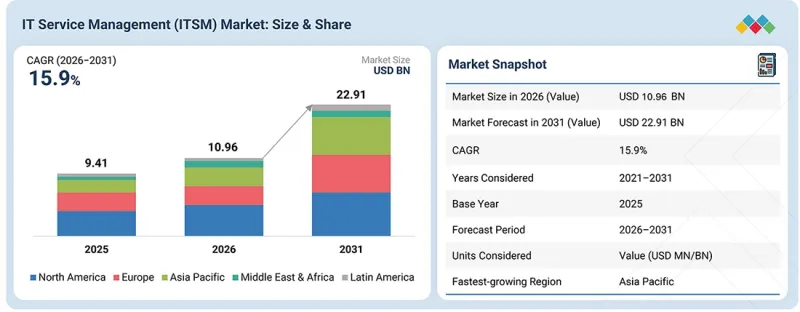
전 세계 IT 서비스 관리(ITSM) 시장은 2026년 109억 6,000만 달러에서 2031년까지 229억 1,000만 달러로 연평균 성장률(CAGR) 15.9%를 기록하며 확대될 것으로 전망됩니다.
이러한 성장은 디지털 서비스 및 하이브리드·멀티 클라우드 환경에 대한 기업의 의존도 증가, 분산형 인력의 증가, 그리고 애플리케이션, 인프라, 엔드포인트, 기업 기술 자산 전반에 걸친 복잡성 증대에 힘입은 것입니다. 각 조직은 인시던트, 문제, 변경, 요청, 구성, 지식 및 서비스 수준 관리 프로세스를 표준화하기 위해 통합형 IT 서비스 관리 플랫폼을 도입하고 있습니다.
| 조사 범위 | |
|---|---|
| 조사 기간 | 2021-2031년 |
| 기준 연도 | 2025년 |
| 예측 기간 | 2026-2031년 |
| 산정 단위 | 금액(백만 달러/십억 달러) |
| 부문 | 제공 내용, 솔루션, 서비스, 용도, 도입 모델, 조직 규모, 업종 |
| 대상 지역 | 북미, 유럽, 아시아태평양, 중동 및 아프리카, 라틴아메리카 |
AI를 활용한 서비스 데스크, 가상 에이전트, 지능형 티켓 라우팅, 자동 해결, 지식 자동화, 예측형 서비스 관리 및 엔터프라이즈 셀프서비스에 대한 수요가 증가하고 있습니다. IT 운영, IT 자산 관리, DevOps, 협업 플랫폼, 보안 운영 및 기업 애플리케이션과의 통합을 통해 플랫폼의 가치는 더욱 높아지고 있습니다. 그러나 도입의 복잡성, 마이그레이션 비용, 파편화된 레거시 시스템, CMDB의 낮은 품질, 맞춤화 요구 사항, 숙련된 IT 서비스 관리 전문가의 부족이 도입을 저해할 수 있습니다. 이러한 제약이 있음에도 불구하고, 클라우드 전환, 엔터프라이즈 서비스 관리, 생성형 AI, 에이전트 기반 자동화 및 디지털 직원 경험 이니셔티브를 통해 IT 서비스 관리는 지속적인 전략적 기업 투자로서 그 입지를 공고히 하고 있습니다.
“전개 방식별로는 예측 기간 동안 클라우드 부문이 가장 높은 성장률을 기록할 것으로 전망됩니다.”
예측 기간 동안 IT 서비스 관리 시장에서 클라우드 도입이 가장 빠른 성장세를 보일 것으로 예상됩니다. 기업들은 인프라 소유 및 관리 부담을 줄이고, 도입을 가속화하며, 지속적인 업그레이드를 지원하고, 새로운 AI 및 자동화 기능에 대한 접근을 용이하게 하기 위해 클라우드 기반 IT 서비스 관리 플랫폼을 점점 더 선호하고 있습니다. 클라우드 플랫폼을 통해 조직은 별도의 인프라를 유지 관리할 필요 없이, 지리적으로 분산된 직원, 사업 부문, SaaS 애플리케이션, 퍼블릭 클라우드 환경 및 하이브리드 기술 환경 전반에 걸쳐 서비스 관리 워크로드를 확장할 수 있습니다. 또한 플랫폼의 지속적인 업데이트를 통해 생성형 AI, 가상 에이전트, 워크플로우 자동화, 분석, 통합 및 보안 강화에 대한 접근도 신속해집니다. 구독형 모델은 확장성을 향상시키고, 레거시 서비스 관리 환경의 현대화를 목표로 하는 조직에 더 큰 비즈니스 유연성을 제공합니다. 클라우드 IT 서비스 관리는 보다 신속한 도입, 원격 액세스, 플랫폼 관리의 간소화, 그리고 최신 디지털 생태계와의 긴밀한 통합을 추구하는 기업에게 특히 매력적입니다. SaaS의 지속적인 도입, 기업 애플리케이션의 현대화, 분산형 인력, 그리고 AI를 활용한 서비스 관리에 대한 수요 증가로 인해, 규모나 업종을 불문하고 조직 전반에 걸쳐 클라우드 도입의 성장이 지속될 것으로 예상됩니다.
“솔루션별로는 예측 기간 동안 서비스 데스크 소프트웨어가 가장 큰 시장 점유율을 차지할 것으로 전망됩니다.”
예측 기간 동안 IT 서비스 관리(ITSM) 시장에서 서비스 데스크 소프트웨어가 가장 큰 점유율을 차지할 것으로 예상됩니다. 서비스 데스크는 인시던트 보고, 요청 제출, 서비스 이용, 지식 확보 및 서비스 상태 추적을 수행하는 데 있어 직원, 고객, IT 지원 팀 간의 주요 접점으로서 여전히 중요한 역할을 하고 있습니다. 기업에서는 방대한 양의 인시던트와 서비스 요청을 처리하고 있기 때문에 통합된 티켓 관리, 워크플로우 자동화, SLA 모니터링, 서비스 카탈로그, 옴니채널 지원 및 셀프서비스는 IT 서비스 관리의 핵심 기능이 되었습니다. 이 부문은 가상 에이전트, 생성형 AI, 티켓 자동 분류, 지능형 라우팅, 권장 해결책, 지식 검색 및 자동 대응의 도입 확대에 힘입어 더욱 강화되고 있습니다. 구성 관리 데이터베이스, 자산 정보, 협업 애플리케이션, 모니터링 시스템 및 기업 애플리케이션과의 통합을 통해 서비스에 대한 추가적인 맥락이 제공되어 문제 해결을 가속화합니다. 직원 경험, 서비스 신뢰성, 자동화 및 지원 비용 최적화에 대한 관심이 높아짐에 따라, 예측 기간 동안 서비스 데스크 소프트웨어에 대한 기업의 지출은 지속될 것으로 예상됩니다.
“북미는 선진적인 클라우드 도입과 기업의 디지털 성숙도 덕분에 IT 서비스 관리 시장을 주도하고 있습니다.”
북미는 성숙한 클라우드 도입, 광범위한 기업 디지털 인프라, 견실한 기술 투자, 그리고 체계화된 서비스 관리 관행의 보급에 힘입어 IT 서비스 관리 시장을 선도하고 있습니다. 미국 및 캐나다의 조직들은 인시던트, 요청, 변경, 구성, 지식 및 서비스 수준에 관한 표준화된 프로세스가 필요한 복잡한 하이브리드 및 멀티 클라우드 기술 환경을 운영하고 있습니다. 이 지역은 주요 IT 서비스 관리 플랫폼 공급업체, 하이퍼스케일 클라우드 제공업체, 시스템 통합업체, 관리형 서비스 제공업체, 엔터프라이즈 소프트웨어 기업 및 대규모 기술 구매 기업의 존재로 인해 혜택을 받고 있으며, 이들은 플랫폼의 혁신과 도입을 가속화하고 있습니다. 생성형 AI, 에이전트 기반 자동화, 엔터프라이즈 서비스 관리, 셀프서비스, IT 서비스 관리와 ITOM의 융합, 그리고 워크플로우 오케스트레이션은 금융 서비스, 기술, 통신, 의료, 정부, 소매, 제조 등 각 산업 분야에서 점점 더 많이 도입되고 있습니다. 또한 기업들은 디지털 직원 경험, 운영 복원력, 자동화, 서비스 수준 향상, 지원 비용 절감을 최우선 과제로 삼고 있습니다. 지속적인 클라우드 전환, AI 투자, 엔터프라이즈 워크플로우 현대화, 자율형 서비스 관리 기능의 도입 확대에 힘입어, 예측 기간 동안 북미는 가장 크고 성숙한 지역 IT 서비스 관리 시장으로서의 입지를 공고히 하고 있습니다.
1차 조사 내역
- 기업 규모별 : Tier 1 - 35%, Tier 2 - 45%, Tier 3 - 20%
- 직책별 : 이사 - 35%, 매니저 - 25%, 기타 - 40%
- 지역별 : 북미 - 45%, 유럽 - 20%, 아시아태평양 - 25%, 중동 및 아프리카 - 5%, 라틴아메리카 - 5%
본 보고서에는 IT 서비스 관리(ITSM) 시장의 주요 업체에 대한 상세한 조사가 포함되어 있습니다. 주요 벤더에 대해서는 사업 개요, 제품 포트폴리오, IT 서비스 관리 기능, 도입 모델, 사업 전개 지역, 파트너십, 사업 전략 및 최근 동향을 바탕으로 프로필을 작성했습니다.
조사 범위
- 제공 유형별 : 솔루션 및 서비스
- 솔루션별 : 서비스 포트폴리오 관리, 구성 및 변경 관리, 서비스 데스크 소프트웨어, 운영 및 성능 관리, 대시보드, 보고서, 분석
- 서비스별 : 매니지드 서비스 및 프로페셔널 서비스
- 용도별 : 인시던트 및 문제 관리, 변경 및 릴리스 관리, 서비스 요청 및 카탈로그 관리, 구성 관리, 지식 및 셀프서비스 관리, 서비스 수준 관리, 기타 IT 서비스 관리 애플리케이션
- 전개 방식별 : 온프레미스 및 클라우드
- 조직 규모별 : 대기업 및 중소기업
- 산업별 : BFSI, IT·통신, IT 및 ITeS, 정부·공공 부문, 소매·소비재, 제조, 에너지·공공사업, 미디어·엔터테인먼트, 의료, 교육 및 기타 산업
- 지역별 : 북미, 유럽, 아시아태평양, 중동 및 아프리카 및 라틴아메리카
본 보고서를 구매해야 하는 이유
본 보고서는 시장을 선도하는 기업 및 신규 진입 기업에게 IT 서비스 관리(ITSM) 시장 전체 및 그 하위 부문에 대한 신뢰할 수 있는 추정치를 제공합니다. 이를 통해 이해관계자들은 경쟁 동향을 파악하고, 벤더의 포지셔닝을 평가하며, 적절한 시장 진입, 제품 개발, 파트너십 및 시장 출시 전략을 수립할 수 있습니다. 또한, 본 조사를 통해 조직은 솔루션, 서비스, 애플리케이션, 도입 모델, 기업 규모, 산업 분야 및 지역에 걸친 시장의 동향을 평가할 수 있습니다. 아울러, IT 서비스 관리 생태계를 형성하는 주요 시장 촉진요인, 제약요인, 기회, 과제, 기술 변화, 고객 요구 사항 및 경쟁 환경의 동향에 대해 체계적인 인사이트를 제공합니다.
본 보고서에서는 다음 사항에 대한 인사이트를 제공합니다:
- 주요 촉진요인, 억제요인, 기회, 과제에 대한 분석 : 촉진요인에는 하이브리드 및 멀티 클라우드의 복잡성 증가, 디지털 직원 경험에 대한 수요 증가, 서비스 가용성 요구 사항 강화, AI를 활용한 자동화 도입 등이 포함됩니다. 억제요인으로는 도입 및 전환 비용의 높음, 통합의 복잡성, 과도한 맞춤화, 숙련된 IT 서비스 관리 전문가의 부족 등이 있습니다. 기회로는 생성형 AI 및 에이전틱 AI, 자율형 서비스 데스크, 엔터프라이즈 서비스 관리, 셀프서비스, IT 서비스 관리와 ITOM의 융합 등이 있습니다. 과제로는 CMDB의 낮은 품질, 파편화된 레거시 시스템, 프로세스 성숙도의 불균형, 거버넌스 요구 사항, 측정 가능한 비즈니스 가치 입증 등이 있습니다.
- 제품 개발/혁신 : IT 서비스 관리 시장 전반에 걸친 신흥 기술, 연구 개발 활동, 플랫폼 기능 강화, 생성형 AI, 에이전틱 AI, 자율적인 티켓 해결, 지식 자동화, 가상 에이전트, 예측형 인시던트 관리, 워크플로우 오케스트레이션, 서비스 분석, 그리고 신제품 및 서비스 출시에 관한 상세한 인사이트.
- 시장 개발 : 매력적인 시장에 대한 종합적인 정보. 여기에는 지역별 IT 서비스 관리 도입 패턴, 클라우드 성숙도, 기업의 IT 지출, 디지털 전환 동향, AI 도입 현황, 서비스 관리 현대화, 주요 산업 부문의 수요 등이 포함됩니다.
- 시장 다각화 : 전체 IT 서비스 관리 시장에서 새로운 제품, 서비스, 도입 모델, 파트너십, 인수, 지리적 확장, 자금 조달 활동, 투자, 엔터프라이즈 서비스 관리의 확대 및 인접한 ServiceOps 기회에 대한 상세한 정보.
- 경쟁 평가 : 주요 기업들의 시장 점유율, 플랫폼 역량, 성장 전략, 제품 포트폴리오, AI 관련 역량, 파트너십 및 지리적 입지에 대한 상세한 평가.
자주 묻는 질문
목차
제1장 서론
제2장 요약
제3장 주요 인사이트
- IT 서비스 관리 시장에서 사업자에게 매력적인 기회
- IT 서비스 관리(ITSM) 시장 : 제공 서비스별
- IT 서비스 관리(ITSM) 시장 : 솔루션별
- IT 서비스 관리(ITSM) 시장 : 서비스별
- IT 서비스 관리(ITSM) 시장 : 지역별
제4장 시장 개요
- 시장 역학
- 성장 촉진요인
- 성장 억제요인
- 기회
- 과제
- 미충족 수요와 미개척 분야
- IT 서비스 관리(ITSM) 시장의 미충족 수요
- 미개척 시장의 기회
- 상호 연관된 시장 및 부문 간 기회
- 상호 연관된 시장
- 부문 간 기회
- 새로운 비즈니스 모델과 생태계의 변화
- 새로운 비즈니스 모델
- 생태계의 변화
- Tier 1/2/3 기업들의 전략적 움직임
- 주요 동향과 전략적 중점
제5장 업계 동향
- Porter's Five Forces 분석
- 신규 진입자의 위협
- 대체품의 위협
- 공급업체의 협상력
- 구매자의 협상력
- 경쟁의 치열함
- 거시경제 지표
- GDP 동향 및 전망
- 클라우드 컴퓨팅 업계 동향
- 가시성 도구 및 플랫폼 업계 동향
- 밸류체인 분석
- 생태계 분석
- 2025-2026년 주요 컨퍼런스 및 행사
- 고객의 비즈니스에 영향을 미치는 동향/파괴적 혁신
- 사례 연구 분석
- ServiceNow 도입을 통해 Mindsprint는 고객으로부터 접수된 인시던트의 최대 95%를 자동화할 수 있었습니다
- BMC Helix IT 서비스 관리 도입을 통해 Quironsalud는 서비스 데스크 문의 건수를 50% 줄였습니다
- Atlassian을 통해 Software AG는 14만 5,000건 이상의 서비스 요청을 관리할 수 있게 되었습니다
- 2025년 미국 관세가 IT 서비스 관리(ITSM) 시장에 미치는 영향
- 주요 관세율
- 가격에 미치는 영향 분석
- 국가 및 지역에 미치는 영향
- 최종 이용 산업에 미치는 영향
제6장 기술, 특허, 디지털화 및 AI 도입에 따른 전략적 변혁
- 기술 분석
- 주요 신흥 기술
- 에이전틱 AI와 자율형 서비스 관리
- 생성형 AI를 활용한 지식 및 대화형 셀프서비스
- AIOPS를 활용한 인시던트 탐지, 진단 및 예방
- 지능형 CMDB, 서비스 그래프 및 컨텍스트 기반 서비스 데이터
- 보완 기술
- 가시성, AIOPS 및 서비스 운영과의 통합
- 로우 코드를 통한 워크플로우 자동화 및 통합 오케스트레이션
- 디지털 직원 경험 및 엔드포인트 인텔리전스
- 관련 기술
- IT 운영 관리 및 가시성
- IT 자산 관리 및 통합 엔드포인트 관리
- DevOps, 소프트웨어 배포 및 보안 운영
- 기술 로드맵
- 단기(2026-2028년) | AI 네이티브, 에이전트 기반, 통합 서비스 관리
- 중기(2028-2031년) | 상황인식형, 멀티 에이전트 및 통합 서비스 운영
- 장기(2031-2035년) | 자율형, 정책 주도형 및 자가 최적화형 서비스 관리
- 특허 분석
- 미래의 응용
- 자율적인 인시던트 조사 및 해결
- AI를 활용한 예측적 및 예방적 서비스 운영
- 에이전트형 직원 셀프서비스 및 요청 처리
- 지능형 변경 위험 평가 및 자율적인 거버넌스
- IT 및 비즈니스 기능을 아우르는 전사적 서비스 오케스트레이션
- AI/생성형 AI가 IT 서비스 관리(ITSM) 시장에 미치는 영향
- 주요 사용 사례 및 시장의 잠재력
- IT 서비스 관리(ITSM) 분야의 모범 사례
- IT 서비스 관리(ITSM) 시장에서 AI 도입 사례 연구
- 상호 연계되는 인접 생태계와 시장 참여자에 미치는 영향
- IT 서비스 관리(ITSM) 시장에서 AI/생성형 AI 도입에 대한 고객의 준비 현황
- 아틀라시안은 AI를 활용한 IT 서비스 관리를 통해 NETA의 티켓 에스컬레이션을 줄일 수 있게 했습니다
- ServiceNow, 딜로이트의 AI 주도형 엔터프라이즈 서비스 관리 확대를 지원
- 규제 현황
- 지역별 규제
- 지역별 업계 표준
제7장 고객 현황 및 구매 행동
- 의사결정 과정
- 구매와 관련된 이해관계자와 구매 평가 기준
- 구매 과정에서 주요 이해관계자
- 구매 기준
- 도입 장벽 및 사내 과제
- 각 최종 이용 산업별 미충족 수요
- 시장의 수익성
- 수익 창출 가능성
- 비용 동향
- 각 최종 이용 산업별 이익률 향상 기회
제8장 IT 서비스 관리(ITSM) 시장 : 제공 유형별
- 솔루션별
- 서비스
제9장 IT 서비스 관리(ITSM) 시장 : 용도별
- 인시던트 및 문제 관리
- 변경 및 릴리스 관리
- 서비스 요청 및 카탈로그 관리
- 구성 관리
- 지식 및 셀프서비스 관리
- 서비스 수준 관리
- 기타 IT 서비스 관리 애플리케이션
제10장 IT 서비스 관리(ITSM) 시장 : 배포 방식별
- 온프레미스
- 클라우드
제11장 IT 서비스 관리(ITSM) 시장 : 조직 규모별
- 대기업
- 중소기업
제12장 IT 서비스 관리(ITSM) 시장 : 산업별
- 은행·금융 서비스·보험(BFSI)
- 통신
- IT 및 ITES
- 정부·공공 부문
- 소매·소비재
- 제조업
- 에너지·공공사업
- 미디어·엔터테인먼트
- 헬스케어
- 교육
- 기타 산업
제13장 IT 서비스 관리(ITSM) 시장 : 지역별
- 북미
- 북미 : IT 서비스 관리 시장 촉진요인
- 미국
- 캐나다
- 유럽
- 유럽 : IT 서비스 관리 시장 촉진요인
- 영국
- 독일
- 프랑스
- 이탈리아
- 기타 유럽
- 아시아태평양
- 아시아태평양 : IT 서비스 관리 시장 촉진요인
- 중국
- 일본
- 인도
- 호주·뉴질랜드(ANZ)
- 기타 아시아태평양
- 중동 및 아프리카
- 중동 및 아프리카 : IT 서비스 관리 시장 촉진요인
- GCC 국가들
- 남아프리카
- 기타 중동 및 아프리카
- 라틴아메리카
- 라틴아메리카 : IT 서비스 관리 시장의 성장 촉진요인
- 브라질
- 멕시코
- 기타 라틴아메리카
제14장 경쟁 현황
- 주요 진입 기업의 전략/강점,2023-2026년
- 수익 분석, 2021-2025년
- 시장 점유율 분석(2026년)
- 제품 비교, 2026년
- 기업 평가 매트릭스 : 주요 기업, 2026년, IT 서비스 관리(ITSM) 시장
- 스타 기업
- 신흥 리더
- 광범위한 업체
- 진입 기업
- 기업 사업 전개 : 주요 기업, 2026년
- 기업 평가 매트릭스 : 스타트업/중소기업, 2026년
- 선도적인 기업
- 대응력이 뛰어난 기업
- 역동적인 기업
- 출발점
- 경쟁사 벤치마킹 : 스타트업/중소기업, 2025년
- 기업 가치 평가 및 재무 지표, 2026년
- 주요 벤더의 기업 가치 평가
- 주요 벤더의 재무 지표
- 경쟁 시나리오
- 제품 출시
- 거래
제15장 기업 개요
- 주요 기업
- SERVICENOW
- BMC SOFTWARE
- ATLASSIAN
- BROADCOM
- ZOHO CORPORATION
- IVANTI
- ZENDESK
- FRESHWORKS
- SOLARWINDS
- OPENTEXT
- 기타 주요 기업
- MICROSOFT
- IBM
- IFS
- SALESFORCE
- AISERA
- NINJAONE
- SYSAID TECHNOLOGIES
- INVGATE
- XURRENT
- HORNBILL
- ALEMBA
- SYMPHONYAI
- HALO SERVICE SOLUTIONS
- TEAMDYNAMIX
- ITARIAN
- EASYVISTA
- TOPDESK
- MATRIX42
- GOTO
제16장 조사 방법론
제17장 부록
KSM 26.10.23The global IT Service Management (ITSM) market is projected to grow from USD 10.96 billion in 2026 to USD 22.91 billion by 2031, at a CAGR of 15.9%. Growth is supported by increasing enterprise dependence on digital services, hybrid and multi-cloud environments, distributed workforces, and growing complexity across applications, infrastructure, endpoints, and enterprise technology estates. Organizations are adopting integrated ITSM platforms to standardize incident, problem, change, request, configuration, knowledge, and service-level management processes.
| Scope of the Report | |
|---|---|
| Years Considered for the Study | 2021-2031 |
| Base Year | 2025 |
| Forecast Period | 2026-2031 |
| Units Considered | Value (USD Million/USD Billion) |
| Segments | Offering, Solution, Service, Application, Deployment Model, Organization Size, Vertical |
| Regions covered | North America, Europe, Asia Pacific, Middle East & Africa, Latin America |
Demand is rising for AI-enabled service desks, virtual agents, intelligent ticket routing, automated resolution, knowledge automation, predictive service management, and enterprise self-service. Integration with IT operations, IT asset management, DevOps, collaboration platforms, security operations, and enterprise applications is further strengthening platform value. However, implementation complexity, migration costs, fragmented legacy systems, poor CMDB quality, customization requirements, and shortages of skilled ITSM professionals can constrain adoption. Despite these limitations, cloud migration, enterprise service management, generative AI, agentic automation, and digital employee experience initiatives are reinforcing ITSM as a recurring strategic enterprise investment.
"By deployment mode, cloud segment to register the fastest growth rate during the forecast period."
Cloud deployment is expected to record the fastest growth in the IT Service Management market during the forecast period. Enterprises increasingly prefer cloud-based ITSM platforms because they reduce infrastructure ownership and administration, accelerate implementation, support continuous upgrades, and provide easier access to new AI and automation capabilities. Cloud platforms enable organizations to scale service-management workloads across geographically distributed employees, business units, SaaS applications, public cloud environments, and hybrid technology estates without maintaining separate infrastructure. Continuous platform updates also provide faster access to generative AI, virtual agents, workflow automation, analytics, integrations, and security enhancements. Subscription-based models improve scalability and provide greater commercial flexibility for organizations seeking to modernize legacy service-management environments. Cloud ITSM particularly appeals to enterprises seeking faster deployment, remote accessibility, simplified platform administration, and tighter integration with modern digital ecosystems. Continued SaaS adoption, enterprise application modernization, distributed workforces, and growing demand for AI-enabled service management are expected to sustain cloud deployment growth across organizations of varying sizes and industries.
"By solution, service desk software to hold the largest market share during the forecast period."
Service desk software is expected to hold the largest share of the IT Service Management market during the forecast period. The service desk remains the primary interaction layer between employees, customers, and IT support teams for reporting incidents, submitting requests, accessing services, obtaining knowledge, and tracking service status. Enterprises process large volumes of incidents and service requests, making centralized ticket management, workflow automation, SLA monitoring, service catalogs, omnichannel support, and self-service foundational ITSM capabilities. The segment is further strengthened by growing adoption of virtual agents, generative AI, automated ticket classification, intelligent routing, recommended resolutions, knowledge retrieval, and automated fulfillment. Integration with configuration management databases, asset information, collaboration applications, monitoring systems, and enterprise applications provides additional service context and helps accelerate issue resolution. Increasing focus on employee experience, service reliability, automation, and support-cost optimization is expected to sustain enterprise spending on service desk software throughout the forecast period.
"North America leads the IT Service Management market through advanced cloud adoption and enterprise digital maturity."
North America leads the IT Service Management market, supported by mature cloud adoption, extensive enterprise digital infrastructure, strong technology spending, and widespread use of structured service-management practices. Organizations across the US and Canada operate complex hybrid and multi-cloud technology environments requiring standardized processes for incidents, requests, changes, configurations, knowledge, and service levels. The region benefits from the presence of major ITSM platform vendors, hyperscale cloud providers, system integrators, managed service providers, enterprise software companies, and large technology buyers that accelerate platform innovation and adoption. Generative AI, agentic automation, enterprise service management, self-service, ITSM-ITOM convergence, and workflow orchestration are increasingly deployed across financial services, technology, telecommunications, healthcare, government, retail, and manufacturing. Enterprises are also prioritizing digital employee experience, operational resilience, automation, service-level improvement, and lower support costs. Continued cloud migration, AI investment, enterprise workflow modernization, and increasing adoption of autonomous service-management capabilities reinforce North America's position as the largest and most mature regional ITSM market throughout the forecast period.
Breakdown of Primaries
In-depth interviews were conducted with Chief Executive Officers (CEOs), Chief Information Officers (CIOs), Chief Technology Officers (CTOs), IT service management leaders, service desk managers, IT operations executives, product leaders, system integrators, managed service providers, and executives from organizations operating across the IT Service Management market.
- By Company: Tier 1 - 35%, Tier 2 - 45%, and Tier 3 - 20%
- By Designation: Directors - 35%, Managers - 25%, and others - 40%
- By Region: North America - 45%, Europe - 20%, Asia Pacific - 25%, Middle East & Africa - 5%, and Latin America - 5%
The report includes a detailed study of leading participants in the IT Service Management market. It profiles major vendors based on their business overview, product portfolio, ITSM capabilities, deployment models, geographic presence, partnerships, business strategies, and recent developments.
Key market players include ServiceNow (US), BMC Software (US), Broadcom (US), ManageEngine (US), Ivanti (US), Zendesk (US), GoTo (US), SolarWinds (US), Atlassian (Australia), OpenText (Canada), SymphonyAI Summit (US), Efecte (Finland), Microsoft (US), IBM (US), IFS (Sweden), Freshworks (US), EasyVista (France), ITarian (US), SysAid Technologies (Israel), InvGate (US), Alemba (UK), Hornbill (UK), NinjaOne (US), HaloITSM (UK), Aisera (US), 4me (US), TOPdesk (Netherlands), TeamDynamix (US), Salesforce (US), Xurrent (US), and Matrix42 (Germany).
Research Coverage
- By Offering: Solutions and Services
- By Solution: Service Portfolio Management, Configuration & Change Management, Service Desk Software, Operations & Performance Management, and Dashboard, Reporting, and Analytics
- By Services: Managed Services and Professional Services
- By Application: Incident & Problem Management, Change & Release Management, Service Request & Catalog Management, Configuration Management, Knowledge & Self-Service Management, Service Level Management, and Other ITSM Applications
- By Deployment Model: On-Premises and Cloud
- By Organization Size: Large Enterprises and SMEs
- By Vertical: BFSI, Telecommunications, IT & ITeS, Government & Public Sector, Retail & Consumer Goods, Manufacturing, Energy & Utilities, Media & Entertainment, Healthcare, Education, and Other Verticals
- By Region: North America, Europe, Asia Pacific, Middle East & Africa, and Latin America
Reason to buy this Report
The report provides market leaders and new entrants with reliable estimates for the overall IT Service Management (ITSM) market and its subsegments. It helps stakeholders understand competitive dynamics, evaluate vendor positioning, and identify suitable market-entry, product-development, partnership, and go-to-market strategies. The study also enables organizations to assess market momentum across solutions, services, applications, deployment models, enterprise sizes, verticals, and regions. Additionally, it provides structured insights into key market drivers, restraints, opportunities, challenges, technology shifts, customer requirements, and competitive developments shaping the ITSM ecosystem.
The report provides insights on the following pointers:
- Analysis of key drivers, restraints, opportunities, and challenges: Drivers include growing hybrid and multi-cloud complexity, rising demand for digital employee experience, increasing service availability requirements, and adoption of AI-enabled automation. Restraints include high implementation and migration costs, integration complexity, excessive customization, and shortages of skilled ITSM professionals. Opportunities include generative and agentic AI, autonomous service desks, enterprise service management, self-service, and ITSM-ITOM convergence. Challenges include poor CMDB quality, fragmented legacy systems, inconsistent process maturity, governance requirements, and demonstrating measurable business value.
- Product Development/Innovation: Detailed insights into emerging technologies, research and development activities, platform enhancements, generative AI, agentic AI, autonomous ticket resolution, knowledge automation, virtual agents, predictive incident management, workflow orchestration, service analytics, and new product and service launches across the ITSM market.
- Market Development: Comprehensive information on attractive markets, including regional ITSM adoption patterns, cloud maturity, enterprise IT spending, digital transformation activity, AI adoption, service-management modernization, and demand across major industry verticals.
- Market Diversification: Detailed information regarding new products, services, deployment models, partnerships, acquisitions, geographic expansions, funding activity, investments, enterprise service management expansion, and adjacent ServiceOps opportunities across the ITSM market.
- Competitive Assessment: In-depth evaluation of market shares, platform capabilities, growth strategies, product portfolios, AI capabilities, partnerships, and geographic presence of leading players, including ServiceNow (US), BMC Software (US), Broadcom (US), ManageEngine (US), Ivanti (US), Zendesk (US), GoTo (US), SolarWinds (US), Atlassian (Australia), OpenText (Canada), SymphonyAI Summit (US), Efecte (Finland), Microsoft (US), IBM (US), IFS (Sweden), Freshworks (US), EasyVista (France), ITarian (US), SysAid Technologies (Israel), InvGate (US), Alemba (UK), Hornbill (UK), NinjaOne (US), HaloITSM (UK), Aisera (US), 4me (US), TOPdesk (Netherlands), TeamDynamix (US), Salesforce (US), Xurrent (US), and Matrix42 (Germany).
TABLE OF CONTENTS
1 INTRODUCTION
- 1.1 STUDY OBJECTIVES
- 1.2 MARKET DEFINITION
- 1.3 MARKET SCOPE
- 1.3.1 MARKET SEGMENTATION AND REGIONAL SCOPE
- 1.3.2 INCLUSIONS AND EXCLUSIONS
- 1.3.3 YEARS CONSIDERED
- 1.4 CURRENCY CONSIDERED
- 1.5 LIMITATIONS
- 1.6 STAKEHOLDERS
- 1.7 SUMMARY OF CHANGES
2 EXECUTIVE SUMMARY
- 2.1 MARKET HIGHLIGHTS AND KEY INSIGHTS
- 2.2 KEY MARKET PARTICIPANTS: MAPPING OF STRATEGIC DEVELOPMENTS
- 2.3 DISRUPTIVE TRENDS IN ITSM MARKET
- 2.4 HIGH-GROWTH SEGMENTS
- 2.5 REGIONAL SNAPSHOT: MARKET SIZE, GROWTH RATE, AND FORECAST
3 PREMIUM INSIGHTS
- 3.1 ATTRACTIVE OPPORTUNITIES FOR PLAYERS IN ITSM MARKET
- 3.2 IT SERVICE MANAGEMENT (ITSM) MARKET, BY OFFERING
- 3.3 IT SERVICE MANAGEMENT (ITSM) MARKET, BY SOLUTION
- 3.4 IT SERVICE MANAGEMENT (ITSM) MARKET, BY SERVICE
- 3.5 IT SERVICE MANAGEMENT (ITSM) MARKET, BY REGION
4 MARKET OVERVIEW
- 4.1 INTRODUCTION
- 4.2 MARKET DYNAMICS
- 4.2.1 DRIVERS
- 4.2.1.1 AI-enabled service automation accelerates enterprise adoption of intelligent ITSM platforms and workflows
- 4.2.1.2 Increasing hybrid and multi-cloud complexity strengthens demand for unified service visibility and coordination
- 4.2.1.3 Growing operational resilience and cybersecurity requirements
- 4.2.2 RESTRAINTS
- 4.2.2.1 High implementation, migration, and customization effort slows replacement of established enterprise ITSM environments
- 4.2.2.2 Complex licensing and total ownership costs constrain expansion among budget-sensitive organizations
- 4.2.3 OPPORTUNITIES
- 4.2.3.1 Agentic AI creates new revenue opportunities through autonomous service resolution and workflow execution
- 4.2.3.2 Enterprise service management expansion into HR, finance, facilities, and business operations
- 4.2.4 CHALLENGES
- 4.2.4.1 Maintaining interoperability across rapidly changing enterprise technology ecosystems
- 4.2.4.2 Balancing autonomous AI actions with security, accountability, and human oversight
- 4.2.1 DRIVERS
- 4.3 UNMET NEEDS AND WHITE SPACES
- 4.3.1 UNMET NEEDS IN IT SERVICE MANAGEMENT (ITSM) MARKET
- 4.3.2 WHITE SPACE OPPORTUNITIES
- 4.4 INTERCONNECTED MARKETS AND CROSS-SECTOR OPPORTUNITIES
- 4.4.1 INTERCONNECTED MARKETS
- 4.4.2 CROSS-SECTOR OPPORTUNITIES
- 4.5 EMERGING BUSINESS MODELS AND ECOSYSTEM SHIFTS
- 4.5.1 EMERGING BUSINESS MODELS
- 4.5.1.1 IT SERVICE MANAGEMENT (ITSM) BUSINESS MODELS
- 4.5.2 ECOSYSTEM SHIFTS
- 4.5.1 EMERGING BUSINESS MODELS
- 4.6 STRATEGIC MOVES BY TIER-1/2/3 PLAYERS
- 4.6.1 KEY MOVES AND STRATEGIC FOCUS
5 INDUSTRY TRENDS
- 5.1 PORTER'S FIVE FORCES ANALYSIS
- 5.1.1 THREAT OF NEW ENTRANTS
- 5.1.2 THREAT OF SUBSTITUTES
- 5.1.3 BARGAINING POWER OF SUPPLIERS
- 5.1.4 BARGAINING POWER OF BUYERS
- 5.1.5 INTENSITY OF COMPETITION RIVALRY
- 5.2 MACROECONOMIC INDICATORS
- 5.2.1 INTRODUCTION
- 5.2.2 GDP TRENDS AND FORECASTS
- 5.2.3 TRENDS IN CLOUD COMPUTING INDUSTRY
- 5.2.4 TRENDS IN OBSERVABILITY TOOLS AND PLATFORMS INDUSTRY
- 5.3 VALUE CHAIN ANALYSIS
- 5.4 ECOSYSTEM ANALYSIS
- 5.5 KEY CONFERENCES AND EVENTS, 2025-2026
- 5.6 TRENDS/DISRUPTIONS IMPACTING CUSTOMER BUSINESS
- 5.7 CASE STUDY ANALYSIS
- 5.7.1 SERVICENOW ENABLED MINDSPRINT TO AUTOMATE UP TO 95% OF CUSTOMER INCIDENTS
- 5.7.2 BMC HELIX ITSM ENABLED QUIRONSALUD TO REDUCE SERVICE DESK CALLS BY 50%
- 5.7.3 ATLASSIAN ENABLED SOFTWARE AG TO MANAGE MORE THAN 145,000 SERVICE REQUESTS
- 5.8 IMPACT OF 2025 US TARIFFS - IT SERVICE MANAGEMENT (ITSM) MARKET
- 5.8.1 INTRODUCTION
- 5.8.2 KEY TARIFF RATES
- 5.8.3 PRICE IMPACT ANALYSIS
- 5.8.4 IMPACT ON COUNTRY/REGION
- 5.8.4.1 US
- 5.8.4.2 Europe
- 5.8.4.3 Asia Pacific
- 5.8.5 IMPACT ON END-USE INDUSTRIES
- 5.8.5.1 BFSI
- 5.8.5.2 IT & ITeS
- 5.8.5.3 Telecommunications
- 5.8.5.4 Healthcare
- 5.8.5.5 Retail
- 5.8.5.6 Manufacturing
- 5.8.5.7 Government & public sector
- 5.8.5.8 Energy & utilities
- 5.8.5.9 Media & entertainment
- 5.8.5.10 Education
6 STRATEGIC DISRUPTION THROUGH TECHNOLOGY, PATENTS, DIGITAL, AND AI ADOPTION
- 6.1 TECHNOLOGY ANALYSIS
- 6.2 KEY EMERGING TECHNOLOGIES
- 6.2.1 AGENTIC AI AND AUTONOMOUS SERVICE MANAGEMENT
- 6.2.2 GENERATIVE AI-POWERED KNOWLEDGE AND CONVERSATIONAL SELF-SERVICE
- 6.2.3 AIOPS-DRIVEN INCIDENT DETECTION, DIAGNOSIS, AND PREVENTION
- 6.2.4 INTELLIGENT CMDB, SERVICE GRAPH, AND CONTEXTUAL SERVICE DATA
- 6.3 COMPLEMENTARY TECHNOLOGIES
- 6.3.1 OBSERVABILITY, AIOPS, AND SERVICE OPERATIONS INTEGRATION
- 6.3.2 LOW-CODE WORKFLOW AUTOMATION AND INTEGRATION ORCHESTRATION
- 6.3.3 DIGITAL EMPLOYEE EXPERIENCE AND ENDPOINT INTELLIGENCE
- 6.4 ADJACENT TECHNOLOGIES
- 6.4.1 IT OPERATIONS MANAGEMENT AND OBSERVABILITY
- 6.4.2 IT ASSET MANAGEMENT AND UNIFIED ENDPOINT MANAGEMENT
- 6.4.3 DEVOPS, SOFTWARE DELIVERY, AND SECURITY OPERATIONS
- 6.5 TECHNOLOGY ROADMAP
- 6.5.1 SHORT-TERM (2026-2028) | AI-NATIVE, AGENTIC, AND INTEGRATED SERVICE MANAGEMENT
- 6.5.1.1 Focus Areas
- 6.5.1.1.1 Technology Development
- 6.5.1.1.2 Product/Service Innovations
- 6.5.1.1.3 Market Adoption
- 6.5.1.1 Focus Areas
- 6.5.2 MID-TERM (2028-2031) | CONTEXT-AWARE, MULTI-AGENT, AND UNIFIED SERVICE OPERATIONS
- 6.5.2.1 Focus Areas
- 6.5.2.1.1 Technology Development
- 6.5.2.1.2 Product/Service Innovations
- 6.5.2.1.3 Market Adoption
- 6.5.2.1 Focus Areas
- 6.5.3 LONG-TERM (2031-2035) | AUTONOMOUS, POLICY-DRIVEN, AND SELF-OPTIMIZING SERVICE MANAGEMENT
- 6.5.3.1 Focus Areas
- 6.5.3.1.1 Technology Development
- 6.5.3.1.2 Product/Service Innovations
- 6.5.3.1.3 Market Adoption
- 6.5.3.1 Focus Areas
- 6.5.1 SHORT-TERM (2026-2028) | AI-NATIVE, AGENTIC, AND INTEGRATED SERVICE MANAGEMENT
- 6.6 PATENT ANALYSIS
- 6.7 FUTURE APPLICATIONS
- 6.7.1 AUTONOMOUS INCIDENT INVESTIGATION AND RESOLUTION
- 6.7.2 AI-DRIVEN PREDICTIVE AND PREVENTIVE SERVICE OPERATIONS
- 6.7.3 AGENTIC EMPLOYEE SELF-SERVICE AND REQUEST FULFILLMENT
- 6.7.4 INTELLIGENT CHANGE-RISK ASSESSMENT AND AUTONOMOUS GOVERNANCE
- 6.7.5 ENTERPRISE-WIDE SERVICE ORCHESTRATION ACROSS IT AND BUSINESS FUNCTIONS
- 6.8 IMPACT OF AI/GENERATIVE AI ON IT SERVICE MANAGEMENT (ITSM) MARKET
- 6.8.1 TOP USE CASES AND MARKET POTENTIAL
- 6.8.2 BEST PRACTICES IN IT SERVICE MANAGEMENT (ITSM)
- 6.8.3 CASE STUDY OF AI IMPLEMENTATION IN IT SERVICE MANAGEMENT (ITSM) MARKET
- 6.8.3.1 FRESHWORKS ENABLES SEAGATE TO MODERNIZE ITSM AND DEPLOY AI AT SCALE
- 6.8.4 INTERCONNECTED ADJACENT ECOSYSTEMS AND IMPACT ON MARKET PLAYERS
- 6.8.5 CLIENT READINESS TO ADOPT AI/GENERATIVE AI IN IT SERVICE MANAGEMENT (ITSM) MARKET
- 6.8.6 ATLASSIAN ENABLES NETA TO REDUCE TICKET ESCALATIONS THROUGH AI-ASSISTED ITSM
- 6.8.7 SERVICENOW ENABLES DELOITTE TO SCALE AI-DRIVEN ENTERPRISE SERVICE MANAGEMENT
- 6.9 REGULATORY LANDSCAPE
- 6.9.1 REGULATIONS, BY REGION
- 6.9.1.1 North America
- 6.9.1.2 Europe
- 6.9.1.3 Asia Pacific
- 6.9.1.4 Rest of the World
- 6.9.2 INDUSTRY STANDARDS, BY REGION
- 6.9.2.1 North America
- 6.9.2.2 Europe
- 6.9.2.3 Asia Pacific
- 6.9.2.4 Middle East & Africa
- 6.9.2.5 Latin America
- 6.9.1 REGULATIONS, BY REGION
7 CUSTOMER LANDSCAPE AND BUYER BEHAVIOR
- 7.1 DECISION-MAKING PROCESS
- 7.2 BUYER STAKEHOLDERS AND BUYING EVALUATION CRITERIA
- 7.2.1 KEY STAKEHOLDERS IN BUYING PROCESS
- 7.2.2 BUYING CRITERIA
- 7.3 ADOPTION BARRIERS AND INTERNAL CHALLENGES
- 7.4 UNMET NEEDS ACROSS END-USE INDUSTRIES
- 7.5 MARKET PROFITABILITY
- 7.5.1 REVENUE POTENTIAL
- 7.5.2 COST DYNAMICS
- 7.5.3 MARGIN OPPORTUNITIES IN END-USE INDUSTRIES
8 IT SERVICE MANAGEMENT (ITSM) MARKET, BY OFFERING
- 8.1 INTRODUCTION
- 8.1.1 OFFERINGS: ITSM MARKET DRIVERS
- 8.2 SOLUTIONS
- 8.2.1 SERVICE PORTFOLIO MANAGEMENT
- 8.2.1.1 Centralized portfolio governance strengthens investment alignment and service value realization
- 8.2.1.2 Service catalog management
- 8.2.1.3 Service pipeline management
- 8.2.1.4 Demand management
- 8.2.1.5 Others
- 8.2.2 CONFIGURATION & CHANGE MANAGEMENT
- 8.2.2.1 Automated change controls strengthen stability across increasingly dynamic IT environments
- 8.2.2.2 Configuration management database
- 8.2.2.3 Change control
- 8.2.2.4 Version control
- 8.2.2.5 Others
- 8.2.3 SERVICE DESK SOFTWARE
- 8.2.3.1 AI-enabled service desks accelerate resolution while consolidating enterprise support workflows
- 8.2.3.2 Incident management
- 8.2.3.3 Problem management
- 8.2.3.4 Service request management
- 8.2.3.5 Knowledge base
- 8.2.3.6 Others
- 8.2.4 OPERATIONS & PERFORMANCE MANAGEMENT
- 8.2.4.1 AI-driven observability strengthens resilience across complex digital service environments
- 8.2.4.2 Performance monitoring
- 8.2.4.3 Capacity management
- 8.2.4.4 Event management
- 8.2.4.5 Others
- 8.2.5 DASHBOARD, REPORTING, AND ANALYTICS
- 8.2.5.1 Unified analytics converts service data into actionable business decisions
- 8.2.1 SERVICE PORTFOLIO MANAGEMENT
- 8.3 SERVICES
- 8.3.1 MANAGED SERVICES
- 8.3.1.1 Managed ITSM services strengthen continuity while reducing operational complexity
- 8.3.2 PROFESSIONAL SERVICES
- 8.3.2.1 Specialized expertise accelerates implementation, adoption, and ITSM transformation outcomes
- 8.3.2.2 Consulting
- 8.3.2.3 Integration & implementation
- 8.3.2.4 Training, support, and maintenance
- 8.3.1 MANAGED SERVICES
9 IT SERVICE MANAGEMENT (ITSM) MARKET, BY APPLICATION
- 9.1 INTRODUCTION
- 9.1.1 APPLICATION: ITSM MARKET DRIVERS
- 9.2 INCIDENT & PROBLEM MANAGEMENT
- 9.2.1 AI-DRIVEN INCIDENT MANAGEMENT ACCELERATES RESTORATION WHILE PREVENTING RECURRING SERVICE FAILURES
- 9.2.2 MAJOR INCIDENT MANAGEMENT
- 9.2.3 INTELLIGENT TRIAGE, CLASSIFICATION, AND ROUTING
- 9.2.4 AUTOMATED INCIDENT RESOLUTION
- 9.2.5 ROOT CAUSE & PROBLEM ANALYSIS
- 9.3 CHANGE & RELEASE MANAGEMENT
- 9.3.1 AUTOMATED CHANGE GOVERNANCE ACCELERATES RELEASES WHILE PROTECTING SERVICE STABILITY
- 9.3.2 CHANGE RISK ASSESSMENT
- 9.3.3 AUTOMATED CHANGE APPROVAL
- 9.3.4 CHANGE IMPACT ANALYSIS
- 9.3.5 RELEASE & DEPLOYMENT COORDINATION
- 9.4 SERVICE REQUEST & CATALOG MANAGEMENT
- 9.4.1 INTELLIGENT REQUEST ORCHESTRATION ACCELERATES FULFILMENT WHILE IMPROVING EMPLOYEE SELF-SERVICE EXPERIENCES
- 9.4.2 SERVICE CATALOG MANAGEMENT
- 9.4.3 AUTOMATED REQUEST FULFILMENT
- 9.4.4 CONVERSATIONAL SELF-SERVICE/VIRTUAL AGENTS
- 9.4.5 WORKFLOW-BASED REQUEST ORCHESTRATION
- 9.5 CONFIGURATION MANAGEMENT
- 9.5.1 TRUSTED CONFIGURATION DATA STRENGTHENS VISIBILITY, AUTOMATION, AND SERVICE RESILIENCE
- 9.5.2 CMDB MANAGEMENT
- 9.5.3 CI RELATIONSHIP & DEPENDENCY MAPPING
- 9.5.4 AUTOMATED CONFIGURATION DATA ENRICHMENT
- 9.5.5 CONFIGURATION DATA QUALITY & RECONCILIATION
- 9.6 KNOWLEDGE & SELF-SERVICE MANAGEMENT
- 9.6.1 AI-POWERED KNOWLEDGE ACCESS EXPANDS SELF-SERVICE AND IMPROVES SUPPORT EFFICIENCY
- 9.6.2 KNOWLEDGE BASE MANAGEMENT
- 9.6.3 AI-GENERATED KNOWLEDGE
- 9.6.4 INTELLIGENT KNOWLEDGE SEARCH & RECOMMENDATIONS
- 9.6.5 CONVERSATIONAL KNOWLEDGE SELF-SERVICE
- 9.7 SERVICE LEVEL MANAGEMENT
- 9.7.1 AUTOMATED SERVICE COMMITMENTS IMPROVE SLA COMPLIANCE AND OPERATIONAL ACCOUNTABILITY
- 9.7.2 SERVICE LEVEL AGREEMENT MANAGEMENT
- 9.7.3 OPERATIONAL LEVEL AGREEMENT MANAGEMENT
- 9.7.4 SLA MONITORING, ALERTS, AND ESCALATION
- 9.7.5 SERVICE LEVEL REPORTING & PERFORMANCE ANALYTICS
- 9.8 OTHER ITSM APPLICATIONS
10 IT SERVICE MANAGEMENT (ITSM) MARKET, BY DEPLOYMENT MODE
- 10.1 INTRODUCTION
- 10.1.1 DEPLOYMENT MODE: ITSM MARKET DRIVERS
- 10.2 ON-PREMISES
- 10.2.1 INFRASTRUCTURE CONTROL SUSTAINS ON-PREMISES ADOPTION ACROSS SECURITY-SENSITIVE IT ENVIRONMENTS
- 10.3 CLOUD
- 10.3.1 CLOUD-NATIVE ITSM ACCELERATES SCALABILITY, INNOVATION, AND DISTRIBUTED SERVICE DELIVERY
11 IT SERVICE MANAGEMENT (ITSM) MARKET, BY ORGANIZATION SIZE
- 11.1 INTRODUCTION
- 11.1.1 ORGANIZATION SIZE: ITSM MARKET DRIVERS
- 11.2 LARGE ENTERPRISES
- 11.2.1 COMPLEX DIGITAL ESTATES ACCELERATE ENTERPRISE-WIDE ITSM STANDARDIZATION AND AUTOMATION
- 11.3 SMES
- 11.3.1 CLOUD-BASED ITSM HELPS SMES SCALE SUPPORT WITH LEANER RESOURCES
12 IT SERVICE MANAGEMENT (ITSM) MARKET, BY VERTICAL
- 12.1 INTRODUCTION
- 12.1.1 VERTICALS: ITSM MARKET DRIVERS
- 12.2 BANKING, FINANCIAL SERVICES, AND INSURANCE (BFSI)
- 12.2.1 BFSI: APPLICATION AREAS
- 12.2.1.1 Transaction processing
- 12.2.1.2 Security management
- 12.2.1.3 Compliance management
- 12.2.1.4 Other BFSI applications
- 12.2.1 BFSI: APPLICATION AREAS
- 12.3 TELECOMMUNICATIONS
- 12.3.1 TELECOMMUNICATIONS: APPLICATION AREAS
- 12.3.1.1 Network management
- 12.3.1.2 Service provisioning
- 12.3.1.3 Incident management
- 12.3.1.4 Other telecommunication applications
- 12.3.1 TELECOMMUNICATIONS: APPLICATION AREAS
- 12.4 IT & ITES
- 12.4.1 IT & ITES: APPLICATION AREAS
- 12.4.1.1 Service desk support
- 12.4.1.2 Change management
- 12.4.1.3 Application development & maintenance
- 12.4.1.4 Other IT & ITeS applications
- 12.4.1 IT & ITES: APPLICATION AREAS
- 12.5 GOVERNMENT & PUBLIC SECTOR
- 12.5.1 GOVERNMENT & PUBLIC SECTOR: APPLICATION AREAS
- 12.5.1.1 eGovernment services
- 12.5.1.2 IT infrastructure management
- 12.5.1.3 Security & compliance
- 12.5.1.4 Other government & public sector applications
- 12.5.1 GOVERNMENT & PUBLIC SECTOR: APPLICATION AREAS
- 12.6 RETAIL & CONSUMER GOODS
- 12.6.1 RETAIL & CONSUMER GOODS: APPLICATION AREAS
- 12.6.1.1 eCommerce platform management
- 12.6.1.2 Inventory management systems
- 12.6.1.3 Customer support
- 12.6.1.4 Other retail & consumer goods applications
- 12.6.1 RETAIL & CONSUMER GOODS: APPLICATION AREAS
- 12.7 MANUFACTURING
- 12.7.1 MANUFACTURING: APPLICATION AREAS
- 12.7.1.1 Manufacturing Execution Systems (MESs)
- 12.7.1.2 Supply chain management
- 12.7.1.3 Quality control systems
- 12.7.1.4 Other manufacturing applications
- 12.7.1 MANUFACTURING: APPLICATION AREAS
- 12.8 ENERGY & UTILITIES
- 12.8.1 ENERGY & UTILITIES: APPLICATION AREAS
- 12.8.1.1 Smart grid management
- 12.8.1.2 SCADA systems
- 12.8.1.3 Asset management
- 12.8.1.4 Other energy & utility applications
- 12.8.1 ENERGY & UTILITIES: APPLICATION AREAS
- 12.9 MEDIA & ENTERTAINMENT
- 12.9.1 MEDIA & ENTERTAINMENT: APPLICATION AREAS
- 12.9.1.1 Content Management Systems (CMSs)
- 12.9.1.2 Digital Rights Management (DRM)
- 12.9.1.3 Broadcasting systems
- 12.9.1.4 Other BFSI applications
- 12.9.1 MEDIA & ENTERTAINMENT: APPLICATION AREAS
- 12.10 HEALTHCARE
- 12.10.1 HEALTHCARE: APPLICATION AREAS
- 12.10.1.1 Electronic health records (EHRs)
- 12.10.1.2 Healthcare IT systems management
- 12.10.1.3 Patient care applications
- 12.10.1.4 Other healthcare applications
- 12.10.1 HEALTHCARE: APPLICATION AREAS
- 12.11 EDUCATION
- 12.11.1 EDUCATION: APPLICATION AREAS
- 12.11.1.1 Learning Management Systems (LMSs)
- 12.11.1.2 Student Information Systems (SISs)
- 12.11.1.3 Campus IT infrastructure
- 12.11.1.4 Other education applications
- 12.11.1 EDUCATION: APPLICATION AREAS
- 12.12 OTHER VERTICALS
13 IT SERVICE MANAGEMENT (ITSM) MARKET, BY REGION
- 13.1 INTRODUCTION
- 13.2 NORTH AMERICA
- 13.2.1 NORTH AMERICA: ITSM MARKET DRIVERS
- 13.2.2 US
- 13.2.2.1 Expanding enterprise cloud adoption and digital infrastructure complexity drive service automation
- 13.2.3 CANADA
- 13.2.3.1 Accelerating cloud-native operations and cybersecurity requirements increase service management needs
- 13.3 EUROPE
- 13.3.1 EUROPE: ITSM MARKET DRIVERS
- 13.3.2 UK
- 13.3.2.1 Cloud infrastructure maturity accelerates demand for automated service management
- 13.3.3 GERMANY
- 13.3.3.1 Hybrid cloud adoption increases operational complexity across enterprises
- 13.3.4 FRANCE
- 13.3.4.1 Digital transformation and cloud adoption strengthen enterprise service operations
- 13.3.5 ITALY
- 13.3.5.1 Digital modernization and cloud migration increase service management requirements
- 13.3.6 REST OF EUROPE
- 13.4 ASIA PACIFIC
- 13.4.1 ASIA PACIFIC: ITSM MARKET DRIVERS
- 13.4.2 CHINA
- 13.4.2.1 Enterprises advance intelligent infrastructure through cloud platforms and industrial digitalization
- 13.4.3 JAPAN
- 13.4.3.1 Japan's headway into automation, mainly in automotive and industrial robotics, to warrant low latency platforms
- 13.4.4 INDIA
- 13.4.4.1 Enterprises accelerate digital transformation through cloud, AI, and technology modernization
- 13.4.5 AUSTRALIA & NEW ZEALAND (ANZ)
- 13.4.5.1 Enterprises strengthen digital resilience through cloud governance and secure operations
- 13.4.6 REST OF ASIA PACIFIC
- 13.5 MIDDLE EAST & AFRICA
- 13.5.1 MIDDLE EAST & AFRICA: ITSM MARKET DRIVERS
- 13.5.2 GCC COUNTRIES
- 13.5.2.1 Saudi Arabia
- 13.5.2.1.1 National transformation programs increase demand for scalable IT service management
- 13.5.2.2 UAE
- 13.5.2.2.1 Accelerating cloud adoption and AI investments reshape enterprise service operations
- 13.5.2.3 Other GCC countries
- 13.5.2.1 Saudi Arabia
- 13.5.3 SOUTH AFRICA
- 13.5.3.1 Digital infrastructure expansion drives modernization of enterprise IT operations
- 13.5.4 REST OF THE MIDDLE EAST & AFRICA
- 13.6 LATIN AMERICA
- 13.6.1 LATIN AMERICA: ITSM MARKET DRIVERS
- 13.6.2 BRAZIL
- 13.6.2.1 Government cloud modernization accelerates structured enterprise service operations through digital transformation
- 13.6.3 MEXICO
- 13.6.3.1 Nearshoring and digital adoption reshape enterprise technology operations requiring scalable services
- 13.6.4 REST OF LATIN AMERICA
14 COMPETITIVE LANDSCAPE
- 14.1 INTRODUCTION
- 14.2 KEY PLAYER STRATEGIES/RIGHT TO WIN, 2023-2026
- 14.3 REVENUE ANALYSIS, 2021-2025
- 14.4 MARKET SHARE ANALYSIS, 2026
- 14.5 PRODUCT COMPARISON, 2026
- 14.6 COMPANY EVALUATION MATRIX: KEY PLAYERS, 2026 (IT SERVICE MANAGEMENT (ITSM) MARKET)
- 14.6.1 STARS
- 14.6.2 EMERGING LEADERS
- 14.6.3 PERVASIVE PLAYERS
- 14.6.4 PARTICIPANTS
- 14.6.5 COMPANY FOOTPRINT: KEY PLAYERS, 2026
- 14.6.5.1 Company footprint
- 14.6.5.2 Region footprint
- 14.6.5.3 Solution footprint
- 14.6.5.4 Services footprint
- 14.6.5.5 Vertical footprint
- 14.7 COMPANY EVALUATION MATRIX: STARTUPS/SMES, 2026
- 14.7.1 PROGRESSIVE COMPANIES
- 14.7.2 RESPONSIVE COMPANIES
- 14.7.3 DYNAMIC COMPANIES
- 14.7.4 STARTING BLOCKS
- 14.7.5 COMPETITIVE BENCHMARKING: STARTUPS/SMES, 2025
- 14.7.5.1 Detailed list of key startups/SMEs
- 14.7.5.2 Competitive benchmarking of key startups/SMEs
- 14.8 COMPANY VALUATION AND FINANCIAL METRICS, 2026
- 14.8.1 COMPANY VALUATION OF KEY VENDORS
- 14.8.2 FINANCIAL METRICS OF KEY VENDORS
- 14.9 COMPETITIVE SCENARIO
- 14.9.1 PRODUCT LAUNCHES
- 14.9.2 DEALS
15 COMPANY PROFILES
- 15.1 INTRODUCTION
- 15.2 KEY PLAYERS
- 15.2.1 SERVICENOW
- 15.2.1.1 Business overview
- 15.2.1.2 Products/Solutions/Services offered
- 15.2.1.3 Recent developments
- 15.2.1.3.1 Product launches and enhancements
- 15.2.1.3.2 Deals
- 15.2.1.4 MnM view
- 15.2.1.4.1 Right to win
- 15.2.1.4.2 Strategic choices
- 15.2.1.4.3 Weaknesses and competitive threats
- 15.2.2 BMC SOFTWARE
- 15.2.2.1 Business overview
- 15.2.2.2 Products/Solutions/Services offered
- 15.2.2.3 Recent developments
- 15.2.2.3.1 Product launches and enhancements
- 15.2.2.3.2 Deals
- 15.2.2.4 MnM view
- 15.2.2.4.1 Right to win
- 15.2.2.4.2 Strategic choices
- 15.2.2.4.3 Weaknesses and competitive threats
- 15.2.3 ATLASSIAN
- 15.2.3.1 Business overview
- 15.2.3.2 Products/Solutions/Services offered
- 15.2.3.3 Recent developments
- 15.2.3.3.1 Product launches and enhancements
- 15.2.3.3.2 Deals
- 15.2.3.4 MnM view
- 15.2.3.4.1 Right to win
- 15.2.3.4.2 Strategic choices
- 15.2.3.4.3 Weaknesses and competitive threats
- 15.2.4 BROADCOM
- 15.2.4.1 Business overview
- 15.2.4.2 Products/Solutions/Services offered
- 15.2.4.3 Recent developments
- 15.2.4.3.1 Product launches and enhancements
- 15.2.4.3.2 Deals
- 15.2.4.4 MnM view
- 15.2.4.4.1 Right to win
- 15.2.4.4.2 Strategic choices
- 15.2.4.4.3 Weaknesses and competitive threats
- 15.2.5 ZOHO CORPORATION
- 15.2.5.1 Business overview
- 15.2.5.2 Products/Solutions/Services offered
- 15.2.5.3 Recent developments
- 15.2.5.3.1 Product launches and enhancements
- 15.2.5.3.2 Deals
- 15.2.5.4 MnM view
- 15.2.5.4.1 Right to win
- 15.2.5.4.2 Strategic choices
- 15.2.5.4.3 Weaknesses and competitive threats
- 15.2.6 IVANTI
- 15.2.6.1 Business overview
- 15.2.6.2 Products/Solutions/Services offered
- 15.2.6.3 Recent developments
- 15.2.6.3.1 Product launches and enhancements
- 15.2.6.3.2 Deals
- 15.2.6.4 MnM view
- 15.2.6.4.1 Right to win
- 15.2.6.4.2 Strategic choices
- 15.2.6.4.3 Weaknesses and competitive threats
- 15.2.7 ZENDESK
- 15.2.7.1 Business overview
- 15.2.7.2 Products/Solutions/Services offered
- 15.2.7.3 Recent developments
- 15.2.7.3.1 Product launches and enhancements
- 15.2.7.3.2 Deals
- 15.2.8 FRESHWORKS
- 15.2.8.1 Business overview
- 15.2.8.2 Products/Solutions/Services offered
- 15.2.8.3 Recent developments
- 15.2.8.3.1 Product launches and enhancements
- 15.2.8.3.2 Deals
- 15.2.9 SOLARWINDS
- 15.2.9.1 Business overview
- 15.2.9.2 Products/Solutions/Services offered
- 15.2.9.3 Recent developments
- 15.2.9.3.1 Product launches and enhancements
- 15.2.9.3.2 Deals
- 15.2.10 OPENTEXT
- 15.2.10.1 Business overview
- 15.2.10.2 Products/Solutions/Services offered
- 15.2.10.3 Recent developments
- 15.2.10.3.1 Product launches and enhancements
- 15.2.1 SERVICENOW
- 15.3 OTHER PLAYERS
- 15.3.1 MICROSOFT
- 15.3.2 IBM
- 15.3.3 IFS
- 15.3.4 SALESFORCE
- 15.3.5 AISERA
- 15.3.6 NINJAONE
- 15.3.7 SYSAID TECHNOLOGIES
- 15.3.8 INVGATE
- 15.3.9 XURRENT
- 15.3.10 HORNBILL
- 15.3.11 ALEMBA
- 15.3.12 SYMPHONYAI
- 15.3.13 HALO SERVICE SOLUTIONS
- 15.3.14 TEAMDYNAMIX
- 15.3.15 ITARIAN
- 15.3.16 EASYVISTA
- 15.3.17 TOPDESK
- 15.3.18 MATRIX42
- 15.3.19 GOTO
16 RESEARCH METHODOLOGY
- 16.1 RESEARCH DATA
- 16.1.1 SECONDARY DATA
- 16.1.1.1 List of key secondary sources
- 16.1.2 PRIMARY DATA
- 16.1.2.1 Breakdown of primary interviews
- 16.1.2.2 Key industry insights
- 16.1.3 MARKET SIZE ESTIMATION
- 16.1.4 DATA TRIANGULATION
- 16.1.5 FACTOR ANALYSIS
- 16.1.6 RESEARCH ASSUMPTIONS
- 16.1.1 SECONDARY DATA
17 APPENDIX
- 17.1 DISCUSSION GUIDE
- 17.2 KNOWLEDGESTORE: MARKETSANDMARKETS' SUBSCRIPTION PORTAL
- 17.3 CUSTOMIZATION OPTIONS
- 17.4 RELATED REPORTS
- 17.5 AUTHOR DETAILS


