

|
시장보고서
상품코드
2099131
북미의 ITSM 시장 : 시장 점유율 분석, 업계 동향 및 통계, 성장 예측(2026-2031년)North America ITSM - Market Share Analysis, Industry Trends & Statistics, Growth Forecasts (2026 - 2031) |
||||||
 Mordor Intelligence
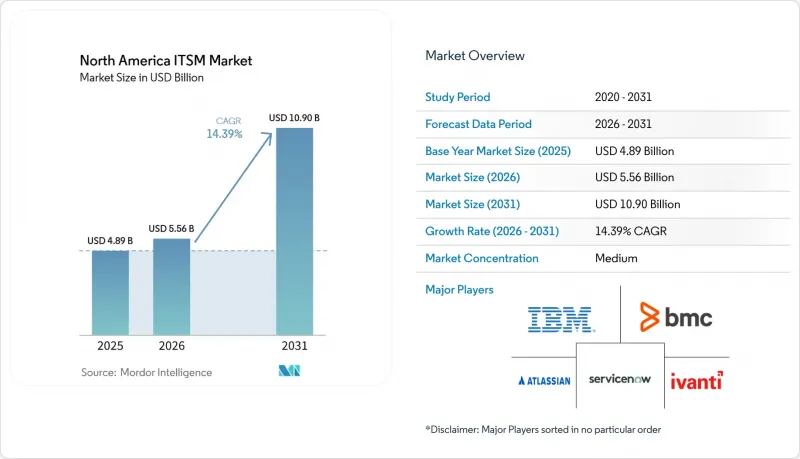
Mordor Intelligence에 의하면, 북미의 ITSM 시장 규모는 2025년 48억 9,000만 달러로 평가되었고, 2026년 55억 6,000만 달러에서 2031년까지 109억 달러로 확대될 것으로 예측되며, 2026-2031년 연평균 복합 성장률(CAGR)은 14.39%를 나타낼 전망입니다.
본 보고서는 컴포넌트별(솔루션 및 서비스), 배포 방식별(클라우드, 온프레미스, 하이브리드), 용도별(서비스 데스크 및 인시던트 관리, 자산 및 구성 관리 등), 최종 사용자 산업별(은행, 금융서비스 및 보험(BFSI), 정부 및 공공 부문 등), 기업 규모별(대기업 및 중소기업), 국가별로 분류되어 있습니다. 시장 전망은 금액(달러) 기준으로 제시되어 있습니다.
북미의 ITSM 시장 동향 및 인사이트
대기업에서의 ‘클라우드 퍼스트’ ITSM 현대화
클라우드 전환은 북미 ITSM 시장에서 여전히 가장 강력한 수요 동력으로 작용하고 있습니다. 많은 대기업들은 2019-2022년 고도로 맞춤화된 온프레미스 환경을 서비스 중단 없이 전환하는 것이 어려웠기 때문에 전환을 연기해 왔습니다. 그러나 구버전에 대한 지원 종료가 임박해 있고, AI를 적극 활용한 로드맵은 클라우드 환경에서 실행하기 용이하기 때문에 이러한 연기는 현재 불가피한 전환 주기로 변화하고 있습니다. ServiceNow는 2025 회계연도 구독 매출이 전년 대비 21% 증가한 128억 8,000만 달러에 달했으며, 연간 계약액이 500만 달러를 초과하는 고객이 603개사에 이르렀다고 보고했는데, 이는 주요 고객들이 클라우드 기반 플랫폼에 얼마나 깊이 관여하고 있는지를 보여줍니다. 또한, 마이그레이션이 이루어질 때마다 기존 구성 속에 묻혀 있던 프로세스에 대한 인사이트이 드러나기 때문에 구매 기업들은 플랫폼 마이그레이션과 더불어 문서화, 지식 수집, 워크플로우 자동화를 점점 더 적극적으로 추진하고 있습니다. 이러한 추세는 벤더가 고객 가치를 높이는 데 기여하는 한편, 규제가 엄격한 대규모 환경에서 도입 수요를 활발하게 유지하는 데에도 기여하고 있습니다.
AI를 활용한 티켓 우선순위 지정 및 워크플로우 자동화
AI를 활용한 티켓 처리는 북미 ITSM 시장의 조달 협상에서 차별화 요소에서 당연한 기대 사항으로 전환되고 있습니다. SolarWinds는 2025년 10월, 생성형 AI 도입률이 상위 10%에 속하는 기업의 경우, 인시던트 평균 해결 시간이 51시간에서 23시간으로 단축되어, 기존 자동화 기술을 활용하는 조직에 비해 54.3%의 감소를 달성했다고 보고했습니다. ServiceNow는 2026년 2월 26일 ‘Autonomous Workforce’를 출시하며, 자사의 ‘ 레벨 1 서비스 데스크 AI 전문가'가 직원들의 IT 요청 중 90% 이상을 자율적으로 해결할 뿐만 아니라, 배정된 IT 케이스 처리에서 인간 운영자보다 99% 더 빠르게 작동한다고 발표했습니다. 이러한 성과로 인해 인력 배치에 대한 사고방식이 변화하고 있습니다. 많은 조직이 단순한 티켓 처리 건수가 아닌, 예외 상황 대응을 기준으로 1선 지원 팀의 규모를 결정하기 시작했기 때문입니다. 또한, AI가 독립적인 어시스턴트로서 워크플로우 외부에 위치하는 것이 아니라, 거버넌스 체계 내에서 기능함을 입증해야 한다는 벤더에 대한 압박도 커지고 있습니다. 규제가 엄격한 환경에서는 거버넌스 및 개인정보 보호에 대한 우려가 여전히 본격적인 도입을 지연시키고 있지만, 도입 방향성은 이제 확고해졌습니다.
대기업의 포화 상태가 신규 라이선스의 순 증가 억제
북미 ITSM 시장의 대기업에서는 이미 플랫폼 보급률이 매우 높기 때문에 성장은 기존 고객 내에서의 확장으로 전환되고 있습니다. ServiceNow는 2025년 4분기 신규 연간 계약액(NCV)이 100만 달러를 초과하는 거래가 244건 발생하여 전년 동기 대비 40% 증가했다고 보고했습니다. 이는 첫 도입이라기보다는 기존 고객의 계약 규모 확대를 시사합니다. 이로 인해 협상 역학이 변화하고 있습니다. 대규모 구매 기업들은 각 벤더들이 기존 소프트웨어 예산에서 더 큰 점유율을 차지하기 위해 경쟁하고 있음을 인식하고 있기 때문입니다. 또한 많은 기업들이 중복된 도구를 재검토하거나 플랫폼의 난립을 해소해야 하는 상황에 직면해 있습니다. 이러한 과정은 유력 벤더들에게는 특정 기존 시스템의 교체에 따른 수주를 촉진하지만, 대기업의 신규 계약 확보에 의존하고 있는 공급업체들에게는 활동의 여지를 좁히게 됩니다. 그 결과, 총 계약액은 계속 상승하고 있음에도 불구하고 신규 라이선스 확보 속도는 둔화되고 있습니다.
부문 분석
2025년, 솔루션 부문은 북미 ITSM 시장에서 62.61%의 점유율을 차지했으며, 서비스 부문도 2031년까지 연평균 성장률(CAGR) 16.12%로 확대될 것으로 예측됩니다. 이러한 선두 위상은 도입 비용이 많이 드는 일회성 계약보다 플랫폼 기반 구독 모델을 고객이 명확히 선호하고 있음을 반영합니다. 기업들은 범위가 변경될 때마다 재협상이 필요한 개별 소프트웨어 계약이나 컨설팅 계약보다, 시간이 지남에 따라 확장 가능한 라이선싱 기능을 점점 더 요구하고 있습니다. 따라서 북미 ITSM 시장에서는 자동화, 셀프 서비스, 분석, AI를 통합된 소프트웨어 계층 내에 통합할 수 있는 벤더가 계속해서 높은 평가를 받고 있습니다. 이러한 추세는 티켓 분류, 1차 대응 지원, 기본적인 워크플로우 운영이 인력이 많이 소요되는 서비스 라인을 통해 제공되는 것이 아니라 플랫폼에 내장되어 있다는 사실도 반영하고 있습니다.
서비스 부문이 가장 빠르게 성장하는 부문이 된 이유는 의료, 정부 기관 및 기타 복잡한 환경에 있는 많은 조직이 워크플로우 설정이나 정책 제어와의 연동을 위해 외부 지원이 필요하기 때문입니다. 그러나 서비스의 역할은 광범위한 도입 주도에서 특정 기능 활용 지원, 관리 운영 및 교육 지원으로 변화하고 있습니다. ServiceNow의 보고서에 따르면, 2025 회계연도 총 수익 중 구독 수익이 97%를 차지하고, 전문 서비스 및 기타 수익은 3%에 그쳐, 가치 창출이 소프트웨어 계층에 집중되어 있음을 여실히 보여주고 있습니다. 이러한 구조로 인해 서비스에 대한 수요가 사라지는 것은 아니지만, 많은 대규모 거래에서 서비스는 중심적인 역할이라기보다는 보완적인 역할을 맡게 되고 있습니다. 장기적으로는 서비스 수익이 절대액 기준으로는 여전히 증가할 가능성이 있으나, 과거에는 별도로 청구되던 업무가 플랫폼 기능에 의해 지속적으로 흡수됨에 따라 총 지출에서 차지하는 비중은 축소될 전망입니다.
2025년 시점에서 클라우드는 도입 부문의 58.72%를 차지했으며, 2031년까지 연평균 성장률(CAGR) 15.89%로 확대될 것으로 예측됩니다. 이는 가장 규모가 크고 성장 속도가 가장 빠른 모델이며, 전환 주기가 성숙기에 접어들지 않고 여전히 활발함을 보여줍니다. 구매자들이 클라우드를 선호하는 이유는 업그레이드가 간소화되고, 새로운 AI 기능의 출시가 신속해지며, 온프레미스 인프라를 최소화하면서도 멀티사이트 운영 모델을 지원할 수 있기 때문입니다. ServiceNow는 2026년 2월, 자사 플랫폼이 전 세계 고객 기반에서 연간 800억 건 이상의 워크플로를 처리하고 있다고 발표했으며, 이는 클라우드 아키텍처에 유리한 규모의 경제를 여실히 보여줍니다. 또한 클라우드 부문은 많은 중견 기업들이 과거 대기업들이 겪었던 것과 같은 장기적인 온프레미스 투자 주기를 반복하지 않고 SaaS를 직접 도입하고 있다는 사실로부터도 혜택을 받고 있습니다.
데이터 관리, 저장 위치 또는 조달에 관한 규제가 더 엄격한 경우에는 온프레미스나 하이브리드 모델이 여전히 중요한 역할을 하고 있습니다. 연방 정부 기관, 국방 관련 계약업체 및 일부 대형 금융·의료 기관은 일반 민간 기업보다 더 엄격한 규정 준수 관점에서 아키텍처 선택지를 지속적으로 평가했습니다. 따라서 기업들은 클라우드 수준의 자동화와 사용자 경험을 추구하면서도, 데이터의 일부나 실행 환경에 대해서는 보다 엄격한 관리가 필요하기 때문에 하이브리드 모델이 주목받고 있습니다. BMC는 2026년 2월, SaaS 제공 범위를 확대하고 통합을 심화하기 위해 AWS와 5년간의 전략적 제휴 계약을 체결했습니다. 이는 해당 지역 전체에서 이러한 하이브리드 도입 수요에 부응하기 위해 각 벤더들이 어떻게 투자하고 있는지를 보여줍니다. 그 결과, 클라우드가 주도권을 계속 확대하는 한편, 규제가 엄격한 환경이나 깊이 통합된 환경에서 리스크가 관리된 가교 역할로서 하이브리드가 여전히 중요한 역할을 수행하고 있다는 도입 시장의 실태가 나타나고 있습니다.
기타 혜택 :
- 엑셀 형식 시장 예측(ME) 시트
- 3개월간의 애널리스트 지원
자주 묻는 질문
목차
제1장 서론
제2장 조사 방법
제3장 주요 요약
제4장 시장 구도
제5장 시장 규모 및 성장 예측
제6장 경쟁 구도
제7장 시장 기회 및 향후 전망
AJY 26.08.07According to Mordor Intelligence, the North America iT service management market size is projected to expand from USD 4.89 billion in 2025 and USD 5.56 billion in 2026 to USD 10.9 billion by 2031, registering a CAGR of 14.39% between 2026 to 2031.
This report is Segmented by Component (Solutions, and Services), Deployment (Cloud, On-Premise, and Hybrid), Application (Service Desk and Incident Management, Asset and Configuration Management, and More), End-User Industry (BFSI, Government and Public Sector, and More), Enterprise Size (Large Enterprises, and SME), and Country. The Market Forecasts are Provided in Terms of Value (USD).
North America ITSM Market Trends and Insights
Cloud-First ITSM Modernization Across Large Enterprises
Cloud migration remains the strongest demand catalyst in the North America IT service management market. Many large organizations delayed shifts during 2019-2022 because heavily customized on-premise environments were difficult to move without service disruption. Those delays have now turned into forced transition cycles, because older releases are reaching end-of-life and AI-heavy roadmaps are easier to execute in cloud environments. ServiceNow reported USD 12.88 billion in subscription revenue for fiscal 2025, up 21% year over year, and 603 customers with more than USD 5 million in annual contract value, which shows how deeply large accounts are engaging with cloud-based platforms. Each migration also exposes process knowledge that had been buried inside legacy configurations, so buyers increasingly pair platform moves with documentation, knowledge capture, and workflow automation work. That pattern is helping vendors raise account value while it keeps implementation demand active in large regulated environments.
AI-Assisted Ticket Triage And Workflow Automation
AI-assisted ticket handling is moving from a differentiating feature to a normal expectation in procurement discussions across the North America IT service management market. SolarWinds reported in October 2025 that top-decile generative AI adopters reduced average incident resolution time from 51 hours to 23 hours, a 54.3% reduction against organizations using conventional automation. ServiceNow launched Autonomous Workforce on February 26, 2026, and said its Level 1 Service Desk AI Specialist resolves over 90% of employee IT requests autonomously while operating 99% faster than human agents for assigned IT cases. These gains are changing staffing logic, because many organizations are beginning to size front-line support teams around exception handling rather than pure ticket volume. They are also increasing pressure on vendors to prove that AI can work inside governed workflows instead of sitting outside them as a separate assistant. Governance and privacy concerns still slow full-scale rollout in regulated settings, but the direction of adoption is now firmly established.
Saturation Among Large Enterprises Limiting Net-New License Growth
Large enterprises across the North America IT service management market already have deep platform penetration, so growth is shifting more toward expansion within existing accounts. ServiceNow reported 244 transactions above USD 1 million in net new annual contract value in Q4 2025, up 40% year over year, which points more to wallet expansion than to first-time adoption. This changes negotiation dynamics because large buyers know vendors are competing for a larger share of an existing software budget. It also pushes many enterprises to review overlapping tools and reduce platform sprawl. That process supports selected displacement wins for stronger vendors, but it narrows the room for providers that depend on new large-enterprise logos. The result is a slower net-new license environment even while total account value keeps rising.
Other drivers and restraints analyzed in the detailed report include:
- Strong Demand For Unified IT, HR, And Customer Service Workflows
- Regulatory Pressure For Auditability and Service Traceability In Regulated Industries
- Long Replacement Cycles Due To Deeply Embedded Legacy Process Customization
For complete list of drivers and restraints, kindly check the Table Of Contents.
Segment Analysis
Solutions held 62.61% of the North America IT service management market share in 2025, and Services are also projected to expand at a 16.12% CAGR through 2031. That lead reflects a clear buyer preference for platform-priced subscriptions over one-time implementation-heavy engagements. Enterprises increasingly want licensed capabilities that can expand over time, rather than separate software and consulting contracts that must be renegotiated whenever the scope changes. The North America IT service management market, therefore, continues to reward vendors that can package automation, self-service, analytics, and AI inside a unified software layer. This pattern also reflects the fact that ticket triage, first-response support, and basic workflow actions are being embedded in the platform rather than delivered through people-intensive service lines.
Services show the fastest-growing segment because many organizations in healthcare, government, and other complex settings need outside help to configure workflows and connect them to policy controls. Their role, however, is changing from broad implementation ownership toward targeted enablement, managed administration, and training support. ServiceNow reported that subscription revenue accounted for 97% of total fiscal 2025 revenue, while professional services and other revenue accounted for 3%, highlighting how value capture is concentrated within the software layer. That structure does not remove the need for services, but it does make them more complementary than central in many large deals. Over time, services revenue can still rise in absolute terms, yet it is likely to represent a smaller share of total spending as platform capabilities continue to absorb work that was once billed separately.
Cloud held 58.72% of the deployment segment in 2025, and it is projected to expand at a 15.89% CAGR through 2031. It was both the largest and the fastest-growing model, indicating that the migration cycle is still active rather than mature. Buyers continue to favor the cloud because it simplifies upgrades, enables new AI features to be released faster, and supports multi-site operating models with less local infrastructure. ServiceNow stated in February 2026 that its platform processes more than 80 billion workflows annually across its global customer base, which illustrates the scale benefits that favor cloud architecture. The cloud segment also benefits from the fact that many mid-sized organizations are adopting SaaS directly, rather than repeating the long on-premises investment cycle that earlier large enterprises experienced.
On-premises and hybrid models still play a role when data control, residency, or procurement rules are tighter. Federal agencies, defense-linked contractors, and some large financial and healthcare organizations continue to evaluate architecture choices through a heavier compliance lens than typical commercial buyers. Hybrid models are therefore gaining attention, as firms want cloud-grade automation and user experience while still needing tighter control over parts of the data or execution environment. BMC signed a five-year strategic collaboration agreement with AWS in February 2026 to widen SaaS availability and deepen integrations, which shows how vendors are investing to meet those mixed deployment needs across the region. The practical outcome is a deployment market where cloud keeps widening its lead, while hybrid remains relevant as a risk-managed bridge for more regulated or deeply embedded environments.
Complete Report Scope:
- By Component
- Solutions
- Services
- By Deployment
- Cloud
- On-Premise
- Hybrid
- By Application
- Service Desk and Incident Management
- Asset and Configuration Management
- Change and Release Management
- Service Request Management
- Knowledge Management
- Other ITSM Applications
- By End-User Industry
- BFSI
- Manufacturing
- Government and Public Sector
- IT and Telecommunications
- Retail and E-Commerce
- Healthcare
- Travel and Hospitality
- Other End-User Industries
- By Enterprise Size
- Large Enterprises
- Small and Mid-Size Enterprises (SME)
- By Country
- United States
- Canada
- Mexico
List of Companies Covered in this Report:
- ServiceNow, Inc.
- IBM Corporation
- BMC Software, Inc.
- Atlassian Corporation Plc
- Ivanti, Inc.
- Freshworks Inc.
- ManageEngine, a division of Zoho Corporation Pvt. Ltd.
- Broadcom Inc.
- Open Text Corporation
- Micro Focus International plc
- ASG Technologies Group, Inc.
- SysAid Technologies Ltd.
- Cherwell Software, LLC
- TOPdesk B.V.
- Hornbill Service Management Ltd.
- SymphonyAI Summit
- EasyVista S.A.
- SolarWinds Corporation
- Atlassian Corporation Plc
- Axelos Limited
Additional Benefits:
- The market estimate (ME) sheet in Excel format
- 3 months of analyst support
TABLE OF CONTENTS
1 INTRODUCTION
- 1.1 Study Assumptions and Market Definition
- 1.2 Scope of the Study
2 RESEARCH METHODOLOGY
3 EXECUTIVE SUMMARY
4 MARKET LANDSCAPE
- 4.1 Market Overview
- 4.2 Market Drivers
- 4.2.1 Cloud-First ITSM Modernization Across Large Enterprises
- 4.2.2 AI Assisted Ticket Triage and Workflow Automation
- 4.2.3 Strong Demand for Unified IT, HR, and Customer Service Workflows
- 4.2.4 Regulatory Pressure for Auditability and Service Traceability in Regulated Industries
- 4.2.5 High Adoption of Enterprise Integration with Security and Observability Stacks
- 4.2.6 Rapid Replacement Cycles Driven by Platform Consolidation Initiatives
- 4.3 Market Restraints
- 4.3.1 Saturation Among Large Enterprises Limiting Net-New License Growth
- 4.3.2 Long Replacement Cycles Due to Deeply Embedded Legacy Process Customization
- 4.3.3 Rising Software Procurement Scrutiny and Vendor Rationalization
- 4.3.4 Data Privacy and AI Governance Concerns Slowing GenAI Feature Rollouts
- 4.4 Industry Value Chain Analysis
- 4.5 Impact of Macroeconomic Factors
- 4.6 Regulatory Landscape
- 4.7 Technological Outlook
- 4.8 Porter's Five Forces Analysis
- 4.8.1 Bargaining Power of Suppliers
- 4.8.2 Bargaining Power of Buyers
- 4.8.3 Threat of New Entrants
- 4.8.4 Threat of Substitutes
- 4.8.5 Intensity of Competitive Rivalry
5 MARKET SIZE AND GROWTH FORECASTS (VALUE)
- 5.1 By Component
- 5.1.1 Solutions
- 5.1.2 Services
- 5.2 By Deployment
- 5.2.1 Cloud
- 5.2.2 On-Premise
- 5.2.3 Hybrid
- 5.3 By Application
- 5.3.1 Service Desk and Incident Management
- 5.3.2 Asset and Configuration Management
- 5.3.3 Change and Release Management
- 5.3.4 Service Request Management
- 5.3.5 Knowledge Management
- 5.3.6 Other ITSM Applications
- 5.4 By End-User Industry
- 5.4.1 BFSI
- 5.4.2 Manufacturing
- 5.4.3 Government and Public Sector
- 5.4.4 IT and Telecommunications
- 5.4.5 Retail and E-Commerce
- 5.4.6 Healthcare
- 5.4.7 Travel and Hospitality
- 5.4.8 Other End-User Industries
- 5.5 By Enterprise Size
- 5.5.1 Large Enterprises
- 5.5.2 Small and Mid-Size Enterprises (SME)
- 5.6 By Country
- 5.6.1 United States
- 5.6.2 Canada
- 5.6.3 Mexico
6 COMPETITIVE LANDSCAPE
- 6.1 Market Concentration
- 6.2 Strategic Moves
- 6.3 Market Share Analysis
- 6.4 Company Profiles (includes Global Level Overview, Market Level Overview, Core Segments, Financials as available, Strategic Information, Market Rank/Share, Products and Services, Recent Developments)
- 6.4.1 ServiceNow, Inc.
- 6.4.2 IBM Corporation
- 6.4.3 BMC Software, Inc.
- 6.4.4 Atlassian Corporation Plc
- 6.4.5 Ivanti, Inc.
- 6.4.6 Freshworks Inc.
- 6.4.7 ManageEngine, a division of Zoho Corporation Pvt. Ltd.
- 6.4.8 Broadcom Inc.
- 6.4.9 Open Text Corporation
- 6.4.10 Micro Focus International plc
- 6.4.11 ASG Technologies Group, Inc.
- 6.4.12 SysAid Technologies Ltd.
- 6.4.13 Cherwell Software, LLC
- 6.4.14 TOPdesk B.V.
- 6.4.15 Hornbill Service Management Ltd.
- 6.4.16 SymphonyAI Summit
- 6.4.17 EasyVista S.A.
- 6.4.18 SolarWinds Corporation
- 6.4.19 Atlassian Corporation Plc
- 6.4.20 Axelos Limited
7 MARKET OPPORTUNITIES AND FUTURE OUTLOOK
- 7.1 White-space and Unmet-Need Assessment


