
|
시장보고서
상품코드
2117636
독일의 ITSM : 시장 점유율 분석, 업계 동향 및 통계, 성장 예측(2026-2035년)Germany ITSM - Market Share Analysis, Industry Trends & Statistics, Growth Forecasts (2026 - 2035) |
||||||
 Mordor Intelligence
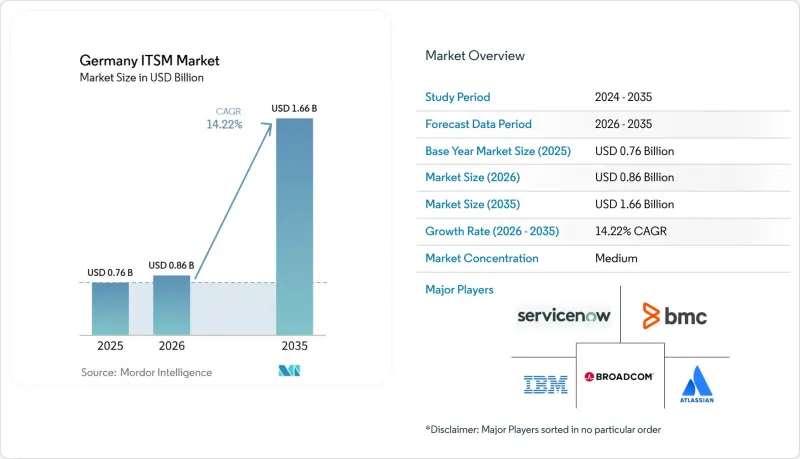
Mordor Intelligence에 의하면, 독일의 ITSM 시장 규모는 2025년 7억 6,000만 달러로 평가되었습니다. 2026년에는 8억 6,000만 달러로 확대되어 2035년까지 16억 6,000만 달러에 이를 것으로 예상되고 2026-2035년에 걸쳐 CAGR 14.22%로 성장할 전망입니다.
본 보고서는 구성 요소(솔루션, 서비스), 배포 방식(클라우드, On-Premise, 하이브리드), 용도(서비스 데스크 및 인시던트 관리, 자산 및 구성 관리, 기타), 최종 사용자 산업(은행, 금융서비스 및 보험(BFSI), 제조업, 기타), 기업 규모(대기업, 중소기업)별로 분류되어 있습니다. 시장 전망은 금액(달러) 기준으로 제시되어 있습니다.
독일의 ITSM 시장 동향 및 인사이트
클라우드 우선 IT 서비스 제공으로의 기업 전환 확대
독일의 ITSM 시장은 클라우드 제공으로 전환되고 있습니다. 이는 구매자들이 갱신 및 확장이 용이하고, 다양한 사용자 그룹에 걸쳐 감사하기 쉬운 서비스 플랫폼을 원하기 때문입니다. 이러한 전환은 인프라 운영 부담을 경감하는 데 그치지 않고, 규제 환경 하에서 프로세스 기록을 명확히 하고 서비스 성과에 대한 보다 강력한 관리의 필요성과도 밀접하게 관련되어 있습니다. 각 벤더는 레거시 시스템에서 급격한 전환을 강요하기보다는 하이브리드 환경에 대한 대응을 강화함으로써 이에 부응하고 있으며, 이는 독일의 ITSM 시장에서 클라우드 도입이 신중한 구매자에게 더 현실적으로 다가오고, 업무에 미치는 혼란도 점차 줄어들고 있음을 보여줍니다. Matrix42 역시 최근 플랫폼 업데이트에서 유연한 제공 방식을 강조하고 있는데, 이는 독일의 ITSM 시장이 단일하고 고정된 운영 모델을 강요하지 않으면서 클라우드, 프라이빗 클라우드, 단계적 전환을 지원할 수 있는 공급업체를 선호하고 있음을 반영합니다. 점점 더 많은 조직이 서비스 관리를 광범위한 디지털 워크플로우와 연계함에 따라, 독일의 ITSM 시장에서는 클라우드 기반 제공 방식이 자동화, 분석, 부서 간 워크플로우 설계를 위한 선호되는 기반이 되어가고 있습니다.
독일 기업의 디지털 전환 가속화
독일의 ITSM 시장은 더 광범위한 기업 현대화의 혜택을 받고 있습니다. 이는 기업이 ERP, 워크플로우, 지원, 운영 프로세스를 동시에 재설계할 때 서비스 관리가 더 중심적인 역할을 맡게 되기 때문입니다. 이러한 추세는 대규모 다중 사이트 운영을 수행하는 산업에서 특히 두드러지며, 이러한 산업에서는 서비스 연속성, 사용자 지원, 변경 승인에 있어 플랫폼의 일관성이 중요하게 여겨집니다. SAP는 47개의 생산·서비스 거점, 3개의 ERP 시스템, 비즈니스 웨어하우스, 약 400개의 인터페이스를 5개월 만에 포괄한 Syntegon의 대규모 클라우드 전환 사례를 소개하고 있으며, 이는 현재 독일의 서비스 운영을 둘러싼 시스템 변경의 규모를 여실히 보여주고 있습니다. 의료 분야에서도 연방 정부의 디지털화 전략에 따라 조직은 프로세스 조정 및 시스템 정비를 강화해야할 것으로 요구받고 있으며, 이는 독일의 ITSM 시장에 대한 체계적인 수요의 새로운 원천이 되고 있습니다. 그 결과, 독일의 ITSM 시장은 서비스 관리가 더 이상 백오피스 도구로서가 아니라 복잡한 프로그램을 통합하는 운영 계층으로 취급되게 된, 보다 광범위한 변혁 주기에 의해 뒷받침되고 있습니다. 따라서 도입 작업, 관리형 지원, 워크플로우 재설계를 결합할 수 있는 공급업체는 이러한 현대화 주기가 지속되는 가운데 더욱 견고한 입지를 확보하게 될 것입니다.
레거시 엔터프라이즈 스택에 수반되는 높은 통합 복잡성
독일의 ITSM 시장은 여전히 레거시 시스템의 복잡성이라는 큰 제약에 직면해 있습니다. 많은 기업에서 구형 ERP 시스템, 플랜트 시스템, 엔드포인트 도구, 사내 맞춤형 지원 프로세스에 걸쳐 서비스 워크플로가 존재하기 때문입니다. 이러한 환경에서 서비스 관리를 교체하거나 업그레이드하는 것은 단일 플랫폼으로 해결되는 경우가 거의 없으며, 그 작업은 자산 데이터, 요청 처리, 사용자 디렉토리, 운영 기록 간의 안정적인 연동에 의존하는 경우가 많습니다. SAP의 Syntegon 사례는 대규모 현대화 프로젝트가 47개 거점과 400개에 가까운 인터페이스에 걸쳐 진행될 수 있음을 보여주며, 이것이 서비스 관리 재설계가 계획보다 지연되고 더 많은 노력이 필요한 이유 중 하나입니다. 또한, Ivanti가 클라우드와 On-Premise 간의 보다 강력한 연동을 중시하고 있다는 점은 독일의 ITSM 시장이 여전히 혼합 환경에서 단번에 벗어나지 못하는 구매자들에게 대응해야 한다는 현실을 여실히 드러내고 있습니다. 이러한 제약은 도입을 방해하는 것은 아니지만, 프로젝트 기간을 장기화시키고 서비스에 대한 의존도를 높이며, 검증된 커넥터, 마이그레이션 도구, 현지 도입 노하우를 갖춘 벤더에게 유리하게 작용합니다. 또한, 많은 고객이 초기 플랫폼 도입 완료 후에도 지속적인 지원을 필요로 하기 때문에 서비스에 대한 수요도 높은 수준을 유지하고 있습니다.
부문별 분석
2025년에는 솔루션이 시장의 66.32%를 차지했으며, 이 부문에서 지출의 대부분을 여전히 라이선싱과 핵심 플랫폼 도입이 차지하고 있음을 알 수 있습니다. 이 점유율은 독일의 ITSM 시장에서 표준화된 플랫폼이 계속해서 중요한 역할을 하고 있음을 시사합니다. 해당 시장에서는 구매자들이 느슨하게 연동된 개별 도구보다 일관된 프로세스 구조를 선호하는 경향이 강하기 때문입니다. 많은 조직에서는 여전히 인시던트, 요청, 자산, 변경 관리 기능부터 도입을 시작하고, 그 후 더 광범위한 워크플로로 범위를 확대되고 있습니다. 이 때문에 특히 공식적인 프로세스 모델과 대규모 사용자 기반을 갖춘 대기업에서는 솔루션이 1단계 구매 결정의 핵심으로 자리 잡고 있습니다. 따라서 컴포넌트 수준에서 독일의 ITSM 시장 규모는 도입 후 광범위한 최적화가 가속화되기 시작할 때까지 소프트웨어 주도형 도입에 의해 지속적으로 뒷받침되어 왔습니다.
또한, 각 벤더들이 AI와 분석, 더 광범위한 서비스 워크플로우 지원을 통해 핵심 플랫폼의 기능 범위를 지속적으로 확대하고 있기 때문에 솔루션의 중요성은 여전히 높습니다. ServiceNow의 2026년 제품 전략을 통해 ITSM 플랫폼이 단순한 티켓 관리 도구가 아니라, 엔터프라이즈 서비스 운영을 위한 보다 광범위한 운영 체제로 자리매김하고 있음을 알 수 있습니다. Ivanti 역시 자사 플랫폼에 AI 주도형 기능 강화를 도입하고 있으며, 이는 독일의 ITSM 시장이 핵심 소프트웨어 계층 내에서 더욱 풍부한 플랫폼 기능으로 전환되고 있다는 견해를 뒷받침합니다. 고객이 컨설팅이나 관리형 지원 서비스를 구매하는 경우라 하더라도, 플랫폼 자체가 서비스 레코드, 워크플로우, 자동화 로직의 주요 운영 기반으로 남아 있습니다. 따라서 서비스의 역할이 시간이 지남에 따라 중요성이 커지고 있음에도 불구하고, 솔루션에 대한 지출이 여전히 독일의 ITSM 시장의 구조를 결정짓고 있습니다.
서비스 분야는 2031년까지 연평균 성장률(CAGR) 16.21%로 확대될 것으로 예상되며, 예측 기간 동안 가장 빠르게 성장하는 분야가 될 전망입니다. 이는 독일의 ITSM 시장이 도입이 단순한 출발점에 불과하며, 시스템 가동 후에도 고객이 추가적인 지원을 필요로 하는 단계로 전환되고 있음을 나타냅니다. 서비스 환경이 복잡해짐에 따라 구매자들은 통합 작업, 프로세스 재설계, 교육, 관리 대행, AI 설정 등을 요구하고 있습니다. 서비스의 성장은 고객 조직 내의 현실적인 한계도 반영하고 있습니다. 많은 사내 팀에는 플랫폼 튜닝, 워크플로우 변경, 자동화 거버넌스를 자체적으로 관리할 충분한 인력이 없기 때문입니다. 그 결과, 독일의 ITSM 시장에서는 일회성 도입 작업이 아닌 지속적인 지원을 제공할 수 있는 전문 파트너에 대한 수요가 발생하고 있습니다.
이러한 경향은 ERP, 엔드포인트 관리, 서비스 관리를 동시에 현대화하고 있는 조직에서 가장 두드러질 것으로 보입니다. 왜냐하면 이러한 프로그램들은 사내 팀이 한 번에 감당할 수 있는 범위를 넘어서는 변화를 가져오기 때문입니다. 또한, 영구적인 사내 채용보다 외부 위탁을 통한 관리가 더 정당화되기 쉬운 중견 기업 시장에서도 이러한 경향은 계속해서 강화될 전망입니다. Matrix42, Ivanti, ServiceNow와 같은 기업들이 초기 도입뿐만 아니라 지속적인 가치를 중심으로 서비스를 지속적으로 구축하고 있는 점도 이러한 방향성을 뒷받침하고 있습니다. 실무적인 관점에서 볼 때, 서비스 분야의 급속한 부상은 독일의 ITSM 시장이 단순히 도구를 판매하는 데 그치지 않고, 해당 도구를 장기간에 걸쳐 효과적으로 활용하기 위해 필요한 운영 지원도 제공하고 있음을 보여줍니다. 따라서, 특히 구매자가 현지 지원, 독일어 제공, 도입 후의 안정적인 성능을 중시하는 경우, 서비스 계층은 향후 경쟁에서 중요한 요소가 될 것입니다.
2025년에는 서비스 데스크와 인시던트 관리가 용도별 수요를 주도하며 28.42%의 점유율을 차지했습니다. 이는 이 분야의 지출과 운영상의 관심의 대부분이 여전히 일선 지원에 집중되어 있음을 보여줍니다. 서비스 데스크는 최종 사용자와 기업의 IT 부서 사이에서 가장 눈에 띄는 접점 역할을 계속하고 있으므로, 이러한 상황은 놀라운 일이 아닙니다. 또한, 서비스 데스크는 이후 플랫폼 전체의 자동화, 근본 원인 분석, 성능 측정을 뒷받침하는 운영 데이터를 생성합니다. 독일의 ITSM 시장에서는 견고한 서비스 데스크 기반이 이후 자산 관리, 변경 관리, 요청 관리, 지식 관리 각 모듈을 도입할 때의 출발점이 되는 경우가 많습니다. 이것이 다른 이용 사례가 부상하는 와중에도 2025년에 이 용도가 여전히 최대 규모를 유지했던 이유 중 하나입니다.
서비스 데스크와 인시던트 관리가 주도적인 역할을 하고 있다는 점은 ITSM 도입 초기 단계에서 구매자가 가치를 어떻게 평가하고 있는지를 반영합니다. 응답 시간 단축, 사용자와의 커뮤니케이션 개선, 에스컬레이션 경로 명확화 등은 다른 모듈의 장기적인 프로세스 이점보다 그 효과가 눈에 띄기 쉬운 요소들입니다. 2026년 2월 ServiceNow가 뮌헨에서 발표한 내용은 벤더의 혁신이 여전히 서비스 데스크를 중심으로 전개되고 있음을 여실히 보여주었습니다. 특히 AI를 통해 반복적인 티켓 처리를 줄이고, 1차 지원팀의 대응 능력을 향상시킬 수 있는 분야에서 이러한 경향은 두드러집니다. 독일의 ITSM 시장에서 이는 벤더의 메시지 전달이나 고객의 투자 대비 효과(ROI)에 관한 논의에서 서비스 데스크가 여전히 중심적인 위치를 차지하고 있음을 의미합니다. 또한, 서비스 데스크의 성과가 우수할수록 초기 도입 후 고객이 다른 용도로 얼마나 신속하게 확대 적용할 수 있는지가 좌우된다는 점도 시사합니다.
지식 관리(Knowledge Management)는 2031년까지 연평균 성장률(CAGR) 17.01%를 나타낼 것으로 예상되며, 예측 기간 동안 가장 빠르게 성장하는 용도가 될 것입니다. 이 부문의 강점은 전문 IT 인력 채용이 여전히 어려운 상황에서 조직이 개별 직원의 기억에만 의존할 수 없다는 현실적인 과제를 반영하고 있습니다. Bitkom이 보고한 10만 9,000건의 IT 인력 부족 수치는 기업들이 검색 가능하고 재사용 가능하며 적절하게 관리된 내부 지식 구조에 왜 점점 더 주목하기 시작했는지를 보여줍니다. 따라서 독일의 ITSM 시장에서 지식 관리는 단순한 부가 모듈이 아니라, 인력 부족에 대한 직접적인 해결책이자 지원의 일관성 확보, 신입 사원 교육 요구에 대한 대응 수단으로서 점점 더 중요한 가치를 지니게 되고 있습니다. 또한 AI를 활용한 서비스 워크플로우와도 잘 어울린다고 할 수 있습니다. 왜냐하면 자동 응답의 품질은 그 배후에 있는 지식베이스의 품질에 좌우되는 경우가 많기 때문입니다.
이로 인해, 이전 플랫폼 도입 주기에서 많은 구매자가 인식했던 것보다 지식 관리와 서비스 요청 자동화 사이에 더 밀접한 연관성이 생겨나고 있습니다. 지식 문서가 최신 상태이고, 검색하기 쉬우며, 워크플로우 설계와 연동되어 있다면, 서비스 팀은 중복 티켓을 줄이고 일상적인 문제 처리 시간을 단축할 수 있습니다. 더 우수한 지식 구조는 사람이 해결하는 경우와 기계가 해결하는 경우 모두를 더욱 신뢰할 수 있게 만들기 때문에 벤더들은 이러한 관계를 중심으로 AI 전략을 구축하는 경향이 강해지고 있습니다. 독일의 ITSM 시장에서 이는 가장 빠르게 성장하고 있는 용도가 비용 관리와 서비스 품질 향상이라는 두 가지 측면 모두와 직접적으로 연결되어 있음을 의미합니다. 그 결과, 활용 사례의 구성은 더욱 다양해지고 있으며, 가장 큰 비중을 차지하는 활용 사례가 여전히 지출의 중심을 이루고 있는 반면, 가장 빠르게 성장하는 활용 사례가 미래의 플랫폼 설계를 형성하기 시작하고 있습니다.
기타 혜택
- 엑셀 형식 시장 예측(ME) 시트
- 3개월간의 애널리스트 지원
자주 묻는 질문
목차
제1장 서론
제2장 조사 방법
제3장 개요
제4장 시장 구도
제5장 시장 규모 및 성장 예측
제6장 경쟁 구도
제7장 시장 기회 및 향후 전망
KTH 26.09.02According to Mordor Intelligence, the Germany ITSM market size is expected to increase from USD 0.76 billion in 2025 to USD 0.86 billion in 2026 and reach USD 1.66 billion by 2035, growing at a CAGR of 14.22% over 2026-2035.
This report is Segmented by Component (Solutions, Services), Deployment (Cloud, On-Premises, Hybrid), Application (Service Desk and Incident Management, Asset and Configuration Management, and More), End-User Industry (BFSI, Manufacturing, and More), and Enterprise Size (Large Enterprises, Small and Medium Enterprises). The Market Forecasts are Provided in Terms of Value (USD).
Germany ITSM Market Trends and Insights
Rising Enterprise Shift to Cloud-First IT Service Delivery
The Germany ITSM market is moving toward cloud delivery because buyers want service platforms that are easier to update, easier to scale, and easier to audit across many user groups. This shift is not only about lower infrastructure effort, because it is also tied to the need for clearer process records and stronger control over service performance in regulated environments. Vendors are responding by improving hybrid support rather than forcing a sudden move away from legacy systems, which shows that cloud adoption in the Germany ITSM market is becoming more practical and less disruptive for cautious buyers. Matrix42 also highlighted flexible delivery paths in its recent platform updates, which reflects how the Germany ITSM market is favoring providers that can support cloud, private cloud, and staged transitions without forcing one fixed operating model. As more organizations connect service management with broader digital workflows, cloud-based delivery is becoming the preferred base for automation, analytics, and cross-functional workflow design in the Germany ITSM market.
Accelerating Digital Transformation Across German Enterprises
The Germany ITSM market is benefiting from broader enterprise modernization, because service management becomes more central when companies redesign ERP, workflow, support, and operating processes at the same time. This is especially visible in sectors that run large multi-site operations, where platform consistency matters for service continuity, user support, and change approval. SAP described a major Syntegon cloud transformation that covered 47 production and service locations, 3 ERP systems, a business warehouse, and nearly 400 interfaces within 5 months, which shows the scale of system change that now surrounds service operations in Germany. In healthcare, the federal digitalization strategy is also pushing organizations to upgrade process coordination and system readiness, which adds another source of structured demand for the Germany ITSM market. The result is that the Germany ITSM market is being supported by a wider transformation cycle where service management is no longer treated as a back-office tool, but as an operating layer that holds complex programs together. Providers that can connect implementation work, managed support, and workflow redesign are therefore in a stronger position as this modernization cycle continues.
High Integration Complexity With Legacy Enterprise Stacks
The Germany ITSM market still faces a major constraint from legacy complexity, because many enterprises have service workflows that sit across old ERP systems, plant systems, endpoint tools, and internally customized support processes. Replacing or upgrading service management in those settings is rarely a single-platform job, and the work often depends on stable links between asset data, request handling, user directories, and operational records. SAP's Syntegon example shows how large modernizations can span 47 locations and nearly 400 interfaces, which helps explain why service management redesign often becomes slower and more demanding than planned. Ivanti's emphasis on stronger cloud-to-on-premises synchronization also underlines the reality that the Germany ITSM market still has to serve buyers who cannot cut away from mixed environments in one step. This restraint does not stop adoption, but it does lengthen project timelines, increase service dependency, and reward vendors with tested connectors, migration tools, and local implementation depth. It also keeps services demand high, because many customers need ongoing support after the initial platform rollout is complete.
Other drivers and restraints analyzed in the detailed report include:
- Regulatory Pressure for Auditability and Service Traceability
- Growing Need for AI-Enabled Workflow Automation
- Data Residency And Sovereignty Constraints
For complete list of drivers and restraints, kindly check the Table Of Contents.
Segment Analysis
Solutions held 66.32% of the market in 2025, which shows that licensing and core platform deployment still formed the largest part of spending in this segment. That share also points to the continued role of standardized platforms in the Germany ITSM market, where buyers often prefer consistent process structures rather than loosely connected point tools. Many organizations still start with incident, request, asset, and change functions before expanding into broader workflow coverage. This keeps solutions at the center of most first-phase buying decisions, especially in larger organizations with formal process models and larger user estates. The Germany ITSM market size at the component level therefore remained anchored by software-led deployments before wider post-launch optimization began to accelerate.
Solutions also stay important because vendors continue to widen what the core platform can do through AI, analytics, and broader service workflow support. ServiceNow's product direction in 2026 showed that ITSM platforms are being positioned as wider operating systems for enterprise service work rather than ticketing tools alone. Ivanti also pushed AI-led enhancements into its platform, which supports the same view that the Germany ITSM market is moving toward richer platform capabilities inside the core software layer. Even when customers buy consulting or managed support, the platform itself remains the main operating base for service records, workflows, and automation logic. That is why solution spending still sets the structure of the Germany ITSM market, even as the role of services becomes more important over time.
Services are projected to expand at a 16.21% CAGR through 2031, making them the faster-growing component across the forecast period. This shows that the Germany ITSM market is moving into a stage where implementation is only the starting point, and customers need more support after the system goes live. Buyers are asking for integration work, process redesign, training, managed administration, and AI configuration as their service environments become more complex. The growth of services also reflects practical limits inside client organizations, since many internal teams do not have enough people to manage platform tuning, workflow changes, and automation governance on their own. As a result, the Germany ITSM market is creating room for specialist partners that can deliver recurring support rather than one-time deployment work.
This pattern is likely to be strongest in organizations that are modernizing ERP, endpoint management, and service management together, because those programs create more change than internal teams can absorb at once. It is also likely to remain strong in the mid-market, where outsourced administration can be easier to justify than permanent internal hiring. Company activity supports this direction, with firms such as Matrix42, Ivanti, and ServiceNow continuing to frame their offers around ongoing value, not only first deployment. In practical terms, the faster rise of services shows that the Germany ITSM market is not only selling tools, but also selling the operational support needed to keep those tools useful over time. That makes the service layer an important part of future competition, especially where buyers care about local support, German-language delivery, and steady post-launch performance.
Service desk and incident management led application demand with a 28.42% share in 2025, showing that frontline support still anchors most spending and operational attention in this area. This position is not surprising because service desks remain the most visible contact point between end users and enterprise IT. They also generate the operational data that later supports automation, root-cause review, and performance measurement across the wider platform. In the Germany ITSM market, a strong service desk base often becomes the entry point for later adoption of asset, change, request, and knowledge modules. That helps explain why this application remained the largest in 2025, even as other use cases gained ground.
The leading role of service desk and incident management also reflects how buyers measure value early in the life of an ITSM deployment. Faster response times, better user communication, and cleaner escalation paths are easier to see than longer-term process benefits in other modules. ServiceNow's Munich announcement in February 2026 underlined how much vendor innovation is still centered on the service desk, especially where AI can reduce repetitive ticket work and improve first-line support capacity. In the Germany ITSM market, that keeps the service desk at the center of vendor messaging and customer return-on-investment discussions. It also means that strong service desk performance often shapes how quickly clients expand into other applications after the first rollout.
Knowledge management is projected to grow at a 17.01% CAGR through 2031, which makes it the fastest-growing application in the forecast period. The strength of this segment reflects a practical problem, because organizations cannot depend on individual staff memory when specialist IT roles remain difficult to fill. Bitkom's figure of 109,000 unfilled IT jobs shows why companies are turning more attention toward searchable, reusable, and better-governed internal knowledge structures. In the Germany ITSM market, knowledge management is therefore becoming more valuable not as a side module, but as a direct answer to labor pressure, support consistency, and onboarding needs. It also works well with AI-enabled service workflows, because the quality of automated responses often depends on the quality of the knowledge base behind them.
This creates a closer link between knowledge management and service request automation than many buyers recognized in earlier platform cycles. When knowledge articles are current, easy to search, and tied to workflow design, service teams can reduce duplicate tickets and shorten handling time for routine problems. Vendors are increasingly building their AI stories around this relationship, since better knowledge structures make both human and machine resolution more reliable. For the Germany ITSM market, that means the fastest-growing application is tied directly to both cost control and service quality improvement. The result is a broader application mix where the largest use case still anchors spending, but the fastest-growing one is starting to shape future platform design.
Complete Report Scope:
- By Component
- Solutions
- Services
- By Deployment
- Cloud
- On-Premises
- Hybrid
- By Application
- Service Desk and Incident Management
- Asset and Configuration Management
- Change and Release Management
- Service Request Management
- Knowledge Management
- Other Applications by Application
- By End-User Industry
- BFSI
- Manufacturing
- Government
- IT and Telecommunications
- Retail and E-Commerce
- Healthcare
- Travel and Hospitality
- Other Industries by End-User Industry
- By Enterprise Size
- Large Enterprises
- Small and Medium Enterprises
List of Companies Covered in this Report:
- ServiceNow, Inc.
- BMC Software, Inc.
- Atlassian Corporation Plc
- IBM Corporation
- Broadcom Inc.
- Freshworks Inc.
- Ivanti, Inc.
- Microsoft Corporation
- Open Text Corporation
- Zoho Corporation Pvt. Ltd.
- SolarWinds Corporation
- EasyVista
- TOPdesk Nederland B.V.
- SysAid Technologies Ltd.
- Matrix42 AG
- USU Software AG
- Hornbill Service Management Limited
- Aisera, Inc.
- 4me, Inc.
- TeamDynamix, LLC
Additional Benefits:
- The market estimate (ME) sheet in Excel format
- 3 months of analyst support
TABLE OF CONTENTS
1 INTRODUCTION
- 1.1 Study Assumptions and Market Definition
- 1.2 Scope of the Study
2 RESEARCH METHODOLOGY
3 EXECUTIVE SUMMARY
4 MARKET LANDSCAPE
- 4.1 Market Overview
- 4.2 Market Drivers
- 4.2.1 Rising Enterprise Shift to Cloud-First IT Service Delivery
- 4.2.2 Accelerating Digital Transformation Across German Enterprises
- 4.2.3 Regulatory Pressure for Auditability and Service Traceability
- 4.2.4 Growing Need For AI-Enabled Workflow Automation
- 4.2.5 SAP-Driven Modernization Across the Mittelstand
- 4.2.6 Hybrid Work Support and Distributed Service Operations
- 4.3 Market Restraints
- 4.3.1 High Integration Complexity With Legacy Enterprise Stacks
- 4.3.2 Data Residency and Sovereignty Constraints
- 4.3.3 Skilled ITSM Process and Automation Talent Shortage
- 4.3.4 Budget Scrutiny and Slow Procurement Cycles in Midmarket Firms
- 4.4 Industry Value Chain Analysis
- 4.5 Supply Chain Analysis
- 4.6 Impact of Macroeconomic Factors on the Market
- 4.7 Regulatory Landscape
- 4.8 Technological Outlook
- 4.9 Porter's Five Forces Analysis
- 4.9.1 Bargaining Power of Buyers
- 4.9.2 Bargaining Power of Suppliers
- 4.9.3 Threat of New Entrants
- 4.9.4 Threat of Substitutes
- 4.9.5 Intensity of Competitive Rivalry
5 MARKET SIZE AND GROWTH FORECASTS (VALUE)
- 5.1 By Component
- 5.1.1 Solutions
- 5.1.2 Services
- 5.2 By Deployment
- 5.2.1 Cloud
- 5.2.2 On-Premises
- 5.2.3 Hybrid
- 5.3 By Application
- 5.3.1 Service Desk and Incident Management
- 5.3.2 Asset and Configuration Management
- 5.3.3 Change and Release Management
- 5.3.4 Service Request Management
- 5.3.5 Knowledge Management
- 5.3.6 Other Applications by Application
- 5.4 By End-User Industry
- 5.4.1 BFSI
- 5.4.2 Manufacturing
- 5.4.3 Government
- 5.4.4 IT and Telecommunications
- 5.4.5 Retail and E-Commerce
- 5.4.6 Healthcare
- 5.4.7 Travel and Hospitality
- 5.4.8 Other Industries by End-User Industry
- 5.5 By Enterprise Size
- 5.5.1 Large Enterprises
- 5.5.2 Small and Medium Enterprises
6 COMPETITIVE LANDSCAPE
- 6.1 Market Concentration
- 6.2 Strategic Moves
- 6.3 Market Share Analysis
- 6.4 Company Profiles (includes Global Level Overview, Market Level Overview, Core Segments, Financials as available, Strategic Information, Market Rank/Share, Products and Services, Recent Developments)
- 6.4.1 ServiceNow, Inc.
- 6.4.2 BMC Software, Inc.
- 6.4.3 Atlassian Corporation Plc
- 6.4.4 IBM Corporation
- 6.4.5 Broadcom Inc.
- 6.4.6 Freshworks Inc.
- 6.4.7 Ivanti, Inc.
- 6.4.8 Microsoft Corporation
- 6.4.9 Open Text Corporation
- 6.4.10 Zoho Corporation Pvt. Ltd.
- 6.4.11 SolarWinds Corporation
- 6.4.12 EasyVista
- 6.4.13 TOPdesk Nederland B.V.
- 6.4.14 SysAid Technologies Ltd.
- 6.4.15 Matrix42 AG
- 6.4.16 USU Software AG
- 6.4.17 Hornbill Service Management Limited
- 6.4.18 Aisera, Inc.
- 6.4.19 4me, Inc.
- 6.4.20 TeamDynamix, LLC
7 MARKET OPPORTUNITIES AND FUTURE OUTLOOK
- 7.1 White-Space and Unmet-Need Assessment