

|
시장보고서
상품코드
2151261
정밀 농업 시장 : 자동화 및 제어 시스템, 클라우드 기반 소프트웨어, 시스템 통합 및 컨설팅 서비스, 가이던스 기술, 가변 시비 기술, 수확량 모니터링, 농지 매핑, 가변 시비 - 세계 예측(-2033년)Precision Farming Market by Automation & Control System, Cloud-based Software, System Integration & Consulting Service, Guidance Technology, Variable Rate Technology, Yield Monitoring, Field Mapping, Variable Rate Application - Global Forecast to 2033 |
||||||

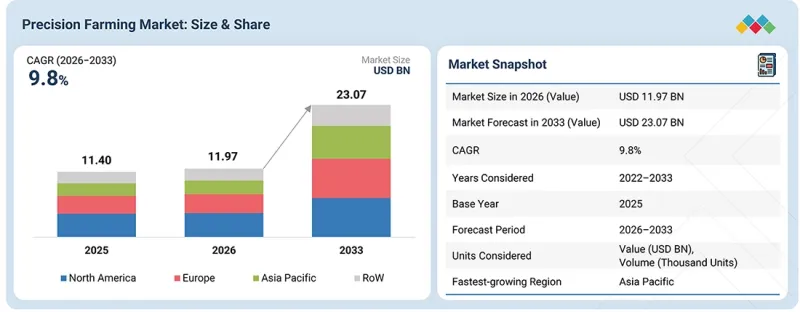
정밀 농업 시장은 2026년 119억 7,000만 달러에서 2033년까지 230억 7,000만 달러로 연평균 성장률(CAGR) 9.8%를 기록하며 확대될 것으로 전망됩니다.
지속가능한 농업 실천에 대한 관심이 높아짐에 따라 자원의 효율적인 이용이 촉진되고 환경에 미치는 영향이 감소함으로써 정밀 농업 시장의 성장이 가속화되고 있습니다.
| 조사 범위 | |
|---|---|
| 조사 대상 기간 | 2021-2033년 |
| 기준 연도 | 2025년 |
| 예측 기간 | 2026-2033년 |
| 산정 단위 | 금액(10억 달러) |
| 부문 | 기술별, 용도별, 지역별 |
| 대상 지역 | 북미, 유럽, 아시아태평양(APAC), 기타 지역(RoW) |
IoT 센서, 드론, AI를 활용한 분석 등의 정밀 농업 기술을 통해 농가는 물, 비료, 농약의 사용을 최적화하여 낭비와 토양 황폐화를 최소화할 수 있습니다. 이는 농업 분야의 탄소발자국 감축을 목표로 하는 전 세계적인 지속가능성 목표 및 규제적 압력과 부합합니다. 또한, 친환경 농산물 및 유기농 농산물에 대한 소비자 수요가 증가함에 따라 농가들은 이러한 기술을 도입하여 생태계를 보전하면서 수확량을 높이고 있습니다. 그 결과, 지속가능한 솔루션에 대한 수요가 기술의 광범위한 보급을 뒷받침하며, 각 지역의 정밀 농업 시장 확대를 촉진하고 있습니다.
“2025년에는 가이던스 기술이 가장 큰 시장 점유율을 차지했습니다.”
가이드 기술은 업무 효율 향상과 인건비 절감에 있어 매우 중요한 역할을 하고 있기 때문에 2025년에는 정밀 농업 시장에서 가장 큰 점유율을 차지했습니다. GPS, 자동 조향 시스템, GNSS 등의 기술을 통해 정밀한 내비게이션과 농지 매핑이 가능해졌으며, 농가는 중복과 낭비를 최소화하면서 파종, 수확, 농지 작업을 최적화할 수 있습니다. 주요 촉진요인으로는 자동화 기계의 도입 확대, 농장 규모 확대, 그리고 인력 부족 속에서 생산성 향상이 요구되고 있다는 점을 들 수 있습니다. 또한, 스마트 농업에 대한 정부의 보조금과 지속가능한 농업 실천에 대한 추진도 수요를 더욱 뒷받침하고 있습니다.
“가변 시비(VRA) 부문은 예측 기간 동안 두 번째로 높은 연평균 성장률(CAGR)을 기록할 것으로 전망됩니다.”
가변 시비(VRA)는 자원 활용을 최적화하고 작물 수확량을 향상시키는 능력 덕분에 예측 기간 동안 정밀 농업 시장에서 두 번째로 높은 연평균 성장률(CAGR)을 기록했습니다. VRA를 통해 농가는 밭 전체에 걸쳐 비료, 농약, 물을 서로 다른 비율로 살포하고, 특정 토양이나 작물의 요구에 맞춰 투입량을 조정할 수 있습니다. 주요 촉진요인으로는 실시간 농지 모니터링을 위한 데이터 분석 및 IoT 도입 확대, 지속가능한 농업 실천에 대한 수요 증가, 그리고 살포 정밀도를 높이는 센서 기술의 발전 등을 들 수 있습니다. 또한, 식량 수요를 충족시키면서 투입 비용과 환경에 미치는 영향을 줄일 필요성이 정밀 농업 분야에서 가변 비율 살포의 급속한 보급을 뒷받침하고 있습니다.
“예측 기간 동안 중국이 아시아태평양의 정밀 농업 시장을 주도할 것으로 전망됩니다.”
중국은 방대한 인구의 식량 안보를 확보하기 위한 스마트 농업 촉진 보조금 및 정책 등 정부의 강력한 지원에 힘입어 아시아태평양 정밀 농업 시장의 성장을 주도할 전망입니다. 급속한 도시화와 식량 수요 증가로 효율적인 농업의 필요성이 높아지면서, 농가들은 더 나은 작물 관리를 위해 IoT, AI, 드론 등의 첨단 기술 도입을 서두르고 있습니다. 또한, 농업 연구개발에 대한 막대한 투자를 바탕으로 한 중국의 기술 혁신에 대한 집중이 정밀 농업 도구의 통합을 가속화하고 있습니다. 정부의 노력, 시급한 식량 안보 수요, 그리고 기술의 광범위한 도입이 맞물리면서, 중국은 이 지역의 정밀 농업 시장 성장에서 선두를 달리고 있습니다.
2차 조사를 통해 수집된 각종 부문 및 하위 부문의 시장 규모를 확정하고 검증하기 위해 정밀 농업 솔루션을 제공하는 주요 업계 전문가들을 대상으로 광범위한 1차 인터뷰가 실시되었습니다. 본 보고서의 1차 인터뷰 대상자 구성은 다음과 같습니다:
본 조사에는 부품 공급업체부터 Tier 1 기업, OEM에 이르기까지 다양한 업계 전문가들의 인사이트이 포함되어 있습니다. 1차 조사 대상자의 구성은 다음과 같습니다:
- 기업 유형별 : Tier 1 - 35%, Tier 2 - 40%, Tier 3 - 25%
- 직책별 : C레벨 임원 - 30%, 이사 - 40%, 기타 - 30%
- 지역별 : 북미 - 40%, 아시아태평양 - 32%, 유럽 - 23%, 기타 지역 - 5%
조사 범위
본 보고서에서는 정밀 농업 시장을 세분화하여 제공 서비스, 기술, 용도, 지역별로 시장 규모를 예측하고 있습니다. 또한, 시장과 관련된 촉진요인, 제약요인, 기회, 과제에 대해서도 다루고 있습니다. 북미, 유럽, 아시아태평양, 기타 지역(RoW) 등 4개 주요 지역에 걸친 시장에 대한 상세한 개요를 제공합니다. 본 보고서에는 공급망 분석 외에도 주요 기업 및 정밀 농업 생태계에 대한 경쟁 분석도 포함되어 있습니다.
본 보고서를 구매할 때의 주요 이점
본 보고서는 이 시장의 시장 선도 기업 및 신규 진입 기업에게 정밀 농업 시장 전체 및 각 하위 부문의 수치에 대한 가장 정확한 추정치를 제공합니다. 본 보고서는 이해관계자가 경쟁 구도를 이해하고, 자사의 비즈니스를 더 나은 위치로 이끌며, 적절한 시장 진입 전략을 수립하기 위한 추가적인 인사이트를 얻는 데 도움이 됩니다. 또한, 본 보고서는 이해관계자가 시장 동향을 파악할 수 있도록 지원하며, 주요 시장 촉진요인, 억제요인, 과제 및 기회에 대한 정보를 제공합니다.
본 보고서는 다음 사항에 대한 인사이트를 제공합니다:
- 주요 촉진요인 분석(기술 발전에 따른 데이터 기반 및 효율적인 농업 지향, 지속가능한 농업 관행에 대한 중요성 증대, 스마트 농업에 대한 정부의 지원 및 보조금), 제약요인(높은 초기 투자 및 기술 비용, 기술적 지식 및 숙련된 인력 부족), 기회(정밀 농업 분야의 가변 시비(VRA) 성장 가능성, 농업 분야에서의 데이터 분석 도입, 정밀 농업을 위한 나노기술의 발전), 그리고 과제(표준화된 규제 및 정책의 부재, 데이터 개인정보 보호 문제 및 보안 우려, 농촌 지역의 디지털 인프라 부족) 등 정밀 농업 시장의 성장에 영향을 미치는 요인
- 제품·솔루션·서비스의 개발 및 혁신 : 정밀 농업 시장의 향후 기술, 연구 개발 활동, 그리고 제품·솔루션·서비스 출시에 관한 상세한 인사이트
- 시장 개발 : 수익성이 높은 시장에 대한 종합적인 정보 - 본 보고서는 다양한 지역에 걸친 정밀 농업 시장을 분석합니다.
- 시장 다각화 : 정밀 농업 시장의 신제품·솔루션·서비스, 미개척 지역, 최근 동향 및 투자에 관한 종합적인 정보
- 경쟁 분석 : 주요 기업의 시장 점유율, 성장 전략 및 서비스 제공 내용에 대한 상세한 평가
자주 묻는 질문
목차
제1장 서론
제2장 요약
제3장 주요 인사이트
- 정밀 농업 시장에서 사업자에게 매력적인 기회
- 자동화 및 제어 시스템용 정밀 농업 시장(기기 유형별)
- 용도별 정밀 농업 시장
- 지역별 정밀 농업 시장
제4장 시장 개요
- 시장 역학
- 성장 촉진요인
- 성장 억제요인
- 기회
- 과제
- 상호 연관된 시장 및 부문 간 기회
- 상호 연관된 시장
- 부문 간 기회
- Tier 1/2/3 주요 기업들의 전략적 움직임
제5장 업계 동향
- Porter's Five Forces 분석
- 경쟁 기업 간의 적대적 관계
- 대체품의 위협
- 구매자의 협상력
- 공급업체의 협상력
- 신규 진입자의 위협
- 거시경제 전망
- GDP 동향 및 전망
- 세계 농업 기계 시장의 동향
- 세계 농업용 드론 및 원격 감지 시장의 동향
- 밸류체인 분석
- 생태계 분석
- 가격 분석
- 지역별 드론 평균 판매 가격 동향(2022-2025년)
- 주요 기업별 정밀 농업용 하드웨어 부품의 평균 판매 가격(2025년)
- 무역 분석
- 수입 데이터
- 수출 데이터
- 주요 회의 및 행사(2026-2027년)
- 고객의 비즈니스에 영향을 미치는 동향/파괴적 혁신
- 투자 및 자금 조달 시나리오
- 사례 연구 분석
- SYNGENTA, PLANET LABS PBC의 위성 데이터를 활용하여 정밀 농업 강화
- TELNYX, IoT 기반 센서를 도입하여 과일 크기 모니터링 및 수확량 관리를 지원
- FARMONAUT TECHNOLOGIES, 드론을 활용한 정밀 농업으로 캘리포니아주의 농업 강화
- 디지털 혁신을 통한 정밀 농업이 파르바니 지역의 면화 수확량을 향상시켰습니다
- 2025년 미국 관세가 정밀 농업 시장에 미치는 영향
- 주요 관세율
- 가격에 미치는 영향 분석
- 국가·지역에 미치는 영향
- 용도에 미치는 영향
제6장 기술의 진보, AI의 영향, 특허 및 혁신
- 주요 신흥 기술
- 전지구위치측정시스템(GPS)/전지구위치위성시스템(GNSS)
- 원격 감지(위성 및 UAV/드론)
- 지리정보시스템(GIS)
- 보완 기술
- 사물인터넷(IoT)
- 인공지능(AI) 및 기계 학습(ML)
- 텔레매틱스 및 무선 통신(예 : LoRa, NB-IoT, 5G)
- 관련 기술
- 증강 현실(AR) 및 가상현실(VR)
- 디지털 트윈 및 시뮬레이션 모델
- 기술 로드맵
- 특허 분석
- AI가 정밀 농업에 미치는 영향
- 주요 활용 사례 및 시장 잠재력
- 정밀 농업 시장의 모범 사례
- 상호 연관된 인접 생태계 및 시장 참여자에 미치는 영향
- 정밀 농업 시장에서 AI 도입에 대한 고객의 준비 현황
제7장 규제 현황
- 규제 기관, 정부 기관 및 기타 조직
- 업계 표준
제8장 고객 현황 및 구매 행동
- 의사결정 과정
- 구매 과정의 주요 이해관계자와 그 평가 기준
- 구매 과정의 주요 이해관계자
- 구매 기준
- 도입 장벽과 사내 과제
- 다양한 용도에서의 미충족 수요
제9장 정밀 농업 시장 : 제공 유형별
- 하드웨어
- 소프트웨어
- 서비스
제10장 정밀 농업 시장 : 기술별
- 가이드 기술
- 원격 감지 기술
- 가변 시비 기술
제11장 정밀 농업 시장 : 용도별
- 수확량 모니터링
- 작물 생육 상황 조사
- 농지 매핑
- 가변 시비
- 기상 추적 및 예측
- 재고 관리
- 농업 인력 관리
- 재무 관리
- 기타 용도
제12장 정밀 농업 시장 : 지역별
- 북미
- 미국
- 캐나다
- 멕시코
- 유럽
- 독일
- 영국
- 프랑스
- 스페인
- 이탈리아
- 폴란드
- 북유럽 국가들
- 기타 유럽
- 아시아태평양
- 중국
- 일본
- 한국
- 인도
- 호주
- 인도네시아
- 말레이시아
- 태국
- 베트남
- 기타 아시아태평양
- 기타 지역
- 중동
- 아프리카
- 남미
- 브라질
- 아르헨티나
- 기타 남미
제13장 경쟁 현황
- 개요
- 주요 진입 기업의 전략/강점, 2023-2026년
- 수익 분석, 2021-2025년
- 시장 점유율 분석(2025년)
- 기업 가치 평가 및 재무 지표(2026년)
- 제품 비교
- 기업 평가 매트릭스 : 주요 기업, 2026년
- 스타 기업
- 신흥 리더
- 광범위한 영향력을 가진 기업
- 진출 기업
- 기업의 사업 전개 : 주요 기업, 2026년
- 기업 평가 매트릭스 : 스타트업/중소기업, 2026년
- 선도적인 기업
- 대응력이 뛰어난 기업
- 역동적인 기업
- 출발점
- 경쟁사 벤치마킹 : 스타트업/중소기업, 2026년
- 경쟁 시나리오
- 제품 출시
- 거래
제14장 기업 개요
- 주요 기업
- DEERE &COMPANY
- AGCO CORPORATION
- CNH INDUSTRIAL N.V.
- AG LEADER TECHNOLOGY
- AGEAGLE AERIAL SYSTEMS INC.
- TOPCON CORPORATION
- BAYER AG(CLIMATE LLC)
- TEEJET TECHNOLOGIES
- HEXAGON AB
- KUBOTA CORPORATION
- 기타 주요 기업
- TRIMBLE INC.
- ABACO S.P.A.
- CROPX INC.
- FARMERS EDGE INC.
- GROWNETICS
- CROPIN TECHNOLOGY SOLUTIONS PRIVATE LIMITED
- GAMAYA
- DICKEY-JOHN
- TELUS
- HARXON CORPORATION
- AGRICOLUS
- ESRI
- FARMDOK GMBH
- YARA
- CLAAS KGAA MBH
제15장 조사 방법론
제16장 부록
KSM 26.10.26The precision farming market is projected to grow from USD 11.97 billion in 2026 to USD 23.07 billion by 2033, at a CAGR of 9.8%. The growing emphasis on sustainable agricultural practices is accelerating the precision farming market's growth by promoting efficient resource use and reducing environmental impact.
| Scope of the Report | |
|---|---|
| Years Considered for the Study | 2021-2033 |
| Base Year | 2025 |
| Forecast Period | 2026-2033 |
| Units Considered | Value (USD Billion) |
| Segments | By Technology, Application and Region |
| Regions covered | North America, Europe, APAC, RoW |
Precision farming technologies, such as IoT sensors, drones, and AI-driven analytics, enable farmers to optimize water, fertilizer, and pesticide usage, minimizing waste and soil degradation. This aligns with global sustainability goals and regulatory pressures to lower carbon footprints in agriculture. Additionally, consumer demand for eco-friendly and organic produce encourages farmers to adopt these technologies, enhancing yields while preserving ecosystems. As a result, the need for sustainable solutions drives widespread adoption, fueling the precision farming market's expansion across regions.
"Guidance technology accounted for the largest market share in 2025"
Guidance technology accounted for the largest share of the precision farming market in 2025 due to its critical role in enhancing operational efficiency and reducing labor costs. Technologies such as GPS, auto-steering systems, and GNSS enable precise navigation and field mapping, allowing farmers to optimize planting, harvesting, and field operations with minimal overlap or waste. Key drivers include the rising adoption of automated machinery, increasing farm sizes, and the need for higher productivity amid labor shortages. Additionally, government subsidies for smart agriculture and the push for sustainable practices further boost demand.
"The variable-rate application segment is projected to register the second-highest CAGR during the forecast period"
Variable rate application (VRA) recorded the second-highest CAGR in the precision farming market during the forecast period due to its ability to optimize resource use and boost crop yields. VRA allows farmers to apply fertilizers, pesticides, and water at varying rates across a field, tailoring inputs to specific soil and crop needs. Key drivers include the rising adoption of data analytics and IoT for real-time field monitoring, increasing demand for sustainable farming practices, and advancements in sensor technology that enhance application precision. Additionally, the need to reduce input costs and environmental impact while meeting food demand fuels the rapid adoption of variable rate application in precision agriculture.
"China is likely to lead the Asia Pacific precision farming market throughout the forecast period"
China is set to lead growth in the Asia Pacific precision farming market due to its robust government support, including subsidies and policies promoting smart agriculture to ensure food security for its massive population. Rapid urbanization and rising food demand drive the need for efficient farming, pushing farmers to adopt advanced technologies like IoT, AI, and drones for better crop management. Additionally, China's focus on technological innovation, supported by heavy investments in agricultural R&D, accelerates the integration of precision farming tools. The combination of government initiatives, pressing food security needs, and widespread tech adoption positions China as a frontrunner in the region's precision farming market growth.
Extensive primary interviews were conducted with key industry experts offering precision farming solutions to determine and verify the market size for various segments and subsegments gathered through secondary research. The breakdown of primary participants for the report is provided below:
The study contains insights from various industry experts, from component suppliers to Tier 1 companies and OEMs. The breakdown of the primary participants is as follows:
- By Company Type: Tier 1 - 35%, Tier 2 - 40%, and Tier 3 - 25%
- By Designation: C-level Executives - 30%, Directors - 40%, and Others - 30%
- By Region: North America - 40%, Asia Pacific - 32%, Europe - 23%, and RoW - 5%
The precision farming market is dominated by globally established players such as Deere & Company (US), AGCO Corporation (US), CNH Industrial N.V. (Netherlands), Ag Leader Technology (US), AgEagle Aerial Systems Inc (US), Topcon Corporation (Japan), Bayer AG (Climate LLC.) (Germany), TeeJet Technologies (US), Hexagon AB (Sweden), Kubota Corporation (Japan), Trimble Inc. (US), Abaco S.p.A. (Italy), Cropx Inc. (Israel), Farmers Edge Inc. (Canada), Grownetics (US), Cropin Technology Solutions Private Limited (India), Gamaya (Switzerland), Dickey-John (US), Telus (Canada), Harxon Corporation (China), Aeris (US), Esri (US), Farmdok GmbH (Austria), Yara (Norway), and Claas KGaA mbH (Germany). The study includes an in-depth competitive analysis of these key players in the precision farming market, with their company profiles, recent developments, and key market strategies.
Research Coverage
The report segments the precision farming market and forecasts its size by offering, technology, application, and region. The report also discusses the drivers, restraints, opportunities, and challenges pertaining to the market. It gives a detailed view of the market across four main regions-North America, Europe, Asia Pacific, and RoW. A supply chain analysis has been included in the report, along with the key players and their competitive analysis of the precision farming ecosystem.
Key Benefits of Buying the Report
The report will help market leaders/new entrants in this market with information on the closest approximations of the numbers for the overall precision farming market and the subsegments. This report will help stakeholders understand the competitive landscape and gain more insights to position their businesses better and plan suitable go-to-market strategies. The report also helps stakeholders understand the pulse of the market and provides them with information on key market drivers, restraints, challenges, and opportunities.
The report provides insights into the following pointers:
- Analysis of key drivers (Inclination toward data-driven and efficient farming due to technological advancements, Growing emphasis on sustainable agricultural practices, Government support and subsidies for smart agriculture), restraints (High initial investment and technology costs, Lack of technical knowledge and skilled workforce), opportunities (Growth potential of variable-rate application (VRA) in precision farming, Adoption of data analytics in the agriculture sector, Advancements in nanotechnology for precision agriculture), and challenges (Lack of standardized policies and regulations, Data privacy issues and security concerns, and Limited digital infrastructure in rural areas) influencing the growth of the precision farming market
- Products/Solution/Service Development/Innovation: Detailed insights on upcoming technologies, research and development activities, and product/solution/service launches in the precision farming market
- Market Development: Comprehensive information about lucrative markets-the report analyses the precision farming market across varied regions.
- Market Diversification: Exhaustive information about new products/solutions/services, untapped geographies, recent developments, and investments in the precision farming market
- Competitive Assessment: In-depth assessment of market shares, growth strategies, and service offerings of leading players such as Deere & Company (US), AGCO Corporation (US), CNH Industrial N.V. (UK), Kubota Corporation (Japan), and Topcon Corporation (Japan), among others
TABLE OF CONTENTS
1 INTRODUCTION
- 1.1 STUDY OBJECTIVES
- 1.2 MARKET DEFINITION
- 1.3 MARKET SCOPE
- 1.3.1 MARKET SEGMENTATION AND REGIONAL SCOPE
- 1.3.2 INCLUSIONS AND EXCLUSIONS
- 1.3.3 YEARS CONSIDERED
- 1.4 CURRENCY CONSIDERED
- 1.5 UNIT CONSIDERED
- 1.6 STAKEHOLDERS
- 1.7 SUMMARY OF CHANGES
2 EXECUTIVE SUMMARY
- 2.1 MARKET HIGHLIGHTS AND KEY INSIGHTS
- 2.2 KEY MARKET PARTICIPANTS: MAPPING OF STRATEGIC DEVELOPMENTS
- 2.3 DISRUPTIVE TRENDS SHAPING MARKET
- 2.4 HIGH-GROWTH SEGMENTS
- 2.5 REGIONAL SNAPSHOT: MARKET SIZE, GROWTH RATE, AND FORECAST
3 PREMIUM INSIGHTS
- 3.1 ATTRACTIVE OPPORTUNITIES FOR PLAYERS IN PRECISION FARMING MARKET
- 3.2 PRECISION FARMING MARKET FOR AUTOMATION & CONTROL SYSTEMS, BY DEVICE TYPE
- 3.3 PRECISION FARMING MARKET, BY APPLICATION
- 3.4 PRECISION FARMING MARKET, BY REGION
4 MARKET OVERVIEW
- 4.1 INTRODUCTION
- 4.2 MARKET DYNAMICS
- 4.2.1 DRIVERS
- 4.2.1.1 Increasing deployment of autonomous machinery and ai-enabled solutions
- 4.2.1.2 Growing emphasis on sustainable agricultural practices
- 4.2.1.3 Increasing government support for smart agriculture
- 4.2.2 RESTRAINTS
- 4.2.2.1 High initial investment and technology costs
- 4.2.2.2 Lack of technical knowledge and shortage of skilled workforce
- 4.2.3 OPPORTUNITIES
- 4.2.3.1 Growing integration of VRA for site-specific input management
- 4.2.3.2 Increasing use of advanced analytics to optimize farm-level decision-making
- 4.2.3.3 Rapid advancements in nanotechnology for precision agriculture
- 4.2.4 CHALLENGES
- 4.2.4.1 Lack of standardized policies and regulations
- 4.2.4.2 Data privacy issues and security concerns
- 4.2.4.3 Limited digital infrastructure in rural areas
- 4.2.1 DRIVERS
- 4.3 INTERCONNECTED MARKETS AND CROSS-SECTOR OPPORTUNITIES
- 4.3.1 INTERCONNECTED MARKETS
- 4.3.2 CROSS-SECTOR OPPORTUNITIES
- 4.4 STRATEGIC MOVES BY TIER 1/2/3 PLAYERS
5 INDUSTRY TRENDS
- 5.1 INTRODUCTION
- 5.2 PORTER'S FIVE FORCE ANALYSIS
- 5.2.1 INTENSITY OF COMPETITIVE RIVALRY
- 5.2.2 THREAT OF SUBSTITUTES
- 5.2.3 BARGAINING POWER OF BUYERS
- 5.2.4 BARGAINING POWER OF SUPPLIERS
- 5.2.5 THREAT OF NEW ENTRANTS
- 5.3 MACROECONOMIC OUTLOOK
- 5.3.1 INTRODUCTION
- 5.3.2 GDP TRENDS AND FORECAST
- 5.3.3 TRENDS IN GLOBAL AGRICULTURAL MACHINERY MARKET
- 5.3.4 TRENDS IN GLOBAL AGRICULTURAL DRONES AND REMOTE SENSING MARKET
- 5.4 VALUE CHAIN ANALYSIS
- 5.5 ECOSYSTEM ANALYSIS
- 5.6 PRICING ANALYSIS
- 5.6.1 AVERAGE SELLING PRICE TREND OF DRONES, BY REGION, 2022-2025
- 5.6.2 AVERAGE SELLING PRICE OF PRECISION FARMING HARDWARE COMPONENTS, BY KEY PLAYER, 2025
- 5.7 TRADE ANALYSIS
- 5.7.1 IMPORT DATA
- 5.7.2 EXPORT DATA
- 5.8 KEY CONFERENCES AND EVENTS, 2026-2027
- 5.9 TRENDS/DISRUPTIONS IMPACTING CUSTOMER BUSINESS
- 5.10 INVESTMENT AND FUNDING SCENARIO
- 5.11 CASE STUDY ANALYSIS
- 5.11.1 SYNGENTA ENHANCES PRECISION AGRICULTURE WITH SATELLITE INSIGHTS FROM PLANET LABS PBC
- 5.11.2 TELNYX DEPLOYS IOT-BASED SENSORS TO SUPPORT FRUIT SIZE MONITORING AND YIELD MANAGEMENT
- 5.11.3 FARMONAUT TECHNOLOGIES ENHANCES CALIFORNIA AGRICULTURE WITH DRONE-ENABLED PRECISION FARMING
- 5.11.4 PRECISION AGRICULTURE ENHANCES COTTON YIELDS IN PARBHANI THROUGH DIGITAL INNOVATION
- 5.12 IMPACT OF 2025 US TARIFF ON PRECISION FARMING MARKET
- 5.12.1 INTRODUCTION
- 5.12.2 KEY TARIFF RATES
- 5.12.3 PRICE IMPACT ANALYSIS
- 5.12.4 IMPACT ON COUNTRIES/REGIONS
- 5.12.4.1 US
- 5.12.4.2 Europe
- 5.12.4.3 Asia Pacific
- 5.12.5 IMPACT ON APPLICATIONS
6 TECHNOLOGICAL ADVANCEMENTS, AI-DRIVEN IMPACT, PATENTS, AND INNOVATIONS
- 6.1 KEY EMERGING TECHNOLOGIES
- 6.1.1 GLOBAL POSITIONING SYSTEM (GPS)/GLOBAL NAVIGATION SATELLITE SYSTEM (GNSS)
- 6.1.2 REMOTE SENSING (SATELLITE AND UAV/DRONES)
- 6.1.3 GEOGRAPHIC INFORMATION SYSTEM (GIS)
- 6.2 COMPLEMENTARY TECHNOLOGIES
- 6.2.1 INTERNET OF THINGS (IOT)
- 6.2.2 ARTIFICIAL INTELLIGENCE (AI) AND MACHINE LEARNING (ML)
- 6.2.3 TELEMATICS AND WIRELESS COMMUNICATION (E.G., LORA, NB-IOT, 5G)
- 6.3 ADJACENT TECHNOLOGIES
- 6.3.1 AUGMENTED REALITY (AR) AND VIRTUAL REALITY (VR)
- 6.3.2 DIGITAL TWIN AND SIMULATION MODELS
- 6.4 TECHNOLOGY ROADMAP
- 6.5 PATENT ANALYSIS
- 6.6 IMPACT OF AI ON PRECISION FARMING
- 6.6.1 TOP USE CASES AND MARKET POTENTIAL
- 6.6.2 BEST PRACTICES IN PRECISION FARMING MARKET
- 6.6.3 INTERCONNECTED ADJACENT ECOSYSTEM AND IMPACT ON MARKET PLAYERS
- 6.6.4 CLIENTS' READINESS TO ADOPT AI IN PRECISION FARMING MARKET
7 REGULATORY LANDSCAPE
- 7.1 INTRODUCTION
- 7.1.1 REGULATORY BODIES, GOVERNMENT AGENCIES, AND OTHER ORGANIZATIONS
- 7.1.2 INDUSTRY STANDARDS
- 7.1.2.1 ISO 18497-1:2024: Safety of Partially Automated, Semi-Autonomous and Autonomous Agricultural Machinery
- 7.1.2.2 ISO 25119: Safety-Related Parts of Control Systems for Agriculture and Forestry
- 7.1.2.3 ISO 11783: Tractors and Machinery for Agriculture and Forestry - Serial Control and Communications Data Network
- 7.1.2.4 ISO 14001: Environmental Management System
8 CUSTOMER LANDSCAPE AND BUYER BEHAVIOR
- 8.1 DECISION-MAKING PROCESS
- 8.2 KEY STAKEHOLDERS IN BUYING PROCESS AND THEIR EVALUATION CRITERIA
- 8.2.1 KEY STAKEHOLDERS IN BUYING PROCESS
- 8.2.2 BUYING CRITERIA
- 8.3 ADOPTION BARRIERS AND INTERNAL CHALLENGES
- 8.4 UNMET NEEDS OF VARIOUS APPLICATIONS
9 PRECISION FARMING MARKET, BY OFFERING
- 9.1 INTRODUCTION
- 9.2 HARDWARE
- 9.2.1 AUTOMATION & CONTROL SYSTEMS
- 9.2.1.1 Displays
- 9.2.1.1.1 Rising use of precision farming solutions in yield monitoring and field mapping applications to boost display demand
- 9.2.1.2 Guidance & steering systems
- 9.2.1.2.1 Increasing deployment of GPS-based guidance and automated steering solutions to drive market
- 9.2.1.3 GPS/GNSS devices
- 9.2.1.3.1 Genuine need for better resource allocation and increasing yield to elevate demand for GPS/GNSS devices
- 9.2.1.4 Drones/UAVs
- 9.2.1.4.1 Rising adoption of drones for early detection of field anomalies, pests, and diseases to drive market
- 9.2.1.5 Irrigation controllers
- 9.2.1.5.1 Growing focus on enhancing water distribution efficiency for optimal crop hydration to propel market
- 9.2.1.6 Handheld mobile devices/handheld computers
- 9.2.1.6.1 Ability to provide real-time connectivity for managing agricultural data and processes to fuel segmental growth
- 9.2.1.7 Flow & application control devices
- 9.2.1.7.1 Increasing adoption of control devices for optimized input delivery to foster market expansion
- 9.2.1.8 Other automation & control systems
- 9.2.1.1 Displays
- 9.2.2 SENSING & MONITORING DEVICES
- 9.2.2.1 Yield monitors
- 9.2.2.1.1 Potential to optimize resource allocation and enhance profitability to accelerate adoption
- 9.2.2.2 Soil sensors
- 9.2.2.2.1 Moisture sensors
- 9.2.2.2.1.1 Greater emphasis on water conservation and crop yield enhancement to facilitate installation
- 9.2.2.2.2 Temperature sensors
- 9.2.2.2.2.1 Growing inclination toward data-driven crop management to promote adoption
- 9.2.2.2.3 Nutrient sensors
- 9.2.2.2.3.1 Increasing demand for real-time soil nutrient monitoring to spike demand
- 9.2.2.2.1 Moisture sensors
- 9.2.2.3 Water sensors
- 9.2.2.3.1 Need to optimize irrigation decisions through real-time water monitoring to spur demand
- 9.2.2.4 Climate sensors
- 9.2.2.4.1 Necessity for early detection of climatic anomalies and optimization of crop conditions to drive market
- 9.2.2.1 Yield monitors
- 9.2.1 AUTOMATION & CONTROL SYSTEMS
- 9.3 SOFTWARE
- 9.3.1 LOCAL/WEB-BASED SOFTWARE
- 9.3.1.1 Rising adoption of advanced connectivity solutions in areas with limited network access to support market growth
- 9.3.2 CLOUD-BASED SOFTWARE
- 9.3.2.1 Expanding deployment of cloud platforms for sustainable agriculture to create opportunities
- 9.3.1 LOCAL/WEB-BASED SOFTWARE
- 9.4 SERVICES
- 9.4.1 SYSTEM INTEGRATION & CONSULTING SERVICES
- 9.4.1.1 Need to align hardware and software components for sustainable farming practices to contribute to segmental growth
- 9.4.2 MANAGED SERVICES
- 9.4.2.1 Farm operation services
- 9.4.2.2 Strong focus of medium- and large-scale farms on maximizing efficiency to boost segmental growth
- 9.4.2.3 Data services
- 9.4.2.4 Proliferation of mobile applications in precision farming to accelerate data service demand
- 9.4.2.5 Data analytics services
- 9.4.2.6 Integration of AI, ML, and big data analytics to evaluate historical and real-time data to propel market
- 9.4.3 CONNECTIVITY SERVICES
- 9.4.3.1 Necessity for synchronized functioning of farm equipment, drones, and IoT devices to stimulate demand
- 9.4.4 ASSISTED PROFESSIONAL SERVICES
- 9.4.4.1 Supply chain management services
- 9.4.4.1.1 Focus on enhancing traceability and transparency across supply chain to drive demand
- 9.4.4.2 Climate information services
- 9.4.4.2.1 Necessity to ensure long-term farm sustainability to accelerate segmental growth
- 9.4.4.3 Other assisted professional services
- 9.4.4.1 Supply chain management services
- 9.4.5 MAINTENANCE & SUPPORT SERVICES
- 9.4.5.1 Need to minimize downtime and resolve technical issues promptly to fuel segmental growth
- 9.4.1 SYSTEM INTEGRATION & CONSULTING SERVICES
10 PRECISION FARMING MARKET, BY TECHNOLOGY
- 10.1 INTRODUCTION
- 10.2 GUIDANCE TECHNOLOGY
- 10.2.1 GPS/GNSS-BASED GUIDANCE TECHNOLOGY
- 10.2.1.1 Ability to enhance site-specific operations, input accuracy, and sustainable resource management to facilitate market growth
- 10.2.2 GIS-BASED GUIDANCE TECHNOLOGY
- 10.2.2.1 Advancing spatial data management, resource optimization, and site-specific decision support to drive market
- 10.2.1 GPS/GNSS-BASED GUIDANCE TECHNOLOGY
- 10.3 REMOTE SENSING TECHNOLOGY
- 10.3.1 HANDHELD OR GROUND-BASED SENSING
- 10.3.1.1 Need for cost-effective field monitoring and yield assessment solutions to fuel demand
- 10.3.2 SATELLITE OR AERIAL SENSING
- 10.3.2.1 Adoption of advanced crop monitoring and yield technologies to drive market
- 10.3.1 HANDHELD OR GROUND-BASED SENSING
- 10.4 VARIABLE-RATE TECHNOLOGY
- 10.4.1 MAP-BASED
- 10.4.1.1 Potential to reduce input waste through site-specific application to boost deployment
- 10.4.2 SENSOR-BASED
- 10.4.2.1 Inclination toward optimized input application and sustainable crop management to support segmental growth
- 10.4.1 MAP-BASED
11 PRECISION FARMING MARKET, BY APPLICATION
- 11.1 INTRODUCTION
- 11.2 YIELD MONITORING
- 11.2.1 ON-FARM YIELD MONITORING
- 11.2.1.1 Growing preference for sustainable and resource-efficient farming to fuel segmental growth
- 11.2.2 OFF-FARM YIELD MONITORING
- 11.2.2.1 Need to assess yield quality post-harvest to foster market growth
- 11.2.1 ON-FARM YIELD MONITORING
- 11.3 CROP SCOUTING
- 11.3.1 USE OF GPS AND UAV TECHNOLOGIES TO ENHANCE CROP HEALTH TO FACILITATE MARKET GROWTH
- 11.3.2 PRE-SEEDING CROP SCOUTING
- 11.3.3 POST-SEEDING CROP SCOUTING
- 11.3.4 CROP MONITORING
- 11.4 FIELD MAPPING
- 11.4.1 BOUNDARY MAPPING
- 11.4.1.1 Greater emphasis on improving sampling accuracy and monitoring crop production to augment segmental growth
- 11.4.2 DRAINAGE MAPPING
- 11.4.2.1 Requirement for improved field conditions and sustainable crop production to propel market
- 11.4.1 BOUNDARY MAPPING
- 11.5 VARIABLE-RATE APPLICATION
- 11.5.1 PRECISION IRRIGATION
- 11.5.1.1 Increasing focus on water waste reduction and yield maximization to stimulate demand
- 11.5.2 PRECISION SEEDING
- 11.5.2.1 Potential to offer higher yields and minimized crop damage to drive segmental growth
- 11.5.3 PRECISION FERTILIZATION
- 11.5.3.1 Significant focus on site-specific nutrient management and resource optimization to drive adoption
- 11.5.3.2 Nitrogen VRA
- 11.5.3.3 Phosphorous VRA
- 11.5.3.4 Lime VRA
- 11.5.4 OTHER VARIABLE-RATE APPLICATION TYPES
- 11.5.1 PRECISION IRRIGATION
- 11.6 WEATHER TRACKING & FORECASTING
- 11.6.1 NEED FOR ENHANCING FARM EFFICIENCY THROUGH ADVANCED WEATHER MONITORING & FORECASTING TO DRIVE DEMAND
- 11.7 INVENTORY MANAGEMENT
- 11.7.1 FOCUS ON OPTIMIZING RESOURCE EFFICIENCY TO DRIVE ADOPTION OF STRATEGIC FARM INVENTORY MANAGEMENT
- 11.8 FARM LABOR MANAGEMENT
- 11.8.1 EMPHASIS ON REDUCING LABOR COSTS AND INCREASING CROP YIELD TO DRIVE SEGMENTAL GROWTH
- 11.9 FINANCIAL MANAGEMENT
- 11.9.1 INCREASING FOCUS ON IMPROVING PROFITABILITY AND MITIGATING FINANCIAL RISKS TO BOOST ADOPTION
- 11.10 OTHER APPLICATIONS
12 PRECISION FARMING MARKET, BY REGION
- 12.1 INTRODUCTION
- 12.2 NORTH AMERICA
- 12.2.1 US
- 12.2.1.1 Significant presence of major market players to fuel market growth
- 12.2.2 CANADA
- 12.2.2.1 Digital innovation and sustainable farming practices to strengthen market expansion
- 12.2.3 MEXICO
- 12.2.3.1 Growing advancements in digital tools and smart farming technologies to drive market
- 12.2.1 US
- 12.3 EUROPE
- 12.3.1 GERMANY
- 12.3.1.1 Digitalization and strategic investments in agriculture sector to accelerate market growth
- 12.3.2 UK
- 12.3.2.1 Rising use of automation and robotics in planting, crop management, and harvesting to support market growth
- 12.3.3 FRANCE
- 12.3.3.1 Data-driven startups and smart environmental insights to facilitate market growth
- 12.3.4 SPAIN
- 12.3.4.1 Elevating use of drone-based field surveillance and smart irrigation systems to reinforce market expansion
- 12.3.5 ITALY
- 12.3.5.1 Rising focus on sustainable and efficient farming to drive market
- 12.3.6 POLAND
- 12.3.6.1 Gradual adoption of smart farming supported by EU funding and modernization efforts to propel market
- 12.3.7 NORDICS
- 12.3.7.1 Strong digital infrastructure and environmental goals to contribute to market growth
- 12.3.8 REST OF EUROPE
- 12.3.1 GERMANY
- 12.4 ASIA PACIFIC
- 12.4.1 CHINA
- 12.4.1.1 Government investments in AI-driven farming and pesticide management to stimulate market growth
- 12.4.2 JAPAN
- 12.4.2.1 Launch of robotic solutions and agricultural automated systems to fuel market growth
- 12.4.3 SOUTH KOREA
- 12.4.3.1 Government support to develop smart farming villages to contribute to market growth
- 12.4.4 INDIA
- 12.4.4.1 AI-enabled agricultural advisory and precision farming infrastructure to accelerate market growth
- 12.4.5 AUSTRALIA
- 12.4.5.1 Rising focus on improving fertilizer efficiency and increase crop yields to boost demand
- 12.4.6 INDONESIA
- 12.4.6.1 Digital transformation in agriculture to facilitate market growth
- 12.4.7 MALAYSIA
- 12.4.7.1 Smart farming initiatives focused on field efficiency improvement and manual labor reduction to fuel market expansion
- 12.4.8 THAILAND
- 12.4.8.1 Escalating use of drones, GPS-guided tractors, sensor-based irrigation systems to drive market
- 12.4.9 VIETNAM
- 12.4.9.1 Integration of satellite imagery and automated irrigation systems to reinforce market expansion
- 12.4.10 REST OF ASIA PACIFIC
- 12.4.1 CHINA
- 12.5 ROW
- 12.5.1 MIDDLE EAST
- 12.5.1.1 Bahrain
- 12.5.1.1.1 Strong government commitment to food security and digital transformation to spike demand
- 12.5.1.2 Kuwait
- 12.5.1.2.1 Adoption of smart water management and vertical farming to support market
- 12.5.1.3 Oman
- 12.5.1.3.1 Implementation of smart agriculture and food security initiatives to strengthen market expansion
- 12.5.1.4 Qatar
- 12.5.1.4.1 Strategic advancements and agricultural digitization for sustainable food security to drive market
- 12.5.1.5 Saudi Arabia
- 12.5.1.5.1 Innovation and strategic initiatives transforming agriculture sector to support market growth
- 12.5.1.6 UAE
- 12.5.1.6.1 Strategic adoption of sustainable desert farming practices to stimulate market growth
- 12.5.1.7 Rest of Middle East
- 12.5.1.1 Bahrain
- 12.5.2 AFRICA
- 12.5.2.1 South Africa
- 12.5.2.1.1 Advancements in agriculture through satellite IoT and AI-driven solutions to contribute to market growth
- 12.5.2.2 Rest of Africa
- 12.5.2.1 South Africa
- 12.5.3 SOUTH AMERICA
- 12.5.3.1 Advancing digital connectivity and technological integration to stimulate demand
- 12.5.4 BRAZIL
- 12.5.4.1 Large-scale commercial agriculture and digitalisation drive precision farming adoption
- 12.5.5 ARGENTINA
- 12.5.5.1 Mechanised broad-acre farming and data-driven agriculture accelerate precision technology adoption
- 12.5.6 REST OF SOUTH AMERICA
- 12.5.6.1 Agricultural modernisation and resource-efficiency needs support emerging precision farming adoption
- 12.5.1 MIDDLE EAST
13 COMPETITIVE LANDSCAPE
- 13.1 OVERVIEW
- 13.2 KEY PLAYER STRATEGIES/RIGHT TO WIN, 2023-2026
- 13.3 REVENUE ANALYSIS, 2021-2025
- 13.4 MARKET SHARE ANALYSIS, 2025
- 13.5 COMPANY VALUATION AND FINANCIAL METRICS, 2026
- 13.6 PRODUCT COMPARISON
- 13.7 COMPANY EVALUATION MATRIX: KEY PLAYERS, 2026
- 13.7.1 STARS
- 13.7.2 EMERGING LEADERS
- 13.7.3 PERVASIVE PLAYERS
- 13.7.4 PARTICIPANTS
- 13.7.5 COMPANY FOOTPRINT: KEY PLAYERS, 2026
- 13.7.5.1 Company footprint
- 13.7.5.2 Region footprint
- 13.7.5.3 Offering footprint
- 13.7.5.4 Technology footprint
- 13.7.5.5 Application footprint
- 13.8 COMPANY EVALUATION MATRIX: STARTUPS/SMES, 2026
- 13.8.1 PROGRESSIVE COMPANIES
- 13.8.2 RESPONSIVE COMPANIES
- 13.8.3 DYNAMIC COMPANIES
- 13.8.4 STARTING BLOCKS
- 13.8.5 COMPETITIVE BENCHMARKING: STARTUPS/SMES, 2026
- 13.8.5.1 Detailed list of key startups/SMEs
- 13.8.5.2 Competitive benchmarking of key startups/SMEs
- 13.9 COMPETITIVE SCENARIO
- 13.9.1 PRODUCT LAUNCHES
- 13.9.2 DEALS
14 COMPANY PROFILES
- 14.1 KEY PLAYERS
- 14.1.1 DEERE & COMPANY
- 14.1.1.1 Business overview
- 14.1.1.2 Products/Solutions/Services offered
- 14.1.1.3 Recent developments
- 14.1.1.3.1 Product launches
- 14.1.1.3.2 Deals
- 14.1.1.3.3 Other developments
- 14.1.1.4 MnM view
- 14.1.1.4.1 Key strengths
- 14.1.1.4.2 Strategic choices
- 14.1.1.4.3 Weaknesses and competitive threats
- 14.1.2 AGCO CORPORATION
- 14.1.2.1 Business overview
- 14.1.2.2 Products/Solutions/Services offered
- 14.1.2.3 Recent developments
- 14.1.2.3.1 Product launches
- 14.1.2.3.2 Deals
- 14.1.2.3.3 Expansions
- 14.1.2.4 MnM view
- 14.1.2.4.1 Key strengths
- 14.1.2.4.2 Strategic choices
- 14.1.2.4.3 Weaknesses and competitive threats
- 14.1.3 CNH INDUSTRIAL N.V.
- 14.1.3.1 Business overview
- 14.1.3.2 Products/Solutions/Services offered
- 14.1.3.3 Recent developments
- 14.1.3.3.1 Product launches
- 14.1.3.3.2 Deals
- 14.1.3.4 MnM view
- 14.1.3.4.1 Key strengths
- 14.1.3.4.2 Strategic choices
- 14.1.3.4.3 Weaknesses and competitive threats
- 14.1.4 AG LEADER TECHNOLOGY
- 14.1.4.1 Business overview
- 14.1.4.2 Products/Solutions/Services offered
- 14.1.4.3 Recent developments
- 14.1.4.3.1 Product launches
- 14.1.4.4 MnM view
- 14.1.4.4.1 Key strengths
- 14.1.4.4.2 Strategic choices
- 14.1.4.4.3 Weaknesses and competitive threats
- 14.1.5 AGEAGLE AERIAL SYSTEMS INC.
- 14.1.5.1 Business overview
- 14.1.5.2 Products/Solutions/Services offered
- 14.1.5.3 Recent developments
- 14.1.5.3.1 Product launches
- 14.1.5.4 MnM view
- 14.1.5.4.1 Key strengths
- 14.1.5.4.2 Strategic choices
- 14.1.5.4.3 Weaknesses and competitive threats
- 14.1.6 TOPCON CORPORATION
- 14.1.6.1 Business overview
- 14.1.6.2 Products/Solutions/Services offered
- 14.1.6.3 Recent developments
- 14.1.6.3.1 Product launches
- 14.1.6.3.2 Deals
- 14.1.6.3.3 Expansions
- 14.1.7 BAYER AG (CLIMATE LLC)
- 14.1.7.1 Business overview
- 14.1.7.2 Products/Solutions/Services offered
- 14.1.7.3 Recent developments
- 14.1.7.3.1 Product launches
- 14.1.7.3.2 Deals
- 14.1.8 TEEJET TECHNOLOGIES
- 14.1.8.1 Business overview
- 14.1.8.2 Products/Solutions/Services offered
- 14.1.8.3 Recent developments
- 14.1.8.3.1 Product launches
- 14.1.8.3.2 Deals
- 14.1.9 HEXAGON AB
- 14.1.9.1 Business overview
- 14.1.9.2 Products/Solutions/Services offered
- 14.1.9.3 Recent developments
- 14.1.9.3.1 Product launches
- 14.1.10 KUBOTA CORPORATION
- 14.1.10.1 Business overview
- 14.1.10.2 Products/Solutions/Services offered
- 14.1.10.3 Recent development
- 14.1.10.3.1 Product launches
- 14.1.10.3.2 Deals
- 14.1.10.4 Other developments
- 14.1.1 DEERE & COMPANY
- 14.2 OTHER PLAYERS
- 14.2.1 TRIMBLE INC.
- 14.2.2 ABACO S.P.A.
- 14.2.3 CROPX INC.
- 14.2.4 FARMERS EDGE INC.
- 14.2.5 GROWNETICS
- 14.2.6 CROPIN TECHNOLOGY SOLUTIONS PRIVATE LIMITED
- 14.2.7 GAMAYA
- 14.2.8 DICKEY-JOHN
- 14.2.9 TELUS
- 14.2.10 HARXON CORPORATION
- 14.2.11 AGRICOLUS
- 14.2.12 ESRI
- 14.2.13 FARMDOK GMBH
- 14.2.14 YARA
- 14.2.15 CLAAS KGAA MBH
15 RESEARCH METHODOLOGY
- 15.1 RESEARCH DATA
- 15.1.1 SECONDARY DATA
- 15.1.1.1 Key data from secondary sources
- 15.1.1.2 List of key secondary sources
- 15.1.2 PRIMARY DATA
- 15.1.2.1 Key data from primary sources
- 15.1.2.2 List of primary interview participants
- 15.1.2.3 Breakdown of primaries
- 15.1.2.4 Key industry insights
- 15.1.3 SECONDARY AND PRIMARY RESEARCH
- 15.1.1 SECONDARY DATA
- 15.2 MARKET SIZE ESTIMATION METHODOLOGY
- 15.2.1 BOTTOM-UP APPROACH
- 15.2.1.1 Approach to arrive at market size using bottom-up analysis (demand side)
- 15.2.2 TOP-DOWN APPROACH
- 15.2.2.1 Approach to arrive at market size using top-down analysis (supply side)
- 15.2.1 BOTTOM-UP APPROACH
- 15.3 DATA TRIANGULATION
- 15.4 RISK ANALYSIS
- 15.5 RESEARCH ASSUMPTIONS
- 15.6 RESEARCH LIMITATIONS
16 APPENDIX
- 16.1 DISCUSSION GUIDE
- 16.2 KNOWLEDGESTORE: MARKETSANDMARKETS' SUBSCRIPTION PORTAL
- 16.3 CUSTOMIZATION OPTIONS
- 16.4 RELATED REPORTS
- 16.5 AUTHOR DETAILS


