|
시장보고서
상품코드
1521640
전기자동차용 니켈계 배터리 : 시장 점유율 분석, 산업 동향 및 통계, 성장 예측(2024-2029년)Nickel-based Batteries For Electric Vehicles - Market Share Analysis, Industry Trends & Statistics, Growth Forecasts (2024 - 2029) |
||||||
 Mordor Intelligence
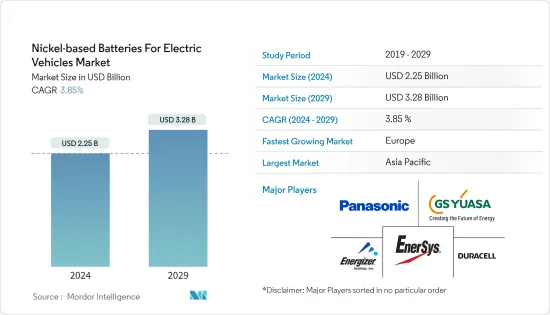
전기자동차용 니켈계 배터리 시장 규모는 2024년 22억 5,000만 달러로 추정되며, 예측 기간(2024-2029년) 동안 3.85%의 CAGR로 성장하여 2029년에는 32억 8,000만 달러에 달할 것으로 예상됩니다.
장기적으로 전기자동차 산업의 급속한 기술 발전은 전기자동차용 니켈계 배터리 시장을 견인할 것으로 예상됩니다. 설계 및 제조 개선, 소비자 선호도 변화, 지속가능성 및 기후 변화에 대한 관심 증가, 정부의 규제 압력 및 조치로 인해 자동차 산업을 뒷받침하는 구조와 시스템이 지속적으로 변화하고 있습니다. 이러한 변화의 한 예가 바로 전기자동차에 대한 수요의 급증입니다.
전기차는 기존 자동차에 비해 비용 측면에서 유리하기 때문에 전기자동차용 배터리 시장 확대가 기대되고 있습니다. 또한, 전기자동차 판매 촉진을 위한 정부의 지원 정책으로 예측 기간 동안 전기자동차용 니켈계 배터리의 수요가 증가할 것으로 예상됩니다.
그러나 전기자동차의 높은 비용, 코발트 등 주요 원자재 수급 격차, 충전 인프라 부족 등이 시장 성장을 저해할 것으로 예상됩니다. 주요 자동차 제조업체들은 빠르게 성장하는 전기자동차 산업을 활용하기 위해 배터리 업체와 협력하고 있습니다.
대형 자동차 제조업체들이 전기자동차 분야에 관심을 보이면서 전기자동차 배터리에 대한 수요가 증가하고 있습니다. 그러나 많은 전기자동차 제조업체들은 배터리 팩 자체 개발에 집중하고 있습니다. 이러한 요인들이 예측 기간 동안 시장을 주도할 것으로 예상됩니다.
전기자동차용 니켈계 배터리 시장 동향
배터리 전기자동차 부문이 시장을 장악할 것으로 예상
지속가능한 교통수단과 청정 에너지에 대한 수요가 증가하면서 배터리 전기자동차에 대한 수요가 증가하고 있습니다. 판촉 활동과 정부 규제는 주행거리, 초기 가격 상승, 제한된 모델 가용성, 지식 부족과 같은 소비자의 제약 요인을 해결하고 있습니다. 이러한 요인들은 배터리 전기차 수요에 영향을 미치고 전기자동차용 니켈계 배터리 시장을 견인할 것으로 예상됩니다.
- 배터리 전기자동차 판매량은 2021년 약 4.6백만 대에서 2022년 약 7.3백만 대에 달할 것으로 예상되며, BEV 판매량은 지속가능한 교통수단에 대한 소비자의 관심 증가와 직접적인 교통 배출을 억제하기 위한 정부 규제 등 여러 가지 요인으로 인해 급증하고 있습니다. 2021년 판매량은 2020년의 두 배 이상이며, 2022년에는 전기차 판매량 신기록을 달성할 것으로 예상됩니다.
니켈은 전기자동차 배터리에서 중요한 역할을 합니다. 전기 배터리 제조에 사용됩니다. 이 재료는 전기자동차에서 매우 일반적인 에너지 원인 리튬이온 배터리의 기초로 사용됩니다. 또한 자동차 제조업체들이 장거리, 고성능 및 많은 보급형 신차에 고니켈 배터리를 계속 선택함에 따라 배터리 구동 전기자동차의 니켈 무게는 2023년 7월 평균 25.3kg으로 연평균 8% 증가하여 2023년 7월에 평균 25.3kg으로 급증했습니다.
최근 일부 자동차 업체들은 시장 점유율을 확대하고 경쟁력을 유지하기 위해 점차 전동화를 고려한 사업 전략을 전개하고 있습니다. 각 업체들은 정책 규제를 준수하거나 정부의 우대 조치에 대응하기 위해 이러한 태도를 견지하고 있습니다. 또한, 업체들은 향후 몇 년 동안 더 많은 모델을 더 빨리 출시할 계획을 발표하여 예측 기간 동안 니켈 기반 배터리 시장을 촉진할 것으로 보입니다.
- 세계 최대 자동차 제조업체인 도요타는 2030년까지 30종의 BEV를 출시할 계획입니다. 연간 350만 대의 전기차 판매를 목표로 하고 있습니다. 렉서스는 2035년 전 세계 BEV 판매 100%를 달성하는 것을 목표로 하고 있습니다.
- 폭스바겐은 2030년까지 전체 전기차 판매량이 유럽에서 70%, 중국과 미국에서 50%를 넘어설 것이며, 2040년에는 거의 100%의 차량이 무공해 차량이 될 것이라고 발표했습니다. 한편, 볼보는 2030년까지 완전한 전기차 회사가 되겠다고 약속했습니다.
이러한 요인으로 인해 전 세계적으로 전기자동차에 니켈계 배터리의 채택이 증가하고 있습니다. 이러한 긍정적인 추세는 예측 기간 동안 니켈 기반 배터리 시장의 성장을 촉진할 것으로 예상됩니다.
아시아태평양이 대상 시장을 독식할 것으로 전망
아시아태평양은 전 세계 니켈 기반 배터리 시장에서 대부분의 점유율을 차지할 것으로 예상됩니다. 이 지역의 가처분 소득 증가와 GDP 증가가 시장을 주도하고 있습니다. 자동차 부품 제조의 용이성, 자동차 판매, 정부 규제 강화, 지역 내 자동차 산업의 수요 증가에 대응하기 위해 이 지역의 거래처 상표 제품 제조업체 및 공급업체가 채택한 견조한 확장은 예측 기간 동안 시장 전망을 밝게 할 것으로 예상됩니다.
중국은 전기자동차의 가장 큰 시장 중 하나이며, 중국 내 전기자동차의 채택 증가는 청정에너지 정책에 따른 것입니다. 또한 중국 정부는 전기자동차의 보급을 촉진하기 위해 금전적, 비금전적 인센티브를 제공하고 있습니다.
- 예를 들어, 2022년 중국에서 생산된 배터리 전기차는 약 547만 대에 달해 2021년 대비 85.8% 증가했습니다. 같은 해 중국에서 생산된 플러그인 하이브리드 자동차는 약 159만 대가 생산되어 전년 대비 164.2% 증가했습니다.
또한 인도 정부는 2030년까지 이륜차와 삼륜차를 100% 전기자동차로 전환하고 전체 자동차 판매량의 30%를 E-모빌리티로 전환하는 것을 목표로 하고 있습니다. 현재 인도는 전기차 배터리 조달을 다른 나라에 의존하고 있으며, 그 결과 전기차 가격이 치솟고 있습니다. 인도 자동차 부문에 EV가 보급되면 리튬이온 배터리의 국산화가 촉진되어 경제성이 확보될 수 있을 것으로 예상됩니다.
- 일본 경제산업성은 2023년 6월, 축전지 및 그 부품의 기술 개발 및 설비 투자에 관한 7개 프로젝트에 도요타 자동차 등에 1,276억 엔(9억 달러)을 투자한다고 발표했습니다.
이러한 신흥국 시장 개척으로 전기자동차 산업은 예측 기간 동안 크게 성장할 것으로 예상되며, 이는 니켈 기반 배터리 시장에 기회를 가져올 것으로 예상됩니다.
전기자동차용 니켈계 배터리 산업 개요
전기자동차용 니켈계 배터리 시장은 어느 정도 통합되어 있습니다. 파나소닉 홀딩스, FDK 코퍼레이션, 에너자이저 홀딩스, GS 유어사 인터내셔널, 에너시스 등이 있습니다. 이 시장의 일부 기업은 고객 기반을 확대하기 위해 제품 포트폴리오를 개선하는 데 주력하고 있습니다. 다른 주요 기업 중 일부는 제품 출시, 공급 확대, 제조 확대, 타사와의 제휴를 통해 시장에서의 입지를 확대하고자 하는 기업도 있습니다.
기타 혜택
- 엑셀 형식의 시장 예측(ME) 시트
- 3개월간의 애널리스트 지원
목차
제1장 소개
- 조사 가정
- 조사 범위
제2장 조사 방법
제3장 주요 요약
제4장 시장 역학
- 시장 성장 촉진요인
- 전기자동차 수요 증가가 시장 성장을 견인
- 시장 과제
- 원재료 부족이 단기적인 허들이 될 가능성
- 업계의 매력 - Porter's Five Forces 분석
- 공급 기업의 교섭력
- 구매자/소비자의 협상력
- 신규 참여업체의 위협
- 경쟁 기업 간의 경쟁 강도
- 대체품의 위협
제5장 시장 세분화
- 추진 유형별
- 배터리 전기자동차
- 하이브리드 전기자동차
- 플러그인 하이브리드 전기자동차
- 연료전지 전기자동차
- 유형별
- 니켈 카드뮴
- 니켈 수소
- 기타(니켈철, 니켈 아연 등)
- 차종별
- 승용차
- 상용차
제6장 경쟁 상황
- 벤더 시장 점유율
- 기업 개요
- EnerSys
- GS Yuasa International Ltd
- Energizer Holdings Inc.
- Panasonic Holdings Corporation
- Duracell
- Varta AG
- FDK Corporation
- BYD Company
- Primearth EV Energy Co. Ltd
- GP Batteries International
- Saft Group
- HBL Batteries
- Alcad ab
제7장 시장 기회와 향후 동향
ksm 24.08.01The Nickel-based Batteries For Electric Vehicles Market size is estimated at USD 2.25 billion in 2024, and is expected to reach USD 3.28 billion by 2029, growing at a CAGR of 3.85% during the forecast period (2024-2029).
Over the long term, rapid technological developments in the electric vehicle industry are expected to drive nickel-based batteries for the electric vehicle market. Improvements in design and manufacturing, changing consumer preferences, growing concern about sustainability and climate change, and governmental regulatory pressures and measures continue to transform the structures and systems that underpin the automotive industry. An example of such transformation is the rapid rise in the demand for electric vehicles.
The cost advantages of electric vehicles over conventional vehicles and other factors are expected to help the electric vehicle battery market expand. Moreover, supportive government policies to promote electric vehicle sales are expected to increase the demand for nickel-based batteries for electric vehicles over the forecast period.
However, the high cost of electric vehicles, the demand-supply gap of vital raw materials such as cobalt, and the lack of charging infrastructure are expected to restrain the market's growth. Leading automakers are working with battery companies to take advantage of the rapidly expanding electric vehicle industry.
As a result of major automakers showing interest in the electric vehicle sector, there is a rising need for electric vehicle batteries. However, many electric vehicle manufacturers are focusing on developing battery packs themselves. These factors are expected to drive the market during the forecast period.
Nickel-based Batteries For Electric Vehicles Market Trends
Battery Electric Vehicle Segment Anticipated to Dominate the Market
The rising demand for sustainable transportation and cleaner energy has increased the demand for battery electric vehicles. Promotional activities and government legislation are solving consumer constraints such as vehicle range, greater upfront prices, limited model availability, and lack of knowledge. These factors are expected to impact the demand for battery electric vehicles, which will drive the nickel-based batteries for the electric vehicles market.
- Battery-electric vehicle sales reached an estimated 7.3 million in 2022, up from around 4.6 million in 2021. BEV sales have soared due to several factors, including an increased consumer interest in more sustainable transport and governmental regulations to curb direct transport emissions. In 2021, these sales more than doubled compared to 2020, and 2022 witnessed a new record in all-electric sales volume.
Nickel plays a vital role in electric vehicle batteries. It is used in the production of electric batteries. This material is used as the basis for lithium-ion batteries, which are a very common energy source in electric vehicles. Moreover, nickel weighting in battery electric vehicles jumped 8% yearly to an average of 25.3 kilograms in July 2023 as carmakers continue to opt for high-nickel batteries for long-range, performance, and many entry-level new models.
In recent years, a few automakers have been gradually developing business strategies that take electrification into account to increase market share and keep a competitive edge. Companies have kept their stance in a way to comply with policy regulations or in response to government incentives. Companies have also announced their plans with a greater choice of models to be rolled out sooner over the coming years, propelling the nickel-based batteries market over the forecast period.
- Toyota, the world's largest car manufacturer, plans to roll out 30 BEV models by 2030. The company aims for 3.5 million annual sales of electric cars. Lexus aims to achieve 100% BEV sales globally in 2035.
- Volkswagen announced that all-electric vehicle sales would exceed 70% of its European and 50% of its Chinese and US sales by 2030. By 2040, nearly 100% of vehicles should be zero-emissions. On the other hand, Volvo is committed to becoming a fully electric car company by 2030.
Owing to these factors, the adoption of nickel-based batteries in electric vehicles is increasing globally. Such positive trends are expected to enhance the growth of the nickel-based batteries market over the forecast period.
Asia-Pacific Region is Expected to Dominate the Target Market
Asia-Pacific is expected to have a majority share in the global nickel-based batteries market. Rising disposable income and an increase in GDP in the region are driving the market. Ease of manufacturing auto parts, vehicle sales, growing government regulations, and robust expansion adopted by original equipment manufacturers and suppliers in the region to accommodate rising demand from the automotive industry across the region are expected to create a positive outlook for the market during the forecast period.
China is one of the largest markets for electric vehicles, and the increasing adoption of electric vehicles in the country has been in line with the clean energy policy. Moreover, the Chinese government has been providing both financial and non-financial incentives to promote the adoption of electric vehicles.
- For instance, in 2022, China produced around 5.47 million battery-electric vehicles, an increase of 85.8% compared to 2021. In the same year, around 1.59 million plug-in hybrid cars were produced in China, an increase of 164.2% compared to the previous year.
Furthermore, the Government of India is targeting the conversion of two and three-wheelers into 100% electric ones and the total automotive sales to 30% into e-mobility by 2030. Currently, India is dependent on other countries to source EV batteries, which has resulted in the hiked price of EVs. The penetration of EVs in the Indian automotive sector is expected to bolster indigenous manufacturing of Li-Ion batteries and make them economically viable.
- In June 2023, Japan's Ministry of Economy, Trade, and Industry announced that it would invest JPY 127.6 billion (USD 900 million) in Toyota Motor Corporation and other companies for seven projects relating to the technical development and capital investment for storage batteries and their parts.
Due to such developments, the electric vehicles industry is expected to see significant growth and create opportunities for the nickel-based batteries market over the forecast period.
Nickel-based Batteries For Electric Vehicles Industry Overview
The nickel-based batteries for electric vehicles market is moderately consolidated. A few prominent companies include Panasonic Holdings Corporation, FDK Corporation, Energizer Holdings Inc., GS Yuasa International Ltd, and EnerSys. Several companies in the market are focusing on improving their product portfolios to widen their customer base. Some other key players aim to expand their presence in the market through product launches, offerings expansion, manufacturing expansion, and collaborations with other companies. For instance,
- In October 2023, LG Energy Solution and Toyota Motor Corporation signed a long-term deal for Nickel-based lithium-ion battery modules to power Toyota's electric vehicles in the United States. Starting in 2025, LG Energy Solution will supply 20 GWh annually, investing USD 3 billion in the endeavor. The high-nickel NCMA pouch-type cells will be produced at LG Energy Solution's Michigan facility.
- In September 2023, Atlas Materials successfully secured USD 27 million in funding for the electric vehicle nickel-based batteries. This financial support comes ahead of the startup's plans to construct a manufacturing plant in North America. Atlas, headquartered in the United States, targets the commencement of large-scale production at one of three potential locations in Canada or the United States by 2027, aiming for an annual nickel output of 1,800 metric tons.
Additional Benefits:
- The market estimate (ME) sheet in Excel format
- 3 months of analyst support
TABLE OF CONTENTS
1 INTRODUCTION
- 1.1 Study Assumptions
- 1.2 Scope of the Study
2 RESEARCH METHODOLOGY
3 EXECUTIVE SUMMARY
4 MARKET DYNAMICS
- 4.1 Market Drivers
- 4.1.1 Increasing Demand for Electric Vehicles Drive the Market Growth
- 4.2 Market Challenges
- 4.2.1 Shortages of Raw Materials May Create Short Term Hurdles
- 4.3 Industry Attractiveness - Porter's Five Forces Analysis
- 4.3.1 Bargaining Power of Suppliers
- 4.3.2 Bargaining Power of Buyers/Consumers
- 4.3.3 Threat of New Entrants
- 4.3.4 Intensity of Competitive Rivalry
- 4.3.5 Threat of Substitute Products
5 MARKET SEGMENTATION
- 5.1 By Propulsion Type
- 5.1.1 Battery Electric Vehicles
- 5.1.2 Hybrid Electric Vehicles
- 5.1.3 Plug-in Hybrid Electric Vehicles
- 5.1.4 Fuel Cell Electric Vehicles
- 5.2 By Type
- 5.2.1 Nickel Cadmium
- 5.2.2 Nickel Metal Hydride
- 5.2.3 Others (Nickel Iron, Nickel Zinc, etc.)
- 5.3 By Vehicle Type
- 5.3.1 Passenger Cars
- 5.3.2 Commercial Vehicles
6 COMPETITIVE LANDSCAPE
- 6.1 Vendor Market Share
- 6.2 Company Profiles
- 6.2.1 EnerSys
- 6.2.2 GS Yuasa International Ltd
- 6.2.3 Energizer Holdings Inc.
- 6.2.4 Panasonic Holdings Corporation
- 6.2.5 Duracell
- 6.2.6 Varta AG
- 6.2.7 FDK Corporation
- 6.2.8 BYD Company
- 6.2.9 Primearth EV Energy Co. Ltd
- 6.2.10 GP Batteries International
- 6.2.11 Saft Group
- 6.2.12 HBL Batteries
- 6.2.13 Alcad ab