


|
시장보고서
상품코드
1636183
전기자동차 배터리 분리막 : 시장 점유율 분석, 산업 동향 및 통계, 성장 예측(2025-2030년)Electric Vehicle Battery Separator - Market Share Analysis, Industry Trends & Statistics, Growth Forecasts (2025 - 2030) |
||||||
 Mordor Intelligence
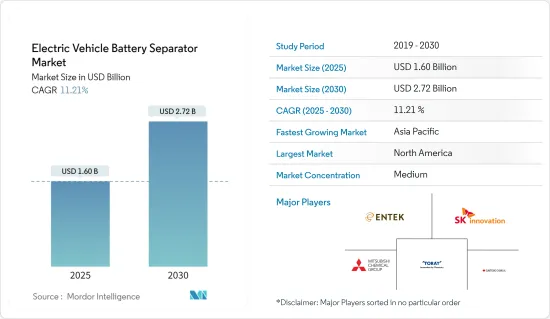
전기자동차 배터리 분리막 시장 규모는 2025년에 16억 달러로 추정되며, 예측 기간(2025-2030년) 동안 11.21%의 CAGR로 2030년에는 27억 2,000만 달러에 달할 것으로 예상됩니다.
주요 하이라이트
- 중기적으로는 전기자동차의 보급과 리튬이온 배터리의 저가화가 예측기간 동안 시장을 견인할 것으로 보입니다.
- 한편, 일부 국가의 독점으로 인한 배터리 재료 공급망 격차(부품 부족, 유통 병목현상 등)는 향후 시장 성장을 억제할 것으로 예상됩니다.
- 고체 배터리, 첨단 리튬 이온 화학, 나트륨 이온 배터리 등 다른 배터리 화학의 연구 개발이 진행됨에 따라 향후 시장에 기회를 가져올 것으로 예상됩니다.
- 북미는 예측 기간 동안 시장이 크게 성장할 것으로 예상되며, 대부분의 수요는 미국, 캐나다 등의 국가에서 발생할 것으로 예상됩니다.
전기자동차 배터리 분리막 시장 동향
리튬이온 배터리 부문이 시장을 장악할 것으로 예상
- 다공성 막인 배터리 분리막은 리튬이온 배터리에서 중요한 역할을 합니다. 양극과 음극을 분리하여 전기적 단락을 방지하고 리튬 이온만 통과할 수 있도록 합니다.
- 최근 몇 년 동안 리튬이온 배터리는 전기자동차에서 가장 일반적으로 사용되는 배터리 기술로 부상했습니다. 이는 높은 에너지 밀도, 비교적 긴 사이클 수명, 효율성 등 리튬이온 배터리와 관련된 몇 가지 장점 때문입니다.
- 국제에너지기구(IEA)에 따르면, 2023년 전기자동차 배터리 수요는 750GWh 이상에 달해 2022년 대비 40% 증가할 것으로 예상됩니다. 이 배터리의 대부분은 리튬 이온 기술입니다. 전기자동차에 리튬이온 배터리의 사용이 증가함에 따라 리튬이온 배터리 기술용 배터리 분리막에 대한 수요도 동시에 증가할 것으로 예상됩니다.
- 또한, 리튬이온 배터리의 가격 하락은 전기자동차에 이 기술의 사용을 촉진하여 리튬 이온 기술의 배터리 분리막 사용에 대한 수요를 증가시킬 것으로 예상되며, 2023년 리튬이온 배터리 팩의 가격은 전년 대비 14% 하락하여 139달러/kWh로 예상됩니다.
- 또한, 전기자동차용 보다 안정적이고 효율적인 배터리 분리막의 연구개발이 진행됨에 따라 리튬이온 기술의 배터리 분리막에 대한 수요는 증가할 것으로 예상됩니다.
- 예를 들어, 2024년 2월 인천대학교 과학자들은 리튬이온 배터리 분리막의 안정성과 특성을 향상시키는 방법을 고안했습니다. 이는 이산화 규소 층을 다른 기능성 분자와 함께 통합하여 달성할 수 있습니다. 이러한 개발은 전기자동차 응용 분야에서 리튬 이온 분리막의 기능성을 향상시킬 수 있을 것으로 기대됩니다.
- 이처럼 리튬이온 배터리의 수요 증가와 전기자동차에 사용되는 배터리 분리막의 기술 개발로 인해 이 부문은 시장에서 큰 비중을 차지할 것으로 예상됩니다.
북미가 시장을 독점할 것으로 예상
- 북미 전기자동차 시장은 5대 기업이 주도하고 있으며, 2023년에는 전체 시장의 70% 이상을 차지할 것으로 예상됩니다. 이들 주요 기업에는 Tesla, Toyota Group, Ford Group, Hyundai, Honda가 포함되며, Tesla는 북미 국가에서 가장 많은 전기자동차를 판매하고 있습니다. 전기자동차에 대한 수요가 증가함에 따라 이러한 자동차의 배터리 사용도 증가하여 전기자동차 배터리 분리막 시장을 주도할 것입니다.
- 북미에서 전기자동차에 대한 수요가 지속적으로 증가하고 있습니다. 에너지 정보국에 따르면, 미국 내 하이브리드 자동차, 플러그인 하이브리드 전기자동차, 배터리 전기자동차(BEV)의 총 판매량은 2023년 전체 소형차(LDV) 신차 판매량의 16.3%로 전년도 12.9%에서 증가할 것으로 예상했습니다.
- 또한, 정부의 지원 정책도 전기자동차 배터리 수요에 영향을 미치고 있으며, 이에 따라 전기자동차 배터리 양극재 시장 수요에도 영향을 미치고 있습니다. 북미 각국 정부는 전기자동차 보급을 촉진하기 위해 다양한 정책 및 인센티브를 제공하고 있습니다. 이러한 노력에는 세액공제, 보조금, 리베이트, 충전 인프라에 대한 투자 등이 포함됩니다. 이러한 지원은 전기자동차에 대한 소비자의 관심을 높이고 배터리 분리막에 대한 수요를 촉진하고 있습니다.
- 정부의 지원을 받아 전기자동차 제조업체들은 이 지역에 배터리 분리막 현지 공장을 설립하기 위해 투자하고 있으며, 이를 통해 공급망을 완화하고 있습니다. 예를 들어, 혼다자동차는 2024년 4월 아사히카세이와 캐나다에서 자동차 배터리 분리막을 생산하기로 합의했습니다.
- 이처럼 전기자동차의 증가와 전기자동차 배터리 분리막의 현지 생산 증가로 인해 이 지역은 예측 기간 동안 시장을 독점할 것으로 예상됩니다.
전기자동차 배터리 분리막 산업 개요
전기자동차 배터리 분리막 시장은 적당히 세분화되어 있습니다. 시장의 주요 기업(무순)으로는 Entek International, SK Innovation, Mitsubishi Chemical Group Corporation, Toray Industries Inc, Sumitomo Chemical 등이 있습니다.
기타 혜택
- 엑셀 형식의 시장 예측(ME) 시트
- 3개월간 애널리스트 지원
목차
제1장 소개
- 조사 범위
- 시장 정의
- 조사 가정
제2장 주요 요약
제3장 조사 방법
제4장 시장 개요
- 소개
- 2029년까지 시장 규모와 수요 예측(단위 : 달러)
- 최근 동향과 개발
- 정부 정책 및 규정
- 시장 역학
- 성장 촉진요인
- 전기자동차 보급 확대
- 리튬이온 배터리 가격 하락
- 성장 억제요인
- 공급망 격차
- 성장 촉진요인
- 공급망 분석
- 산업의 매력 - Porter's Five Forces 분석
- 공급 기업의 교섭력
- 소비자의 협상력
- 신규 참여업체의 위협
- 대체품의 위협 제품·서비스
- 경쟁 기업 간의 경쟁 관계
제5장 시장 세분화
- 배터리 유형
- 리튬이온
- 납축배터리
- 기타
- 재료 유형
- 폴리프로필렌
- 폴리에틸렌
- 기타 재료 유형
- 2029년까지 시장 규모·수요 예측(지역별)
- 북미
- 미국
- 캐나다
- 기타 북미
- 유럽
- 독일
- 프랑스
- 영국
- 이탈리아
- 스페인
- 북유럽
- 러시아
- 터키
- 기타 유럽
- 아시아태평양
- 중국
- 인도
- 호주
- 일본
- 한국
- 말레이시아
- 태국
- 인도네시아
- 베트남
- 기타 아시아태평양
- 중동 및 아프리카
- 사우디아라비아
- 아랍에미리트
- 나이지리아
- 이집트
- 카타르
- 남아프리카공화국
- 기타 중동 및 아프리카
- 남미
- 브라질
- 아르헨티나
- 콜롬비아
- 기타 남미
- 북미
제6장 경쟁 구도
- M&A, 합작투자, 제휴, 협정
- 주요 기업의 전략과 SWOT 분석
- 기업 개요
- Entek International
- SK Innovation Co. Ltd
- Mitsubishi Chemical Group Corporation
- Hitachi Chemical Company Ltd
- Toray Industries Inc.
- Sumitomo Chemical Co. Ltd
- UBE Corp
- Teijin Ltd
- Yunnan Enjie New Materials Co. Ltd
- Cangzhou Mingzhu Plastic Co. Ltd
- 기타 저명한 기업 리스트
- 시장 순위/점유율(%) 분석
제7장 시장 기회와 향후 동향
- 기타 배터리 화학의 연구개발 증가
The Electric Vehicle Battery Separator Market size is estimated at USD 1.60 billion in 2025, and is expected to reach USD 2.72 billion by 2030, at a CAGR of 11.21% during the forecast period (2025-2030).
Key Highlights
- Over the medium period, the growing adoption of electric vehicles and the decreasing price of lithium-ion batteries is expected to drive the market in the forecast period.
- On the other hand, the supply chain gap in battery materials created by the monopolies of some countries, such as ingredient shortages or distribution bottlenecks, is expected to restrain market growth in the future.
- Nevertheless, the increasing research and development of other battery chemistries like solid-state batteries, advanced lithium-ion chemistry, Sodium-ion batteries, etc, are expected to create an opportunity for the market in the future.
- North America is expected to have significant growth in the market during the forecast period, with most of the demand coming from countries like the United States, Canada, etc.
Electric Vehicle Battery Separator Market Trends
Lithium-ion Battery Segment is Expected to Dominate the Market
- A battery separator, a porous membrane, plays a crucial role in lithium-ion batteries. It prevents electrical short circuits by isolating the cathode and anode, ensuring only lithium ions can pass through.
- In recent years, lithium-ion batteries have emerged as the most commonly used battery technology in electric vehicles. This is due to several advantages associated with them, such as high energy density, relatively long cycle life, and efficiency.
- According to the International Energy Agency, demand for EV batteries reached more than 750 GWh in 2023, up 40% relative to 2022. The majority of these batteries are lithium-ion technology. As lithium-ion battery application in electric vehicles increases, the demand for battery separators for lithium-ion battery technology is expected to increase simultaneously.
- Additionally, the decreasing price of lithium-ion batteries is expected to drive the use of this technology in electric vehicles, which, in turn, will boost the demand for the use of battery separators of lithium-ion technology. In 2023, the price of lithium-ion battery packs suffered a 14% drop compared to the previous year to USD139/kWh.
- Further, as research and development continue to develop more stable and efficient battery separators for electric vehicles, the demand for lithium-ion technology battery separators is expected to increase.
- For instance, in February 2024, Scientists at Incheon National University devised a method to enhance the stability and characteristics of lithium-ion battery separators. They achieve this by incorporating a layer of silicon dioxide along with other functional molecules. Such developments will improve the functionality of lithium-ion separators in electric vehicle applications.
- Thus, owing to the increasing demand for lithium-ion batteries and the technological development of battery separators used in electric vehicles, this segment is expected to have a major share of the market.
North America is Expected to Dominate the Market
- The North American electric vehicle market is majorly driven by the five major players, accounting for more than 70% of the market in 2023. These prominent players include Tesla, Toyota Group, Ford Group, Hyundai, and Honda. Tesla is the highest seller of electric vehicles in North American countries. As the demand for electric vehicles increases, the use of batteries in these vehicles will also increase, thereby driving the electric vehicle battery separator market.
- The demand for electric vehicles is increasing continuously in North America. According to the Energy Information Administration, the combined sales of hybrid vehicles, plug-in hybrid electric vehicles, and battery electric vehicles (BEV) in the United States rose to 16.3% of total new light-duty vehicle (LDV) sales in 2023, which was 12.9% in the previous year.
- Further, supportive government policies are also affecting the demand for electric vehicle batteries, thereby affecting the demand for the electric vehicle battery cathode market. Governments across North America have been rolling out policies and incentives to spur EV adoption. These initiatives encompass tax credits, grants, rebates, and investments in charging infrastructure. Such support has bolstered consumer interest in EVs, thereby driving the demand for battery separators.
- With the support of the government, electric vehicle manufacturers are investing in opening local factories for battery separators in the region, thereby easing the supply chain. For instance, in April 2024, Honda Motor Co. Ltd agreed with Asahi Kasei Corporation to produce battery separators for automotive batteries in Canada.
- Thus, owing to the growing number of electric vehicles and increasing local manufacturing of electric vehicle battery separators, the region is expected to dominate the market in the forecast period.
Electric Vehicle Battery Separator Industry Overview
The electric vehicle battery separator market is moderately fragmented. Some of the major players in the market (in no particular order) include Entek International, SK Innovation Co. Ltd, Mitsubishi Chemical Group Corporation, Toray Industries Inc., and Sumitomo Chemical Co. Ltd, among others.
Additional Benefits:
- The market estimate (ME) sheet in Excel format
- 3 months of analyst support
TABLE OF CONTENTS
1 INTRODUCTION
- 1.1 Scope of the Study
- 1.2 Market Definition
- 1.3 Study Assumptions
2 EXECUTIVE SUMMARY
3 RESEARCH METHODOLOGY
4 MARKET OVERVIEW
- 4.1 Introduction
- 4.2 Market Size and Demand Forecast in USD, till 2029
- 4.3 Recent Trends and Developments
- 4.4 Government Policies and Regulations
- 4.5 Market Dynamics
- 4.5.1 Drivers
- 4.5.1.1 The Growing Adoption of Electric Vehicles
- 4.5.1.2 Decreasing Price of Lithium-ion Batteries
- 4.5.2 Restraints
- 4.5.2.1 The Supply Chain Gap
- 4.5.1 Drivers
- 4.6 Supply Chain Analysis
- 4.7 Industry Attractiveness - Porter's Five Forces Analysis
- 4.7.1 Bargaining Power of Suppliers
- 4.7.2 Bargaining Power of Consumers
- 4.7.3 Threat of New Entrants
- 4.7.4 Threat of Substitutes Products and Services
- 4.7.5 Intensity of Competitive Rivalry
5 MARKET SEGMENTATION
- 5.1 Battery Type
- 5.1.1 Lithium-ion
- 5.1.2 Lead-acid
- 5.1.3 Other Battery Type
- 5.2 Material Type
- 5.2.1 Polypropylene
- 5.2.2 Polyethylene
- 5.2.3 Other Material Types
- 5.3 Geography [Market Size and Demand Forecast till 2029 (for regions only)]
- 5.3.1 North America
- 5.3.1.1 United States
- 5.3.1.2 Canada
- 5.3.1.3 Rest of North America
- 5.3.2 Europe
- 5.3.2.1 Germany
- 5.3.2.2 France
- 5.3.2.3 United Kingdom
- 5.3.2.4 Italy
- 5.3.2.5 Spain
- 5.3.2.6 NORDIC
- 5.3.2.7 Russia
- 5.3.2.8 Turkey
- 5.3.2.9 Rest of Europe
- 5.3.3 Asia-Pacific
- 5.3.3.1 China
- 5.3.3.2 India
- 5.3.3.3 Australia
- 5.3.3.4 Japan
- 5.3.3.5 South Korea
- 5.3.3.6 Malaysia
- 5.3.3.7 Thailand
- 5.3.3.8 Indonesia
- 5.3.3.9 Vietnam
- 5.3.3.10 Rest of Asia-Pacific
- 5.3.4 Middle East and Africa
- 5.3.4.1 Saudi Arabia
- 5.3.4.2 United Arab Emirates
- 5.3.4.3 Nigeria
- 5.3.4.4 Egypt
- 5.3.4.5 Qatar
- 5.3.4.6 South Africa
- 5.3.4.7 Rest of Middle East and Africa
- 5.3.5 South America
- 5.3.5.1 Brazil
- 5.3.5.2 Argentina
- 5.3.5.3 Colombia
- 5.3.5.4 Rest of South America
- 5.3.1 North America
6 COMPETITIVE LANDSCAPE
- 6.1 Mergers and Acquisitions, Joint Ventures, Collaborations, and Agreements
- 6.2 Strategies Adopted & SWOT Analysis for Leading Players
- 6.3 Company Profiles
- 6.3.1 Entek International
- 6.3.2 SK Innovation Co. Ltd
- 6.3.3 Mitsubishi Chemical Group Corporation
- 6.3.4 Hitachi Chemical Company Ltd
- 6.3.5 Toray Industries Inc.
- 6.3.6 Sumitomo Chemical Co. Ltd
- 6.3.7 UBE Corp
- 6.3.8 Teijin Ltd
- 6.3.9 Yunnan Enjie New Materials Co. Ltd
- 6.3.10 Cangzhou Mingzhu Plastic Co. Ltd
- 6.4 List of Other Prominent Companies
- 6.5 Market Ranking/Share (%) Analysis
7 MARKET OPPORTUNITIES AND FUTURE TRENDS
- 7.1 The Increasing Research and Development of Other Battery Chemistries


