|
시장보고서
상품코드
1636557
일본의 이차 전지 시장 전망 : 시장 점유율 분석, 산업 동향 및 통계, 성장 예측(2025-2030년)Japan Rechargeable Battery - Market Share Analysis, Industry Trends & Statistics, Growth Forecasts (2025 - 2030) |
||||||
 Mordor Intelligence
■ 보고서에 따라 최신 정보로 업데이트하여 보내드립니다. 배송일정은 문의해 주시기 바랍니다.
가격
※ 부가세 별도
한글목차
영문목차
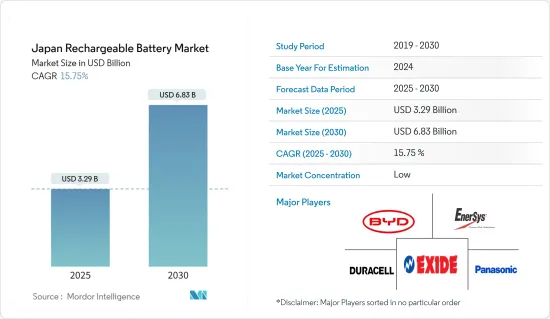
일본의 이차 전지 시장 규모는 2025년에 32억 9,000만 달러로 추정되며, 예측기간(2025-2030년)의 연평균 성장률(CAGR)은 15.75%로, 2030년에는 68억 3,000만 달러에 달할 것으로 예측됩니다.
주요 하이라이트
- 중기적으로는 전기자동차(EV) 생산량 증가와 리튬이온 배터리 가격 하락이 예측 기간 동안 이차 전지 수요를 주도할 것으로 예상됩니다.
- 한편, 원료의 매장량 부족이 일본의 이차 전지 시장의 성장을 크게 억제할 가능성이 있습니다.
- 그럼에도 불구하고 스마트 워치, 무선 이어폰, 스마트 밴드 등과 같은 웨어러블 디바이스의 채택이 확대되고 있기 때문에 장래에 이차 전지 시장의 진출기업에 기회가 생길 것으로 예상됩니다.
일본의 이차 전지 시장 동향
리튬 이온 배터리가 시장을 독점
- 많은 이점으로 알려진 리튬 이온 이차 전지는 다양한 부문에서 광범위하게 적용되고 있습니다. 이 배터리는 전기 에너지 저장을 위한 신뢰할 수 있는 효율적인 솔루션으로 등장했습니다. 리튬 이온 이차 전지의 두드러진 특징 중 하나는 에너지 밀도가 높기 때문에 콤팩트하고 경량인 형태로 대용량의 전력을 담을 수 있습니다.
- 일본의 리튬 이온 이차 전지 시장은 기회와 도전으로 가득한 역동적인 시장입니다. 용량 대 중량비의 유리함 덕분에 리튬 이온 이차 전지는 다른 기술을 능가하여 널리 사용되고 있습니다. 리튬 이온 배터리는 일반적으로 다른 배터리에 비해 비싸지만, 시장을 선도하는 시업들은 연구 개발에 다액의 투자를 실시해 사업을 확대하고 있습니다. 이러한 경쟁의 심화는 배터리 성능을 향상시킬 뿐만 아니라 리튬 이온 배터리의 가격 하락 동향에도 기여하고 있습니다.
- 2023년에는 전기자동차(EV) 및 배터리 에너지 저장 시스템(BESS)에서 배터리 팩의 평균 가격 상승에 주도되었으며, 배터리 가격은 현저한 하락을 보이며 13% 이상 하락한 139달러/kWh에 마감했습니다. 채굴 및 정제 용량의 증가에 따라 리튬 가격은 안정되어 2026년에는 100달러/kWh를 목표로 할 것으로 예측되고 있습니다.
- 많은 배터리 에너지 저장 시스템(BESS)의 중심인 리튬 이온 배터리는 높은 에너지 밀도, 급속 충전 및 수명 주기 연장으로 매우 중요합니다. 이러한 특성은 BESS 용도에서 효율적인 에너지 저장 및 방출에 매우 적합합니다. 일본 기업들은 앞으로 수년간 BESS를 강화하는 프로젝트를 적극적으로 추진하고 있습니다.
- 그 예로 2023년 8월 일본의 유명한 배터리 제조업체인 Power X는 현지 신재생에너지 개발 회사인 West Holdings와 제휴했습니다. 양사의 합작회사는 축전지 시스템과 태양광 발전 시설을 전국에 전개하는 것을 목표로 하고 있습니다. 2025년 봄의 완성을 목표로, 2사는 저장 용량 200MWh, 태양광 발전 출력 30MW를 달성할 계획입니다. 이 구상은 지역의 저장 시스템의 강화를 약속할 뿐만 아니라, 급증하는 에너지 수요에 대응하고, 그 결과, 리튬 이온 이차 전지의 수요를 높일 것입니다.
- 일본의 재생 가능 에너지, 특히 태양광과 풍력에 대한 노력은 리튬 이온 이차 전지의 매우 중요한 역할을 강조합니다. 이러한 배터리는 재생 가능 에너지로부터의 잉여 에너지를 이용 및 저장하고 날씨 변화에도 안정적인 전력 공급을 보장하기 위해 필수적입니다.
- 모든 에너지원 중에서 태양에너지가 중심이 될 것입니다. 일본은 원자력에너지 의존을 줄이는 전략의 일환으로 2030년까지 태양광 발전용량을 108GW 가까이까지 늘리겠다는 야심을 가지고 있으며, 가까운 미래에 리튬 이온 배터리 수요가 급증할 것을 예고합니다.
- 이러한 프로젝트와 정책적 노력을 바탕으로 리튬 이온 이차 전지 수요는 향후 수년간 급증할 전망입니다.
현저한 성장을 이루는 자동차 부문
- 오랫동안 내연 기관차(ICE)가 도로를 지배해 왔습니다. 그러나 환경에 대한 관심이 높아짐에 따라 전기자동차(EV)로의 이동이 눈에 띄게 나타나고 있습니다. EV의 주류는 리튬 이온 이차 배터리를 이용한 것으로, 에너지 밀도가 높고, 경량이며, 자기 방전이 적고, 유지 보수의 필요성이 낮은 것으로 유명합니다.
- 플러그인 하이브리드 자동차 및 전기자동차는 리튬 이온 이차 전지 시스템을 전원으로 사용합니다. 급속 충전 기능과 고에너지 밀도로 인해 리튬 이온 배터리는 주행 거리와 충전 시간에 대한 OEM의 요구를 충족시키는 유일한 기술로 각광받고 있습니다. 대조적으로, 납 배터리는 무게가 무겁고 비 에너지가 낮기 때문에 풀 하이브리드 자동차와 EV에 적합하지 않습니다.
- 일본에서는 최근 전기자동차의 보급이 눈에 띄게 급증하고 있습니다. 국제에너지기구(IEA)는 2023년 전기자동차 판매 대수를 14만대로 발표했으며, 이는 2022년 대비 44.3% 증가한 것입니다. 향후 몇 년간 이 지역 전체의 EV 판매 대수가 대폭 증가할 것으로 보고 있습니다.
- 전기차와 신재생에너지를 지지하기 위해 일본 정부는 일련의 정책과 인센티브를 전개해 왔습니다. 이러한 노력이 리튬 이온 배터리의 수요를 높이고 있습니다. 2023년 정부는 EV 생산을 확대하고 탄소 중립을 촉진하는 야심찬 계획을 발표했습니다.
- 일본 정부는 전동화 자동차 전략 2050을 도입하여 2050년까지 일본 자동차 제조업체가 생산하는 전 차량의 EV로의 완전 이행을 목표로 하고 있습니다. 게다가 일본의 EV충전 인프라 상황 하에서 도쿄전력파워홀딩스는 2025년까지 고속도로의 급속충전기를 1,000대로 늘리기로 했습니다.
- 게다가 국제사회가 지속가능성에 관심을 옮기는 가운데 일본도 이 전기 혁명을 진심으로 받아들이고 있습니다. 도쿄는 2030년까지 공공 충전 포인트를 3만 곳에서 15만 곳으로 늘리는 것을 목표로 하고 있습니다. 이러한 노력으로 일본은 EV의 생산, 나아가서는 리튬 이온 배터리 수요를 높이게 될 것입니다.
- 이러한 적극적인 대책은 이 지역에서 EV의 판매와 충전 인프라가 활발해지므로 예측 기간에 있어서 이차 전지 수요가 증가할 것으로 예상됩니다.
일본의 이차 전지 산업 개요
일본의 이차 전지는 절반 단절되어 있습니다. 주요 기업(무순서)으로는 BYD Company Ltd., Duracell Inc., Exide Industries Ltd., EnerSys, Panasonic Holdings Corporation 등이 있습니다.
기타 혜택
- 엑셀 형식 시장 예측(ME) 시트
- 3개월간의 애널리스트 지원
목차
제1장 서론
- 조사 범위
- 시장의 정의
- 조사의 전제
제2장 주요 요약
제3장 조사 방법
제4장 시장 개요
- 소개
- 2029년까지 시장 규모와 수요 예측(단위 : 달러)
- 최근 동향과 개발
- 정부의 규제와 시책
- 시장 역학
- 성장 촉진요인
- 전기자동차(EV) 생산 증가
- 리튬 이온 배터리 가격 하락
- 성장 억제요인
- 원료의 매장량 부족
- 성장 촉진요인
- 공급망 분석
- PESTLE 분석
- 투자 분석
제5장 시장 세분화
- 배터리 유형
- 리튬 이온 배터리
- 납 배터리
- 기타 기술(NiMh, Nicd 등)
- 용도
- 자동차용 전지
- 산업용 전지(동력용, 거치형(텔레콤, UPS, 에너지 저장 시스템(ESS) 등))
- 휴대용 배터리(가전 제품 등)
- 기타
제6장 경쟁 구도
- M&A, 합작사업, 제휴, 협정
- 주요 기업의 전략
- 기업 프로파일
- BYD Company Ltd
- Duracell Inc.
- EnerSys
- Panasonic Holdings Corporation
- Energizer
- Saft Groupe SA
- Exide Industries Ltd
- Gotion High tech Co Ltd
- Murrata Manufacturing Co. Ltd.
- GS Yuasa International Ltd.
- 기타 저명한 기업 일람
- 시장 랭킹, 점유율 분석
제7장 시장 기회와 앞으로의 동향
- 웨어러블 디바이스의 채택 확대
The Japan Rechargeable Battery Market size is estimated at USD 3.29 billion in 2025, and is expected to reach USD 6.83 billion by 2030, at a CAGR of 15.75% during the forecast period (2025-2030).
Key Highlights
- Over the medium term, rising electric vehicle (EV) production and declining lithium-ion battery prices are expected to drive the demand for rechargeable batteries during the forecast period.
- On the other hand, the lack of raw material reserves can significantly restrain the growth of the Japan rechargeable battery market.
- Nevertheless, the growing adoption of wearable devices like smartwatches, wireless earphones, smart bands, and more are expected to create significant opportunities for rechargeable battery market players in the near future.
Japan Rechargeable Battery Market Trends
Lithium-Ion Battery Type Dominate the Market
- Lithium-ion rechargeable batteries, known for their numerous advantages, find extensive applications across various sectors. These batteries have emerged as a trusted and efficient solution for electrical energy storage. One of their standout features is their high energy density, allowing them to pack substantial power into a compact and lightweight form.
- Japan's lithium-ion rechargeable battery market is a dynamic arena, brimming with both opportunities and challenges. Thanks to their favorable capacity-to-weight ratio, lithium-ion batteries are outpacing other technologies in popularity. While lithium-ion batteries typically come with a premium price tag compared to their counterparts, leading market players are heavily investing in R&D and scaling up operations. This intensified competition has not only enhanced battery performance but also contributed to a downward trend in lithium-ion battery prices.
- In 2023, driven by rising average battery pack prices in electric vehicles (EVs) and battery energy storage systems (BESS), battery prices saw a notable dip, settling at USD 139/kWh-a drop of over 13%. With the ramp-up of extraction and refining capacities, lithium prices are projected to stabilize, aiming for USD 100/kWh by 2026.
- Central to many Battery Energy Storage Systems (BESS), lithium-ion batteries are prized for their high energy density, rapid charging, and extended cycle life. These attributes make them exceptionally suited for efficient energy storage and release in BESS applications. Companies in Japan are actively pursuing projects to bolster BESS in the upcoming years.
- As a case in point, in August 2023, Power X, a prominent Japanese battery manufacturer, teamed up with West Holdings, a local renewable energy developer. Their joint venture aims to roll out battery storage systems and solar power facilities nationwide. Targeting a spring 2025 completion, the duo plans to achieve a storage capacity of 200MWh and a solar output of 30MW. This initiative not only promises to bolster regional storage systems but also addresses the surging energy demand, subsequently driving up the need for lithium-ion rechargeable batteries.
- Japan's commitment to renewable energy, particularly solar and wind, underscores the pivotal role of lithium-ion batteries. These batteries are essential for harnessing and storing surplus energy from renewables, ensuring consistent power supply despite weather variations.
- Solar energy, among all sources, is set to take center stage. Japan's ambition to boost its solar capacity to nearly 108 GW by 2030, as part of its strategy to reduce nuclear energy reliance, signals a burgeoning demand for lithium-ion batteries in the near future.
- Given these projects and initiatives, the demand for lithium-ion rechargeable batteries is poised for an upswing in the coming years.
Automobile Segment to Witness Significant Growth
- For a long time, vehicles with internal combustion engines (ICE) dominated the roads. However, as environmental concerns grow, there's a noticeable shift towards electric vehicles (EVs). Predominantly, EVs utilize lithium-ion rechargeable batteries, celebrated for their high energy density, lightweight nature, minimal self-discharge, and low maintenance needs.
- Plug-in hybrids and electric vehicles are powered by lithium-ion battery systems. Thanks to their rapid recharge capability and high energy density, lithium-ion batteries stand out as the sole technology meeting OEM demands for driving range and charging time. In contrast, lead-based traction batteries fall short for full hybrids or EVs, given their heftier weight and lower specific energy.
- Japan has seen a remarkable surge in electric vehicle adoption recently. In 2023, the International Energy Agency (IEA) reported sales of 140,000 electric vehicles, marking a 44.3% increase from 2022. Projections indicate a significant uptick in EV sales across the region in the coming years.
- To champion electric vehicles and renewable energy, the Japanese government has rolled out a suite of policies and incentives. These initiatives have bolstered the demand for lithium-ion batteries. In 2023, the government unveiled ambitious plans to ramp up EV production and expedite the journey to zero carbon emissions.
- Japan's government introduced the Electrified Vehicle Strategy 2050, targeting a complete transition to EVs for all vehicles produced by Japanese automakers by 2050. Additionally, under Japan's EV Charging Infrastructure Landscape, Tokyo Electric Power Company Holdings is set to increase rapid highway chargers to 1,000 units by 2025.
- Moreover, as the global community pivots towards sustainability, Japan is wholeheartedly embracing this electric revolution. The Tokyo government aims to amplify public charging points from 30,000 to 150,000 by 2030. With these concerted efforts, Japan is poised to boost EV production and, consequently, the demand for lithium-ion batteries.
- Given these proactive measures, it's anticipated that EV sales and charging infrastructure will flourish in the region, subsequently driving up the demand for rechargeable batteries in the forecast period.
Japan Rechargeable Battery Industry Overview
The Japan rechargeable Battery is semi-fragmented. Some of the key players (not in particular order) are BYD Company Ltd, Duracell Inc., Exide Industries Ltd, EnerSys, and Panasonic Holdings Corporation, among others.
Additional Benefits:
- The market estimate (ME) sheet in Excel format
- 3 months of analyst support
TABLE OF CONTENTS
1 INTRODUCTION
- 1.1 Scope of the Study
- 1.2 Market Definition
- 1.3 Study Assumptions
2 EXECUTIVE SUMMARY
3 RESEARCH METHODOLOGY
4 MARKET OVERVIEW
- 4.1 Introduction
- 4.2 Market Size and Demand Forecast, in USD till 2029
- 4.3 Recent Trends and Developments
- 4.4 Government Policies and Regulations
- 4.5 Market Dynamics
- 4.5.1 Drivers
- 4.5.1.1 The Increasing Electric Vehicle (EV) Production
- 4.5.1.2 Declining Lithium-ion Battery Prices
- 4.5.2 Restraints
- 4.5.2.1 Lack of Raw Material Reserves
- 4.5.1 Drivers
- 4.6 Supply Chain Analysis
- 4.7 PESTLE Analysis
- 4.8 Investment Analysis
5 MARKET SEGMENTATION
- 5.1 Battery Type
- 5.1.1 Lithium-ion Battery
- 5.1.2 Lead-Acid Battery
- 5.1.3 Other Technologies (NiMh, Nicd, etc.)
- 5.2 Application
- 5.2.1 Automotive Batteries
- 5.2.2 Industrial Batteries (Motive, Stationary (Telecom, UPS, Energy Storage Systems (ESS), etc.)
- 5.2.3 Portable Batteries (Consumer Electronics, etc.)
- 5.2.4 Other Applications
6 COMPETITIVE LANDSCAPE
- 6.1 Mergers and Acquisitions, Joint Ventures, Collaborations, and Agreements
- 6.2 Strategies Adopted by Leading Players
- 6.3 Company Profiles
- 6.3.1 BYD Company Ltd
- 6.3.2 Duracell Inc.
- 6.3.3 EnerSys
- 6.3.4 Panasonic Holdings Corporation
- 6.3.5 Energizer
- 6.3.6 Saft Groupe SA
- 6.3.7 Exide Industries Ltd
- 6.3.8 Gotion High tech Co Ltd
- 6.3.9 Murrata Manufacturing Co. Ltd.
- 6.3.10 GS Yuasa International Ltd.
- 6.4 List of Other Prominent Companies
- 6.5 Market Ranking/ Share Analysis
7 MARKET OPPORTUNITIES AND FUTURE TRENDS
- 7.1 Growing Adoption of Wearable Devices