
|
시장보고서
상품코드
1911387
인도네시아의 시설 관리 시장 : 시장 점유율 분석, 업계 동향과 통계, 성장 예측(2026-2031년)Indonesia Facility Management - Market Share Analysis, Industry Trends & Statistics, Growth Forecasts (2026 - 2031) |
||||||
 Mordor Intelligence
인도네시아의 시설관리 시장은 2025년 128억 6,000만 달러에서 2026년에는 135억 7,000만 달러에 이를 것으로 예측됩니다. 2026-2031년에 걸쳐 CAGR 5.55%로 성장을 지속하여 2031년까지 177억 7,000만 달러로 성장할 전망입니다.
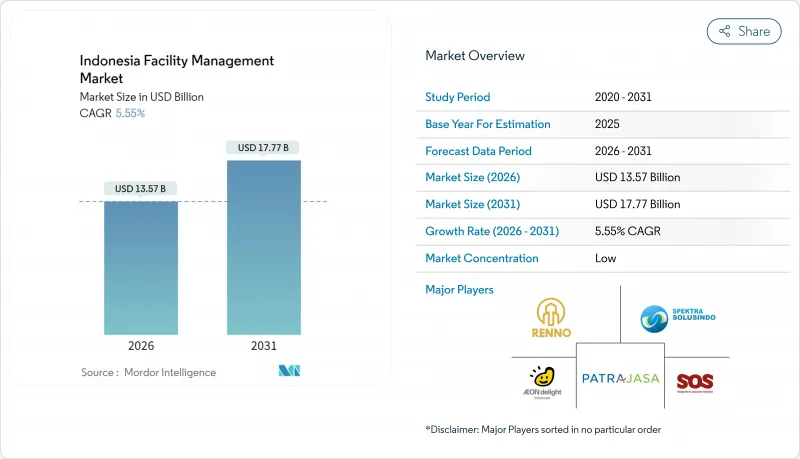
가속화되는 도시화, 31억 7,000만 달러 규모의 인프라 자금 조달 계획, 정부가 내걸고 있는 연간 8%의 경제 성장 목표가 주요 성장 요인이 되고 있습니다. 자카르타 및 기타 대도시의 상업용 부동산 활동은 통합 서비스 수요를 지속적으로 촉진하는 한편, 2022년 332억 달러 규모의 산업 투자는 기술적으로 특화된 지원 요구를 증폭시키고 있습니다. 아웃소싱 확대 추세, 사물인터넷(IoT) 플랫폼 도입, 지속가능성 연계 의무사항이 운영 모델을 재편하고 있습니다. 한편 임금 인플레이션, 규제 복잡성, 심화되는 인재 유출은 공급업체 마진에 압박을 가합니다. 이에 따라 기술 기반 차별화와 성과 기반 계약이 인도네시아의 시설 관리 시장에서 핵심 경쟁 전략으로 부상하고 있습니다.
인도네시아의 시설 관리 시장 동향 및 인사이트
주요 도시권의 도시화
급증하는 도시 인구는 주택, 사무실 및 교통 프로젝트의 급증으로 자산 성능 요구 사항이 강화되면서 인도네시아의 시설 관리 시장을 재구성하고 있습니다. 자카르타의 1,130만 주민은 기존 재고에 대한 압박을 가중시키는 한편, 교통 중심 개발은 부동산 가치를 최대 10%까지 상승시켜 첨단 유지보수, IoT 기반 점유 모니터링 및 예측 서비스 모델에 대한 수요를 촉발하고 있습니다. 외국인 유입 증가로 서비스 품질 기준이 높아지면서 공급업체들은 세계의 안전, 위생 및 디지털 보고 프로토콜을 도입해야 하는 압박을 받고 있습니다.
점유율 최적화 진전
하이브리드 근무 정책으로 건물주와 임차인은 잠재적 공간 효율성을 발굴해야 합니다. 시설 관리자들은 점유 데이터를 HVAC, 조명, 보안 시스템과 연계하는 센서 네트워크 및 분석 플랫폼을 도입해 에너지 절감 효과를 창출합니다. PT 아스펙스 쿰봉의 보고르 공장에서 달성한 8.5% 전력 절감 사례가 대표적입니다. 보상 체계가 점유율 성과와 연계되면서 인도네시아의 시설 관리 시장 전반에 데이터 기반 문화가 정착되고 있습니다.
주요 기업의 이익률 압력
가격 민감 고객과 임금 상승이 수익성을 압박하고 있습니다. 소덱소(Sodexo)의 2025년 1분기 시설 서비스 성장률 2.4%가 이러한 추세를 반영합니다. 2025년 1월 부가가치세(VAT)가 12%로 인상되면서 운영 비용이 더욱 증가해 협상된 요금이 압박받고 있습니다. 주요 업체들은 작업 주문 관리 자동화, 인력 풀 통합, 성과 연계 수수료 구조로의 계약 재협상을 통해 대응하고 있습니다.
부문 분석
하드 서비스 부문은 2025년 인도네시아의 시설 관리 시장 점유율의 58.42%를 차지했으며, 이는 대규모 프로젝트 전반에 걸친 인프라 확장과 엄격한 안전 규정에서 비롯되었습니다. 열대 기후의 HVAC 수요와 강화된 비상 시스템 감사로 인해 기계, 전기, 배관(MEP) 작업이 주를 이루고 있습니다. 신규 유료 도로, 항만 및 철도 회랑에 연계된 자산 관리 프로그램이 안정적인 수수료 수입을 뒷받침합니다. 소프트 서비스는 입주자들이 사용자 경험과 위생을 우선시함에 따라 성장 동력을 얻으며, 2031년까지 연평균 6.78% 성장할 것으로 전망됩니다. 보안, 청소 및 케이터링 업체들은 스마트 카메라, 로봇 청소기, 영양 분석을 활용해 효율성을 개선하고 ESG 보고 지표를 충족시키고 있습니다. 의료 및 호텔 산업에서의 서비스 기대치 상승은 프리미엄 아웃소싱 기회를 확대하며, 인도네시아의 시설 관리 시장 전체 내 수익 비중을 점진적으로 재조정하고 있습니다.
기타 혜택 :
- 엑셀 형식 시장 예측(ME) 시트
- 애널리스트의 3개월간 지원
자주 묻는 질문
목차
제1장 서론
- 조사의 전제조건과 시장 정의
- 조사 범위
제2장 조사 방법
제3장 주요 요약
제4장 시장 상황
- 시장 개요
- 현재 가동률
- 주요 FM 사업자의 수익성률
- 노동력 지표 : 노동 참가율
- 서비스 유형별 시설 관리 시장 점유율(%)
- 시설 관리 시장 점유율(%), 하드 서비스별
- 소프트 서비스별 시설 관리 시장 점유율(%)
- 주요 도시권의 도시화와 인구 증가
- 인도네시아의 인프라 정비 계획의 섹터별 투자 우선 순위
- 노동 및 안전 기준에 관한 규제상의 촉진요인
- 시장 성장 촉진요인
- 주요 도시권에서의 도시화
- 점유율 최적화 진전
- 인프라 파이프라인 투자
- 노동 및 안전규제
- ESG 관련 대출의 급증이 그린 인증 시설을 우대
- 지방 도시에서의 복합 용도형 메가 개발의 급증
- 시장 성장 억제요인
- 주요 기업의 이익률 압력
- 숙련 노동력 부족
- 수입 빌딩 자동화 장비에 대한 의존도
- 지방별 규제 감독의 분산화
- 밸류체인 분석
- PESTEL 분석
- 신규 참가 기업용의 규제 및 법적 틀
- 거시경제지표가 FM 수요에 미치는 영향
- Porter's Five Forces 분석
- 공급기업의 협상력
- 구매자의 협상력
- 신규 참가업체의 위협
- 대체품의 위협
- 경쟁 기업간 경쟁 관계
- 투자 및 자금 조달 분석
제5장 시장 규모와 성장 예측
- 서비스 유형별
- 하드 서비스
- 자산 관리
- MEP 및 HVAC 서비스
- 소방 설비와 안전 대책
- 기타 하드 FM 서비스
- 소프트 서비스
- 사무 지원 및 보안
- 청소 서비스
- 케이터링 서비스
- 기타 소프트 FM 서비스
- 하드 서비스
- 제공 형태별
- 자사 관리
- 아웃소싱
- 단일 시설 관리(Single FM)
- 종합 시설 관리(Bundled FM)
- 통합 시설 관리(Integrated FM)
- 최종 사용자 업계별
- 상업시설(IT 및 통신, 소매 및 창고 등)
- 호스피탈리티(호텔, 음식점, 대규모 레스토랑)
- 공공 및 공공 인프라(정부기관, 교육기관, 교통)
- 의료(공적 및 민간 시설)
- 산업 및 프로세스(제조업, 에너지, 광업)
- 기타 최종 사용자 산업(공동 주택, 엔터테인먼트, 스포츠 레저)
제6장 경쟁 구도
- 시장 집중도
- 전략적 전개와 파트너십
- 시장 점유율 분석
- 기업 프로파일
- PT. SGS Indonesia(Societe Generale de Surveillance SA(SGS SA))
- OCS Group Holdings Ltd
- PT Shield On Service Tbk(SOS)
- Sodexo Group
- ISS A/S
- PT Patra Jasa
- PT. Spektra Solusindo
- Titan Facility Services
- Astra Property Services
- Angkasa Pura Supports
- Colliers
- Renno Indonesia
- AEON Deligh Indonesia
- Indoservice
- Atalian Global Services
제7장 시장 기회와 장래의 전망
HBR 26.01.29The Indonesia facility management market is expected to grow from USD 12.86 billion in 2025 to USD 13.57 billion in 2026 and is forecast to reach USD 17.77 billion by 2031 at 5.55% CAGR over 2026-2031.
Accelerating urbanisation, a USD 3.17 billion infrastructure financing pipeline, and the government's goal of 8% annual economic expansion are the primary growth catalysts. Commercial real-estate activity in Jakarta and other metros continues to spur demand for integrated services, while industrial investments worth USD 33.2 billion in 2022 amplify requirements for technically specialised support. Outsourcing momentum, the adoption of Internet-of-Things (IoT) platforms, and sustainability-linked mandates are reshaping operating models. Meanwhile, wage inflation, regulatory complexity and an intensifying talent drain put pressure on provider margins. Technology-enabled differentiation and outcome-based contracts therefore emerge as pivotal competitive strategies within the Indonesia facility management market.
Indonesia Facility Management Market Trends and Insights
Urbanisation in Major Metros
Soaring city populations reconfigure the Indonesia facility management market as surging housing, office and transit projects tighten asset-performance requirements. Jakarta's 11.3 million residents intensify pressure on existing stock, while transport-oriented developments raise property values by up to 10 %, triggering demand for advanced maintenance, IoT-based occupancy monitoring and predictive service models. Expatriate inflows heighten service-quality benchmarks, pushing providers toward globally aligned safety, hygiene and digital reporting protocols.
Rising Occupancy Optimisation
Hybrid work policies oblige landlords and tenants to unlock latent floor-space efficiencies. Facility managers deploy sensor networks and analytics platforms that knit occupancy data to HVAC, lighting and security systems, delivering measured energy savings such as the 8.5 % electricity reduction achieved at PT Aspex Kumbong's Bogor plant. Compensation structures are increasingly tied to utilisation outcomes, cementing a data-driven culture across the wider Indonesia facility management market.
Margin Pressure on Leading Firms
Price-sensitive clients and rising wages compress profitability. Sodexo's Q1 2025 facilities-services growth of 2.4 % underscores the trend. A January 2025 VAT rise to 12 % further heightens operating costs, squeezing negotiated rates. Key players counter by automating work-order management, consolidating labour pools and renegotiating contracts toward performance-linked fee structures.
Other drivers and restraints analyzed in the detailed report include:
- Infrastructure Pipeline Investment
- Labour and Safety Regulation
- Skilled Labour Shortages
For complete list of drivers and restraints, kindly check the Table Of Contents.
Segment Analysis
Hard Services held 58.42 % of the Indonesia facility management market share in 2025, driven by infrastructure build-out and stringent safety codes across mega-projects. Mechanical, electrical and plumbing (MEP) work dominates, backed by tropical-climate HVAC demand and stricter emergency-system audits. Asset-management programmes attached to new toll roads, ports and rail corridors underpin stable fee income. Soft Services, forecast to expand 6.78 % annually to 2031, gain momentum as occupants prioritise user experience and hygiene. Security, cleaning and catering providers leverage smart cameras, robotic cleaners and nutritional analytics to improve efficiency and satisfy ESG reporting metrics. Elevated service expectations in healthcare and hospitality amplify premium outsourcing opportunities, gradually rebalancing revenue weightings within the wider Indonesia facility management market.
The Indonesia Facility Management Market Report is Segmented by Service Type (Hard Services, and Soft Services), Offering Type (In-House, and Outsourced), and End-User Industry (Commercial, Hospitality, Institutional and Public Infrastructure, Healthcare, Industrial and Process, and Other End-User Industries). The Market Forecasts are Provided in Terms of Value (USD).
List of Companies Covered in this Report:
- PT. SGS Indonesia (Societe Generale de Surveillance SA (SGS SA))
- OCS Group Holdings Ltd
- PT Shield On Service Tbk (SOS)
- Sodexo Group
- ISS A/S
- PT Patra Jasa
- PT. Spektra Solusindo
- Titan Facility Services
- Astra Property Services
- Angkasa Pura Supports
- Colliers
- Renno Indonesia
- AEON Deligh Indonesia
- Indoservice
- Atalian Global Services
Additional Benefits:
- The market estimate (ME) sheet in Excel format
- 3 months of analyst support
TABLE OF CONTENTS
1 INTRODUCTION
- 1.1 Study Assumptions and Market Definition
- 1.2 Scope of the Study
2 RESEARCH METHODOLOGY
3 EXECUTIVE SUMMARY
4 MARKET LANDSCAPE
- 4.1 Market Overview
- 4.1.1 Current Occupancy Rates
- 4.1.2 Profitability Rates of Major FM Players
- 4.1.3 Workforce Indicators - Labor Participation
- 4.1.4 Facility Management Market Share (%), by Service Type
- 4.1.5 Facility Management Market Share (%), by Hard Services
- 4.1.6 Facility Management Market Share (%), by Soft Services
- 4.1.7 Urbanization and Population Growth in Major Metros
- 4.1.8 Sector Investment Priorities in Indonesia's Infrastructure Pipeline
- 4.1.9 Regulatory Drivers Specific to Labour and Safety Standards
- 4.2 Market Drivers
- 4.2.1 Urbanisation in Major Metros
- 4.2.2 Rising Occupancy Optimisation
- 4.2.3 Infrastructure Pipeline Investment
- 4.2.4 Labour and Safety Regulation
- 4.2.5 Surge in ESG-linked Financing Favoring Green-Certified Facilities
- 4.2.6 Proliferation of Mixed-Use Mega-Developments in Secondary Cities
- 4.3 Market Restraints
- 4.3.1 Margin Pressure on Leading Firms
- 4.3.2 Skilled Labour Shortages
- 4.3.3 Dependency on Imported Building Automation Hardware
- 4.3.4 Fragmented Provincial Regulatory Oversight
- 4.4 Value Chain Analysis
- 4.5 PESTEL Analysis
- 4.6 Regulatory and Legislative Framework for Market Entrants
- 4.7 Impact of Macroeconomic Indicators on FM Demand
- 4.8 Porter's Five Forces Analysis
- 4.8.1 Bargaining Power of Suppliers
- 4.8.2 Bargaining Power of Buyers
- 4.8.3 Threat of New Entrants
- 4.8.4 Threat of Substitute Services
- 4.8.5 Intensity of Competitive Rivalry
- 4.9 Investment and Funding Analysis
5 MARKET SIZE AND GROWTH FORECASTS (VALUES)
- 5.1 By Service Type
- 5.1.1 Hard Services
- 5.1.1.1 Asset Management
- 5.1.1.2 MEP and HVAC Services
- 5.1.1.3 Fire Systems and Safety
- 5.1.1.4 Other Hard FM Services
- 5.1.2 Soft Services
- 5.1.2.1 Office Support and Security
- 5.1.2.2 Cleaning Services
- 5.1.2.3 Catering Services
- 5.1.2.4 Other Soft FM Services
- 5.1.1 Hard Services
- 5.2 By Offering Type
- 5.2.1 In-house
- 5.2.2 Outsourced
- 5.2.2.1 Single FM
- 5.2.2.2 Bundled FM
- 5.2.2.3 Integrated FM
- 5.3 By End-user Industry
- 5.3.1 Commercial (IT and Telecom, Retail and Warehouses, etc.)
- 5.3.2 Hospitality (Hotels, Eateries, Large-scale Restaurants)
- 5.3.3 Institutional and Public Infrastructure (Govt, Education, Transportation)
- 5.3.4 Healthcare (Public and Private Facilities)
- 5.3.5 Industrial and Process (Manufacturing, Energy, Mining)
- 5.3.6 Other End-user Industries (Multi-housing, Entertainment, Sports and Leisure)
6 COMPETITIVE LANDSCAPE
- 6.1 Market Concentration
- 6.2 Strategic Moves and Partnerships
- 6.3 Market Share Analysis
- 6.4 Company Profiles (includes Global level Overview, Market level overview, Core Segments, Financials as available, Strategic Information, Market Rank/Share for key companies, Products and Services, and Recent Developments)
- 6.4.1 PT. SGS Indonesia (Societe Generale de Surveillance SA (SGS SA))
- 6.4.2 OCS Group Holdings Ltd
- 6.4.3 PT Shield On Service Tbk (SOS)
- 6.4.4 Sodexo Group
- 6.4.5 ISS A/S
- 6.4.6 PT Patra Jasa
- 6.4.7 PT. Spektra Solusindo
- 6.4.8 Titan Facility Services
- 6.4.9 Astra Property Services
- 6.4.10 Angkasa Pura Supports
- 6.4.11 Colliers
- 6.4.12 Renno Indonesia
- 6.4.13 AEON Deligh Indonesia
- 6.4.14 Indoservice
- 6.4.15 Atalian Global Services
7 MARKET OPPORTUNITIES AND FUTURE OUTLOOK
- 7.1 White-space and Unmet-Need Assessment
- 7.2 Technology-led Integrated FM (IoT, BMS, AI-based Predictive Maintenance)
- 7.3 ESG-compliant FM Solutions Demand
- 7.4 Future Service-Model Shifts (Outcome-based Contracts)