|
시장보고서
상품코드
1939610
중국의 당뇨병용 디바이스 : 시장 점유율 분석, 업계 동향과 통계, 성장 예측(2026-2031년)China Diabetes Devices - Market Share Analysis, Industry Trends & Statistics, Growth Forecasts (2026 - 2031) |
||||||
 Mordor Intelligence
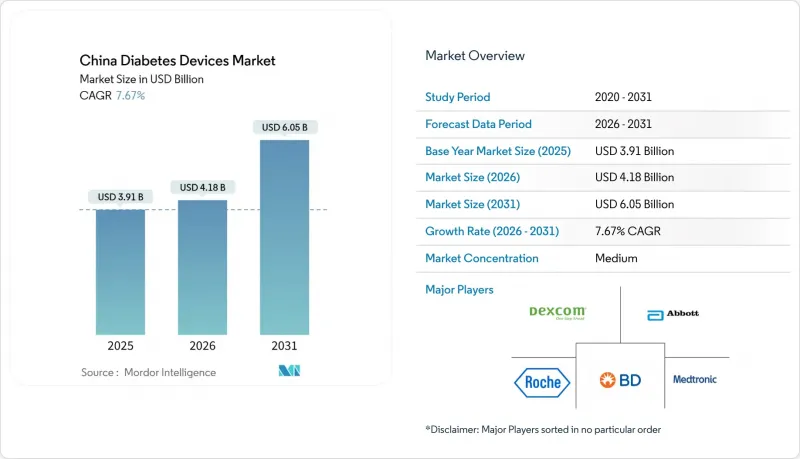
중국의 당뇨병용 디바이스 시장은 2025년 38억 8,000만 달러에서 2026년에는 41억 8,000만 달러로 성장하며, 2026-2031년에 CAGR 7.72%로 추이하며, 2031년까지 60억 6,000만 달러에 달할 것으로 예측됩니다.
이러한 성장은 2024년 기준 1.48억 명에 달하는 국내 성인 당뇨병 환자 수와 만성질환 관리를 우선시하는 '건강 중국 2030' 프로그램을 통한 지속적인 정책적 지원으로 지원되고 있습니다. 연속 혈당 모니터링(CGM) 시스템은 정확성과 가격 우위를 겸비한 국내 3세대 센서의 보급으로 기존 스트립형 검사를 대체하고 있습니다. 당뇨병 치료제의 보험 적용 범위 확대가 모니터링 기기 및 투약 기기에 대한 수요를 동시에 불러일으키는 한편, 디지털 치료 플랫폼은 의료 서비스가 부족한 지역의 임상 결과 개선에 기여하고 있습니다. 다국적 기업 및 국내 기업의 생산 및 R&D 시설에 대한 자본 투자는 중국 당뇨병 기기 시장공급 기반을 더욱 강화하고 있습니다.
중국 당뇨병 기기 시장 동향과 인사이트
당뇨병 유병률 증가와 고령화
중국의 당뇨병 유병률은 1980년 1% 미만에서 2018년 12.4%로 증가했으며, 2030년까지 환자 수는 1억 6,400만 명에 달할 것으로 예측됩니다. 도시화, 좌식 생활습관, 고령화(노인의 75% 이상이 하나 이상의 만성질환을 앓고 있음)로 인해 의료기기의 잠재적 사용자층은 계속 확대되고 있습니다. 연간 경제적 비용은 10년내 3,600억 위안(약 6조 원)을 넘어설 것으로 예상되며, 효율적인 모니터링 기술 및 투여 기술에 대한 민관 투자가 촉진되고 있습니다.
정부의 의료 개혁과 보험 적용 범위 확대
2024년 국가 보험 적용 의약품 리스트(NRDL) 업데이트로 15종의 당뇨병 치료제가 추가되어 본인부담금이 즉시 경감되고, 관련 기기 도입이 촉진될 것으로 보입니다. 돌잘리아틴의 적용으로 2024년 매출액은 2억 5,590만 위안(전년 대비 234% 증가)을 기록했습니다. 지방의 정액제 시범 도입은 처방 기준의 개선과 예방적 모니터링에 대한 경제적 인센티브 전환을 촉진하고 있습니다.
첨단 의료기기의 높은 본인 부담금
연속 혈당 모니터링 장치와 인슐린 펌프 시스템은 보험 적용 범위가 확대되었음에도 불구하고 여전히 고가입니다. 베이징의 고령 당뇨병 환자의 연간 약제비는 이미 평균 12,186위안(1,676달러)에 달하고, 장비 업그레이드를 위한 여력이 거의 없습니다. 펌프 보급률은 0.5%에 불과하며, 선진국 시장과 비교했을 때 가격의 제약이 두드러지게 나타나고 있습니다.
부문 분석
2025년 모니터링 기기 매출은 전체 매출의 59.83%를 차지하며, 중국 당뇨병 기기 시장의 핵심 분야로 확고히 자리매김하고 있습니다. CGM(연속 혈당 모니터링) 매출은 2020년 8억 9,900만 위안에서 2030년 50억 3,200만 위안으로 CAGR 18.8%로 급증할 것으로 예측됩니다. 따라서 중국 당뇨 모니터링 기기 시장 규모는 실시간 인사이트을 원하는 소비자의 선호와 CGM 도입이 HbA1c 개선에 도움이 된다는 임상적 근거에 힘입어 전체 시장보다 빠른 속도로 성장하고 있습니다. 자가혈당측정(SMBG) 기기는 특히 비용에 민감한 계층에서 일상적인 검사에 필수적이지만, CGM의 가격 하락으로 인해 성장이 둔화되고 있습니다.
관리 장비 시장은 2026-2031년 연평균 8.78%의 연평균 복합 성장률(CAGR)로 확대될 것으로 예측됩니다. 인슐린 펌프 보급률은 2030년까지 0.5%에서 1.5%로 상승할 것으로 예상되며, 선진국 수준에는 미치지 못하지만 잠재적인 수요를 보여주고 있습니다. 현재 해외 브랜드가 70% 이상의 점유율을 차지하고 있지만, 국내 제조업체들은 펌프에 블루투스 연결 기능 및 CGM 호환성을 통합하여 보다 빠른 점유율 확대를 목표로 하고 있습니다. 일부 병원 시범사업에서는 센서 강화형 펌프와 알고리즘에 의한 용량 조절을 결합하여 저혈당 발작을 두 자릿수 비율로 감소시킴으로써 도입 촉진에 더욱 박차를 가하고 있습니다.
중국 당뇨병 기기 시장 보고서는 기기 카테고리(관리 기기 및 모니터링 기기), 최종사용자(병원 및 클리닉, 재택치료 환경, 소매 약국 및 당뇨병 센터), 유통 채널(병원 약국, 소매 약국, E-Commerce/온라인 약국)로 분류됩니다. 본 시장 보고서에서는 위 부문 시장 규모(기준) 및 판매량(대수 기준)을 제공합니다.
기타 특전:
- 엑셀 형식 시장 예측(ME) 시트
- 애널리스트의 3개월간 지원
자주 묻는 질문
목차
제1장 서론
제2장 조사 방법
제3장 개요
제4장 시장 구도
제5장 시장 규모와 성장 예측
제6장 시장 지표
제7장 경쟁 구도
제8장 시장 기회와 향후 전망
KSA 26.03.06The China diabetes devices market is expected to grow from USD 3.88 billion in 2025 to USD 4.18 billion in 2026 and is forecast to reach USD 6.06 billion by 2031 at 7.72% CAGR over 2026-2031.
Growth is underpinned by the country's 148 million-strong adult diabetic population in 2024 and by sustained policy support through the Healthy China 2030 program, which prioritizes chronic disease management. Continuous glucose monitoring (CGM) systems are displacing traditional strip-based testing, aided by domestic third-generation sensors that combine accuracy with price advantages. Broader reimbursement for diabetes medicines is spurring parallel demand for monitoring and delivery devices, while digital therapeutics platforms are improving clinical outcomes in underserved regions. Capital investment by multinational and local firms into production and R&D facilities further strengthens the supply base for the China diabetes devices market.
China Diabetes Devices Market Trends and Insights
Rising Diabetes Prevalence and Aging Population
Diabetes prevalence in China rose from below 1% in 1980 to 12.4% in 2018, and cases are projected to climb to 164 million by 2030. Urbanisation, sedentary lifestyles and an expanding older population-over 75% of older adults have at least one chronic disease-continue to enlarge the addressable pool of device users. Annual economic costs are expected to exceed RMB 360 billion within the decade, prompting both public and private investment in efficient monitoring and delivery technologies.
Government Healthcare Reforms and Insurance Coverage Expansion
National Reimbursement Drug List (NRDL) updates in 2024 added 15 diabetes drugs, immediately lowering out-of-pocket costs and stimulating complementary device uptake . Inclusion of dorzagliatin led to sales of RMB 255.9 million in 2024, up 234% year-on-year . Capitation payment pilots in rural counties have improved prescribing standards and redirect financial incentives toward preventive monitoring.
High Out-of-Pocket Costs for Advanced Devices
Continuous glucose monitoring and insulin pump systems remain expensive despite broader reimbursement. Annual medication costs already average RMB 12,186 (USD 1,676) for older diabetics in Beijing, leaving little room for device upgrades . Pump penetration stands at a modest 0.5%, underlining affordability constraints versus developed markets.
Other drivers and restraints analyzed in the detailed report include:
- Technological Advancements in Glucose Monitoring and Insulin Delivery
- Growing Affordability of Domestic Devices
- Limited Patient Education and Training for Device Use
For complete list of drivers and restraints, kindly check the Table Of Contents.
Segment Analysis
Monitoring Devices generated 59.83% of revenue in 2025, cementing their status as the backbone of the China diabetes devices market. CGM sales are forecast to jump from RMB 899 million in 2020 to RMB 5.032 billion by 2030, registering an 18.8% CAGR. The China diabetes devices market size for Monitoring Devices therefore expands faster than the overall market, driven by consumer preference for real-time insights and by clinical evidence linking CGM adoption to improved HbA1c. Self-monitoring blood glucose (SMBG) devices remain essential for routine testing, especially in cost-conscious cohorts, but their growth plateaus as CGM costs fall.
Management Devices are set to grow at 8.78% CAGR between 2026 and 2031. Insulin pump penetration is expected to rise from 0.5% to 1.5% by 2030, still below developed-market norms but indicative of latent demand. Foreign brands presently hold more than 70% share, yet local manufacturers have begun integrating Bluetooth connectivity and CGM compatibility into pumps, positioning for quicker gains. In select hospital pilots, pairing sensor-augmented pumps with algorithm-guided dosing cut hypoglycemic episodes by double-digit percentages, further stimulating adoption.
The China Diabetes Devices Market Report is Segmented Into Device Category (Management Devices and Monitoring Devices), End User (Hospital and Clinics, Home-Care Settings, Retail Pharmacies & Diabetes Centers), Distribution Channel (Hospital Pharmacies, Retail Pharmacies, and E-Commerce / Online Pharmacies). The Market Provides the Value (in USD) and (in Units) for the Above-Mentioned Segments.
List of Companies Covered in this Report:
- Roche
- Abbott Laboratories
- Sinocare
- Yuwell-Jiangsu Yuyue Medical
- Medtronic
- Dexcom
- Johnson & Johnson
- Novo Nordisk
- Beckton Dickinson
- Ascensia
- Arkray
- MicroTech Medical
- Lepu Medical
- Tianjin MinFound Medical
- Sanofi
Additional Benefits:
- The market estimate (ME) sheet in Excel format
- 3 months of analyst support
TABLE OF CONTENTS
1 Introduction
- 1.1 Study Assumptions & Market Definition
- 1.2 Scope of the Study
2 Research Methodology
3 Executive Summary
4 Market Landscape
- 4.1 Market Overview
- 4.2 Market Drivers
- 4.2.1 Rising Diabetes Prevalence and Aging Population in China
- 4.2.2 Government Healthcare Reforms and Insurance Coverage Expansion
- 4.2.3 Technological Advancements in Glucose Monitoring and Insulin Delivery
- 4.2.4 Growing Affordability of Domestic Devices
- 4.2.5 Increasing Adoption of Digital Health and Telemedicine
- 4.2.6 Expanding Private and Public Hospital Infrastructure
- 4.3 Market Restraints
- 4.3.1 High Out-of-Pocket Costs for Advanced Devices
- 4.3.2 Limited Patient Education and Training for Device Use
- 4.3.3 Stringent and Lengthy Regulatory Approval for Novel Devices
- 4.3.4 Competition from Low-Cost Unregulated Products
- 4.4 Value / Supply-Chain Analysis
- 4.5 Regulatory & Technological Outlook
- 4.6 Porter's Five Forces
- 4.6.1 Bargaining Power of Suppliers
- 4.6.2 Bargaining Power of Buyers
- 4.6.3 Threat of New Entrants
- 4.6.4 Threat of Substitutes
- 4.6.5 Intensity of Competitive Rivalry
5 Market Size & Growth Forecasts (Value, USD)
- 5.1 By Device Category
- 5.1.1 Monitoring Devices
- 5.1.1.1 Self-Monitoring Blood Glucose (SMBG) Devices
- 5.1.1.1.1 Glucometers
- 5.1.1.1.2 Test Strips
- 5.1.1.1.3 Lancets
- 5.1.1.2 Continuous Glucose Monitoring (CGM) Devices
- 5.1.1.2.1 Sensors
- 5.1.1.2.2 Durables (Receivers & Transmitters)
- 5.1.1.1 Self-Monitoring Blood Glucose (SMBG) Devices
- 5.1.2 Management Devices
- 5.1.2.1 Insulin Delivery Devices
- 5.1.2.1.1 Insulin Pump Devices
- 5.1.2.1.2 Insulin Disposable Pens
- 5.1.2.1.3 Insulin Cartridges in Re-usable Pens
- 5.1.2.1.4 Insulin Syringes & Jet Injectors
- 5.1.2.1 Insulin Delivery Devices
- 5.1.1 Monitoring Devices
- 5.2 By End User
- 5.2.1 Hospitals & Clinics
- 5.2.2 Home-Care Settings
- 5.2.3 Retail Pharmacies & Diabetes Centers
- 5.3 By Distribution Channel
- 5.3.1 Hospital Pharmacies
- 5.3.2 Retail Pharmacies
- 5.3.3 E-commerce / Online Pharmacies
6 Market Indicators
- 6.1 Type-1 Diabetes Population
- 6.2 Type-2 Diabetes Population
7 Competitive Landscape
- 7.1 Market Concentration
- 7.2 Strategic Moves
- 7.3 Market Share Analysis
- 7.4 Company Profiles {(includes Global level Overview, Market level overview, Core Segments, Financials as available, Strategic Information, Market Rank/Share for key companies, Products & Services, and Recent Developments)}
- 7.4.1 Roche Diagnostics
- 7.4.2 Abbott Laboratories
- 7.4.3 Sinocare Inc.
- 7.4.4 Yuwell-Jiangsu Yuyue Medical
- 7.4.5 Medtronic plc
- 7.4.6 Dexcom Inc.
- 7.4.7 Johnson & Johnson (LifeScan)
- 7.4.8 Novo Nordisk A/S
- 7.4.9 Becton, Dickinson and Company
- 7.4.10 Ascensia Diabetes Care
- 7.4.11 ARKRAY Inc.
- 7.4.12 MicroTech Medical
- 7.4.13 Lepu Medical Technology
- 7.4.14 Tianjin MinFound Medical
- 7.4.15 Sanofi
8 Market Opportunities & Future Outlook
- 8.1 White-Space & Unmet-Need Assessment