

|
시장보고서
상품코드
2061699
아프리카의 접이식 카톤 : 시장 점유율 분석, 업계 동향 및 통계, 성장 예측(2026-2031년)Africa Folding Carton - Market Share Analysis, Industry Trends & Statistics, Growth Forecasts (2026 - 2031) |
||||||
 Mordor Intelligence
Mordor Intelligence에 의하면, 아프리카의 접이식 카톤 시장 규모는 2025년 11억 2,000만 달러로 평가되었습니다. 2026년 12억 1,000만 달러로 확대되고 2026년부터 2031년에 걸쳐 CAGR은 7.29%를 나타내, 2031년까지 17억 2,000만 달러에 이를 것으로 예측됩니다.
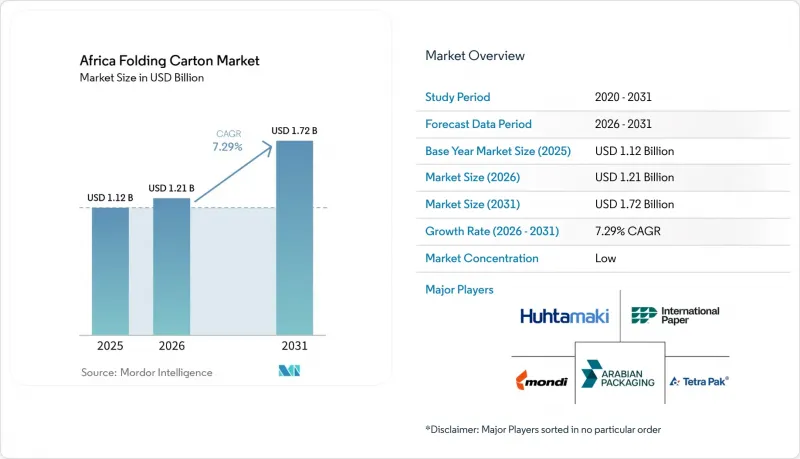
본 보고서는 원료 유형(고형 표백 황산 펄프, 접이식 상자용 판지, 코팅 미표백 크라프트지, 화이트라인 칩보드 등), 인쇄 기술(평판 인쇄, 그라비아 인쇄, 디지털 인쇄 등), 최종 사용자 산업(식품 및 음료, 전자상거래 및 소매용 포장, 담배 등), 그리고 지역별로 분류되어 있습니다. 시장 전망은 금액(달러) 기준으로 제시되어 있습니다.
아프리카의 접이식 카톤 시장 동향 및 인사이트
전자상거래 분야 수요 증가
스마트폰의 보급, 라스트 마일 물류의 개선, 그리고 결제 게이트웨이의 확대로 인해 나이지리아, 남아프리카공화국, 이집트, 케냐에서는 온라인 소매 시장이 두 자릿수 성장을 기록하고 있습니다. 패션, 전자기기, 개인 위생 용품을 배송하는 브랜드 소유주들은 현재 개봉 경험을 개선하고, 혹독한 배송 환경을 견딜 수 있으며, 보호 기능이 뛰어나고 시각적으로 돋보이는 접이식 카톤를 찾고 있습니다. AfCFTA(아프리카 대륙 자유무역협정)에 기반한 세관 현대화 프로그램에서 요구되는 QR 코드를 통한 추적성은 인쇄 해상도 요건을 높이는 동시에, 보안 기능을 통합할 수 있는 컨버터의 경쟁력을 높여주고 있습니다. 디지털 인쇄기는 디자인 주기를 단축하고, 프로모션을 빈번하게 활용하는 온라인 채널을 위해 아트워크를 신속하게 업데이트할 수 있게 해 주지만, 한편으로는 평균 발주 수량의 감소로 인해 장기간에 걸친 오프셋 인쇄의 경제적 매력은 떨어지고 있습니다. 따라서 전자상거래에 따른 구조적 수요는 단기 납기·소량 생산을 확대하고, 고급 소재를 통한 이익률 향상을 뒷받침하며, 아프리카의 접이식 카톤 시장 전망을 견인하고 있습니다.
식품 및 음료 산업의 확대
2024년, 남아프리카공화국의 감귤류 수출량은 15kg 환산 기준으로 1억 6,450만 상자를 넘어섰으며, 이는 유럽의 식물 검역 규정을 충족하는 내습성 접이식 카톤에 대한 안정적인 수요를 뒷받침하고 있습니다. 나이지리아와 케냐에서는 금지된 폴리스티렌 재질의 클램쉘 용기 대신, 내유성 판지 포장을 도입하는 퀵서비스 레스토랑이 급속히 확산되고 있습니다. 도시 지역 가구의 가처분 소득 증가에 따라 조리 식품의 보급이 가속화되고 있으며, SKU(품목 수)가 다양해지고 있습니다. 이로 인해 가공업체들은 식품 접촉 규정을 준수하면서도 비용 관리를 병행할 수 있는 유연한 생산 라인을 도입해야 하는 상황에 놓여 있습니다. 또한, 수출을 목표로 하는 과일, 수산물, 육류 가공업체들도 콜드체인 환경의 습기를 견디고 층간 박리가 발생하지 않는 판지를 찾고 있습니다. 이러한 수출과 국내 소비의 상호 연관된 동향은 아프리카의 접이식 카톤 시장을 확대하는 데 있어 식품 및 음료가 수행하는 핵심적인 역할을 더욱 공고히 하고 있습니다.
재활용 종이 펄프 가격의 변동
2024년 하반기, 남아프리카공화국에서 아시아로 향하는 폐지 수출이 증가함에 따라 국내 가격이 상승했고, 판매량은 늘었으나 Mpact사의 종이 제품 매출 총이익률은 2.7포인트 하락했습니다. 도시 지역의 수거 네트워크는 사용 후 섬유를 수출 경로로 보내고 있으며, 지역 제지 공장들이 공급을 놓고 경쟁할 때 가공업체들은 현물 시장의 가격 급등에 더 큰 영향을 받기 쉽습니다. 이집트의 초기 단계에 있는 EPR(생산자 책임 회수) 프로그램은 농촌 지역의 회수 인프라가 제대로 갖춰지지 않았음에도 불구하고 재생 소재 함유량 표기를 의무화하고 있어, 원료 조달에 대한 압박을 더욱 가중시키고 있습니다. 수거 업체와의 장기 계약을 통해 비용의 일부는 헤지되고 있지만, 중소 가공업체들은 협상력이 부족합니다. Polysmart사의 6,000만 달러 규모의 라고스 공장 등 다양한 노력을 통해 생산 능력이 확대되어 지역 내 공급이 안정화될 때까지, 펄프 가격 변동은 아프리카의 접이식 카톤 시장에 계속해서 큰 걸림돌이 될 것입니다.
부문별 분석
2025년, 접이식 카톤 시장에서 접이식 보드가 38.43%의 점유율을 차지했습니다. 이는 강성과 경량화의 균형을 잘 맞춘 다층 구조 덕분입니다. SBS(Solid Bleached Board)는 화장품 및 의약품 브랜드들이 순백색과 위생적인 섬유를 선호하는 경향을 반영하여 연평균 성장률(CAGR) 8.06%로 증가할 것으로 전망됩니다. 표백하지 않은 코트 크래프트 보드는 자연스러운 아름다움을 강조하고자 하는 유기농 및 공정무역 식품 제조업체들 사이에서 지지를 넓혀가고 있는 반면, 화이트 라이닝 칩보드는 이익 마진이 좁은 제품이나 건조 식품용 상자에 있어 여전히 가성비가 뛰어난 선택지로 자리 잡고 있습니다.
몬디사가 남아프리카에 보유한 25만 3,000헥타르 규모의 FSC 인증 산림은 원목 펄프의 안정적인 공급을 보장하며, SBS공급 능력과 추적 가능성을 뒷받침하고 있습니다. 동시에, 남아프리카공화국의 재활용 원료 함유율 목표는 식품 등급 용도를 위한 재생 펄프를 고도화하는 탈잉크 및 분산 시스템에 대한 투자를 촉진하고 있으며, 아프리카의 접이식 카톤 산업에서 재활용 인프라와 원료 구성의 발전 간의 연계성을 강화하고 있습니다.
기타 혜택 :
- 엑셀 형식 시장 예측(ME) 시트
- 3개월간의 애널리스트 지원
자주 묻는 질문
목차
제1장 서론
제2장 조사 방법
제3장 주요 요약
제4장 시장 구도
제5장 시장 규모 및 성장 예측
제6장 경쟁 구도
제7장 시장 기회 및 향후 전망
KTH 26.06.22According to Mordor Intelligence, the africa folding carton market size is expected to grow from USD 1.12 billion in 2025 to USD 1.21 billion in 2026 and is forecast to reach USD 1.72 billion by 2031 at a 7.29% CAGR over 2026-2031.
This report is Segmented by Material Type (Solid Bleached Sulfate, Folding Boxboard, Coated Unbleached Kraft, White Line Chipboard, and More), Printing Technology (Lithographic Printing, Gravure Printing, Digital Printing, and More), End-User Industry (Food and Beverage, E-Commerce and Retail-Ready Packaging, Tobacco and More), and Geography. The Market Forecasts are Provided in Terms of Value (USD).
Africa Folding Carton Market Trends and Insights
Growing Demand from the E-Commerce Sector
Smartphone adoption, improved last-mile logistics, and expanding payment gateways are fueling double-digit online retail growth in Nigeria, South Africa, Egypt, and Kenya. Brand owners shipping fashion, electronics, and personal-care items now require protective, visually distinct folding cartons that enhance unboxing experiences and withstand the rigors of parcel networks. QR-code traceability demanded by customs modernization programs under AfCFTA raises print-resolution requirements and favors converters able to integrate security features. Digital presses shorten design cycles, allowing rapid artwork refreshes for promotion-heavy online channels, while smaller average order quantities reduce the economic appeal of long offset runs. The structural pull from e-commerce therefore expands short-run volumes, supports higher margins on premium substrates, and bolsters the Africa folding carton market outlook.
Expansion of Food and Beverage Industry
Citrus exports from South Africa exceeded 164.5 million 15-kilogram-equivalent cartons in 2024, anchoring steady demand for moisture-resistant folding cartons that meet European phytosanitary rules. Nigeria and Kenya are witnessing rapid rollouts of quick-service restaurants that replace banned polystyrene clamshells with grease-resistant paperboard packaging. Rising disposable incomes across urban households accelerate packaged-meal adoption and diversify SKU counts, pushing converters toward flexible production lines that balance food-contact compliance with cost control. Export-oriented fruit, seafood, and meat processors also demand cartonboard that endures cold-chain humidity without delamination. These intertwined export and domestic consumption trends reinforce the central role of food and beverages in scaling the Africa folding carton market.
Volatility in Recycled Paper Pulp Prices
Recovered-paper exports from South Africa to Asia lifted domestic prices in late 2024, trimming Mpact's paper gross margin by 2.7% points despite volume gains. Urban collection networks funnel post-consumer fiber into export channels, leaving converters exposed to spot-market spikes when local mills compete for supply.Egypt's early-stage EPR program magnifies feedstock pressure by stipulating recycled-content labeling without parallel rural collection infrastructure. Long-term contracts with aggregators partly hedge costs, but smaller converters lack bargaining power. Until incremental capacity from initiatives such as Polysmart's USD 60 million Lagos plant stabilizes regional supply, pulp price swings will remain a material drag on the Africa folding carton market.
Other drivers and restraints analyzed in the detailed report include:
- Rising Adoption of Sustainable Packaging Regulations
- Rapid Growth of Quick-Commerce Dark Stores in Urban Hubs
- Skilled Technician Shortage Limiting Automation Uptake
For complete list of drivers and restraints, kindly check the Table Of Contents.
Segment Analysis
Folding Boxboard captured 38.43% of the African folding carton market in 2025, owing to its multi-ply architecture that balances rigidity and lightweighting. Solid Bleached Board is forecast to rise at an 8.06% CAGR, reflecting cosmetics and pharmaceutical brands' preference for pristine whiteness and hygienic fiber. Coated Unbleached Kraftboard is gaining traction among organic and fair-trade food producers eager to showcase natural aesthetics, while White-lined Chipboard remains the value option for dry-goods cartons despite narrower margin buffers.
Mondi's 253,000 hectares of FSC-certified forestry in South Africa secure a virgin fiber supply, supporting SBS availability and traceability claims. Concurrently, South Africa's recycled-content targets are stimulating investment in de-inking and dispersion systems that upgrade recovered fiber for food-grade applications, tightening the linkage between recycling infrastructure and material-mix evolution in the Africa folding carton industry.
List of Companies Covered in this Report:
- International Paper Company
- Gulf Printing and Packaging FZ-LLC
- Arabian Packaging Ltd.
- Al Ghurair Printing and Publishing LLC
- Emirates Printing Press LLC
- Al Bayader International LLC
- Tetra Pak International SA
- SIG Combibloc Group AG
- Smurfit WestRock plc
- Mondi plc
- Huhtamaki Oyj
- Ittihad Paper Mill LLC
- Prism Packaging Industries LLC
- Hotpack Packaging Industries LLC
- Trost Creative Packaging GmbH
Additional Benefits:
- The market estimate (ME) sheet in Excel format
- 3 months of analyst support
TABLE OF CONTENTS
1 INTRODUCTION
- 1.1 Study Assumptions and Market Definition
- 1.2 Scope of the Study
2 RESEARCH METHODOLOGY
3 EXECUTIVE SUMMARY
4 MARKET LANDSCAPE
- 4.1 Market Overview
- 4.2 Market Drivers
- 4.2.1 Premiumization of Food and Beverage Carton Demand
- 4.2.2 Expansion of E-commerce Fulfillment Networks
- 4.2.3 Government Sustainability Mandates for Recyclable Packaging
- 4.2.4 Rising Adoption of Digital Printing for Short-Run Jobs
- 4.2.5 Growth of Dubai Pharmaceutical Manufacturing Cluster
- 4.2.6 Surge in Duty-Free Retail Sales Boosting Carton Volumes
- 4.3 Market Restraints
- 4.3.1 Volatility in Virgin Fiber and Recovered Paper Prices
- 4.3.2 Limited Domestic Paperboard Production Capacity
- 4.3.3 Stringent Food-Contact Compliance Costs for SMEs
- 4.3.4 Substitution Threat From Flexible Packaging Formats
- 4.4 Industry Value Chain Analysis
- 4.5 Regulatory Landscape
- 4.6 Technological Outlook
- 4.7 Impact of Macroeconomic Factors on the Market
- 4.8 Porter's Five Forces Analysis
- 4.8.1 Threat of New Entrants
- 4.8.2 Bargaining Power of Suppliers
- 4.8.3 Bargaining Power of Buyers
- 4.8.4 Threat of Substitutes
- 4.8.5 Competitive Rivalry
5 MARKET SIZE AND GROWTH FORECASTS (VALUE)
- 5.1 By Material Type
- 5.1.1 Solid Bleached Sulfate
- 5.1.2 Folding Boxboard
- 5.1.3 Coated Unbleached Kraft
- 5.1.4 White Line Chipboard
- 5.1.5 Other Material Types
- 5.2 By Printing Technology
- 5.2.1 Lithographic Printing
- 5.2.2 Flexographic Printing
- 5.2.3 Digital Printing
- 5.2.4 Gravure Printing
- 5.2.5 Other Printing Technologies
- 5.3 By End-User Industry
- 5.3.1 Food and Beverage
- 5.3.2 Healthcare/Pharmaceuticals
- 5.3.3 Personal Care and Cosmetics
- 5.3.4 Electrical and Electronics
- 5.3.5 Household and Industrial Goods
- 5.3.6 Tobacco
- 5.3.7 E-commerce and Retail-ready Packaging
- 5.3.8 Other End-User Industries
- 5.4 By Geography
- 5.4.1 South Africa
- 5.4.2 Nigeria
- 5.4.3 Egypt
- 5.4.4 Rest of Africa
6 COMPETITIVE LANDSCAPE
- 6.1 Market Concentration
- 6.2 Strategic Moves
- 6.3 Market Share Analysis
- 6.4 Company Profiles (includes Global level Overview, Market level overview, Core Segments, Financials as available, Strategic Information, Market Rank/Share for key companies, Products and Services, and Recent Developments)
- 6.4.1 International Paper Company
- 6.4.2 Gulf Printing and Packaging FZ-LLC
- 6.4.3 Arabian Packaging Ltd.
- 6.4.4 Al Ghurair Printing and Publishing LLC
- 6.4.5 Emirates Printing Press LLC
- 6.4.6 Al Bayader International LLC
- 6.4.7 Tetra Pak International SA
- 6.4.8 SIG Combibloc Group AG
- 6.4.9 Smurfit WestRock plc
- 6.4.10 Mondi plc
- 6.4.11 Huhtamaki Oyj
- 6.4.12 Ittihad Paper Mill LLC
- 6.4.13 Prism Packaging Industries LLC
- 6.4.14 Hotpack Packaging Industries LLC
- 6.4.15 Trost Creative Packaging GmbH
7 MARKET OPPORTUNITIES AND FUTURE OUTLOOK
- 7.1 White-Space and Unmet-Need Assessment


