

|
시장보고서
상품코드
2061774
태국의 히트펌프 : 시장 점유율 분석, 업계 동향 및 통계, 성장 예측(2026-2031년)Thailand Heat Pump - Market Share Analysis, Industry Trends & Statistics, Growth Forecasts (2026 - 2031) |
||||||
 Mordor Intelligence
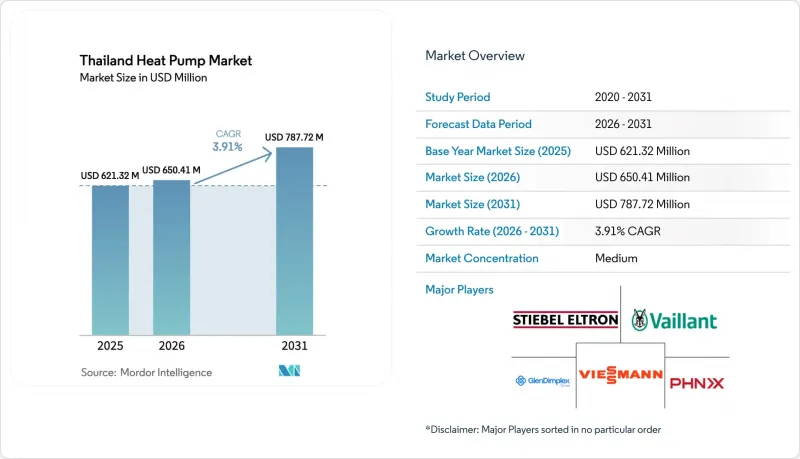
Mordor Intelligence에 의하면, 태국의 히트펌프 시장 규모는 2025년에 6억 2,132만 달러로 평가되었습니다. 2026년 6억 5,041만 달러에서 2031년까지 7억 8,772만 달러에 이를 것으로 예상되며, 예측 기간(2026-2031년) CAGR은 3.91%를 나타낼 전망입니다.
본 보고서는 공급원(공기원, 수원 등), 기술(공기-공기, 공기-물 등), 용량(10kW 미만, 10-50kW 등), 용도(공간 난방, 공간 냉방 등), 최종 사용자(주거, 상업, 산업), 설치 형태(신규 설치, 개보수), 지역별로 분류되어 있습니다. 시장 전망은 금액(달러) 기준으로 제시되어 있습니다.
태국의 히트펌프 시장 동향과 인사이트
태국의 전력 개발 계획에 따른 전기화 목표 가속화
태국의 ‘2026-2050년 전력 개발 계획’에서는 2037년까지 재생에너지 발전 비중 목표를 51%로 상향 조정하고, 공조 및 공정 가열 부하의 전기화를 위한 정책적 압력을 강화하고 있습니다. 동부 경제 회랑 지역의 산업용 전력 수요 증가는 이미 피크 시간대 발전 용량에 부담을 주고 있으며, 송전망 운영자는 히트펌프를 야간 태양광 발전의 잉여 전력을 흡수할 수 있는 제어 가능한 부하로 간주하고 있습니다. EGAT의 ‘Energy Plus’ 리베이트 제도는 5성급 라벨 획득과 스마트 그리드 대응 제어 시스템 도입을 수혜 요건으로 하고 있으며, 이를 통해 태국 혼다 매뉴팩처링사의 400kW 유닛과 같은 프로젝트가 가능해졌습니다. 이 프로젝트를 통해 천연가스 사용량을 줄여 2.4년 만에 투자 회수를 달성했습니다. 또한, 바이오·순환·녹색 경제(BCG) 공시 규정을 준수함으로써 제조업체들이 가스 보일러에서 히트 펌프로의 전환을 더욱 촉진하고, 탄소 제약이 있는 시장에서 수출 경쟁력을 확보하고 있습니다.
히트펌프의 경제성을 뒷받침하는 EGAT의 시간대별 요금제 확대
EGAT는 2026년에 피크 시간대와 비피크 시간대의 요금 차이를 1kWh당 1.8바트(0.055달러)로 확대함으로써, 부하 이동을 실시하는 히트펌프 이용자의 균등화 에너지 비용을 최대 40% 절감했습니다. 숙박 시설들은 이를 신속하게 활용했습니다. 라야바디 크라비는 할인 시간대에 거의 한정하여 가동되는 100대 이상의 인버터 유닛을 설치한 후, 온수 공급에 드는 전기 요금을 70% 절감했다고 보고했습니다. 이러한 가격 차이는 고요금 시간대를 완전히 회피하는 하이브리드 구성의 연평균 성장률(CAGR)을 4.61%로 끌어올리고 있지만, 3년을 초과하는 기간 동안의 요금 개정 불확실성으로 인해 자금 조달 모델은 여전히 과제를 안고 있습니다.
스플릿형 공조 시스템에 비해 높은 초기 설치 비용
일반적인 10kW 주택용 유닛의 설치 비용은 18만-25만 바트(5,140-7,140달러)로, 동급의 스플릿형 에어컨 가격의 3배에 달할 전망입니다. 이로 인해, 미래의 절약 효과를 두 자릿수 할인율로 할인하여 계산하는 구매자의 의욕을 꺾고 있습니다. 전용 온수 배관 설치 및 여러 업종 간의 조정이 필요하기 때문에 인건비는 최대 50% 증가합니다. 2025년 상업 프로젝트 중 성과 연계형 에너지 서비스 기업(ESCO) 계약을 활용한 프로젝트는 고작 12%에 그쳤습니다. 이는 대출 기관이 공동 이익 보증을 제공하기 전에 표준화된 측정 프로토콜을 요구하기 때문입니다. 압축기에 부과되는 5-10%의 관세 변동이 예산 리스크를 가중시키고 있지만, 현지 공급업체들은 비용 격차를 줄이기 위해 국내 조달 부품 도입을 검토하고 있습니다.
부문별 분석
2025년, 태국의 히트펌프 시장에서 공기원식 유닛은 62.78%의 시장 점유율을 차지했습니다. 이는 굴착이나 냉각탑 연결이 필요 없는 플러그 앤 플레이 방식의 설치가 뒷받침한 결과입니다. 방콕의 중층 호텔에서 진행된 상업용 리모델링 사례는 업무에 미치는 영향을 최소화하고 신속한 운영 재개가 가능하다는 이 방식의 장점을 여실히 보여주고 있습니다. 수열원 및 지열원 시스템은 합쳐서 28%를 차지하며, 콘도미니엄과 산업 플랜트에 집중되어 있습니다. 이러한 시설에서는 높은 초기 투자 비용이 태국의 더운 계절에 효율성이 향상됨으로써 상쇄되고 있습니다. 지열 시스템의 도입은 현재로서는 틈새 시장에 불과하지만, 지열 시스템을 고급 설비로 내세우는 고가 콘도미니엄들 사이에서 그 기세가 점점 더 커지고 있습니다.
하이브리드 방식은 연평균 성장률(CAGR) 4.61%를 기록하며 가장 빠르게 성장하고 있는 분야입니다. 피크 시간대의 높은 요금 위험에 직면한 산업용 사용자들은 보조적인 가스나 전기를 활용한 백업 시스템의 중복성을 중시하는 반면, 데이터센터는 하이브리드화를 전력망의 불안정성에 대한 대비책으로 간주하고 있습니다. 각 제조업체들은 외기 온도가 38℃를 초과하는 경우에도 공기원 시스템의 성능 계수(COP) 저하를 15% 미만으로 억제하기 위해, 개량형 증기 주입 압축기나 가변속 팬을 도입하고 있습니다.
공기-물 플랫폼은 2025년 매출의 48.31%를 차지하며, 공유된 온수 루프를 통해 공간 냉방 및 온수 공급 부하를 처리했습니다. 호텔이나 병원에서는 단일 플랜트실을 통해 설치 면적을 줄이고, 유지보수 계약을 일원화할 수 있다는 점이 높이 평가받고 있습니다. 공기-공기형 가변 냉매 유량(VRF) 시스템은 약 3분의 1 시장 점유율을 차지하며, 냉수 배관망이 갖춰지지 않은 곳에서 널리 보급되고 있습니다. 지중 대수형 솔루션 시장은 연평균 성장률(CAGR) 5.02%로 확대되고 있으며, 각 제조업체는 스코프 1 공시 의무에 따라 액화석유 및 가스(LPG) 사용을 억제하는 한편, 연중 내내 40-80℃의 안정적인 공정 열을 필요로 하고 있습니다.
수-수 설계는 여전히 틈새 분야이지만, 기술적으로 최첨단을 보여주고 있습니다. GR TECH사의 HEATAQUA는 식품 공장을 대상으로 5℃의 냉수와 80℃의 온수를 동시에 생산하며, 열병합 발전의 가능성을 입증하고 있습니다. 방콕 정부 복합 시설과 같은 공공 프로젝트는 수냉식 히트 펌프 도입에 적합한 온수 순환 시스템을 입증하고 있습니다.
기타 혜택 :
- 엑셀 형식 시장 예측(ME) 시트
- 3개월간의 애널리스트 지원
자주 묻는 질문
목차
제1장 서론
제2장 조사 방법
제3장 주요 요약
제4장 시장 구도
제5장 시장 규모 및 성장 예측
제6장 경쟁 구도
제7장 시장 기회 및 향후 전망
KTH 26.06.22According to Mordor Intelligence, the thailand heat pump market size was valued at USD 621.32 million in 2025 and estimated to grow from USD 650.41 million in 2026 to reach USD 787.72 million by 2031, at a CAGR of 3.91% during the forecast period (2026-2031).
This report is Segmented by Source Type (Air Source, Water Source, and More), Technology (Air-To-Air, Air-To-Water, and More), Capacity (Below 10 KW, 10-50 KW, and More), Application (Space Heating, Space Cooling, and More), End User (Residential, Commercial, and Industrial), Installation (New Installation, and Retrofit), and Geography. The Market Forecasts are Provided in Terms of Value (USD).
Thailand Heat Pump Market Trends and Insights
Accelerating Electrification Targets in Thailand's Power Development Plan
Thailand's 2026-2050 Power Development Plan lifts the renewable-generation target to 51% by 2037, reinforcing policy pressure to electrify space-conditioning and process-heating loads. Rising industrial electricity demand in the Eastern Economic Corridor is already stressing peak generation windows, and grid operators view heat pumps as controllable loads that can absorb overnight solar surplus. EGAT's Energy Plus rebates link eligibility to five-star labels and smart-grid-ready controls, enabling projects such as Thai Honda Manufacturing's 400 kW unit that trimmed natural-gas use and achieved a 2.4-year payback. Compliance with Bio-Circular-Green Economy disclosure rules further incentivizes manufacturers to switch from gas boilers to heat pumps, ensuring export competitiveness in carbon-constrained market.
Extension of EGAT Time-of-Use Tariffs Favoring Heat Pump Economics
EGAT widened the peak-to-off-peak differential to 1.8 THB (USD 0.055) kWh in 2026, cutting levelized energy costs for load-shifting heat-pump users by up to 40%. Hospitality properties have quickly capitalized; Rayavadee Krabi reported 70% hot-water electricity savings after installing more than 100 inverter units that operate almost exclusively during discounted hours. The pricing spread is also spurring a 4.61% CAGR for hybrid configurations that bypass high-tariff windows entirely, although financing models still grapple with tariff-review uncertainty beyond three-year horizons.
High Up-Front Installation Cost Versus Split-Type HVAC Systems
Typical 10 kW residential units cost 180,000-250,000 THB (USD 5,140-7,140) installed, three times the price of comparable split air conditioners, deterring buyers who discount future savings at double-digit rates. Specialized hydronic piping and multi-trade coordination inflate labor outlays by up to 50%. Only 12% of commercial projects in 2025 leveraged performance-based Energy Service Company contracts, as lenders demand standardized measurement protocols before underwriting shared-savings streams. Import-duty swings of 5-10% on compressors compound budgeting risk, although local suppliers are exploring domestically sourced components to narrow the cost gap.
Other drivers and restraints analyzed in the detailed report include:
- Energy-Efficiency Fund Rebates for Commercial Buildings
- Shift Toward Low-GWP Refrigerants Mandated by Ozone Protection Act Amendments
- Limited Public Awareness of Heat Pump Benefits
For complete list of drivers and restraints, kindly check the Table Of Contents.
Segment Analysis
Air source units delivered 62.78% Thailand heat pump market share in 2025, propelled by plug-and-play installation that avoids drilling or cooling-tower tie-ins. Commercial retrofits in mid-rise Bangkok hotels underline the appeal of minimal disruption and rapid commissioning. Water- and ground-source systems together held 28%, clustered in condominiums and industrial plants where higher capital outlays are offset by efficiency gains during Thailand's hot season. Ground-source installations, though just a niche today, are gathering momentum among luxury condominiums marketing geothermal systems as premium amenities.
Hybrid architectures are the quickest-growing slice at a 4.61% CAGR. Industrial users facing peak-tariff exposure value the redundancy of auxiliary gas or electric backup, while data centers view hybridization as a hedge against grid instability. Manufacturers are rolling out enhanced-vapor-injection compressors and variable-speed fans to keep air-source coefficient-of-performance drops below 15% even when ambient temperatures top 38 °C.
Air-to-water platforms captured 48.31% of 2025 revenue, serving space cooling and hot-water loads from a shared hydronic loop. Hotels and hospitals appreciate the single-plantroom footprint and consolidated maintenance contracts. Air-to-air variable refrigerant flow systems held roughly one-third share, thriving where chilled-water distribution is absent. Ground-to-water solutions are expanding at 5.02% CAGR as manufacturers seek stable year-round 40-80 °C process heat while curbing liquefied-petroleum-gas use under Scope 1 disclosure mandates.
Water-to-water designs remain niche but showcase technical frontiers: GR TECH's HEATAQUA simultaneously produces 5 °C chilled water and 80 °C hot water for food plants, demonstrating co-generation potential. Public projects like the Government Complex Bangkok validate hydronic architectures that favor water-based heat-pump roll-outs.
List of Companies Covered in this Report:
- Stiebel Eltron GmbH & Co. KG
- Vaillant Group
- Viessmann Climate Solutions SE
- Glen Dimplex Group
- PHNIX Eco-Energy Solution Ltd.
- Sanden Holdings Corp. (Heat Pump Div.)
- MasterTherm CZ s.r.o.
- Mayekawa Mfg. Co., Ltd. (Heat Pump Div.)
- Mitsubishi Electric Corp.
- Johnson Controls International plc
- Aermec S.p.A
- Alpha Innotec GmbH
- Daikin Applied
- Ochsner Warmepumpen GmbH
- Clivet SpA
- NIBE Industrier AB (NIBE Climate Solutions)
Additional Benefits:
- The market estimate (ME) sheet in Excel format
- 3 months of analyst support
TABLE OF CONTENTS
1 INTRODUCTION
- 1.1 Study Assumptions and Market Definition
- 1.2 Scope of the Study
2 RESEARCH METHODOLOGY
3 EXECUTIVE SUMMARY
4 MARKET LANDSCAPE
- 4.1 Market Overview
- 4.2 Market Drivers
- 4.2.1 Accelerating Electrification Targets in Thailand's Power Development Plan
- 4.2.2 Extension of EGAT Time-of-Use Tariffs Favoring Heat Pump Economics
- 4.2.3 Energy-Efficiency Fund Rebates for Commercial Buildings
- 4.2.4 Crowding-In of Green Real Estate Investment Trusts
- 4.2.5 Shift Toward Low-GWP Refrigerants Mandated by Ozone Protection Act Amendments
- 4.2.6 Growth of Data Centers Requiring High-Efficiency Cooling
- 4.3 Market Restraints
- 4.3.1 High Up-Front Installation Cost Versus Split-Type HVAC Systems
- 4.3.2 Limited Public Awareness of Heat Pump Benefits
- 4.3.3 Fragmented After-Sales Service Network Outside Greater Bangkok
- 4.3.4 Volatile Import Duties on Key Components Such as Compressors
- 4.4 Industry Value Chain Analysis
- 4.5 Regulatory Landscape
- 4.6 Technological Outlook
- 4.7 Porter's Five Forces Analysis
- 4.7.1 Bargaining Power of Suppliers
- 4.7.2 Bargaining Power of Buyers
- 4.7.3 Threat of New Entrants
- 4.7.4 Threat of Substitutes
- 4.7.5 Intensity of Competitive Rivalry
- 4.8 Impact of Macroeconomic Factors on the Market
5 MARKET SIZE AND GROWTH FORECASTS (VALUE)
- 5.1 By Source Type
- 5.1.1 Air Source
- 5.1.2 Water Source
- 5.1.3 Ground Source
- 5.1.4 Hybrid
- 5.2 By Technology
- 5.2.1 Air-to-Air
- 5.2.2 Air-to-Water
- 5.2.3 Water-to-Water
- 5.2.4 Ground-to-Water
- 5.3 By Capacity
- 5.3.1 Below 10 kW
- 5.3.2 10-50 kW
- 5.3.3 50-200 kW
- 5.3.4 Above 200 kW
- 5.4 By Application
- 5.4.1 Space Heating
- 5.4.2 Space Cooling
- 5.4.3 Domestic and Sanitary Hot Water
- 5.4.4 Industrial and Process Heating
- 5.4.5 Other Applications
- 5.5 By End User
- 5.5.1 Residential
- 5.5.2 Commercial
- 5.5.3 Industrial
- 5.6 By Installation
- 5.6.1 New Installation
- 5.6.2 Retrofit
6 COMPETITIVE LANDSCAPE
- 6.1 Market Concentration
- 6.2 Strategic Moves
- 6.3 Vendor Positioning Analysis
- 6.4 Company Profiles (includes Global Level Overview, Market Level Overview, Core Segments, Financials as available, Strategic Information, Market Rank/Share, Products and Services, Recent Developments)
- 6.4.1 Stiebel Eltron GmbH & Co. KG
- 6.4.2 Vaillant Group
- 6.4.3 Viessmann Climate Solutions SE
- 6.4.4 Glen Dimplex Group
- 6.4.5 PHNIX Eco-Energy Solution Ltd.
- 6.4.6 Sanden Holdings Corp. (Heat Pump Div.)
- 6.4.7 MasterTherm CZ s.r.o.
- 6.4.8 Mayekawa Mfg. Co., Ltd. (Heat Pump Div.)
- 6.4.9 Mitsubishi Electric Corp.
- 6.4.10 Johnson Controls International plc
- 6.4.11 Aermec S.p.A
- 6.4.12 Alpha Innotec GmbH
- 6.4.13 Daikin Applied
- 6.4.14 Ochsner Warmepumpen GmbH
- 6.4.15 Clivet SpA
- 6.4.16 NIBE Industrier AB (NIBE Climate Solutions)
7 MARKET OPPORTUNITIES AND FUTURE OUTLOOK
- 7.1 White-Space and Unmet-Need Assessment


