

|
시장보고서
상품코드
2063684
유럽의 머시닝 센터 시장 : 점유율 분석, 업계 동향과 통계, 성장 예측(2026-2031년)Europe Machining Centers - Market Share Analysis, Industry Trends & Statistics, Growth Forecasts (2026 - 2031) |
||||||
 Mordor Intelligence
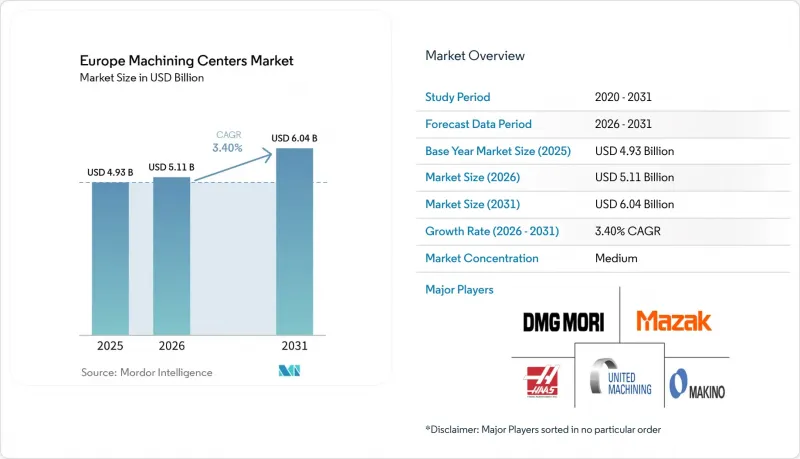
Mordor Intelligence에 의하면, 유럽 머시닝 센터 시장 규모는 2025년에 49억 3,000만 달러로 평가되었고 2026년 51억 1,000만 달러에서 2031년까지 60억 4,000만 달러에 이를 것으로 예측되며, 예측 기간(2026-2031년) CAGR은 3.40%를 나타낼 전망입니다.
본 보고서는 기계 유형별(수평형 머시닝 센터 등), 축 구성별(3축, 4축, 5축 이상), 주축 방향별(수평, 수직, 다중 주축), 구조 유형별(컬럼형, 갠트리형, 이동 테이블형), 최종 사용자 산업별(자동차, 기타), 국가(독일, 기타)별로 분류되어 있습니다. 시장 전망은 금액(달러) 기준으로 제공됩니다.
유럽 머시닝 센터 시장 동향과 인사이트
전기차(EV) 중심의 경량 부품 가공 수요가 다축 기계 도입을 가속화하고 있습니다.
배터리식 전기차에서는 주철로 만든 엔진 블록 대신 알루미늄으로 만든 전동 모터 하우징과 CFRP로 만든 차체 부품이 채택되고 있습니다. 이러한 부품들은 열변형을 방지하기 위해 5축 동시 가공을 통한 윤곽 가공이 필요합니다. BMW는 란트슈투트 공장에서 2억 1,600만 달러를 투자해 설비를 현대화하고, 산업용 프린터 17대를 도입함으로써 하루 4,500개의 모래 주형 코어를 공급하여 주조 사이클 시간과 에너지 소비를 줄였습니다. 스텔란티스는 사라고사의 기가팩토리에 막대한 설비 투자를 진행하고 있으며, 이로 인해 현지 인력 공급량을 크게 웃도는 대규모 채용 수요가 발생하고 있습니다. 이러한 심각한 인력 부족으로 인해, 각 제조업체는 숙련된 공작기계 조작 인력의 부족을 보완하기 위해 AI를 활용한 공구 경로 최적화 시스템 도입을 추진하고 있습니다. Chery-Ebro의 바르셀로나 합작회사는 2029년까지 연간 15만 대의 생산을 목표로 하고 있으며, 냉각 채널이 장착된 알루미늄 배터리 트레이를 한 번의 세팅으로 마무리 가공할 수 있는 다축 머시닝 센터를 도입했습니다. 세아트의 6만 4,000제곱미터 규모 배터리 공장은 2026년 가동을 시작한 후 연간 30만 세트를 출하할 예정이며, 각 세트에는 공차가 엄격한 하우징에 대해 ISO 9001 인증을 획득한 가공이 요구됩니다. 전반적으로, 3축 수평형 머시닝 센터에서 범용 머시닝 센터로 전환함으로써, 세팅 시간이 단축되고 불량품이 감소하며, 고정밀 기계에 대한 투자 회수가 가속화됩니다.
인더스트리 4.0에 대응하는 HMC/VMC 개조를 통해 공장 전체의 스마트 가공 역량이 확대됨
독일과 이탈리아의 공작기계군의 평균 사용 연수는 10-15년이지만, 견고한 철제 기반은 최신 제어 시스템으로 업그레이드하면 앞으로 10년 동안 더 가동할 수 있습니다. 2025년에 출시될 하이덴하인의 TNC7 3세대는 24개의 제어 루프와 0.5밀리초의 블록 처리 시간을 지원하며, 주축 부하 텔레메트리 데이터를 기반으로 한 실시간 이송 속도 조정이 가능합니다. 이러한 가능성을 입증한 VDW의 사례 연구에 따르면, 12년 동안 사용된 수평형 공작기계에 지멘스의 SINUMERIK 840D sl과 상태 모니터링 센서를 사후 장착한 결과, 사이클 타임이 대폭 단축되고 생산성이 향상된 것으로 확인되었습니다. 이러한 업그레이드를 지원하기 위해, EU의 IPCEI를 통한 막대한 자금 지원으로 중소기업이 디지털 트윈이나 자체 관리형 On-Premise AI를 도입할 수 있게 되었으며, 사후 설치형 패키지에 대한 투자 장벽이 완화되고 있습니다. 대상을 좁혀서 진행하는 개보는 효율을 대폭 향상시킵니다. 예를 들어, 마자크의 우스터 공장에서는 구형 CO₂ 레이저 4대를 자동 파이버 시스템 2대로 교체하여 생산량을 40% 늘리고 전력 소비량을 67% 줄였습니다. 결국, 신규 설비 구입을 미룸으로써 개보수를 통해 설비 투자를 최대 70%까지 절감할 수 있으며, 이는 수주량이 감소했을 때 중요한 재정적 여력을 확보해 줍니다.
EU의 산업 생산 변동에 기인한 주기적인 설비 투자 축소가 설비 투자를 감소시킵니다.
2025년 상반기, 독일의 공작기계 수주는 배터리 화학 성분에 대한 불확실성으로 인해 자동차 제조업체들이 전기차(EV) 플랫폼용 금형 도입을 연기함에 따라 급감했습니다. 생산량은 3% 감소했으나, 각 제조업체가 해고 대신 주당 근로시간 단축에 의존한 덕분에 직원수는 6만 4,000명 전후를 유지했고, 이익률은 압박을 받았습니다. 유로스타트의 자료에 따르면, 자본재 인플레이션율은 1.8%이지만, 2025년에 소폭 하락했음에도 불구하고 전력 가격은 구조적으로 2022년 이전 수준을 상회하고 있습니다. 화학제품의 생산 능력은 10% 감소했고, 투자액은 80%나 급감했습니다. 이는 에너지 비용이 낮은 미국 제조업체에 대한 경쟁력이 약화되고 있음을 여실히 보여주고 있습니다. 이에 대해 고객사들은 설비 교체 주기를 12-15년으로 연장하고, OEM 제조업체에 장기 대출을 요구함으로써 대응하고 있으며, 이는 유럽의 기계 머시닝 센터 시장에서 단기적인 성장세를 꺾고 있습니다.
부문별 분석
2025년, 유럽의 머시닝 센터 시장에서 수직형 머시닝 센터는 35%를 차지했습니다. 이는 프레스 금형의 마무리 가공, 의료용 마이크로 밀링 및 일반적인 수탁 가공 업무에 유연하게 활용할 수 있기 때문입니다. 3축 모델은 매력적인 설비 투자 비용으로 금형의 거친 가공 및 직육면체 형태의 자동차 부품 가공에 대응하며, 4축 로터리 테이블은 측면 가공을 위한 인덱스 위치 결정 기능을 추가합니다. 가장 빠르게 성장하고 있는 부문인 유니버설/5축 플랫폼은 항공우주 분야의 주요 제조업체와 의료기기 제조업체들이 단일 세팅으로 윤곽 가공을 요구하는 가운데, 2031년까지 연평균 성장률(CAGR) 5.8%로 확대되고 있습니다. 오쿠마의 ‘MULTUS U3000 2SW’와 같은 첨단 밀-턴 플랫폼은 트윈 스핀들 프레임 내에 12,000rpm의 고부하 밀링 기능을 통합하여 설치 면적을 30%, 재고를 40% 절감합니다. 인력 부족으로 인해 무인 가공의 가치가 높아지는 가운데, 각 제조업체들은 팔레트 풀, 공정 내 프로빙, 클라우드를 통한 상태 모니터링 기능을 패키지화하고 있으며, 신규 수주는 기본적인 수직형 가공기에서 점차 벗어나고 있습니다.
이러한 전환 추세는 부품의 복잡화로 인해 더욱 가속화되고 있습니다. 티타늄 터빈 블레이드, 정형외과용 관절, 알루미늄 배터리 트레이 등은 모두 가변 리드각이나 경사각으로 자유 곡면을 가공하는 공구 벡터가 필요합니다. 5축 사이클은 세팅 시간을 절반으로 줄이고, 첫 가공의 수율을 향상시키기 때문에 동급의 3축 기계보다 40-60% 높은 가격 차이를 상쇄하고 있습니다. VMC(수직 가공기)가 이미 도입 기반의 대부분을 차지하고 있기 때문에 트러니언이나 회전 테이블을 추가하는 개조 키트가 전환 수단으로 제공되고 있지만, 현재는 많은 구매자가 보간 동작 시의 진동을 억제하는 갠트리식 Y축 지지대를 갖춘, 처음부터 새롭게 설계된 범용 기계를 선택하고 있습니다. 이를 통해 미래를 내다보며 생산 능력을 확보하는 동시에, 프로그래밍 노하우를 통합할 수 있게 됩니다.
2025년 현재, 3축 시스템은 유럽 머시닝 센터 시장 점유율의 42%를 차지하고 있으며, 이는 가공 요소가 단일 평면상에 배치되는 대량 생산용 자동차 부품 가공에 힘입은 결과입니다. 그러나 5축 이상의 시스템군은 연평균 성장률(CAGR) 6.2%로 성장할 것으로 전망됩니다. 이는 동시 윤곽 가공을 통해 재고정이 필요 없어지고, 사이클 타임이 절반으로 단축되며, 조각적인 형상의 가공이 가능하기 때문입니다. 2026년에 출시된 DMG MORI의 ‘DMU 65 H monoBLOCK’은 453개의 공구를 수납할 수 있는 공구 매거진과 5μm의 위치 결정 정밀도를 갖추고 있으며, 지속적인 공구 접촉이 요구되는 터빈 케이싱 가공을 목표로 하고 있습니다. FANUC의 소형 ‘Robodrill a-D14MiA5’는 5축 운동 기구를 2제곱미터 미만의 초소형 설치 면적에 집약하고 있어, 공간 제약이 있는 의료용 임플란트 클린룸에 도입하기에 매우 적합합니다.
인덱스 방식의 4축 수평형 머시닝 센터는 엔진 블록이나 변속기 하우징 가공 분야에서 여전히 인기가 높으며, 애더 팔레트를 활용한 무인 운전 사이클을 통해 한 번의 클램핑으로 양면 가공이 가능합니다. 그러나 티타늄 및 인코넬의 가공량이 급증함에 따라, 4축 가공기에서는 수동 재클램핑 없이는 실현할 수 없는 공구 경사 가공이 필요해졌으며, 이에 따라 항공우주 부품 공급업체들은 1,200 Nm의 스핀들 토크를 지원하는 풀 5축 수평형 머시닝 센터로 전환해야 하는 상황에 직면해 있습니다. 현재 인증 기관은 공장 인수 시험 시 ISO 230-1 및 ISO 230-2 적합성 보고서를 요구하고 있으며, 이로 인해 중소규모 공장은 공작기계 구매와 병행하여 계측 기기 및 환경 제어 시스템의 업그레이드를 강요받고 있습니다.
기타 혜택:
- 엑셀 형식 시장 예측(ME) 시트
- 3개월간의 애널리스트 지원
자주 묻는 질문
목차
제1장 서론
제2장 조사 방법
제3장 주요 요약
제4장 시장 구도
제5장 시장 규모와 성장 예측
제6장 경쟁 구도
제7장 시장 기회와 향후 전망
JHS 26.06.23According to Mordor Intelligence, the europe machining centers market size was valued at USD 4.93 billion in 2025 and is estimated to grow from USD 5.11 billion in 2026 to reach USD 6.04 billion by 2031, at a CAGR of 3.40% during the forecast period (2026-2031).
This report is Segmented by Machine Type (Horizontal Machining Centers, and More), by Axis Configuration (3-Axis, 4-Axis, 5-Axis & Above), by Spindle Orientation (Horizontal, Vertical, Multi-Spindle), by Structure Type (Column-Type, Gantry-Type, Moving-Table), by End-User Industry (Automotive, and More), and by Country (Germany, and More). The Market Forecasts are Provided in Terms of Value (USD).
Europe Machining Centers Market Trends and Insights
EV-Driven Lightweight Component Machining Demand Accelerates Multi-Axis Machine Adoption
Battery-electric vehicles swap cast-iron engine blocks for aluminum e-motor housings and CFRP body parts that require simultaneous five-axis contouring to avoid thermal distortion. BMW's USD 216 million upgrade in Landshut added 17 industrial printers to supply 4,500 sand cores daily, cutting casting cycle time and energy use. Stellantis is directing massive capital investments toward its Zaragoza gigafactory, triggering a large-scale hiring demand that severely outpaces the local talent pool. This profound labor gap is pushing builders to embed AI-assisted tool-path optimization to compensate for the scarcity of master machinists. Chery-Ebro's Barcelona joint venture aims to reach 150,000 units annually by 2029 and is sourcing multi-axis centers capable of finishing aluminum battery trays with cooling channels in a single setup. Seat's 64,000-square-meter battery plant will ship 300,000 systems per year once operational in 2026, each calling for ISO 9001-certified machining of tight-tolerance housings. Altogether, the migration from three-axis horizontals to universal centers shortens changeovers, lowers scrap, and accelerates payback on high-precision machinery.
Industry 4.0-Ready HMC/VMC Retrofits Expand Smart-Machining Capabilities Across Factories
Machine parks across Germany and Italy average 10 to 15 years in age, yet they retain rigid iron foundations capable of performing for another decade when upgraded with modern controls. HEIDENHAIN's TNC7 Generation 3, released in 2025, supports 24 control loops and 0.5-millisecond block times, unlocking real-time feed-rate adaptations based on spindle-load telemetry. Demonstrating this potential, a VDW case study showed significant cycle-time reductions and productivity lifts after a 12-year-old horizontal machine was retrofitted with a Siemens SINUMERIK 840D sl and condition-monitoring sensors. To support these upgrades, vast EU IPCEI funding helps SMEs deploy digital twins and sovereign on-premise AI, easing the investment hurdle for retrofit packages. Targeted retrofits also yield massive efficiency gains; for instance, Mazak's Worcester site swapped four legacy CO2 lasers for two automated fiber systems, boosting output by 40% and trimming power use by 67%. Ultimately, by postponing greenfield purchases, retrofits can shave as much as 70% off capital outlay, a vital financial cushion when order books thin.
Cyclical Capex Cuts Driven by EU Industrial-Output Volatility Reduce Equipment Investments
German machine-tool orders declined sharply in the first half of 2025 as automakers deferred EV-platform tooling amid uncertainty over battery chemistry. Production dropped 3%, yet headcount stayed near 64,000 because builders leaned on shorter workweeks over layoffs, compressing profit margins. Eurostat shows capital-goods inflation at 1.8%, while electricity prices remain structurally above pre-2022 levels despite modest 2025 retreats. Chemical capacity shrank by 10%, and investment plummeted by 80%, underscoring the erosion of competitiveness against the United States producers that enjoy lower energy costs. Customers answer by stretching replacement cycles to 12-15 years and pushing OEMs to finance extended terms, sapping near-term momentum in the Europe machining centers market.
Other drivers and restraints analyzed in the detailed report include:
- EU IPCEI Funding Boosts Strategic Investment in Advanced Machine-Tool Capacity
- Near-Shoring of Aerospace Titanium Machining to Eastern Europe Increases Precision-Machining Demand
- Skilled-Operator Shortages Persist Despite Increasing Automation Adoption
For complete list of drivers and restraints, kindly check the Table Of Contents.
Segment Analysis
Vertical machining centers accounted for 35% of the Europe machining centers market in 2025, thanks to their flexibility across stamping-die finishing, medical micro-milling, and general job-shop tasks. Three-axis versions serve mold roughing or prismatic automotive parts at attractive capital costs, while four-axis rotary tables add indexed positioning for side features. The fastest-growing slice, universal/5-axis platforms, is expanding at a 5.8% CAGR through 2031 as aerospace primes and medical-device makers chase one-setup contouring. Advanced mill-turn platforms like Okuma's MULTUS U3000 2SW fold heavy-duty 12,000-rpm milling inside a twin-spindle frame, trimming floor space 30% and inventory 40%. As labor scarcity lifts the value of unattended machining, builders bundle pallet pools, in-process probing, and cloud condition monitoring, tilting new orders away from basic verticals.
The migration is reinforced by the complexity of the parts. Titanium turbine blades, orthopedic joints, and aluminum battery trays all need tool vectors that strike freeform surfaces at variable lead and tilt angles. Five-axis cycles cut setup time in half and raise first-pass yield, offsetting sticker premiums that run 40-60% above equivalent three-axis units. Because VMC iron already dominates the install base, retrofit kits that add trunnions or rotary tables offer a transition path, but most buyers now opt for ground-up universal machines with gantry-style Y-axis support that suppresses vibration on interpolated moves, future-proofing capacity while consolidating programming know-how.
Three-axis systems held 42% of the Europe machining centers market share in 2025, underpinned by high-volume automotive work where features lie in a single plane. Yet the 5-axis & above cohort is forecast to grow at 6.2% CAGR because simultaneous contouring eliminates re-fixturing, halves cycle times, and unlocks sculptured geometries. DMG MORI's DMU 65 H monoBLOCK, released in 2026, carries a 453-tool magazine and 5-µm positioning accuracy, targeting turbine casings that demand continuous tool engagement. FANUC's compact Robodrill a-D14MiA5 squeezes five-axis kinematics into an ultra-compact footprint of less than 2 square meters, making it highly viable for space-constrained medical implant cleanrooms.
Indexed four-axis horizontals remain popular for engine blocks and transmission housings, offering two-face machining in a single clamp with adder pallets for lights-out cycles. However, soaring titanium and Inconel volumes require tool tilts that four-axis units cannot deliver without manual reclamping, pushing aerospace suppliers toward full five-axis horizontals rated for 1,200 Nm spindle torque. Certification bodies now expect ISO 230-1 and ISO 230-2 compliance reports during factory acceptance testing, nudging smaller shops to upgrade metrology and environmental controls alongside machine purchases.
List of Companies Covered in this Report:
- DMG MORI AG
- Yamazaki Mazak Europe
- GF Machining Solutions (United Grinding Group)
- Makino Europe GmbH
- Haas Automation Europe
- Okuma Europe GmbH
- Doosan Machine Tools
- Chiron Group SE
- Gebr. Heller Maschinenfabrik
- FFG Europe & Americas
- GROB-Werke GmbH
- Hermle AG
- Starrag Group
- Hyundai WIA Europe
- EMCO Group
- Hurco Europe Ltd.
- INDEX-TRAUB Group
- Brother Europe Ltd.
- FANUC Robodrill Europe
- JTEKT Toyoda Europe
Additional Benefits:
- The market estimate (ME) sheet in Excel format
- 3 months of analyst support
TABLE OF CONTENTS
1 Introduction
- 1.1 Study Assumptions & Market Definition
- 1.2 Scope of the Study
2 Research Methodology
3 Executive Summary
4 Market Landscape
- 4.1 Market Overview
- 4.2 Market Drivers
- 4.2.1 EV-driven lightweight component machining demand accelerates multi-axis machine adoption
- 4.2.2 Industry 4.0-ready HMC/VMC retrofits expand smart machining capabilities across factories
- 4.2.3 EU IPCEI funding boosts strategic investment in advanced machine-tool capacity
- 4.2.4 Near-shoring of aerospace titanium machining to Eastern Europe increases precision machining demand
- 4.2.5 Hybrid additive-subtractive machining center rollout enhances production flexibility and efficiency
- 4.2.6 Rising demand for micro-machining in medical implants drives ultra-precision machine adoption
- 4.3 Market Restraints
- 4.3.1 Cyclical capex cuts driven by EU industrial output volatility reduce equipment investments
- 4.3.2 Skilled operator shortages persist despite increasing automation adoption
- 4.3.3 High energy costs impact operational viability of large-format gantry machining centers
- 4.3.4 Extended lead times for precision spindles and controllers delay machine deployment
- 4.4 Value/Supply-Chain Analysis
- 4.5 Regulatory Landscape
- 4.6 Technological Outlook
- 4.7 Industry Attractiveness - Porter's Five Forces
- 4.7.1 Threat of New Entrants
- 4.7.2 Bargaining Power of Suppliers
- 4.7.3 Bargaining Power of Buyers
- 4.7.4 Threat of Substitutes
- 4.7.5 Competitive Rivalry
5 Market Size and Growth Forecasts (Value, USD)
- 5.1 By Machine Type
- 5.1.1 Horizontal Machining Centers (HMC)
- 5.1.2 Vertical Machining Centers (VMC)
- 5.1.3 Universal/5-Axis Machining Centers
- 5.1.4 Multi-Tasking Machining Centers (MTM)
- 5.1.5 Others (Gantry/Bridge-Type Centers, Turn-Mill Centers)
- 5.2 By Axis Configuration
- 5.2.1 3-Axis
- 5.2.2 4-Axis
- 5.2.3 5-Axis & Above
- 5.3 By Spindle Orientation
- 5.3.1 Horizontal
- 5.3.2 Vertical
- 5.3.3 Multi-spindle
- 5.4 By Structure Type
- 5.4.1 Column-Type
- 5.4.2 Gantry-Type
- 5.4.3 Moving-Table
- 5.5 By End-User Industry
- 5.5.1 Automotive
- 5.5.2 Aerospace & Defense
- 5.5.3 Energy (Oil-Gas, Renewables)
- 5.5.4 Medical Devices
- 5.5.5 Mold and Die Manufacturing
- 5.5.6 Others (General Manufacturing, Job Shops, Electronics, etc.)
- 5.6 By Country
- 5.6.1 Germany
- 5.6.2 France
- 5.6.3 United Kingdom
- 5.6.4 Spain
- 5.6.5 Italy
- 5.6.6 Rest of Europe
6 Competitive Landscape
- 6.1 Market Concentration
- 6.2 Strategic Moves
- 6.3 Market Share Analysis
- 6.4 Company Profiles (includes Global Level Overview, Market Level Overview, Core Segments, Financials as Available, Strategic Information, Products & Services, and Recent Developments)
- 6.4.1 DMG MORI AG
- 6.4.2 Yamazaki Mazak Europe
- 6.4.3 GF Machining Solutions (United Grinding Group)
- 6.4.4 Makino Europe GmbH
- 6.4.5 Haas Automation Europe
- 6.4.6 Okuma Europe GmbH
- 6.4.7 Doosan Machine Tools
- 6.4.8 Chiron Group SE
- 6.4.9 Gebr. Heller Maschinenfabrik
- 6.4.10 FFG Europe & Americas
- 6.4.11 GROB-Werke GmbH
- 6.4.12 Hermle AG
- 6.4.13 Starrag Group
- 6.4.14 Hyundai WIA Europe
- 6.4.15 EMCO Group
- 6.4.16 Hurco Europe Ltd.
- 6.4.17 INDEX-TRAUB Group
- 6.4.18 Brother Europe Ltd.
- 6.4.19 FANUC Robodrill Europe
- 6.4.20 JTEKT Toyoda Europe
7 Market Opportunities and Future Outlook
- 7.1 White-space and Unmet-Need Assessment


