
|
시장보고서
상품코드
2064530
호스피탈리티용 인력 관리(WFM) 시장 : 시장 점유율 분석, 산업 동향 및 통계 데이터, 성장 예측(2026-2031년)Workforce Management (WFM) In Hospitality - Market Share Analysis, Industry Trends & Statistics, Growth Forecasts (2026 - 2031) |
||||||
 Mordor Intelligence
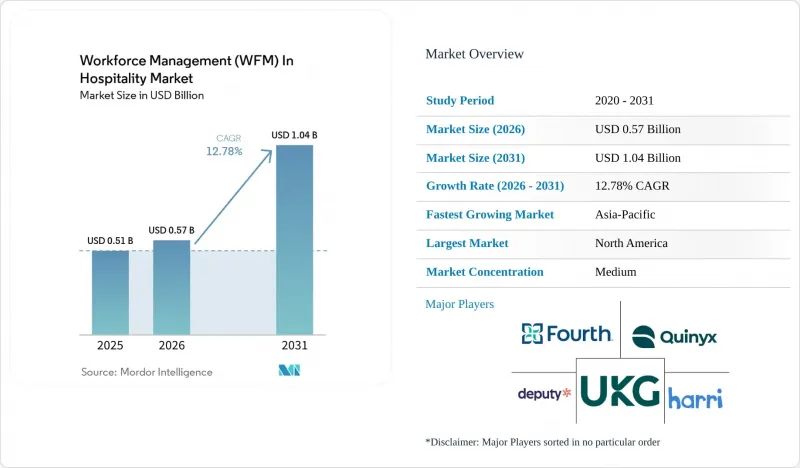
Mordor Intelligence에 의하면, 호스피탈리티용 인력 관리(WFM) 시장 규모는 2025년에 5억 1,000만 달러로 평가되었고, 2026년 5억 7,000만 달러로 추정되고, 2031년까지 10억 4,000만 달러에 이를 것으로 예측되며, 예측 기간(2026-2031년) CAGR은 12.78%를 나타낼 전망입니다.
본 보고서는 구성 요소별(소프트웨어(근태 관리 등), 서비스), 배포 방식별(클라우드 기반, 온프레미스, 하이브리드), 기업 규모별(대기업, 중소기업), 최종 사용자별(호텔, 레스토랑, 리조트, 카지노, 크루즈선) 및 지역별로 분류되어 있습니다. 시장 전망은 금액(달러) 기준으로 제시되어 있습니다.
세계의 호스피탈리티용 인력 관리 시장 동향 및 인사이트
인건비 및 초과근무 수당 최적화에 대한 압박이 커지고 있습니다.
인건비 관리는 호스피탈리티용 인력 관리(WFM) 도입에 있어 여전히 가장 중요한 요인으로 꼽히고 있습니다. 이는 사업자가 이에 대해 직접 대응하고, 그 성과를 신속하게 측정할 수 있기 때문입니다. 호스피탈리티 업계에서는 일반적으로 인건비가 매출의 28%에서 40%를 차지하고 있어, 적정 인력 배치가 경영 판단의 핵심으로 자리 잡고 있습니다. 주당 220시간의 근로 시간을, 각각 44시간씩 근무하는 직원 5명에서 8명으로 재배치함으로써 20시간의 초과근무를 줄일 수 있으며, 중앙값 임금률을 기준으로 할 때, 사업장당 주당 170-250달러를 절감할 수 있습니다. 이 계산은 여러 거점을 운영하는 경우 그 중요성이 더욱 커집니다. 왜냐하면, 동일한 일정상의 비효율이 더 광범위한 시설 전체에서 반복되기 때문입니다. 따라서, 호텔 및 레스토랑 업계의 인력 관리 시장 구매 담당자들은 단순한 근무표 작성에 그치지 않고, 객실 점유율, 서비스 기간 및 초과근무 위험과 연계하여 인력 배치를 결정할 수 있는 인력 관리 도구를 원하고 있습니다. 이에 따라 인건비 투명화 및 초과근무 관리는 호스피탈리티용 인력 관리 시장에서 조달 결정 시 최우선 고려 사항 중 하나가 되었습니다.
AI를 활용한 수요 예측 및 일정 최적화를 통한 노동 생산성 향상
호스피탈리티용 인력 관리(WFM) 시장에서 AI를 활용한 스케줄링은 시범 운영 단계에서 일상 업무로 점차 전환되고 있습니다. 현재 이 플랫폼은 매주 16억 개의 데이터 포인트를 처리하고, 30만 개의 모델을 학습시키며, 매주 120만 건의 근무 일정을 생성하고 있는데, 이는 예측 기반 스케줄링이 실제 운영 환경에서 얼마나 확대되고 있는지를 보여줍니다. 직원 참여도 관리 솔루션을 이용 중인 고객사의 경우, 현장 직원의 이직률이 평균 33% 개선되었습니다. 또한, 조사에 따르면 영국 관리직의 65%가 AI를 통해 일정 관리가 간소화될 것이라고 생각하는 반면, 현재 이러한 도구를 활용하고 있는 비율은 고작 19%에 그치고 있어, 도입 여지가 충분히 남아 있음을 보여주고 있습니다. 2025년에 시작된 오픈 베타 버전에서 에이전트형 시스템이 근무표의 부적합을 차단하고, 직원의 근무 가능 여부와 과거 매출 패턴을 활용하여 근무 배정을 제안할 수 있음이 입증되었습니다. 이러한 기능 덕분에, 호텔 및 레스토랑 업계의 인력 관리 시장에서는 정적인 예측 지원에서 실시간 일정 조정 및 자동화된 규정 준수 관리로 전환될 것이라는 기대가 높아지고 있습니다.
PMS, POS, 급여 계산, 근태 관리 시스템에 걸쳐 있는 레거시 시스템 통합의 복잡성
호스피탈리티용 인력 관리 시장에서 단기적으로 가장 큰 제약 요인은 여전히 통합의 복잡성입니다. 호텔이나 레스토랑 그룹은 대개 오랜 기간에 걸쳐 구축된 다양한 기술 환경을 운영하고 있기 때문입니다. 호스피탈리티 업체 3곳 중 1곳만이 현재 시스템이 생성하는 데이터를 신뢰하고 있으며, 이로 인해 인력 최적화가 시작되기도 전에 예측 정확도가 떨어지고 있습니다. 단일 시설이라 하더라도, 운영 주기가 서로 다른 시기에 도입된 별도의 PMS, 급여 계산, 인사, POS, 근태 관리 시스템에 의존하고 있는 경우가 있습니다. 이 때문에 호스피탈리티 분야 인력 관리 시스템의 도입이 지연되고 있으며, 호스피탈리티 업계 전체에 걸쳐 완전히 도입되기까지 6-12개월이 소요되는 경우도 드물지 않습니다. 일부 벤더들은 대형 컨설팅 회사나 기술 기업을 파트너 생태계에 임베디드함으로써 이러한 마찰을 완화하려고 시도하고 있습니다. 그럼에도 불구하고, 대규모의 여러 시설을 보유한 그룹이나 프랜차이즈 네트워크의 경우, 통합 작업으로 인해 호스피탈리티 분야 인력 관리 시장에서 가치를 실현하는 데 걸리는 시간이 계속 지연되고 있습니다.
부문별 분석
2025년, 소프트웨어는 호스피탈리티용 인력 관리(WFM) 시장 점유율의 74.23%를 차지했으며, 전체 도입에서 핵심적인 구성 요소로 자리매김하고 있습니다. 소프트웨어 분야 내에서 2025년 기준 근태 관리가 소프트웨어 하위 부문의 25.22%를 차지하고 있으며, 초과근무 관리, 급여 계산의 정확성, 그리고 규정 준수 기록 관리에 있어 정확한 시간 기록의 중요성이 계속해서 강조되고 있습니다. 호스피탈리티용 인력 관리 시장에서 스케줄링, 인력 최적화 및 분석 기능은 단순한 보고서 작성 지원에서 벗어나, 일상적인 의사결정 도구로 점차 전환되고 있습니다. 휴가, 결근 및 업무 관리는 단 한 명의 인력 부족만으로도 여러 팀에 동시에 영향을 미칠 수 있는 다부서 체제의 호텔 환경에서 주목받고 있습니다. 또한, 직원 유지 계획은 근무 일정의 가시성, 유연성 및 모바일 접근성에 크게 의존하고 있기 때문에 직원용 셀프 서비스 및 커뮤니케이션 모듈의 보급도 확대되고 있습니다.
서비스 분야는 2031년까지 연평균 성장률(CAGR) 13.12%로 확대될 것으로 예상되며, 호스피탈리티 산업용 인력 관리 시장 내에서 가장 빠르게 성장하고 있는 분야입니다. 이러한 성장은 단순한 소프트웨어 수요뿐만 아니라, 통합, 교육, 변경 관리 및 지속적인 지원에 수반되는 업무량을 반영한 것입니다. 호스피탈리티 사업자는 PMS, POS, 급여 계산, 근태 데이터를 통합하여 실용적인 업무 흐름으로 운영하기 위해 6-12개월간의 지원이 필요한 경우가 많습니다. 따라서, 특히 사업자가 시설 차원에서의 신속한 도입, 원활한 구현, 그리고 더욱 신뢰할 수 있는 운영을 원할 경우, 이 서비스는 호텔·리조트 업계용 인력 관리(WFM) 분야에서 실질적인 차별화 요소가 됩니다.
2025년 호스피탈리티용 인력 관리(WFM) 시장에서 클라우드 기반 솔루션이 69.41%를 차지했으며, 이는 분산된 시설 전반에 걸친 집중적인 인력 관리의 장점이 반영된 결과입니다. 이 모델은 관리자가 모바일 대시보드나 공유 데이터 레이어를 통해 근무 중 인력 배치를 조정할 수 있으므로, 호텔 및 레스토랑 업계의 인력 관리에 적합합니다. 각 인터넷 서비스 제공업체들은 100개국 이상, 수십만 개의 사업장에 걸쳐 수백만 명의 직원에게 서비스를 제공하고 있으며, 2025년 후반에 도입된 새로운 인프라를 통해 AI 기능 지원이 추가되었습니다. 규정 준수를 위한 자동 업데이트와 인프라 부담 경감 역시 사업자들이 완전한 온프레미스형 도입 모델에서 벗어나게 하는 요인으로 계속 작용하고 있습니다. 바로 이러한 장점들이 현재의 구매 주기에서 호스피탈리티용 인력 관리 분야에서 여전히 SaaS 방식의 제공을 강력히 지지하는 이유를 설명해 줍니다.
하이브리드 도입은 2031년까지 연평균 성장률(CAGR) 14.37%를 나타낼 것으로 예측되며, 호텔 및 레스토랑 업계의 인력 관리 도입 방식 중 가장 빠른 성장세를 보일 것으로 전망됩니다. 대규모 호텔이나 카지노 시설의 경우, 일정 관리 및 분석 업무가 클라우드로 이전되더라도 생체 인증 정보 수집 및 안전한 출퇴근 기록 워크플로우를 위해 여전히 온프레미스 하드웨어가 필요합니다. 일부 공급업체는 현장 Face ID 인증과 PMS 가동률 데이터와 연동된 클라우드 예측을 결합한 아키텍처를 통해 이 모델을 강조하고 있습니다. 그 결과, 온사이트 제어와 클라우드의 유연성이 공존해야 하는 호텔·리조트 업계의 인력 관리 시장에서 하이브리드 설계가 전환의 길로 자리 잡고 있습니다.
지역별 분석
2025년, 북미는 호스피탈리티 분야 인력 관리(WFM) 시장 점유율의 41.02%를 차지했으며, 주요 지역 클러스터로 자리매김하고 있습니다. 이 지역은 레스토랑과 호텔의 긴밀한 프랜차이즈 네트워크의 혜택을 누리고 있으며, 표준화된 근로 규정과 일관된 근무 일정 관리 도구가 지점 간 편차를 줄이는 데 기여하고 있습니다. 규제 준수 압박 또한 강력한 호재가 되고 있습니다. 이는 2024년에 미국 노동부가 외식업계로부터 3,470만 달러의 체불 임금을 회수했을 뿐만 아니라, ‘페어 워크위크(Fair Workweek)’ 요건이 주요 도시에서 지속적으로 확대되고 있기 때문입니다. 또한 북미에는 UKG, Fourth, Legion, Harri, 7shifts 등 호스피탈리티용 인력 관리 시장에서 가장 유명한 벤더들 중 다수가 거점을 두고 있습니다. 이러한 공급업체들의 집적은 제품의 신속한 개선을 촉진하며, 해당 지역을 호스피탈리티 업계의 인재 관리 시장에서 기업들의 시스템 갱신 주기의 최전선에 계속해서 자리매김하게 하고 있습니다.
유럽은 호스피탈리티 분야 인력 관리 시장에서 2위의 점유율을 차지했으며, 영국과 독일이 활발한 도입 거점으로 자리 잡고 있습니다. 영국에서는 2026년 4월부터 단계적으로 시행될 노동 규정 변경에 따라, 보장 근로 시간, 병가 수당 지급 의무, 그리고 갑작스러운 일정 변경에 대응할 수 있는 시스템의 중요성이 커지고 있습니다. 또한, EU의 데이터 거주 요건에 대한 기대감도 구매 행동에 영향을 미치고 있으며, 규정 준수를 충족하는 호스팅 서비스와 감사에 대응할 수 있는 관리 체계를 입증할 수 있는 공급업체가 선호되고 있습니다. ATOSS는 2025 회계연도 매출을 1억 8,930만 유로(1억 9,870만 달러)로 보고했으며, 클라우드 및 구독 매출은 전년 대비 28% 증가하여 유럽에서 규정 준수를 지원하는 클라우드 기반 인력 관리 도구에 대한 견조한 수요를 보여주고 있습니다.
아시아태평양은 2031년까지 연평균 성장률(CAGR) 15.21%로 확대될 것으로 예상되며, 호텔 및 레스토랑 업계용 인력 관리 시장에서 가장 빠르게 성장하는 지역이 될 전망입니다. 일본에서는 근로 방식 개혁 규정을 준수하기 위해 클라우드 기반 근태 관리·근무표 관리 시스템 도입이 촉진되고 있으며, 2026년 1월까지 관광업용 SaaS 플랫폼은 171개 호텔 시설로 확대되었습니다. 중국에서는 호텔 그룹 전체에 걸쳐 AI를 도입한 결과, 일정 관리 효율이 20% 향상되었고, 조정 시간이 25% 단축되었습니다. 인도 및 호주에서는 호텔 공급 증가와 복잡한 근무 교대 편성 규칙이 성장세를 뒷받침하고 있으며, 중동 및 아프리카에서는 국제 호텔 체인이 주도하는 관광 시설 확충에 따른 선택적 수요가 나타나고 있습니다. 남미에서는 도시 지역의 호텔 체인과 프랜차이즈 레스토랑 네트워크가 점진적인 성장에 기여하고 있지만, 환율 변동과 현지 공급업체 기반의 취약성으로 인해 여전히 호텔 및 레스토랑 업계의 인력 관리 시장에서의 도입 확대가 제한되고 있습니다.
기타 혜택 :
- Excel 형식 시장 예측(ME) 시트
- 3개월간의 애널리스트 지원
자주 묻는 질문
목차
제1장 서론
제2장 분석 방법
제3장 주요 요약
제4장 시장 구도
제5장 시장 규모 및 성장률 예측
제6장 경쟁 구도
제7장 시장 기회 및 향후 전망
AJY 26.06.26According to Mordor Intelligence, the workforce management (WFM) in hospitality market was valued at USD 0.51 billion in 2025 and estimated to grow from USD 0.57 billion in 2026 to reach USD 1.04 billion by 2031, at a CAGR of 12.78% during the forecast period (2026-2031).
This report is Segmented by Component (Software [Time and Attendance Management, and More], and Services), Deployment Mode (Cloud-Based, On-Premise, and Hybrid), Enterprise Size (Large Enterprises, and Small and Medium Enterprises), End User (Hotels, Restaurants, Resorts, Casinos, and Cruise Lines), and Geography. The Market Forecasts are Provided in Terms of Value (USD).
Global Workforce Management (WFM) In Hospitality Market Trends and Insights
Rising Pressure To Optimize Labor Costs And Overtime
Labor cost management remains the clearest adoption trigger in the workforce management (WFM) in hospitality market because operators can act on it directly and measure the outcome quickly. Labor typically accounts for 28% to 40% of revenue in hospitality, keeping staffing discipline at the center of operating decisions. Shifting 220 weekly labor hours from 5 employees working 44 hours each to 8 employees can remove 20 overtime hours and save USD 170 to USD 250 per week per location at median wage rates. That arithmetic becomes more important in multi-unit operations because the same scheduling leakage repeats across a larger estate. Buyers in the workforce management in hospitality market are therefore moving past basic roster creation and are asking for labor tools that connect staffing decisions to occupied rooms, service periods, and overtime exposure. This is keeping labor-cost visibility and overtime control near the front of procurement decisions across the hospitality workforce management market.
AI-Driven Forecasting And Schedule Optimization Improving Labor Productivity
AI-driven scheduling is moving from the pilot stage to daily operations in the workforce management (WFM) in hospitality market. Platforms are now processing 1.6 billion data points weekly, training 300,000 models, and generating 1.2 million shifts per week, which shows how forecast-led scheduling is scaling in live environments. Customers using employee engagement suites have recorded an average 33% improvement in frontline retention. Surveys also show that 65% of managers in the UK believe AI could simplify scheduling, while only 19% currently use such tools, leaving ample room for further adoption. Open beta launches in 2025 have demonstrated how agentic systems can block non-compliant rosters and suggest assignments using availability and historical sales patterns. These capabilities are raising expectations in the hospitality workforce management market from static forecast support to real-time schedule intervention and automated compliance controls.
Legacy Integration Complexity Across PMS, POS, Payroll, And Time Clocks
Integration complexity remains the most material near-term drag on workforce management in the hospitality market, as hotel and restaurant groups often run mixed technology estates built over many years. Only 1 in 3 hospitality operators trusts the data produced by their current systems, which weakens forecast quality before labor optimization even begins. A single property can still rely on separate PMS, payroll, HR, POS, and time-capture systems that were chosen at different points in the operating cycle. This slows rollouts in the workforce management market for hospitality and stretches implementation programs to 6 to 12 months for full hospitality deployments. Some vendors have tried to reduce that friction by expanding their partner ecosystems to include major consulting and technology firms. Even so, integration work continues to delay time-to-value in the hospitality workforce management market for large multi-property groups and franchise networks.
Other drivers and restraints analyzed in the detailed report include:
- Growing Adoption Of Cloud-Based And Mobile WFM Platforms
- Tightening Labor Compliance And Predictive Scheduling Requirements
- Data Privacy And Cybersecurity Risks Around Employee Data
For complete list of drivers and restraints, kindly check the Table Of Contents.
Segment Analysis
Software held 74.23% of the workforce management (WFM) in hospitality market share in 2025, making it a core component across deployments. Within software, time and attendance management accounted for 25.22% of the software sub-segment in 2025, underscoring the continued importance of precise time capture for overtime control, payroll accuracy, and compliance recordkeeping. Scheduling, labor optimization, and analytics are moving from reporting support to everyday decision-making tools in the hospitality workforce management market. Leave, absence, and task management are gaining traction in multi-department hotel environments, where a single staffing gap can affect several teams simultaneously. Employee self-service and communication modules are also gaining ground because retention plans depend more on shift visibility, flexibility, and mobile access.
Services are projected to expand at a 13.12% CAGR through 2031, making them the faster-moving component of the WFM in the hospitality market. This growth reflects the workload associated with integration, training, change management, and ongoing support, rather than just software demand. Hospitality operators often need 6 to 12 months of support to connect PMS, POS, payroll, and time data into a usable operating flow. That makes services a practical differentiator in the workforce management in the hospitality market, especially when operators want faster adoption, cleaner implementation, and more reliable use at the property level.
Cloud-based deployment accounted for 69.41% of the workforce management (WFM) in hospitality market in 2025, reflecting the appeal of centralized labor control across distributed properties. The model suits workforce management in the hospitality market because managers can adjust staffing mid-shift via mobile dashboards and shared data layers. Providers serve millions of workers across hundreds of thousands of workplaces in over 100 countries, and new infrastructure launches in late 2025 added support for AI capability. Automatic compliance updates and lower infrastructure burden are also continuing to pull operators away from fully local deployment models. These advantages explain why the workforce management in the hospitality market still leans heavily toward SaaS delivery in current buying cycles.
Hybrid deployment is projected to grow at a 14.37% CAGR through 2031, the fastest pace among deployment modes in the workforce management in hospitality market. Large hotels and casino properties still need local hardware for biometric capture and secure clock-in workflows, even when scheduling and analytics move to the cloud. Some vendors have highlighted this model through architectures that combine on-site Face ID verification with cloud forecasting linked to PMS occupancy data. As a result, hybrid designs are becoming the transition path in the workforce management market in the hospitality industry, where on-site control and cloud flexibility must coexist.
Geography Analysis
North America held 41.02% of the workforce management (WFM) in the hospitality market share in 2025, making it the leading regional cluster. The region benefits from dense franchise networks in restaurants and hotels, where standardized labor rules and consistent scheduling tools help reduce variance across locations. Compliance pressure is another strong tailwind because the U.S. Department of Labor recovered USD 34.7 million in back wages from the food-service industry in 2024, while Fair Workweek requirements continue to spread across major cities. North America also hosts many of the best-known vendors in the hospitality workforce management market, including UKG, Fourth, Legion, Harri, and 7shifts. That vendor density supports faster product iteration and keeps the region at the forefront of enterprise replacement cycles in the hospitality workforce management market.
Europe held the second-largest share of the hospitality workforce management market, with the United Kingdom and Germany as active deployment centers. In the UK, phased labor rule changes from April 2026 are increasing the value of systems that can handle guaranteed hours, sick pay obligations, and short-notice schedule changes. EU data-residency expectations are also shaping buying behavior, supporting vendors that can demonstrate compliant hosting and audit-ready controls. ATOSS reported FY2025 revenue of EUR 189.3 million (USD 198.7 million), with cloud and subscription revenue growing 28% year over year, indicating healthy demand for compliant cloud workforce tools in Europe.
Asia-Pacific is projected to expand at a 15.21% CAGR through 2031, making it the fastest-growing geography in the workforce management in hospitality market. In Japan, compliance with Work Style Reform rules is supporting the adoption of cloud attendance and shift systems, and tourism SaaS platforms had expanded to 171 hotel facilities by January 2026. In China, AI-driven deployments across hotel groups increased scheduling efficiency by 20% and reduced coordination time by 25%. India and Australia are adding momentum through hotel supply growth and complex shift-loading rules, while the Middle East and Africa are seeing selective demand from tourism build-outs led by international hotel chains. South America contributes incremental growth through urban hotel chains and franchise restaurant networks, but currency volatility and a thinner local vendor base still limit faster adoption in the hospitality workforce management market.
- UKG Inc.
- Fourth Enterprises LLC
- Harri (US) LLC
- Quinyx AB
- Deputy Corporation
- TimeClock Plus, LLC
- Humanforce Pty Ltd
- Legion Technologies, Inc.
- Unifocus Inc.
- Planday A/S
- 7shifts Employee Scheduling Software Inc.
- Agendrix Inc.
- Push Technologies
- Bizimply Limited
- When I Work, Inc.
- Schedulefly, Inc.
- Findmyshift B.V.
- Nowsta, Inc.
- Nesto Software GmbH
- ATOSS Software SE
- Alkimii Ltd
- Synerion North America Inc.
- Rotaready Limited
- ZoomShift, Inc.
Additional Benefits:
- The market estimate (ME) sheet in Excel format
- 3 months of analyst support
TABLE OF CONTENTS
1 INTRODUCTION
- 1.1 Study Assumptions and Market Definition
- 1.2 Scope of the Study
2 RESEARCH METHODOLOGY
3 EXECUTIVE SUMMARY
4 MARKET LANDSCAPE
- 4.1 Market Overview
- 4.2 Market Drivers
- 4.2.1 Rising Pressure to Optimize Labor Costs and Overtime
- 4.2.2 Growing Adoption of Cloud-Based and Mobile WFM Platforms
- 4.2.3 Tightening Labor Compliance and Predictive Scheduling Requirements
- 4.2.4 AI-Driven Forecasting and Schedule Optimization Improving Labor Productivity
- 4.2.5 Occupancy and Daypart Volatility Is Raising the Value of Intra-Day Staffing Precision
- 4.2.6 Cross-Property Labor Sharing and Internal Shift Marketplaces Are Expanding Coverage Flexibility
- 4.3 Market Restraints
- 4.3.1 Data Privacy and Cybersecurity Risks Around Employee Data
- 4.3.2 Legacy Integration Complexity Across PMS, POS, Payroll, and Time Clocks
- 4.3.3 Franchise and Management-Contract Operating Models Slow Portfolio-Wide Standardization
- 4.3.4 High-Churn, Multilingual Frontline Workforces Can Limit Daily System Adoption Discipline
- 4.4 Impact of Macroeconomic Factors on the Market
- 4.5 Industry Value Chain Analysis
- 4.6 Regulatory Landscape
- 4.7 Technological Outlook
- 4.8 Porter's Five Forces Analysis
- 4.8.1 Threat of New Entrants
- 4.8.2 Bargaining Power of Suppliers
- 4.8.3 Bargaining Power of Buyers
- 4.8.4 Threat of Substitutes
- 4.8.5 Intensity of Competitive Rivalry
5 MARKET SIZE AND GROWTH FORECASTS (VALUE)
- 5.1 By Component
- 5.1.1 Software
- 5.1.1.1 Employee Scheduling and Labor Optimization
- 5.1.1.2 Time and Attendance Management
- 5.1.1.3 Workforce Analytics and Forecasting
- 5.1.1.4 Leave and Absence Management
- 5.1.1.5 Task and Execution Management
- 5.1.1.6 Employee Self-service and Communication
- 5.1.2 Services
- 5.1.1 Software
- 5.2 By Deployment Mode
- 5.2.1 Cloud-Based
- 5.2.2 On-Premise
- 5.2.3 Hybrid
- 5.3 By End User Enterprise Size
- 5.3.1 Large Enterprises
- 5.3.2 Small and Medium Enterprises
- 5.4 By End User
- 5.4.1 Hotels
- 5.4.2 Restaurants
- 5.4.3 Resorts
- 5.4.4 Casinos
- 5.4.5 Cruise Lines
- 5.5 By Geography
- 5.5.1 North America
- 5.5.1.1 United States
- 5.5.1.2 Canada
- 5.5.1.3 Mexico
- 5.5.2 South America
- 5.5.2.1 Brazil
- 5.5.2.2 Argentina
- 5.5.2.3 Rest of South America
- 5.5.3 Europe
- 5.5.3.1 Germany
- 5.5.3.2 United Kingdom
- 5.5.3.3 France
- 5.5.3.4 Italy
- 5.5.3.5 Spain
- 5.5.3.6 Rest of Europe
- 5.5.4 Asia-Pacific
- 5.5.4.1 China
- 5.5.4.2 Japan
- 5.5.4.3 India
- 5.5.4.4 Australia
- 5.5.4.5 South Korea
- 5.5.4.6 Rest of Asia-Pacific
- 5.5.5 Middle East
- 5.5.5.1 Saudi Arabia
- 5.5.5.2 United Arab Emirates
- 5.5.5.3 Turkey
- 5.5.5.4 Rest of Middle East
- 5.5.6 Africa
- 5.5.6.1 South Africa
- 5.5.6.2 Nigeria
- 5.5.6.3 Rest of Africa
- 5.5.1 North America
6 COMPETITIVE LANDSCAPE
- 6.1 Market Concentration
- 6.2 Strategic Moves
- 6.3 Market Share Analysis
- 6.4 Company Profiles (includes Global Level Overview, Market Level Overview, Core Segments, Financials as available, Strategic Information, Market Rank/Share, Products and Services, Recent Developments).
- 6.4.1 UKG Inc.
- 6.4.2 Fourth Enterprises LLC
- 6.4.3 Harri (US) LLC
- 6.4.4 Quinyx AB
- 6.4.5 Deputy Corporation
- 6.4.6 TimeClock Plus, LLC
- 6.4.7 Humanforce Pty Ltd
- 6.4.8 Legion Technologies, Inc.
- 6.4.9 Unifocus Inc.
- 6.4.10 Planday A/S
- 6.4.11 7shifts Employee Scheduling Software Inc.
- 6.4.12 Agendrix Inc.
- 6.4.13 Push Technologies
- 6.4.14 Bizimply Limited
- 6.4.15 When I Work, Inc.
- 6.4.16 Schedulefly, Inc.
- 6.4.17 Findmyshift B.V.
- 6.4.18 Nowsta, Inc.
- 6.4.19 Nesto Software GmbH
- 6.4.20 ATOSS Software SE
- 6.4.21 Alkimii Ltd
- 6.4.22 Synerion North America Inc.
- 6.4.23 Rotaready Limited
- 6.4.24 ZoomShift, Inc.
7 MARKET OPPORTUNITIES AND FUTURE OUTLOOK
- 7.1 White-Space and Unmet-Need Assessment