|
시장보고서
상품코드
2066548
배터리 에너지 저장 시스템(BESS) 시장 : 점유율 분석, 업계 동향과 통계, 성장 예측(2026-2031년)Battery Energy Storage System (BESS) - Market Share Analysis, Industry Trends & Statistics, Growth Forecasts (2026 - 2031) |
||||||
 Mordor Intelligence
Mordor Intelligence에 의하면, 배터리 에너지 저장 시스템(BESS) 시장 규모는 2025년 766억 9,000만 달러에서 2026년에는 898억 9,000만 달러로 확대되어 2026년부터 2031년까지 CAGR 17.21%로 성장을 지속하여, 2031년에는 1,988억 8,000만 달러에 이를 것으로 예측됩니다.
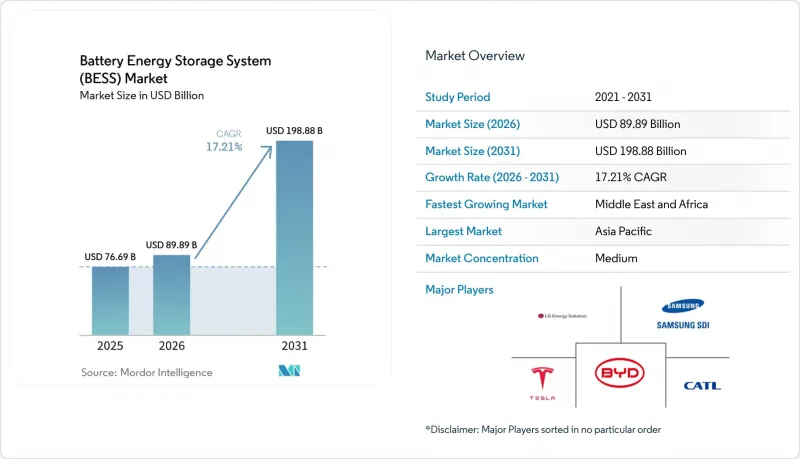
본 보고서는 배터리 유형(리튬이온, 인산철리튬, 기타), 연결 유형(계통 연계형 및 독립형), 구성 부품(배터리 팩 및 랙, 전력 변환 시스템, 기타), 에너지 용량 범위(100 MWh 미만, 기타), 최종 사용자용도(전력 회사, 주택, 기타), 지역(북미, 유럽, 아시아태평양, 기타)으로 분류되어 있습니다.
전 세계 배터리 에너지 저장 시스템(BESS) 시장 동향 및 분석
미국, 중국, 유럽연합의 유틸리티 규모 조달 의무
이러한 조달 의무화로 인해 BESS 시장의 상황은 급변하고 있습니다. 캘리포니아주의 장기 전력 저장 시스템 입찰은 2 GW를 목표로 하고 있으며, 파워 차이나(Power China)의 입찰에서는 16GWh가 요구되었고, 한국에서는 540 MW/3,240 MWh가 낙찰되었습니다. 이로 인해 개발 사업자에게는 수익 전망과 자금 조달의 확실성이 높아지고 있습니다(1). 유럽에서는 ‘넷 제로 산업법’이 국내 제품 사용을 장려하고 있는 반면, 중국에서는 최근 개혁을 통해 엄격한 할당 규정이 폐지됨에 따라 시장의 펀더멘털이 경제성을 좌우하게 되었습니다. 이러한 프로그램은 자금 조달 비용을 절감하는 동시에, 계통 서비스 성능 보증을 충족하는 적격 통합업체로 사업을 유도하고 있습니다.
그리드 포밍형 인버터의 도입이, 공동 설치를 통한 가치를 실현합니다.
그리드 팔로잉형 아키텍처에서 그리드 포밍형 아키텍처로의 전환을 통해, 축전지는 합성 관성 및 전압 지지 기능을 제공할 수 있게 됩니다. 이것들은 기존에 계통 운영자가 동기 발전에서 조달하던 서비스입니다. Transgrid사의 조사에서 드러난 4.8 GW 규모의 그리드 포밍 수요와 Fluence사의 호주 내 300 MW 프로젝트는 그 상업적 실현 가능성을 여실히 보여주고 있습니다. 유럽의 송전망 운영사인 TenneT는 2030년까지 5.2-12.7 GW의 에너지 저장 용량을 전망하고 있으며, 이는 이 기술의 폭넓은 적용 가능성을 뒷받침하고 있습니다. 관성력 관련 제품을 통한 추가 수익과 계통 연계 조건의 강화로 프로젝트의 경제성이 향상되어, BESS 시장에서 태양광 발전과 에너지 저장을 결합한 하이브리드 개발이 촉진될 것입니다.
리튬 및 흑연 가공의 병목 현상
중국은 전 세계 흑연의 90%를 가공하고 있으며, 인도네시아의 니켈 수출 금지 조치로 인해 국내 정련이 확대되면서 집중 위험이 발생하고 있습니다(2). BESS 시장에서 멀티 기가와트 규모의 입찰이 급증하는 가운데, 소재 부족이 셀 생산을 위협하고 있습니다. Group14 등의 스타트업 기업들은 실리콘을 풍부하게 함유한 음극재의 시범 운영을 진행하고 있지만, 상업적 규모의 생산까지는 아직 수년이 더 걸릴 것으로 예측됩니다. 재활용 프로그램은 1차 수요를 완화할 가능성은 있지만, 물류상의 문제로 인해 고순도 원료가 필요한 유틸리티 규모의 프로젝트에 대한 즉각적인 효과는 제한적입니다.
부문별 분석
2025년, 리튬 이온 배터리는 배터리 에너지 저장 시스템(BESS) 시장에서 88.05%의 점유율을 유지했습니다. 그러나 LFP(리튬 철 인산염)의 비용 및 열 안정성 측면에서의 우위가 연평균 성장률(CAGR) 18.62%를 견인하고 있으며, BYD가 2024년에 40 GWh를 도입한 실적이 그 대표적인 사례입니다. NMC 계열 배터리는 에너지 밀도가 중요한 분야에서는 여전히 중요한 위치를 차지하고 있지만, 바나듐 흐름 전지나 나트륨 이온 전지 기술은 장시간 운전이나 고주기 사용 분야에서 틈새 시장의 관심을 끌고 있습니다. 리튬 이온 배터리의 다양한 유형에 따른 에너지 저장 시스템 시장 규모는 시장 규모가 확대됨에 따라 1kW시당 비용이 감소함에 따라 확대될 것으로 전망됩니다. 화학 조성의 다양화는 공급망 리스크를 줄이고, 자산 고유의 헤지 구조를 통해 프로젝트 파이낸싱의 가능성을 넓혀줍니다.
도입 전략은 지역에 따라 다릅니다. 중국 기업들은 초저가 LFP 랙을 공급하고 있으며, 유럽의 전력 회사들은 한랭 지역에서의 내구성을 검증하기 위해 나트륨 이온 배터리를 시범 도입하고 있고, 미국의 송전망 운영사들은 8시간 서비스에 대비해 아연-브롬 플로우 배터리의 시범 운영을 진행하고 있습니다. 이러한 병행적인 노력은 배터리 화학 물질의 선택이 ‘만능형’ 패러다임이 아니라, 작동 주기에 맞추어 최적화되는 경향이 강해지고 있음을 보여줍니다.
2025년 도입 실적 중 계통 연계형 시스템이 77.35%를 차지했습니다. 이는 표준화된 계통 연계 규격과 견실한 전력 판매 수익 기회에 힘입은 것입니다. 한편, Off-grid 분야는 농촌 지역의 전기화 및 산업의 회복탄력성 요건에 힘입어 연평균 성장률(CAGR) 18.04%로 급속히 확대되고 있습니다. 파키스탄의 2030년까지 수입 전망치인 8.75GWh는 취약한 국가 인프라를 우회하는 마이크로그리드에 대한 신흥 시장 수요를 상징합니다.
계통 연계 모드와 독립 모드를 전환하는 하이브리드 구성은 BESS 시장에서 부상하고 있는 분야로, 고객에게 수요 요금 절감과 백업 전원을 모두 제공합니다. 이러한 유연성이 높은 자산들은 가상 발전소(VPP)를 통해 도매 시장에 참여하고 있으며, 이러한 추세는 현재 미국의 여러 독립계통운영기관(ISO)의 요금 개정에서 공식적으로 규정되어 있습니다.
지역별 분석
BESS 시장의 2025년 매출 중 유틸리티급 자산이 56.30%를 차지했으나, 주거용 시스템은 2031년까지 연평균 성장률(CAGR) 18.97%로 성장할 것으로 전망되며, 이를 주도할 시장은 옥상 태양광 발전 보급률이 20% 이상의 유럽 시장입니다. 고정가격 임베디드 제도(FIT)의 변동과 자가 소비에 대한 수요가 가정 내 도입을 촉진하고 있습니다. 또한, 축전지 시스템 업계에서는 상업 및 산업용 사용자들도 피크 부하 완화 및 전력 품질 확보를 위해 축전 기술을 활용하고 있습니다.
중동 및 아프리카는 연평균 성장률(CAGR) 19.07%를 기록하며, BESS 시장에서 가장 빠르게 성장하고 있는 지역입니다. 사우디아라비아에서 Sungrow사와 체결한 7.8 GW 규모의 제휴와, 이집트의 아프리카개발은행(AfDB)이 자금을 지원하는 200 MWh 규모의 프로젝트는 대규모 사업의 한 예입니다. 남아프리카공화국에서 1GW 규모의 수주는 에너지 저장 시스템이 만성적인 송전망 불안정성에 어떻게 대처하고 있는지를 여실히 보여주고 있습니다. 또한, 아랍에미리트(UAE)는 5.2GW 규모의 태양광 발전소와 19GWh 규모의 에너지 저장 시스템을 통합하여, 사막 기후에서 베이스로드 재생에너지의 선구적인 사업을 추진하고 있습니다.
북미와 유럽에서는 배터리 에너지 저장 시스템 시장에서 계속해서 높은 절대 거래량을 기록하고 있습니다. 미국에서는 1,000억 달러 규모의 투자가 발표되었으나, 2,600 GW에 달하는 프로젝트의 경우 계통 연계까지 4년이나 걸리는 상황입니다. 유럽의 ‘넷제로 산업법’은 공급망의 현지화를 목표로 하고 있지만, 이미 발표된 기가팩토리의 절반 이상이 자금 조달 지연에 직면해 있습니다. 지역별 정책의 다양성?영국의 용량 시장, 이탈리아의 차량 도입 의무, 캐나다의 생산 크레딧?으로 인해 수익 모델의 모자이크가 형성되어 있으며, 경험이 풍부한 개발업체들은 이를 활용하여 차익 거래를 하고 있습니다.
기타 혜택:
- 엑셀 형식 시장 예측(ME) 시트
- 3개월간의 애널리스트 지원
자주 묻는 질문
목차
제1장 서론
제2장 조사 방법
제3장 주요 요약
제4장 시장 구도
제5장 시장 규모와 성장 예측
제6장 경쟁 구도
제7장 시장 기회와 향후 전망
JHS 26.06.29According to Mordor Intelligence, the battery energy storage system market size is expected to grow from USD 76.69 billion in 2025 to USD 89.89 billion in 2026 and is forecast to reach USD 198.88 billion by 2031 at 17.21% CAGR over 2026-2031.
This report is Segmented Into Battery Type (Lithium-Ion, Lithium Iron Phosphate, and Others), Connection Type (On-Grid and Off-Grid), Components (Battery Pack and Racks, Power Conversion System, and Others), Energy Capacity Range (Below 100 MWh, and Others), End-User Application (Utility, Residential, and Others), and Geography (North America, Europe, Asia-Pacific, and Others).
Global Battery Energy Storage System (BESS) Market Trends and Insights
Utility-scale procurement mandates in the United States, China, and the European Union
Mandated procurements are reshaping the BESS market development landscape. California's long-duration solicitation targets 2 GW, Power China tender seeks 16 GWh, and South Korea awarded 540 MW/3,240 MWh, giving developers visibility on revenue and bankability(1). In Europe, the Net-Zero Industry Act incentivizes domestic content, while recent Chinese reforms removed rigid allocation rules, letting market fundamentals guide economics. Such programs lower financing costs and channel volume to qualified integrators who meet grid-service performance guarantees.
Grid-forming inverter adoption unlocking co-location value
Moving from grid-following to grid-forming architectures lets batteries deliver synthetic inertia and voltage support, services that grid operators historically procured from synchronous generation. Transgrid's study showing 4.8 GW of grid-forming needs and Fluence's 300 MW Australian project highlight commercial viability. European operator TenneT foresees 5.2-12.7 GW storage by 2030, underscoring broad applicability. Added revenue from inertia products and strengthened interconnection terms improve project economics and favor hybrid solar-storage development, in the BESS market.
Lithium and graphite processing bottlenecks
China processes 90% of global graphite, and Indonesia's nickel export bans push domestic refining, introducing concentration risk(2). Material shortages threaten cell production just as multi-gigawatt auctions surge in the BESS market. Start-ups such as Group14 are piloting silicon-rich anodes, but commercial volumes remain years away. Recycling programs can ease primary demand, yet logistic hurdles limit immediate impact for utility-scale projects that require high-purity inputs.
Other drivers and restraints analyzed in the detailed report include:
- PV-plus-storage PPA price parity in Australia and Chile
- EU and US supply-chain acts catalyzing domestic manufacturing
- Fire-safety code tightening under UL-9540A and NFPA-855
For complete list of drivers and restraints, kindly check the Table Of Contents.
Segment Analysis
Lithium-ion maintained 88.05% battery energy storage system market share in 2025. Yet LFP's cost and thermal-stability advantages drive its 18.62% CAGR, exemplified by BYD's 40 GWh 2024 installations. NMC chemistries remain relevant where energy density matters, while vanadium flow and sodium-ion technologies attract niche interest for long-duration or high-cycle use. Lithium-ion variants' battery energy storage system market size is projected to widen as scaling lowers per-kilowatt-hour costs. Diversification across chemistries reduces supply-chain risk and opens project financing to asset-specific hedging structures.
Implementation tactics vary by region. Chinese players offer ultra-low-priced LFP racks, European utilities test sodium-ion for cold-weather resilience, and U.S. grid operators pilot zinc-bromine flow batteries for eight-hour services. These parallel pathways illustrate how chemistry choice is increasingly optimized for duty cycle rather than a one-size-fits-all paradigm.
On-grid systems captured 77.35% of 2025 deployments, supported by standardized interconnection and robust merchant revenue opportunities. The off-grid segment, however, is accelerating at 18.04% CAGR owing to rural electrification and industrial resilience requirements. Pakistan's import projection of 8.75 GWh by 2030 typifies emerging-market demand for microgrids that bypass weak national infrastructure.
Hybrid configurations that switch between grid and islanded mode are a rising subset in the BESS market, offering customers demand-charge reduction plus backup power. These flexible assets partake in wholesale markets through virtual-power-plant aggregation, a trend now codified in several U.S. independent system operators' tariff updates.
Geography Analysis
Utility-scale assets delivered 56.30% of 2025 revenue in the BESS market, but residential systems are set to grow at 18.97% CAGR through 2031, led by European markets where rooftop solar penetrations exceed 20%. Variability in feed-in tariffs and the quest for self-consumption drive household adoption. The battery energy storage system industry also sees commercial and industrial users leveraging storage for peak-shaving and power-quality assurance.
The Middle East and Africa are the fastest-growing regions in the BESS market at 19.07% CAGR. Saudi Arabia's 7.8 GW partnership with Sungrow and Egypt's 200 MWh AfDB-financed project illustrate large-scale commitments. South Africa's 1 GW awards highlight how storage addresses chronic grid instability. Moreover, the United Arab Emirates integrates 19 GWh with a 5.2 GW solar plant, pioneering baseload renewables in desert climates.
North America and Europe continue to post high absolute volumes in the battery energy storage system market. The United States hosts USD 100 billion in announced investments but suffers four-year interconnection queues for 2,600 GW of projects. Europe's Net-Zero Industry Act seeks to localize supply chains, yet over half of announced gigafactories face financing delays. Regional policy diversity-capacity markets in the United Kingdom, fleet mandates in Italy, and production credits in Canada-produces a mosaic of revenue models that sophisticated developers arbitrage.
- BYD Company Limited
- Contemporary Amperex Technology Co. Ltd. (CATL)
- LG Energy Solution Ltd.
- Panasonic Holdings Corp.
- Tesla Inc.
- Samsung SDI Co. Ltd.
- Fluence Energy Inc.
- ABB Ltd.
- Siemens Energy AG
- GE Vernova
- Hitachi Energy Ltd.
- Mitsubishi Power
- Sungrow Power Supply Co.
- Eaton Corporation plc
- Toshiba Corp.
- EVE Energy Co.
- VARTA AG
- Saft SAS (TotalEnergies)
- CellCube Energy Storage Systems Inc.
- Enphase Energy Inc.
Additional Benefits:
- The market estimate (ME) sheet in Excel format
- 3 months of analyst support
TABLE OF CONTENTS
1 Introduction
- 1.1 Study Assumptions & Methodology Scope
- 1.2 Market Definition
2 Research Methodology
3 Executive Summary
4 Market Landscape
- 4.1 Market Overview
- 4.2 Recent Trends & Innovations
- 4.3 Market Drivers
- 4.3.1 Utility-Scale Procurement Mandates in U.S., China & EU Accelerating Gigawatt-Scale Orders
- 4.3.2 Grid-Forming Inverter Requirements Unlocking Co-Location Value Stacks
- 4.3.3 PV-Plus-Storage PPA Price Parity in Australia & Chile
- 4.3.4 EU & U.S. Battery Supply-Chain Acts Creating Domestic Manufacturing Pull-Through
- 4.3.5 Data-Center & AI Load Growth Driving 4-Hr Storage Demand in North America
- 4.3.6 Second-Life EV Battery Availability Reducing CapEx in Asia
- 4.4 Market Restraints
- 4.4.1 Lithium & Graphite Processing Bottlenecks in Indonesia and Africa
- 4.4.2 Fire-Safety Code Tightening (UL-9540A, NFPA-855) Inflating Balance-of-Plant Costs
- 4.4.3 Long Interconnection Queues in U.S. ISOs Delaying FTM Project Revenues
- 4.4.4 High Interest-Rate Environment Compressing Merchant Revenue Stacks
- 4.5 Supply-Chain Analysis
- 4.6 Regulatory and Policy Outlook
- 4.7 Technological Outlook
- 4.8 Porter's Five Forces
- 4.8.1 Bargaining Power of Suppliers
- 4.8.2 Bargaining Power of Buyers
- 4.8.3 Threat of New Entrants
- 4.8.4 Threat of Substitutes
- 4.8.5 Intensity of Competitive Rivalry
5 Market Size & Growth Forecasts
- 5.1 By Battery Type
- 5.1.1 Lithium-ion
- 5.1.2 Lithium Iron Phosphate (LFP)
- 5.1.3 Nickel-Manganese-Cobalt (NMC)
- 5.1.4 Lead-acid
- 5.1.5 Others [Flow Batteries (Vanadium, Zinc-Br), Sodium-based (NaS, Na-ion)]
- 5.2 By Connection Type
- 5.2.1 On-Grid (Utility Interconnected)
- 5.2.2 Off-Grid (Micro-Grid, Hybrid)
- 5.3 By Component
- 5.3.1 Battery Pack and Racks
- 5.3.2 Power Conversion System (PCS)
- 5.3.3 Energy Management Software (EMS)
- 5.3.4 Balance-of-Plant and Services
- 5.4 By Energy Capacity Range
- 5.4.1 Below 100 MWh
- 5.4.2 101 to 500 MWh
- 5.4.3 Above 500 MWh
- 5.5 By End-user Application
- 5.5.1 Residential
- 5.5.2 Commercial and Industrial
- 5.5.3 Utility
- 5.6 By Geography
- 5.6.1 North America
- 5.6.1.1 United States
- 5.6.1.2 Canada
- 5.6.1.3 Mexico
- 5.6.2 Europe
- 5.6.2.1 United Kingdom
- 5.6.2.2 Germany
- 5.6.2.3 France
- 5.6.2.4 Spain
- 5.6.2.5 Nordic Countries
- 5.6.2.6 Russia
- 5.6.2.7 Rest of Europe
- 5.6.3 Asia-Pacific
- 5.6.3.1 China
- 5.6.3.2 India
- 5.6.3.3 Japan
- 5.6.3.4 South Korea
- 5.6.3.5 Malaysia
- 5.6.3.6 Thailand
- 5.6.3.7 Indonesia
- 5.6.3.8 Vietnam
- 5.6.3.9 Australia
- 5.6.3.10 Rest of Asia-Pacific
- 5.6.4 South America
- 5.6.4.1 Brazil
- 5.6.4.2 Argentina
- 5.6.4.3 Colombia
- 5.6.4.4 Rest of South America
- 5.6.5 Middle East and Africa
- 5.6.5.1 United Arab Emirates
- 5.6.5.2 Saudi Arabia
- 5.6.5.3 South Africa
- 5.6.5.4 Egypt
- 5.6.5.5 Rest of Middle East and Africa
- 5.6.1 North America
6 Competitive Landscape
- 6.1 Market Concentration
- 6.2 Strategic Moves (M&A, Partnerships, PPAs)
- 6.3 Market Share Analysis (Market Rank/Share for key companies)
- 6.4 Company Profiles (includes Global level Overview, Market level overview, Core Segments, Financials as available, Strategic Information, Products & Services, and Recent Developments)
- 6.4.1 BYD Company Limited
- 6.4.2 Contemporary Amperex Technology Co. Ltd. (CATL)
- 6.4.3 LG Energy Solution Ltd.
- 6.4.4 Panasonic Holdings Corp.
- 6.4.5 Tesla Inc.
- 6.4.6 Samsung SDI Co. Ltd.
- 6.4.7 Fluence Energy Inc.
- 6.4.8 ABB Ltd.
- 6.4.9 Siemens Energy AG
- 6.4.10 GE Vernova
- 6.4.11 Hitachi Energy Ltd.
- 6.4.12 Mitsubishi Power
- 6.4.13 Sungrow Power Supply Co.
- 6.4.14 Eaton Corporation plc
- 6.4.15 Toshiba Corp.
- 6.4.16 EVE Energy Co.
- 6.4.17 VARTA AG
- 6.4.18 Saft SAS (TotalEnergies)
- 6.4.19 CellCube Energy Storage Systems Inc.
- 6.4.20 Enphase Energy Inc.
7 Market Opportunities & Future Outlook
- 7.1 White-space & Unmet-Need Assessment