

|
시장보고서
상품코드
2066666
아시아태평양의 건설용 접착제 및 실란트 : 시장 점유율 분석, 업계 동향 및 통계, 성장 예측(2026-2031년)Asia-Pacific Construction Adhesives And Sealants - Market Share Analysis, Industry Trends & Statistics, Growth Forecasts (2026 - 2031) |
||||||
 Mordor Intelligence
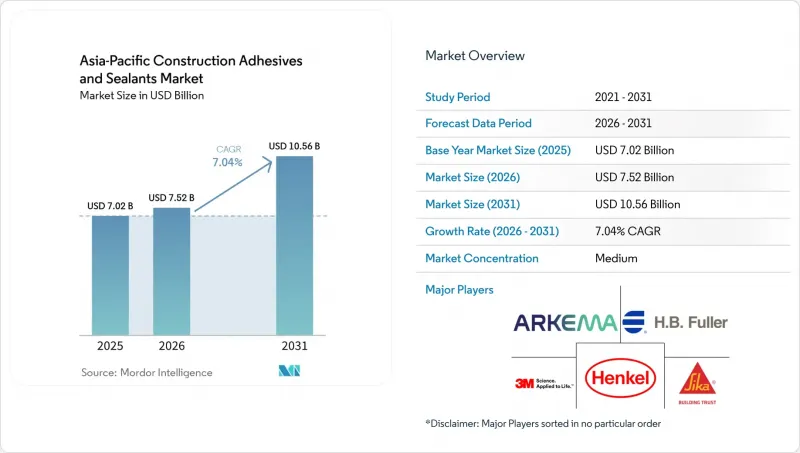
Mordor Intelligence에 의하면, 아시아태평양의 건설용 접착제 및 실란트 시장 규모는 2025년에 70억 2,000만 달러로 평가되었습니다. 2026년 75억 2,000만 달러에서 2031년까지 105억 6,000만 달러에 이를 것으로 예상되며, 예측 기간(2026-2031년) CAGR은 7.04%를 나타낼 전망입니다.
본 보고서는 수지(아크릴, 시아노아크릴레이트, 에폭시 등), 기술(수성, 용제계 등), 용도(바닥재·타일, 지붕재 등), 최종 용도(주택, 상업시설 등) 및 지역(호주, 중국, 인도, 일본, 베트남, 태국 등)별로 분류되어 있습니다. 시장 전망은 금액(달러) 기준으로 제시되어 있습니다.
아시아태평양의 건설용 접착제 및 실란트 시장 동향 및 인사이트
아시아태평양의 인프라 메가 프로젝트 파이프라인
태국의 360억 달러 규모 육교 프로젝트에서는 조간대 부두 및 터널 내벽에 해양용 폴리설파이드계 실란트의 사용이 지정되어 있습니다. 베트남의 투티엠 4호교에서는 10만 회의 압축 사이클을 견딜 수 있는 신축 이음매 시스템이 채택되었으며, 그 성능은 현재 도시 지역의 고가교 프로젝트에서도 재현되고 있습니다. BMI는 인도가 6.2%의 성장률로 주도함에 따라, 해당 지역의 건설 지출이 2025년 2조 4,290억 달러로 평가되었습니다. 2026년에는 2조 5,804억 달러로 증가할 것으로 전망하고 있습니다. 자동 접착제 도포 시스템 덕분에 현장 인력이 30% 감소하고 접착 강도의 균일성이 40% 향상됨에 따라, 소규모 혼합 업체 시장 진입 장벽이 높아지고 있습니다. 이러한 메가 프로젝트의 파이프라인이 전반적으로 아시아태평양의 건설용 접착제 및 실란트 시장을 뒷받침할 장기적인 전망을 확고히 하고 있습니다.
친환경 건축 기준이 저VOC 실런트 수요를 촉진하고 있습니다.
중국의 GB 33372-2020에서는 용도별로 VOC 상한치가 설정되어 있으며, 베이징시의 DB11/1983-2022에서는 실내 용도의 제한치를 50 g/L로 강화하여, 국가 프로젝트에서 용제계 매스틱의 사용을 사실상 금지하고 있습니다. 홍콩 건설업평의회의 인증 기준에 따르면, 실외용 실란트의 VOC 배출량을 100 g/L로 제한하고 있으며, 수성 아크릴계 또는 변성 실란계 폴리머의 사용을 권장하고 있습니다. 일본의 ‘4VOC’ 자율 등록 제도에 따라 건축가는 검증된 배출 데이터를 갖춘 제품을 선택할 수 있게 되었으며, 이는 2025년도 내진 보강을 위해 배정된 2,088억 엔(13억 9,500만 달러)의 예산과 맞물려 시장을 뒷받침하고 있습니다. 싱가포르의 ‘그린 빌딩 마스터플랜’에서는 2030년까지 신축 건물의 80%가 ‘그린마크 플래티넘’ 인증을 획득해야 하며, 다국적 공급업체가 손쉽게 제공할 수 있는 환경제품선언서(EPD)의 도입이 권장되고 있습니다. 이러한 규제로 인해 수성 화학제품으로의 전환이 가속화되면서, 아시아태평양의 건설용 접착제 및 실란트 시장이 확대되고 있습니다.
변동이 심한 석유화학 원료 가격
2024년 하반기, 생산 능력 확대가 폴리머 수요를 상회함에 따라 에틸렌의 마진은 50% 하락했습니다. 2025년 중반 호르무즈 해협의 항로가 90% 폐쇄되었다는 시나리오에 따라, 한국의 크래커는 설비를 가동 중단할 수밖에 없게 되었고, 이로 인해 지역 내 올레핀 공급이 급감했습니다. 선물 곡선에 유동성이 부족하기 때문에 접착제 배합 제조업체는 6개월을 초과하는 헤지를 할 수 없습니다. 그 때문에 현물 가격의 급등이 마진을 압박하고 있습니다. 태국과 말레이시아에서 진행 중인 바이오나프타 시범 프로젝트는 30-40%의 프리미엄 가격에 거래되고 있으며, 그 적용은 친환경 건축의 모범 사례로 한정되어 있습니다. 따라서 원자재 가격의 변동성은 아시아태평양의 건설용 접착제 및 실란트 시장에서 이익률 확대를 억제하고 있습니다.
부문별 분석
폴리우레탄은 2025년 매출의 25.14%를 차지하며, 지붕재, 단열재, 바닥재 각 분야에서 주도적인 위치를 확립했습니다. 실리콘은 초고층 빌딩의 외관에 ±25%의 변형 허용도와 자외선 안정성이 요구되기 때문에 예측 기간(2026-2031년) 동안 연평균 성장률(CAGR) 7.18%를 기록하며 폴리우레탄을 앞지를 것으로 전망됩니다. 중성 경화형 제품은 양극 산화 알루미늄의 부식을 방지하기 위해 커튼월 시공업체들에게 표준적인 선택지로 자리 잡고 있습니다. 에폭시는 여전히 틈새 시장이지만, 3,500 PSI의 인장 강도 덕분에 용접이 필요 없는 조립식 강재 접합이 가능해져, 열 작업 허가 비용과 보험 할증료를 절감할 수 있습니다.
판매량 동향은 지속가능성을 중심으로 전개되고 있습니다. 다우사의 탄소 중립 실리콘 서비스는 생애주기 평가(LCA) 문서를 제공하여 ‘그린마크 플래티넘’ 인증 신청을 용이하게 함에 따라, 고급 프로젝트에서 실리콘으로의 전환이 진행되고 있습니다. 아크릴 계열 제품은 고급 비닐 타일 시공에서 주류를 이루고 있으며, 특히 전자상거래 물류창고에서는 감압 접착성 덕분에 인도 과정이 신속해지고 있습니다. 드라이 믹스 모르타르에 사용되는 범용 VAE 분산액은 중국의 과잉 생산 능력으로 인해 이익률이 압박을 받고 있어, 가격 면에서 어려움을 겪고 있습니다. 시아노아크릴레이트 계열 및 핫멜트 계열은 즉각적인 접착력이 가격 프리미엄을 정당화하는 모듈식 공장 라인에 한정되어 있습니다. 따라서 각 수지 카테고리는 아시아태평양의 건설용 접착제 및 실란트 시장 내의 개별 가치 풀을 목표로 하고 있습니다.
실란트(1K 및 2K)는 2025년 매출의 44.37%를 차지했으며, 이는 지진이 빈번한 지역에서의 방수 공사 및 구조용 유리 공법에 대한 의존도가 높음을 반영하고 있습니다. 1액형 실리콘은 시공이 간편하여 주택 외벽에 널리 사용되는 반면, 2액형 시스템은 긴 작업 시간이 요구되는 교량이나 터널에서 주로 사용되고 있습니다. 아시아태평양의 건설용 접착제 및 실란트 시장에서 수성 접착제 시장 점유율은 예측 기간(2026-2031년) 동안 연평균 성장률(CAGR) 7.32%로 증가할 것으로 전망됩니다. 베이징시의 조달 기준에 따르면, 이미 실내 VOC(휘발성 유기화합물) 배출을 거의 제로 수준으로 억제하는 것이 의무화되어 있으며, 이에 따라 건설업체들은 수성 아크릴계 접착제로 전환해야 하는 상황에 놓여 있습니다.
반응형 화학계 접착제, 습기 경화형 폴리우레탄 및 2액형 에폭시는 6분 만에 취급 강도를 확보할 수 있어 생산성을 높여주는 프리팹 공장에서 시장 점유율을 확대되고 있습니다. 핫멜트 계열은 실외 내구성에 대한 우려가 여전히 남아 있어 시장 점유율은 낮은 편이지만, 가구 가장자리 마감 분야에서는 여전히 인기를 유지하고 있습니다. 1급 도시와 내륙 지방의 성 사이에 규제 적용에 차이가 있어 이중 가격 구조가 형성되고 있습니다. 지방에서는 여전히 용제형 아크릴계 접착제가 사용되고 있는 반면, 도심 고층 빌딩에서는 수성계 또는 변성 실란계가 지정되어 있습니다. 이 정책의 격차는 앞으로도 아시아태평양의 건설용 접착제 및 실란트 시장에서 기술 대체를 좌우할 것입니다.
기타 혜택 :
- 엑셀 형식 시장 예측(ME) 시트
- 3개월간의 애널리스트 지원
자주 묻는 질문
목차
제1장 서론
제2장 조사 방법
제3장 주요 요약
제4장 시장 구도
제5장 시장 규모 및 성장 예측
제6장 경쟁 구도
제7장 시장 기회 및 향후 전망
KTH 26.06.29According to Mordor Intelligence, the asia-Pacific construction adhesives and sealants market size was valued at USD 7.02 billion in 2025 and is estimated to grow from USD 7.52 billion in 2026 to reach USD 10.56 billion by 2031, at a CAGR of 7.04% during the forecast period (2026-2031).
This report is Segmented by Resin Type (Acrylic, Cyanoacrylate, Epoxy, and More), Technology (Water-Borne, Solvent-Borne, and More), Application (Flooring and Tiling, Roofing, and More), End-Use Sector (Residential, Commercial, and More), and Geography (Australia, China, India, Japan, Vietnam, Thailand, and More). The Market Forecasts are Provided in Terms of Value (USD).
Asia-Pacific Construction Adhesives And Sealants Market Trends and Insights
Infrastructure Megaproject Pipeline Across APAC
Thailand's USD 36 billion land-bridge will specify marine-grade polysulfide sealants for tidal-zone piers and tunnel linings. Vietnam's Thu Thiem 4 Bridge used expansion-joint systems that endured 100,000 compression cycles, a performance now replicated in metro-viaduct projects. BMI forecasts regional construction spending to climb from USD 2,429 billion in 2025 to USD 2,580.4 billion in 2026, led by India at 6.2% growth. Automated adhesive-dispensing systems are trimming on-site labor by 30% and lifting bond-strength consistency by 40%, raising entry barriers for smaller blenders. Collectively, megaproject pipelines anchor long-run visibility that sustains the Asia-Pacific Construction Adhesives and Sealants market.
Green-Building Codes Boosting Low-VOC Sealants Demand
China's GB 33372-2020 sets differentiated VOC ceilings, and Beijing's DB11/1983-2022 tightens limits to 50 g/L for interior applications, effectively banning solvent-borne mastics in state projects. Hong Kong's Construction Industry Council certification caps exterior sealant emissions at 100 g/L, favoring water-borne acrylics and modified-silane polymers. Japan's 4VOC voluntary registry lets architects select products with verified emission data, dovetailing with JPY 208.8 billion (USD 1.395 billion) allocated for seismic upgrades in FY2025. Singapore's Green Building Masterplan requires 80% of new builds to achieve Green Mark Platinum by 2030, incentivizing Environmental Product Declarations that multinational suppliers can readily furnish. These codes accelerate substitution toward water-borne chemistries, expanding the Asia-Pacific Construction Adhesives and Sealants market.
Volatile Petrochemical Feedstock Prices
Ethylene margins slid 50% in H2 2024 as capacity additions outpaced polymer demand. A 90% shipping-lane closure scenario in the Strait of Hormuz during mid-2025 forced South Korean crackers to idle units, slashing regional olefin supply. Adhesive formulators cannot hedge beyond six months because forward curves lack liquidity, so spot price spikes squeeze margins. Bio-naphtha pilots in Thailand and Malaysia trade at 30-40% premiums, confining uptake to green-building showcases. Feedstock volatility, therefore, tempers margin expansion inside the Asia-Pacific Construction Adhesives and Sealants market.
Other drivers and restraints analyzed in the detailed report include:
- Rapid Growth of Modular and Prefab Construction
- E-Commerce Warehousing Fuelling Industrial Flooring Adhesives
- Stricter VOC Limits on Solvent-Borne Technologies
For complete list of drivers and restraints, kindly check the Table Of Contents.
Segment Analysis
Polyurethane captured 25.14% of 2025 revenue, anchoring its leadership across roofing, insulation, and flooring. Silicone is set to outpace at 7.18% CAGR during the forecast period (2026-2031) because supertall facades require +-25% movement plus UV stability. Neutral-cure profiles avert corrosion on anodized aluminum, making them the default for curtain-wall contractors. Epoxy remains a niche, but its 3,500 PSI tensile strength enables weld-free prefab steel connections, saving hot-work permits and insurance surcharges.
Volume dynamics pivot on sustainability. Dow's carbon-neutral silicone service provides Life-Cycle-Assessment documentation that eases Green Mark Platinum submissions, tilting premium projects toward silicone. Acrylics dominate luxury-vinyl-tile installations, especially in e-commerce warehouses where pressure-sensitive tack accelerates handover. Commodity VAE dispersions in dry-mix mortars face price pressure as Chinese overcapacity drags margins. Cyanoacrylates and hot-melts stay confined to modular-factory lines where instant tack justifies price premiums. Each resin tier, therefore, targets discrete value pools inside the Asia-Pacific Construction Adhesives and Sealants market.
Sealant (1K and 2K) combined for 44.37% of 2025 sales, reflecting reliance on weatherproofing and structural glazing in seismic-prone geographies. One-component silicones are prevalent in residential facades due to application simplicity, whereas two-component systems prevail on bridges and tunnels that demand extended pot life. The Asia-Pacific Construction Adhesives and Sealants market share for water-borne adhesives is poised to climb at a CAGR of 7.32% during the forecast period (2026-2031). Beijing's procurement standards already enforce near-zero-VOC interiors, pushing contractors toward water-borne acrylics.
Reactive chemistries, moisture-cure polyurethanes, and two-part epoxies are stealing share in prefab factories where six-minute handling strength boosts throughput. Hot-melts remain small because outdoor durability concerns persist, but they retain popularity in furniture edge-banding. Enforcement gaps between tier-1 and interior provinces create dual pricing structures: solvent-borne acrylics linger in rural zones, while city-center towers specify water-borne or modified-silane systems. This policy gradient will continue to shape technology substitution inside the Asia-Pacific Construction Adhesives and Sealants market.
List of Companies Covered in this Report:
- 3M
- Aica Kogyo Co., Ltd.
- Arkema
- Ashland Inc.
- Dow
- H.B. Fuller Company
- Henkel AG & Co. KGaA
- ITW Performance Polymers
- Momentive
- Pidilite Industries Ltd.
- PPG Industries Inc.
- Shin-Etsu Chemical Co., Ltd.
- Sika AG
- Soudal Group
- Wacker Chemie AG
Additional Benefits:
- The market estimate (ME) sheet in Excel format
- 3 months of analyst support
TABLE OF CONTENTS
1 Introduction
- 1.1 Study Assumptions and Market Definition
- 1.2 Scope of the Study
2 Research Methodology
3 Executive Summary
4 Market Landscape
- 4.1 Market Drivers
- 4.1.1 Infrastructure megaproject pipeline across APAC
- 4.1.2 Green-building codes boosting low-VOC sealants demand
- 4.1.3 Rapid growth of modular and prefab construction
- 4.1.4 E-commerce warehousing fuelling industrial flooring adhesives
- 4.1.5 Substitution of mechanical fasteners by structural adhesives
- 4.1.6 Ageing building stock retrofits in mature Asia-Pacific economies
- 4.2 Market Restraints
- 4.2.1 Volatile petrochemical feedstock prices
- 4.2.2 Stricter VOC limits on solvent-borne technologies
- 4.2.3 Silicone monomer supply disruptions in China
- 4.2.4 Skilled labour shortage for advanced application methods
- 4.3 Value Chain Analysis
- 4.4 Porter's Five Forces
- 4.4.1 Threat of New Entrants
- 4.4.2 Bargaining Power of Suppliers
- 4.4.3 Bargaining Power of Buyers
- 4.4.4 Threat of Substitutes
- 4.4.5 Competitive Rivalry
5 Market Size and Growth Forecasts (Value and Volume)
- 5.1 By Resin
- 5.1.1 Acrylic
- 5.1.2 Cyanoacrylate
- 5.1.3 Epoxy
- 5.1.4 Polyurethane
- 5.1.5 Silicone
- 5.1.6 VAE/EVA
- 5.1.7 Others
- 5.2 By Technology
- 5.2.1 Water-borne
- 5.2.2 Solvent-borne
- 5.2.3 Reactive
- 5.2.4 Hot-melt
- 5.2.5 Sealants (1K and 2K)
- 5.3 By Application
- 5.3.1 Flooring and Tiling
- 5.3.2 Roofing
- 5.3.3 Wall Panels and Facades
- 5.3.4 Insulation and Weatherproofing
- 5.3.5 Infrastructure Joints (bridges and tunnels)
- 5.4 By End-use Sector
- 5.4.1 Residential
- 5.4.2 Commercial
- 5.4.3 Industrial
- 5.4.4 Infrastructure
- 5.5 By Country
- 5.5.1 Australia
- 5.5.2 China
- 5.5.3 India
- 5.5.4 Indonesia
- 5.5.5 Japan
- 5.5.6 Malaysia
- 5.5.7 Singapore
- 5.5.8 South Korea
- 5.5.9 Thailand
- 5.5.10 Vietnam
- 5.5.11 Philippines
- 5.5.12 Rest of Asia-Pacific
6 Competitive Landscape
- 6.1 Market Concentration
- 6.2 Strategic Moves
- 6.3 Market Share/(%)Ranking Analysis
- 6.4 Company Profiles {(includes Global level Overview, Market level overview, Core Segments, Financials as available, Strategic Information, Products and Services, and Recent Developments)}
- 6.4.1 3M
- 6.4.2 Aica Kogyo Co., Ltd.
- 6.4.3 Arkema
- 6.4.4 Ashland Inc.
- 6.4.5 Dow
- 6.4.6 H.B. Fuller Company
- 6.4.7 Henkel AG & Co. KGaA
- 6.4.8 ITW Performance Polymers
- 6.4.9 Momentive
- 6.4.10 Pidilite Industries Ltd.
- 6.4.11 PPG Industries Inc.
- 6.4.12 Shin-Etsu Chemical Co., Ltd.
- 6.4.13 Sika AG
- 6.4.14 Soudal Group
- 6.4.15 Wacker Chemie AG
7 Market Opportunities and Future Outlook
- 7.1 White-space and Unmet-need Assessment


