

|
시장보고서
상품코드
2072652
미국의 디스크리트 GPU 시장 : 시장 점유율 분석, 업계 동향 및 통계, 성장 예측(2026-2031년)United States Discrete GPU - Market Share Analysis, Industry Trends & Statistics, Growth Forecasts (2026 - 2031) |
||||||
 Mordor Intelligence
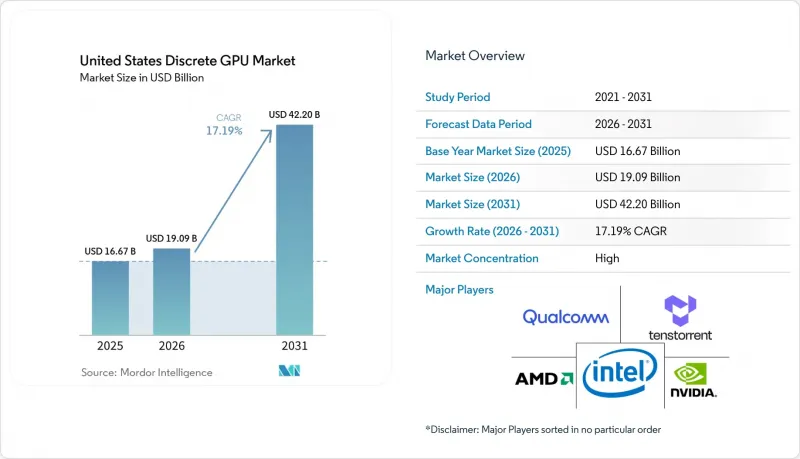
Mordor Intelligence에 의하면, 미국의 디스크리트 GPU 시장 규모는 2025년에 166억 7,000만 달러로 평가되었고, 2026년 190억 9,000만 달러로 추정되고, 2031년까지 422억 달러에 이를 것으로 예측되며, 예측 기간(2026-2031년) CAGR은 17.19%를 나타낼 전망입니다.
본 보고서는 디바이스 용도별(모바일 디바이스 및 태블릿, PC 및 워크스테이션, 서버 및 데이터센터용 가속기, 게임기 등), 메모리 유형별(GDDR 기반 GPU 및 HBM 기반 GPU), 성능 수준별(저가형 GPU, 메인스트림 GPU, 고성능 소비자용 GPU, 데이터센터/AI 가속기용 GPU)로 분류되어 있습니다. 시장 전망은 금액(달러) 기준으로 제시되어 있습니다.
미국의 디스크리트 GPU 시장 동향 및 인사이트
데이터센터 내 AI 및 머신러닝 워크로드의 확산
각 하이퍼스케일러 기업들은 지속적인 연산 리소스의 가용성이 필요한 대규모 언어 모델의 추론을 배경으로, 간헐적인 리프레시 주기에서 지속적인 인프라 확장으로 전환하고 있습니다. OpenAI는 데이터센터용량 6기가와트에 해당하는 AMD Instinct MI400 가속기에 대한 다년 계약을 체결했으며, Meta도 2026년 초에 동등한 6기가와트 분량을 도입하겠다고 약속했습니다. 건설 규모는 사상 최고치를 기록하고 있지만, 2026년까지의 미국 데이터센터 계획 용량 중 전력 회사와의 연결이 확실하게 확보된 비중은 고작 23%에 그치고 있으며, 조달 기준은 '와트당 성능'을 중시하는 쪽으로 기울고 있습니다. NVIDIA의 Rubin 플랫폼은 수냉 기술과 동적 전압 조절을 통해 유휴 상태의 전력 소비를 40% 줄임으로써 이 과제를 해결하고 있습니다. 추론 처리에서 300와트 미만의 TDP를 달성하는 업체는 전력망 제약이 심해지는 상황에서 타사를 압도할 정도의 할당량을 확보할 전망입니다.
CHIPS법에 따른 보조금이 국내 GPU 생산을 활성화
연방 정부의 인센티브에 힘입어 생산 거점의 지도가 재편되고 있습니다. 인텔이 확보한 78억 6,000만 달러의 보조금은 4개의 첨단 팹에 투입될 예정이며, 2027년에는 18옹스트롬 공정의 생산 능력이 가동될 예정입니다. 66억 달러의 지원을 받은 TSMC의 애리조나 복합 시설에서는 6개의 팹 외에도 첨단 CoWoS 패키징 기술이 도입되어, HBM 스택을 국내에서 통합할 수 있게 됩니다. 설계, 팹, 패키징이 한 곳에 집중됨에 따라, 테이프아웃부터 양산 개시까지의 기간이 18개월에서 12개월 미만으로 단축될 것으로 예측됩니다. 마이크론이 뉴욕에 건설할 예정인 HBM 시설은 공급원을 더욱 다각화하고, 해외 메모리 공급업체에 대한 의존도를 낮추게 될 것입니다.
첨단 노드 제조 역량에 대한 공급망의 취약성
TSMC와 삼성은 전 세계 7나노미터 미만 반도체 생산 능력의 90% 이상을 차지하고 있으며, 두 회사 모두 2026년까지 거의 풀가동 상태가 지속될 전망입니다. NVIDIA의 Blackwell GPU는 애플의 A 시리즈 프로세서에도 채택된 CoWoS-L 패키징을 적용한 TSMC의 4nm 공정에 의존하고 있으며, 이로 인해 GPU용 웨이퍼의 리드타임이 길어지고 있습니다. AMD의 MI400은 TSMC의 3nm 공정을 채택하고 있지만, 양산은 2026년 하반기까지 제한되어 있습니다. 인텔의 18옹스트롬 노드는 향후 대안이 될 수 있지만, 그 수율은 아직 입증되지 않았습니다. 파운드리 생산 여력이 제한적이기 때문에 수년에 걸친 웨이퍼 공급 계약을 체결한 기존 기업들에게는 유리하게 작용하는 반면, 신규 진출기업들에게는 제약 요인이 되고 있습니다.
부문별 분석
2025년 미국 디스크리트 GPU 시장에서 서버 및 데이터센터용 가속기가 출하량의 41.62%를 차지했으며, 게이머 중심 수요에서 AI 추론 클러스터로의 전환을 반영하고 있습니다. 각 하이퍼스케일러 기업들이 수년에 걸친 로드맵에 따라 수백만 대 규모의 가속기를 추가로 도입함에 따라, 이 부문에 기인한 미국의 디스크리트 GPU 시장 규모는 더욱 확대될 전망입니다. 한때 출하량의 주축이었던 PC와 워크스테이션은 통합형 GPU의 부상과 교체 주기의 장기화로 인해 현재는 약 30% 수준에 그치고 있습니다. 게임기는 여전히 틈새 시장에 머물러 있지만, NVIDIA DRIVE Thor와 같은 자동차용 ADAS 설계는 평균 판매 가격(ASP)이 높은 새로운 시장을 개척하고 있습니다.
나머지 판매 대수는 모바일, 임베디드 비전, 엣지 서버에 분산되어 있으며, 각각 전용 SKU를 소비하고 있습니다. 소매 분석, 스마트 팩토리, 의료 영상 진단 분야의 엣지 추론 게이트웨이는 아직 초기 단계이긴 하지만, 중요한 비즈니스 기회를 보여주고 있습니다. 하이퍼스케일러에 대한 수요가 지속되고 있다는 점을 고려할 때, 데이터센터 수요는 주기적인 것이 아니라 지속적인 성격을 띠고 있으며, 이 부문은 2028년까지 미국 디스크리트 GPU 시장 매출의 50%를 넘어설 것으로 전망됩니다.
기타 혜택 :
- 엑셀 형식 시장 예측(ME) 시트
- 3개월간의 애널리스트 지원
자주 묻는 질문
목차
제1장 서론
제2장 조사 방법
제3장 주요 요약
제4장 시장 구도
제5장 시장 규모 및 성장 예측
제6장 경쟁 구도
제7장 시장 기회 및 향후 전망
AJY 26.07.03According to Mordor Intelligence, the united states discrete GPU market size was valued at USD 16.67 billion in 2025 and estimated to grow from USD 19.09 billion in 2026 to reach USD 42.20 billion by 2031, at a CAGR of 17.19% during the forecast period (2026-2031).
This report is Segmented by Device Application (Mobile Devices and Tablets, Pcs and Workstations, Servers and Datacenter Accelerators, Gaming Consoles, and More), Memory Type (GDDR-Based GPUs, and HBM-Based GPUs), Performance Tier (Low-Cost GPUs, Mainstream GPUs, High-Performance Consumer GPUs, and Data Center/AI Accelerator GPUs). The Market Forecasts are Provided in Terms of Value (USD).
United States Discrete GPU Market Trends and Insights
Proliferation Of AI And Machine Learning Workloads In Data Centers
Hyperscalers have moved from episodic refresh cycles to continuous fleet expansion, driven by large-language-model inference that demands sustained compute availability. OpenAI signed a multi-year contract for AMD Instinct MI400 accelerators equal to 6 GW of datacenter capacity, while Meta committed to a matching 6 gigawatts in early 2026. Despite record construction, only 23% of planned U.S. data-center capacity through 2026 has secured firm utility interconnects, tilting procurement criteria toward performance-per-watt. NVIDIA's Rubin platform addresses this by cutting idle draw 40% through liquid cooling and dynamic voltage scaling.Vendors demonstrating sub-300-watt TDP for inference stand to win disproportionate allocations as grid constraints tighten.
CHIPS Act Subsidies Stimulating Domestic GPU Production
Federal incentives are re-shaping the production map. Intel's USD 7.86 billion award funds four advanced fabs that will bring 18-angstrom process capacity onstream in 2027. TSMC's Arizona complex, backed by USD 6.6 billion, adds six fabs plus advanced CoWoS packaging, enabling onshore integration of HBM stacks. Close proximity between design, fab, and packaging is projected to compress tape-out-to-volume timelines from 18 months to under 12 months. Micron's planned HBM facility in New York further diversifies supply, mitigating reliance on overseas memory providers.
Supply Chain Vulnerability To Advanced Node Manufacturing Capacity
TSMC and Samsung control above 90% of global sub-7-nanometer capacity, and both are running at near-full utilization through 2026. NVIDIA's Blackwell GPUs rely on TSMC's 4 nm process with CoWoS -L packaging that is also used by Apple's A-series processors, lengthening lead times for GPU wafers. AMD's MI400 uses TSMC 3 nm, yet volume is capped until late 2026. Although Intel's 18-angstrom node provides a prospective hedge, its yields remain unproven. Limited foundry headroom empowers incumbents with multiyear wafer agreements while constraining new entrants.
Other drivers and restraints analyzed in the detailed report include:
- Expansion Of Cloud Gaming Infrastructure Across The United States
- Rise In High-Resolution Gaming And Esports Monitor Adoption
- Growing Energy Consumption Concerns Of High-End GPUs In Data Centers
For complete list of drivers and restraints, kindly check the Table Of Contents.
Segment Analysis
Servers and datacenter accelerators accounted for 41.62% of shipments in 2025 within the United States discrete GPU market, reflecting the pivot from gamer-centric demand to AI inference clusters. The United States discrete GPU market size attributed to this segment is set to widen further as hyperscalers deploy millions of additional accelerators under multi-year roadmaps. PCs and workstations, once the backbone of volumes, now trail at roughly 30%, pressured by integrated GPU gains and longer replacement cycles. Gaming consoles remain niche, while automotive ADAS designs such as NVIDIA DRIVE Thor introduce fresh high-ASP pockets.
The remainder of the unit volume is split across mobile, embedded vision, and edge servers, each consuming specialized SKUs. Edge inference gateways in retail analytics, smart factories, and healthcare imaging illustrate early but material opportunities. Given sustained hyperscaler appetite, datacenter demand has become secular rather than cyclical, positioning the segment to surpass 50% of the United States discrete GPU market revenues before 2028.
Complete Report Scope:
- By Device Application
- Mobile Devices and Tablets
- PCs and Workstations
- Servers and Datacenter Accelerators
- Gaming Consoles and Handhelds
- Automotive / ADAS
- Other Embedded and Edge Devices
- By Memory Type
- GDDR-based GPUs
- HBM-based GPUs
- By Performance Tier
- Low-Cost GPUs (less than 100 USD)
- Mainstream GPUs (100 USD to 400 USD)
- High-Performance Consumer GPUs (400 USD to 1,200 USD)
- Data Center / AI Accelerator GPUs (greater than 1,200 USD)
List of Companies Covered in this Report:
- NVIDIA Corporation
- Advanced Micro Devices, Inc.
- Intel Corporation
- Qualcomm Technologies, Inc.
- Apple Inc.
- Samsung Electronics Co., Ltd.
- Imagination Technologies Limited
- Arm Holdings plc
- Tenstorrent Inc.
- Graphcore Ltd.
- Cerebras Systems Inc.
- Broadcom Inc.
- Marvell Technology, Inc.
- ASUSTeK Computer Inc.
- Giga-Byte Technology Co., Ltd.
- ASRock Inc.
- EVGA Corporation
- Super Micro Computer, Inc.
- Dell Technologies Inc.
- Hewlett Packard Enterprise Company
Additional Benefits:
- The market estimate (ME) sheet in Excel format
- 3 months of analyst support
TABLE OF CONTENTS
1 INTRODUCTION
- 1.1 Study Assumptions and Market Definition
- 1.2 Scope of the Study
2 RESEARCH METHODOLOGY
3 EXECUTIVE SUMMARY
4 MARKET LANDSCAPE
- 4.1 Market Overview
- 4.2 Market Drivers
- 4.2.1 Proliferation of AI and Machine Learning Workloads in Data Centers
- 4.2.2 Rise in High-Resolution Gaming and Esports Monitor Adoption
- 4.2.3 Expansion of Cloud Gaming Infrastructure Across the United States
- 4.2.4 Accelerated Content Creation Demands in Media and Entertainment Workflows
- 4.2.5 CHIPS Act Subsidies Stimulating Domestic GPU Production
- 4.2.6 Automotive OEM Adoption of Discrete GPUs for Advanced Driver-Assistance Systems
- 4.3 Market Restraints
- 4.3.1 Supply Chain Vulnerability to Advanced Node Manufacturing Capacity
- 4.3.2 Growing Energy Consumption Concerns of High-End GPUs in Data Centers
- 4.3.3 Cannibalization by Integrated GPUs in Entry-Level PCs
- 4.3.4 Geopolitical Export Controls Limiting Chinese Foundry Collaboration
- 4.4 Industry Value-Chain Analysis
- 4.5 Regulatory Landscape
- 4.6 Technological Outlook
- 4.7 Impact of Macroeconomic Factors on the Market
- 4.8 Porter's Five Forces Analysis
- 4.8.1 Threat of New Entrants
- 4.8.2 Bargaining Power of Suppliers
- 4.8.3 Bargaining Power of Buyers
- 4.8.4 Threat of Substitutes
- 4.8.5 Competitive Rivalry
5 MARKET SIZE AND GROWTH FORECASTS (VALUE)
- 5.1 By Device Application
- 5.1.1 Mobile Devices and Tablets
- 5.1.2 PCs and Workstations
- 5.1.3 Servers and Datacenter Accelerators
- 5.1.4 Gaming Consoles and Handhelds
- 5.1.5 Automotive / ADAS
- 5.1.6 Other Embedded and Edge Devices
- 5.2 By Memory Type
- 5.2.1 GDDR-based GPUs
- 5.2.2 HBM-based GPUs
- 5.3 By Performance Tier
- 5.3.1 Low-Cost GPUs (less than 100 USD)
- 5.3.2 Mainstream GPUs (100 USD to 400 USD)
- 5.3.3 High-Performance Consumer GPUs (400 USD to 1,200 USD)
- 5.3.4 Data Center / AI Accelerator GPUs (greater than 1,200 USD)
6 COMPETITIVE LANDSCAPE
- 6.1 Market Concentration
- 6.2 Strategic Moves
- 6.3 Market Share Analysis
- 6.4 Company Profiles (includes Global Level Overview, Market Level Overview, Core Segments, Financials as available, Strategic Information, Market Rank/Share, Products and Services, Recent Developments)
- 6.4.1 NVIDIA Corporation
- 6.4.2 Advanced Micro Devices, Inc.
- 6.4.3 Intel Corporation
- 6.4.4 Qualcomm Technologies, Inc.
- 6.4.5 Apple Inc.
- 6.4.6 Samsung Electronics Co., Ltd.
- 6.4.7 Imagination Technologies Limited
- 6.4.8 Arm Holdings plc
- 6.4.9 Tenstorrent Inc.
- 6.4.10 Graphcore Ltd.
- 6.4.11 Cerebras Systems Inc.
- 6.4.12 Broadcom Inc.
- 6.4.13 Marvell Technology, Inc.
- 6.4.14 ASUSTeK Computer Inc.
- 6.4.15 Giga-Byte Technology Co., Ltd.
- 6.4.16 ASRock Inc.
- 6.4.17 EVGA Corporation
- 6.4.18 Super Micro Computer, Inc.
- 6.4.19 Dell Technologies Inc.
- 6.4.20 Hewlett Packard Enterprise Company
7 MARKET OPPORTUNITIES AND FUTURE OUTLOOK
- 7.1 White-space and Unmet-Need Assessment


