

|
시장보고서
상품코드
2073511
실시간 결제 : 시장 점유율 분석, 업계 동향 및 통계, 성장 예측(2026-2031년)Real-Time Payments - Market Share Analysis, Industry Trends & Statistics, Growth Forecasts (2026 - 2031) |
||||||
 Mordor Intelligence
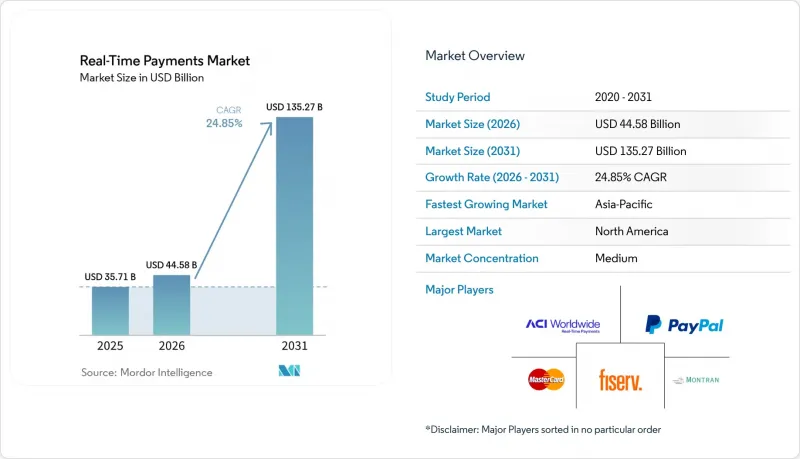
Mordor Intelligence에 의하면, 2026년 실시간 결제 시장 규모는 445억 8,000만 달러에 달할 것으로 예상됩니다. 2025년 357억 1,000만 달러에서 확대해, 2031년에는 1,352억 7,000만 달러에 이를 것으로 예측됩니다.
2026년부터 2031년까지의 연평균 성장률(CAGR)은 24.85%를 나타낼 것으로 전망됩니다.
본 보고서는 거래 유형(개인 간(P2P), 개인에서 기업으로(P2B)), 구성 요소(플랫폼/솔루션, 서비스), 배포 방식(클라우드, On-Premise), 기업 규모(대기업, 중소기업), 최종 사용자 산업(소매 및 전자상거래, 은행, 금융서비스 및 보험(BFSI), 유틸리티·통신, 헬스케어 등) 및 지역별로 분류되어 있습니다. 시장 전망은 금액(달러) 기준으로 제시되어 있습니다.
세계의 실시간 결제 시장 동향 및 인사이트
ISO 20022로의 전환이 인프라 현대화를 가속화
2025년 11월로 예정된 ISO 20022 도입 기한에 따라 은행들은 메시징 엔진과 처리 엔진을 동시에 업데이트할 수밖에 없었으며, 실시간 결제 네트워크 도입이 가장 비용 효율적인 규정 준수 대책이 되었습니다. SWIFT에 따르면, 국경을 넘는 메시지의 32.9%가 이미 ISO 20022 표준으로 전송되고 있으며, 이는 2024년 4분기 대비 6퍼센트 포인트 증가한 수치입니다. 데이터 페이로드가 강화됨에 따라 제재 심사 절차가 개선되었으며, 도이체방크는 기업을 대상으로 한 실시간 규정 준수 관리의 이점을 소개했습니다. 공존 기간이 끝나갈 무렵, 금융기관들은 이중 시스템의 운영 비용을 피할 수밖에 없는 상황에 처해 있습니다. 지역 은행은 ISO 20022 변환 기능과 실시간 결제 연결 기능을 결합한 제3자 처리 업체에 업무를 아웃소싱함으로써 기능상의 격차를 해소하고 있습니다.
FedNow의 확장이 북미 및 남미 시장에서의 리더십을 견인하고 있습니다.
FedNow의 네트워크 효과는 2025년 1분기에 거래 건수가 전 분기 대비 43.1% 증가하고, 거래 금액이 140.8% 급증한 사실에서 분명히 드러나며, 이는 상업적 활용 사례가 확대되고 있음을 시사합니다. 연방준비제도이사회(FRB)가 8,000개 금융기관의 참여를 목표로 하는 이 야심 찬 계획은 이 결제 네트워크를 전 미국에 보급하기 위한 기반을 마련하고 있습니다. 이와 동시에, 브라질의 PIX 2.0은 2025년 9월에 정기 결제 및 할부 결제 기능을 도입할 예정이며, 이는 성숙한 시스템이 어떻게 다기능 플랫폼으로 진화하는지를 보여주고 있습니다. 이러한 노력들이 어우러져, 다른 시장들이 모방하는 대륙을 아우르는 성과 기준을 확립하고 있습니다.
부정 행위 감시의 복잡성이 도입 속도를 저해하고 있습니다.
수취인 확인 체계는 각 결제 방식마다 다르기 때문에 은행들은 FedNow, PIX, SEPA Instant 각각에 대해 별도의 규칙 세트에 투자할 수밖에 없습니다. ACI Worldwide가 Banfico와 공동으로 유럽에서 실시한 PoC(개념 검증)는 EU의 2025년 10월 규정 준수 기한을 맞추기 위한 대안으로서의 파트너십 사례를 보여주었습니다. Visa의 Featurespace 인수는 AI 기반의 실시간 부정 행위 감지가 자본 집약적인 특성을 지닌다는 점을 여실히 보여주고 있습니다. 소규모 금융기관들은 병행되는 시스템으로 인한 운영상의 부담에 직면해 있어, 여러 네트워크에의 진출이 지연되고 있습니다.
부문별 분석
2025년에는 실시간 결제 시장 매출의 54.62%를 개인 간 송금이 차지하며, 소비자들 사이에서 이 서비스가 널리 보급되었음이 드러났습니다. 현재 비즈니스 중심의 결제 흐름이 개인 간 송금을 앞지르고 있으며, 즉시 급여 지급 및 가맹점 결제가 정착됨에 따라 개인에서 기업으로의 거래는 연평균 27.55%의 속도로 성장하고 있습니다. FedNow가 급여 지급 및 공급업체 대금 지급 분야에서 실시한 초기 기업 대상 시범 사업은 이러한 변화를 여실히 보여주고 있으며, 운전자금 측면에서의 이점이 재무 담당자들의 공감을 얻고 있음을 시사하고 있습니다. 기업 간(B2B) 도입은 여전히 초기 단계에 있지만, ACH 결제에 며칠이 걸린다는 점을 고려할 때 가장 큰 잠재 시장 규모가 기대됩니다. 또한, “지금 구매, 후불(BNPL)"인터넷 서비스 제공업체가 인터체인지 수수료를 최소화하기 위해 계좌 간 결제를 도입한 지역에서는 소비자로부터 기업으로의 자금 이동이 활발해지고 있습니다. 브라질의 PIX는 이러한 전환을 여실히 보여주고 있으며, 2025년에는 전자상거래 사업자들이 300억 달러 규모의 즉시 결제 거래액을 기록했습니다. GCC 국가들에서 정부로부터 개인에 대한 지급을 의무화함으로써, 연중무휴 24시간 지급이 새로운 기준으로 자리 잡게 되었으며, 즉시 결제 인프라가 공공 서비스의 표준으로 확고히 자리매김하고 있습니다.
실시간 급여 선지급 서비스는 급여 지급의 경제 구조를 혁신하고, 거래 금액이 아닌 거래 빈도를 확대함으로써 절대적인 결제 처리량을 늘리고 있습니다. 기업들은 재무 관리와 임베디드채무(AP) 프로세스를 연계하여, 주간 지급 처리에서 주문형 송금으로 전환하고 있습니다. 국경을 넘어 사업을 전개하는 조직들은 UPI-PayNow와 같은 양국 간 연계를 활용하여 동남아시아 내 공급업체에 대한 결제 주기를 단축하고 있습니다. 시장 플랫폼에서는 수수료와 원금을 동시에 배분하는 분할 결제 모델이 도입되어, 대조 과정으로 인한 지연이 해소되었습니다. 이러한 이용 사례가 결합되면서, 유동성 최적화에 없어서는 안 될 요소로서 실시간 결제 시장의 중요성이 더욱 커지고 있습니다.
2025년 수익 중 플랫폼 및 솔루션에 대한 지출이 74.95%를 차지했으며, 이는 은행들이 전술적인 추가 기능보다는 종합적인 개편을 선호하고 있음을 보여줍니다. 메시지 변환, 부정 분석, API 오케스트레이션은 통합된 스택에서 가장 효율적으로 수행되므로, ISO 20022로의 전환이 촉매 역할을 하고 있습니다. 그러나 서비스 수익은 연간 28.05% 증가했으며, 이는 단계적 도입 과정에서 전문 통합 업체에 대한 의존도가 높다는 점을 반영하고 있습니다. 컨설팅 업무에는 도입 준비 평가, 로드맵 설계, 규제 격차 분석 등이 포함됩니다. 금융기관은 24시간 365일 가동 시간을 보장하는 SLA(서비스 수준 계약)에 기반한 관리형 서비스를 외부에 위탁함으로써, 규정 준수를 확보하는 동시에 인력을 줄이고 있습니다. ACI Worldwide 등 통합 파트너들은 2025년 1분기에 소프트웨어 부문에서 42%의 성장률을 기록했으며, 이는 플랫폼과 전문 서비스를 결합한 계약이 중견 금융 기관들로부터 지지를 받고 있음을 입증하고 있습니다.
예측 기간 동안 실시간 처리와 일괄 처리를 병행하여 조정할 수 있는 미들웨어가 필수적입니다. 컨테이너화된 마이크로서비스를 갖춘 하이브리드 클라우드 오케스트레이터를 통해 레거시 핵심 시스템으로부터의 단계적 분리가 가능해집니다. 이 아키텍처를 통해 은행은 메인프레임 모듈을 단계적으로 폐지하는 동시에, 즉시 결제 API를 통해 고객에게 프런트엔드 서비스를 제공할 수 있게 됩니다. 이 교육 프로그램은 지속적인 결제 및 실시간 유동성 모니터링을 위한 업무 문화의 변화에 대응하고 있습니다.
지역별 분석
북미는 2025년에 매출 점유율 37.72%를 기록했으며, 이는 FedNow 및 The Clearing House의 RTP 네트워크가 성숙기에 접어든 데 기인합니다. 패키지화된 클라우드 커넥터의 지원을 받아 지역 은행들이 잇달아 시장에 진입함에 따라 거래량 증가세가 가속화되고 있습니다. 실시간 직불 거래에 대한 인터체인지 수수료 규정이 명확해짐에 따라, 가맹점들의 도입이 촉진되고 있습니다. 캐나다는 2026년에 “Real-Time Rail"의 시작을 계획하고 있으며, 이를 통해 미국과의 간에 달러建て의 국경 간 결제 경로가 열릴 가능성이 있습니다.
아시아태평양은 2031년까지 28.1%라는 가장 높은 연평균 성장률(CAGR)을 보일 것으로 전망됩니다. 인도의 UPI는 2024 회계연도에 1,310억 건의 거래(총액 200조 루피, 2조 4,000억 달러 상당)를 처리하며, 정부가 지원하는 오픈 API 모델의 규모의 경제 효과를 입증했습니다. 싱가포르의 ‘ 프로젝트 넥서스"는 다자간 결제의 모범 사례를 보여주고 있는 반면, 호주의 NPP는 “PayTo"의 의무화를 최종 결정하고, 기업용 청구 기능을 확대되고 있습니다. 일본의 지방 은행들은 국가의 무현금 결제율 목표를 달성하기 위해 현대화를 가속화하고 있습니다.
2025년 1월부터 시행된 유럽의 연중무휴 24시간 수신 의무에 따라, 같은 달 도이체방크의 즉시 결제 건수는 27% 증가했습니다. 2025년 10월까지 완전한 송금 기능을 구현하면서, 추가적인 보급을 촉진하는 한편, 규제에 따른 가격 상한선으로 인해 수수료 마진이 압박받을 가능성이 있습니다. 북유럽의 P27이 일시 중단됨에 따라, 유럽 내에서 사실상 국경을 초월한 결제 수단으로는 SEPA 인스턴트만 남게 되었으며, 은행들은 영국의 FPS와의 양자 간 연계를 추진해야 하는 상황에 놓여 있습니다.
남미의 동향은 PIX가 중심을 이루고 있으며, 현재는 할부 결제 모드와 오프라인 모드로도 확대되어 현금이 사용되는 마지막 이용 사례를 점차 없애고 있습니다. 콜롬비아, 칠레, 아르헨티나에서는 PIX의 민관 협력 구조 도입을 검토하고 있습니다. 중동에서는 정책 주도형 성장이 나타나고 있으며, 사우디아라비아의 ‘Sarie" 및 UAE의 IPP에서는 공무원 급여의 즉시 입금이 의무화되어 있습니다. 아프리카에서는 모바일 머니 사업자들이 오픈 루프 방식의 실시간 결제 네트워크를 통합하여, 전자지갑의 보급과 은행 수준의 결제 기능을 결합하고 있습니다.
기타 혜택 :
- 엑셀 형식 시장 예측(ME) 시트
- 3개월간의 애널리스트 지원
자주 묻는 질문
목차
제1장 서론
제2장 조사 방법
제3장 주요 요약
제4장 시장 구도
제5장 시장 규모 및 성장 예측
제6장 경쟁 구도
제7장 시장 기회 및 향후 전망
KTH 26.07.08According to Mordor Intelligence, real time payments market size in 2026 is estimated at USD 44.58 billion, growing from 2025 value of USD 35.71 billion with 2031 projections showing USD 135.27 billion, growing at 24.85% CAGR over 2026-2031.
This report is Segmented by Transaction Type (Peer-To-Peer (P2P), Peer-To-Business (P2B)), Component (Platform / Solution, Services), Deployment (Cloud, On-Premise), Enterprise Size (Large Enterprises, Small and Medium Enterprises), End-User Industry (Retail and E-Commerce, BFSI, Utilities & Telecom, Healthcare, and More), and Geography. The Market Forecasts are Provided in Terms of Value (USD).
Global Real-Time Payments Market Trends and Insights
ISO 20022 migration accelerates infrastructure modernization
The November 2025 ISO 20022 deadline compels banks to update messaging and processing engines simultaneously, making real-time payment rail adoption the most cost-efficient compliance path. SWIFT notes that 32.9% of cross-border messages already ride ISO 20022, up six percentage points in Q4 2024. Richer data payloads improve sanctions screening, and Deutsche Bank showcases real-time compliance benefits for corporates. The looming end of the coexistence period forces institutions to avoid dual-system overhead. Community banks mitigate capability gaps by outsourcing to third-party processors that bundle ISO 20022 translation with instant-payment connectivity.
FedNow expansion drives Americas market leadership
FedNow's network effects were evident with a 43.1% quarterly volume spike in Q1 2025 and a 140.8% value leap, signalling widening commercial use cases. The Federal Reserve's ambition to onboard 8,000 institutions positions the rail for nationwide ubiquity. In parallel, Brazil's PIX 2.0 will introduce recurring and instalment capabilities in September 2025, showing how mature systems evolve into multifunction platforms. Combined, these initiatives set cross-continental performance benchmarks that other markets emulate.
Fraud monitoring complexity constrains adoption velocity
Verification-of-Payee frameworks differ across schemes, obliging banks to invest in separate rule sets for FedNow, PIX, and SEPA Instant. ACI Worldwide's European PoC with Banfico illustrates workaround partnerships to meet the EU's October 2025 compliance deadline. Visa's Featurespace acquisition underscores the capital-intensive nature of AI-based instant fraud detection. Smaller institutions face operational strain from parallel systems, slowing onboarding to multiple networks.
Other drivers and restraints analyzed in the detailed report include:
- Earned-wage access transforms payroll economics
- Cross-border RTP corridors reshape international payments
- Legacy infrastructure modernization challenges
For complete list of drivers and restraints, kindly check the Table Of Contents.
Segment Analysis
Peer-to-peer transfers accounted for 54.62% of Real Time Payments market revenue in 2025, underscoring widespread consumer adoption. Business-driven flows now outpace personal transfers, with peer-to-business transactions growing 27.55% annually as instant payroll disbursements and merchant settlement take hold. FedNow's early corporate pilots in payroll and supplier payments highlight this pivot, signalling that working-capital benefits resonate with finance executives. Business-to-business adoption remains in early stages but promises the largest addressable pool, given ACH's multi-day settlement drag. Consumer-to-business flows gain momentum where buy-now-pay-later (BNPL) providers embed account-to-account settlement to minimise interchange costs. Brazil's PIX demonstrates this migration, with e-commerce merchants projected to book USD 30 billion in instant-payment turnover during 2025. Government-to-person mandates across GCC economies create a new baseline expectation for 24/7 disbursement, cementing instant infrastructure as a public-service standard.
Real-time salary advances reshape payroll economics, enlarging transaction frequency rather than ticket size, thus increasing absolute rail volume. Corporates synchronise treasury and AP processes, shifting from weekly payment runs to on-demand pushes. Cross-border organisations leverage bilateral links such as UPI-PayNow to shorten supplier settlement cycles in Southeast Asia. Market platforms introduce split-payment models that route commission and principal amounts simultaneously, removing reconciliation delays. These combined use cases reinforce the Real Time Payments market as indispensable for liquidity optimisation.
Platform & solution spending captured 74.95% of 2025 revenue, signalling that banks favour holistic overhauls versus tactical bolt-ons. ISO 20022 migration serves as the triggering event, since message translation, fraud analysis, and API orchestration are most efficient on unified stacks. Yet service revenue rises 28.05% annually, reflecting heavy reliance on specialist integrators for phased rollout. Consulting engagements cover readiness assessments, roadmap design, and regulatory gap analysis. Institutions outsource managed services for SLAs covering 24/7 uptime, ensuring compliance while containing headcount. Integration partners such as ACI Worldwide logged 42% software-segment growth in Q1 2025, proving that combinational platform-plus-professional-services deals resonate with mid-tier institutions.
Over the forecast period, middleware capable of orchestrating real-time and batch flows side-by-side becomes critical. Hybrid-cloud orchestrators with containerised microservices enable progressive decoupling from legacy cores. This architecture allows banks to retire mainframe modules gradually while front-ending customers with instant-payment APIs. Training programmes address the operational culture shift to continuous settlement and real-time liquidity monitoring.
Complete Report Scope:
- By Transaction Type
- Peer-to-Peer (P2P)
- Peer-to-Business (P2B)
- By Component
- Platform / Solution
- Services
- By Deployment Mode
- Cloud
- On-Premise
- By Enterprise Size
- Large Enterprises
- Small and Medium Enterprises
- By End-User Industry
- Retail and E-Commerce
- BFSI
- Utilities and Telecom
- Healthcare
- Government and Public Sector
- Other End-user Industries
- By Geography
- North America
- United States
- Canada
- Mexico
- Europe
- United Kingdom
- Germany
- France
- Spain
- Rest of Europe
- Asia-Pacific
- China
- India
- Japan
- South Korea
- Rest of Asia-Pacific
- South America
- Brazil
- Argentina
- Colombia
- Rest of South America
- Middle East
- United Arab Emirates
- Saudi Arabia
- Rest of Middle East
- Africa
- South Africa
- Nigeria
- Rest of Africa
- North America
Geography Analysis
North America posted 37.72% revenue share in 2025, anchored by FedNow and The Clearing House RTP network maturity. Volume growth accelerates as regional banks join en masse, aided by packaged cloud connectors. Regulatory clarity on interchange treatment for instant debit pushes merchant adoption. Canada plans Real-Time Rail launch in 2026, which could open a USD-denominated cross-border corridor with the United States.
Asia-Pacific delivers the highest CAGR at 28.1% to 2031. India's UPI handled 131 billion transactions worth INR 200 trillion (USD 2.4 trillion) in FY24, illustrating scale benefits of a government-backed open API model. Singapore's Project Nexus presents a template for multi-country clearing, while Australia's NPP finalises PayTo mandates, expanding business billing capabilities. Japan's regional banks accelerate modernization to meet the national cashless-ratio target.
Europe's mandatory 24/7 receiving requirement effective January 2025 induced a 27% instant-payment jump at Deutsche Bank that same month. Full send capability by October 2025 will drive further adoption yet may squeeze fee margins given regulation-imposed price caps. Nordic P27's pause leaves SEPA Instant as the de-facto cross-border option inside Europe, pushing banks toward bilateral links with the UK's FPS.
South America's trajectory centres on PIX, now extending to instalment and offline modes that remove the last cash use-cases. Colombia, Chile, and Argentina examine replicating PIX's public-private partnership structure. The Middle East experiences policy-driven growth where Saudi Arabia's Sarie rail and the UAE's IPP mandate instant salary credits for government workers. Africa witnesses mobile-money players integrating open-loop instant rails, blending wallet ubiquity with bank-grade clearing.
- ACI Worldwide Inc.
- Fiserv Inc.
- PayPal Holdings Inc.
- Mastercard Inc.
- Montran Corporation
- FIS Global
- Temenos AG
- Volante Technologies Inc.
- Finastra Inc.
- Ant Group (Alipay)
- Tencent Holdings Ltd. (WeChat Pay)
- The Clearing House Payments Co.
- Visa Inc.
- SWIFT SCRL
- Worldline SA
- Nets Group
- Nexi SpA
- Ripple Labs Inc.
- Wise PLC
- Pay.UK
- GoCardless Ltd.
- Jack Henry and Associates Inc.
- Infosys Finacle
- VSoft Corporation
- OpenPayd Holdings Ltd.
Additional Benefits:
- The market estimate (ME) sheet in Excel format
- 3 months of analyst support
TABLE OF CONTENTS
1 INTRODUCTION
- 1.1 Study Assumptions and Market Definition
- 1.2 Scope of the Study
2 RESEARCH METHODOLOGY
3 EXECUTIVE SUMMARY
4 MARKET LANDSCAPE
- 4.1 Market Overview
- 4.2 Market Drivers
- 4.2.1 Proliferation of ISO 20022-enabled domestic rails in Europe and Asia-Pacific
- 4.2.2 Expansion of FedNow and upcoming PIX 2.0 accelerating adoption in the Americas
- 4.2.3 Real-time payroll and earned-wage access (EWA) demand among U.S. gig workers
- 4.2.4 BNPL players shifting to RTP for instant merchant settlement in Europe
- 4.2.5 Government mandates for instant salary and welfare disbursement in GCC countries
- 4.2.6 Surging cross-border RTP corridors via RippleNet and Visa Direct
- 4.3 Market Restraints
- 4.3.1 Fragmented fraud-monitoring standards across RTP schemes
- 4.3.2 Legacy core-bank modernisation backlog in Tier-2 Asian banks
- 4.3.3 Interoperability gaps between card tokenisation and account-to-account rails
- 4.3.4 Merchant surcharge regulation uncertainty in the U.S.
- 4.4 Value Chain Analysis
- 4.5 Regulatory and Standards Outlook
- 4.6 Porter's Five Forces Analysis
- 4.6.1 Threat of New Entrants
- 4.6.2 Bargaining Power of Buyers
- 4.6.3 Bargaining Power of Suppliers
- 4.6.4 Threat of Substitutes
- 4.6.5 Intensity of Competitive Rivalry
- 4.7 Assessment of Macro Economic Trends on the Market
- 4.8 Case Studies and Use-cases
- 4.9 RTP Transactions as % of All Transactions - Regional and Key-Country Split
- 4.10 RTP Transactions as % of Non-Cash Transactions - Regional and Key-Country Split
5 MARKET SIZE AND GROWTH FORECASTS (VALUES)
- 5.1 By Transaction Type
- 5.1.1 Peer-to-Peer (P2P)
- 5.1.2 Peer-to-Business (P2B)
- 5.2 By Component
- 5.2.1 Platform / Solution
- 5.2.2 Services
- 5.3 By Deployment Mode
- 5.3.1 Cloud
- 5.3.2 On-Premise
- 5.4 By Enterprise Size
- 5.4.1 Large Enterprises
- 5.4.2 Small and Medium Enterprises
- 5.5 By End-User Industry
- 5.5.1 Retail and E-Commerce
- 5.5.2 BFSI
- 5.5.3 Utilities and Telecom
- 5.5.4 Healthcare
- 5.5.5 Government and Public Sector
- 5.5.6 Other End-user Industries
- 5.6 By Geography
- 5.6.1 North America
- 5.6.1.1 United States
- 5.6.1.2 Canada
- 5.6.1.3 Mexico
- 5.6.2 Europe
- 5.6.2.1 United Kingdom
- 5.6.2.2 Germany
- 5.6.2.3 France
- 5.6.2.4 Spain
- 5.6.2.5 Rest of Europe
- 5.6.3 Asia-Pacific
- 5.6.3.1 China
- 5.6.3.2 India
- 5.6.3.3 Japan
- 5.6.3.4 South Korea
- 5.6.3.5 Rest of Asia-Pacific
- 5.6.4 South America
- 5.6.4.1 Brazil
- 5.6.4.2 Argentina
- 5.6.4.3 Colombia
- 5.6.4.4 Rest of South America
- 5.6.5 Middle East
- 5.6.5.1 United Arab Emirates
- 5.6.5.2 Saudi Arabia
- 5.6.5.3 Rest of Middle East
- 5.6.6 Africa
- 5.6.6.1 South Africa
- 5.6.6.2 Nigeria
- 5.6.6.3 Rest of Africa
- 5.6.1 North America
6 COMPETITIVE LANDSCAPE
- 6.1 Market Concentration
- 6.2 Strategic Moves
- 6.3 Market Share Analysis
- 6.4 Company Profiles {(includes Global level Overview, Market level overview, Core Segments, Financials as available, Strategic Information, Market Rank/Share, Products and Services, and Recent Developments)}
- 6.4.1 ACI Worldwide Inc.
- 6.4.2 Fiserv Inc.
- 6.4.3 PayPal Holdings Inc.
- 6.4.4 Mastercard Inc.
- 6.4.5 Montran Corporation
- 6.4.6 FIS Global
- 6.4.7 Temenos AG
- 6.4.8 Volante Technologies Inc.
- 6.4.9 Finastra Inc.
- 6.4.10 Ant Group (Alipay)
- 6.4.11 Tencent Holdings Ltd. (WeChat Pay)
- 6.4.12 The Clearing House Payments Co.
- 6.4.13 Visa Inc.
- 6.4.14 SWIFT SCRL
- 6.4.15 Worldline SA
- 6.4.16 Nets Group
- 6.4.17 Nexi SpA
- 6.4.18 Ripple Labs Inc.
- 6.4.19 Wise PLC
- 6.4.20 Pay.UK
- 6.4.21 GoCardless Ltd.
- 6.4.22 Jack Henry and Associates Inc.
- 6.4.23 Infosys Finacle
- 6.4.24 VSoft Corporation
- 6.4.25 OpenPayd Holdings Ltd.
7 MARKET OPPORTUNITIES AND FUTURE OUTLOOK
- 7.1 White-space and Unmet-Need Assessment


