

|
시장보고서
상품코드
2125258
유럽의 실시간 결제 : 시장 점유율 분석, 업계 동향과 통계, 성장 예측(2026-2031년)Europe Real Time Payments - Market Share Analysis, Industry Trends & Statistics, Growth Forecasts (2026 - 2031) |
||||||
 Mordor Intelligence
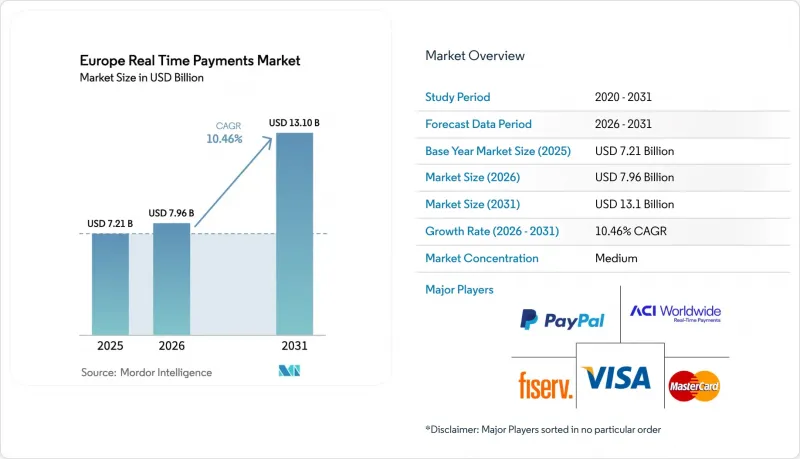
Mordor Intelligence에 따르면 2026년 유럽의 실시간 결제 시장 규모는 79억 6,000만 달러로 추정되고 있으며, 2025년 72억 1,000만 달러에서 확대하며, 2031년에는 131억 달러에 달할 것으로 예측됩니다.
2026-2031년까지의 연평균 성장률(CAGR)은 10.46%에 달할 것으로 전망됩니다.
이 보고서는 결제 유형(P2P, P2B/C2B), 구성 요소(플랫폼/소프트웨어, 서비스(컨설팅, 통합, 매니지드)), 기업 규모(대기업, 중소기업(SME)), 최종사용자 산업(은행·금융 서비스(BFSI),소매·E-Commerce, 통신·미디어, 기타) 및 국가별로 분류되어 있습니다. 시장 전망은 금액(달러) 기준으로 제시되어 있습니다.
유럽 실시간 결제 시장의 동향 및 인사이트
범유럽 즉시 SEPA 결제(SCT Inst) 도입이 시장 성장을 주도
SCT Inst 준수 의무에 따라 유로존 은행들은 2025년 1월까지 즉시 결제를 수취하고, 2025년 10월까지 송금해야 합니다. 비용 균등 조항에 따라 즉시 송금의 평균 수수료가 2.19유로에서 0.76유로로 인하되어, 소비자 이용 확대를 가로막던 경제적 장벽이 해소되었습니다. 최신 규정집에서는 처리 시간을 5초로 단축하는 한편, 1회 거래 한도를 10억 유로(10억 8,000만 달러) 가까이까지 상향 조정하여 고액의 기업 간 자금 흐름에 대응할 수 있는 기반이 마련되었습니다. 이에 따라 각 은행은 거래별 과금 모델에서 ‘Request-to-Pay’나 부정 방지 대책이 적용된 계좌 대조와 같은 부가가치 서비스로 투자를 전환하고 있습니다. 유동성이 거의 실시간으로 결제됨에 따라 기업은 입금에 대한 접근성을 신속하게 확보할 수 있게 되어, 유럽의 실시간 결제 시장내 거래량 성장을 더욱 촉진하게 될 것입니다.
PSD3 및 SPAA 주도의 오픈 뱅킹 활용 사례는 결제 개시를 넘어 확대되고 있습니다.
SPAA의 보상 체계는 프리미엄 API를 위한 실현 가능한 경제 모델을 마침내 도입하여, 은행이 오픈 뱅킹을 규정 준수 비용으로 취급하는 대신 데이터 제품의 상용화를 촉진하도록 장려하고 있습니다. 2025년에 시범 테스트가 진행될 ‘동적 정기 결제’를 통해 가맹점은 새로운 위임장 없이도 인출 금액을 변경할 수 있게 되어, 거절률을 낮추고 현금 흐름을 원활하게 할 수 있습니다. PSD3는 결제 기관 및 전자화폐 기관의 라이선스 발급을 통합하여 시장 진입의 파편화를 조장하던 허점을 메웁니다. 이러한 개혁을 통해 즉시 결제 네트워크와 부가가치 디지털 서비스 간의 통합이 심화되어, 은행과 핀테크 기업에게 새로운 수익 창출의 길이 열립니다.
분절화된 RTP 결제 인프라가 업무상의 복잡성을 야기하고 있습니다.
TIPS는 2024년 상반기에 1억 9,600만 건, 총액 1,220억 유로(1,320억 달러) 규모의 결제를 처리했으며, 그 중 99%가 5초 이내에 완료되었습니다. 그러나 PSP는 여전히 TIPS, RT1 및 국내 결제 체계 전반에 걸쳐 유동성을 확보해야 하며, 이로 인해 운전 자금이 묶이고 결제 리스크가 높아지고 있습니다. ECB의 단일 유동성 풀 구상은 현금 완충 자금의 통합을 목표로 하고 있지만, 도입 일정의 불일치로 인해 유동성은 여전히 분절된 상태에 있으며, 중소규모 PSP에 불균형한 부담을 주는 동시에 유럽 실시간 결제 시장의 규모의 경제 효과를 저해하고 있습니다.
부문 분석
2025년 거래액 중 P2P 송금이 40.80%를 차지했으나, P2B/C2B 거래량은 2031년까지 연평균 13.59% 성장할 것으로 예측됩니다. 가맹점이 카드 인터체인지 수수료에서 벗어나려는 움직임을 보임에 따라 2026-2031년에 유럽 실시간 결제 시장의 P2B 거래 규모는 33억 6,000만 달러의 매출 증가를 가져올 것으로 전망됩니다. 2024년 7월 독일과 벨기에에서 서비스를 시작한 Wero는 P2P에서 온라인 결제로의 전략적 확장을 보여주고 있으며, 이러한 확장은 전 세계 카드 브랜드에 경쟁적 압력을 가하고 있습니다. 스페인의 Bizum, 이탈리아의 Bancomat Pay, 포르투갈의 MB Way와 같은 신흥 멀티 스킴 라우팅 서비스는 국내 주권을 유지하면서도 국경을 초월한 소비자의 기대에 부응하기 위한 지역 간 협력을 구현하고 있습니다. 가맹점의 입장에서 볼 때, 계좌 간 결제 시스템은 가맹점 수수료를 절감하고 결제 속도를 향상시킴으로써 고객 충성도를 높이는 데 기여하며, 기존 카드 네트워크를 대체할 수 있는 신뢰할 수 있는 대안으로서 유럽 실시간 결제 시장에서의 입지를 공고히 하고 있습니다.
2차적인 동향에서는 수입원의 단계적인 재균형이 시사되고 있습니다. 단일 API로 여러 즉시 결제 스킴에 접근할 수 있는 결제 서비스 제공업체는 대규모 P2B 거래량을 확보하는 데 있으며, 가장 유리한 입장에 있습니다. ‘Request-to-Pay’가 성숙해짐에 따라 공공사업체와 공공기관은 비정기적인 일괄 수금에서 양방향 청구 방식으로 전환하게 되며, 인프라 이용률을 유지하는 정기적인 거래량이 증가할 것입니다. 따라서 유럽의 실시간 결제 시장은 소비자 주도 송금에서 기업 주도 현금 관리로 중심을 옮기게 되어, 서비스 계층 전반에 걸친 수익화 가능성을 가속화할 것입니다.
2025년 지출 중 플랫폼/소프트웨어 라이선스가 62.70%를 차지했으나, 서비스 부문은 연평균 성장률(CAGR) 15.32%로 성장할 것으로 예측됩니다. 2025년 10월까지 유로존에서 송금 기능 도입이 의무화됨에 따라 컨설팅 업무와 매니지드 서비스 계약이 급증할 것이며,유럽의 실시간 결제 시장에서 서비스 분야 시장 규모는 2025년 23억 달러에서 2031년에는 54억 1,000만 달러로 확대될 것으로 전망됩니다. Tier 1 은행들은 ‘리프트 앤 시프트(Lift-and-Shift)’ 전략을 빈번히 채택하고 있으며, 레거시 결제 허브를 현대화하는 동시에 ISO 20022 매핑이나 스킴 인증과 같이 차별화 요소가 되지 않는 기능을 외부에 위탁하고 있습니다. ACI Worldwide의 클라우드 네이티브 도입 사례와 IBM Z 기반의 확장 사례는 전문적인 서비스 래퍼로 보완된, 내결함성이 높고 대용량인 플랫폼에 대한 수요를 지원하고 있습니다.
IT 예산이 제한적인 금융 기관에서는 막대한 설비 투자를 수반하지 않으면서도 규제 기한을 충족할 수 있는 공유 서비스 유틸리티를 점점 더 선호하고 있습니다. 이러한 변화는 분석, 부정 관리, 부가가치 오버레이 서비스 분야에서 교차 판매의 가능성도 열어줍니다. 실시간 처리량이 증가함에 따라 지속적인 성능 조정이 필수적이며, 전문 통합 업체에 대한 수요가 끊임없이 증가하여 유럽의 실시간 결제 시장에서 서비스 중심의 수익 추세가 더욱 공고해질 것입니다.
기타 혜택:
- 엑셀 형식의 시장 예측(ME) 시트
- 3개월간의 애널리스트 지원
자주 묻는 질문
목차
제1장 서론
제2장 조사 방법
제3장 개요
제4장 시장 구도
제5장 시장 규모와 성장 예측
제6장 경쟁 구도
제7장 시장 기회와 향후 전망
KSA 26.09.08According to Mordor Intelligence, Europe real time payments market size in 2026 is estimated at USD 7.96 billion, growing from 2025 value of USD 7.21 billion with 2031 projections showing USD 13.1 billion, growing at 10.46% CAGR over 2026-2031.
This report is Segmented by Payment Type (P2P, P2B / C2B), Component (Platform / Software, Services (Consulting, Integration, Managed)), Enterprise Size (Large Enterprises, Small and Mid-Size Enterprises (SMEs)), End-User Industry (Banking and Financial Services (BFSI), Retail and ECommerce, Telecom and Media, and More), and Country. The Market Forecasts are Provided in Terms of Value (USD).
Europe Real Time Payments Market Trends and Insights
Adoption of Pan-European Instant SEPA Mandate (SCT Inst) Drives Market Acceleration
Mandatory SCT Inst adherence compels Eurozone banks to receive instant payments by January 2025 and dispatch them by October 2025. Cost-parity clauses cut average instant transfer fees from EUR 2.19 to EUR 0.76, eliminating the economic barrier that had capped consumer uptake. The latest rulebook also tightens execution to 5 seconds and lifts single-transaction limits close to EUR 1 billion (USD 1.08 billion), positioning the rail for high-value corporate flows. Banks are therefore shifting investment from per-transaction pricing models to value-added overlay services such as Request-to-Pay and fraud-verified account matching. As liquidity settles in near-real time, corporates gain faster access to incoming funds, further perpetuating volume growth in the Europe real time payments market.
PSD3 and SPAA-Driven Open-Banking Use-Cases Expand Beyond Payment Initiation
SPAA's remuneration framework finally introduces a viable economic model for premium APIs, encouraging banks to commercialise data products rather than treating open banking as a compliance cost. Dynamic Recurring Payments, pilot-tested in 2025, allow merchants to vary debits without fresh mandates, reducing rejection rates and smoothing cash flow. PSD3 harmonises licensing for Payment and Electronic Money Institutions, closing loopholes that had supported fragmented market entry. These reforms deepen integration between instant clearing rails and value-added digital services, creating new monetisation paths for banks and fintechs.
Fragmented RTP Clearing Infrastructure Creates Operational Complexity
TIPS processed 196 million payments worth EUR 122 billion (USD 132 billion) in H1 2024 with 99% completion inside 5 seconds. Yet PSPs must still fund liquidity across TIPS, RT1 and domestic schemes, tying up working capital and raising settlement risk. The ECB's project for a single liquidity pool aims to consolidate cash buffers, but divergent implementation timelines keep liquidity siloed, disproportionately burdening smaller PSPs and tempering scale economics in the Europe real time payments market.
Other drivers and restraints analyzed in the detailed report include:
- Corporate Treasury Shift to ISO 20022 for Instant Liquidity Management
- Rise of Request-to-Pay (R2P) for Utilities and Public Sector Applications
- Payment Fraud Escalation Threatens Consumer Confidence
For complete list of drivers and restraints, kindly check the Table Of Contents.
Segment Analysis
P2P transfers controlled 40.80% of 2025 volumes; however, P2B/C2B flows are forecast to grow 13.59% annually through 2031. The Europe real time payments market size for P2B transactions is expected to add USD 3.36 billion in incremental revenue between 2026 and 2031 as merchants pivot away from card interchange. Wero's July 2024 launch in Germany and Belgium showcases the strategic sequencing from P2P to online checkout, an expansion that brings competitive pressure to global card schemes. Emerging multi-scheme routing-Spain's Bizum, Italy's Bancomat Pay and Portugal's MB Way-illustrates regional collaboration designed to maintain domestic sovereignty while meeting cross-border consumer expectations. For merchants, account-to-account rails lower acceptance costs and improve settlement speed, strengthening loyalty propositions and solidifying the Europe real time payments market as a credible alternative to established card networks.
Second-order dynamics suggest a gradual re-balancing of revenue pools. Payment-service providers able to deliver single-API access across multiple instant schemes are best positioned to capture scaled P2B volumes. As Request-to-Pay matures, utilities and public entities will shift from episodic batch collections to interactive billing, adding recurring traffic that sustains infrastructure utilisation. The Europe real time payments market therefore pivots from consumer-initiated transfers to enterprise-led cash management, accelerating monetisation potential across service layers.
Platform/Software licences represented 62.70% of 2025 spending, but Services are forecast to grow 15.32% CAGR. Mandatory eurozone Send-capability by October 2025 drives a wave of consulting engagements and managed-service contracts, moving the Europe real time payments market size for Services from USD 2.3 billion in 2025 to USD 5.41 billion by 2031. Tier-1 banks frequently adopt "lift-and-shift" strategies-modernising legacy payment hubs while outsourcing non-differentiating functions such as ISO 20022 mapping and scheme certification. ACI Worldwide's cloud-native deployments and IBM Z-based scaling examples prove demand for resilient, high-volume platforms complemented by expert service wrappers.
Institutions with thin IT budgets increasingly favour shared-service utilities, allowing them to meet regulatory timelines without heavy capital spend. This shift also opens cross-selling potential for analytics, fraud management and value-added overlay services. As real-time volumes rise, continuous performance tuning becomes critical, keeping specialised integrators in constant demand and reinforcing the Europe real time payments market's service-centric revenue trajectory.
Complete Report Scope:
- By Payment Type
- P2P
- P2B / C2B
- By Component
- Platform / Software
- Services (Consulting, Integration, Managed)
- By Enterprise Size
- Large Enterprises
- Small and Mid-Size Enterprises (SMEs)
- By End-User Industry
- Banking and Financial Services (BFSI)
- Retail and eCommerce
- Telecom and Media
- Healthcare
- Other End-user Industries
- By Country
- United Kingdom
- Germany
- France
- Spain
- Italy
- Poland
- Rest of Europe
List of Companies Covered in this Report:
- PayPal Holdings Inc.
- Fiserv Inc.
- ACI Worldwide Inc.
- Mastercard Inc.
- Visa Inc.
- FIS Global
- Adyen NV
- Nexi Group (Nets)
- Worldline SA
- Apple Inc.
- Klarna Bank AB
- Tink AB (Visa)
- Finastra
- Volante Technologies Inc.
- Temenos AG
- Modulr
- TrueLayer
- Trustly Group
- Banking Circle
- GoCardless
Additional Benefits:
- The market estimate (ME) sheet in Excel format
- 3 months of analyst support
TABLE OF CONTENTS
1 INTRODUCTION
- 1.1 Study Assumptions and Market Definition
- 1.2 Scope of the Study
2 RESEARCH METHODOLOGY
3 EXECUTIVE SUMMARY
4 MARKET LANDSCAPE
- 4.1 Market Overview
- 4.2 Market Drivers
- 4.2.1 Adoption of Pan-European Instant SEPA Mandate (SCT Inst)
- 4.2.2 PSD3 and SPAA-Driven Open-Banking Use-Cases Drives the Market
- 4.2.3 Corporate Treasury Shift to ISO 20022 for Instant Liquidity Drives the Market
- 4.2.4 Rise of Request-to-Pay (R2P) for Utilities and Public Sector Drives the Market
- 4.3 Market Restraints
- 4.3.1 Fragmented RTP Clearing Infrastructure (TIPS vs. RT1 vs. Domestic) Hinders the Market
- 4.3.2 Payment Fraud such as Authorized Push Payment Scams
- 4.3.3 High AML/SCA Compliance Costs Hinders the Market
- 4.4 Value Chain Analysis
- 4.5 Regulatory Outlook
- 4.6 Porter's Five Forces Analysis
- 4.6.1 Bargaining Power of Suppliers
- 4.6.2 Bargaining Power of Buyers
- 4.6.3 Threat of New Entrants
- 4.6.4 Threat of Substitutes
- 4.6.5 Intensity of Competitive Rivalry
- 4.7 Pricing Analysis
- 4.8 Evolution of Europe's Payments Landscape
- 4.9 Cashless-Transaction Growth Trends
- 4.10 Assessment of Macro Economic Trends on the Market
- 4.11 RTP Share of All Transactions - Volumes and Values (Country-level)
- 4.12 RTP Share of Non-Cash Transactions - Volumes
5 MARKET SIZE AND GROWTH FORECASTS (VALUES)
- 5.1 By Payment Type
- 5.1.1 P2P
- 5.1.2 P2B / C2B
- 5.2 By Component
- 5.2.1 Platform / Software
- 5.2.2 Services (Consulting, Integration, Managed)
- 5.3 By Enterprise Size
- 5.3.1 Large Enterprises
- 5.3.2 Small and Mid-Size Enterprises (SMEs)
- 5.4 By End-User Industry
- 5.4.1 Banking and Financial Services (BFSI)
- 5.4.2 Retail and eCommerce
- 5.4.3 Telecom and Media
- 5.4.4 Healthcare
- 5.4.5 Other End-user Industries
- 5.5 By Country
- 5.5.1 United Kingdom
- 5.5.2 Germany
- 5.5.3 France
- 5.5.4 Spain
- 5.5.5 Italy
- 5.5.6 Poland
- 5.5.7 Rest of Europe
6 COMPETITIVE LANDSCAPE
- 6.1 Market Concentration
- 6.2 Strategic Moves (MandA, JV, Product Launches)
- 6.3 Market Share Analysis
- 6.4 Company Profiles (includes Global-level Overview, Market-level Overview, Core Segments, Financials, Strategic Info, Market Rank/Share, Products and Services, Recent Developments)
- 6.4.1 PayPal Holdings Inc.
- 6.4.2 Fiserv Inc.
- 6.4.3 ACI Worldwide Inc.
- 6.4.4 Mastercard Inc.
- 6.4.5 Visa Inc.
- 6.4.6 FIS Global
- 6.4.7 Adyen NV
- 6.4.8 Nexi Group (Nets)
- 6.4.9 Worldline SA
- 6.4.10 Apple Inc.
- 6.4.11 Klarna Bank AB
- 6.4.12 Tink AB (Visa)
- 6.4.13 Finastra
- 6.4.14 Volante Technologies Inc.
- 6.4.15 Temenos AG
- 6.4.16 Modulr
- 6.4.17 TrueLayer
- 6.4.18 Trustly Group
- 6.4.19 Banking Circle
- 6.4.20 GoCardless
7 MARKET OPPORTUNITIES AND FUTURE OUTLOOK
- 7.1 White-Space and Unmet-Need Assessment


