

|
시장보고서
상품코드
2125260
중국의 실시간 결제 : 시장 점유율 분석, 업계 동향과 통계, 성장 예측(2026-2031년)China Real Time Payments - Market Share Analysis, Industry Trends & Statistics, Growth Forecasts (2026 - 2031) |
||||||
 Mordor Intelligence
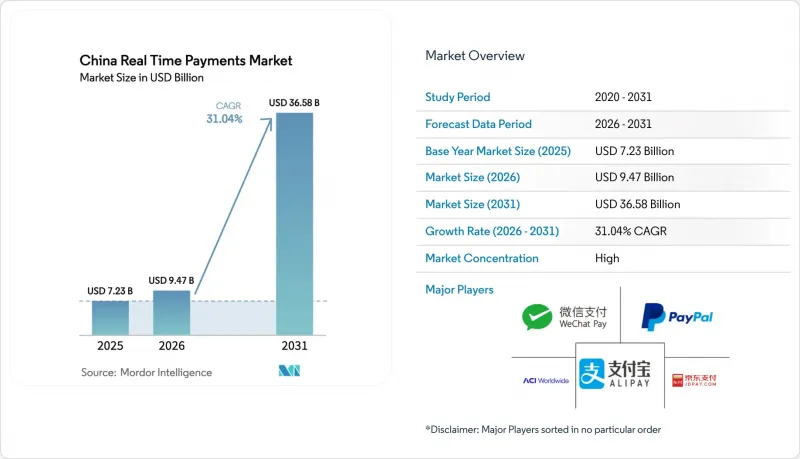
Mordor Intelligence에 따르면 중국의 실시간 결제 시장 규모는 2025년에 72억 3,000만 달러로 평가되며, 2026년 94억 7,000만 달러에서 2031년까지 365억 8,000만 달러에 달할 것으로 예측되고 있으며, 예측 기간(2026-2031년)에 CAGR은 31.04%에 달할 전망입니다.
이 보고서는 거래 유형(개인 간(P2P), 개인에서 기업(P2B)), 구성 요소(플랫폼/솔루션, 서비스), 도입 형태(클라우드, 온프레미스), 기업 규모(대기업, 중소기업), 최종사용자 산업(소매·E-Commerce,BFSI, 공공사업·통신, 의료 등)별로 분류되어 있습니다. 시장 예측은 금액(달러)으로 제시되어 있습니다.
중국 실시간 결제 시장의 동향 및 인사이트
‘Alipay-Lite’ 미니 프로그램이 주도한 모바일 지갑의 폭발적인 확산
소셜 피드 내에 결제 버튼을 매끄럽게 통합함으로써 전환 퍼널이 재구성되고 있습니다. 알리페이의 ‘탭원’ 기능은 2024년 6월 출시 후 불과 11개월 만에 사용자 수가 1억 명을 돌파했습니다. 앱을 전환하는 번거로움을 없앰으로써 패밀리마트 등 오프라인 체인점의 회원 가입 수가 3배로 증가했습니다. 이는 내장형 결제가 고객 충성도를 높이는 동시에 쇼핑객의 데이터 레이크를 풍부하게 한다는 사실을 입증합니다. 알리페이가 400개 도시·5,000개 브랜드로 생태계를 확장하기 위해 14억 달러(100억 위안)의 자금을 투입한 것은 경쟁의 축이 수수료 할인 캠페인에서 경험을 통한 고객 충성도 강화 및 옴니채널 데이터 활용으로 전환되고 있음을 보여줍니다.
중국인민은행(PBoC)의 NetsUnion 플랫폼에 대한 기업 연결 의무화
2024년에 비은행 결제 기관이 중앙 청산 허브로 완전히 전환됨에 따라 API가 표준화되었고, 은행 간 양자 간 연동이 불필요해졌으며, 규제 당국의 가시성이 높아지고 자금 세탁 방지 분석 능력이 향상되었습니다. 기업은 즉시 결제 기능을 확보했으나, 서비스 제공업체는 새로운 청산 수수료 부담을 떠안게 되어, 이익률을 지키기 위해 컴플라이언스 대시보드 및 유동성 관리 애드온 기능을 패키지로 묶어 제공해야만 하는 상황에 처해 있습니다. 따라서 NetsUnion의 아키텍처는 플랫폼 사업자가 가격이 아닌, 부가가치가 높은 재무 기능을 통해 차별화를 꾀하도록 유도하고 있습니다.
도시 상업은행의 ISO 20022 도입 현황
CNAPS2나 CIPS와 같은 대규모 결제 체계는 이미 ISO 20022로 운영되고 있지만, 120개 이상의 도시 상업 은행에서는 여전히 두 가지 형식을 병용하고 있으며, 메시지 생략이나 대조 지연이 발생하고 있습니다. 예산 제약으로 인해 업그레이드가 지연되고 있으며, 결제 제공업체는 포맷 변환 툴을 유지할 수밖에 없으며, 이로 인해 운영 비용 구조가 부풀어 오르고 있습니다. 2025년 7월로 다가오는 전 세계적인 규정 준수 기한이 임박함에 따라 압박은 더욱 가중될 것이며, 중소 은행들이 핵심 시스템을 재구축을 완료할 때까지는 지방 지역의 거래 증가세가 일시적으로 정체될 가능성이 있습니다.
부문 분석
2025년, 중국의 실시간 결제 시장에서 P2P 송금은 71.85%를 차지하며, 소셜미디어 지갑의 보급으로 인해 개인 간 결제가 확고한 습관으로 자리 잡았음을 여실히 보여주었습니다. 이러한 우위는 즉시 분할 결제나 ‘붉은 봉투(레드 패킷)’를 통한 선물 기능에 기인하며, 이러한 기능들이 소비자들이 앱을 매일 사용하도록 정착시키고 있습니다. P2B(개인 대 기업) 자금 흐름은 규모는 작지만 연평균 성장률(CAGR) 33.68%를 기록하고 있으며, 기업이 즉시 현금 이체와 청구서 자동 대조를 우선시함에 따라 기업 자금 관리의 상식을 재정의하고 있습니다. JD.com의 국경 간 스테이블코인 프로그램은 결제 비용을 90% 절감하고 10초내 결제를 목표로 하고 있으며, 실시간 유동성 최적화가 이제 무역 경쟁에 필수적임을 입증하고 있습니다.
이러한 추세는 기업이 매입채무 주기를 지속적인 결제로 재조정하고, 운전 자본의 완충 여력을 축소하며, 거래 상대방 리스크를 낮추고 있음을 보여줍니다. 공급망 마켓플레이스와 B2B 핀테크 기업은 신용 평가와 즉시 결제를 결합하여 결제 수수료 외의 수입원을 확대하고 있습니다. 이러한 변화로 인해 중국 실시간 결제 시장에서 P2B의 중요성이 더욱 높아지고 있으며, 거래액을 견인하는 데 있으며, 소비자 대상 P2P를 능가하는 ‘기업 중심’의 시대가 도래할 것임을 시사합니다.
은행 및 결제 서비스 제공업체(PSP)가 핵심 스위칭 엔진, 오픈 API, 원장 서비스를 도입한 결과, 2025년 수익의 63.92%를 플랫폼/솔루션 스택이 차지했습니다. 기반이 성숙해짐에 따라 서비스 부문은 연평균 성장률(CAGR) 32.8%로 확대되고 있으며, 수요는 ISO 20022로의 전환, 전자 인민폐(e-CNY) 통합, AI를 활용한 부정 방지 대책에 집중되고 있습니다. 컨설팅 회사와 전문 통합 업체들은 레거시 코어 뱅킹 플랫폼과 클라우드 네이티브 프로세서를 연동하거나, NetsUnion의 보고 형식을 충족하는 규칙 기반의 규정 준수 계층을 도입함으로써 가치를 창출하고 있습니다.
Ant International의 임베디드 금융 제품군은 2024년에 관리 중인 대출 잔액을 두 배로 늘렸습니다. 이는 서비스 주도형 수익화가 일회성 라이선스 수익을 능가하는 성과를 내고 있음을 보여주는 증거입니다. 향후 표준화된 툴키트이 맞춤형 코딩을 대체함에 따라 전문 서비스의 이익률은 안정화될 것으로 예상되지만, 규제 대응 조정에 대한 전략적 필요성은 더 광범위한 중국의 실시간 결제 업계에서 자문 사업의 지속적인 성장을 보장할 것입니다.
기타 혜택:
- 엑셀 형식의 시장 예측(ME) 시트
- 3개월간의 애널리스트 지원
자주 묻는 질문
목차
제1장 서론
제2장 조사 방법
제3장 개요
제4장 시장 구도
제5장 시장 규모와 성장 예측
제6장 경쟁 구도
제7장 시장 기회와 향후 전망
KSA 26.09.08According to Mordor Intelligence, the China real time payments market size was valued at USD 7.23 billion in 2025 and estimated to grow from USD 9.47 billion in 2026 to reach USD 36.58 billion by 2031, at a CAGR of 31.04% during the forecast period (2026-2031).
This report is Segmented by Transaction Type (Peer-To-Peer (P2P), Peer-To-Business (P2B)), Component (Platform / Solution, Services), Deployment (Cloud, On-Premise), Enterprise Size (Large Enterprises, Small and Medium Enterprises), End-User Industry (Retail and E-Commerce, BFSI, Utilities & Telecom, Healthcare, and More). The Market Forecasts are Provided in Terms of Value (USD).
China Real Time Payments Market Trends and Insights
Explosive Mobile Wallet Adoption Fuelled by "Alipay-Lite" Mini-Programs
The seamless insertion of payment buttons inside social feeds is reshaping conversion funnels as Alipay's "Tap Once" feature surpassed 100 million users within 11 months of its June 2024 launch. Eliminating app-switch friction triples membership registrations for offline chains such as FamilyMart, proving that embedded payments amplify loyalty acquisition while enriching shopper data lakes. Alipay's USD 1.4 billion (RMB 10 billion) capital commitment to extend the ecosystem across 400 cities and 5,000 brands signals that the competitive axis is shifting from fee-discount campaigns to experiential stickiness and omnichannel data leverage.
Mandatory Corporate Connectivity to PBoC NetsUnion Platform
Full migration of non-bank payment institutions to the central clearing hub in 2024 standardized APIs and removed bilateral bank integrations, raising regulatory visibility and improving anti-money-laundering analytics. Corporates gain instant settlement capability, but service providers absorb a new layer of clearing fees, prompting them to bundle compliance dashboards and liquidity-management add-ons to defend margins. The NetsUnion architecture therefore incentivizes platform players to differentiate on value-added treasury functions rather than price.
Fragmented ISO 20022 Implementation Among City Commercial Banks
Large schemes such as CNAPS2 and CIPS already run on ISO 20022, yet 120-plus city commercial banks still juggle dual formats, creating message truncation and reconciliation lags. Budget constraints delay upgrades, forcing payment providers to maintain format converters that inflate operating cost structures. The July 2025 global compliance deadline intensifies pressure and could temporarily cap rural transaction growth until smaller banks finish rewiring core systems.
Other drivers and restraints analyzed in the detailed report include:
- QR-Code Interoperability Mandate Accelerating SME Uptake in Lower-Tier Cities
- Accelerated Cross-Border e-CNY Pilots for Belt & Road Digital Trade
- Real-Time Fraud-as-a-Service Rings Targeting QR Rail
For complete list of drivers and restraints, kindly check the Table Of Contents.
Segment Analysis
P2P transfers commanded 71.85% of the China Real Time Payments market in 2025, underlining entrenched peer payment habits that arose from social media wallet penetration. The dominance stems from features such as instant split bills and red-packet gifting that lock consumers into daily app usage. P2B flows, while smaller, are charting a 33.68% CAGR that is reshaping corporate treasury norms as businesses prioritize instantaneous cash application and automated invoice reconciliation. JD.com's cross-border stablecoin program targets a 90% reduction in settlement cost and 10-second clearing, reinforcing that real-time liquidity optimization is now integral to trade competitiveness.
The trajectory shows enterprises recalibrating accounts-payable cycles toward continuous settlement, shrinking working capital buffers, and lowering counterparty risk. Supply-chain marketplaces and B2B fintechs bundle credit scoring with instant disbursement, broadening monetization beyond payment fees. The shift elevates P2B relevance within the China Real Time Payments market, signaling a future where merchant centricity overtakes consumer P2P in driving transaction value.
Platform/Solution stacks accounted for 63.92% of 2025 revenue as banks and PSPs implemented core switching engines, open APIs, and ledger services. As the foundation matures, the Services segment is expanding at 32.8% CAGR, with demand clustering around ISO 20022 migration, e-CNY integration, and AI fraud orchestration. Consulting houses and specialist integrators capture value by bridging legacy core banking platforms to cloud-native processors and by deploying rule-based compliance layers that satisfy NetsUnion reporting formats.
Ant International's embedded finance suite doubled loans under administration in 2024, proof that service-led monetization outperforms one-time license revenue. Over time, professional services margins are expected to stabilize as standardized toolkits replace bespoke coding, yet the strategic need for regulatory choreography ensures durable growth for advisory portfolios within the wider China Real Time Payments industry.
Complete Report Scope:
- By Transaction Type
- Peer-to-Peer (P2P)
- Peer-to-Business (P2B)
- By Component
- Platform / Solution
- Services
- By Deployment Mode
- Cloud
- On-Premise
- By Enterprise Size
- Large Enterprises
- Small and Medium Enterprises
- By End-User Industry
- Retail and E-Commerce
- BFSI
- Utilities and Telecom
- Healthcare
- Government and Public Sector
- Other End-user Industries
List of Companies Covered in this Report:
- Ant Group Co., Ltd. (Alipay)
- Tencent Holdings Ltd. (WeChat Pay)
- China UnionPay Co., Ltd.
- JD.com, Inc. (JD Pay)
- Apple Inc. (Apple Pay China)
- PayPal Holdings Inc.
- ACI Worldwide Inc.
- Fidelity National Information Services, Inc. (FIS)
- Fiserv, Inc.
- Mastercard Inc.
- Visa Inc.
- NetsUnion Clearing Corp.
- Lakala Payment Co., Ltd.
- 99Bill Corporation
- China UMS Co., Ltd.
- Shanghai Pudong Development Bank Co., Ltd.
- Industrial and Commercial Bank of China Ltd. (ICBC)
- China Construction Bank Corp.
- Ping An OneConnect Bank
- Huawei Technologies Co., Ltd. (Huawei Pay)
Additional Benefits:
- The market estimate (ME) sheet in Excel format
- 3 months of analyst support
TABLE OF CONTENTS
1 INTRODUCTION
- 1.1 Study Assumptions and Market Definition
- 1.2 Scope of the Study
2 RESEARCH METHODOLOGY
3 EXECUTIVE SUMMARY
4 MARKET LANDSCAPE
- 4.1 Market Overview
- 4.2 Market Drivers
- 4.2.1 Explosive Mobile Wallet Adoption Fuelled by "Alipay-Lite" Mini-Programs
- 4.2.2 Mandatory Corporate Connectivity to PBoC NetsUnion Platform
- 4.2.3 QR-Code Interoperability Mandate Accelerating SME Uptake in Lower-Tier Cities
- 4.2.4 Accelerated Cross-Border e-CNY Pilots for Belt and Road Digital Trade
- 4.2.5 "Zero-Fee" Domestic Retail Transfers Policy Drives the Market
- 4.2.6 High-Frequency Social Commerce Driving In-Chat Micro-Payments
- 4.3 Market Restraints
- 4.3.1 Fragmented ISO 20022 Implementation Among City Commercial Banks
- 4.3.2 Real-Time Fraud-as-a-Service Rings Targeting QR Rail
- 4.3.3 Rising CPU and Network Costs for Sub-Millisecond Settlement SLAs
- 4.3.4 Saturation in Tier-1 Urban User Base Hinders the Market
- 4.4 Value Chain Analysis
- 4.5 Regulatory Outlook
- 4.6 Porter's Five Forces Analysis
- 4.6.1 Bargaining Power of Suppliers
- 4.6.2 Bargaining Power of Buyers/Consumers
- 4.6.3 Threat of New Entrants
- 4.6.4 Threat of Substitute Products
- 4.6.5 Intensity of Competitive Rivalry
- 4.7 Evolution of China's Payments Landscape
- 4.8 Key Trends in Cashless Transactions
- 4.9 Assessment of Macro Economic Trends on the Market
5 MARKET SIZE AND GROWTH FORECASTS (VALUES)
- 5.1 By Transaction Type
- 5.1.1 Peer-to-Peer (P2P)
- 5.1.2 Peer-to-Business (P2B)
- 5.2 By Component
- 5.2.1 Platform / Solution
- 5.2.2 Services
- 5.3 By Deployment Mode
- 5.3.1 Cloud
- 5.3.2 On-Premise
- 5.4 By Enterprise Size
- 5.4.1 Large Enterprises
- 5.4.2 Small and Medium Enterprises
- 5.5 By End-User Industry
- 5.5.1 Retail and E-Commerce
- 5.5.2 BFSI
- 5.5.3 Utilities and Telecom
- 5.5.4 Healthcare
- 5.5.5 Government and Public Sector
- 5.5.6 Other End-user Industries
6 COMPETITIVE LANDSCAPE
- 6.1 Market Concentration
- 6.2 Strategic Moves
- 6.3 Market Share Analysis
- 6.4 Company Profiles (includes Global level Overview, Market level overview, Core Segments, Financials as available, Strategic Information, Market Rank/Share for key companies, Products and Services, and Recent Developments)
- 6.4.1 Ant Group Co., Ltd. (Alipay)
- 6.4.2 Tencent Holdings Ltd. (WeChat Pay)
- 6.4.3 China UnionPay Co., Ltd.
- 6.4.4 JD.com, Inc. (JD Pay)
- 6.4.5 Apple Inc. (Apple Pay China)
- 6.4.6 PayPal Holdings Inc.
- 6.4.7 ACI Worldwide Inc.
- 6.4.8 Fidelity National Information Services, Inc. (FIS)
- 6.4.9 Fiserv, Inc.
- 6.4.10 Mastercard Inc.
- 6.4.11 Visa Inc.
- 6.4.12 NetsUnion Clearing Corp.
- 6.4.13 Lakala Payment Co., Ltd.
- 6.4.14 99Bill Corporation
- 6.4.15 China UMS Co., Ltd.
- 6.4.16 Shanghai Pudong Development Bank Co., Ltd.
- 6.4.17 Industrial and Commercial Bank of China Ltd. (ICBC)
- 6.4.18 China Construction Bank Corp.
- 6.4.19 Ping An OneConnect Bank
- 6.4.20 Huawei Technologies Co., Ltd. (Huawei Pay)
7 MARKET OPPORTUNITIES AND FUTURE OUTLOOK
- 7.1 White-Space and Unmet-Need Assessment


