

|
시장보고서
상품코드
2097365
영국의 국내 택배, 익스프레스 및 소포(CEP) 시장 : 시장 점유율 분석, 산업 동향 및 통계 데이터, 성장 예측(2026-2031년)United Kingdom Domestic Courier, Express and Parcel (CEP) - Market Share Analysis, Industry Trends & Statistics, Growth Forecasts (2026 - 2031) |
||||||
 Mordor Intelligence
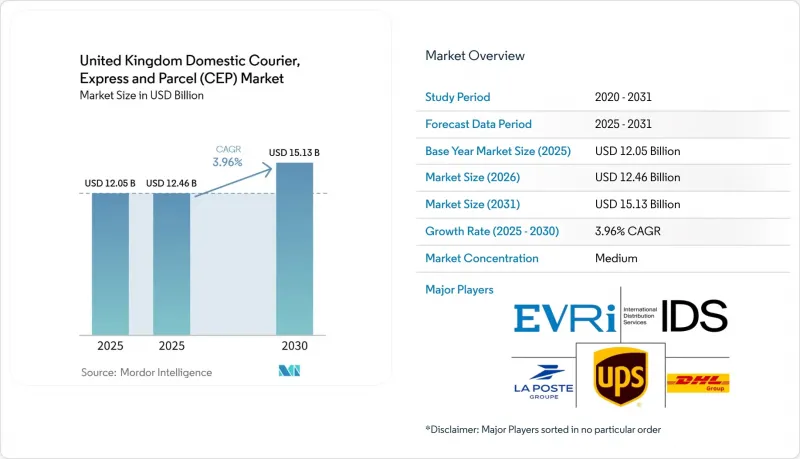
Mordor Intelligence에 의하면, 영국의 국내 택배, 익스프레스 및 소포(CEP) 시장 규모는 2025년 120억 5,000만 달러로 평가되었고, 2026년에는 124억 6,000만 달러로 추정되고, 2031년까지 151억 3,000만 달러에 이를 것으로 예상되고 있으며, 2026-2031년 CAGR 3.96%로 성장할 전망입니다.
본 보고서는 배송 속도별(특급 배송, 비특급 배송), 출하 중량별(경량 화물, 중량 화물 등), 최종 이용 산업별(전자상거래, 제조업 등), 비즈니스 모델별(B2B 등), 운송 수단별(도로, 항공, 기타)로 분류되어 있습니다. 시장 전망은 금액(달러) 기준으로 제시되어 있습니다.
영국의 국내 택배, 익스프레스 및 소포(CEP) 시장 동향 및 인사이트
옴니채널 풀필먼트(Omni-channel Fulfillment)를 도입하는 중소기업이 주도하는 전자상거래 소포 처리량 성장
중소 소매업체들은 온라인과 오프라인 매장의 재고를 통합하고 있으며, 이로 인해 소포 밀도가 높아지고 국내 택배 네트워크로의 주문이 증가하고 있습니다. 브렉시트 이후 공급망의 국내화로 인해 물류 관리자의 57%가 현재 국내에서 상품을 조달하고 있어, 영국 국내 택배 시장의 배송 흐름이 더욱 집중되고 있습니다. 물류 기업 1곳당 평균 3만 8,315달러에 달하는 정부의 AI 보조금은 중소기업이 수요를 정확하게 예측할 수 있도록 지원하며, 과거에는 처리 능력을 한계에 몰아넣었던 수요의 피크를 평준화하고 있습니다. 가시성이 향상됨에 따라 운송업체는 배송 차량을 동적으로 배차할 수 있게 되어, 중량 화물의 지속적인 성장을 뒷받침하고 수익의 회복력을 강화하고 있습니다.
런던 및 주요 도시에서 라스트 마일 거리를 단축하는 도시형 마이크로 풀필먼트 센터
액센츄어의 분석에 따르면, 적절한 위치에 설치된 마이크로 풀필먼트 센터(MFC)는 인구 밀도가 높은 도시에서 배송용 밴의 주행 거리를 최대 26%까지 줄일 수 있으며, 배출량과 라스트 마일 비용을 동시에 절감할 수 있는 것으로 추정됩니다. 런던교통국(TfL)은 MFC가 일정 수에 도달하면 배송 교통량이 13% 감소할 것으로 예측하고 있으며, 이 결과는 이미 차량의 96.7%가 충족하고 있는 엄격한 초저배출구역(ULEZ) 규제와 부합합니다. 아마존의 철도 연계형 물류 센터는 MFC가 국가 인프라와 어떻게 통합될 수 있는지를 보여주는 좋은 사례이며, 이를 통해 전기 트럭은 주행 거리 불안감 없이 배송의 마지막 구간을 완수할 수 있게 됩니다. 특히, 온도 변동을 허용할 수 없는 콜드체인 의약품 운송의 경우, 거점의 근접성이 큰 이점이 됩니다.
심각한 운전기사 부족이 라스트 마일 업무의 임금 상승을 가속화
Logistics UK의 데이터에 따르면, 운송업체들이 희소한 인재 확보를 위한 경쟁을 벌이는 가운데, 최근 보고 기간 동안 대형 화물 차량 운전기사의 임금은 12% 상승했습니다. 운전자의 평균 연령은 현재 50세를 넘어섰으며, 브렉시트 이후 유럽에서의 신규 채용이 감소하는 가운데 후임자 확보 문제는 더욱 심각해지고 있습니다. 정부는 트럭 정류장 개보수에 1,600만 달러를 배정했으나, 특히 고객과의 직접 접촉이 있어 자동화가 제한되는 라스트 마일 업무에서는 채용 공석률이 높은 수준을 유지하고 있습니다. 임금 상승은 이익률을 압박하고 있으며, 사업자들은 인건비를 상쇄하기 위해 자율주행 솔루션과 전기화 방향으로 나아가고 있습니다.
부문별 분석
2025년 영국 국내 택배 시장에서 전자상거래의 점유율은 30.17%를 차지했으나, 의류 등 주요 카테고리의 침투율은 정체되어 있으며, 성장률은 시장 전체의 평균 수준에 머물고 있습니다. 대조적으로, 의료 관련 배송은 환자에게 직접 배송을 수행하는 약국 서비스와 프리미엄 가격 책정을 뒷받침하는 엄격한 콜드체인 기준에 힘입어 연평균 성장률(CAGR) 6.37%(2026-2031년)로 확대될 것으로 예측됩니다. 영국 국내 택배 업계에서는 생물학적 제제의 온도를 8℃ 이하로 유지하기 위한 단열 사양의 전기자동차(EV) 밴과 데이터 로깅 장치에 대한 의존도가 높아지고 있습니다.
제조업에서는 국내 공급업체들이 국경에서의 혼란에 대비해 적시 생산(JIT) 방식을 채택하고 있어 수요가 안정적입니다. 한편, 금융 서비스 업계에서는 디지털화가 진행되고 있음에도 불구하고 안전한 서류 송부가 계속해서 요구되고 있습니다. 재생에너지 관련 부품 및 전기차(EV) 부품은 ‘기타’ 범주로 분류되며, 산발적이긴 하지만 수익성이 높은 초대형 소포 수요를 창출하고 있어, 전문 취급 인증을 보유한 운송업체가 이 수요를 확보할 수 있습니다.
특급 배송 서비스는 가장 빠르게 확대되고 있는 부문으로, 연평균 성장률(CAGR) 5.98%(2026-2031년)로 성장하고 있습니다. 한편, 2025년 기준으로 비특급 배송 서비스는 영국 국내 택배 시장 규모의 73.03%를 차지했습니다. 현재 30곳의 배송 센터에서 운영 중인 DPD의 자율 주행 로봇은 특급 배송 사업자가 인건비 급등을 억제하면서도 당일 배송 목표를 지속적으로 달성할 수 있는 좋은 사례입니다. 소매업체들이 확실한 배송을 중시하는 경향에 따라 프리미엄 요금이 설정되어, 이를 통해 높은 기술 투자 비용이 상쇄되고 있습니다. 비특급 배송 사업자들은 비용 우위를 실현하기 위해 노선 통합을 중시하고 있으며, 이로 인해 영국의 국내 택배 시장은 비용을 중시하는 고객층과 속도를 중시하는 고객층 모두에게 서비스를 제공할 수 있는 체제가 갖춰져 있습니다.
DPD, Evri-DHL, 로열 메일은 현재 API를 통해 수거 마감 시간을 공개하고 있으며, 이를 통해 판매업체는 익일 도착을 저해하지 않으면서도 더 늦은 주문 마감 시간을 설정할 수 있게 되었습니다. 동시에, 로열 메일이 국내 배송 운항 횟수를 절반으로 줄임으로써 익일 배송 실적을 유지하면서도 연간 3만 톤의 CO₂ 배출량을 감축하고 있습니다. 비용과 CO₂ 배출량의 이러한 이중 최적화를 통해 특급 배송 서비스는 계속해서 영국 국내 택배 시장의 중요한 축으로 자리매김하고 있으며, 한편 표준 서비스는 대량의 전자상거래 물류를 뒷받침하는 기반이 되고 있습니다.
기타 혜택 :
- Excel 형식 시장 예측(ME) 시트
- 3개월간의 애널리스트 지원
자주 묻는 질문
목차
제1장 서론
제2장 분석 방법
제3장 주요 요약
제4장 시장 구도
제5장 시장 규모 및 성장 예측
제6장 경쟁 구도
제7장 시장 기회 및 향후 전망
AJY 26.08.07According to Mordor Intelligence, the United Kingdom domestic courier, express and parcel market size is expected to increase from USD 12.05 billion in 2025 to USD 12.46 billion in 2026 and reach USD 15.13 billion by 2031, growing at a CAGR of 3.96% over 2026-2031.
This report is Segmented by Speed of Delivery (Express and Non-Express), by Shipment Weight (Light Weight Shipments, Medium Weight Shipments and More), by End User Industry (E-Commerce, Manufacturing and More), by Model (Business-To-Business (B2B) and More) and by Mode of Transport (Road, Air, and Others). The Market Forecasts are Provided in Terms of Value (USD).
United Kingdom Domestic Courier, Express and Parcel (CEP) Market Trends and Insights
Growth in E-commerce Parcel Volumes Driven by SMEs Adopting Omnichannel Fulfillment
Small and medium-sized retailers are integrating online and store inventory, which lifts parcel density and pushes more orders into domestic courier networks. Post-Brexit localization of supply chains means 57% of logistics managers now source goods domestically, further concentrating shipment flows inside the United Kingdom domestic courier market. Government AI grants averaging USD 38,315 per logistics firm help SMEs forecast demand accurately, smoothing peaks that once strained capacity. Higher visibility encourages carriers to allocate vans dynamically, supporting sustained medium-weight growth and underpinning revenue resilience.
Urban Micro-Fulfillment Centers Shortening Last-Mile Distances in London and Major Cities
Accenture analysis estimates that well-placed Micro-fulfillment centers (MFCs) can reduce parcel-van km by up to 26% in dense cities, cutting emissions and last-mile costs simultaneously. Transport for London projects a 13% drop in delivery traffic once a critical MFC mass is reached, an outcome that dovetails with strict Ultra Low Emission Zone (ULEZ) rules already met by 96.7% of vehicles. Amazon's rail-connected depots exemplify how MFCs integrate with national infrastructure, enabling electric trucks to complete the final leg of delivery without range anxiety. Closer proximity especially benefits cold-chain pharmaceutical shipments that cannot tolerate temperature excursions.
Acute Driver Shortages Amplifying Wage Inflation in Last-Mile Operations
Logistics UK data show heavy-goods-vehicle driver pay increased 12% in the most recent reporting window as haulers bid for scarce talent. Average driver age now exceeds 50, intensifying replacement challenges as European recruits decline post-Brexit. Although the government earmarked USD 16 million for truck-stop upgrades, vacancy rates remain high, particularly in last-mile roles where direct customer contact limits automation. Elevated wages compress margins and push operators toward autonomous solutions and electrification to offset personnel costs.
Other drivers and restraints analyzed in the detailed report include:
- Expansion of Out-of-Home Delivery Networks Reducing Failed Deliveries
- On-Demand Gig Couriers Catering to less than 30-Minute Delivery Market
- High Customer Expectation for Free Returns Increasing Reverse Logistics Cost Pressure
For complete list of drivers and restraints, kindly check the Table Of Contents.
Segment Analysis
E-commerce commanded 30.17% of the United Kingdom domestic courier market share in 2025, however, penetration levels in core categories such as apparel are flattening, moderating growth to the overall market rate. In contrast, Healthcare deliveries are forecast to expand at 6.37% CAGR (2026-2031), propelled by direct-to-patient pharmacy services and stringent cold-chain standards that favor premium pricing. The United Kingdom domestic courier industry increasingly relies on insulated EV vans and data-logging devices that ensure temperatures of 8 °C or lower for biologics.
Manufacturing maintains consistent demand as domestic suppliers adopt just-in-time flows to guard against border disruption, while Financial Services continue to require secure document transfer despite digitalization. Renewable-energy components and EV parts enter the Others bucket, creating sporadic but lucrative oversized-parcel demand that carriers with specialist handling endorsements can capture.
Express services represented the faster-expanding tier, growing at a 5.98% CAGR (2026-2031), while non-express accounted for 73.03% of the United Kingdom domestic courier market size in 2025. DPD's autonomous robots, now active at 30 depots, illustrate how Express players can contain rising labor costs while still meeting same-day windows. Retailer preference for guaranteed delivery drives premium rates that offset higher technological outlays. Non-Express operators emphasize route consolidation to achieve cost advantages, positioning the United Kingdom domestic courier market to serve both value-driven and speed-sensitive customer segments.
DPD, Evri-DHL, and Royal Mail now publish late-collection cut-off times via API, permitting merchants to offer later order deadlines without jeopardizing next-day arrival. At the same time, Royal Mail's halving of domestic flights removes 30,000 tons of CO2 annually while safeguarding next-day performance. This dual optimization of cost and carbon ensures Express remains a key contributor to the United Kingdom domestic courier market while standard services anchor high-volume e-commerce flows.
Complete Report Scope:
- Speed of Delivery
- Express
- Non-Express
- Shipment Weight
- Heavy Weight Shipments
- Light Weight Shipments
- Medium Weight Shipments
- End User Industry
- E-Commerce
- Financial Services (BFSI)
- Healthcare
- Manufacturing
- Primary Industry
- Wholesale and Retail Trade (Offline)
- Others
- Model
- Business-to-Business (B2B)
- Business-to-Consumer (B2C)
- Consumer-to-Consumer (C2C)
- Mode of Transport
- Road
- Air
- Others
List of Companies Covered in this Report:
- AnyVan, Ltd. (Owned by Vitruvian Partners LLP)
- ArrowXL, Ltd.
- ComfortDelGro (Including Addison Lee, Ltd.)
- DHL Group
- DX Group (Owned by H.I.G. Capital, LLC)
- Evri, Ltd. (Acquired by Apollo Global Management)
- FedEx
- Freedom Couriers, Ltd.
- InPost (Including Yodel Delivery Network Ltd./Judge Logistics, Ltd.)
- International Distribution Services PLC (Including Royal Mail)
- Kuehne+Nagel (Including QUICK UP)
- LaPoste Group (Including DPD Group, and CitySprint (UK), Ltd.)
- Menzies Distribution, Ltd. (Including Gnewt Cargo, Ltd.)
- Parker Couriers (Part of Parker Car Service)
- Quickshift UK, Ltd.
- Rapid Fleet, Ltd.
- Redhead Couriers, Ltd.
- Speedy Fleet, Ltd.
- TVS SCS Courier Services (Part of TVS Group)
- United Parcel Service of America, Inc. (UPS)
- Whistl UK, Ltd.
Additional Benefits:
- The market estimate (ME) sheet in Excel format
- 3 months of analyst support
TABLE OF CONTENTS
1 Introduction
- 1.1 Study Assumptions and Market Definition
- 1.2 Scope of the Study
2 Research Methodology
3 Executive Summary
4 Market Landscape
- 4.1 Market Overview
- 4.2 Demographics
- 4.3 GDP Distribution by Economic Activity
- 4.4 GDP Growth by Economic Activity
- 4.5 Inflation
- 4.6 Economic Performance and Profile
- 4.6.1 Trends in E-Commerce Industry
- 4.6.2 Trends in Manufacturing Industry
- 4.7 Transport and Storage Sector GDP
- 4.8 Export Trends
- 4.9 Import Trends
- 4.10 Fuel Price
- 4.11 Infrastructure
- 4.12 Regulatory Framework
- 4.13 Value Chain and Distribution Channel Analysis
- 4.14 Value Chain and Distribution Channel Analysis
- 4.15 Market Drivers
- 4.15.1 Growth in E-Commerce Parcel Volumes Driven by SMEs Adopting Omnichannel Fulfilment
- 4.15.2 Urban Micro-Fulfilment Centers Shortening Last-Mile Distances in London and Major Cities
- 4.15.3 Expansion of Out-of-Home Delivery Networks (Parcel Lockers and Shops) Reducing Failed Deliveries
- 4.15.4 On-Demand Gig Couriers, Empowered by Digital Tools, are Now Catering to the Sub-30-Minute Delivery Market
- 4.15.5 Retailer Consolidation of Delivery Partnerships Boosting Premium Same-Day Growth
- 4.15.6 Government Net-Zero Incentives Accelerating Electric Delivery-Van Fleet Adoption
- 4.16 Market Restraints
- 4.16.1 Acute Driver Shortages Amplifying Wage Inflation in Last-Mile Operations
- 4.16.2 Congestion and Clean Air Zone Charges Eroding Margins for Diesel-Heavy Fleets
- 4.16.3 High Customer Expectation for Free Returns Increasing Reverse Logistics Cost Pressure
- 4.16.4 Surge in Parcel Locker Vandalism Heightens Capital Expenditure Risks for Delivery Networks
- 4.17 Technology Innovations in the Market
- 4.18 Porter's Five Forces Analysis
- 4.18.1 Competitive Rivalry
- 4.18.2 Bargaining Power of Buyers
- 4.18.3 Bargaining Power of Suppliers
- 4.18.4 Threat of New Entrants
- 4.18.5 Threat of Substitutes
5 Market Size and Growth Forecasts (Value, USD)
- 5.1 Speed of Delivery
- 5.1.1 Express
- 5.1.2 Non-Express
- 5.2 Shipment Weight
- 5.2.1 Heavy Weight Shipments
- 5.2.2 Light Weight Shipments
- 5.2.3 Medium Weight Shipments
- 5.3 End User Industry
- 5.3.1 E-Commerce
- 5.3.2 Financial Services (BFSI)
- 5.3.3 Healthcare
- 5.3.4 Manufacturing
- 5.3.5 Primary Industry
- 5.3.6 Wholesale and Retail Trade (Offline)
- 5.3.7 Others
- 5.4 Model
- 5.4.1 Business-to-Business (B2B)
- 5.4.2 Business-to-Consumer (B2C)
- 5.4.3 Consumer-to-Consumer (C2C)
- 5.5 Mode of Transport
- 5.5.1 Road
- 5.5.2 Air
- 5.5.3 Others
6 Competitive Landscape
- 6.1 Market Concentration
- 6.2 Key Strategic Moves
- 6.3 Market Share Analysis
- 6.4 Company Profiles (Includes Global Level Overview, Market Level Overview, Core Segments, Financials as Available, Strategic Information, Market Rank/Share for Key Companies, Products and Services, and Recent Developments)
- 6.4.1 AnyVan, Ltd. (Owned by Vitruvian Partners LLP)
- 6.4.2 ArrowXL, Ltd.
- 6.4.3 ComfortDelGro (Including Addison Lee, Ltd.)
- 6.4.4 DHL Group
- 6.4.5 DX Group (Owned by H.I.G. Capital, LLC)
- 6.4.6 Evri, Ltd. (Acquired by Apollo Global Management)
- 6.4.7 FedEx
- 6.4.8 Freedom Couriers, Ltd.
- 6.4.9 InPost (Including Yodel Delivery Network Ltd./Judge Logistics, Ltd.)
- 6.4.10 International Distribution Services PLC (Including Royal Mail)
- 6.4.11 Kuehne+Nagel (Including QUICK UP)
- 6.4.12 LaPoste Group (Including DPD Group, and CitySprint (UK), Ltd.)
- 6.4.13 Menzies Distribution, Ltd. (Including Gnewt Cargo, Ltd.)
- 6.4.14 Parker Couriers (Part of Parker Car Service)
- 6.4.15 Quickshift UK, Ltd.
- 6.4.16 Rapid Fleet, Ltd.
- 6.4.17 Redhead Couriers, Ltd.
- 6.4.18 Speedy Fleet, Ltd.
- 6.4.19 TVS SCS Courier Services (Part of TVS Group)
- 6.4.20 United Parcel Service of America, Inc. (UPS)
- 6.4.21 Whistl UK, Ltd.
7 Market Opportunities and Future Outlook
- 7.1 White-Space and Unmet-Need Assessment


