

|
시장보고서
상품코드
2097431
독일의 AI 기반 에너지 관리 소프트웨어 : 시장 점유율 분석, 업계 동향과 통계, 성장 예측(2026-2031년)Germany AI-powered Energy Management Software - Market Share Analysis, Industry Trends & Statistics, Growth Forecasts (2026 - 2031) |
||||||
 Mordor Intelligence
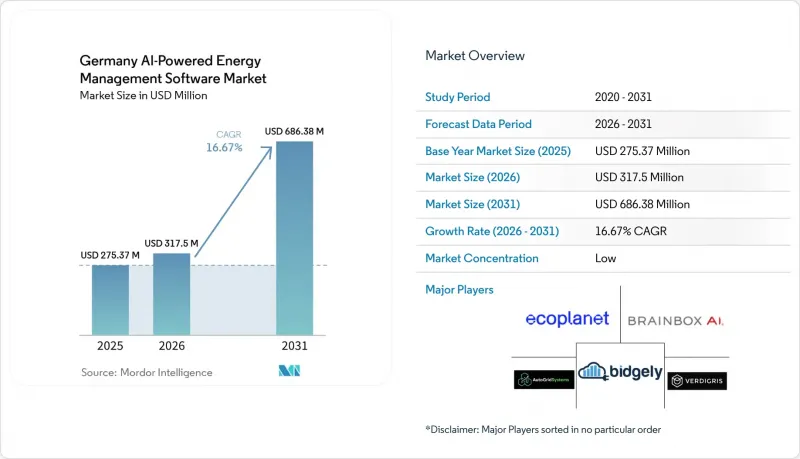
Mordor Intelligence에 의하면, 독일의 AI 기반 에너지 관리 소프트웨어 시장 규모는 2025년 2억 7,537만 달러에서 2026년에는 3억 1,750만 달러로 확대되고, 2031년까지 6억 8,638만 달러에 이를 것으로 예상되고 있으며, 2026-2031년 CAGR 16.67%를 기록할 전망입니다.
본 보고서는 구성 요소(소프트웨어, 서비스), 배포 방식(클라우드 기반, On-Premise형, 하이브리드형), 용도(에너지 소비, 자산 성과, 스마트 그리드, 재생 에너지 예측, 에너지 거래) 및 최종 사용자(유틸리티, 상업용 건물, 산업 시설, 주택)별로 분류되어 있습니다. 시장 전망은 금액(달러) 기준으로 제시되어 있습니다.
독일 AI 기반 에너지 관리 소프트웨어 시장 동향 및 인사이트
송전망 유연성에 대한 요구 증가
2030년까지 재생에너지에 의한 전력 공급 비율을 80%로 높이고, 2035년까지 화석 연료에 의존하지 않는 발전을 실현하겠다는 독일의 목표에 따라, 송전망 사업자들은 보다 신속한 디지털 균형 조정 도구에 의존할 수밖에 없는 상황에 놓여 있습니다. Dena SET Pilot 4 실증 실험에서는 비주거용 건물에서 AI를 활용한 유연성 제어가 실제 운영 환경에서 동적 요금 체계 및 시간 변동형 송전망 요금과 연동되어 작동한다는 사실이 입증되었습니다. 이는 재생에너지의 출력, 건물 수요, 그리고 유연한 부하가 단시간 내에 변동할 경우 수동 제어 방식으로는 대응하기 어렵기 때문에 중요한 의미를 지닙니다. 따라서 독일의 AI 활용형 에너지 관리 소프트웨어 시장에서는 지연을 최소화하면서 예측, 배전, 최적화를 수행할 수 있는 플랫폼에 대한 수요가 높아지고 있습니다. 이러한 요인은 산업용 부하 밀도가 높고 전력 계통의 안정성에 대한 요구가 더욱 시급한 지역에서 특히 두드러집니다.
AI를 활용한 부하 관리에 대한 수요 증가
독일의 상업 및 산업 부문 전력 사용은 전기화의 진전으로 인해 더욱 큰 압박을 받고 있으며, 이로 인해 유연하고 데이터 기반의 부하 제어의 가치가 높아지고 있습니다. Dena의 시범 프로젝트를 통해 하이브리드형 클라우드·엣지 AI 에너지 관리 시스템이 실제 운영 요구에 부합하는 방식으로 동적 요금 체계와 변동하는 계통 요금에 대응할 수 있음이 확인되었습니다. 또한 C3 AI는 기업용 에너지 도입 사례에서 고주파 예측을 통해 단일 의사결정 환경 내에서 부하 신호와 가격 신호를 통합할 수 있음을 입증했습니다. 구매자들은 현재 이러한 도구를 단순한 선택적 분석 도구로만 보지 않고, 피크 시간대의 부하 위험을 줄이고 운영 관리를 개선하는 수단으로 인식하고 있습니다. 수요 관리가 단순한 시범 사례가 아니라 일상적인 운영 요건이 되어가고 있는 만큼, 독일의 AI 기반 에너지 관리 소프트웨어 시장은 이러한 변화의 혜택을 누리고 있습니다.
분산된 건물 데이터와 레거시 인프라
독일은 2025년 2월, ‘Messstellenbetriebsgesetz(계측점 운영법)’을 개정하여 스마트 계량기 도입을 가속화했으나, 그 도입 현황은 여전히 에너지 전환이 요구하는 수준에는 미치지 못하는 것으로 밝혀졌습니다. 또한 Dena는 AI 기반 유연성 제어를 확대하기 위한 미해결 구조적 과제 중 하나로 스마트 미터 도입 가속화를 꼽고 있습니다. 건물이나 유틸리티 시스템이 여전히 불완전한 장비, 계량기, 제어 기록 하에서 운영되고 있다면, AI 모델은 불충분한 입력 데이터로 시작하게 됩니다. 이로 인해 독일의 AI 기반 에너지 관리 소프트웨어 시장은 성장세가 주춤하고 있습니다. 구매자들은 기존 자산 포트폴리오 전체로 확대를 진행하기 전에 성능 입증을 요구하고 있기 때문입니다. 따라서 장기적인 수요 여건이 양호하더라도 레거시 인프라는 여전히 실질적인 장벽으로 작용하고 있습니다.
부문 분석
2025년, 독일의 AI 기반 에너지 관리 시스템 시장에서 소프트웨어가 68.12%의 점유율을 차지했습니다. 이는 구매자들이 하드웨어 중심의 업데이트 주기보다 적응성이 높은 디지털 레이어를 우선시하고 있음을 보여줍니다. 소프트웨어가 주도적인 위치를 차지하고 있는 것은 이미 도입된 시스템을 전면적으로 재구축할 필요 없이 기존의 빌딩 자동화, 스마트 미터 게이트웨이 및 전력 회사의 제어 환경과 연동할 수 있는 능력 덕분입니다. 독일의 AI 기반 에너지 관리 소프트웨어 시장에서도 소프트웨어가 우위를 점하고 있습니다. 이는 발전 구성이나 요금 환경의 변화에 따라 구독 모델을 통해 예측 및 최적화 로직을 업데이트할 수 있기 때문입니다. 도입 후 구현, 모델 재학습, 지원, 운영 조정이 지속됨에 따라 서비스 분야는 2031년까지 연평균 성장률(CAGR) 18.23%로 확대될 것으로 예측됩니다.
또한, 이 부문은 단일 목적의 도구에서 예측, 모니터링, 예측 유지보수, 수요 반응을 단일 운영 계층으로 통합한 플랫폼으로의 전환에 의해 형성되고 있습니다. 유틸리티, 빌딩, 산업 시설 분야의 구매자들은 시스템의 분산화를 줄이려고 노력하고 있으며, 이는 독일의 AI 기반 에너지 관리 소프트웨어 시장에서 소프트웨어의 더 광범위한 채택을 촉진하고 있습니다. 2026년 1월, Itron은 마이크로소프트와의 제휴를 강화하고 생성형 AI 기술을 ‘Intelligent Edge Operating System’에 통합했습니다. 이는 주요 벤더들이 기존 인프라 전반에 걸쳐 소프트웨어 기능을 확장하고 있음을 보여주는 좋은 사례입니다. 따라서 소프트웨어는 여전히 핵심 부문으로 남아 있는 반면, 도입의 운영상 복잡성이 증가함에 따라 서비스 부문의 성장은 가속화되고 있습니다.
2025년, 독일의 AI 기반 에너지 관리 소프트웨어 시장 규모 중 클라우드 기반 도입이 52.04%를 차지했습니다. 이는 확장 용이성, 초기 비용 절감, 그리고 최신 AI 도구에 대한 신속한 접근이 뒷받침한 결과입니다. 운영 데이터 및 현장 수준의 의사결정 과정에 대해 보다 엄격한 로컬 제어를 요구하는 사업자에게는 On-Premise 환경이 여전히 중요합니다. 하이브리드 배포는 로컬에서의 응답 속도와 연결된 자산 전반에 걸친 광범위한 최적화를 양립시킬 수 있기 때문에 2031년까지 연평균 성장률(CAGR) 18.97%를 나타낼 것으로 예측됩니다. 현장의 응답성과 중앙 집중식 분석이 모두 중요시되는 독일의 AI 기반 에너지 관리 소프트웨어 시장에서 이러한 균형은 매우 중요합니다.
Dena의 파일럿 프로젝트에서는 비주거용 건물에서 AI 기반 유연성 제어에 하이브리드 클라우드·엣지 아키텍처를 채택하여 실용적인 참고 사례를 제시했습니다. 이 모델이 효과적인 이유는 시설이 현장에서 신속하게 대응하면서도 최적화 및 학습을 위해 광범위한 데이터 세트를 활용할 수 있기 때문입니다. 따라서 독일의 AI 기반 에너지 관리 소프트웨어 시장은 단순한 ‘클라우드 대 On-Premise’라는 선택을 넘어, 제어 속도, 감사 가능성, 통합의 깊이를 축으로 한 도입 모델로 전환되고 있습니다. 엣지와 클라우드를 가로지르는 원활한 데이터 흐름을 입증할 수 있는 벤더는 유틸리티 및 산업 분야의 입찰에서 더 많은 수주를 확보할 가능성이 높을 것입니다.
기타 혜택:
- 엑셀 형식 시장 예측(ME) 시트
- 3개월간의 애널리스트 지원
자주 묻는 질문
목차
제1장 서론
제2장 조사 방법
제3장 주요 요약
제4장 시장 구도
제5장 시장 규모와 성장 예측
제6장 경쟁 구도
제7장 시장 기회와 향후 전망
KTH 26.08.06According to Mordor Intelligence, the Germany AI-powered energy management software market size is expected to increase from USD 275.37 million in 2025 to USD 317.50 million in 2026 and reach USD 686.38 million by 2031, growing at a CAGR of 16.67% over 2026-2031.
This report is Segmented by Component (Software, Services), Deployment Mode (Cloud-Based, On-Premises, Hybrid), Application (Energy Consumption, Asset Performance, Smart Grid, Renewable Forecasting, Energy Trading), and End User (Utilities, Commercial Buildings, Industrial Facilities, Residential Buildings). The Market Forecasts are in Terms of Value (USD).
Germany AI-powered Energy Management Software Market Trends and Insights
Accelerating Grid Flexibility Requirements
Germany's target to move to 80% renewable electricity by 2030 and fossil-free power generation by 2035 is pushing grid operators to rely on faster digital balancing tools. The Dena SET Pilot 4 showed that AI-based control of flexibility in nonresidential buildings can operate with dynamic tariffs and time-variable grid charges in a real operating environment. That matters because manual control methods cannot keep pace when renewable output, building demand, and flexible loads shift across short time intervals. The Germany AI-powered Energy Management Software Market is therefore seeing stronger demand for platforms that can forecast, dispatch, and optimize with limited delay. This driver is strongest where industrial load density is high, and grid stability needs are more immediate.
Rising Demand For AI-Driven Load Management
Germany's commercial and industrial power use is under added pressure from electrification, which is increasing the value of flexible and data-driven load control. The Dena pilot confirmed that a hybrid cloud-edge AI energy management system can respond to dynamic tariffs and variable grid charges in ways that align with real operating needs. C3 AI has also demonstrated in enterprise energy deployments that high-frequency forecasting can combine load and price signals within a single decision environment. Buyers now see these tools less as optional analytics and more as a way to reduce peak exposure and improve operational control. The Germany AI-powered Energy Management Software Market is benefiting from this shift, as demand management is becoming a daily operating requirement rather than a pilot use case.
Fragmented Building Data And Legacy Infrastructure
Germany amended the Messstellenbetriebsgesetz in February 2025 to accelerate smart meter rollout, which showed that deployment was still behind what the energy transition requires. Dena also identified faster smart meter rollout as one of the unresolved structural conditions for scaling AI-based flexibility control. Where buildings and utility systems still operate with incomplete device, meter, and control records, AI models start from weaker inputs. That slows the Germany AI-powered Energy Management Software Market because buyers want proof of performance before they expand deployments across older portfolios. Legacy infrastructure, therefore, remains a practical barrier even when long-term demand conditions are favorable.
Other drivers and restraints analyzed in the detailed report include:
- Expanding Smart Building Retrofit Programs
- Growing Need For Automated Energy Compliance
- Cybersecurity And Data Sovereignty Concerns
For complete list of drivers and restraints, kindly check the Table Of Contents.
Segment Analysis
Software captured 68.12% of the German AI-Powered Energy Management System market in 2025, which shows that buyers are prioritizing adaptable digital layers over hardware-led replacement cycles. Software leadership is tied to its ability to work with existing building automation, smart meter gateways, and utility control environments without forcing a full rebuild of installed systems. The Germany AI-powered Energy Management Software Market also favors software, as subscription models can update forecasting and optimization logic as the generation mix and tariff environment change. Services are projected to expand at a 18.23% CAGR through 2031, as implementation, model retraining, support, and operational tuning continue after the initial rollout.
This segment is also shaped by the move away from single-purpose tools toward platforms that combine forecasting, monitoring, predictive maintenance, and demand response in a single operating layer. Buyers across utilities, buildings, and industrial sites are trying to reduce system fragmentation, which supports broader software adoption in the Germany AI-powered Energy Management Software Market. In January 2026, Itron deepened its Microsoft collaboration and integrated generative AI technology into the Intelligent Edge Operating System, demonstrating how major vendors are expanding software capabilities across their installed infrastructure base. Software, therefore, remains the anchor segment, while services grow faster as deployments become more operationally complex.
Cloud-based deployment held 52.04% of the Germany AI-powered Energy Management Software Market size in 2025, supported by easier scaling, lower upfront burden, and faster access to updated AI tools. On-premises setups still matter where operators want tighter local control over operational data and site-level decision paths. Hybrid deployment is projected to grow at a 18.97% CAGR through 2031, as it combines local response speed with broader optimization across connected assets. That balance is important in the Germany AI-powered Energy Management Software Market, where site responsiveness and centralized analytics both carry weight.
The Dena pilot provided a practical reference point by using a hybrid cloud-edge architecture for AI-based flexibility control in a non-residential building. The model works because facilities can react quickly on-site while still using broader datasets for optimization and learning. The Germany AI-powered Energy Management Software Market is therefore moving beyond a simple cloud-versus-on-premises choice toward deployment models built around control speed, auditability, and integration depth. Vendors that can demonstrate clean data flows across the edge and the cloud are likely to win more utility and industrial tenders.
Complete Report Scope:
- By Component
- Software
- Services
- By Deployment Mode
- Cloud-Based
- On-Premises
- Hybrid
- By Application
- Energy Consumption and Demand Optimization
- Asset Performance and Predictive Maintenance
- Smart Grid and Distributed Energy Resource (DER) Management
- Renewable Energy Forecasting and Integration
- Energy Trading, Pricing and Market Intelligence
- By End User
- Utilities
- Commercial Buildings
- Industrial Facilities
- Residential Buildings
List of Companies Covered in this Report:
- AutoGrid Systems, Inc.
- Bidgely, Inc.
- BrainBox AI Inc.
- BuildingIQ, Inc.
- C3.AI, Inc.
- Carbon Lighthouse, Inc.
- CopperTree Analytics Inc.
- DEXMA Sensors, S.L.
- ecoplanet GmbH
- EnergyCAP, LLC
- Enertiv, Inc.
- Flexidao Ltd.
- GridPoint, Inc.
- Green Fusion GmbH
- Itron, Inc.
- KODE Labs, Inc.
- Landis+Gyr Group AG
- Lumenaza GmbH
- Open Energy Solutions GmbH
- Optiwatt, Inc.
- Pecan Street Inc.
- Smappee NV
- Spacewell International N.V.
- Tibber AS
- Verdigris Technologies, Inc.
- Wattics Limited
- 7Signal, LLC
- WiredScore, Inc.
- ZE PowerGroup Inc.
- ZENNER International GmbH & Co. KG
Additional Benefits:
- The market estimate (ME) sheet in Excel format
- 3 months of analyst support
TABLE OF CONTENTS
1 INTRODUCTION
- 1.1 Study Assumptions and Market Definition
- 1.2 Scope of the Study
2 RESEARCH METHODOLOGY
3 EXECUTIVE SUMMARY
4 MARKET LANDSCAPE
- 4.1 Market Overview
- 4.2 Market Drivers
- 4.2.1 Accelerating Grid Flexibility Requirements From Renewables and Electrification
- 4.2.2 Rising Demand for AI-Driven Load Forecasting and Peak Shaving
- 4.2.3 Expanding Smart Building Retrofits Across Commercial Portfolios
- 4.2.4 Growing Need for Automated Energy Cost and Carbon Optimization
- 4.2.5 Utility Incentives for Demand Response and Distributed Energy Resource Orchestration
- 4.2.6 Increased Adoption of Edge-Aware Analytics for Real-Time Energy Control
- 4.3 Market Restraints
- 4.3.1 Fragmented Building Data and Legacy System Interoperability Gaps
- 4.3.2 Cybersecurity and Data Sovereignty Concerns for Operational Technology Data
- 4.3.3 High Integration and Change Management Costs for Midmarket Buyers
- 4.3.4 Limited Trust in Autonomous Control Decisions in Safety-Critical Assets
- 4.4 Industry Value Chain Analysis
- 4.5 Impact of Macroeconomic Factors on the Market
- 4.6 Regulatory Landscape
- 4.7 Technological Outlook
- 4.8 Porter's Five Forces Analysis
- 4.8.1 Bargaining Power of Suppliers
- 4.8.2 Bargaining Power of Buyers
- 4.8.3 Threat of New Entrants
- 4.8.4 Threat of Substitutes
- 4.8.5 Competitive Rivalry
5 MARKET SIZE AND GROWTH FORECASTS (VALUE)
- 5.1 By Component
- 5.1.1 Software
- 5.1.2 Services
- 5.2 By Deployment Mode
- 5.2.1 Cloud-Based
- 5.2.2 On-Premises
- 5.2.3 Hybrid
- 5.3 By Application
- 5.3.1 Energy Consumption and Demand Optimization
- 5.3.2 Asset Performance and Predictive Maintenance
- 5.3.3 Smart Grid and Distributed Energy Resource (DER) Management
- 5.3.4 Renewable Energy Forecasting and Integration
- 5.3.5 Energy Trading, Pricing and Market Intelligence
- 5.4 By End User
- 5.4.1 Utilities
- 5.4.2 Commercial Buildings
- 5.4.3 Industrial Facilities
- 5.4.4 Residential Buildings
6 COMPETITIVE LANDSCAPE
- 6.1 Market Concentration
- 6.2 Strategic Moves
- 6.3 Market Share Analysis
- 6.4 Company Profiles (includes Global Level Overview, Market Level Overview, Core Segments, Financials as available, Strategic Information, Market Rank/Share, Products and Services, Recent Developments)
- 6.4.1 AutoGrid Systems, Inc.
- 6.4.2 Bidgely, Inc.
- 6.4.3 BrainBox AI Inc.
- 6.4.4 BuildingIQ, Inc.
- 6.4.5 C3.ai, Inc.
- 6.4.6 Carbon Lighthouse, Inc.
- 6.4.7 CopperTree Analytics Inc.
- 6.4.8 DEXMA Sensors, S.L.
- 6.4.9 ecoplanet GmbH
- 6.4.10 EnergyCAP, LLC
- 6.4.11 Enertiv, Inc.
- 6.4.12 Flexidao Ltd.
- 6.4.13 GridPoint, Inc.
- 6.4.14 Green Fusion GmbH
- 6.4.15 Itron, Inc.
- 6.4.16 KODE Labs, Inc.
- 6.4.17 Landis+Gyr Group AG
- 6.4.18 Lumenaza GmbH
- 6.4.19 Open Energy Solutions GmbH
- 6.4.20 Optiwatt, Inc.
- 6.4.21 Pecan Street Inc.
- 6.4.22 Smappee NV
- 6.4.23 Spacewell International N.V.
- 6.4.24 Tibber AS
- 6.4.25 Verdigris Technologies, Inc.
- 6.4.26 Wattics Limited
- 6.4.27 7Signal, LLC
- 6.4.28 WiredScore, Inc.
- 6.4.29 ZE PowerGroup Inc.
- 6.4.30 ZENNER International GmbH & Co. KG
7 MARKET OPPORTUNITIES AND FUTURE OUTLOOK
- 7.1 White-Space and Unmet-Need Assessment


