

|
시장보고서
상품코드
2097463
인도의 AI 기반 에너지 관리 소프트웨어 시장 : 시장 점유율 분석, 업계 동향 및 통계, 성장 예측(2026-2031년)India AI-powered Energy Management Software - Market Share Analysis, Industry Trends & Statistics, Growth Forecasts (2026 - 2031) |
||||||
 Mordor Intelligence
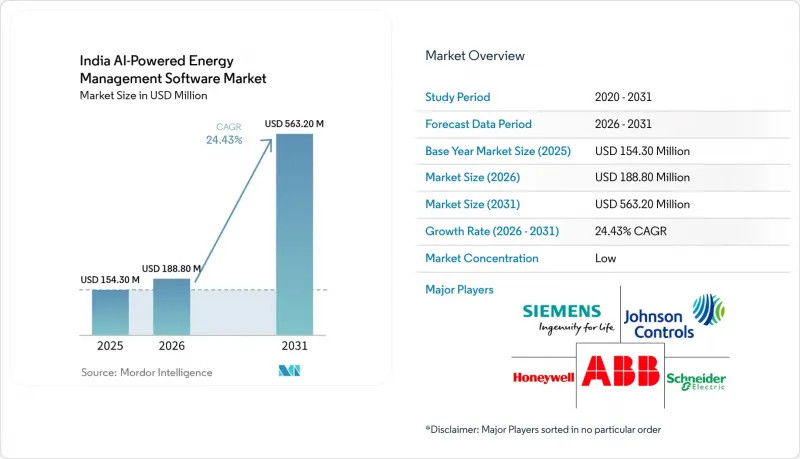
Mordor Intelligence에 의하면, 인도의 AI 기반 에너지 관리 소프트웨어 시장 규모는 2025년에 1억 5,430만 달러로 평가되었고, 2031년까지 5억 6,320만 달러에 이를 것으로 예측되며, 2026-2031년 CAGR 24.43%를 기록할 전망입니다.
본 보고서는 컴포넌트별(소프트웨어 및 서비스), 배포 방식별(클라우드 기반, 온프레미스형, 하이브리드형), 용도별(에너지 소비 및 수요 최적화, 자산 성능 및 예측 유지보수 등), 최종 사용자별(유틸리티, 상업용 건물, 산업 시설 등)로 분류되어 있습니다. 시장 전망은 금액(달러) 기준으로 제시되어 있습니다.
인도의 AI 기반 에너지 관리 소프트웨어 시장 동향 및 인사이트
상업 시설의 에너지 요금 및 피크 수요 요금 상승
각 주별 전기 요금 개정에 따라 대규모 상업 및 산업 사용자에게 에너지 비용 관리가 더욱 어려워지고 있습니다. 타밀나두주 전력 규제 위원회는 2025년 7월 1일부터 2026 회계연도에 걸쳐 산업용 요금을 3.4% 인상하여 1kWh당 7.5루피(1kWh당 0.079달러)로 책정하고, 수요 요금을 월 1kVA당 608루피(1kVA당 6.43달러)로 인상했습니다. 주요 산업 주에서 다른 고전압 수요자 범주에서도 유사한 압박이 가중되고 있어, 예산 협의 과정에서 에너지 최적화 소프트웨어 도입의 정당성이 더욱 부각되고 있습니다. 그 직접적인 가치는 15분 단위의 피크 시간대에 AI 주도형 부하 이동을 통해 실현됩니다. 인도의 요금 체계에서는 이 시간대에 청구액 변동이 가장 심하기 때문입니다. 인도의 AI 기반 에너지 관리 소프트웨어 시장에서 이는 수요 최적화가 상업시설 및 공장에 있어 가시적인 비용 절감을 실현하는 가장 신속한 수단 중 하나로 계속 자리매김할 것임을 의미합니다.
스마트 계량기 도입 확대로 고주파수 에너지 데이터의 가용성 향상
인도의 스마트 계량기 도입으로 인해 전력 회사 및 서비스 제공업체의 간격별 소비 데이터 기반이 대폭 확대되었습니다. 2025년 12월까지 5,280만 대의 스마트 계량기가 도입되었으며, 부문 현대화와 관련된 광범위한 배전 설비 투자 계획은 11조 2,000억 루피(131억 달러)에 달했습니다. 2026년, 전력부는 전력 사업자들에게 AI 및 ML 활용 사례를 시범 프로그램 단계에서 다음 단계로 발전시키도록 지시했습니다. 이에 따라 수요 예측, 손실 분석, 예측 유지보수가 실제 운영에 더 가까운 단계로 전환되었습니다. 또한, 승인된 계량기 수와 실제로 설치된 계량기 수 사이에 발생하는 격차도 AMI 공급업체에 압박을 가하고 있습니다. 가동 시작 일정이 지연됨에 따라 더욱 강력한 예측 및 분석 지원의 필요성이 높아지고 있기 때문입니다. 2026년 검침기 설치 및 운영 규정 개정을 통해 상호 운용성 조건도 개선되었습니다. 모델의 정확도는 더 깨끗하고 표준화된 데이터 흐름에 의존하기 때문에 이는 중요한 사항입니다.
분산된 레거시 OT 및 BMS 데이터가 모델 도입을 지연시킵니다.
인도의 전력 및 대규모 건축물 인프라의 상당수는 여전히 IT와 OT의 원활한 통합을 전제로 구축되지 않은 구식 SCADA, BMS, PLC 환경에서 운영되고 있습니다. 이로 인해 거점, 공급업체, 프로토콜 세대를 가로지르는 데이터 정규화 문제가 발생하여 도입 기간이 수주에서 수개월로 늘어납니다. 유틸리티 및 대규모 산업 시설에서는 서로 다른 세대의 제어 시스템이 병행하여 가동되는 경우가 많으며, 각 시스템이 서로 다른 형식의 데이터를 생성하기 때문에 이 문제는 더욱 복잡해집니다. 하네웰이 2026년 2월 인도의 TCS와 체결한 제휴는 OT 연결성, 클라우드를 통한 현대화, AI 주도 운영 지원을 결합함으로써 바로 이 문제를 직접 해결하는 것을 목적으로 했습니다. 따라서 인도의 AI 기반 에너지 관리 소프트웨어 시장에서 통합 기능은 단순한 구현상의 세부 사항이 아니라, 제품 차별화를 도모하는 핵심 요소가 되고 있습니다.
부문 분석
2025년 인도의 AI 기반 에너지 관리 소프트웨어 시장에서 소프트웨어가 66.21%를 차지했으며, 이 카테고리는 독립된 도구가 아닌 플랫폼 중심의 구매 패턴이 주를 이루고 있습니다. 구매자가 소프트웨어를 선호하는 이유는 수요 예측, 자산 진단, 재생에너지 통합을 개별 용도가 아닌 단일 운영 계층에 집약할 수 있기 때문입니다. 이는 유틸리티체나 대규모 산업 그룹이 일반적으로 여러 거점에 걸친 에너지 성과를 관리하기 위한 단일 기록 시스템을 원한다는 점에서 중요한 의미를 지닙니다. 또한, 소프트웨어 계약이 지속적인 수익을 창출한다는 특성은 규제가 엄격한 분야나 에너지 집약적 부문에서 장기적인 플랫폼 관리를 중시하는 경향과도 부합합니다.
서비스 시장은 2031년까지 연평균 성장률(CAGR) 25.47%로 확대될 것으로 예측되며, 이는 도입이 더욱 복잡한 운영 환경으로 전환됨에 따라 구현 작업의 중요성이 점점 더 커지고 있음을 보여줍니다. 이미 소프트웨어를 구매한 기업들 사이에서는 운영상의 가치가 표면화되기 전에 매니지드 애널리틱스, 통합 지원 및 사이트 수준의 모델 조정이 필요한 사례가 증가하고 있습니다. 하네웰과 TCS의 제휴는 기존의 OT와 새로운 클라우드 분석의 융합을 일회성 설정이 아닌 지속적인 서비스 업무로 자리매김함으로써 이러한 변화를 반영한 것입니다. 또한, BEE의 ECBC와 관련된 계측 및 관리 요건 역시 벤더가 소프트웨어 업그레이드나 관련 서비스를 통해 발전시킬 수 있는 기반을 형성하고 있습니다.
2025년 인도의 AI 기반 에너지 관리 소프트웨어 시장에서 클라우드 기반 도입은 56.17%를 차지했습니다. 이는 낮은 초기 비용과 분석 집약형 컴퓨팅에 대한 용이한 접근성이 뒷받침된 결과입니다. 상업용 빌딩 운영자나 중규모 산업 사용자들은 도입 기간을 단축하고 대규모 온프레미스 인프라에 대한 투자를 피할 수 있다는 점에서 클라우드를 선호하고 있습니다. 시장에서는 이로 인해 엄격한 데이터 관리보다 속도와 비용이 중시되는 기밀성이 낮은 운영 환경에서 클라우드가 기본 선택지가 되는 요인이 되고 있습니다. 또한, 인도에서 하이퍼스케일 클라우드 인프라의 보급이 확대되고 있는 점도, 실시간 분석에 의존하는 소프트웨어 벤더들에게 클라우드 기반 서비스를 더욱 현실적인 선택지로 만들고 있습니다.
하이브리드 배포는 클라우드의 효율성과 온프레미스에서의 제어라는 상반된 요건의 균형을 맞추기 위해 2031년까지 연평균 성장률(CAGR) 25.58%를 나타낼 것으로 예측됩니다. 규제가 엄격한 전력 및 유틸리티 분야에서는 구매자가 기밀성이 높은 OT 데이터를 온프레미스에 남겨두면서, 중요도가 낮은 분석 워크로드를 클라우드로 이전하기를 원하는 경우가 많이 나타납니다. 따라서 특히 배전 사업자, 발전 사업자, 송전망에 연결된 사용자의 경우, 아키텍처의 유연성이 조달 요건으로 자리 잡고 있습니다. 엣지, 온프레미스, 클라우드 각 배포 환경에 대응하는 ABB의 ‘BuildingPro Suites’가 2026년에 출시된 것은 이러한 ‘하이브리드 우선’이라는 방향성을 반영한 것입니다.
기타 혜택 :
- 엑셀 형식 시장 예측(ME) 시트
- 3개월간의 애널리스트 지원
자주 묻는 질문
목차
제1장 서론
제2장 조사 방법
제3장 주요 요약
제4장 시장 구도
제5장 시장 규모 및 성장 예측
제6장 경쟁 구도
제7장 시장 기회 및 향후 전망
AJY 26.08.07According to Mordor Intelligence, the India AI-powered energy management software market size was USD 154.3 million in 2025 and is projected to reach USD 563.2 million by 2031, registering a CAGR of 24.43% during 2026-2031.
This report is Segmented by Component (Software, and Services), Deployment Mode (Cloud-Based, On-Premises, and Hybrid), Application (Energy Consumption and Demand Optimization, Asset Performance and Predictive Maintenance, and More), and End User (Utilities, Commercial Buildings, Industrial Facilities, and More). The Market Forecasts are Provided in Terms of Value (USD).
India AI-powered Energy Management Software Market Trends and Insights
Rising Energy Tariffs and Peak-Demand Charges Across Commercial Facilities
Electricity tariff revisions across states have made energy costs harder to manage for large commercial and industrial users. The Tamil Nadu Electricity Regulatory Commission raised industrial tariffs by 3.4% to INR 7.5 per kWh (USD 0.079 USD per kWh) and increased demand charges to INR 608 per kVA (USD 6.43 per kVA) per month for FY2026, effective July 1, 2025. Similar pressure has been building in other high-tension consumer categories across major industrial states, making energy optimization software easier to justify in budget discussions. The direct value comes from AI-led load shifting during 15-minute peak intervals, because that is where India's tariff structure creates the sharpest billing exposure. In the India AI-powered Energy Management Software Market, this means demand optimization remains one of the quickest paths to visible savings for commercial campuses and factories.
Smart Meter Rollout Expands High-Frequency Energy Data Availability
India's smart meter rollout has created a much larger base of interval-level consumption data for utilities and service providers. By December 2025, 52.8 million smart meters had been deployed, and the broader distribution capex pipeline tied to sector modernization reached INR 11.2 trillion (USD 131 billion). In 2026, the Ministry of Power directed utilities to move AI and ML use cases beyond pilot programs, which pushed demand forecasting, loss analysis, and predictive maintenance into a more operational stage. The gap between sanctioned meters and installed meters has also put pressure on AMI providers, as delayed go-live schedules increase the need for stronger forecasting and analytics support. The 2026 amendment to the meter installation and operation rules also improved interoperability conditions, which matters because model accuracy depends on cleaner, more standardized data flows.
Fragmented Legacy OT and BMS Data Slows Model Deployment
Much of India's power and large-building infrastructure still runs on older SCADA, BMS, and PLC environments that were not built for smooth IT and OT integration. That creates data normalization issues across sites, vendors, and protocol generations, pushing deployment timelines from weeks to several months. In utilities and large industrial facilities, this problem is more difficult because different generations of control systems often operate side by side, and each one can produce data in a different format. Honeywell's February 2026 partnership with TCS in India was aimed directly at this problem by combining OT connectivity, cloud modernization, and AI-led operations support. In the India AI-powered Energy Management Software Market, integration capability has therefore become a core product differentiator rather than an implementation detail.
Other drivers and restraints analyzed in the detailed report include:
- Net-Zero Commitments Push Continuous Energy Optimization Programs
- Expansion of Distributed Energy Resources Raises Need for AI Orchestration
- Cybersecurity and Data Sovereignty Concerns Limit Cloud Adoption in Critical Sites
For complete list of drivers and restraints, kindly check the Table Of Contents.
Segment Analysis
Software accounted for 66.21% of India AI-powered Energy Management Software Market in 2025, keeping the category centered on platform-led buying patterns rather than isolated tools. Buyers have favored software because it enables demand forecasting, asset diagnostics, and renewable integration to be housed in a single operating layer rather than separate applications. This matters because utilities and large industrial groups typically want a single system of record for energy performance across multiple sites. The recurring-revenue nature of software contracts also fits the preference for long-term platform control in regulated and energy-intensive sectors.
Services are projected to expand at a 25.47% CAGR through 2031, indicating that implementation work is becoming increasingly important as deployments move into more complex operating environments. Companies that have already purchased software increasingly need managed analytics, integration support, and site-level model tuning before operational value becomes visible. The Honeywell and TCS partnership reflected that shift by treating convergence between legacy OT and newer cloud analytics as an ongoing service task rather than a one-time setup. BEE's ECBC-linked metering and management requirements also create a baseline that vendors can build on through software upgrades and associated services.
Cloud-based deployment accounted for 56.17% of India AI-powered Energy Management Software Market in 2025, supported by lower upfront costs and easier access to analytics-intensive computing. Commercial building operators and mid-sized industrial users have leaned toward the cloud because it shortens deployment time and avoids heavy local infrastructure investment. For the market, that has helped cloud become the default option in less sensitive operating environments where speed and cost carry more weight than strict data control. The growing presence of hyperscale cloud infrastructure in India has also made cloud-based delivery more practical for software vendors that rely on real-time analytics.
Hybrid deployment is expected to grow at a 25.58% CAGR through 2031 because it addresses the tension between cloud efficiency and local control. In regulated power and utility settings, buyers often want sensitive OT data to remain on-site while less critical analytics workloads move to the cloud. That is why architecture flexibility is becoming a procurement requirement, especially for discoms, generators, and transmission-linked users. ABB's 2026 launch of BuildingPro Suites, which supports edge, on-premises, and cloud deployment, reflected this hybrid-first direction.
Complete Report Scope:
- By Component
- Software
- Services
- By Deployment Mode
- Cloud-Based
- On-Premises
- Hybrid
- By Application
- Energy Consumption and Demand Optimization
- Asset Performance and Predictive Maintenance
- Smart Grid and Distributed Energy Resource (DER) Management
- Renewable Energy Forecasting and Integration
- Energy Trading, Pricing and Market Intelligence
- By End User
- Utilities
- Commercial Buildings
- Industrial Facilities
- Residential Buildings
List of Companies Covered in this Report:
- Schneider Electric SE
- Siemens AG
- Johnson Controls International plc
- Honeywell International Inc.
- ABB Ltd
- Eaton Corporation plc
- Emerson Electric Co.
- IBM Corporation
- Microsoft Corporation
- Oracle Corporation
- SAP SE
- C3.AI, Inc.
- BrainBox AI Inc.
- GridPoint, Inc.
- Verdigris Technologies, Inc.
- Uplight, Inc.
- AutoGrid Systems, Inc.
- EnergyCAP, LLC
- Amp X Ltd.
- GNA Energy
- Greenovative Energy
- Tata Power
- AutoGrid Systems, Inc.
- EnerCog
Additional Benefits:
- The market estimate (ME) sheet in Excel format
- 3 months of analyst support
TABLE OF CONTENTS
1 INTRODUCTION
- 1.1 Study Assumptions and Market Definition
- 1.2 Scope of the Study
2 RESEARCH METHODOLOGY
3 EXECUTIVE SUMMARY
4 MARKET LANDSCAPE
- 4.1 Market Overview
- 4.2 Market Drivers
- 4.2.1 Rising Energy Tariffs and Peak-Demand Charges Across Commercial Facilities
- 4.2.2 Smart Meter Rollout Expands High-Frequency Energy Data Availability
- 4.2.3 Net-Zero Commitments Push Continuous Energy Optimization Programs
- 4.2.4 Expansion of Distributed Energy Resources Raises Need For AI Orchestration
- 4.2.5 Retrofit-Heavy Building Stock Creates Large Software-First Efficiency Opportunity
- 4.2.6 Demand For Remote Monitoring In Multi-Site Enterprises Accelerates Adoption
- 4.3 Market Restraints
- 4.3.1 Fragmented Legacy OT and BMS Data Slows Model Deployment
- 4.3.2 Cybersecurity and Data Sovereignty Concerns Limit Cloud Adoption in Critical Sites
- 4.3.3 Weak Internal AI and Energy Analytics Skills Reduce Implementation Velocity
- 4.3.4 Long Sales Cycles and Low-Capex Prioritization Delay Enterprise Purchases
- 4.4 Impact of Macroeconomic Factors on the Market
- 4.5 Industry Value-Chain Analysis
- 4.6 Regulatory Landscape
- 4.7 Technological Outlook
- 4.8 Porter's Five Forces Analysis
- 4.8.1 Bargaining Power of Buyers
- 4.8.2 Bargaining Power of Suppliers
- 4.8.3 Threat of New Entrants
- 4.8.4 Threat of Substitutes
- 4.8.5 Intensity of Competitive Rivalry
5 MARKET SIZE AND GROWTH FORECASTS (VALUE)
- 5.1 By Component
- 5.1.1 Software
- 5.1.2 Services
- 5.2 By Deployment Mode
- 5.2.1 Cloud-Based
- 5.2.2 On-Premises
- 5.2.3 Hybrid
- 5.3 By Application
- 5.3.1 Energy Consumption and Demand Optimization
- 5.3.2 Asset Performance and Predictive Maintenance
- 5.3.3 Smart Grid and Distributed Energy Resource (DER) Management
- 5.3.4 Renewable Energy Forecasting and Integration
- 5.3.5 Energy Trading, Pricing and Market Intelligence
- 5.4 By End User
- 5.4.1 Utilities
- 5.4.2 Commercial Buildings
- 5.4.3 Industrial Facilities
- 5.4.4 Residential Buildings
6 COMPETITIVE LANDSCAPE
- 6.1 Market Concentration
- 6.2 Strategic Moves
- 6.3 Market Share Analysis
- 6.4 Company Profiles (includes Global Level Overview, Market Level Overview, Core Segments, Financials as available, Strategic Information, Market Rank/Share, Products and Services, Recent Developments)
- 6.4.1 Schneider Electric SE
- 6.4.2 Siemens AG
- 6.4.3 Johnson Controls International plc
- 6.4.4 Honeywell International Inc.
- 6.4.5 ABB Ltd
- 6.4.6 Eaton Corporation plc
- 6.4.7 Emerson Electric Co.
- 6.4.8 IBM Corporation
- 6.4.9 Microsoft Corporation
- 6.4.10 Oracle Corporation
- 6.4.11 SAP SE
- 6.4.12 C3.ai, Inc.
- 6.4.13 BrainBox AI Inc.
- 6.4.14 GridPoint, Inc.
- 6.4.15 Verdigris Technologies, Inc.
- 6.4.16 Uplight, Inc.
- 6.4.17 AutoGrid Systems, Inc.
- 6.4.18 EnergyCAP, LLC
- 6.4.19 Amp X Ltd.
- 6.4.20 GNA Energy
- 6.4.21 Greenovative Energy
- 6.4.22 Tata Power
- 6.4.23 AutoGrid Systems, Inc.
- 6.4.24 EnerCog
7 MARKET OPPORTUNITIES AND FUTURE OUTLOOK
- 7.1 White-Space and Unmet-Need Assessment


