

|
시장보고서
상품코드
2097457
싱가포르의 AI 기반 에너지 관리 소프트웨어 시장 : 시장 점유율 분석, 업계 동향 및 통계, 성장 예측(2026-2031년)Singapore AI-powered Energy Management Software - Market Share Analysis, Industry Trends & Statistics, Growth Forecasts (2026 - 2031) |
||||||
 Mordor Intelligence
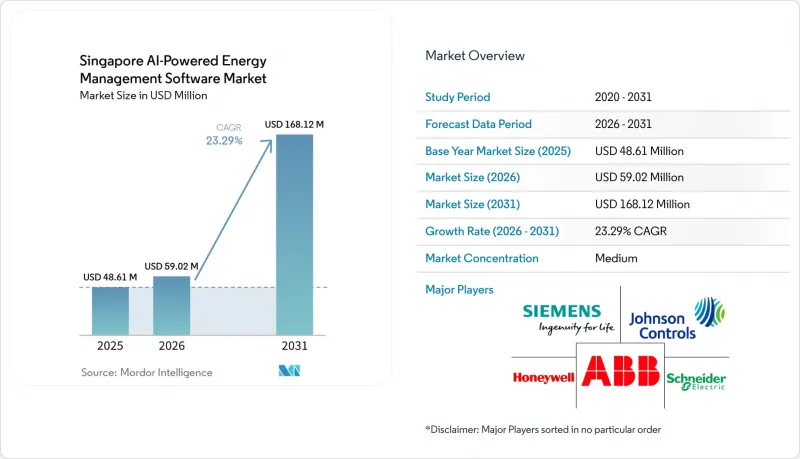
Mordor Intelligence에 의하면, 싱가포르의 AI 기반 에너지 관리 소프트웨어 시장 규모는 2025년에 4,861만 달러로 평가되었고, 2026년 5,902만 달러에서 성장하여 2031년까지 1억 6,812만 달러에 이를 것으로 추정되며, 예측 기간(2026-2031년)에 CAGR 23.29%로 성장할 전망입니다.
본 보고서는 컴포넌트별(소프트웨어 및 서비스), 배포 방식별(클라우드 기반, 온프레미스형, 하이브리드형), 용도별(에너지 소비 및 수요 최적화, 자산 성능 및 예측 유지보수 등), 최종 사용자별(유틸리티, 상업용 빌딩 등)로 분류되어 있습니다. 시장 전망은 금액(달러)으로 표시되어 있습니다.
싱가포르의 AI 기반 에너지 관리 소프트웨어 시장 동향 및 인사이트
싱가포르의 상업용 부동산에서 스마트 빌딩 리모델링 증가
총 연면적 5,000 m²를 초과하는 민간 소유 건물의 개조에 대한 경제적 장벽을 낮추기 위해, 6,300만 싱가포르 달러(4,600만 달러) 규모의 프로그램인 ‘기존 건축물 대상 그린마크 인센티브 제도 2.0’이 도입되었습니다. 이로 인해 AI 최적화에 필요한 제어 시스템 및 계측 기기가 더 많은 노후 건물에 도입되면서, 싱가포르의 AI 활용형 에너지 관리 소프트웨어 시장의 도입 기반이 직접적으로 확대되었습니다. 또한, ‘에너지 개선 의무 제도’에서는 에너지 다소비형 빌딩이 3년 연속으로 에너지 사용 원단위의 기준치를 초과할 경우 조치를 취하도록 의무화하기 시작하여, 소유주에게 체계적인 개보수 프로그램의 이행을 촉진하고 있습니다. 이러한 개보수 프로그램에서는 대개 세밀한 서브 미터링이 필요하지만, 해당 데이터 계층이 마련되어 있으면 추후 AI 소프트웨어를 추가할 때 통합 비용을 절감할 수 있습니다. 이러한 효과는 특히 호텔·관광 업계와 의료 업계에서 두드러지게 나타납니다. 이 업계에서는 소유주가 동일한 자본 주기 내에서 규정 준수, 그린마크 재인증, 그리고 투자자 보고 요건을 충족하려고 하기 때문입니다.
점점 엄격해지는 기업의 에너지 보고 및 ESG 공시 요건
싱가포르에서는 기후 변화 관련 보고 의무가 강화됨에 따라, 에너지 데이터가 단순한 시설 관리 문제에서 재무 및 거버넌스 문제로 전환되고 있습니다. SGX 상장 기업은 2025 회계연도부터 스코프 1 및 스코프 2 배출량을 보고해야 하며, STI 구성 종목 기업은 2026 회계연도부터 스코프 3 배출량도 보고해야 합니다. 이러한 변화로 인해 지속적이고 감사 대응이 가능한 에너지 데이터에 대한 수요가 증가하고 있습니다. 정기적인 수동 측정만으로는 보고 팀이 현재 필요로 하는 일관성을 확보할 수 없기 때문입니다. 또한, 탄소세가 2024-2025 회계연도 톤당 CO2e 25 싱가포르 달러에서 2026 회계연도에는 45 싱가포르 달러로 인상됨에 따라, 지출 배분처를 결정하는 재무팀에게 있어 그 비즈니스상의 이점이 더욱 명확해지고 있습니다. 싱가포르의 AI 기반 에너지 관리 소프트웨어 시장에서 이러한 일련의 정책으로 인해 시설 관리, 재무, 지속가능성 각 부서가 단일 소프트웨어 도입이라는 결정을 중심으로 협력하게 되었습니다.
구형 빌딩 시스템에 걸친 데이터의 파편화
구형 빌딩 군에 걸친 데이터의 파편화는 싱가포르의 AI 기반 에너지 관리 소프트웨어 시장에서 여전히 가장 두드러진 장벽 중 하나입니다. 2005년 이전에 건설된 많은 상업용 부동산에서는 여전히 독자적인 사양의 빌딩 관리 환경이 운영되고 있으며, BACnet, Modbus, LonWorks 각 시스템 간에 프로토콜 구현 현황에 편차가 나타납니다. 서로 다른 시공사들이 오랜 시간에 걸쳐 추가한 개조 계층으로 인해 계량기, HVAC 제어, 조명 플랫폼, 출입 통제 시스템 간에 격차가 발생하고 있으며, 이로 인해 통합적인 데이터 수집이 지연되고 있습니다. 이러한 격차는 기준선의 품질을 저하시키고, 예측의 정확도를 떨어뜨리며, 감사 대응이 가능한 보고서의 타당성을 입증하는 것을 어렵게 만듭니다. 강력한 에지 계층 프로토콜 변환 기능을 갖춘 벤더는 BMS를 전면 교체하지 않고도 데이터를 정규화할 수 있으므로, 개조 공사 비중이 높은 프로젝트를 수주하는 데 유리한 입장에 있습니다.
부문 분석
2025년, 싱가포르의 AI 기반 에너지 관리 소프트웨어 시장에서 소프트웨어가 65.18%의 점유율을 차지했습니다. 이는 유틸리티, 상업용 부동산 포트폴리오 및 산업 시설에서의 플랫폼 도입 확산을 반영한 것입니다. 구매자들은 이미 에너지 분석, 실시간 대시보드 및 탄소 보고 기능을 일상적인 운영 워크플로우에 통합하고 있으며, 이로 인해 소프트웨어 계층은 건물 운영에서 중심적인 역할을 담당하고 있습니다. 이러한 지위는 전환 비용에 의해 더욱 공고해지고 있습니다. 빌딩 관리 시스템의 데이터, 과거 기준치 및 보고서 작성 워크플로가 단일 플랫폼에 통합되면, 공급업체를 변경하는 것은 소유주나 운영자에게 큰 혼란을 초래하게 됩니다. 이로 인해 기존 소프트웨어 공급업체는 많은 관련 기업 소프트웨어 분야보다 높은 계약 갱신율을 유지하고 있습니다.
서비스 분야는 2026-2031년 연평균 성장률(CAGR) 24.31%로 확대될 것으로 예측되며, 싱가포르의 AI 기반 에너지 관리 소프트웨어 시장에서 가장 빠르게 성장하는 분야가 될 전망입니다. 이러한 성장세의 상당 부분은 중규모 상업 및 산업 사업자들에 의해 주도되고 있습니다. 그 이유는 많은 사업자가 사내에 에너지 엔지니어링 팀을 보유하고 있지 않으며, 소프트웨어 관리보다는 성과 중심의 운영을 선호하기 때문입니다. 싱가포르가 추진하는 다년간의 AI 네이티브 생태계 이니셔티브는 에너지 모니터링과 ESG 보고를 보다 지속적인 관리 워크플로우에 통합함으로써 이러한 변화에 직접 대응했습니다. 또한, 성과 기반의 에너지 성과 계약은 실행 위험의 일부를 공급업체로 이전하고 초기 투자를 지속적인 운영 비용으로 전환할 수 있기 때문에 점점 더 매력적으로 다가오고 있습니다.
2025년, 싱가포르의 AI 기반 에너지 관리 소프트웨어 시장에서 클라우드 기반 도입은 55.14%를 차지했습니다. 이는 구독 방식의 경제성, 지속적인 모델 업데이트, 그리고 여러 거점에 걸친 포트폴리오에서 벤치마킹이 용이하다는 점에 힘입은 결과입니다. 또한, 많은 부동산 소유주와 운영 사업자가 피하고 싶어 하는 정기적인 현장 하드웨어 업데이트 주기의 필요성도 줄어들었습니다. 그럼에도 불구하고 하이브리드형 도입은 2026-2031년 연평균 성장률(CAGR) 24.42%를 나타낼 것으로 예측되며, 규제가 엄격하고 복잡한 환경에서 선호되는 아키텍처로 자리 잡고 있습니다. 기업들은 기밀성이 높은 텔레메트리 데이터를 로컬에 보관하면서, 정규화된 성과 지표를 클라우드 분석 계층으로 전송하기 위해 하이브리드 구성을 채택하고 있습니다.
이러한 균형은 싱가포르의 AI 기반 에너지 관리 소프트웨어 시장에 매우 적합합니다. 구매자 입장에서 AI의 확장성과 보다 엄격한 데이터 관리를 동시에 달성할 수 있는 수단이 되기 때문입니다. 이는 특히 에어 갭, 로컬 호스팅, 혹은 더 엄격한 심사 절차가 여전히 조달 방침을 좌우하는 병원, 데이터센터, 정부 관련 시설에서 중요합니다. 따라서 온프레미스 배포는 특히 완전한 클라우드 연결이 운영상 어렵거나 바람직하지 않은 경우, 여전히 중요한 역할을 수행하고 있습니다. CES 2026에서 발표된 Univers EnOS™ AI Box를 포함한 전용으로 설계된 엣지 추론 하드웨어 역시, 고주파 제어 용도 분야에서 온프레미스와 하이브리드 아키텍처 간의 격차가 점차 좁혀지고 있음을 보여줍니다.
기타 혜택 :
- 엑셀 형식 시장 예측(ME) 시트
- 3개월간의 애널리스트 지원
자주 묻는 질문
목차
제1장 서론
제2장 조사 방법
제3장 주요 요약
제4장 시장 구도
제5장 시장 규모 및 성장 예측
제6장 경쟁 구도
제7장 시장 기회 및 향후 전망
AJY 26.08.07According to Mordor Intelligence, the Singapore AI-powered energy management software market size was valued at USD 48.61 million in 2025 and is estimated to grow from USD 59.02 million in 2026 to reach USD 168.12 million by 2031, at a CAGR of 23.29% during the forecast period (2026-2031).
This report is Segmented by Component (Software, and Services), Deployment Mode (Cloud-Based, On-Premises, and Hybrid), Application (Energy Consumption and Demand Optimization, Asset Performance and Predictive Maintenance, and More), and End User (Utilities, Commercial Buildings, and More). The Market Forecasts are Provided in Terms of Value (USD).
Singapore AI-powered Energy Management Software Market Trends and Insights
Rising Smart Building Retrofits in Singapore Commercial Real Estate
The Green Mark Incentive Scheme for Existing Buildings 2.0, a SGD 63 million (USD 46 million) program, lowered the financial barrier to retrofitting in privately owned buildings with a gross floor area above 5,000 m2. That directly widened the deployment base for the Singapore AI-powered Energy Management Software Market because more older buildings are now being fitted with the controls and metering needed for AI optimization. The Mandatory Energy Improvement regime also began to require action when energy-intensive buildings exceeded Energy Use Intensity thresholds for three consecutive years, pushing owners toward structured upgrade programs. These retrofit programs often require granular submetering, and that data layer lowers integration costs later when AI software is added on top. The effect is especially visible in hospitality and healthcare, where owners are trying to meet compliance, Green Mark recertification, and investor reporting needs within the same capital cycle.
Tightening Corporate Energy Reporting and ESG Disclosure Requirements
Mandatory climate reporting is moving energy data from a facilities issue into a finance and governance issue in Singapore. SGX-listed companies must report Scope 1 and Scope 2 emissions from the financial year 2025, and STI constituents must also report Scope 3 emissions from FY2026. That shift is driving demand for continuous, audit-ready energy data because periodic manual readings do not provide the consistency reporting teams now need. The carbon tax increase from SGD 25/tCO2e in 2024-2025 to SGD 45/tCO2e in 2026 is also making the business case more direct for finance teams that are deciding where to allocate spending. In the Singapore AI-powered Energy Management Software Market, this policy stack is aligning facilities, finance, and sustainability functions around a single software decision.
Data Fragmentation across Legacy Building Systems
Data fragmentation across older building estates remains one of the clearest barriers in the Singapore AI-powered Energy Management Software Market. Many commercial properties built before 2005 still operate with proprietary building management environments and uneven protocol implementation across BACnet, Modbus, and LonWorks systems. Retrofit layers added over time by different contractors have left gaps between meters, HVAC controls, lighting platforms, and access systems, which slows unified data ingestion. Those gaps degrade baseline quality, weakening forecast accuracy and making audit-ready reporting harder to defend. Vendors with strong edge-layer protocol translation are better placed to win retrofit-heavy projects because they can normalize data without forcing a full BMS replacement.
Other drivers and restraints analyzed in the detailed report include:
- Accelerating Utility Tariff Optimization and Demand Charge Management
- AI-Enabled Fault Detection, Diagnostics, and Predictive Control Adoption
- Cybersecurity And Data Residency Concerns in Cloud-Hosted Energy Platforms
For complete list of drivers and restraints, kindly check the Table Of Contents.
Segment Analysis
Software held 65.18% of the Singapore AI-powered Energy Management Software Market share in 2025, which reflected the depth of platform adoption across utilities, commercial real estate portfolios, and industrial facilities. Buyers have already embedded energy analytics, real-time dashboards, and carbon reporting into day-to-day operating workflows, which gives the software layer a central role in building operations. That position is reinforced by switching costs: once building management system data, historical baselines, and reporting workflows are housed on a single platform, vendor migration becomes disruptive for owners and operators. This helps incumbent software providers maintain stronger renewal rates than many adjacent enterprise software categories.
Services are projected to expand at a 24.31% CAGR from 2026 to 2031, making them the fastest-growing component of the Singapore AI-powered Energy Management Software Market. Mid-size commercial and industrial operators are driving much of this momentum because many lack in-house energy engineering teams and prefer managed outcomes over software administration. A multi-year AI-native ecosystem initiative from Singapore directly addressed this shift by linking energy monitoring and ESG reporting into a more continuous managed workflow. Outcome-based energy performance contracts are also becoming more attractive because they shift part of the execution risk to vendors and convert upfront investment into recurring operating expense.
Cloud-based deployment accounted for 55.14% of the Singapore AI-powered Energy Management Software Market in 2025, supported by subscription economics, continuous model updates, and easier benchmarking across multi-site portfolios. It also reduced the need for regular on-site hardware refresh cycles, which many property owners and operators prefer to avoid. Even so, hybrid deployment is projected to grow at a 24.42% CAGR from 2026 to 2031 and is becoming the preferred architecture for more regulated and complex environments. Enterprises are using hybrid setups to keep sensitive telemetry local while still sending normalized performance indicators into cloud analytics layers.
This balance fits the Singapore AI-powered Energy Management Software Market well because it gives buyers a way to combine AI scalability with tighter data control. It is particularly relevant in hospitals, data centers, and government-linked sites where air-gapping, local hosting, or stricter review processes still shape procurement. On-premises deployment, therefore, retains a role, especially where full cloud connectivity is operationally difficult or not preferred. Purpose-built edge inference hardware, including the Univers EnOS(TM) AI Box introduced at CES 2026, also shows how the gap between on-premises and hybrid architecture is narrowing for high-frequency control applications.
Complete Report Scope:
- By Component
- Software
- Services
- By Deployment Mode
- Cloud-Based
- On-Premises
- Hybrid
- By Application
- Energy Consumption and Demand Optimization
- Asset Performance and Predictive Maintenance
- Smart Grid and Distributed Energy Resource (DER) Management
- Renewable Energy Forecasting and Integration
- Energy Trading, Pricing and Market Intelligence
- By End User
- Utilities
- Commercial Buildings
- Industrial Facilities
- Residential Buildings
List of Companies Covered in this Report:
- Schneider Electric SE
- Siemens AG
- Johnson Controls International plc
- Honeywell International Inc.
- ABB Ltd
- Delta Electronics, Inc.
- Eaton Corporation plc
- IBM Corporation
- Cisco Systems, Inc.
- SAP SE
- Oracle Corporation
- C3.AI, Inc.
- Univers
- Keppel Infrastructure
- Azendian Solutions
- Planon B.V.
- SP Digital
- Carrier Global Corporation
- Trane Technologies plc
- SensorFlow
Additional Benefits:
- The market estimate (ME) sheet in Excel format
- 3 months of analyst support
TABLE OF CONTENTS
1 INTRODUCTION
- 1.1 Study Assumptions and Market Definition
- 1.2 Scope of the Study
2 RESEARCH METHODOLOGY
3 EXECUTIVE SUMMARY
4 MARKET LANDSCAPE
- 4.1 Market Overview
- 4.2 Market Drivers
- 4.2.1 Rising Smart Building Retrofits in Singapore Commercial Real Estate
- 4.2.2 Tightening Corporate Energy Reporting and ESG Disclosure Requirements
- 4.2.3 Accelerating Utility Tariff Optimization and Demand Charge Management
- 4.2.4 AI-Enabled Fault Detection, Diagnostics, and Predictive Control Adoption
- 4.2.5 Edge-Connected IoT Metering and Building Management System Integration
- 4.2.6 Growing Enterprise Preference for Continuous Commissioning and Autonomous Optimization
- 4.3 Market Restraints
- 4.3.1 Data Fragmentation Across Legacy Building Systems
- 4.3.2 Cybersecurity and Data Residency Concerns in Cloud-Hosted Energy Platforms
- 4.3.3 High Integration Complexity With Mixed Vendor Building Estates
- 4.3.4 Limited Energy Baseline Visibility in Older Small and Medium Buildings
- 4.4 Impact of Macroeconomic Factors on the Market
- 4.5 Industry Value-Chain Analysis
- 4.6 Regulatory Landscape
- 4.7 Technological Outlook
- 4.8 Porter's Five Forces Analysis
- 4.8.1 Bargaining Power of Buyers
- 4.8.2 Bargaining Power of Suppliers
- 4.8.3 Threat of New Entrants
- 4.8.4 Threat of Substitutes
- 4.8.5 Intensity of Competitive Rivalry
5 MARKET SIZE AND GROWTH FORECASTS (VALUE)
- 5.1 By Component
- 5.1.1 Software
- 5.1.2 Services
- 5.2 By Deployment Mode
- 5.2.1 Cloud-Based
- 5.2.2 On-Premises
- 5.2.3 Hybrid
- 5.3 By Application
- 5.3.1 Energy Consumption and Demand Optimization
- 5.3.2 Asset Performance and Predictive Maintenance
- 5.3.3 Smart Grid and Distributed Energy Resource (DER) Management
- 5.3.4 Renewable Energy Forecasting and Integration
- 5.3.5 Energy Trading, Pricing and Market Intelligence
- 5.4 By End User
- 5.4.1 Utilities
- 5.4.2 Commercial Buildings
- 5.4.3 Industrial Facilities
- 5.4.4 Residential Buildings
6 COMPETITIVE LANDSCAPE
- 6.1 Market Concentration
- 6.2 Strategic Moves
- 6.3 Market Share Analysis
- 6.4 Company Profiles (includes Global Level Overview, Market Level Overview, Core Segments, Financials as available, Strategic Information, Market Rank/Share, Products and Services, Recent Developments)
- 6.4.1 Schneider Electric SE
- 6.4.2 Siemens AG
- 6.4.3 Johnson Controls International plc
- 6.4.4 Honeywell International Inc.
- 6.4.5 ABB Ltd
- 6.4.6 Delta Electronics, Inc.
- 6.4.7 Eaton Corporation plc
- 6.4.8 IBM Corporation
- 6.4.9 Cisco Systems, Inc.
- 6.4.10 SAP SE
- 6.4.11 Oracle Corporation
- 6.4.12 C3.ai, Inc.
- 6.4.13 Univers
- 6.4.14 Keppel Infrastructure
- 6.4.15 Azendian Solutions
- 6.4.16 Planon B.V.
- 6.4.17 SP Digital
- 6.4.18 Carrier Global Corporation
- 6.4.19 Trane Technologies plc
- 6.4.20 SensorFlow
7 MARKET OPPORTUNITIES AND FUTURE OUTLOOK
- 7.1 White-Space and Unmet-Need Assessment


