

|
시장보고서
상품코드
2099085
남미의 AI 기반 에너지 관리 소프트웨어 시장 : 시장 점유율 분석, 업계 동향 및 통계, 성장 예측(2026-2031년)South America AI-powered Energy Management Software - Market Share Analysis, Industry Trends & Statistics, Growth Forecasts (2026 - 2031) |
||||||
 Mordor Intelligence
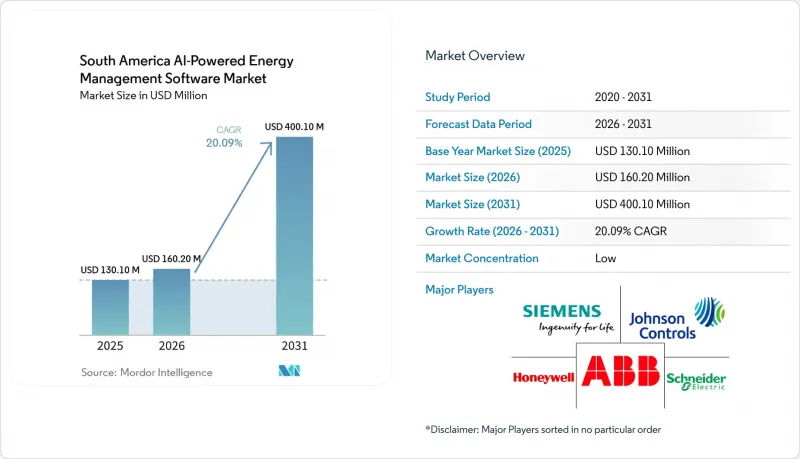
Mordor Intelligence에 의하면, 남미의 AI 기반 에너지 관리 소프트웨어 시장은 2025년에 1억 3,010만 달러 규모가로 평가되었고, 2026년 1억 6,020만 달러에서 2031년까지 4억 10만 달러에 이를 것으로 예측되며, 2026-2031년 예측 기간 CAGR은 20.09%를 나타낼 전망입니다.
본 보고서는 구성 요소별(소프트웨어 및 서비스), 배포 방식별(클라우드 기반, 온프레미스형, 하이브리드형), 용도별(에너지 소비 및 수요 최적화, 자산 성능 및 예측 유지보수 등), 최종 사용자별(상업용 건물, 산업 시설 등), 그리고 지역별로 분류되어 있습니다. 시장 전망은 금액(달러)으로 표시되어 있습니다.
남미의 AI 기반 에너지 관리 소프트웨어 시장 동향 및 인사이트
AI를 활용한 부하 최적화에 대한 산업 수요 증가
남미의 에너지 집약형 산업 기반에서는 특히 광업, 시멘트, 펄프 및 제지, 금속 업계에서 AI를 활용한 부하 최적화를 통해 뚜렷한 성과를 거두고 있습니다. 발레(Vale)사는 2026년 6월, 미나스제라이스주에 자사 최초의 AI 탑재 광석 처리 플랜트를 가동했습니다. 이 플랜트에서는 400개 이상의 변수를 실시간으로 최적화하면서 생산성을 25% 향상시켰으며, 에너지 관리가 개별적으로 처리되는 것이 아니라 핵심 생산 관리에 통합되고 있음을 입증했습니다. ABB는 2026년 4월, ABB Ability 에너지 관리 시스템에 생성형 AI를 추가했습니다. 이를 통해 에너지 사용량, 배출량, 설비 성능에 대해 자연어 기반 조회가 가능해졌으며, 플랜트 팀의 기술 요건 기준이 낮아졌습니다. 칠레에서는 전기 요금 급등으로 인해 AI를 활용한 부하 이동 및 시간대별 요금 관리가 광업 회사들에게 직접적인 이익 증대 수단이 되고 있으며, 이에 따라 남미의 AI 기반 에너지 관리 소프트웨어 시장의 역할은 단순한 규정 준수 대응을 넘어 확장되고 있습니다. 2026년 4월 사마르코(Samarco)사가 도입한 ‘COI Maestro’ 역시 생산 모니터링, 품질 관리, 공급망 조정, 에너지 추적을 통합한 단일 운영 계층을 원하는 구매자가 증가하고 있음을 보여줍니다.
에너지 효율 및 탄소 보고를 위한 규제 추진
남미의 AI 기반 에너지 관리 소프트웨어 시장은 에너지 모니터링을 탄소 공개 및 공식 관리 시스템과 연계하도록 하는 규제의 혜택도 받고 있습니다. 브라질의 법률 제15.042/2024호는 연간 1만 톤 이상의 CO2 환산량을 배출하는 기업에 대해 온실가스 연간 인벤토리 작성 의무를 부과했습니다. 이에 따라 2026년 이후 에너지 데이터 수집은 자산 수준에 더욱 가까워지게 되었습니다. 칠레의 ‘에너지 효율법’은 2026년에 확대되어, 소비량 보고 의무 대상 기업이 522개사 추가되었으며, 2026년 8월까지 운영 가능한 에너지 관리 시스템의 도입이 의무화되었습니다. 콜롬비아 상원은 2025년 12월, 법률 제143호/2024를 가결하여 에너지 효율 기준 및 배출 감축에 관한 정책 기반을 확대했습니다. 이러한 규제들의 조합으로 인해 남미의 AI 기반 에너지 관리 소프트웨어 시장에는 더욱 안정적인 수요 기반이 형성되고 있습니다. 다만, 공급업체는 여전히 규정 준수를 목적으로 도입하는 구매자와 성능 향상을 위해 도입하는 구매자를 구분해야 합니다.
분산형 사이트에서의 클라우드 및 엣지 배포
분산형 에너지 자산과 원격지 산업 시설로 인해, 남미의 AI 기반 에너지 관리 소프트웨어 시장은 클라우드와 엣지를 결합한 아키텍처로 전환되고 있습니다. 법률 제15.269/2025호에 따른 브라질 시장 자유화로 인해, 국가 전력 기관과 연계하면서 거래, 수요 반응, 피어 투 피어(P2P) 거래를 조정할 수 있는 클라우드 네이티브 플랫폼에 대한 수요가 증가하고 있습니다. 국가 송전 시스템 운영 기관은 12개의 프로세스와 4개의 센터에 걸쳐 AVEVA PI 시스템을 도입하여 실시간 디스패치를 자동화했습니다. 이를 통해 통합된 데이터 레이어가 송전망 규모의 최적화를 어떻게 지원하는지가 입증되었습니다. 한편, 광산, 외딴 지역의 수력 발전 시설 및 해상 시설에서는 운영 루프와 안전 기능을 위해 여전히 1초 미만의 엣지 제어가 필요하며, 이것이 남미의 AI 기반 에너지 관리 소프트웨어 시장에서 하이브리드 배포가 급속히 확대되고 있는 이유입니다. 구매자들은 전력 회사, 계량기, 분산형 에너지 자원을 가로질러 연결할 수 있는 시스템을 원하고 있기 때문에 OpenADR이나 DLMS/COSEM과 같은 조달 기준이 이러한 환경에서 그 중요성을 더하고 있습니다.
부문 분석
2025년, 남미의 AI 기반 에너지 관리 소프트웨어 시장에서 소프트웨어가 71.19%의 점유율을 차지했습니다. 이는 고립된 계측 기기에서 예측, 보고서 작성, 이상 감지, 벤치마킹을 결합한 플랫폼으로의 전환을 반영한 것입니다. 브라질의 탄소 인벤토리 규정과 칠레의 SGE 보고 요건은 모두 데이터 검증 및 정기적인 제출을 자동화할 수 있는 플랫폼에 대한 수요를 촉진하고 있습니다. 이러한 규제 구조는 각국의 의무 변경에 따라 지속적으로 업데이트될 수 있어 소프트웨어에 구조적인 우위를 가져다주고 있습니다. 이러한 상황에서 남미의 AI 기반 에너지 관리 소프트웨어 시장에서 소프트웨어는 운영 데이터와 비즈니스 보고서를 연결하는 제어 계층으로서의 역할을 수행하고 있습니다.
많은 사용자가 통합, 모델 튜닝, 규정 준수 워크플로우 및 지속적인 모니터링과 관련하여 여전히 외부 지원을 필요로 하고 있기 때문에 서비스 시장은 2031년까지 연평균 성장률(CAGR) 20.23%로 확대될 것으로 예측됩니다. 지멘스와 CPFL 에너지아가 진행한 측정 프로그램은 장기적인 가치가 단순한 장치 출하량이 아니라 데이터 관리, 부정 감지 및 분석 서비스 구독에 점점 더 많이 있다는 점을 보여주었습니다. ABB가 2026년 4월에 실시한 ‘ABB Ability Energy Management System’ 업데이트도 이러한 변화를 뒷받침하고 있습니다. 이 업데이트를 통해 플랜트 팀이 플랫폼을 더욱 편리하게 사용할 수 있게 되었으며, 사내 분석가 자원이 제한적인 경우에도 지속적인 서비스 관계를 심화할 수 있게 되었습니다. 대규모 산업 환경에서 ISO 50001의 중요성도 매니지드 서비스에 대한 수요를 더욱 부추기고 있습니다. 이는 인증 및 보고 절차에서 남미의 AI 기반 에너지 관리 소프트웨어 시장 전반에 걸친 지속적인 모니터링이 요구되기 때문입니다.
2025년, 남미의 AI 기반 에너지 관리 소프트웨어 시장에서 클라우드 기반 도입은 59.14%의 점유율을 차지했습니다. 이는 광범위한 자산 네트워크 전체를 통합적으로 가시화해야 하는 유틸리티체 및 대형 사업자들에 의해 뒷받침되고 있습니다. 2025년 8월, 엘레트로브라스(Eletrobras)와 C3 AI의 사업 확장은 클라우드 네이티브 아키텍처가 전국 네트워크에서 송전 장애를 10초 이내에 감지하고 완화할 수 있음을 보여주었습니다. 또한, 클라우드 환경은 결제, 계량, 거래, 벤치마킹에 공유 데이터 레이어가 필요한 브라질의 지속적으로 성장하는 자유 에너지 시장과도 부합합니다. 이로 인해, 특히 사업 거점이 여러 지역에 걸쳐 있는 경우, 남미의 AI 기반 에너지 관리 소프트웨어 시장 전체에서 클라우드 도입이 주도적인 위치를 유지하고 있습니다.
하이브리드 도입은 2031년까지 연평균 성장률(CAGR) 20.34%를 나타낼 것으로 예측됩니다. 이는 외딴 지역의 광산, 수력 발전소 및 해상 자산에서 현장 에지 제어와 클라우드 기반의 엔터프라이즈 분석이 모두 필요하기 때문입니다. 칠레의 안토파가스타(Antifagasta)사의 운영 모델은 전력 소비량이 많은 광산 거점 전반에 걸쳐 원격지 운영과 계획·최적화를 연계함으로써 이러한 요구를 여실히 보여주었습니다. 또한, ONS의 AVEVA PI 시스템 활용은 브라질의 전력망 환경에서 중앙 집중식 관리를 통한 가시성과 현지 인프라 제어 간의 균형을 맞추는 실용적인 모델을 제시했습니다. 데이터 상주 요건 및 중요 인프라 관련 규제로 인해 외부 호스팅이 제한되고 있기 때문에 온프레미스 수요는 여전히 소규모이긴 하지만 견조하며, 중남미의 AI 기반 에너지 관리 소프트웨어 시장 전체에서 도입 형태의 선택지는 매우 다양합니다.
기타 혜택 :
- 엑셀 형식 시장 예측(ME) 시트
- 3개월간의 애널리스트 지원
자주 묻는 질문
목차
제1장 서론
제2장 조사 방법
제3장 주요 요약
제4장 시장 구도
제5장 시장 규모 및 성장 예측
제6장 경쟁 구도
제7장 시장 기회 및 향후 전망
AJY 26.08.07According to Mordor Intelligence, the South America AI-powered energy management software market was valued at USD 130.1 million in 2025 and estimated to grow from USD 160.2 million in 2026 to reach USD 400.1 million by 2031, at a CAGR of 20.09% during the forecast period 2026-2031.
This report is Segmented by Component (Software, and Services), Deployment Mode (Cloud-Based, On-Premises, and Hybrid), Application (Energy Consumption and Demand Optimization, Asset Performance and Predictive Maintenance, and More), End User (Commercial Buildings, Industrial Facilities, and More), and Geography. The Market Forecasts are Provided in Terms of Value (USD).
South America AI-powered Energy Management Software Market Trends and Insights
Rising Industrial Demand for AI-Based Load Optimization
South America's energy-intensive industrial base is generating clear returns from AI-based load optimization, especially in mining, cement, pulp, paper, and metals. Vale inaugurated its first AI-powered ore processing plant in Minas Gerais in June 2026, and the site delivered a 25% productivity gain while optimizing more than 400 variables in real time, demonstrating how energy choices are being integrated into core production control rather than handled separately. ABB added generative AI to the ABB Ability Energy Management System in April 2026, which lowered the skill barrier for plant teams by enabling natural-language queries on energy use, emissions, and equipment performance. In Chile, rising power tariffs are making AI load shifting and time-of-use management a direct margin tool for mining companies, which broadens the role of the South America AI-powered Energy Management Software Market beyond compliance work alone. Samarco's COI Maestro rollout in April 2026 also showed that buyers increasingly want one operating layer that combines production monitoring, quality control, supply chain coordination, and energy tracking.
Regulatory Push for Energy Efficiency and Carbon Reporting
The South America AI-powered Energy Management Software Market is also benefiting from regulations that now link energy monitoring to carbon disclosure and formal management systems. Brazil's Law 15.042/2024 created annual greenhouse gas inventory obligations for companies that emit more than 10,000 tons of CO2 equivalent per year, which pushed energy data collection closer to the asset level from 2026 onward. Chile's Energy Efficiency Law, expanded in 2026, added 522 companies to mandatory consumption reporting, with operational energy management systems required by August 2026. Colombia's Senate approved Law 143/2024 in December 2025, which widened the policy base for energy efficiency standards and emissions reduction. This regulatory mix is giving the South America AI-powered Energy Management Software Market a steadier demand base, although vendors still need to separate buyers moving for compliance from those moving for performance gains.
Cloud and Edge Deployment for Distributed Sites
Distributed energy assets and remote industrial sites are pushing the South America AI-powered Energy Management Software Market toward mixed cloud and edge architectures. Brazil's market liberalization under Law 15.269/2025 increased the need for cloud-native platforms that can coordinate trading, demand response, and peer-to-peer transactions while linking with national power institutions. The National Grid Operator used the AVEVA PI System across 12 processes and 4 centers to automate real-time dispatch, which showed how centralized data layers support grid-scale optimization. At the same time, mining sites, remote hydropower assets, and offshore facilities still need sub-second edge control for operational loops and safety functions, which is why hybrid deployment is rising quickly in the South America AI-powered Energy Management Software Market. Procurement standards such as OpenADR and DLMS/COSEM are gaining weight in this environment because buyers want systems that can connect across utilities, meters, and distributed energy resources.
Other drivers and restraints analyzed in the detailed report include:
- Utility AMI and Smart Meter Rollouts
- High Integration Complexity With Legacy OT and IT Systems
- Upfront Retrofit CAPEX and Long Payback Cycles
For complete list of drivers and restraints, kindly check the Table Of Contents.
Segment Analysis
Software held 71.19% of the South America AI-powered Energy Management Software Market share in 2025, reflecting the shift from isolated instruments toward platforms that combine forecasting, reporting, anomaly detection, and benchmarking. Brazil's carbon inventory rules and Chile's SGE reporting requirements are both pushing buyers toward platforms that can validate data and automate recurring submissions. That regulatory structure gives software a structural advantage because it can be updated continuously as obligations change across countries. In this setting, software serves as the control layer that links operational data with business reporting in the South America AI-powered Energy Management Software Market.
Services are projected to expand at a 20.23% CAGR through 2031, because many users still need outside support for integration, model tuning, compliance workflows, and ongoing monitoring. The Siemens and CPFL Energia metering program showed that the long-term value increasingly lies in data management, fraud detection, and analytics subscriptions rather than in device shipments alone. ABB's April 2026 update to the ABB Ability Energy Management System also supports this shift by making the platform easier for plant teams to use, thereby deepening recurring service relationships even when internal analyst resources are limited. The relevance of ISO 50001 in large industrial settings further supports demand for managed services, as certification and reporting routines require steady oversight across the South America AI-powered Energy Management Software Market.
Cloud-based deployment held 59.14% of the South America AI-powered Energy Management Software Market share in 2025, supported by utilities and large operators that need centralized visibility across wide asset networks. The Eletrobras and C3 AI expansion in August 2025 showed that cloud-native architecture can detect and mitigate transmission faults in under 10 seconds across a national network. Cloud environments also align with Brazil's growing free energy market, where settlement, metering, trading, and benchmarking require shared data layers. This has kept cloud deployment in the lead across the South America AI-powered Energy Management Software Market, especially where operating footprints span several regions.
Hybrid deployment is projected to grow at a 20.34% CAGR through 2031, because remote mines, hydropower sites, and offshore assets need edge control at the site and enterprise analytics in the cloud. Antofagasta's operating model in Chile illustrated this need by linking remote operations with planning and optimization across a power-intensive mining base. The ONS use of the AVEVA PI System also provided a practical model for balancing centralized visibility with local infrastructure control inside Brazil's grid environment. On-premises demand remains smaller but durable, as data residency and critical infrastructure rules limit external hosting, keeping deployment choices varied across the South America AI-powered Energy Management Software Market.
Complete Report Scope:
- By Component
- Software
- Services
- By Deployment Mode
- Cloud-Based
- On-Premises
- Hybrid
- By Application
- Energy Consumption and Demand Optimization
- Asset Performance and Predictive Maintenance
- Smart Grid and Distributed Energy Resource (DER) Management
- Renewable Energy Forecasting and Integration
- Energy Trading, Pricing and Market Intelligence
- By End User
- Utilities
- Commercial Buildings
- Industrial Facilities
- Residential Buildings
- By Geography
- Brazil
- Argentina
- Chile
- Colombia
- Rest of South America
List of Companies Covered in this Report:
- ABB Ltd.
- Schneider Electric SE
- Siemens AG
- Honeywell International Inc.
- Johnson Controls International plc
- IBM Corporation
- SAP SE
- Oracle Corporation
- Cisco Systems, Inc.
- Rockwell Automation, Inc.
- Eaton Corporation plc
- Emerson Electric Co.
- Mitsubishi Electric Corporation
- Yokogawa Electric Corporation
- Enel X S.r.l.
- C3.AI, Inc.
- Stem Inc.
- Tractian,
- Bidgely Inc.
- AutoGrid Systems, Inc.
Additional Benefits:
- The market estimate (ME) sheet in Excel format
- 3 months of analyst support
TABLE OF CONTENTS
1 INTRODUCTION
- 1.1 Study Assumptions and Market Definition
- 1.2 Scope of the Study
2 RESEARCH METHODOLOGY
3 EXECUTIVE SUMMARY
4 MARKET LANDSCAPE
- 4.1 Market Overview
- 4.2 Market Drivers
- 4.2.1 Rising Industrial Demand for AI-Based Load Optimization
- 4.2.2 Regulatory Push for Energy Efficiency and Carbon Reporting
- 4.2.3 Utility AMI and Smart Meter Rollouts
- 4.2.4 Cloud and Edge Deployment for Distributed Sites
- 4.2.5 ESG-Linked Procurement in Export-Oriented Industries
- 4.2.6 Retrofit Demand in Mining, Manufacturing, and Commercial Real Estate
- 4.3 Market Restraints
- 4.3.1 High Integration Complexity With Legacy OT and IT Systems
- 4.3.2 Upfront Retrofit CAPEX and Long Payback Cycles
- 4.3.3 Data Quality and Interoperability Gaps Across Multi-Site Operations
- 4.3.4 Cybersecurity and Data Sovereignty Concerns for Critical Energy Assets
- 4.4 Impact of Macroeconomic Factors on The Market
- 4.5 Industry Value-Chain Analysis
- 4.6 Regulatory Landscape
- 4.7 Technological Outlook
- 4.8 Porter's Five Forces Analysis
- 4.8.1 Bargaining Power of Buyers
- 4.8.2 Bargaining Power of Suppliers
- 4.8.3 Threat of New Entrants
- 4.8.4 Threat of Substitutes
- 4.8.5 Intensity of Competitive Rivalry
5 MARKET SIZE AND GROWTH FORECASTS (VALUE)
- 5.1 By Component
- 5.1.1 Software
- 5.1.2 Services
- 5.2 By Deployment Mode
- 5.2.1 Cloud-Based
- 5.2.2 On-Premises
- 5.2.3 Hybrid
- 5.3 By Application
- 5.3.1 Energy Consumption and Demand Optimization
- 5.3.2 Asset Performance and Predictive Maintenance
- 5.3.3 Smart Grid and Distributed Energy Resource (DER) Management
- 5.3.4 Renewable Energy Forecasting and Integration
- 5.3.5 Energy Trading, Pricing and Market Intelligence
- 5.4 By End User
- 5.4.1 Utilities
- 5.4.2 Commercial Buildings
- 5.4.3 Industrial Facilities
- 5.4.4 Residential Buildings
- 5.5 By Geography
- 5.5.1 Brazil
- 5.5.2 Argentina
- 5.5.3 Chile
- 5.5.4 Colombia
- 5.5.5 Rest of South America
6 COMPETITIVE LANDSCAPE
- 6.1 Market Concentration
- 6.2 Strategic Moves
- 6.3 Market Share Analysis
- 6.4 Company Profiles (includes Global Level Overview, Market Level Overview, Core Segments, Financials as available, Strategic Information, Market Rank/Share, Products and Services, Recent Developments)
- 6.4.1 ABB Ltd.
- 6.4.2 Schneider Electric SE
- 6.4.3 Siemens AG
- 6.4.4 Honeywell International Inc.
- 6.4.5 Johnson Controls International plc
- 6.4.6 IBM Corporation
- 6.4.7 SAP SE
- 6.4.8 Oracle Corporation
- 6.4.9 Cisco Systems, Inc.
- 6.4.10 Rockwell Automation, Inc.
- 6.4.11 Eaton Corporation plc
- 6.4.12 Emerson Electric Co.
- 6.4.13 Mitsubishi Electric Corporation
- 6.4.14 Yokogawa Electric Corporation
- 6.4.15 Enel X S.r.l.
- 6.4.16 C3.ai, Inc.
- 6.4.17 Stem Inc.
- 6.4.18 Tractian,
- 6.4.19 Bidgely Inc.
- 6.4.20 AutoGrid Systems, Inc.
7 MARKET OPPORTUNITIES AND FUTURE OUTLOOK
- 7.1 White-Space and Unmet-Need Assessment


