

|
시장보고서
상품코드
2097466
중국의 AI 기반 에너지 관리 소프트웨어 시장 : 시장 점유율 분석, 업계 동향 및 통계, 성장 예측(2026-2031년)China AI-powered Energy Management Software - Market Share Analysis, Industry Trends & Statistics, Growth Forecasts (2026 - 2031) |
||||||
 Mordor Intelligence
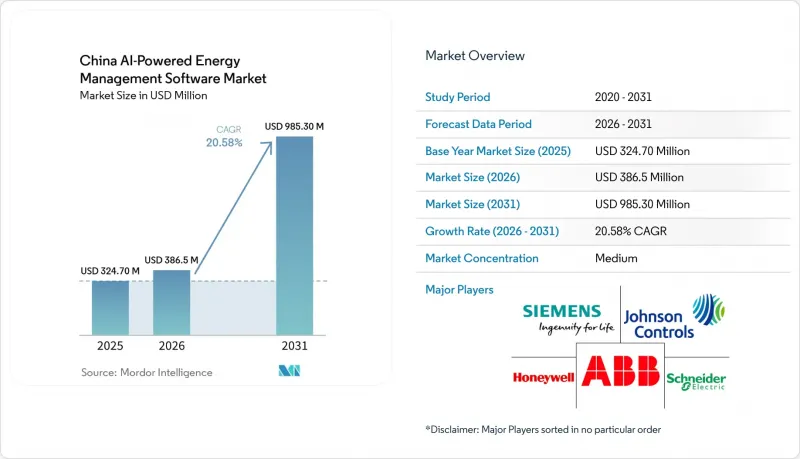
Mordor Intelligence에 의하면, 중국의 AI 기반 에너지 관리 소프트웨어 시장 규모는 2025년에 3억 2,470만 달러로 평가되었고, 2026년에 3억 8,650만 달러로 추정되고, 2031년까지 9억 8,530만 달러에 이를 것으로 예측되며, 2026-2031년 CAGR 20.58%로 성장할 전망입니다.
본 보고서는 컴포넌트별(소프트웨어 및 서비스), 배포 방식별(클라우드 기반, 온프레미스형, 하이브리드형), 용도별(에너지 소비 및 수요 최적화, 자산 성능 및 예측 유지보수 등), 최종 사용자별(유틸리티, 상업용 빌딩 등)로 분류되어 있습니다. 시장 전망은 금액(달러) 기준으로 제시되어 있습니다.
중국의 AI 기반 에너지 관리 소프트웨어 시장 동향 및 인사이트
상업 및 산업 시설에서의 실시간 에너지 최적화에 대한 수요 증가
산업 및 상업 부문의 에너지 사용자들은 점점 더 엄격해지는 효율성 및 탄소 배출량 목표를 달성하면서 동시에 소비량을 억제해야 하는 압박에 직면하고 있어, 중국의 AI 기반 에너지 관리 소프트웨어 시장에서 여전히 핵심적인 위치를 차지하고 있습니다. 2025년 9월 국가발전개혁위원회 및 국가에너지국이 발표한 시행 의견에 따라, 에너지 분야의 AI는 광범위한 정책 주제에서 전력, 석탄, 석유 및 가스 시스템에 걸친 명확한 용도 의제로 전환되었습니다. 이어 2026년 5월의 행동 계획에서는 51가지 AI 및 에너지 용도 시나리오를 제시함으로써 그 방향성을 더욱 구체화하고, 기업 및 유틸리티자에게 조달 및 도입을 위한 보다 명확한 로드맵을 제시했습니다. 이 정책 구조가 중요한 이유는 구매자가 플랜트나 건물 전체의 모니터링, 제어, 보고 기능을 향상시키는 소프트웨어에 대한 지출을 정당화할 수 있는 더 강력한 근거를 얻었기 때문입니다. 또한, 중국의 AI 활용형 에너지 관리 소프트웨어 시장에서 핵심 분석 도구뿐만 아니라 실제 운영상의 의사결정으로 이어지는 도입 지원 및 워크플로우 통합에 대한 수요가 높아지고 있는 이유도 이 정책 구조를 통해 설명할 수 있습니다.
AI와 스마트 그리드 및 분산형 에너지 자원의 통합
중국의 AI 기반 에너지 관리 소프트웨어 시장은 송전망 측면에서도 지지를 얻고 있습니다. 송전망 측면에서는 재생에너지의 통합이나 전력 균형 조정이 기존의 정적 도구로는 관리가 점점 더 어려워지고 있습니다. 중국의 재생에너지는 이미 설치된 발전 용량의 48%를 차지하고 있으며, 이로 인해 변동하는 발전량을 예측하고 분산형 자원을 보다 효과적으로 조정할 수 있는 소프트웨어의 가치가 높아지고 있습니다. 2026년 국가 행동 계획에는 스마트 그리드, 가상 발전소, 신에너지 예측이 우선적인 응용 분야로 구체적으로 포함되어 있어, 송전망용 AI 활용 사례가 공식적인 국가 계획의 일부가 되었음을 보여줍니다. 이에 따라 송배전망 운영, 분산형 자산, 기업 에너지 시스템을 아우르는 기능을 제공하는 벤더에 대한 수요 기반이 더욱 공고해질 것입니다. 또한 공급업체에게는 신뢰할 수 있는 현지 도입 실적과 전력 회사의 운영 규정을 준수하는 아키텍처가 점점 더 요구될 것이므로, 중국 AI 기반 에너지 관리 소프트웨어 시장의 진입 장벽도 높아지고 있습니다.
레거시 OT 및 IT 시스템과의 통합 복잡성
AI 도구는 안정적이고 구조화된 운영 데이터에 의존하기 때문에 레거시 제어 환경은 여전히 중국 AI 기반 에너지 관리 소프트웨어 시장에서 가장 두드러진 제약 요인 중 하나입니다. 2025년에 실시된 IT와 OT 통합에 관한 동료 심사 연구에 따르면, 산업의 디지털화는 통신, IT 주도형 OT 지원, 인간 중심 설계, 보안, 그리고 첨단 산업 용도이라는 5가지 상호 연관된 영역에 의존하며, 각 영역마다 전용 엔지니어링 작업이 필요하다는 사실이 밝혀졌습니다. 이는 현장이 구형 PLC, 사일로화된 모니터링 시스템, 그리고 수년에 걸쳐 구축된 맞춤형 인터페이스에 의존하고 있는 경우, 많은 프로젝트가 여전히 더딘 진전을 보이는 이유를 설명해 줍니다. 문제는 기술적 비용뿐만이 아닙니다. 통합 주기가 길어지면 구매자가 측정 가능한 비용 절감이나 규정 준수상의 이점을 체감할 수 있는 시기도 늦어지기 때문입니다. 중국의 AI 기반 에너지 관리 소프트웨어 시장에서 데이터 수집과 시스템 통합을 간소화하는 벤더는 가치를 입증하기 전에 사이트 전체의 현대화에 의존하는 벤더보다 더 많은 비즈니스 기회를 성사시킬 가능성이 높을 것으로 보입니다.
부문 분석
2025년에는 소프트웨어가 매출의 68.11%를 차지했으며, 중국 AI 기반 에너지 관리 소프트웨어 시장에서 가장 큰 구성 요소가 되었습니다. 이러한 우위는 기업 도입 과정에서 플랫폼 라이선스, 소프트웨어 구독, 분석 모듈 및 제어 용도이 중심적인 역할을 하고 있음을 반영합니다. 대규모 유틸리티 계약이나 여러 거점에 걸친 산업 분야에서의 도입에서도 구매자는 일반적으로 자문 및 최적화 단계를 추가하기 전에 ‘시스템 오브 레코드(System of Record)’를 필요로 하기 때문에 지출은 우선 핵심 플랫폼에 집중되는 경향이 있습니다. 따라서 중국의 AI 기반 에너지 관리 소프트웨어 시장에서는 특히 여러 자산에 걸쳐 모니터링, 예측 및 운영 제어를 통합해야 하는 경우, 가치 창출의 기반으로 소프트웨어에 대한 의존도가 지속되었습니다.
서비스 부문은 2026-2031년 연평균 성장률(CAGR) 21.22%로 확대될 것으로 예측되며, 예측 기간 동안 가장 빠르게 성장하는 부문이 될 것입니다. 이러한 성장은 많은 도입 사례에서 실질적인 결과를 도출하기 위해 모델 튜닝, 도입 지원, 탄소 회계 워크플로우, 지속적인 최적화가 필요하기 때문에 구매자들이 단순히 소프트웨어 구매만으로는 만족하지 않는다는 점을 보여줍니다. 2026년 3월에 수립된 에너지 절약 기기 도입 계획에서는 AI 활용형 대규모 에너지 절약·탄소 감축 모델의 개발과 지능형 기기 관리 서비스의 추진이 요구되고 있으며, 이는 소프트웨어 도입 서비스 부문의 추가적인 확장을 직접적으로 뒷받침하는 요소입니다. 이러한 변화는 벤더 입장에서는 초기 소프트웨어 판매뿐만 아니라, 도입 및 지원을 통한 지속적인 수익 확대의 여지가 넓어진다는 점에서 중요합니다. 또한, 중국의 AI 활용형 에너지 관리 소프트웨어 시장이 제품 기능 그 자체보다 실행 능력이나 현지 서비스 제공의 충실도에 점점 더 의존하게 되고 있는 이유도 설명해 줍니다.
2025년, 중국의 AI 기반 에너지 관리 소프트웨어 시장에서 클라우드 기반 도입은 58.16%의 점유율을 차지하며 가장 큰 도입 형태가 되었습니다. 이러한 상황은 국내 클라우드 인프라의 급속한 확대에 더해, 분산된 운영 환경 전체에 대한 통합적인 접근, 신속한 업데이트, 그리고 광범위한 데이터 집계라는 장점이 높이 평가된 것을 반영합니다. 많은 기업이 각 거점에 완전히 독립된 소프트웨어 스택을 구축하지 않고도 모니터링, 분석, 보고 기능을 연계하고자 했기 때문에 시장은 이러한 구성의 혜택을 누렸습니다. 또한, 클라우드 도입은 유연성과 초기 인프라 투자 절감을 중시하는 상업용 빌딩 및 경공업 환경에서의 새로운 이용 사례에도 적합했습니다.
하이브리드 배포는 2026-2031년 연평균 성장률(CAGR) 21.34%로 확대될 것으로 예측되며, 시장에서 가장 빠르게 성장하는 아키텍처가 될 전망입니다. 이러한 추세는 특히 유틸리티 및 중요 인프라 운영 사업자의 경우, 기밀 정보를 승인된 관할 구역 내에 보관해야 한다는 점 때문에 에너지 및 운영 데이터 처리가 더욱 엄격해지고 있는 상황과 일치합니다. 2025년 12월에 제정되어 2026년 7월 1일부터 시행되는 에너지 분야 데이터 보안 관리 관련 조치에 따라, 집계 및 보고에는 클라우드 리소스를 활용하면서도 일부 데이터와 워크로드를 로컬에 보관하는 실용적인 접근 방식의 타당성이 더욱 강화되었습니다. 따라서 중국의 AI 기반 에너지 관리 소프트웨어 시장은 기업이 OT(운영 기술)상의 기밀성이 높은 기능을 자산 근처에 유지하면서도 사이트 전반에 걸친 광범위한 분석 및 벤치마킹을 계속 활용할 수 있는 도입 모델로 전환되고 있습니다. 이러한 균형은 AI 활용 사례가 공공 서비스, 제조업, 데이터센터 환경으로 확대됨에 따라 앞으로도 계속 중요할 것입니다.
기타 혜택 :
- 엑셀 형식 시장 예측(ME) 시트
- 3개월간의 애널리스트 지원
자주 묻는 질문
목차
제1장 서론
제2장 조사 방법
제3장 주요 요약
제4장 시장 구도
제5장 시장 규모 및 성장 예측
제6장 경쟁 구도
제7장 시장 기회 및 향후 전망
AJY 26.08.07According to Mordor Intelligence, the China AI-powered energy management software market size is projected to be USD 324.7 million in 2025, USD 386.5 million in 2026, and reach USD 985.3 million by 2031, growing at a CAGR of 20.58% from 2026 to 2031.
This report is Segmented by Component (Software, and Services), Deployment Mode (Cloud-Based, On-Premises, and Hybrid), Application (Energy Consumption and Demand Optimization, Asset Performance and Predictive Maintenance, and More), and End User (Utilities, Commercial Buildings, and More). The Market Forecasts are Provided in Terms of Value (USD).
China AI-powered Energy Management Software Market Trends and Insights
Rising Need For Real-Time Energy Optimization in Commercial and Industrial Facilities
Industrial and commercial energy users remain central to the China AI-powered Energy Management Software Market, as they face growing pressure to control consumption while meeting increasingly stringent efficiency and carbon-emission targets. The September 2025 implementation opinions from the National Development and Reform Commission and the National Energy Administration moved AI in energy from a broad policy theme to a defined application agenda across power, coal, and oil and gas systems. The May 2026 action plan then expanded on that direction by setting out 51 AI and energy application scenarios, providing enterprises and utilities with a clearer path for procurement and deployment. This policy structure matters because buyers now have stronger reasons to justify software spending that improves monitoring, control, and reporting across plants and buildings. It also helps explain why the China AI-powered Energy Management Software Market is seeing demand not only for core analytics tools, but also for implementation support and workflow integration tied to real operating decisions.
Integration of AI With Smart Grid and Distributed Energy Resources
The China AI-powered Energy Management Software Market is also gaining support from the grid side, where integrating renewables and balancing power have become more difficult to manage with static tools. China's renewables already accounted for 48% of installed power capacity, and that has raised the value of software that can forecast variable output and coordinate distributed resources more effectively. The 2026 national action plan specifically included smart grids, virtual power plants, and new energy forecasting among its priority application areas, indicating that grid-facing AI use cases are now part of formal state planning. That creates a stronger demand base for vendors whose products can work across grid operations, distributed assets, and enterprise energy systems. It also raises the bar in the China AI-powered Energy Management Software Market, as suppliers increasingly need credible local deployment experience and architectures that comply with utility operating rules.
High Integration Complexity with Legacy OT and IT Systems
Legacy control environments remain one of the clearest constraints on the China AI-powered Energy Management Software Market, as AI tools depend on stable, structured operational data. A 2025 peer-reviewed survey on IT and OT integration found that industrial digitalization depends on five linked domains: communication, IT-driven OT support, human centricity, security, and advanced industrial applications, and each one needs dedicated engineering effort. That helps explain why many projects still move slowly when sites rely on old PLCs, siloed supervisory systems, and custom interfaces built over many years. The issue is not only technical cost, because long integration cycles also delay the point at which buyers can see measurable savings or compliance gains. In the China AI-powered Energy Management Software Market, vendors that simplify data capture and system integration are likely to convert more opportunities than those that depend on full-site modernization before value can be demonstrated.
Other drivers and restraints analyzed in the detailed report include:
- Increasing Demand for Automated Demand Response and Peak Load Management
- Expansion of ESG Reporting and Carbon Accounting Workflows
- Data Quality, Interoperability, and Sensor Fragmentation Issues
For complete list of drivers and restraints, kindly check the Table Of Contents.
Segment Analysis
Software accounted for 68.11% of revenue in 2025, making it the largest component of the China AI-powered Energy Management Software Market. This lead reflects the central role of platform licenses, software subscriptions, analytics modules, and control applications in enterprise deployments. Large utility contracts and multi-site industrial rollouts also tend to concentrate spending in core platforms first, since buyers usually need a system of record before they add advisory or optimization layers. The China AI-powered Energy Management Software Market, therefore, continued to lean on software as the basis for value creation, especially when monitoring, forecasting, and operational control needed to be integrated across multiple assets.
Services are projected to expand at a 21.22% CAGR from 2026 to 2031, which makes them the fastest-growing component over the forecast period. This rise shows that buyers are not stopping at software purchase, because many deployments require model tuning, implementation support, carbon accounting workflows, and ongoing optimization to produce usable results. The March 2026 implementation plan for energy-saving equipment called for the development of large-scale AI-based energy-saving and carbon-reducing models and for promoting intelligent device management services, which directly support a broader software adoption service layer. The shift is important because it gives vendors more room to grow recurring revenue from delivery and support, not just from initial software sales. It also explains why the China AI-powered Energy Management Software Market is becoming more dependent on execution capability and local service depth, rather than on product features alone.
Cloud-based deployment held 58.16% of the China AI-powered Energy Management Software Market share in 2025, making it the largest deployment mode. This position reflected the rapid expansion of domestic cloud infrastructure and the appeal of centralized access, faster updates, and wider data aggregation across distributed operations. The market benefited from this setup because many enterprises wanted to connect monitoring, analytics, and reporting without building fully separate software stacks at every site. Cloud deployment also suited newer use cases in commercial buildings and lighter industrial environments where buyers favored flexibility and lower upfront infrastructure needs.
Hybrid deployment is projected to expand at a 21.34% CAGR from 2026 to 2031, which makes it the fastest-growing architecture in the market. This pattern aligns with the stricter treatment of energy and operational data, especially for utilities and critical infrastructure operators that must keep sensitive information within approved jurisdictions. The December 2025 measures for data security management in the energy sector, effective July 1, 2026, strengthened the practical case for keeping some data and workloads local while still using cloud resources for aggregation and reporting. The China AI-powered Energy Management Software Market is therefore shifting toward deployment models that let enterprises keep OT-sensitive functions close to the asset while still using broader analytics and benchmarking across sites. That balance is likely to remain important as AI use cases expand across utilities, manufacturing, and data center environments.
Complete Report Scope:
- By Component
- Software
- Services
- By Deployment Mode
- Cloud-Based
- On-Premises
- Hybrid
- By Application
- Energy Consumption and Demand Optimization
- Asset Performance and Predictive Maintenance
- Smart Grid and Distributed Energy Resource (DER) Management
- Renewable Energy Forecasting and Integration
- Energy Trading, Pricing and Market Intelligence
- By End User
- Utilities
- Commercial Buildings
- Industrial Facilities
- Residential Buildings
List of Companies Covered in this Report:
- Siemens AG
- Schneider Electric SE
- ABB Ltd.
- Honeywell International Inc.
- IBM Corporation
- Johnson Controls International plc
- Oracle Corporation
- Microsoft Corporation
- Amazon Web Services, Inc.
- C3.AI, Inc.
- Bidgely, Inc.
- Grid4C Ltd.
- Innowatts, Inc.
- EnergyCAP, LLC
- Enel X S.r.l.
- Guoneng Rixin
- State Grid Corporation of China
- Dexma Sensors, S.L.
- Rockwell Automation, Inc.
- Envision Digital
Additional Benefits:
- The market estimate (ME) sheet in Excel format
- 3 months of analyst support
TABLE OF CONTENTS
1 INTRODUCTION
- 1.1 Study Assumptions and Market Definition
- 1.2 Scope of the Study
2 RESEARCH METHODOLOGY
3 EXECUTIVE SUMMARY
4 MARKET LANDSCAPE
- 4.1 Market Overview
- 4.2 Market Drivers
- 4.2.1 Rising Need for Real-Time Energy Optimization in Commercial and Industrial Facilities
- 4.2.2 Integration of AI With Smart Grid and Distributed Energy Resources
- 4.2.3 Increasing Demand for Automated Demand Response and Peak Load Management
- 4.2.4 Expansion of ESG Reporting and Carbon Accounting Workflows
- 4.2.5 Edge AI Adoption for Site-Level Energy Control and Fault Detection
- 4.2.6 Growing Retrofit Demand From Aging Building and Industrial Infrastructure
- 4.3 Market Restraints
- 4.3.1 High Integration Complexity With Legacy OT and IT Systems
- 4.3.2 Data Quality, Interoperability, and Sensor Fragmentation Issues
- 4.3.3 Cybersecurity and Data Sovereignty Concerns for Critical Energy Assets
- 4.3.4 Payback Uncertainty in Small and Mid-Sized Sites With Limited Load Density
- 4.4 Impact of Macroeconomic Factors on the Market
- 4.5 Industry Value-Chain Analysis
- 4.6 Regulatory Landscape
- 4.7 Technological Outlook
- 4.8 Porter's Five Forces Analysis
- 4.8.1 Bargaining Power of Buyers
- 4.8.2 Bargaining Power of Suppliers
- 4.8.3 Threat of New Entrants
- 4.8.4 Threat of Substitutes
- 4.8.5 Intensity of Competitive Rivalry
5 MARKET SIZE AND GROWTH FORECASTS (VALUE)
- 5.1 By Component
- 5.1.1 Software
- 5.1.2 Services
- 5.2 By Deployment Mode
- 5.2.1 Cloud-Based
- 5.2.2 On-Premises
- 5.2.3 Hybrid
- 5.3 By Application
- 5.3.1 Energy Consumption and Demand Optimization
- 5.3.2 Asset Performance and Predictive Maintenance
- 5.3.3 Smart Grid and Distributed Energy Resource (DER) Management
- 5.3.4 Renewable Energy Forecasting and Integration
- 5.3.5 Energy Trading, Pricing and Market Intelligence
- 5.4 By End User
- 5.4.1 Utilities
- 5.4.2 Commercial Buildings
- 5.4.3 Industrial Facilities
- 5.4.4 Residential Buildings
6 COMPETITIVE LANDSCAPE
- 6.1 Market Concentration
- 6.2 Strategic Moves
- 6.3 Market Share Analysis
- 6.4 Company Profiles (includes Global Level Overview, Market Level Overview, Core Segments, Financials as available, Strategic Information, Market Rank/Share, Products and Services, Recent Developments)
- 6.4.1 Siemens AG
- 6.4.2 Schneider Electric SE
- 6.4.3 ABB Ltd.
- 6.4.4 Honeywell International Inc.
- 6.4.5 IBM Corporation
- 6.4.6 Johnson Controls International plc
- 6.4.7 Oracle Corporation
- 6.4.8 Microsoft Corporation
- 6.4.9 Amazon Web Services, Inc.
- 6.4.10 C3.ai, Inc.
- 6.4.11 Bidgely, Inc.
- 6.4.12 Grid4C Ltd.
- 6.4.13 Innowatts, Inc.
- 6.4.14 EnergyCAP, LLC
- 6.4.15 Enel X S.r.l.
- 6.4.16 Guoneng Rixin
- 6.4.17 State Grid Corporation of China
- 6.4.18 Dexma Sensors, S.L.
- 6.4.19 Rockwell Automation, Inc.
- 6.4.20 Envision Digital
7 MARKET OPPORTUNITIES AND FUTURE OUTLOOK
- 7.1 White-Space and Unmet-Need Assessment


