

|
시장보고서
상품코드
2097467
ASEAN의 디지털 워크플레이스 : 시장 점유율 분석, 업계 동향 및 통계, 성장 예측(2026-2031년)ASEAN Digital Workplace - Market Share Analysis, Industry Trends & Statistics, Growth Forecasts (2026 - 2031) |
||||||
 Mordor Intelligence
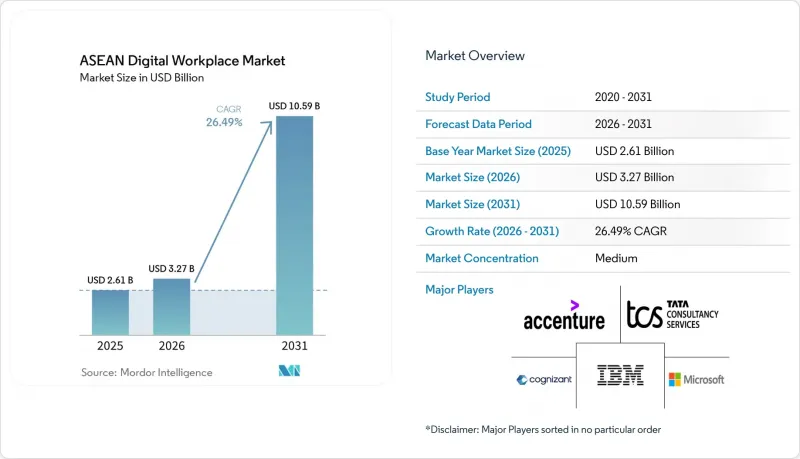
Mordor Intelligence에 의하면, ASEAN의 디지털 워크플레이스 시장 규모는 2025년 26억 1,000만 달러로 평가되었습니다. 2026년에는 32억 7,000만 달러로 확대되고 2026년부터 2031년에 걸쳐 CAGR 26.49%로 성장을 지속하여, 2031년에는 105억 9,000만 달러에 이를 것으로 예측됩니다.
본 보고서는 구성 요소(솔루션 및 서비스), 도입 형태(클라우드, On-Premise 등), 조직 규모(대기업 및 중소기업), 최종 사용자 산업(IT 및 통신, 은행, 금융서비스 및 보험(BFSI), 의료, 제조, 소매, 정부·공공 부문, 교육 등), 그리고 지역별로 분류되어 있습니다. 시장 전망은 금액(달러) 기준으로 제시되어 있습니다.
ASEAN의 디지털 워크플레이스 시장 동향 및 인사이트
하이브리드 및 원격 근무 모델로의 전환이 진행 중
하이브리드 근무는 ASEAN의 주요 비즈니스 센터에서 표준 업무 모델로 자리 잡았으며, 이러한 변화로 인해 ASEAN의 디지털 워크플레이스 시장은 강력한 상승세를 유지하고 있습니다. 이는 기업들이 분산된 팀을 위한 안정적인 도구, 안전한 접근, 그리고 거점 간 연계된 워크플로우를 필요로 하기 때문입니다. 또한, 하이브리드 근무의 확산으로 인해 기업들은 병행하여 운영되던 원격 접속 시스템을 장기적으로 관리 및 보안 유지가 용이한, 보다 통합된 업무 환경 스택으로 대체해야 하는 상황에 놓여 있으며, 시장도 이에 따른 혜택을 누리고 있습니다. 아울러, ‘ASEAN의 디지털 마스터플랜 2030’은 2028년까지 공공 행정 분야의 디지털 역량과 변혁 관리 역량 강화를 요구함으로써 이러한 전환에 추가적인 제도적 뒷받침을 제공했고, 수요 기반을 민간 기업에만 국한되지 않는 수준으로 확대시켰습니다. 이 지역 프레임워크에서 조사 대상 이해관계자의 61%가 인프라의 최우선 과제로 클라우드와 데이터센터를 꼽은 것으로 밝혀졌으며, 이는 하이브리드 근무에 대한 수요가 현재 아세안 전역에 걸친 보다 광범위한 디지털 인프라 결정과 연결되어 있음을 여실히 보여줍니다. 이에 따라 ASEAN의 디지털 업무 환경 시장은 일시적인 근무 정책 변경에 대한 의존도를 낮추고, 국가와 사업 부문을 초월하여 직원들이 연결되고, 협업하며, 시스템에 접근하는 방식을 장기적으로 재설계하는 것과 더욱 밀접하게 연계되고 있습니다. 또한 하이브리드 업무가 성숙해짐에 따라 구매자들은 관리해야 할 시스템 수를 줄이고자 하는 경향이 강해지고 있어, 협업, 엔드포인트 제어, 액세스 거버넌스를 단일 솔루션으로 통합할 수 있는 벤더의 가치도 높아지고 있습니다.
클라우드 기반 협업 제품군에 대한 수요 증가
클라우드 기반 협업 제품군은 기업이 커뮤니케이션, 문서 관리, 워크플로 자동화, AI 기능을 대규모로 배포하기 위한 주요 기반 역할을 하며, 현재 아세안(ASEAN) 디지털 업무 환경 시장의 핵심 성장 동력이 되고 있습니다. 마이크로소프트는 2025년부터 2029년까지 싱가포르의 클라우드 및 AI 인프라와 운영에 55억 달러를 투자할 것이라고 발표했습니다. 이를 통해 싱가포르가 기업의 클라우드 도입 및 생태계 개발에서 지역 거점으로서의 역할이 더욱 강화되었습니다. 또한, 2026년 4월 액센츄어 직원 74만 3,000명을 대상으로 ‘Microsoft 365 Copilot’이 도입된 것은 AI가 더 이상 독립적인 실험적 시스템이 아니라, 주류 워크플레이스 제품군을 통해 제공되고 있음을 보여줍니다. 인도네시아의 경우, 마이크로소프트 관련 보고서에 따르면 2025년 시점에서 경영진의 59%가 이미 AI 에이전트를 도입했으며, 95%가 12-18개월 이내에 그 도입 규모를 확대할 계획인 것으로 나타났습니다. 이는 클라우드 제품군에 대한 수요가 단순한 기본적인 생산성 향상 요구뿐만 아니라 자동화 활용 사례에 의해 주도되고 있음을 시사합니다. 말레이시아도 유사한 추세를 보이고 있으며, AI 도입률은 2025년 하반기 19.7%에서 2026년 1분기 21.8%로 상승하여, 클라우드 퍼스트 워크플레이스 플랫폼의 구독 서비스 성장을 더욱 뒷받침하고 있습니다. 그 결과, 아세안(ASEAN)의 디지털 업무 환경 시장은 생산성, 자동화, 거버넌스, AI를 단일 구독 서비스로 통합한 플랫폼 생태계에 의해 점점 더 형성되고 있습니다.
레거시 기업 시스템과의 통합 복잡성
많은 기업이 새로운 워크플레이스 플랫폼과 원활하게 연동되지 않는 구식 생산, 은행 또는 관리 시스템을 여전히 운영하고 있어, 레거시 인프라가 ASEAN의 디지털 워크플레이스 시장의 성장을 계속해서 저해하고 있습니다. 『더 비즈니스 타임즈』는 2025년 보도에서 아세안 지역 제조업체들이 AI 및 첨단 기술 도입 확대에 어려움을 겪고 있다고 전했습니다. 그 배경에는 많은 시설이 10년 이상 전에 건설되어 호환되지 않는 다중 벤더 시스템에 의존하고 있다는 점이 있으며, 이는 더 광범위한 업무 환경 혁신이 직면한 과제와 유사합니다. 이 문제는 단순한 소프트웨어 호환성 문제를 넘어섭니다. 통합 문제를 해결하는 데 시간을 쏟는 IT 팀은 교육, 도입 거버넌스, 프로세스 재설계에 할애할 여력이 부족하기 때문입니다. 인도네시아 산업부는 ‘PIDI 4.0’ 프로그램을 통해 이러한 근본적인 기술 격차를 해소하려 시도했습니다. 이 프로그램을 통해 2022년부터 2025년까지 1,921명의 근로자가 디지털 기술을 습득했으나, 레거시 시스템의 도입 기반이 여전히 존재하기 때문에 조직이 시범 운영에서 본격적인 전개로 전환하는 속도에는 한계가 있습니다. 따라서 아세안(ASEAN)의 디지털 워크플레이스 시장에서는 기존 인프라를 전면적으로 교체할 것을 요구하기보다는 커넥터, 단계적 전환 계획 및 다층적 도입 모델을 제공할 수 있는 공급업체가 선호되고 있습니다. 이러한 통합 장벽이 완화될 때까지는 기업 수요의 상당 부분이 예산 계획에서 예상하는 것보다 더 느린 속도로 지속될 것입니다.
부문 분석
2025년에는 솔루션이 시장의 68.32%를 차지하며, ASEAN의 디지털 워크플레이스 시장에서 가장 큰 수익 기반을 형성했습니다. 이는 기업들이 커뮤니케이션, 워크플로우 관리, 엔드포인트 일관성, 그리고 직원의 업무를 직접 지원하는 소프트웨어 계층을 선호했기 때문입니다. 또한, 많은 구매자가 파편화된 단일 기능 도구에서 벗어나, 더 적은 수의 벤더로 디지털 직원 라이프사이클의 더 많은 부분을 지원할 수 있는 광범위한 플랫폼 환경으로의 전환을 원했던 점도 솔루션이 주도적인 위치를 차지한 이유입니다. 이러한 구성 속에서 통합 커뮤니케이션 및 협업 도구가 여전히 가장 널리 활용되었으며, 그 뒤를 워크플로우 자동화, 지식 관리, 직원 경험(EX) 시스템이 이었습니다. 이는 아세안(ASEAN)의 디지털 워크플레이스 업계가 실용성이 높은 소수의 도구를 중심으로 통합이 진행되고 있음을 반영합니다. 또한, 조직들이 하이브리드 액세스를 확보하고 분산된 팀 전체에 걸쳐 엔드포인트 환경을 표준화하려는 시도를 하면서 가상 데스크톱 인프라(VDI) 및 클라우드 PC 도구도 주목을 받았습니다. 이러한 동향으로 인해 도입 지원 측면에서 서비스의 중요성은 여전히 크지만, ASEAN의 디지털 워크플레이스 시장은 제품 주도형 지출을 중심으로 계속 유지되었습니다.
서비스 분야는 예측 기간 동안 연평균 성장률(CAGR) 26.89%를 나타낼 것으로 예측되며, 국가 및 사업 부문을 아우르는 전개 과정의 복잡성, 통합 작업, 도입 후 관리에 대처하기 위해 기업들이 외부 지원을 구함에 따라 계속해서 확대되고 있습니다. 이러한 수요는 레거시 아키텍처로 인해 도입이 지연되고 사내 IT 팀의 부담이 가중되고 있는 제조업 및 은행 업계에서 특히 두드러집니다. 2026년 4월 액센츄어가 74만 3,000명의 직원을 대상으로 Microsoft 365 Copilot을 도입한 사례는 대규모 워크플레이스 프로그램이 단순한 소프트웨어 구매가 아닌 솔루션 주도형 변혁 모델을 통해 현재 기업 규모로 어떻게 구현되고 있는지를 보여줍니다. 이와 유사한 경향은 2026년 3월 액센츄어가 출범한 ‘Microsoft Forward Deployment Engineering Practice’에서도 확인할 수 있었습니다. 이는 기업의 AI 프로그램을 며칠 만에 구상 단계에서 운영 환경으로 전환하기 위해 구축된 것으로, 아세안(ASEAN) 디지털 워크플레이스 시장에서 소프트웨어 및 서비스가 긴밀하게 연계된 제공 체제의 가치를 입증하는 사례입니다. 향후에는 네이티브 플랫폼의 기능과 도입 노하우를 겸비한 제공업체가 유리한 입지를 차지할 것입니다. 왜냐하면 구매자들은 벤더의 복잡성을 가중시키지 않으면서도 도입까지의 시간을 단축할 수 있는 파트너를 점점 더 선택하고 있기 때문입니다.
클라우드는 2025년에 시장 점유율의 66.87%를 차지했으며, 2031년까지 공개된 성장률은 27.08%로 가장 높은 성장세를 보이고 있어, 아세안(ASEAN)의 디지털 워크플레이스 시장이 호스팅형 및 구독형 제공 모델로 얼마나 확실하게 전환되고 있는지를 여실히 보여주고 있습니다. 클라우드가 점유율을 확대한 것은 On-Premise 시스템과 같은 대규모 사내 인프라 투자가 필요 없이, 신속한 배포, 손쉬운 확장성, 그리고 여러 거점에 분산된 직원들에게 광범위한 접근성을 제공함으로써 해당 지역의 요구를 충족시켰기 때문입니다. 이러한 변화는 많은 자동화 기능과 어시스턴트 기능이 처음부터 클라우드 생태계를 통해 제공되어 왔기 때문에 워크플레이스 소프트웨어가 현재 AI 도입 준비와 더욱 밀접하게 연결되어 있음을 반영합니다. 마이크로소프트의 싱가포르 인프라 구축 노력은 기업의 워크플레이스 도입을 뒷받침하는 클라우드 및 AI 워크로드에 대한 지역적 처리 능력을 강화함으로써 이러한 방향성을 뒷받침했습니다. 말레이시아의 AI 도입률은 현지 클라우드 용량 확대에 따라 2025년 하반기 19.7%에서 2026년 1분기 21.8%로 상승했습니다. 이는 인프라 가용성과 최신 업무 공간 플랫폼에 대한 수요 사이에 상관관계가 있음을 시사합니다.
금융 서비스, 의료, 정부 기관 등 규제 대상 분야에서는 On-Premise 시스템의 중요성이 여전히 유지되었습니다. 이러한 분야에서는 데이터 소재지에 관한 규제와 과거의 인프라 투자로 인해 도입 결정에 있어 강한 관성이 계속해서 나타나고 있습니다. 또한 하이브리드 모델의 중요성도 계속해서 커지고 있습니다. 이는 조직이 퍼블릭 클라우드의 확장성과 기밀 데이터 및 워크로드 배치에 대한 엄격한 관리 사이의 균형을 현실적으로 도모할 수 있는 수단이 되기 때문입니다. 2026년 6월로 예정된 ASEAN DEFA 협상 타결은 시간이 지남에 따라 국경을 넘는 데이터 유통에 따른 마찰을 어느 정도 완화하는 데 기여할 것이며, 이를 통해 ASEAN의 디지털 워크플레이스 시장에서 다국적 확장을 위한 클라우드 도입의 근거가 점차 강화될 것입니다. 동시에, 싱가포르의 PDPA나 ‘AI 거버넌스 및 윤리에 관한 아세안 가이드’와 같은 규정 준수 프레임워크는 기업이 퍼블릭 클라우드와 관리된 환경의 경계를 어떻게 그을지 앞으로도 계속해서 좌우할 것입니다. 즉, 도입 여부는 기술적 선호도와 마찬가지로 규제 해석에 따라 계속해서 좌우될 것입니다.
기타 혜택 :
- 엑셀 형식 시장 예측(ME) 시트
- 3개월간의 애널리스트 지원
자주 묻는 질문
목차
제1장 서론
제2장 조사 방법
제3장 주요 요약
제4장 시장 구도
제5장 시장 규모 및 성장 예측
제6장 경쟁 구도
제7장 시장 기회 및 향후 전망
KTH 26.08.05According to Mordor Intelligence, the ASEAN digital workplace market size is expected to grow from USD 2.61 billion in 2025 to USD 3.27 billion in 2026, and is forecast to reach USD 10.59 billion by 2031, at a 26.49% CAGR over 2026-2031.
This report is Segmented by Component (Solutions, and Services), Deployment Mode (Cloud, On-Premises, and More), Organization Size (Large Enterprises, and Small and Medium-Sized Enterprises), End-User Industry (IT and Telecommunications, BFSI, Healthcare, Manufacturing, Retail, Government and Public Sector, Education, and More), and Geography. The Market Forecasts are Provided in Terms of Value (USD).
ASEAN Digital Workplace Market Trends and Insights
Rising Shift To Hybrid and Remote Work Models
Hybrid work has become a normal operating model in major ASEAN business centers, and that change is keeping the ASEAN digital workplace market on a strong upward path because companies now need stable tools for distributed teams, secure access, and coordinated workflows across sites. The market is also benefiting because hybrid work has pushed companies to replace parallel remote access systems with more unified workplace stacks that are easier to manage and secure over time. The ASEAN Digital Masterplan 2030 also gave this shift greater institutional backing by calling for stronger digital competencies and change management capabilities in public administration by 2028, broadening the demand base beyond private enterprise alone. The same regional framework identified cloud and data centers as the top infrastructure priority for 61% of surveyed stakeholders, underscoring that hybrid work needs are now tied to broader digital infrastructure decisions across ASEAN. This is making the ASEAN digital workplace market less dependent on temporary work policy changes and more tied to long-term redesign of how employees connect, collaborate, and access systems across countries and business units. It also raises the value of vendors that can combine collaboration, endpoint control, and access governance into a single offer, because buyers increasingly want fewer systems to manage as hybrid operations mature.
Expanding Demand for Cloud-Based Collaboration Suites
Cloud-based collaboration suites are now a core growth engine for the ASEAN digital workplace market, as they serve as the primary layer through which companies deploy communication, document management, workflow automation, and AI features at scale. Microsoft announced a USD 5.5 billion investment in cloud and AI infrastructure and operations in Singapore for 2025-2029, which reinforced Singapore's role as a regional base for enterprise cloud adoption and ecosystem development. The rollout of Microsoft 365 Copilot to 743,000 Accenture employees in April 2026 also showed that AI is now being delivered through mainstream workplace suites rather than through separate experimental systems. In Indonesia, Microsoft-linked reporting showed that 59% of business leaders had already deployed AI agents in 2025 and that 95% planned to expand that capacity within 12-18 months, indicating that cloud suite demand is being driven by automation use cases, not just basic productivity needs. Malaysia followed a similar trajectory, with AI adoption rising to 21.8% in Q1 2026 from 19.7% in H2 2025, supporting further subscription growth for cloud-first workplace platforms. As a result, the ASEAN digital workplace market is increasingly shaped by platform ecosystems that bundle productivity, automation, governance, and AI into a single subscription.
Integration Complexity With Legacy Enterprise Systems
Legacy infrastructure continues to slow the ASEAN digital workplace market because many enterprises still operate older production, banking, or administrative systems that do not connect easily with newer workplace platforms. The Business Times reported in 2025 that ASEAN manufacturers were struggling to scale AI and advanced technology adoption because many facilities were over a decade old and relied on incompatible multi-vendor systems, a challenge similar to that for broader workplace transformation. This issue goes beyond software compatibility, because IT teams that spend time fixing integrations often have less capacity left for training, rollout governance, and process redesign. Indonesia's Ministry of Industry tried to address the underlying skills gap through the PIDI 4.0 program, which trained 1,921 workers in digital competencies between 2022 and 2025, but the installed base of legacy systems still limits how quickly organizations can move from pilot activity to full deployment. The ASEAN digital workplace market, therefore, favors vendors that can offer connectors, phased migration plans, and layered deployment models rather than demanding the full replacement of existing infrastructure. Until those integration barriers ease, a meaningful share of enterprise demand will continue to move more slowly than budget plans suggest.
Other drivers and restraints analyzed in the detailed report include:
- Fast Adoption of Employee Experience Platforms and Digital Adoption Tools
- Increasing SME Digitization Across ASEAN
- Budget Constraints Among Small and Medium-Sized Enterprises
For complete list of drivers and restraints, kindly check the Table Of Contents.
Segment Analysis
Solutions accounted for 68.32% of the market in 2025 and represented the largest revenue base in the ASEAN digital workplace market, as enterprises preferred software layers that directly support communication, workflow management, endpoint consistency, and employee-facing operations. Solutions also led because many buyers wanted to move away from fragmented point tools and toward broader platform environments that could support more of the digital employee lifecycle under fewer vendors. Unified communication and collaboration tools remained the most widely used part of this mix, followed by workflow automation, knowledge management, and employee experience systems, which reflects how the ASEAN digital workplace industry is consolidating around a smaller set of high-utility tools. Virtual desktop infrastructure and cloud PC tools also gained traction as organizations tried to secure hybrid access and standardize endpoint environments across dispersed teams. This positioning kept the ASEAN digital workplace market centered on product-led spending, even as services remained important for implementation support.
The services segment is expected to generate a CAGR of 26.89% over the forecast period, and it continued to expand as companies sought external support to address rollout complexity, integration work, and post-deployment management across countries and business functions. That demand is especially relevant in manufacturing and banking settings where legacy architecture slows adoption and raises the burden on internal IT teams. Accenture's rollout of Microsoft 365 Copilot to 743,000 employees in April 2026 showed how large workplace programs are now being implemented at enterprise scale through solution-led transformation models rather than narrow software purchases. The same pattern was evident in the March 2026 launch of Accenture's Microsoft forward-deployed engineering practice, built to move enterprise AI programs from concept to production within days, reinforcing the value of tightly linked software and services offerings in the ASEAN digital workplace market. Over time, this should favor providers that can combine native platform capability with implementation depth, because buyers are increasingly selecting partners that can reduce time to deployment without adding another layer of vendor complexity.
Cloud held 66.87% of the market in 2025 and posted the strongest disclosed growth rate at 27.08% through 2031, underscoring how firmly the ASEAN digital workplace market has shifted toward hosted and subscription-based delivery. Cloud won share because it matched the region's need for faster rollout, easier scaling, and broader access across multi-site workforces without requiring the same level of internal infrastructure investment as on-premises systems. This shift also reflects how workplace software is now more closely tied to AI readiness, as many automation and assistant features are initially delivered through cloud ecosystems. Microsoft's infrastructure commitment in Singapore supported that direction by strengthening regional capacity for cloud and AI workloads that feed enterprise workplace adoption. Malaysia's AI adoption rate rose to 21.8% in Q1 2026 from 19.7% in H2 2025, following the expansion of local cloud capacity, suggesting a link between infrastructure availability and demand for modern workplace platforms.
On-premises systems remained relevant in regulated sectors such as financial services, healthcare, and government, where data residency rules and prior infrastructure investments continue to create strong inertia around deployment decisions. Hybrid models also continued to gain relevance because they gave organizations a practical way to balance public cloud scalability with tighter control over sensitive data and workload placement. The June 2026 conclusion of ASEAN DEFA negotiations should help reduce some cross-border data flow friction over time, thereby gradually strengthening the cloud case for multi-country deployments in the ASEAN digital workplace market. At the same time, compliance frameworks such as Singapore's PDPA and the ASEAN Guide on AI Governance and Ethics will continue to shape how companies draw the boundary between public cloud and controlled environments, which means deployment choices will remain tied to regulatory interpretation as much as to technical preference.
Complete Report Scope:
- By Component
- Solutions
- Unified Communication and Collaboration
- Unified Endpoint Management
- Enterprise Mobility and Management
- Employee Experience Platforms and Intranet
- Workflow Automation and Knowledge Management
- Virtual Desktop Infrastructure and Cloud PC
- Services
- Solutions
- By Deployment Mode
- Cloud
- On-Premises
- Hybrid
- By Organization Size
- Large Enterprises
- Small and Medium-sized Enterprises
- By End-User Industry
- IT and Telecommunications
- BFSI
- Healthcare
- Manufacturing
- Retail
- Government and Public Sector
- Education
- Energy and Utilities
- Legal and Professional Services
- Other End-User Industries
- By Geography
- Singapore
- Malaysia
- Thailand
- Indonesia
- Philippines
- Vietnam
- Rest of ASEAN
List of Companies Covered in this Report:
- Accenture plc
- Atos SE
- Capgemini SE
- Citrix Systems, Inc.
- Cognizant Technology Solutions Corporation
- Cloud Software Group, Inc.
- DXC Technology Company
- Fujitsu Limited
- HCL Technologies Limited
- Hewlett Packard Enterprise Company
- HTC Global Services, Inc.
- IBM Corporation
- Infosys Limited
- Microland Limited
- Microsoft Corporation
- NEC Corporation
- NTT DATA Group Corporation
- RingCentral, Inc.
- Tata Consultancy Services Limited
- Unisys Corporation
- Wipro Limited
- Yonyou Network Technology Co., Ltd.
Additional Benefits:
- The market estimate (ME) sheet in Excel format
- 3 months of analyst support
TABLE OF CONTENTS
1 INTRODUCTION
- 1.1 Study Assumptions and Market Definition
- 1.2 Scope of the Study
2 RESEARCH METHODOLOGY
3 EXECUTIVE SUMMARY
4 MARKET LANDSCAPE
- 4.1 Market Overview
- 4.2 Market Drivers
- 4.2.1 Rising Shift to Hybrid and Remote Work Models
- 4.2.2 Expanding Demand for Cloud-Based Collaboration Suites
- 4.2.3 Fast Adoption of Employee Experience Platforms and Digital Adoption Tools
- 4.2.4 Increasing SME Digitization Across ASEAN
- 4.2.5 Growing Need for Zero Trust Workplace Security and Compliance Automation
- 4.2.6 Rise of Super-App Style Workflows and Mobile-First Work Culture
- 4.3 Market Restraints
- 4.3.1 Integration Complexity With Legacy Enterprise Systems
- 4.3.2 Budget Constraints Among Small and Medium-Sized Enterprises
- 4.3.3 Data Sovereignty, Privacy, and Cross-Border Compliance Constraints
- 4.3.4 Skills Gaps in Digital Workplace Administration and Change Management
- 4.4 Impact of Macroeconomic Factors on the Market
- 4.5 Industry Value Chain Analysis
- 4.6 Regulatory Landscape
- 4.7 Technological Outlook
- 4.8 Porter's Five Forces Analysis
- 4.8.1 Threat of New Entrants
- 4.8.2 Bargaining Power of Suppliers
- 4.8.3 Bargaining Power of Buyers
- 4.8.4 Threat of Substitutes
- 4.8.5 Intensity of Competitive Rivalry
5 MARKET SIZE AND GROWTH FORECASTS (VALUE)
- 5.1 By Component
- 5.1.1 Solutions
- 5.1.1.1 Unified Communication and Collaboration
- 5.1.1.2 Unified Endpoint Management
- 5.1.1.3 Enterprise Mobility and Management
- 5.1.1.4 Employee Experience Platforms and Intranet
- 5.1.1.5 Workflow Automation and Knowledge Management
- 5.1.1.6 Virtual Desktop Infrastructure and Cloud PC
- 5.1.2 Services
- 5.1.1 Solutions
- 5.2 By Deployment Mode
- 5.2.1 Cloud
- 5.2.2 On-Premises
- 5.2.3 Hybrid
- 5.3 By Organization Size
- 5.3.1 Large Enterprises
- 5.3.2 Small and Medium-sized Enterprises
- 5.4 By End-User Industry
- 5.4.1 IT and Telecommunications
- 5.4.2 BFSI
- 5.4.3 Healthcare
- 5.4.4 Manufacturing
- 5.4.5 Retail
- 5.4.6 Government and Public Sector
- 5.4.7 Education
- 5.4.8 Energy and Utilities
- 5.4.9 Legal and Professional Services
- 5.4.10 Other End-User Industries
- 5.5 By Geography
- 5.5.1 Singapore
- 5.5.2 Malaysia
- 5.5.3 Thailand
- 5.5.4 Indonesia
- 5.5.5 Philippines
- 5.5.6 Vietnam
- 5.5.7 Rest of ASEAN
6 COMPETITIVE LANDSCAPE
- 6.1 Market Concentration
- 6.2 Strategic Moves
- 6.3 Market Share Analysis
- 6.4 Company Profiles (includes Global Level Overview, Market Level Overview, Core Segments, Financials as available, Strategic Information, Market Rank/Share, Products and Services, Recent Developments)
- 6.4.1 Accenture plc
- 6.4.2 Atos SE
- 6.4.3 Capgemini SE
- 6.4.4 Citrix Systems, Inc.
- 6.4.5 Cognizant Technology Solutions Corporation
- 6.4.6 Cloud Software Group, Inc.
- 6.4.7 DXC Technology Company
- 6.4.8 Fujitsu Limited
- 6.4.9 HCL Technologies Limited
- 6.4.10 Hewlett Packard Enterprise Company
- 6.4.11 HTC Global Services, Inc.
- 6.4.12 IBM Corporation
- 6.4.13 Infosys Limited
- 6.4.14 Microland Limited
- 6.4.15 Microsoft Corporation
- 6.4.16 NEC Corporation
- 6.4.17 NTT DATA Group Corporation
- 6.4.18 RingCentral, Inc.
- 6.4.19 Tata Consultancy Services Limited
- 6.4.20 Unisys Corporation
- 6.4.21 Wipro Limited
- 6.4.22 Yonyou Network Technology Co., Ltd.
7 MARKET OPPORTUNITIES AND FUTURE OUTLOOK
- 7.1 White-Space and Unmet-Need Assessment


