

|
시장보고서
상품코드
2098466
교육 분야 디지털 워크플레이스 : 시장 점유율 분석, 업계 동향과 통계, 성장 예측(2026-2031년)Digital Workplace In Education - Market Share Analysis, Industry Trends & Statistics, Growth Forecasts (2026 - 2031) |
||||||
 Mordor Intelligence
Mordor Intelligence에 의하면, 교육 분야 디지털 워크플레이스 시장 규모는 2025년에 54억 3,000만 달러에 이르고, 2031년까지 186억 8,000만 달러에 이를 것으로 예측되며, 2026-2031년 CAGR 23.04%를 기록할 전망입니다.
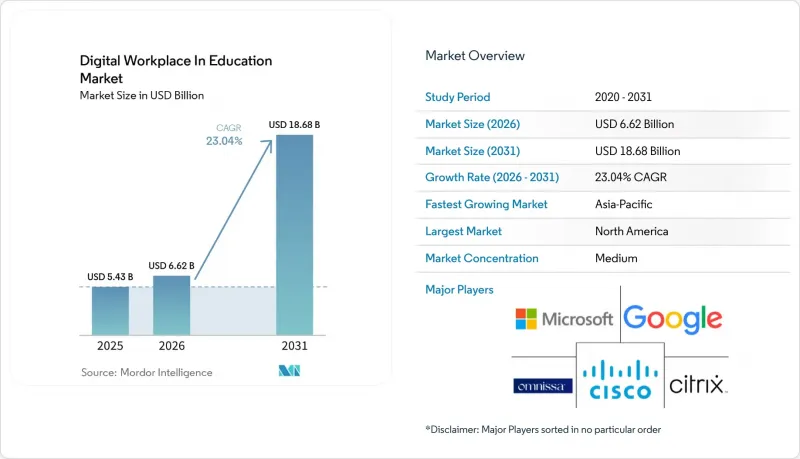
본 보고서는 구성 요소(솔루션(통합 커뮤니케이션 및 협업, 통합 엔드포인트 관리, 엔터프라이즈 모빌리티 및 관리 등) 및 서비스), 도입 형태(클라우드, On-Premise, 하이브리드), 조직 규모(대기업, 중소기업), 지역별로 분류되어 있습니다. 시장 예측은 금액(달러) 기준으로 제시되어 있습니다.
교육 분야의 세계 디지털 워크플레이스 시장 동향 및 인사이트
GenAI를 활용한 지식 발견 및 워크플로우 자동화
생성형 AI(GenAI)는 교육 분야의 디지털 워크플레이스 시장에서 플랫폼의 가치를 수동적인 소프트웨어 접근에서 검색, 초안 작성, 일정 관리, 지식 습득에 대한 능동적인 지원으로 전환시키고 있습니다. OECD 보고서에 따르면, 전 세계 중학교 교사의 57%가 AI가 수업 계획 개선에 도움이 된다고 응답했으며, 2024년에는 37%가 이미 업무에서 AI 도구를 활용하고 있었습니다. 이는 학교에서의 AI 도입이 많은 공식 조달 주기보다 이미 앞서 있음을 보여줍니다. 플랫폼 통합을 미루고 있는 교육 기관은 일상적인 학술 및 관리 업무를 위한 AI 에이전트를 지원하지 못하는 시스템에 얽매이게 될 위험이 커지고 있습니다. 『Frontiers in Artificial Intelligence』 저널의 2026년 연구에 따르면, 다중 에이전트 기반 정보 검색 파이프라인이 기업 문서를 바탕으로 SCORM 표준을 준수하는 과정을 자동으로 생성할 수 있는 것으로 나타났으며, 이는 교육 현장에서 AI 네이티브 워크플로우 도구가 훨씬 더 중요한 역할을 수행할 것임을 시사합니다. 이로 인해 교육 시장의 디지털 워크플레이스 구매 행태에 변화가 일어나고 있습니다. 소프트웨어 선정 시 단일 생산성 기능보다 모델 통합, 거버넌스, 워크플로우와의 적합성을 더욱 중시하게 되었기 때문입니다. 또한, 내장형 AI가 프리미엄 추가 기능이 아닌 기본 요건으로 자리 잡아가고 있어, 주요 플랫폼 벤더들의 입지도 강화되고 있습니다.
교직원과 학생 간의 통합적인 협업에 대한 수요 증가
교육 시장의 디지털 워크플레이스에서 단기적인 주요 성장 요인 중 하나는 개별 커뮤니케이션 도구를 교육 제공 및 백오피스 업무를 모두 지원하는 단일 협업 레이어로 대체하는 추세입니다. EDUCAUSE는 데이터 기반 의사 결정, 미래 인력 대비, 그리고 AI를 고려한 지식 실천을 2026년 고등교육 IT 리더의 핵심 우선순위로 꼽았습니다. 이는 통합된 업무 환경 시스템에 대한 교육 기관 수요 증가를 뒷받침하는 것입니다. 각 교육 기관에서는 로그인 횟수를 줄이고, ID 관리를 간소화하며, 인사, 학생 서비스, 교직원 간의 협업에서 일관된 경험을 제공하는 플랫폼을 점점 더 선호하고 있습니다. 일반적으로 수강생 명단, 일정, 교직원 기록이 협업 계층에 원활하게 연동되어 있을 경우 도입이 수월해집니다. 이는 사용자가 서로 연동되지 않은 여러 인터페이스 사이를 이동할 필요가 없어지면 일상적인 이용 빈도가 높아지기 때문입니다. 교육 분야의 디지털 워크플레이스 시장은 하이브리드 방식의 교원 근무 형태와 캠퍼스 간 연계, 그리고 학사 지도, 행정 처리, 학생 지원에 있어 신속한 대응을 지원해야 한다는 실질적인 필요성에 의해서도 뒷받침되고 있습니다. 또한, 교육 기관이 플랫폼 설계 및 데이터 처리를 평가할 때 학생 기록과 교직원 간의 커뮤니케이션을 감사 가능한 형태로 분리할 것을 요구하고 있어 조달 기준도 엄격해지고 있습니다.
공립 교육 분야의 예산 압박과 긴 갱신 주기
예산 압박은 교육 시장 내 디지털 워크플레이스의 추가 확장을 가로막는 가장 명백한 제약 요소 중 하나로 남아 있습니다. 특히 공립 유치원부터 고등학교에 이르는 교육 시스템이나 소규모 공립 대학에서 두드러집니다. 많은 교육 기관이 다년간의 계약 주기로 운영되고 있기 때문에 새로운 도구를 도입하고자 하는 의향이 있더라도 반드시 즉각적인 구매로 이어지지는 않습니다. 팬데믹 대응을 위한 긴급 자금 지원이 종료됨에 따라 2025년과 2026년에는 재량적 IT 예산도逼迫하게 되어, 많은 관리자들이 플랫폼 변경을 연기하고 기존 소프트웨어의 수명을 연장할 수밖에 없게 되었습니다. 이는 교육 시장의 디지털 업무 환경에 직접적인 영향을 미치고 있습니다. 왜냐하면 고급 AI, 엔드포인트 관리, 거버넌스 기능은 대개 소규모 교육 기관이 당장 도입하기 어려운 엔터프라이즈 라이선싱 계층과 연계되어 있기 때문입니다. 보조금 프로그램이나 국가 차원의 지원 체계가 어느 정도 도움이 되기는 하지만, 통합형 업무 환경 플랫폼에 필요한 광범위한 투자를 완전히 충당할 수는 없습니다. 그 결과, 벤더들은 현대화의 운영상 필요성이 이미 명백한 경우에도 공공 부문에서 도입 주기의 지연을 겪고 있습니다.
부문 분석
2025년 교육 분야의 디지털 워크플레이스 시장 규모 중 솔루션이 64.22%를 차지했습니다. 이는 교육 기관이 여전히 개별 지원 계약보다 소프트웨어 플랫폼을 가장 중요하게 여기고 있음을 보여줍니다. 통합 커뮤니케이션(UC) 및 협업 도구는 대면 및 하이브리드 환경을 불문하고 교직원, 관리자, 지원 팀 간의 일상적인 커뮤니케이션을 형성하기 때문에 계속해서 이 지출의 중심을 이루고 있습니다. 또한 교육 기관이 일정 관리, 신입 직원 온보딩, 보조금 관리, 보고 업무에서 반복적인 작업을 줄이려 함에 따라 워크플로 자동화 및 지식 관리도 주목받고 있습니다. 교육 분야의 디지털 워크플레이스 시장에서는 고등 교육 기관의 가상 데스크톱 환경에 대한 수요도 증가하고 있습니다. 이는 연구팀이 장소에 구애받지 않고 안전하고 유연하게 컴퓨팅 환경에 접근할 수 있어야 하기 때문입니다. 대규모 대학 시스템에서는 경영진이 내부 커뮤니케이션의 질과 인재 유지율, 서비스의 일관성, 그리고 직원 간의 협력을 점점 더 밀접하게 연관 짓고 있기 때문에 직원 경험(EX) 및 인트라넷 플랫폼의 중요성이 날로 커지고 있습니다.
서비스 부문의 점유율은 비교적 작았으나, AI, 보안, 통합 등 각 워크스트림에서의 도입 수요가 증가함에 따라 그 중요성은 커지고 있습니다. 많은 교육 기관은 복잡한 제품군 설정, 보안 제어 유지, 그리고 부서 및 캠퍼스 전반에 걸친 변경 관리를 지원할 충분한 내부 자원을 보유하고 있지 않습니다. 따라서 특히 대규모 사내 지원 팀을 구축하지 않고도 엔터프라이즈급 기능을 원하는 교육 기관에서 매니지드 서비스는 교육 분야의 디지털 워크플레이스 시장에서 현실적인 성장 동력이 되고 있습니다. 자동화된 SCORM 코스 제작에 관한 ‘2026년 인공지능 최전선’ 조사는 AI가 교육 워크플로우에 통합됨에 따라 현대 업무 환경의 도입이 얼마나 기술 중심적으로 변하고 있는지를 보여줍니다. 이것이 교육 업계의 디지털 업무 환경에서 서비스의 중요성이 커지고 있는 이유 중 하나입니다. 이는 설정, 거버넌스, 사용자 배포에 있어 이전의 생산성 향상 도구 도입 시보다 더 전문적인 지원이 필요해졌기 때문입니다. 또한 이는 소프트웨어 조달 태도가 여전히 신중한 경우에도, 소프트웨어와 강력한 도입 및 모니터링 기능을 결합한 제공업체가 고객 가치를 더욱 높일 수 있음을 의미합니다.
지역별 분석
2025년, 북미는 매출의 38.22%를 차지하며 교육 시장 내 디지털 워크플레이스의 주요 지역 거점으로서의 지위를 유지했습니다. 미국이 여전히 주요 견인차 역할을 하고 있는 것은 그 고등교육 시스템, K-12(유치원부터 고등학교까지)의 기술 지출, 그리고 벤더의 깊은 침투가 모든 유형의 교육 기관에서 광범위한 플랫폼 도입을 뒷받침하고 있기 때문입니다. 또한, 이 지역에서는 주 전체나 교육 시스템 전체를 대상으로 한 계약도 중요한 역할을 하고 있습니다. 이는 다수의 사용자를 일괄적으로 단일 플랫폼으로 전환할 수 있기 때문입니다. 2026년 6월, 구글이 유타주 교육위원회와 제휴하여 70만 8,000명 이상의 학생 및 교육자에게 ‘Gemini for Education’과 교육 지원을 제공한 것은 미국 교육 현장에서 현재 진행 중인 플랫폼 주도형 도입이 어느 정도의 규모에 달했는지를 보여줍니다. 또한 북미에서는 엄격한 규정 준수 기준이 마련되어 있어, 교육 기관은 FERPA, COPPA 및 주 차원의 개인정보 보호 규정을 준수하면서 최신 협업 환경을 제공해야 합니다.
아시아태평양은 2031년까지 연평균 성장률(CAGR) 24.07%로 확대될 것으로 예측되며, 교육 분야 디지털 워크플레이스 시장에서 가장 빠르게 성장하는 지역 블록으로 자리매김하고 있습니다. 이 지역의 성장은 국가 차원의 디지털화 프로그램, 학생 수 증가, 그리고 AI 및 클라우드 기반 교육 시스템에 대한 직접적인 정책 지원에 힘입고 있습니다. 중국의 ‘2026년 교육 계획’ 방향성과 푸젠성이 수립한 ‘1-1-3-5’ 디지털 교육 아키텍처 실행 프레임워크는 공공 정책이 인프라, 지능형 시스템, 학습 환경에 걸친 플랫폼 구축을 어떻게 주도하고 있는지를 보여줍니다. 또한 인도와 동남아시아에서도 교육 기관들이 클라우드 주도형 캠퍼스 모델로 전환하여, 기존의 On-Premise형 투자에 수반되는 장기적인 지연을 피하려는 움직임이 탄력을 받고 있습니다. 일본의 경우, 조달 관행과 기존 공급업체와의 관계가 여전히 플랫폼 전환 속도를 제한하고 있어, 해당 지역의 많은 국가 및 지역에 비해 진전이 더딘 상황입니다.
유럽은 교육 분야의 디지털 워크플레이스 시장에서 여전히 주요 지출 지역이며, 독일, 영국, 프랑스, 북유럽 국가들이 지역 수요의 대부분을 차지하고 있습니다. 독일의 ‘디지털 팍트 2.0’은 2030년까지 50억 유로(54억 달러)를 학교 디지털 인프라에 투입하여 시스템 및 교육에 걸친 장기적인 투자 주기를 지원한다는 점에서 특히 중요합니다. 중동도 주목받고 있습니다. 사우디아라비아와 아랍에미리트(UAE)의 교육 인프라 프로그램이 보다 엄격한 주권 요건을 수반하는 엔터프라이즈급 도입을 지원하고 있기 때문입니다. 남미는 꾸준한 속도로 발전하고 있으며, 2026년 4월 연방 정부가 교사 지원을 위한 전국적인 디지털 미디어 교육 컨텐츠 모음을 공개함에 따라 브라질이 특히 두드러지고 있습니다.
기타 혜택:
- 엑셀 형식 시장 예측(ME) 시트
- 3개월간의 애널리스트 지원
자주 묻는 질문
목차
제1장 서론
제2장 조사 방법
제3장 주요 요약
제4장 시장 구도
제5장 시장 규모와 성장 예측
제6장 경쟁 구도
제7장 시장 기회와 향후 전망
KTH 26.08.06According to Mordor Intelligence, the digital workplace in education market size reached USD 5.43 billion in 2025 and is forecast to reach USD 18.68 billion by 2031, growing at a CAGR of 23.04% during 2026-2031.
This report is Segmented by Component (Solutions [Unified Communication and Collaboration, Unified Endpoint Management, Enterprise Mobility and Management, and More] and Services), Deployment Mode (Cloud, On-Premises, and Hybrid), Organization Size (Large Enterprises, and Small and Medium-Sized Enterprises), and Geography. The Market Forecasts are Provided in Terms of Value (USD).
Global Digital Workplace In Education Market Trends and Insights
GenAI-Enabled Knowledge Discovery and Workflow Automation
Generative AI is shifting platform value in the digital workplace in education market from passive software access to active support for search, drafting, scheduling, and knowledge retrieval. The OECD reported that 57% of lower secondary teachers globally said AI improves lesson planning, and 37% already used AI tools for professional work in 2024, which shows that adoption in schools is already moving ahead of many formal procurement cycles. Institutions that delay platform consolidation now face a higher risk of being locked into systems that cannot support AI agents for routine academic and administrative tasks. A 2026 study in Frontiers in Artificial Intelligence showed that a multi-agent retrieval pipeline could automatically create SCORM-compliant courses from enterprise documents, which points to a much deeper role for AI-native workflow tools in education settings. That changes buying behavior in the digital workplace in education market, because software selection now depends more on model integration, governance, and workflow fit than on standalone productivity features. It also strengthens the position of larger platform vendors, because embedded AI is becoming a baseline expectation rather than a premium add-on.
Rising Demand for Unified Staff and Student Collaboration
A major near-term growth force in the digital workplace in education market is the push to replace separate communication tools with one collaboration layer that serves academic delivery and back-office work together. EDUCAUSE highlighted data-informed decision making, future workforce readiness, and AI-aware knowledge practices as central priorities for higher education IT leaders in 2026, which supports stronger institutional demand for connected workplace systems. Institutions are increasingly favoring platforms that reduce the number of logins, simplify identity controls, and create a consistent experience across HR, student services, and faculty coordination. Adoption is usually stronger when course rosters, schedules, and staff records connect cleanly into the collaboration layer, because daily use rises when users do not need to move across multiple disconnected interfaces. The digital workplace in education market is also being lifted by the practical need to support hybrid faculty work, cross-campus coordination, and faster response times in advising, administration, and student support. Procurement standards are also becoming stricter, because institutions want auditable separation between student records and staff communications when they evaluate platform design and data handling.
Budget Pressure and Long Replacement Cycles in Public Education
Budget pressure remains one of the clearest limits on faster expansion in the digital workplace in education market, especially across public K-12 systems and smaller public colleges. Many institutions work within multi-year contract cycles, which means willingness to adopt newer tools does not always translate into immediate purchasing action. The end of emergency pandemic funding also tightened discretionary technology budgets in 2025 and 2026, which forced many administrators to delay platform changes and extend the life of existing software. This has a direct effect on the digital workplace in education market because advanced AI, endpoint management, and governance features are often tied to enterprise licensing tiers that smaller institutions cannot reach quickly. Grant programs and national frameworks provide some relief, but they do not fully cover the broader investment needed for integrated workplace platforms. Vendors therefore face slower conversion cycles in the public segment, even when the operational case for modernization is already clear.
Other drivers and restraints analyzed in the detailed report include:
- Higher Education Digital Experience Modernization
- Security-First Consolidation of Fragmented Education Systems
- Data Privacy, Child Protection, And Consent Compliance Complexity
For complete list of drivers and restraints, kindly check the Table Of Contents.
Segment Analysis
Solutions accounted for 64.22% of the digital workplace in education market size in 2025, which shows that institutions still place the highest value on software platforms rather than stand-alone support contracts. UC and collaboration tools remain the center of this spending because they shape daily communication between faculty, administrators, and support teams across in-person and hybrid settings. Workflow automation and knowledge management are also gaining more attention as institutions try to reduce repetitive work in scheduling, onboarding, grant administration, and reporting. The digital workplace in education market is also seeing stronger demand for virtual desktop environments in higher education, where research teams need secure and flexible access to computing environments across locations. Employee experience and intranet platforms are becoming more relevant in large university systems because leadership teams increasingly connect internal communication quality with retention, service consistency, and workforce coordination.
Services held a smaller share, but they are becoming more important as implementation demands rise across AI, security, and integration workstreams. Many institutions do not have enough internal capacity to configure complex suites, maintain security controls, and support change management across departments and campuses. That is making managed services a practical growth engine in the digital workplace in education market, especially among institutions that want enterprise features without building large in-house support teams. The 2026 Frontiers in Artificial Intelligence study on automated SCORM course creation illustrates how technical modern workplace deployments are becoming when AI is embedded into education workflows. This is one reason services are gaining weight in the digital workplace in education industry, because configuration, governance, and user rollout now require more specialized support than earlier productivity deployments. It also means providers that combine software with strong implementation and monitoring capabilities can deepen account value even when software procurement remains cautious.
Complete Report Scope:
- By Component
- Solutions
- Unified Communication and Collaboration
- Unified Endpoint Management
- Enterprise Mobility and Management
- Employee Experience Platforms and Intranet
- Workflow Automation and Knowledge Management
- Virtual Desktop Infrastructure and Cloud PC
- Services
- Solutions
- By Deployment Mode
- Cloud
- On-Premises
- Hybrid
- By Organization Size
- Large Enterprises
- Small and Medium-Sized Enterprises
- By Geography
- North America
- United States
- Canada
- Mexico
- South America
- Brazil
- Argentina
- Chile
- Colombia
- Rest of South America
- Europe
- Germany
- United Kingdom
- France
- Italy
- Spain
- Netherlands
- Nordics
- Russia
- Rest of Europe
- Asia-Pacific
- China
- Japan
- India
- South Korea
- Australia and New Zealand
- Southeast Asia
- Rest of Asia-Pacific
- Middle East
- Saudi Arabia
- United Arab Emirates
- Turkey
- Israel
- Rest of Middle East
- Africa
- South Africa
- Egypt
- Nigeria
- Kenya
- Rest of Africa
- North America
Geography Analysis
North America held 38.22% of revenue in 2025, which kept it as the leading regional base for the digital workplace in education market. The United States remains the main driver because its higher education system, K-12 technology spending, and deep vendor presence support broad platform adoption across institutional types. Statewide and system-wide agreements also matter more in this region, because they can move large user populations onto one platform at once. Google's June 2026 partnership with the Utah State Board of Education to provide Gemini for Education and training support to more than 708,000 students and educators shows the scale of platform-led deployment now taking shape in U.S. education. North America also sets a demanding compliance standard, because institutions must manage FERPA, COPPA, and state-level privacy rules while still delivering modern collaboration environments.
Asia-Pacific is projected to expand at a 24.07% CAGR through 2031, which makes it the fastest-growing regional block in the digital workplace in education market. Growth in this region is being supported by national digitalization programs, growing enrollment, and direct policy support for AI and cloud-based education systems. China's 2026 education planning direction and Fujian Province's implementation framework for a "1-1-3-5" digital education architecture show how public policy is guiding platform buildout across infrastructure, intelligent systems, and learning environments. India and Southeast Asia are also adding momentum as institutions move toward cloud-led campus models and try to avoid long delays tied to older on-premises investments. Japan remains slower than many regional peers, because procurement practices and legacy vendor relationships still limit the speed of platform transition.
Europe remains a major spending geography in the digital workplace in education market, with Germany, the United Kingdom, France, and the Nordics accounting for much of regional demand. Germany's Digitalpakt 2.0 is especially important because it directs EUR 5 billion, or USD 5.4 billion, toward school digital infrastructure through 2030 and supports a longer investment cycle across systems and training. The Middle East is also gaining attention as education infrastructure programs in Saudi Arabia and the UAE support enterprise-grade deployments with stronger sovereignty requirements. South America is developing at a steadier pace, with Brazil standing out after the federal launch of a national digital and media education collection for teacher support in April 2026.
- Microsoft Corporation
- Google LLC
- Cisco Systems, Inc.
- Omnissa, LLC
- Citrix Systems, Inc.
- Unily Group Ltd
- LumApps SAS
- Staffbase GmbH
- Workvivo Limited
- Simpplr, Inc.
- Happeo Oy
- Interact Software Limited
- Claromentis Limited
- Atlassian Corporation Plc
- Zoho Corporation Pvt. Ltd.
- Blackbaud, Inc.
- Anthology Inc.
- PowerSchool Holdings, Inc.
- D2L Inc.
- Instructure Holdings, Inc.
Additional Benefits:
- The market estimate (ME) sheet in Excel format
- 3 months of analyst support
TABLE OF CONTENTS
1 INTRODUCTION
- 1.1 Study Assumptions and Market Definition
- 1.2 Scope of the Study
2 RESEARCH METHODOLOGY
3 EXECUTIVE SUMMARY
4 MARKET LANDSCAPE
- 4.1 Market Overview
- 4.2 Market Drivers
- 4.2.1 Rising Demand for Unified Staff and Student Collaboration
- 4.2.2 Security-First Consolidation of Fragmented Education Systems
- 4.2.3 Higher Education Digital Experience Modernization
- 4.2.4 GenAI-Enabled Knowledge Discovery and Workflow Automation
- 4.2.5 Campus Mobility, BYOD, and Zero-Trust Access Expansion
- 4.2.6 Managed Digital Workplace Outsourcing in Education
- 4.3 Market Restraints
- 4.3.1 Budget Pressure and Long Replacement Cycles in Public Education
- 4.3.2 Data Privacy, Child Protection, and Consent Compliance Complexity
- 4.3.3 Integration Friction With Legacy SIS, LMS, and IAM Stacks
- 4.3.4 Low Change Absorption Across Faculty and Administrative Teams
- 4.4 Industry Value Chain Analysis
- 4.5 Regulatory Landscape
- 4.6 Technological Outlook
- 4.7 Porter's Five Forces Analysis
- 4.7.1 Bargaining Power of Buyers
- 4.7.2 Bargaining Power of Suppliers
- 4.7.3 Threat of New Entrants
- 4.7.4 Threat of Substitutes
- 4.7.5 Industry Rivalry
- 4.8 Impact of Macroeconomic Factors on the Market
5 MARKET SIZE AND GROWTH FORECASTS (VALUE)
- 5.1 By Component
- 5.1.1 Solutions
- 5.1.1.1 Unified Communication and Collaboration
- 5.1.1.2 Unified Endpoint Management
- 5.1.1.3 Enterprise Mobility and Management
- 5.1.1.4 Employee Experience Platforms and Intranet
- 5.1.1.5 Workflow Automation and Knowledge Management
- 5.1.1.6 Virtual Desktop Infrastructure and Cloud PC
- 5.1.2 Services
- 5.1.1 Solutions
- 5.2 By Deployment Mode
- 5.2.1 Cloud
- 5.2.2 On-Premises
- 5.2.3 Hybrid
- 5.3 By Organization Size
- 5.3.1 Large Enterprises
- 5.3.2 Small and Medium-Sized Enterprises
- 5.4 By Geography
- 5.4.1 North America
- 5.4.1.1 United States
- 5.4.1.2 Canada
- 5.4.1.3 Mexico
- 5.4.2 South America
- 5.4.2.1 Brazil
- 5.4.2.2 Argentina
- 5.4.2.3 Chile
- 5.4.2.4 Colombia
- 5.4.2.5 Rest of South America
- 5.4.3 Europe
- 5.4.3.1 Germany
- 5.4.3.2 United Kingdom
- 5.4.3.3 France
- 5.4.3.4 Italy
- 5.4.3.5 Spain
- 5.4.3.6 Netherlands
- 5.4.3.7 Nordics
- 5.4.3.8 Russia
- 5.4.3.9 Rest of Europe
- 5.4.4 Asia-Pacific
- 5.4.4.1 China
- 5.4.4.2 Japan
- 5.4.4.3 India
- 5.4.4.4 South Korea
- 5.4.4.5 Australia and New Zealand
- 5.4.4.6 Southeast Asia
- 5.4.4.7 Rest of Asia-Pacific
- 5.4.5 Middle East
- 5.4.5.1 Saudi Arabia
- 5.4.5.2 United Arab Emirates
- 5.4.5.3 Turkey
- 5.4.5.4 Israel
- 5.4.5.5 Rest of Middle East
- 5.4.6 Africa
- 5.4.6.1 South Africa
- 5.4.6.2 Egypt
- 5.4.6.3 Nigeria
- 5.4.6.4 Kenya
- 5.4.6.5 Rest of Africa
- 5.4.1 North America
6 COMPETITIVE LANDSCAPE
- 6.1 Market Concentration
- 6.2 Strategic Moves
- 6.3 Market Share Analysis
- 6.4 Company Profiles (includes Global Level Overview, Market Level Overview, Core Segments, Financials as available, Strategic Information, Market Rank/Share, Products and Services, Recent Developments)
- 6.4.1 Microsoft Corporation
- 6.4.2 Google LLC
- 6.4.3 Cisco Systems, Inc.
- 6.4.4 Omnissa, LLC
- 6.4.5 Citrix Systems, Inc.
- 6.4.6 Unily Group Ltd
- 6.4.7 LumApps SAS
- 6.4.8 Staffbase GmbH
- 6.4.9 Workvivo Limited
- 6.4.10 Simpplr, Inc.
- 6.4.11 Happeo Oy
- 6.4.12 Interact Software Limited
- 6.4.13 Claromentis Limited
- 6.4.14 Atlassian Corporation Plc
- 6.4.15 Zoho Corporation Pvt. Ltd.
- 6.4.16 Blackbaud, Inc.
- 6.4.17 Anthology Inc.
- 6.4.18 PowerSchool Holdings, Inc.
- 6.4.19 D2L Inc.
- 6.4.20 Instructure Holdings, Inc.
7 MARKET OPPORTUNITIES AND FUTURE OUTLOOK
- 7.1 White-Space and Unmet-Need Assessment


