

|
시장보고서
상품코드
2098471
BFSI 분야 디지털 워크플레이스 시장 : 시장 점유율 분석, 업계 동향 및 통계, 성장 예측(2026-2031년)Digital Workplace In BFSI - Market Share Analysis, Industry Trends & Statistics, Growth Forecasts (2026 - 2031) |
||||||
 Mordor Intelligence
Mordor Intelligence에 의하면, BFSI 분야 디지털 워크플레이스 시장 규모는 2025년에 135억 4,000만 달러로 평가되었고, 2026년 162억 6,000만 달러에서 2031년까지 424억 8,000만 달러에 이를 것으로 예측되며, 2026-2031년 CAGR 21.17%로 성장할 전망입니다.
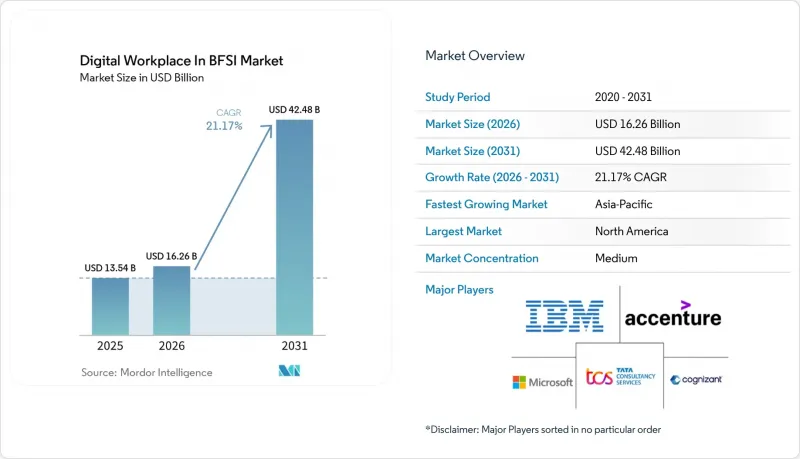
본 보고서는 컴포넌트별(솔루션(통합 커뮤니케이션 및 협업, 통합 엔드포인트 관리, 직원 경험 플랫폼 및 인트라넷 등) 및 서비스), 배포 방식별(클라우드, 온프레미스, 하이브리드), 조직 규모별(대기업 및 중소기업), 지역별로 분류되어 있습니다. 시장 전망은 금액(달러) 기준으로 제시되어 있습니다.
세계의 BFSI 분야 디지털 워크플레이스 시장 동향 및 인사이트
GenAI를 활용한 직원 경험 및 지식 검색
2026년, BFSI 분야의 디지털 워크플레이스 시장에서 GenAI는 시범 운영에서 본격적인 도입 단계로 전환되고 있으며, 특히 지식 검색 및 직원 지원 워크플로우에서 이러한 경향이 두드러집니다. Broadridge의 보고서에 따르면, 금융 서비스 업계에서 AI를 적극적으로 활용하는 비율은 2025년 31%에서 2026년 80%로 상승할 전망이며, 26%의 기업이 이미 에이전트형 AI를 도입했고, 그중 51%의 사용자가 시범 단계를 넘어 운영 중입니다. 이러한 변화는 직장에서의 AI 도입 경제성을 바꿔가고 있습니다. 일상 업무에 AI를 통합하는 기업은 신입 사원의 업무 숙련 기간을 단축하고, 사내 방침, 제품, 프로세스에 관한 정보를 검색할 때 발생하는 지연을 줄일 수 있기 때문입니다. BFSI 분야의 디지털 워크플레이스 시장에서 이러한 추세는 독립형 채팅 기능이 아닌, 거버넌스가 확보된 검색 기능, 사내 어시스턴트 도구, 그리고 워크플로우와 연동된 직원용 플랫폼에 대한 수요를 촉진하고 있습니다. BankUnited는 2025년, AWS Bedrock과 Anthropic Claude를 기반으로 한 ‘SAVI’ 솔루션을 통해 백오피스 지원 문의 건수를 40% 줄이고, 400건의 사내 문서에서 10초 이내에 95%의 정확도로 답변을 제공할 수 있었으며, 이를 통해 이러한 방향성을 보여주었습니다. 따라서 BFSI 분야의 디지털 워크플레이스 시장은 규제된 운영 환경에 적응하면서도 직원의 업무 수행 품질을 향상시키는 실용적인 AI 도구로 전환되고 있습니다.
BFSI 시장의 하이브리드 근무 및 원격 근무 확산
하이브리드 근무는 BFSI 분야 디지털 워크플레이스 시장에서 일시적인 조치가 아닌, 정착된 운영 모델이 되었습니다. 이러한 변화로 인해 벤더와 금융 기관은 사무실, 자택, 지점, 모바일 업무 환경을 불문하고 안전한 접근, 워크플로우의 연속성, 감사에 대응 가능한 협업을 지원해야 할 필요가 있습니다. Nubank는 5년에 걸친 ‘원격 우선(Remote First)’ 운영을 거쳐, 2026년 7월부터 공식적이고 체계적인 하이브리드 모델을 도입한다고 발표했습니다. 이 기간 동안 해당 회사의 고객 수는 5,900만 명에서 1억 2,200만 명으로 확대되었습니다. BFSI 분야 디지털 워크플레이스 시장은 이러한 추세에 대응하여, 장소에 관계없이 일관되게 작동하는 통합 커뮤니케이션, 안전한 엔드포인트 액세스, 그리고 직원 지원 플랫폼에 대한 수요가 증가하고 있습니다. 이는 인재 경제에도 영향을 미치고 있으며, 디지털 업무 환경이 취약한 금융 기관은 경쟁이 치열한 노동 시장에서 숙련된 기술 및 운영 인력을 유지하기가 더욱 어려워지고 있습니다. 따라서 BFSI 분야의 디지털 워크플레이스 시장은 인프라의 변화뿐만 아니라, 유연성과 원활한 디지털 도구를 일반적인 고용 조건의 일부로 간주하게 된 직원들의 기대에 의해서도 형성되고 있습니다.
레거시 핵심 시스템 통합의 복잡성
레거시 핵심 뱅킹 인프라는 여전히 BFSI 분야의 디지털 업무 환경 시장에 있어 가장 큰 구조적 걸림돌로 남아 있습니다. 이는 업무 환경 도구가 가동 중인 프로세스 데이터나 고객 데이터에 대한 신뢰할 수 있는 접근에 의존하는 경우가 많기 때문입니다. DXC Technology는 2025년, 은행의 98%가 3년 이내에 핵심 시스템을 업그레이드할 계획이라고 발표했으나, 여전히 많은 은행이 불안정한 API, 배치 인터페이스, 일관성 없는 데이터 모델을 통해 핵심 시스템 주변의 10-15개 위성 시스템을 관리하고 있습니다. BFSI 분야의 디지털 워크플레이스 시장에서 이러한 복잡성은 데이터 및 프로세스 간의 의존 관계가 워크플레이스 프로그램과 같은 속도로 해소되지 않기 때문에 협업, 자동화, AI 도구 도입을 지연시키고 있습니다. IBM과 ServiceNow는 2026년 6월, 공동의 애플리케이션 현대화 및 엔터프라이즈 데이터 거버넌스 솔루션을 통해 이러한 장벽을 해결하기 위해 제휴를 확대했습니다. BFSI 분야의 디지털 워크플레이스 시장은 부분적인 현대화가 진행 중인 금융 기관에서 여전히 성장하고 있지만, 새로운 워크플레이스 도구로부터 얻을 수 있는 가치의 질은 더 깔끔한 API와 더 안정적인 통합 계층이 구축되어야 비로소 향상되는 경향이 있습니다. 따라서 소프트웨어 예산이 넉넉한 경우에도 레거시 시스템의 통합은 장기적인 제약 요인으로 남아 있습니다.
부문 분석
2025년 매출에서 솔루션이 차지하는 비중은 67.88%로 평가되었고, 이는 BFSI 분야의 디지털 워크플레이스 시장에서 주요 지출이 여전히 서비스 계층이 아닌 소프트웨어 플랫폼에 집중되어 있음을 보여줍니다. 이러한 상황은 동일한 운영 환경 내에서 통합된 커뮤니케이션, 보안, 워크플로우 및 직원 지원 기능에 대한 요구를 반영합니다. BFSI 분야의 디지털 워크플레이스 시장에서 통합 커뮤니케이션 및 협업 플랫폼은 하이브리드 근무, 기록 관리, 직원 간 협업이 모두 이에 의존하고 있기 때문에 기반 계층을 형성하고 있습니다. 또한, FINRA 규정 4511 및 SEC 17a-4의 요건으로 인해 이러한 플랫폼의 규정 준수상 중요성도 높아지고 있습니다. 이는 디지털 네이티브 커뮤니케이션 채널에서도 감사 가능한 기록의 수집 및 보존을 지원해야 하기 때문입니다. 이에 따라 솔루션 조달 시 단순한 사용자 편의성뿐만 아니라 거버넌스 측면의 성과에도 중점을 두게 되었습니다.
또한, BFSI 분야의 디지털 워크플레이스 시장에서는 금융 기관들이 GenAI(생성형 AI) 기반 검색 기능을 일상적인 워크플로우에 직접 통합하고 있어, 직원 경험 플랫폼 및 인트라넷 도구도 주목을 받고 있습니다. 2025년, BankUnited는 SAVI를 도입하여 지원 문의 건수를 40% 줄이고, 400건의 사내 문서에서 10초 이내에 95%의 정확도로 답변을 제공하는 데 성공하며 그 모범 사례를 보여주었습니다. 원격 근무자나 지점 근무 직원이 기기에 구애받지 않고 규제 대상 시스템에 안전하게 접근해야 하기 때문에 가상 데스크톱 인프라(VDI) 및 클라우드 PC 제품이 확대되고 있습니다. 또한, 기업들이 DORA 및 관련 프레임워크에 기반해 분산형 보안을 표준화함에 따라, 엔터프라이즈 모빌리티 관리(EMM) 및 통합 엔드포인트 관리(UEM)에 대한 구매 우선순위가 높아지고 있습니다. BFSI 업계의 디지털 워크플레이스에서 서비스 분야는 여전히 중요한 위치를 차지하고 있습니다. 이는 복잡한 멀티 벤더 프로그램에서 도입, 관리형 지원, 컨설팅이 여전히 필요하기 때문입니다. 그러나 수익의 대부분은 솔루션 분야에 집중되어 있는데, 이는 핵심 소프트웨어 스택의 구매 및 관리가 해당 분야에서 이루어지기 때문입니다.
지역별 분석
2025년, 북미는 BFSI 업계의 디지털 워크플레이스 시장 점유율의 39.22%를 차지했으며, 원문에서 가장 규모가 큰 지역 기여자로 나타났습니다. 이 지역은 탄탄한 자본 시장 인프라, 성숙한 클라우드 생태계, 그리고 금융 커뮤니케이션 전반에 걸친 엄격한 기록 보관 요건의 혜택을 받고 있습니다. BFSI 업계의 디지털 워크플레이스 시장에서 이러한 조건으로 인해 워크플레이스 소프트웨어는 단순한 생산성 향상을 위한 구매 품목이 아니라, 업무 관리 및 감독 체계 구축의 일환으로 자리매김하고 있습니다. 또한, 북미의 금융 기관들은 엔터프라이즈 AI 및 ID 기반 보안 도입을 조기에 추진하는 경향이 있으며, 이는 거버넌스에 부합하는 협업, 자동화, 엔드포인트 관리에 대한 수요를 뒷받침하고 있습니다. 따라서 BFSI 분야의 디지털 워크플레이스 시장은 규정 준수 압박과 기술 예산이 상호 보완되는 북미에서 여전히 가장 견조한 상태를 유지하고 있습니다.
조사 자료에 따르면, 유럽은 두 번째로 큰 지역 블록을 차지하고 있으며, 독일, 영국, 프랑스가 도입의 핵심을 이루고 있습니다. DORA는 EU 규제 대상 기업에서 업무 환경의 보안, 복원력, 사고 대응 체계를 ‘선택적 투자’에서 ‘규제 요건’으로 전환시켰기 때문에 주요 지출의 촉매제가 되고 있습니다. 영국은 대규모 도입 사례에서 두드러지며, 로이즈 뱅킹 그룹은 2026년에 Microsoft 365 E7을 도입하고 4만 건의 Copilot 라이선스를 확보하여 97%의 활성 이용률을 달성했습니다. 남미 지역의 기여도는 비교적 적지만, 디지털 네이티브 기업들은 하이브리드 근무 및 클라우드 기반 업무 운영에 대한 지역 직장 환경의 기대치를 형성하고 있습니다. 예를 들어, 누뱅크(Nubank)는 수년에 걸친 ‘원격 우선(Remote First)’ 방식의 사업 확장을 거쳐 2026년 7월부터 체계적인 하이브리드 모델을 공식적으로 도입했습니다.
아시아태평양은 2026-2031년 연평균 성장률(CAGR) 22.87%를 나타낼 것으로 예측되며, BFSI 분야의 디지털 워크플레이스에서 가장 두드러진 성장을 보이는 지역이 될 것입니다. 이러한 성장은 일본, 인도, 동남아시아의 은행 업무 디지털화, 규제 현대화, 그리고 기업 내 AI 활용 확대에 의해 주도되고 있습니다. 일본의 경우, 기업 내 도입 현황을 통해 업무 현장에서의 AI 활용이 시범 운영 단계를 넘어 보다 광범위한 업무로의 도입으로 전환되고 있음을 알 수 있습니다. SBI 그룹은 2026년 6월, 은행, 증권, 보험, 자산운용 각 부문에 걸쳐 Anthropic의 AI 혁신을 전사적으로 도입한 일본 최초의 금융 그룹이 되었습니다. 중동도 목표가 명확한 디지털 전환 파트너십을 통해 탄력을 받고 있습니다. 한편, 아프리카는 여전히 초기 단계 시장이며, 기존 은행 시장에 비해 레거시 시스템의 제약이 적기 때문에 모바일 우선 금융 서비스가 도입을 촉진할 가능성이 있습니다. 이처럼 BFSI 분야의 디지털 워크플레이스 시장은 지리적으로 확대되고 있지만, 아시아태평양은 현대화, AI 도입, 그리고 워크플레이스 재설계가 하나로 어우러져 진행되는 속도 면에서 두드러집니다.
기타 혜택 :
- 엑셀 형식 시장 예측(ME) 시트
- 3개월간의 애널리스트 지원
자주 묻는 질문
목차
제1장 서론
제2장 조사 방법
제3장 주요 요약
제4장 시장 구도
제5장 시장 규모 및 성장 예측
제6장 경쟁 구도
제7장 시장 기회 및 향후 전망
AJY 26.08.07According to Mordor Intelligence, the digital workplace in BFSI market size is projected to be USD 13.54 billion in 2025, USD 16.26 billion in 2026, and reach USD 42.48 billion by 2031, growing at a CAGR of 21.17% from 2026 to 2031.
This report is Segmented by Component (Solutions [Unified Communication and Collaboration, Unified Endpoint Management, Employee Experience Platforms and Intranet, and More] and Services), Deployment Mode (Cloud, On-Premises, and Hybrid), Organization Size (Large Enterprises and Small and Medium-Sized Enterprises), and Geography. The Market Forecasts are Provided in Terms of Value (USD).
Global Digital Workplace In BFSI Market Trends and Insights
GenAI-Enabled Employee Experience and Knowledge Search
GenAI has moved from pilot use to live deployment in the Digital workplace in BFSI market in 2026, especially in knowledge retrieval and employee support workflows. Broadridge reported that active AI use in financial services rose to 80% in 2026 from 31% in 2025, and 26% of firms had already deployed agentic AI, with 51% of those users operating beyond pilot stage.That shift is changing the economics of workplace adoption because firms that embed AI into daily work can shorten ramp times for new employees and reduce the delay involved in finding internal policy, product, and process information. In the Digital workplace in BFSI market, this is pushing demand toward governed search, internal assistance tools, and workflow-linked employee platforms rather than stand-alone chat features. BankUnited showed this direction in 2025 when its SAVI solution, built on AWS Bedrock and Anthropic Claude, reduced back-office support calls by 40% and returned answers from 400 internal documents in under 10 seconds with 95% accuracy. The Digital workplace in BFSI market is therefore moving toward practical AI tools that improve employee execution quality while still fitting regulated operating environments.
Hybrid and Remote Work Adoption Across BFSI
Hybrid work has become a settled operating model in the Digital workplace in BFSI market rather than a temporary arrangement. That change is forcing vendors and financial institutions to support secure access, workflow continuity, and audit-ready collaboration across offices, homes, branches, and mobile work settings. Nubank announced a formal structured hybrid model for July 2026 after 5 years of remote-first operations, during which it expanded from 59 million to 122 million customers. The Digital workplace in BFSI market is responding to that pattern with stronger demand for unified communications, secure endpoint access, and employee support platforms that work consistently across locations. This also affects talent economics because institutions with weak digital work environments face more difficulty retaining skilled technology and operations staff in competitive labor markets. The Digital workplace in BFSI market is therefore being shaped not only by infrastructure change, but also by workforce expectations that now treat flexibility and seamless digital tools as part of normal employment conditions.
Legacy Core System Integration Complexity
Legacy core banking infrastructure remains the largest structural drag on the Digital workplace in BFSI market because workplace tools often depend on reliable access to live process and customer data. DXC Technology stated in 2025 that 98% of banks planned to upgrade their core systems within 3 years, yet many still manage 10 to 15 satellite systems around the core through fragile APIs, batch interfaces, and inconsistent data models. In the Digital workplace in BFSI market, that complexity slows the rollout of collaboration, automation, and AI tools because data and process dependencies are not resolved at the same pace as workplace programs. IBM and ServiceNow expanded their collaboration in June 2026 to address this barrier through joint application modernization and enterprise data governance solutions. The Digital workplace in BFSI market still advances in institutions with partial modernization, but the quality of value captured from new workplace tools tends to rise only after cleaner APIs and more stable integration layers are in place. This keeps legacy integration as a long-duration restraint even when software budgets remain healthy.
Other drivers and restraints analyzed in the detailed report include:
- Cloud-First Workplace Modernization In Regulated Banking Environments
- Zero-Trust Access and Identity-Centric Workplace Security
- Heightened Cybersecurity, Privacy, and Data Residency Exposure
For complete list of drivers and restraints, kindly check the Table Of Contents.
Segment Analysis
Solutions accounted for 67.88% of revenue in 2025, which shows that the core spend in the Digital workplace in BFSI market still sits with software platforms rather than service layers. That position reflects the need for integrated communication, security, workflow, and employee support functions inside the same operating environment. In the Digital workplace in BFSI market, unified communication and collaboration platforms form the basic layer because hybrid work, recordkeeping, and employee coordination all depend on them. FINRA Rule 4511 and SEC 17a-4 requirements have also raised the compliance weight of these platforms, since digitally native communication channels now need auditable capture and retention support. This has made solution procurement more focused on governance outcomes rather than only user convenience.
Employee experience platforms and intranet tools are also gaining traction in the Digital workplace in BFSI market because institutions are embedding GenAI-based search directly into daily workflows. BankUnited provided a clear example in 2025 when its SAVI deployment reduced support calls by 40% and returned answers from 400 internal documents in under 10 seconds with 95% accuracy. Virtual desktop infrastructure and cloud PC products are expanding because remote and branch-based staff need secure access to regulated systems without device dependency. Enterprise mobility management and unified endpoint management are moving higher in buying priorities as firms standardize distributed security under DORA and related frameworks. The services segment still matters in the Digital workplace in BFSI industry because implementation, managed support, and consulting remain necessary in complex multi-vendor programs, yet the larger revenue base stays with solutions because that is where the central software stack is purchased and governed.
Complete Report Scope:
- By Component
- Solutions
- Unified Communication and Collaboration
- Unified Endpoint Management
- Enterprise Mobility and Management
- Employee Experience Platforms and Intranet
- Workflow Automation and Knowledge Management
- Virtual Desktop Infrastructure and Cloud PC
- Services
- Solutions
- By Deployment Mode
- Cloud
- On-Premises
- Hybrid
- By Organization Size
- Large Enterprises
- Small and Medium-Sized Enterprises
- By Geography
- North America
- United States
- Canada
- Mexico
- South America
- Brazil
- Argentina
- Chile
- Colombia
- Rest of South America
- Europe
- Germany
- United Kingdom
- France
- Italy
- Spain
- Netherlands
- Nordics
- Russia
- Rest of Europe
- Asia-Pacific
- China
- Japan
- India
- South Korea
- Australia and New Zealand
- Southeast Asia
- Rest of Asia-Pacific
- Middle East
- Saudi Arabia
- United Arab Emirates
- Turkey
- Israel
- Rest of Middle East
- Africa
- South Africa
- Egypt
- Nigeria
- Kenya
- Rest of Africa
- North America
Geography Analysis
North America held 39.22% of the Digital workplace in BFSI market share in 2025, which made it the largest regional contributor in the source text. The region benefits from deep capital markets infrastructure, a mature cloud ecosystem, and strict recordkeeping expectations across financial communications. In the Digital workplace in BFSI market, those conditions make workplace software part of operational control and supervisory readiness rather than a simple productivity purchase. North American institutions also tend to move early on enterprise AI and identity-led security, which supports demand for governed collaboration, automation, and endpoint management. The Digital workplace in BFSI market therefore remains strongest in North America where compliance pressure and technology budgets reinforce each other.
Europe represented the second-largest regional block in the source material, with Germany, the United Kingdom, and France serving as the core adoption centers. DORA has been a major spending catalyst because it has shifted workplace security, resilience, and incident readiness from discretionary investment to regulatory requirement across EU-regulated firms. The United Kingdom stands out for large-scale deployment examples, and Lloyds Banking Group rolled out Microsoft 365 E7 in 2026 with 40,000 Copilot licenses and 97% active usage. South America is a smaller contributor, but digitally native players are shaping regional workplace expectations around hybrid work and cloud-based operations, with Nubank formalizing a structured hybrid model from July 2026 after years of remote-first scale-up.
Asia-Pacific is projected to grow at 22.87% CAGR from 2026 to 2031, which makes it the fastest-growing geography in the Digital workplace in BFSI market. Growth is being driven by banking digitization, regulatory modernization, and rising enterprise AI use across Japan, India, and Southeast Asia. In Japan, enterprise deployments show that workplace AI is moving beyond pilot use into broader operational adoption. SBI Group became the first Japanese financial group to adopt Anthropic AI transformation enterprise-wide in June 2026 across banking, securities, insurance, and asset management divisions. The Middle East is also gaining momentum through targeted digital transformation partnerships, while Africa remains an earlier-stage opportunity where mobile-first financial services can support adoption with fewer legacy constraints than older banking markets. The Digital workplace in BFSI market is therefore broadening geographically, but Asia-Pacific stands out for the pace at which modernization, AI deployment, and workplace redesign are coming together.
- Microsoft Corporation
- IBM Corporation
- Accenture plc
- Cognizant Technology Solutions Corporation
- Tata Consultancy Services Limited
- Wipro Limited
- HCL Technologies Limited
- DXC Technology Company
- NTT DATA Group Corporation
- Capgemini SE
- Atos SE
- Cisco Systems, Inc.
- Cloud Software Group
- Broadcom Inc.
- ServiceNow, Inc.
- Zoom Communications, Inc.
- Google LLC
- Amazon Web Services, Inc.
- Oracle Corporation
- SAP SE
- Unisys Corporation
Additional Benefits:
- The market estimate (ME) sheet in Excel format
- 3 months of analyst support
TABLE OF CONTENTS
1 INTRODUCTION
- 1.1 Study Assumptions and Market Definition
- 1.2 Scope of the Study
2 RESEARCH METHODOLOGY
3 EXECUTIVE SUMMARY
4 MARKET LANDSCAPE
- 4.1 Market Overview
- 4.2 Market Drivers
- 4.2.1 Hybrid and Remote Work Adoption Across BFSI
- 4.2.2 GenAI Enabled Employee Experience and Knowledge Search
- 4.2.3 Cloud-First Workplace Modernization in Regulated Banking Environments
- 4.2.4 Zero-Trust Access and Identity-Centric Workplace Security
- 4.2.5 Intelligent Automation of Branch, Back-Office, and Contact Center Workflows
- 4.2.6 Audit-Ready Collaboration and Compliance Archiving
- 4.3 Market Restraints
- 4.3.1 Legacy Core System Integration Complexity
- 4.3.2 Heightened Cybersecurity, Privacy, and Data Residency Exposure
- 4.3.3 User Adoption Friction for New Digital Experience Tools
- 4.3.4 Vendor Sprawl and Tool Overlap Driving Governance Burden
- 4.4 Value Chain Analysis
- 4.5 Supply Chain Analysis
- 4.6 Technological Outlook
- 4.7 Regulatory Landscape
- 4.8 Porter's Five Forces Analysis
- 4.8.1 Bargaining Power of Suppliers
- 4.8.2 Bargaining Power of Buyers
- 4.8.3 Threat of New Entrants
- 4.8.4 Threat of Substitutes
- 4.8.5 Competitive Rivalry
5 MARKET SIZE AND GROWTH FORECASTS (VALUE)
- 5.1 By Component
- 5.1.1 Solutions
- 5.1.1.1 Unified Communication and Collaboration
- 5.1.1.2 Unified Endpoint Management
- 5.1.1.3 Enterprise Mobility and Management
- 5.1.1.4 Employee Experience Platforms and Intranet
- 5.1.1.5 Workflow Automation and Knowledge Management
- 5.1.1.6 Virtual Desktop Infrastructure and Cloud PC
- 5.1.2 Services
- 5.1.1 Solutions
- 5.2 By Deployment Mode
- 5.2.1 Cloud
- 5.2.2 On-Premises
- 5.2.3 Hybrid
- 5.3 By Organization Size
- 5.3.1 Large Enterprises
- 5.3.2 Small and Medium-Sized Enterprises
- 5.4 By Geography
- 5.4.1 North America
- 5.4.1.1 United States
- 5.4.1.2 Canada
- 5.4.1.3 Mexico
- 5.4.2 South America
- 5.4.2.1 Brazil
- 5.4.2.2 Argentina
- 5.4.2.3 Chile
- 5.4.2.4 Colombia
- 5.4.2.5 Rest of South America
- 5.4.3 Europe
- 5.4.3.1 Germany
- 5.4.3.2 United Kingdom
- 5.4.3.3 France
- 5.4.3.4 Italy
- 5.4.3.5 Spain
- 5.4.3.6 Netherlands
- 5.4.3.7 Nordics
- 5.4.3.8 Russia
- 5.4.3.9 Rest of Europe
- 5.4.4 Asia-Pacific
- 5.4.4.1 China
- 5.4.4.2 Japan
- 5.4.4.3 India
- 5.4.4.4 South Korea
- 5.4.4.5 Australia and New Zealand
- 5.4.4.6 Southeast Asia
- 5.4.4.7 Rest of Asia-Pacific
- 5.4.5 Middle East
- 5.4.5.1 Saudi Arabia
- 5.4.5.2 United Arab Emirates
- 5.4.5.3 Turkey
- 5.4.5.4 Israel
- 5.4.5.5 Rest of Middle East
- 5.4.6 Africa
- 5.4.6.1 South Africa
- 5.4.6.2 Egypt
- 5.4.6.3 Nigeria
- 5.4.6.4 Kenya
- 5.4.6.5 Rest of Africa
- 5.4.1 North America
6 COMPETITIVE LANDSCAPE
- 6.1 Market Concentration
- 6.2 Strategic Moves
- 6.3 Market Share Analysis
- 6.4 Company Profiles (includes Global Level Overview, Market Level Overview, Core Segments, Financials as available, Strategic Information, Market Rank/Share, Products and Services, Recent Developments)
- 6.4.1 Microsoft Corporation
- 6.4.2 IBM Corporation
- 6.4.3 Accenture plc
- 6.4.4 Cognizant Technology Solutions Corporation
- 6.4.5 Tata Consultancy Services Limited
- 6.4.6 Wipro Limited
- 6.4.7 HCL Technologies Limited
- 6.4.8 DXC Technology Company
- 6.4.9 NTT DATA Group Corporation
- 6.4.10 Capgemini SE
- 6.4.11 Atos SE
- 6.4.12 Cisco Systems, Inc.
- 6.4.13 Cloud Software Group
- 6.4.14 Broadcom Inc.
- 6.4.15 ServiceNow, Inc.
- 6.4.16 Zoom Communications, Inc.
- 6.4.17 Google LLC
- 6.4.18 Amazon Web Services, Inc.
- 6.4.19 Oracle Corporation
- 6.4.20 SAP SE
- 6.4.21 Unisys Corporation
7 MARKET OPPORTUNITIES AND FUTURE OUTLOOK
- 7.1 White-Space and Unmet-Need Assessment


