

|
시장보고서
상품코드
2098465
정부 및 공공 부문 디지털 워크플레이스 시장 : 시장 점유율 분석, 업계 동향 및 통계, 성장 예측(2026-2031년)Digital Workplace In Government and Public Sector - Market Share Analysis, Industry Trends & Statistics, Growth Forecasts (2026 - 2031) |
||||||
 Mordor Intelligence
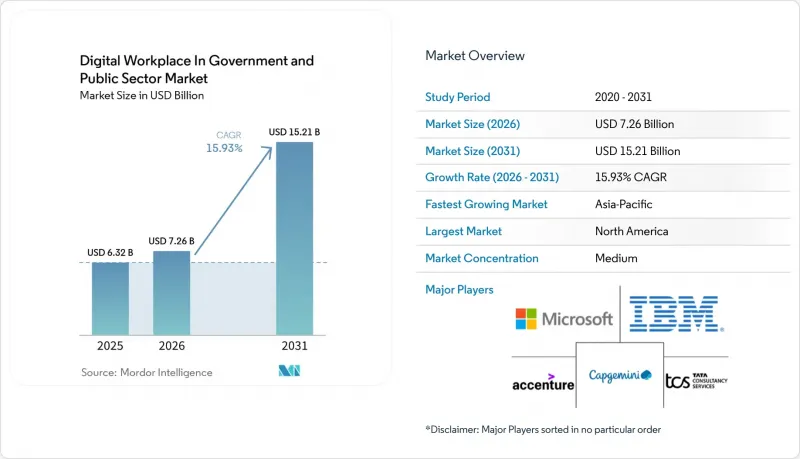
Mordor Intelligence에 의하면, 정부 및 공공 부문 디지털 워크플레이스 시장 규모는 2025년에 63억 2,000만 달러로 평가되었고, 2026년 72억 6,000만 달러에서 2031년까지 152억 1,000만 달러에 이를 것으로 예측되며, 2026-2031년 CAGR 15.93%로 성장할 전망입니다.
본 보고서는 컴포넌트별(솔루션(통합 커뮤니케이션 및 협업, 통합 엔드포인트 관리, 엔터프라이즈 모빌리티 및 관리 등) 및 서비스), 배포 방식별(클라우드, 하이브리드 등), 조직 규모별(대기업 및 중소기업), 지역별로 분류되어 있습니다. 시장 전망은 금액(달러) 기준으로 제시되어 있습니다.
세계의 정부 및 공공 부문 디지털 워크플레이스 시장 동향 및 인사이트
정부 기관의 클라우드 현대화 프로그램 확대
정부 기관의 클라우드 현대화는 광범위한 정책 목표에서 많은 공공 기관의 운영상 요구 사항으로 전환되고 있습니다. GSA(미국 연방조달청)와 ServiceNow의 'OneGov' 계약을 통해 연방 정부 기관은 ITSM Pro 및 Pro Plus 번들을 최대 70% 할인된 가격으로 이용할 수 있게 되었으며, 워크플로우 효율이 30% 향상될 것으로 예측됩니다. 이는 현대적인 업무 환경 플랫폼 도입을 가속화하기 위해 통합 조달이 이루어지고 있음을 보여줍니다. 독일의 ‘Deutsche Verwaltungscloud 2.0’ 프로그램에서는 2026-2029년 행정용 연합 클라우드 인프라 구축이 계획되어 있으며, 이를 통해 여러 행정 수준에 걸친 규정 준수 대응 워크플레이스 도구의 적용 범위가 직접 확대될 것입니다. 또한, 유럽연합 집행위원회는 2026년 4월에 1억 8,000만 유로(1억 9,400만 달러) 규모의 주권 클라우드 계약을 체결했습니다. 이는 대규모 공공 기관이 클라우드 환경을 일회성 IT 프로젝트가 아닌 장기적인 조직 인프라로 자금을 지원하고 있음을 보여줍니다. FedRAMP가 규정 통합 및 지속적 승인 모델로 전환되고 있는 점도 이러한 추세를 더욱 뒷받침하고 있습니다. 이는 정부 기관과 공급업체가 정기적인 문서 제출 대신, 규정 준수에 대한 지속적인 증거를 제시할 수 있는 클라우드 서비스 이용으로 유도되고 있기 때문입니다.
시민 및 직원의 지식 워크플로우에 생성형 AI 도입
생성형 AI는 정부 및 공공 부문 디지털 워크플레이스 시장에서 핵심적인 층으로 자리 잡고 있습니다. 이는 각 기관이 생성형 AI를 제한적인 시범 사업에 그치지 않고, 일상적인 지식 관리, 검색, 지원 워크플로우에 활용하고 있기 때문입니다. GAO(정부감사원)는 2025년 7월, 일부 연방 기관이 2024년까지 생성형 AI의 활용 및 관리를 실제 운영 환경으로 전환했다고 보고했으며, 도입 활동이 실험 단계를 넘어 진전되고 있음이 확인되었습니다. 일본 디지털청은 2026년 5월, 각 부처의 약 18만 명 직원을 대상으로 행정 용어에 최적화된 국산 대규모 언어 모델을 활용한 정부 차원의 'GENNAI' 시범 프로젝트를 시작했습니다. 이는 현재 운영 중인 정부 주도의 직장 AI 프로그램 중에서도 최대 규모 중 하나입니다. ServiceNow는 2026년 3월, Moveworks와의 통합 기능을 갖춘 ‘EmployeeWorks’를 출시하여 대화형 AI와 엔터프라이즈 검색을 정부 기관 직원을 위한 단일 포털에 통합함으로써, 이와 같은 방향성을 한층 더 강화했습니다. 인도에서는 안드라프라데시 주 정부가 2026년 2월, IBM, BharatGen, NxtGen과 제휴하여 시민 중심이자 다국어를 지원하는 AI 서비스를 위한 ‘주권 AI 스택’을 구축하겠다고 발표했습니다. 이는 공공 부문의 AI가 국내 관리 및 언어적 관련성과 어떻게 연결되어 있는지를 뒷받침하는 사례입니다.
레거시 시스템과 조달상의 과제
레거시 인프라는 정부 및 공공 부문 디지털 워크플레이스 시장 신속한 도입에 있어 여전히 가장 뿌리 깊은 장벽으로 남아 있습니다. GAO(미국 정부감사원) 보고서에 따르면, 연방 정부 기관은 매년 1,000억 달러 이상을 IT에 지출하고 있으며, 그 중 약 80%를 기존 시스템의 운영 및 유지보수에 할당하고 있어 전면적인 현대화 프로그램에 할당될 수 있는 예산은 제한적입니다. 영국 내각부는 2025년 1월, 위험이 가장 높고 가장 중요한 레거시 시스템의 수가 2023-2024년 26% 증가한 반면, 공공 서비스의 디지털화는 절반 수준에 그쳤으며, 디지털 관련 지출은 벤치마크 수준보다 30% 낮은 상태를 유지하고 있다고 보고했습니다. 이러한 추세로 인해 구형 협업 환경, 엔드포인트 환경, 워크플로우 환경의 교체가 지연되고 있습니다. 이는 각 기관이 우선 업무 연속성을 확보하기 위해 자금을 투입하고, 그 다음에야 변혁에 착수해야 하기 때문입니다. 조달 개혁을 통해 향후 이러한 상황이 개선될 가능성은 있지만, 현재의 조달 프로세스는 여전히 도입 일정을 장기화시키고 있어 각 기관이 분산된 도구에서 통합된 워크플레이스 플랫폼으로 신속하게 전환하는 것을 어렵게 만들고 있습니다.
부문 분석
솔루션은 2025년에 시장의 62.55%를 차지한 것으로 평가되었으며, 2031년까지 연평균 성장률(CAGR) 16.23%로 성장할 것으로 전망됩니다. 이는 구매자들이 독립형 서비스 운영보다 통합 플랫폼의 기능성을 더 중요하게 여기고 있음을 보여줍니다. 정부 및 공공 부문의 디지털 워크플레이스 시장에서 각 기관은 통합 커뮤니케이션 및 협업, 직원 경험 플랫폼, 인트라넷 도구, 보안 데스크톱 액세스에 대해 뚜렷한 수요를 보이고 있습니다. 이는 이러한 기능들이 현재 일상적인 업무 수행과 밀접하게 연관되어 있기 때문입니다. GSA와 ServiceNow의 ‘OneGov’ 계약은 AI 지원 워크플로 번들에 대한 대폭적인 할인을 제공하며, 각 기관의 보다 신속하고 표준화된 현대화를 강조함으로써 이러한 추세를 더욱 뒷받침했습니다. 또한, 마이크로소프트가 2026년에 GCC 및 GCC High를 대상으로 ‘Windows 365 Frontline’을 출시할 예정인 점도 이 솔루션의 유효성을 뒷받침합니다. 이는 클라우드 PC와 보안 워크스페이스 도구가 협업, 엔드포인트 제어, ID 중심 액세스 관리와 동일한 구매 프레임워크에 포함되기 시작했기 때문입니다.
서비스 측면은 여전히 중요하지만, 그 역할은 기본적인 관리형 지원에서 플랫폼 환경과 관련된 도입, 마이그레이션, 통합, 거버넌스로 변화하고 있습니다. FedRAMP 규정의 통합 및 지속적인 인증으로의 전환은 정기적인 SaaS 및 규정 준수를 기반으로 한 제품을 우선시하는 시장 구조를 보여주고 있으며, 이에 따라 노동 집약적인 서비스 모델의 상대적 비중은 시간이 지남에 따라 감소할 것입니다. 그렇지만 정부 및 공공 부문 디지털 워크플레이스에서는 내부 역량이 여전히 제한적인 상황에서 레거시 시스템을 연결하고 변경 사항을 관리하며 부처 간 배포를 지원하는 서비스 제공업체가 여전히 필요합니다. 즉, 서비스는 계약 가치의 일부로 계속 남아 있을 것이며, 가장 견고한 입지를 확보할 수 있는 것은 서비스를 독립적인 엔드포인트로 판매하는 것이 아니라, 규정 준수를 충족하는 제품 플랫폼에 서비스를 통합할 수 있는 벤더입니다.
지역별 분석
2025년, 북미는 정부 및 공공 부문의 디지털 워크플레이스 시장 점유율의 38.45%를 차지했으며, 지출 및 도입 측면에서 최대 지역 거점으로서의 지위를 유지했습니다. 이 지역은 성숙한 조달 및 승인 프레임워크의 혜택을 받고 있으며, 그 가장 명확한 예로는 GSA의 'OneGov' 계약 모델과 FedRAMP 인증 서비스의 대규모 카탈로그를 들 수 있습니다. 2025년 초 OMB 및 OPM이 발표한 사무실 복귀 실행 계획 또한 각 기관에 단순한 사무실 전용 모델이 아닌 안전한 하이브리드 환경에 대한 투자를 촉구했습니다. 마이크로소프트의 정부용 클라우드 PC 확대와 FedRAMP 20x는 북미 공급업체들에게 사용 편의성과 지속적인 규정 준수 입증을 동시에 달성해야 할 필요성이 점점 더 커지고 있음을 보여줍니다.
아시아태평양은 2031년까지 연평균 성장률(CAGR)이 16.67%로 가장 빠르게 성장하는 지역이며, 정부의 AI 및 주권 클라우드 이니셔티브가 성숙해짐에 따라 정부 및 공공 부문의 디지털 워크플레이스 시장 규모가 급속히 확대되고 있는 것으로 나타났습니다. 2026년 5월 일본에서 시작된 ‘GENNAI’는 부처 간 약 18만 명의 직원을 대상으로 한 정부의 워크플레이스 AI 대규모 도입 사례로서, 이 지역에서 가장 대표적인 사례 중 하나가 되었습니다. 인도에서는 2026년 2월 안드라프라데시 주가 IBM, BharatGen, NxtGen과 공동으로 주권 AI 스택 관련 이니셔티브를 추진한 것이, 이 지역 수요가 공공 서비스 제공, 언어 현지화, 그리고 기밀성이 높은 시스템의 국내 관리와 어떻게 연결되어 있는지를 보여줍니다. 이 지역의 성장은 국내 데이터 처리 및 정부 특유의 규정 준수 체계에 대한 강한 지향과도 관련이 있습니다. 따라서 현지 인프라, 국내 파트너십, 그리고 주권 요건을 충족하는 제품 옵션을 갖춘 공급업체는 아시아태평양 전체에서 새로운 수주를 확보하는 데 유리한 입장에 있습니다.
유럽에서는 디지털 주권에 관한 규제와 상호 운용 가능한 공공 디지털 인프라의 필요성이 결합되어 그 방향성이 형성되고 있습니다. 2026년 6월 유럽집행위원회가 제안한 ‘클라우드·AI 개발법’에서는 48개 기준으로 구성된 주권 프레임워크가 도입되었으며, 이를 통해 공공 부문 조달에서 감사 가능성이 높고 관할권을 고려한 아키텍처로의 전환이 촉진되고 있습니다. 2026년 4월 유럽집행위원회가 발표한 주권 클라우드 계약과 독일의 DVC 2.0 프로그램은 이것이 더 이상 단순한 정책 방향성에 그치지 않고 자금 지원을 받은 인프라 및 도입 설계로 구체화되고 있음을 보여줍니다. 중동, 남미, 아프리카는 여전히 초기 단계 시장이지만, 각국의 디지털 정부 프로그램과 외부 자금 지원에 힘입어 협업, 워크플로우, 직원 지원 플랫폼에 대한 수요가 확대되기 시작하고 있습니다.
기타 혜택 :
- 엑셀 형식 시장 예측(ME) 시트
- 3개월간의 애널리스트 지원
자주 묻는 질문
목차
제1장 서론
제2장 조사 방법
제3장 주요 요약
제4장 시장 구도
제5장 시장 규모 및 성장 예측
제6장 경쟁 구도
제7장 시장 기회 및 향후 전망
AJY 26.08.07According to Mordor Intelligence, the digital workplace in government and public sector market size is projected to be USD 6.32 billion in 2025, USD 7.26 billion in 2026, and reach USD 15.21 billion by 2031, growing at a CAGR of 15.93% from 2026 to 2031.
This report is Segmented by Component (Solutions [Unified Communication and Collaboration, Unified Endpoint Management, Enterprise Mobility and Management, and More] and Services), Deployment Mode (Cloud, Hybrid, and More), Organization Size (Large Enterprises and Small and Medium-Sized Enterprises), and Geography. The Market Forecasts are Provided in Terms of Value (USD).
Global Digital Workplace In Government and Public Sector Market Trends and Insights
Rising Government Cloud Modernization Programs
Government cloud modernization has moved from a broad policy goal to an operational requirement inside many public institutions. The GSA and ServiceNow OneGov agreement gave federal agencies discounts of up to 70% on ITSM Pro and Pro Plus bundles and projected workflow efficiency gains of 30%, which shows that centralized buying is being used to speed adoption of modern workplace platforms. Germany's Deutsche Verwaltungscloud 2.0 program set out a federated cloud infrastructure for public administration from 2026 to 2029, which directly expands the addressable base for compliant workplace tools across multiple levels of government. The European Commission also awarded a EUR 180 million (USD 194 million) sovereign cloud contract in April 2026, which shows that large public bodies are now funding cloud environments as long-term institutional infrastructure rather than one-off IT projects. FedRAMP's move toward consolidated rules and a continuous authorization model further supports this trend because agencies and vendors are being pushed toward cloud services that can present ongoing evidence of compliance instead of periodic documentation.
Adoption of Generative AI for Citizen and Employee Knowledge Workflows
Generative AI is becoming a core layer of the digital workplace in government and public sector market because agencies are using it in routine knowledge, search, and support workflows instead of limiting it to narrow pilots. The GAO reported in July 2025 that selected federal agencies had already moved generative AI use and management into active operating environments by 2024, which confirmed that deployment activity had advanced beyond experimentation. Japan's Digital Agency launched the government-wide GENNAI pilot in May 2026 for nearly 180,000 employees across ministries, using domestic large language models tuned to administrative language, which makes it one of the largest state-led workplace AI programs now in operation. ServiceNow strengthened the same direction in March 2026 when it launched EmployeeWorks with Moveworks integration, combining conversational AI and enterprise search in a single government-oriented front door for agency workers. In India, the Government of Andhra Pradesh announced work with IBM, BharatGen, and NxtGen in February 2026 to build a sovereign AI stack for citizen-focused and multilingual AI services, which reinforces how public sector AI is being tied to domestic control and language relevance.
Legacy Systems and Procurement Friction
Legacy infrastructure remains the most persistent barrier to faster adoption in the digital workplace in government and public sector market. The GAO reported that federal agencies spend more than USD 100 billion each year on IT and direct nearly 80% of that amount to operating and maintaining existing systems, which leaves a smaller pool for full modernization programs. The UK Cabinet Office reported in January 2025 that the number of highest-risk and most critical legacy systems rose 26% from 2023 to 2024, while only half of public services were digitized and digital expenditure remained 30% below benchmark levels. That pattern slows the replacement of old collaboration, endpoint, and workflow environments because agencies must fund continuity first and transformation second. Procurement reform may improve this over time, but current buying processes still stretch deployment timelines and make it harder for agencies to move quickly from fragmented tools to integrated workplace platforms.
Other drivers and restraints analyzed in the detailed report include:
- Expansion of Secure Hybrid Work in Public Administration
- Demand for Unified Digital Employee Experience Across Agencies
- Heightened Data Sovereignty and Residency Constraints
For complete list of drivers and restraints, kindly check the Table Of Contents.
Segment Analysis
Solutions accounted for 62.55% of the market in 2025 and are expected to grow at 16.23% CAGR through 2031, which shows that buyers are placing more value on integrated platform capability than on stand-alone service labor. Within the digital workplace in government and public sector market, agencies are directing visible demand toward unified communication and collaboration, employee experience platforms, intranet tools, and secure desktop access because these functions now sit close to daily mission delivery. The GSA and ServiceNow OneGov agreement reinforced that direction by offering deep discounts on AI-enabled workflow bundles and by emphasizing faster, more standardized modernization across agencies. Microsoft's 2026 rollout of Windows 365 Frontline for GCC and GCC High also supports the solutions case because cloud PC and secure workspace tools are moving into the same buying frame as collaboration, endpoint control, and identity-centered access.
The services side is still important, but its role is changing from basic managed support toward implementation, migration, integration, and governance around platform environments. FedRAMP's consolidated rules and transition toward continuous authorization signal a market structure that favors recurring SaaS and compliance-backed products, which reduces the relative weight of labor-heavy service models over time. Even so, the digital workplace in government and public sector industry still needs service providers to connect legacy estates, manage change, and support cross-agency rollout where internal skills remain limited. That means services will remain part of contract value, but the strongest position sits with vendors that can wrap services around a compliant product platform instead of selling services as a separate end point.
Complete Report Scope:
- By Component
- Solutions
- Unified Communication and Collaboration
- Unified Endpoint Management
- Enterprise Mobility and Management
- Employee Experience Platforms and Intranet
- Workflow Automation and Knowledge Management
- Virtual Desktop Infrastructure and Cloud PC
- Services
- Solutions
- By Deployment Mode
- Cloud
- On-Premises
- Hybrid
- By Organization Size
- Large Enterprises
- Small and Medium-Sized Enterprises
- By Geography
- North America
- United States
- Canada
- Mexico
- South America
- Brazil
- Argentina
- Chile
- Colombia
- Rest of South America
- Europe
- Germany
- United Kingdom
- France
- Italy
- Spain
- Netherlands
- Nordics
- Russia
- Rest of Europe
- Asia-Pacific
- China
- Japan
- India
- South Korea
- Australia and New Zealand
- Southeast Asia
- Rest of Asia-Pacific
- Middle East
- Saudi Arabia
- United Arab Emirates
- Turkey
- Israel
- Rest of Middle East
- Africa
- South Africa
- Egypt
- Nigeria
- Kenya
- Rest of Africa
- North America
Geography Analysis
North America held 38.45% of the digital workplace in government and public sector market share in 2025, which kept it as the largest regional base for spending and deployment. The region benefits from mature procurement and authorization frameworks, and the clearest examples are the GSA's OneGov contracting model and FedRAMP's large catalog of certified services. Return-to-office implementation plans issued by OMB and OPM in early 2025 also pushed agencies to invest in secure hybrid environments rather than simple office-only models. Microsoft's government cloud PC expansion and FedRAMP 20x together show that vendors in North America are increasingly expected to pair usability with continuous compliance evidence.
Asia-Pacific is the fastest-growing region with a 16.67% CAGR through 2031, which shows that the digital workplace in government and public sector market size is rising quickly as government AI and sovereign cloud agendas mature. Japan's GENNAI launch in May 2026 gave the region one of the clearest examples of large-scale government workplace AI deployment, with a target base of nearly 180,000 employees across ministries. In India, Andhra Pradesh's February 2026 work with IBM, BharatGen, and NxtGen on a sovereign AI stack showed how regional demand is being linked to public service delivery, language localization, and domestic control of sensitive systems. This regional growth is also tied to a stronger preference for in-country data handling and government-specific compliance structures. Vendors with local infrastructure, domestic partnerships, and sovereign-ready product options are therefore better placed to capture new awards across Asia-Pacific.
Europe is being shaped by a combination of digital sovereignty rules and the need for interoperable public digital infrastructure. The European Commission's Cloud and AI Development Act proposal in June 2026 introduced a 48-criterion sovereignty framework, which is pushing workplace procurement toward more auditable and jurisdiction-aware architectures. The Commission's April 2026 sovereign cloud contract and Germany's DVC 2.0 program show that this is no longer just a policy direction, it is now being translated into funded infrastructure and deployment design. The Middle East, South America, and Africa remain earlier-stage markets, but national digital government programs and external funding support are beginning to widen demand for collaboration, workflow, and employee support platforms.
- Accenture plc
- Atos SE
- Capgemini SE
- Cognizant Technology Solutions Corporation
- DXC Technology Company
- Fujitsu Limited
- HCL Technologies Limited
- Hewlett Packard Enterprise Company
- IBM Corporation
- Infosys Limited
- Kyndryl Holdings, Inc.
- Microsoft Corporation
- Nippon Telegraph and Telephone Corporation
- Oracle Corporation
- ServiceNow, Inc.
- Tata Consultancy Services Limited
- TeamViewer SE
- Unisys Corporation
- Wipro Limited
- Zensar Technologies Limited
Additional Benefits:
- The market estimate (ME) sheet in Excel format
- 3 months of analyst support
TABLE OF CONTENTS
1 INTRODUCTION
- 1.1 Study Assumptions and Market Definition
- 1.2 Scope of the Study
2 RESEARCH METHODOLOGY
3 EXECUTIVE SUMMARY
4 MARKET LANDSCAPE
- 4.1 Market Overview
- 4.2 Impact of Macroeconomic Factors on the Market
- 4.3 Market Drivers
- 4.3.1 Rising Government Cloud Modernization Programs
- 4.3.2 Expansion of Secure Hybrid Work in Public Administration
- 4.3.3 Adoption of Generative AI for Citizen and Employee Knowledge Workflows
- 4.3.4 Demand for Unified Digital Employee Experience Across Agencies
- 4.3.5 Workforce Compliance and Auditability Requirements
- 4.3.6 Rising Need for Zero Trust Collaboration Environments
- 4.4 Market Restraints
- 4.4.1 Legacy Systems and Procurement Friction
- 4.4.2 Heightened Data Sovereignty and Residency Constraints
- 4.4.3 Multi-Vendor Interoperability Complexity
- 4.4.4 Public Sector Budget Rigidity and Multi-Year Approval Cycles
- 4.5 Industry Value Chain Analysis
- 4.6 Supply Chain Analysis
- 4.7 Regulatory Landscape
- 4.8 Technological Outlook
- 4.9 Porter's Five Forces Analysis
- 4.9.1 Threat of New Entrants
- 4.9.2 Bargaining Power of Suppliers
- 4.9.3 Bargaining Power of Buyers
- 4.9.4 Threat of Substitutes
- 4.9.5 Competitive Rivalry
5 MARKET SIZE AND GROWTH FORECASTS (VALUE)
- 5.1 By Component
- 5.1.1 Solutions
- 5.1.1.1 Unified Communication and Collaboration
- 5.1.1.2 Unified Endpoint Management
- 5.1.1.3 Enterprise Mobility and Management
- 5.1.1.4 Employee Experience Platforms and Intranet
- 5.1.1.5 Workflow Automation and Knowledge Management
- 5.1.1.6 Virtual Desktop Infrastructure and Cloud PC
- 5.1.2 Services
- 5.1.1 Solutions
- 5.2 By Deployment Mode
- 5.2.1 Cloud
- 5.2.2 On-Premises
- 5.2.3 Hybrid
- 5.3 By Organization Size
- 5.3.1 Large Enterprises
- 5.3.2 Small and Medium-Sized Enterprises
- 5.4 By Geography
- 5.4.1 North America
- 5.4.1.1 United States
- 5.4.1.2 Canada
- 5.4.1.3 Mexico
- 5.4.2 South America
- 5.4.2.1 Brazil
- 5.4.2.2 Argentina
- 5.4.2.3 Chile
- 5.4.2.4 Colombia
- 5.4.2.5 Rest of South America
- 5.4.3 Europe
- 5.4.3.1 Germany
- 5.4.3.2 United Kingdom
- 5.4.3.3 France
- 5.4.3.4 Italy
- 5.4.3.5 Spain
- 5.4.3.6 Netherlands
- 5.4.3.7 Nordics
- 5.4.3.8 Russia
- 5.4.3.9 Rest of Europe
- 5.4.4 Asia-Pacific
- 5.4.4.1 China
- 5.4.4.2 Japan
- 5.4.4.3 India
- 5.4.4.4 South Korea
- 5.4.4.5 Australia and New Zealand
- 5.4.4.6 Southeast Asia
- 5.4.4.7 Rest of Asia-Pacific
- 5.4.5 Middle East
- 5.4.5.1 Saudi Arabia
- 5.4.5.2 United Arab Emirates
- 5.4.5.3 Turkey
- 5.4.5.4 Israel
- 5.4.5.5 Rest of Middle East
- 5.4.6 Africa
- 5.4.6.1 South Africa
- 5.4.6.2 Egypt
- 5.4.6.3 Nigeria
- 5.4.6.4 Kenya
- 5.4.6.5 Rest of Africa
- 5.4.1 North America
6 COMPETITIVE LANDSCAPE
- 6.1 Market Concentration
- 6.2 Strategic Moves
- 6.3 Market Share Analysis
- 6.4 Company Profiles (includes Global Level Overview, Market Level Overview, Core Segments, Financials as available, Strategic Information, Market Rank/Share, Products and Services, Recent Developments)
- 6.4.1 Accenture plc
- 6.4.2 Atos SE
- 6.4.3 Capgemini SE
- 6.4.4 Cognizant Technology Solutions Corporation
- 6.4.5 DXC Technology Company
- 6.4.6 Fujitsu Limited
- 6.4.7 HCL Technologies Limited
- 6.4.8 Hewlett Packard Enterprise Company
- 6.4.9 IBM Corporation
- 6.4.10 Infosys Limited
- 6.4.11 Kyndryl Holdings, Inc.
- 6.4.12 Microsoft Corporation
- 6.4.13 Nippon Telegraph and Telephone Corporation
- 6.4.14 Oracle Corporation
- 6.4.15 ServiceNow, Inc.
- 6.4.16 Tata Consultancy Services Limited
- 6.4.17 TeamViewer SE
- 6.4.18 Unisys Corporation
- 6.4.19 Wipro Limited
- 6.4.20 Zensar Technologies Limited
7 MARKET OPPORTUNITIES AND FUTURE OUTLOOK
- 7.1 White-Space and Unmet-Need Assessment


