

|
시장보고서
상품코드
2098472
헬스케어용 디지털 워크플레이스 시장 : 시장 점유율 분석, 업계 동향 및 통계, 성장 예측(2026-2031년)Digital Workplace In Healthcare - Market Share Analysis, Industry Trends & Statistics, Growth Forecasts (2026 - 2031) |
||||||
 Mordor Intelligence
Mordor Intelligence에 의하면, 헬스케어용 디지털 워크플레이스 시장 규모는 2025년에 72억 3,000만 달러로 평가되었고, 2026년 89억 4,000만 달러에서 2031년까지 271억 5,000만 달러에 이를 것으로 예측되며, 2026-2031년 CAGR 24.87%로 성장할 전망입니다.
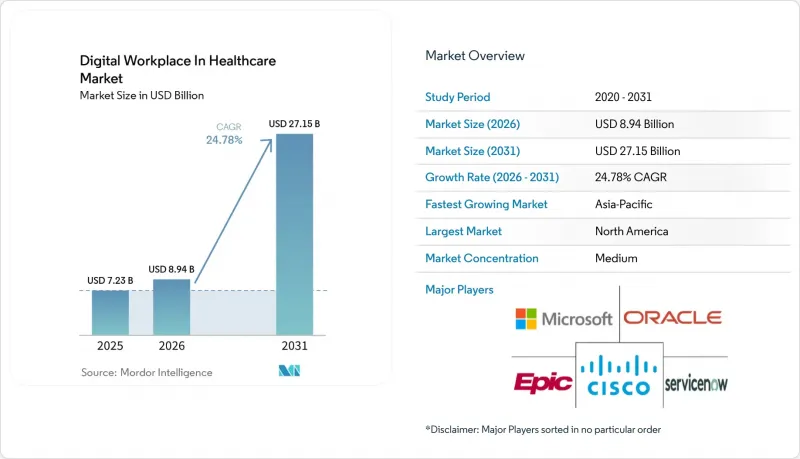
본 보고서는 컴포넌트별(솔루션(통합 커뮤니케이션 및 협업, 통합 엔드포인트 관리, 직원 경험 플랫폼 및 인트라넷 등) 및 서비스), 배포 모드별(클라우드, 온프레미스, 하이브리드), 조직 규모별(대기업 및 중소기업), 지역별로 분류되어 있습니다. 시장 전망은 금액(달러) 기준으로 제시되어 있습니다.
세계의 헬스케어용 디지털 워크플레이스 시장 동향 및 인사이트
의료 현장 전반에 걸친 가상 진료 조정 수요 증가
헬스케어용 디지털 워크플레이스 시장은 하이브리드 케어 모델에서 워크플로우의 연속성을 해치지 않으면서 응급실, 외래 진료, 재택 치료 서비스, 원격 모니터링 프로그램을 아우르는 직원 간 협력이 요구됨에 따라 성장세를 보이고 있습니다. 진료 기록, 업무, 보안 메시징, 진료 전 준비 및 사후 관리 업무를 반복적인 업무 인계나 책임의 분산을 피하기 위해 동일한 운영 환경 내에서 관리해야 할 필요성이 대두됨에 따라, 의료 제공업체들은 더 이상 원격 의료를 독립된 채널로 취급하지 않습니다. 이에 따라 구매 우선순위는 고립된 커뮤니케이션 도구에서 진료 전후 및 진료 중의 일상 업무를 지원할 수 있는 플랫폼으로 이동하고 있습니다. 2026년 3월, 아마존 웹 서비스(AWS)는 ‘Amazon Connect Health’를 출시했습니다. 이는 기존 전자건강기록(EHR) 시스템과 통합 가능한 통합 SDK 내에, 진료 전 환자 인사이트, 환경에 따른 임상 문서, 진료 후 의료 코딩을 결합한, 전용으로 설계된 에이전트형 AI 플랫폼입니다. 이번 출시는 각 하이퍼스케일러 기업들이 케어 코디네이션을 단순한 컨택 센터의 제한적인 기회로만 보지 않고, 의료 워크플로우에서 더 깊은 주도권을 확보하기 위한 직접적인 경로로 인식하고 있음을 보여줍니다. 그 결과, 헬스케어용 디지털 워크플레이스 시장은 엔터프라이즈용 클라우드 계약을 통해 점점 더 형성되고 있으며, 이에 따라 CIO 주도의 조달 팀은 과거에는 비교적 좁은 임상 기술 예산 범위 내에서만 이루어지던 의사 결정에 대해 더 큰 영향력을 행사하게 되었습니다.
상호 운용 가능한 임상 협업 워크플로우의 확대
헬스케어용 디지털 워크플레이스 시장은 각 부서를 별도의 시스템으로 격리하는 대신, 임상, 관리, 운영 각 업무를 실시간으로 연계하는 플랫폼으로의 광범위한 전환으로부터도 혜택을 받고 있습니다. 병원 측은 간호사, 의사, 관리 팀이 단순한 의뢰를 완료하거나 서비스상의 문제를 기록하기 위해 여전히 여러 인터페이스 사이를 오가야 하는 상황에서는 커뮤니케이션 도구의 가치가 충분히 발휘되지 않는다는 점을 인식하고 있습니다. EHR(전자건강기록)과의 통합은 현재 벤더 선정 시 필수 조건이 되었습니다. 이는 구매자가 임상 업무가 이미 수행되고 있는 것과 동일한 워크플로우 맥락 내에서 작동하는 협업 도구를 원하기 때문입니다. 2026년 2월, ServiceNow는 ‘Healthcare Operations’를 출시했습니다. 이는 공유된 운영 기록 시스템을 전자 차트에 통합하여, 진료 팀이 평소 사용하는 워크플로우 환경을 벗어나지 않고도 IT, 생의학, 시설, 환경 서비스에 관한 요청을 발행할 수 있도록 하는 것입니다. 이 모델을 통해 컨텍스트 전환이 줄어들고, 현장 팀과 지원 부서 간의 대응 주기가 단축됩니다. 또한, 운영상의 조정이 외부 서비스 티켓 처리가 아닌 임상 업무 처리 능력의 일부로 통합됩니다. 이러한 변화는 헬스케어용 디지털 워크플레이스 시장을 뒷받침할 것입니다. 협업에 대한 투자가 환자 흐름, 인력 배치 효율, 서비스 신뢰성과 밀접하게 연결되며, 이익률과 인력 부족이 심각한 상황에서 의료 제공업체가 이를 뒷전으로 미루기 어렵기 때문입니다.
레거시 EHR 및 ID 시스템 통합의 복잡성
헬스케어용 디지털 워크플레이스 시장은 여전히 뿌리 깊은 구조적 제약에 직면해 있습니다. 그 이유는 많은 의료 기관이 오랜 기간에 걸쳐 구축되고 여러 부분에서 맞춤화된 EHR, ID 관리, 메시징 환경에서 운영되고 있기 때문입니다. 이러한 기존 시스템에는 대개 로컬 코드, 구식 메시지 표준, 그리고 새로운 협업 플랫폼이나 최신 API 기반 아키텍처에 원활하게 매핑할 수 없는 포인트-투-포인트 인터페이스가 포함되어 있습니다. 『Trends in Health Informatics』지의 2025년 기사에서는 조직이 상호 운용 가능한 디지털 헬스 환경으로의 전환을 시도할 때, 파편화된 EHR 및 의료 정보 교환 생태계로 인해 여전히 맞춤형 미들웨어와 데이터 매핑 도구, 그리고 장기간에 걸친 통합 기간이 필요함을 설명하고 있습니다. 이로 인해 도입 비용이 높아지고 예측도 어려워집니다. 구매자가 대규모 의료 네트워크 전체에서 ID 관리, 임상 기록, 일정 관리 도구, 지원 시스템을 연동하기 시작하기 전까지는 협업 플랫폼이 단순하고 명확해 보일 수 있기 때문입니다. 이 문제는 수년에 걸쳐 맞춤화가 누적되어 워크플로우의 작은 변경 하나만으로도 여러 운영 팀에 동시에 영향을 미칠 수 있는 대학 부속 병원이나 다중 거점 의료 제공 시스템에서 특히 두드러집니다. 따라서 통합 계획, 테스트 및 유지보수에 플랫폼 도입 자체와 거의 동등한 수준의 주의를 기울여야 하는 환경에서는 헬스케어용 디지털 워크플레이스 보급이 더 완만한 속도로 진행되고 있습니다.
부문 분석
2025년, 솔루션은 헬스케어용 디지털 워크플레이스 시장 점유율의 66.64%를 차지했으며, 소프트웨어 주도형 플랫폼에 대한 지출이 계속해서 해당 시장의 중심임을 뒷받침하고 있습니다. 의료 서비스 제공업체들은 지출의 대부분을 임상 및 관리 업무 모두에서 일상 업무를 지원할 수 있는 통합 커뮤니케이션·협업 플랫폼, 가상 데스크톱 인프라, 워크플로우 자동화 도구, 그리고 직원 경험(EX)을 중시하는 인트라넷에 할당했습니다. 이러한 구성은 실질적인 구매 패턴을 반영합니다. 의료 시스템에서는 소규모 포인트 제품에 대한 컨설팅이나 통합 범위를 확대하기 전에, 도구의 난립을 해소하는 것을 우선시하는 경향이 강하기 때문입니다. 의료 업계의 디지털 워크플레이스에서 통합 커뮤니케이션·협업 플랫폼이 여전히 중심적인 위치를 차지하고 있는 것은 보안 메시징, 통화, 공유 작업 공간, 모바일 액세스가 현재 환자 관리 조정, 직원의 대응 능력, 거버넌스에 동시에 영향을 미치고 있기 때문입니다.
솔루션 분야는 2031년까지 연평균 성장률(CAGR) 25.22%로 확대될 것으로 예측되며, 이러한 전망은 병원 캠퍼스, 외래 진료소, 원격 의료 환경에 걸친 업무를 표준화할 수 있는 플랫폼 계층에 대한 수요가 지속되고 있음을 반영합니다. 가상 데스크톱 인프라(VDI)와 클라우드 PC 모델이 이러한 위상을 강화하고 있는 것은 공유 워크스테이션이나 사용자 세션 전환이 여전히 중요한 감염 위험이 높은 임상 공간에서 의료 제공업체들이 보다 일관된 접근 경험을 원하고 있기 때문입니다. 또한, 관리상의 부담이 여전히 직원 불만, 서비스 대응 지연, 불균일한 온보딩의 직접적인 원인이 되고 있기 때문에 워크플로우 자동화 및 지식 관리도 더 큰 역할을 담당하게 되었습니다. 직원 경험 플랫폼은 사내 커뮤니케이션 포털이라기보다는 인재 유지, 정책 접근 및 관리자의 후속 조치를 지원할 수 있는 운영 인프라로 인식되고 있습니다. 이 서비스는 헬스케어용 디지털 워크플레이스 시장에서 여전히 중요하지만, 그 수요는 플랫폼 투자를 기존 EHR 신원 관리 스택과 연계하고, 기반이 되는 임상 시스템이 변화하는 상황에서도 장기적으로 통합을 유지해야 할 필요성에 의해 형성되고 있습니다. EHR에 연결된 환경에서는 단순한 도입 후 안정화뿐만 아니라 지속적인 API 유지 관리, 거버넌스 점검, 워크플로우 업데이트가 필요하기 때문에 구매자가 일회성 도입 프로젝트에서 지속적인 관리형 지원으로 전환함에 따라 서비스 분야에서도 의미 있는 변화가 일어나고 있습니다.
지역별 분석
2025년, 북미는 35.78%의 점유율을 차지했으며, 이 지역은 헬스케어용 디지털 워크플레이스 시장의 중심적 위치를 유지했습니다. 미국은 여전히 주요 견인차 역할을 하고 있으며, 이는 의료 IT에 대한 높은 지출, EHR의 광범위한 보급, 그리고 규정 준수에 부합하는 커뮤니케이션에 대한 더 엄격한 책임 요구가 보다 구조화된 업무 환경에 대한 수요를 뒷받침하고 있기 때문입니다. 또한, 이 지역의 구매자들은 협업 플랫폼을 단편적인 커뮤니케이션 기능의 업그레이드가 아닌, 기업 생산성, 클라우드 및 보안 아키텍처의 일부로 평가하는 경향이 강해지고 있습니다. 2026년 3월, Google Cloud와 CVS Health는 소비자, 의료 서비스 제공업체, 보험사, 디지털 헬스 분야 혁신가를 위한 통합형 헬스 기술 서비스 플랫폼 ‘Health100’을 개발하기 위한 전략적 제휴를 발표했습니다. 이는 케어 팀의 워크플로우를 보다 광범위한 플랫폼 생태계와 연계하려는 해당 지역의 추세를 반영합니다. 보험사와 의료 제공업체의 융합 및 기업의 클라우드 전략이 업무 환경 도구 선정 및 확충에 점점 더 큰 영향을 미치고 있는 만큼, 이러한 추세는 헬스케어 분야의 디지털 업무 환경 시장을 강화할 것입니다.
아시아태평양은 2031년까지 연평균 성장률(CAGR) 25.43%로 확대될 것으로 예상되며, 헬스케어용 디지털 워크플레이스 시장에서 가장 빠르게 성장하는 지역 부문이 될 것입니다. 이러한 성장은 각국의 의료 디지털화 프로그램, 민간 병원 네트워크의 확대, 그리고 인도, 중국, 한국, 호주, 일본에서 AI를 활용한 문서 작성 및 치료 조정에 대한 관심이 높아짐에 힘입어 이루어지고 있습니다. 2026년 5월, 텔스트라 헬스(Telstra Health)는 클라우드 네이티브이자 FHIR 네이티브인 치료 인텔리전스 생태계 ‘Corus’를 출시했습니다. 이는 다양한 의료 환경에 걸친 집단건강관리, 케어 내비게이션 및 케어 조정을 지원하는 것입니다. 이번 출시는 지역 수요가 기본적인 디지털화를 넘어, 보다 명확한 상호 운용성이 기대되는 상호 연결성이 높은 워크플로우 인프라로 전환되고 있음을 보여줍니다. 헬스케어용 디지털 워크플레이스 시장은 아시아태평양의 많은 의료 제공업체들이 유럽과 미국의 오래된 병원 시설에서 볼 수 있는 대량의 레거시 맞춤형 시스템을 안고 있지 않은 상태에서 새로운 디지털 레이어를 구축하고 있다는 사실로부터도 혜택을 받고 있습니다.
2025년, 유럽은 견고한 입지를 확립하고 있으며, 독일, 영국, 프랑스, 네덜란드가 헬스케어용 디지털 워크플레이스 시장 도입을 주도하고 있습니다. 독일이 특히 두드러지는 이유는 연방 보건부가 2026년 2월 ‘GEMEINSAM DIGITAL 2026’을 개정하여, 2028년까지 의료 및 요양 시설의 70% 이상에서 AI를 활용한 문서 작성을 도입하겠다는 목표를 설정했기 때문입니다. 이러한 정책 방향에 따라 문서 작성 및 워크플로우 도구는 시스템 차원의 도입 우선순위로 자리매김하고 있으며, EU 데이터 레지던시 및 GDPR(EU 개인정보보호규정) 준수를 충족하는 도입 모델을 제공할 수 있는 벤더가 우대받고 있습니다. 남미, 중동 및 아프리카도 계속해서 시장 범위에 포함되지만, 본 자료에서는 북미, 유럽, 아시아태평양에서 진행 중인 정책, 조달, 플랫폼 관련 동향에 중점을 두고 있습니다.
기타 혜택 :
- 엑셀 형식 시장 예측(ME) 시트
- 3개월간의 애널리스트 지원
자주 묻는 질문
목차
제1장 서론
제2장 조사 방법
제3장 주요 요약
제4장 시장 구도
제5장 시장 규모 및 성장 예측
제6장 경쟁 구도
제7장 시장 기회 및 향후 전망
AJY 26.08.07According to Mordor Intelligence, the digital workplace in healthcare market size is projected to be USD 7.23 billion in 2025, USD 8.94 billion in 2026, and reach USD 27.15 billion by 2031, growing at a CAGR of 24.87% from 2026 to 2031.
This report is Segmented by Component (Solutions [Unified Communication and Collaboration, Unified Endpoint Management, Employee Experience Platforms and Intranet, and More] and Services), Deployment Mode (Cloud, On-Premises, and Hybrid), Organization Size (Large Enterprises and Small and Medium-Sized Enterprises), and Geography. The Market Forecasts are Provided in Terms of Value (USD).
Global Digital Workplace In Healthcare Market Trends and Insights
Rising Virtual Care Coordination Needs Across Care Settings
The digital workplace in healthcare market is gaining momentum because hybrid care models now require staff to coordinate across emergency departments, outpatient clinics, home health services, and remote monitoring programs without losing workflow continuity. Providers are no longer treating telehealth as a separate channel, because notes, tasks, secure messaging, pre-visit preparation, and follow-up work now need to sit inside the same operating environment to avoid repeated handoffs and fragmented accountability. This has shifted buying priorities away from isolated communication tools and toward platforms that can support daily work before, during, and after the care encounter. In March 2026, Amazon Web Services launched Amazon Connect Health, a purpose-built agentic AI platform that combines pre-visit patient insights, ambient clinical documentation, and post-visit medical coding within a unified SDK that integrates into existing EHR systems. That launch shows that hyperscalers view care coordination as a direct route to deeper healthcare workflow ownership rather than a limited contact center opportunity. As a result, the digital workplace in healthcare market is increasingly shaped by enterprise cloud agreements, which gives CIO-led procurement teams more influence over decisions that once sat inside narrower clinical technology budgets.
Expansion of Interoperable Clinical Collaboration Workflows
The digital workplace in healthcare market is also benefiting from a broad shift toward platforms that connect clinical, administrative, and operational tasks in real time instead of leaving departments on separate systems. Hospitals have learned that communication tools create less value when nurses, physicians, and administrative teams still need to move between multiple interfaces to complete a simple request or document a service issue. EHR integration now serves as a screening condition in vendor selection, because buyers want collaboration tools that stay inside the same workflow context where clinical work already happens. In February 2026, ServiceNow launched Healthcare Operations, which embeds a shared operational system of record into the electronic medical record and lets care teams raise IT, biomedical, facilities, and environmental services requests without leaving the workflow environment they already use. This model reduces context switching, shortens response loops between frontline teams and support functions, and makes operational coordination part of clinical throughput rather than an external service ticket process. That change supports the digital workplace in healthcare market because it moves collaboration spending closer to patient flow, staffing efficiency, and service reliability, which are harder for providers to delay when margins and labor capacity remain under pressure.
Legacy EHR and Identity System Integration Complexity
The digital workplace in healthcare market still faces a persistent structural constraint because many provider organizations operate on EHR, identity, and messaging environments that were built over long periods and customized at many points. These installed systems often contain local codes, older message standards, and point-to-point interfaces that do not map cleanly into newer collaboration platforms or modern API-based architectures. A 2025 article in Trends in Health Informatics described how fragmented EHR and health information exchange ecosystems continue to require custom middleware, data mapping tools, and long integration timelines when organizations try to move toward interoperable digital health environments. This makes deployment more expensive and less predictable because a collaboration platform may appear straightforward until the buyer begins connecting identity controls, clinical records, scheduling tools, and support systems across a large health network. The problem is especially visible in academic medical centers and multi-site delivery systems where past customization has accumulated over many years and where each workflow change can affect several operational teams at once. The digital workplace in healthcare market therefore advances more slowly in settings where integration planning, testing, and maintenance demand almost as much attention as the platform rollout itself.
Other drivers and restraints analyzed in the detailed report include:
- Shift Toward Unified Digital Front Doors for Care Teams
- Compliance Pressure for Audit-Ready Communication Trails
- Cybersecurity And PHI Exposure Concerns In Distributed Workflows
For complete list of drivers and restraints, kindly check the Table Of Contents.
Segment Analysis
Solutions held 66.64% of digital workplace in healthcare market share in 2025, which confirms that software-led platform spending remained the core of the digital workplace in healthcare market. Providers directed most of that spending toward unified communication and collaboration platforms, virtual desktop infrastructure, workflow automation tools, and employee experience intranets that could support daily work across clinical and administrative settings. This mix reflects a practical buying pattern, because health systems often prefer to reduce tool sprawl before they expand consulting or integration scope around smaller point products. Within the digital workplace in healthcare industry, unified communication and collaboration platforms remained central because secure messaging, calling, shared workspaces, and mobile access now affect care coordination, staff responsiveness, and governance at the same time.
The solutions segment is projected to expand at a 25.22% CAGR through 2031, and that outlook reflects continued demand for platform layers that can standardize work across hospital campuses, ambulatory clinics, and remote care settings. Virtual desktop infrastructure and cloud PC models are strengthening this position because providers want more consistent access experiences in infection-sensitive clinical spaces where shared workstations and shifting user sessions still matter. Workflow automation and knowledge management are also taking a larger role because administrative burden remains a direct source of staff friction, delayed service response, and uneven onboarding. Employee experience platforms are being treated less as internal communication portals and more as operational infrastructure that can support retention, policy access, and manager follow-through. Services remain important to the digital workplace in healthcare market, but their demand is being shaped by the need to connect platform investments into existing EHR identity stacks and to maintain integrations over time as underlying clinical systems change. A meaningful shift is taking place within services as buyers move from one-time implementation projects toward recurring managed support, because EHR-connected environments require continuous API maintenance, governance checks, and workflow updates rather than simple post-launch stabilization.
Complete Report Scope:
- By Component
- Solutions
- Unified Communication and Collaboration
- Unified Endpoint Management
- Enterprise Mobility and Management
- Employee Experience Platforms and Intranet
- Workflow Automation and Knowledge Management
- Virtual Desktop Infrastructure and Cloud PC
- Services
- Solutions
- By Deployment Mode
- Cloud
- On-Premises
- Hybrid
- By Organization Size
- Large Enterprises
- Small and Medium-Sized Enterprises
- By Geography
- North America
- United States
- Canada
- Mexico
- South America
- Brazil
- Argentina
- Chile
- Colombia
- Rest of South America
- Europe
- Germany
- United Kingdom
- France
- Italy
- Spain
- Netherlands
- Nordics
- Russia
- Rest of Europe
- Asia-Pacific
- China
- Japan
- India
- South Korea
- Australia and New Zealand
- Southeast Asia
- Rest of Asia-Pacific
- Middle East
- Saudi Arabia
- United Arab Emirates
- Turkey
- Israel
- Rest of Middle East
- Africa
- South Africa
- Egypt
- Nigeria
- Kenya
- Rest of Africa
- North America
Geography Analysis
North America held 35.78% share in 2025, and that kept the region at the center of the digital workplace in healthcare market. The United States remains the main driver because high healthcare IT spending, broad EHR penetration, and stricter accountability around compliant communication all support demand for more structured work environments. Buyers in this region are also more likely to evaluate collaboration platforms as part of enterprise productivity, cloud, and security architecture rather than as isolated communication upgrades. In March 2026, Google Cloud and CVS Health announced a strategic partnership to develop Health100, an integrated health technology services platform for consumers, care providers, payers, and digital health innovators, which reflects the region's tendency to connect care-team workflow with broader platform ecosystems. That pattern strengthens the digital workplace in healthcare market because payer-provider convergence and enterprise cloud strategy are increasingly influencing how workplace tools are selected and expanded.
Asia-Pacific is projected to expand at a 25.43% CAGR through 2031, making it the fastest-growing regional segment in the digital workplace in healthcare market. Growth is being supported by national health digitalization programs, expanding private hospital networks, and stronger interest in AI-supported documentation and care coordination across India, China, South Korea, Australia, and Japan. In May 2026, Telstra Health launched Corus, a cloud-native and FHIR-native care intelligence ecosystem that supports population health, care navigation, and care coordination across multi-setting healthcare environments. That launch shows that regional demand is moving beyond basic digitization toward more connected workflow infrastructure with clearer interoperability expectations. The digital workplace in healthcare market is also benefiting from the fact that many Asia-Pacific providers are building newer digital layers without carrying the same volume of long-tail legacy customization seen in older Western hospital estates.
Europe recorded a solid position in 2025, with Germany, the United Kingdom, France, and the Netherlands leading adoption in the digital workplace in healthcare market. Germany stands out because the Federal Ministry of Health updated GEMEINSAM DIGITAL 2026 in February 2026 and set a target for AI-assisted documentation to reach more than 70% of health and nursing facilities by 2028. That policy direction is pushing documentation and workflow tools closer to system-level implementation priorities and is favoring vendors that can provide EU data residency and GDPR-ready deployment models. South America and the Middle East and Africa remain part of the market scope, but the source material placed greater momentum on the policy, procurement, and platform activity occurring across North America, Europe, and Asia-Pacific.
- Microsoft Corporation
- Oracle Corporation
- Cisco Systems, Inc.
- VMware, Inc.
- Citrix Systems, Inc.
- ServiceNow, Inc.
- IBM Corporation
- SAP SE
- Zoom Video Communications, Inc.
- Google LLC
- Amazon Web Services, Inc.
- Dell Technologies Inc.
- Hewlett Packard Enterprise Company
- VMware by Broadcom Inc.
- eClinicalWorks LLC
- Epic Systems Corporation
- InterSystems Corporation
- Salesforce, Inc.
- athenahealth, Inc.
- Accenture plc
Additional Benefits:
- The market estimate (ME) sheet in Excel format
- 3 months of analyst support
TABLE OF CONTENTS
1 INTRODUCTION
- 1.1 Study Assumptions and Market Definition
- 1.2 Scope of the Study
2 RESEARCH METHODOLOGY
3 EXECUTIVE SUMMARY
4 MARKET LANDSCAPE
- 4.1 Market Overview
- 4.2 Impact of Macroeconomic Factors on the Market
- 4.3 Market Drivers
- 4.3.1 Rising Virtual Care Coordination Needs Across Care Settings
- 4.3.2 Expansion of Interoperable Clinical Collaboration Workflows
- 4.3.3 Shift Toward Unified Digital Front Doors for Care Teams
- 4.3.4 Compliance Pressure for Audit-Ready Communication Trails
- 4.3.5 Growth in Healthcare Employee Experience and Retention Programs
- 4.3.6 Rising Demand for Cloud-Based Desktop and Workspace Standardization
- 4.4 Market Restraints
- 4.4.1 Legacy EHR and Identity System Integration Complexity
- 4.4.2 Cybersecurity and PHI Exposure Concerns in Distributed Workflows
- 4.4.3 Change Management Resistance Among Clinical Users
- 4.4.4 Fragmented Budget Ownership Across IT, Clinical, and Operations Teams
- 4.5 Industry Value Chain Analysis
- 4.6 Industry Supply Chain Analysis
- 4.7 Regulatory Landscape
- 4.8 Technological Outlook
- 4.9 Porter's Five Forces Analysis
- 4.9.1 Bargaining Power of Buyers
- 4.9.2 Bargaining Power of Suppliers
- 4.9.3 Threat of New Entrants
- 4.9.4 Threat of Substitutes
- 4.9.5 Industry Rivalry
5 MARKET SIZE AND GROWTH FORECASTS (VALUE)
- 5.1 By Component
- 5.1.1 Solutions
- 5.1.1.1 Unified Communication and Collaboration
- 5.1.1.2 Unified Endpoint Management
- 5.1.1.3 Enterprise Mobility and Management
- 5.1.1.4 Employee Experience Platforms and Intranet
- 5.1.1.5 Workflow Automation and Knowledge Management
- 5.1.1.6 Virtual Desktop Infrastructure and Cloud PC
- 5.1.2 Services
- 5.1.1 Solutions
- 5.2 By Deployment Mode
- 5.2.1 Cloud
- 5.2.2 On-Premises
- 5.2.3 Hybrid
- 5.3 By Organization Size
- 5.3.1 Large Enterprises
- 5.3.2 Small and Medium-Sized Enterprises
- 5.4 By Geography
- 5.4.1 North America
- 5.4.1.1 United States
- 5.4.1.2 Canada
- 5.4.1.3 Mexico
- 5.4.2 South America
- 5.4.2.1 Brazil
- 5.4.2.2 Argentina
- 5.4.2.3 Chile
- 5.4.2.4 Colombia
- 5.4.2.5 Rest of South America
- 5.4.3 Europe
- 5.4.3.1 Germany
- 5.4.3.2 United Kingdom
- 5.4.3.3 France
- 5.4.3.4 Italy
- 5.4.3.5 Spain
- 5.4.3.6 Netherlands
- 5.4.3.7 Nordics
- 5.4.3.8 Russia
- 5.4.3.9 Rest of Europe
- 5.4.4 Asia-Pacific
- 5.4.4.1 China
- 5.4.4.2 Japan
- 5.4.4.3 India
- 5.4.4.4 South Korea
- 5.4.4.5 Australia and New Zealand
- 5.4.4.6 Southeast Asia
- 5.4.4.7 Rest of Asia-Pacific
- 5.4.5 Middle East
- 5.4.5.1 Saudi Arabia
- 5.4.5.2 United Arab Emirates
- 5.4.5.3 Turkey
- 5.4.5.4 Israel
- 5.4.5.5 Rest of Middle East
- 5.4.6 Africa
- 5.4.6.1 South Africa
- 5.4.6.2 Egypt
- 5.4.6.3 Nigeria
- 5.4.6.4 Kenya
- 5.4.6.5 Rest of Africa
- 5.4.1 North America
6 COMPETITIVE LANDSCAPE
- 6.1 Market Concentration
- 6.2 Strategic Moves
- 6.3 Market Share Analysis
- 6.4 Company Profiles (includes Global Level Overview, Market Level Overview, Core Segments, Financials as available, Strategic Information, Market Rank/Share, Products and Services, Recent Developments)
- 6.4.1 Microsoft Corporation
- 6.4.2 Oracle Corporation
- 6.4.3 Cisco Systems, Inc.
- 6.4.4 VMware, Inc.
- 6.4.5 Citrix Systems, Inc.
- 6.4.6 ServiceNow, Inc.
- 6.4.7 IBM Corporation
- 6.4.8 SAP SE
- 6.4.9 Zoom Video Communications, Inc.
- 6.4.10 Google LLC
- 6.4.11 Amazon Web Services, Inc.
- 6.4.12 Dell Technologies Inc.
- 6.4.13 Hewlett Packard Enterprise Company
- 6.4.14 VMware by Broadcom Inc.
- 6.4.15 eClinicalWorks LLC
- 6.4.16 Epic Systems Corporation
- 6.4.17 InterSystems Corporation
- 6.4.18 Salesforce, Inc.
- 6.4.19 athenahealth, Inc.
- 6.4.20 Accenture plc
7 MARKET OPPORTUNITIES AND FUTURE OUTLOOK
- 7.1 White-Space and Unmet-Need Assessment


