
|
시장보고서
상품코드
2098480
AI 슈퍼칩 : 시장 점유율 분석, 업계 동향과 통계, 성장 예측(2026-2031년)AI Superchip - Market Share Analysis, Industry Trends & Statistics, Growth Forecasts (2026 - 2031) |
||||||
 Mordor Intelligence
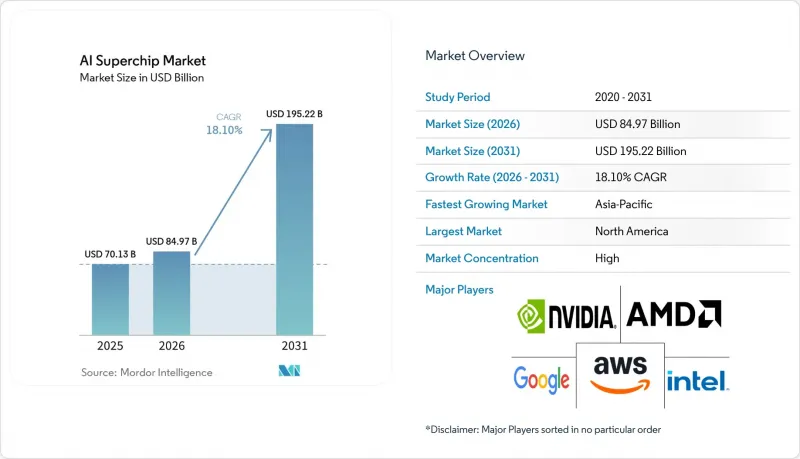
Mordor Intelligence에 의하면, AI 슈퍼칩 시장 규모는 2025년 701억 3,000만 달러에서 2026년에는 849억 7,000만 달러로 확대되고, 2026-2031년 CAGR 18.10%로 성장을 지속하여 2031년에는 1,952억 2,000만 달러에 이를 것으로 예측됩니다.
본 보고서는 기능별(훈련 및 추론), 아키텍처 유형별(CPU-GPU 통합 슈퍼칩, GPU-GPU 결합 슈퍼칩 등), 패키징 기술별(모놀리식 시스템 온 칩(SoC) 등), 도입 형태별(클라우드, On-Premise, 엣지), 최종 사용자(하이퍼스케일 클라우드 제공업체, 데이터센터, 기업 등), 지역별로 분류되어 있습니다. 시장 전망은 금액(달러) 기준으로 제시되어 있습니다.
전 세계 AI 슈퍼칩 시장 동향과 인사이트
프론티어 모델 훈련을 위한 연산 능력 확대가 실리콘 수요의 지속적인 증가를 견인
최첨단 모델 훈련으로 인해 AI 슈퍼칩 시장은 계속해서 급격한 지출 확대 추세를 보이고 있습니다. 이는 최신 언어, 비전, 멀티모달 시스템이 이전 세대에 비해 실질적으로 더 많은 병렬 연산 능력을 필요로 하기 때문입니다. '전문가 혼합(MOE)' 설계 및 다단계 사후 훈련으로의 전환에 따라, 하드웨어 수요는 단일 사전 훈련 단계에 그치지 않고 튜닝, 정렬, 평가 주기까지 확대되고 있습니다. NVIDIA는 2026년 1월 5일, GPU당 50페타플롭스의 NVFP4 추론 연산 능력을 갖춘 ‘Rubin’ 플랫폼을 발표했습니다. 이 회사에 따르면, 이 플랫폼을 사용하면 이전 세대인 ‘Blackwell’에 비해 4분의 1에 해당하는 GPU 수로 MOE 모델 훈련이 가능하다고 합니다. 모델당 계산 비용이 낮아지더라도 연구 기관은 대개 더 대규모 시스템을 구축하고 더 많은 실험을 수행하게 되므로, 칩에 대한 전반적인 수요는 줄어들지 않습니다. 이러한 동일한 추세는 실제 운영 단계로도 이어지고 있으며, 추론 워크로드에서는 고정된 추론 예산이 아닌 쿼리마다 변동하는 계산 자원이 소비됩니다. 그 결과, AI 슈퍼칩 시장에서는 훈련 클러스터와 대규모 추론 플릿을 모두 지원하는 모델 라이프사이클 전반에 걸친 수요가 축적되고 있습니다.
HBM의 콜로케이션과 메모리 대역폭 확장이 칩 아키텍처를 재구성
현대 가속기는 연산 처리 근처에 메모리가 배치되어 있지 않으면 처리량을 유지할 수 없기 때문에 고대역폭 메모리는 AI 슈퍼칩 시장에서 단순한 성능 차별화 요소에서 기본적인 설계 요건으로 변화했습니다. JEDEC는 2024년 12월, 2,048비트 인터페이스와 스택당 1.5-2TB/s의 대역폭을 목표로 하는 HBM4 규격을 발표했으며, 이를 통해 향후 가속기 설계의 상한선이 높아졌습니다. 지멘스(Siemens)는 HBM4를 통해 스택 용량도 64GB로 확대되어, 설계자가 동일한 패키지 내에서 대역폭, 용량, 소비 전력의 균형을 맞출 여지가 넓어졌습니다고 지적하고 있습니다. 이러한 메모리의 변혁은 아키텍처의 선택지를 변화시키고 있습니다. 왜냐하면 연산 블록, 인터포저, 열 경로가 처음부터 메모리의 제약을 고려하여 설계되게 되었기 때문입니다. 또한, 메모리 공급 상황은 로직 설계와 마찬가지로 제품 출시 시기를 좌우할 수 있으므로, 한국과 대만공급업체 준비 태세의 중요성이 부각되고 있습니다. 그 결과, 제품의 성공은 프로세서의 처리량뿐만 아니라, 벤더가 메모리, 패키징, 시스템 통합을 얼마나 잘 조율할 수 있는지에 점점 더 의존하게 되었습니다.
첨단 패키징의 생산 능력 제약이 단기적인 공급량을 억제
첨단 패키징은 AI 슈퍼칩 시장에서 단기적으로 가장 큰 걸림돌로 남아 있습니다. 가속기는 연산 다이와 HBM을 동일한 패키지 내에 배치하는 복잡한 조립 공정 없이는 출하할 수 없기 때문입니다. 웨이퍼 공급이 개선되더라도 패키징 라인에는 여전히 전용 본더, 배치 장비, 검사 시스템이 필요하며, 이들의 도입 및 인증에는 시간이 소요됩니다. 이로 인해 많은 공급업체는 할당량에 제약을 계속 받고 있으며, 패키지의 확보 가능성은 칩 설계나 웨이퍼 가동과 동등하게 중요한 상업적 레버리지로 자리 잡고 있습니다. 또한, 이러한 공급 부족은 시장의 집중화를 더욱 가속화하고 있습니다. 대기업은 중소 경쟁사보다 더 쉽게 기판, 메모리, 파운드리 접근성을 확보할 수 있기 때문입니다. 냉각 및 상호 연결 설계 기준은 고밀도 배치를 위한 기술적 장벽을 더욱 높이고 있으며, 이로 인해 패키징 제약이 랙 설계 및 시스템 인증에도 파급되고 있습니다. 생산 능력이 충분히 확대될 때까지는 납기 기간이 프로세서 수요와 마찬가지로 패키징 준비 상황에 크게 좌우될 것입니다.
부문 분석
2025년, AI 슈퍼칩 시장에서 훈련이 59.32%를 차지하며, 최첨단 모델 개발이 여전히 가장 많은 연산 자원을 소비하고 있어 시장에서 가장 큰 점유율을 기록했습니다. 이러한 선두 위상은 대규모 클러스터에서의 치열한 훈련 경쟁을 반영하며, 최첨단 모델의 경우 장기간에 걸친 개발 주기를 통해 수만 대의 GPU가 사용되기도 합니다. 또한 주요 연구 기관들이 모델 규모를 확대할 뿐만 아니라 튜닝 및 평가를 위한 단계도 추가하고 있기 때문에 훈련은 여전히 중심적인 위치를 차지하고 있습니다. 이러한 추가 단계로 인해 초기 사전 훈련 단계가 완료된 후에도 클러스터의 가동률은 높은 수준을 유지합니다. NVIDIA에 따르면, Rubin 플랫폼에서는 기존 Blackwell 세대에 비해 4분의 1 수준의 GPU 수로도 Mixture of Experts(MoE) 모델 훈련이 가능하며, 이는 효율성 기준이 얼마나 빠르게 발전하고 있는지를 보여줍니다.
이러한 효율성의 변화로 인해 시간이 지남에 따라 훈련이 차지하는 비중은 줄어들 수 있겠지만, 절대적인 지출액 측면에서 훈련의 중요성이 낮아지는 것은 아닙니다. 기업 소프트웨어, 소비자 대상 서비스, 자율 시스템에 도입되는 모델 수가 증가함에 따라, 추론 시장 규모는 2031년까지 연평균 성장률(CAGR) 18.49%로 확대될 것으로 예측됩니다. 따라서 AI 슈퍼칩 업계는 훈련에서 멀어지고 있는 것이 아니라, 실시간 추론을 통해 두 번째로 큰 수요원을 추가하고 있는 것입니다. 추론 워크로드는 고정된 응답 경로를 따르지 않고 각 프롬프트에 가변적인 GPU 시간을 할당할 수 있기 때문에 배포 시 연산 자원 사용량도 증가합니다. 이는 추론의 성장이 기존의 훈련 수요를 대체하는 것이 아니라, 그에 더해질 것임을 의미합니다. AI 슈퍼칩 시장은 대규모 훈련 클러스터가 필요한 연구 기관과, 빠르고 효율적인 추론 플릿이 필요한 사업자 사이에서 앞으로도 균형을 유지할 것으로 보입니다.
CPU와 GPU를 통합한 슈퍼칩은 2025년에 43.76%의 점유율을 기록하며 AI 슈퍼칩 시장에서 가장 큰 비중을 차지했습니다. 이는 대규모 훈련 및 혼합 연산 환경에 대한 요구를 충족시키기 때문입니다. 이러한 우위는 Arm 기반 CPU와 GPU를 매우 높은 상호 연결 대역폭으로 연결하는 ‘Grace Blackwell’이나 ‘Vera Rubin’과 같은 플랫폼을 통해 구축되어 왔습니다. CPU와 GPU의 연동이 긴밀해짐에 따라 데이터 마이그레이션이 개선되고, 서로 다른 메모리 도메인을 넘나들면서 발생하는 성능 저하가 완화됩니다. 이러한 조합은 오케스트레이션, 메모리 액세스, 가속기 실행이 단일 시스템으로 작동해야 하는 경우에 유용합니다. 또한 통합 플랫폼이 여전히 대규모 AI 클러스터의 기반으로 선호되는 이유도 이 점에서 설명할 수 있습니다.
각 하이퍼스케일러 기업들이 특정 워크로드의 경제성에 실리콘을 최적화하려는 움직임을 강화함에 따라, AI ASIC 기반 슈퍼칩은 2031년까지 18.81%라는 가장 높은 연평균 성장률(CAGR)을 나타낼 전망입니다. AI 슈퍼칩 업계에서 이러한 경향이 가장 명확하게 드러나는 분야는 추론 분야입니다. 이 분야에서는 예측 가능하고 반복적인 워크로드가 맞춤형 칩 설계에 유리하게 작용하고 있습니다. 구글은 2026년 4월, 훈련용 TPU 8t와 추론용 TPU 8i를 발표하며 워크로드에 특화된 가속기 경로 간의 명확한 구분을 보여주었습니다. 이는 구매자가 소프트웨어 스택과 도입 모델을 제어함으로써 비용, 전력 소비, 처리량을 보다 세밀하게 조정할 수 있다는 점에서 중요합니다. GPU 간 결합이나 이종 멀티 가속기 구성은 특수한 환경에서는 여전히 중요하지만, 가장 강력한 성장 조짐을 보이는 것은 하이퍼스케일 환경에서의 맞춤형 ASIC 도입입니다. 이러한 구성 비율이 확대됨에 따라, 범용 GPU 벤더들은 소유 비용이 더 중요한 구매 요인이 되는 추론 부하가 높은 이용 사례에서 더 큰 압박에 직면하게 될 것입니다.
지역별 분석
2025년, 북미는 AI 슈퍼칩 시장의 55.69%를 차지하며 최대 점유율을 기록했습니다. 이는 최첨단 AI 연구소, 하이퍼스케일러의 본사, 그리고 발표된 최대 규모의 인프라 예산이 이 지역에 집중되어 있기 때문입니다. 미국은 상용 가속기 설계 및 맞춤형 실리콘 전략의 중심지로 계속 자리 잡고 있으며, 업계 지적 재산권의 상당 부분이 이곳에 집중되어 있습니다. 또한 이 지역은 클라우드 구매자, 칩 설계자, 시스템 구축 업체 및 소프트웨어 생태계 간의 긴밀한 협력이라는 이점도 누리고 있습니다. 캐나다는 주권적 컴퓨팅 이니셔티브를 뒷받침하는 거점으로 부상하고 있는 반면, 멕시코는 주요 수요원이라기보다는 니어쇼어 생산 거점으로서 더 중요한 위치를 차지하고 있습니다. 이러한 요인들로 인해 제조가 다른 지역에서 이루어지더라도 북미는 구조적으로 견고한 입지를 유지하고 있습니다.
아시아태평양은 2031년까지 연평균 성장률(CAGR) 19.09%로 확대될 것으로 예측되며, 인공지능(AI) 슈퍼칩 시장에서 가장 빠르게 성장하는 지역이 될 전망입니다. 이 지역은 최첨단 파운드리 사업, 고대역폭 메모리 생산, 그리고 첨단 패키징의 중심에 위치해 있어, 이를 통해 전 세계 공급 시기에 직접적인 영향력을 행사하고 있습니다. 대만과 한국은 제조의 깊이와 메모리 관리가 첨단 가속기의 전개 속도를 좌우하기 때문에 여전히 중요한 위치를 차지하고 있습니다. 인도의 ‘IndiaAI Mission’은 2026년 초에 3만 8,000대의 GPU를 갖춘 컴퓨팅 시설을 가동하고, 연말까지 10만 대를 목표로 하고 있어 현지 수요 기반이 급속히 확대되고 있음을 보여줍니다.
2025년, 유럽은 독일, 영국, 프랑스를 필두로 매출액에서 중규모의 점유율을 차지했습니다. 영국 정부는 2026년 6월, 11억 파운드(14억 1,000만 달러) 규모의 ‘AI 하드웨어 계획’을 발표했으며, 여기에는 국가 AI 슈퍼컴퓨터 구축 및 칩 조달에 대한 자금 지원이 포함되어 있습니다. 이 정책 방향은 국내 연산 능력 확대를 지원할 뿐만 아니라, 규제가 엄격한 환경에서의 On-Premise 수요를 강화하는 것입니다. 남미, 중동 및 아프리카는 매출액 측면에서 여전히 소규모이지만, 각국 정부 주도의 인프라 구축 프로그램이 새로운 기회를 창출하고 있으며, 특히 걸프 국가 시장에서는 정부 주도의 디지털 투자가 증가하고 있습니다.
기타 혜택:
- 엑셀 형식 시장 예측(ME) 시트
- 3개월간의 애널리스트 지원
자주 묻는 질문
목차
제1장 서론
제2장 조사 방법
제3장 주요 요약
제4장 시장 구도
제5장 시장 규모와 성장 예측
제6장 경쟁 구도
제7장 시장 기회와 향후 전망
KTH 26.08.06According to Mordor Intelligence, the AI superchip market size is expected to grow from USD 70.13 billion in 2025 to USD 84.97 billion in 2026 and is forecast to reach USD 195.22 billion by 2031 at 18.10% CAGR over 2026-2031.
This report is Segmented by Function (Training, and Inference), Architecture Type (CPU-GPU Integrated Superchips, GPU-GPU Coupled Superchips, and More), Packaging Technology (Monolithic System-On-Chip (SoC), and More), Deployment (Cloud, On-Premises, and Edge), End-User (Hyperscale Cloud Providers, Data Centers, Enterprises, and More), and Geography. The Market Forecasts are Provided in Terms of Value (USD).
Global AI Superchip Market Trends and Insights
Frontier Model Training Compute Expansion Drives Sustained Silicon Appetite
Frontier model training continues to keep the AI superchip market on a steep spending path because newer language, vision, and multimodal systems require materially more parallel compute than earlier generations. The move toward mixture-of-experts designs and multi-stage post-training has extended hardware demand beyond a single pre-training window and into tuning, alignment, and evaluation cycles. NVIDIA launched the Rubin platform on January 5, 2026, with 50 petaflops of NVFP4 inference compute per GPU, and the company said the platform can train mixture-of-experts models with 4x fewer GPUs than the prior Blackwell generation. Lower compute cost per model does not ease overall chip demand because labs usually respond by targeting larger systems and running more experiments. This same pattern is carried over into deployment, where reasoning workloads consume variable compute per query rather than a fixed inference budget. The result is that the AI superchip market is seeing demand accumulate across the full model lifecycle, which supports both training clusters and high-volume inference fleets.
HBM Co-Location and Memory Bandwidth Scaling Reshapes Chip Architecture
High-bandwidth memory has moved from a performance differentiator to a basic design requirement for the AI superchip market, as modern accelerators cannot sustain throughput without memory close to compute. JEDEC published the HBM4 standard in December 2024 with a 2,048-bit interface and a target of 1.5-2TB/s bandwidth per stack, which raised the ceiling for future accelerator designs. Siemens noted that HBM4 also increases stack capacity to 64GB, giving designers more room to balance bandwidth, capacity, and power within the same package. This memory shift is changing architecture choices because compute blocks, interposers, and thermal paths are now being designed around memory constraints from the start. It also underscores the importance of supplier readiness in South Korea and Taiwan, as memory availability can shape launch timing as strongly as logic design. As a result, product success increasingly depends on how well vendors coordinate memory, packaging, and system integration, rather than on processor throughput alone.
Advanced Packaging Capacity Constraints Cap Near-Term Supply Throughput
Advanced packaging remains the clearest near-term brake on the AI superchip market because accelerators cannot ship without complex assembly that places compute dies and HBM inside the same package. Even when wafer supply improves, packaging lines still need specialized bonders, placement tools, and inspection systems that take time to install and qualify. This keeps many vendors allocation-constrained and makes package availability a commercial lever as important as chip design or wafer starts. The shortage also reinforces concentration because larger firms can secure substrate, memory, and foundry access more easily than smaller rivals. Cooling and interconnect design standards are raising the technical bar for dense deployments, which means packaging constraints now spill into rack design and system qualification as well. Until capacity expands more fully, delivery schedules will continue to depend on packaging readiness as much as on processor demand.
Other drivers and restraints analyzed in the detailed report include:
- Chiplet-Based Heterogeneous Integration Breaks Through The Reticle Ceiling
- Sovereign AI Infrastructure Buildout Diversifies The Demand Base
- Export Controls On Leading-Edge Accelerators Fragment Global Market Access
For complete list of drivers and restraints, kindly check the Table Of Contents.
Segment Analysis
Training held 59.32% of the AI superchip market in 2025, and it represented the largest slice of the market because frontier model development still consumes the most compute. That lead reflected the intensity of large cluster training, where state-of-the-art models can use tens of thousands of GPUs over extended development cycles. Training also remains central because leading labs are not only scaling model size but also adding more stages for tuning and evaluation. These added steps keep cluster usage high even after the initial pretraining phase is complete. NVIDIA said the Rubin platform can train mixture-of-experts models with 4x fewer GPUs than the prior Blackwell generation, demonstrating how quickly the efficiency baseline is advancing.
That efficiency shift may compress training share over time, but it does not reduce the importance of training in absolute spending terms. Inference is forecast to expand at a 18.49% CAGR through 2031 as deployed model counts rise across enterprise software, consumer services, and autonomous systems. The AI superchip industry is therefore not moving away from training; it is adding a second large demand pool through real-time inference. Reasoning workloads also increase compute usage during deployment because they can allocate variable GPU time to each prompt rather than following a fixed response path. This means inference growth adds to existing training demand rather than replacing it. The AI superchip market is likely to remain balanced between labs that need large training clusters and operators that need fast, efficient inference fleets.
CPU-GPU integrated superchips held a 43.76% share in 2025 and accounted for the largest share of the AI superchip market because they meet the needs of large-scale training and mixed-compute environments. Their lead has been built on platforms such as Grace Blackwell and Vera Rubin, which tie Arm-based CPUs and GPUs together with very high interconnect bandwidth. Tighter CPU-GPU coordination improves data movement and reduces the performance loss caused by crossing separate memory domains. That combination is useful when orchestration, memory access, and accelerator execution must work as a single system. It also helps explain why integrated platforms remain the preferred foundation for large AI clusters.
AI ASIC-based superchips are projected to post the fastest CAGR of 18.81% through 2031, as hyperscalers increasingly match silicon to specific workload economics. The AI superchip industry is seeing this most clearly in inference, where predictable, repetitive workloads favor custom chip design. Google introduced TPU 8t for training and TPU 8i for inference in April 2026, which showed a clearer split between workload-specific accelerator paths. This matters because cost, power, and throughput can be tuned more tightly when the buyer controls the software stack and deployment model. GPU-GPU coupled and heterogeneous multi-accelerator setups will remain important in specialized environments, but the strongest growth signal is coming from custom ASIC deployment at hyperscale. As that mix expands, merchant GPU vendors will face greater pressure in inference-heavy use cases, where ownership costs become a stronger buying factor.
Complete Report Scope:
- By Function
- Training
- Inference
- By Architecture Type
- CPU-GPU Integrated Superchips
- GPU-GPU Coupled Superchips
- AI ASIC-Based Superchips
- Heterogeneous Multi-Accelerator Superchips
- By Packaging Technology
- Monolithic System-on-Chip (SoC)
- Chiplet-Based SoC
- System-in-Package (SiP)
- Multi-Chip Module (MCM)
- By Deployment
- Cloud
- On-Premises
- Edge
- By End-User
- Hyperscale Cloud Providers
- Data Centers
- Enterprises
- Government and Defense Organizations
- Research and Academic Institutions
- By Geography
- North America
- United States
- Canada
- Mexico
- Europe
- Germany
- United Kingdom
- France
- Italy
- Rest of Europe
- Asia-Pacific
- China
- Japan
- South Korea
- India
- Southeast Asia
- Rest of Asia-Pacific
- South America
- Middle East and Africa
- North America
Geography Analysis
North America held 55.69% of the AI superchip market in 2025, the largest share, because frontier AI labs, hyperscaler headquarters, and the largest announced infrastructure budgets are concentrated there. The United States remains the center of merchant-accelerator design and custom silicon strategy, which keeps much of the industry's intellectual property anchored there. The region also benefits from close alignment between cloud buyers, chip designers, system builders, and software ecosystems. Canada is emerging as a supporting node for sovereign compute efforts, while Mexico remains more relevant as a nearshore production location than as a major source of demand. These factors keep North America structurally strong even when manufacturing is elsewhere.
Asia-Pacific is projected to expand at a 19.09% CAGR through 2031, making it the fastest-growing geography in the artificial intelligence (AI) superchip market. The region sits at the center of leading-edge foundry work, high-bandwidth memory production, and advanced packaging, which gives it direct influence over global supply timing. Taiwan and South Korea remain critical because manufacturing depth and memory control shape the rollout pace of advanced accelerators. India's IndiaAI Mission operated a compute facility with 38,000 GPUs in early 2026 and targeted 100,000 by year-end, indicating a rapidly rising local demand base.
Europe held a mid-sized share of revenue in 2025, led by Germany, the United Kingdom, and France. The UK government announced a GBP 1.1 billion (USD 1.41 billion) AI Hardware Plan in June 2026, including funding for a national AI supercomputer and chip procurement. That policy direction supports more local compute capacity and reinforces on-premises demand in regulated environments. South America, the Middle East, and Africa remain smaller in terms of revenue, but sovereign infrastructure programs are opening new opportunities, especially in Gulf markets, where state-backed digital investment is rising.
- NVIDIA Corporation
- Advanced Micro Devices, Inc.
- Intel Corporation
- Google LLC
- Amazon.com, Inc.
- Microsoft Corporation
- Apple Inc.
- Qualcomm Incorporated
- Broadcom Inc.
- Samsung Electronics Co., Ltd.
- SK hynix Inc.
- Micron Technology, Inc.
- Taiwan Semiconductor Manufacturing Company Limited
- Alchip Technologies
- Arm Holdings plc
- Huawei Technologies Co., Ltd.
- Cerebras Systems Inc.
- Groq, Inc.
- Graphcore Limited
- Tenstorrent Inc.
- Hailo Technologies Ltd.
- SiMa Technologies, Inc.
- SambaNova Systems, Inc.
- Rebellions Inc.
- Marvell Technology, Inc.
Additional Benefits:
- The market estimate (ME) sheet in Excel format
- 3 months of analyst support
TABLE OF CONTENTS
1 INTRODUCTION
- 1.1 Study Assumptions And Market Definition
- 1.2 Scope Of The Study
2 RESEARCH METHODOLOGY
3 EXECUTIVE SUMMARY
4 MARKET LANDSCAPE
- 4.1 Market Overview
- 4.2 Impact of Macroeconomic Factors On The Market
- 4.3 Market Drivers
- 4.3.1 Frontier Model Training Compute Expansion
- 4.3.2 HBM Co-Location And Memory Bandwidth Scaling
- 4.3.3 Chiplet-Based Heterogeneous Integration
- 4.3.4 Sovereign AI Infrastructure Buildout
- 4.3.5 Edge Inferencing At Scale In Industrial Systems
- 4.3.6 Advanced Interconnect Demand For Multi-Die Systems
- 4.4 Market Restraints
- 4.4.1 Advanced Packaging Capacity Constraints
- 4.4.2 Export Controls On Leading-Edge Accelerators
- 4.4.3 Power Density And Cooling Limits In Dense Racks
- 4.4.4 Model Efficiency Gains That Reduce Incremental Silicon Demand
- 4.5 Industry Value Chain Analysis
- 4.6 Regulatory Landscape
- 4.7 Technological Outlook
- 4.8 Porter's Five Forces Analysis
- 4.8.1 Threat of New Entrants
- 4.8.2 Bargaining Power of Suppliers
- 4.8.3 Bargaining Power of Buyers
- 4.8.4 Threat of Substitutes
- 4.8.5 Intensity of Competitive Rivalry
5 MARKET SIZE AND GROWTH FORECASTS (VALUE)
- 5.1 By Function
- 5.1.1 Training
- 5.1.2 Inference
- 5.2 By Architecture Type
- 5.2.1 CPU-GPU Integrated Superchips
- 5.2.2 GPU-GPU Coupled Superchips
- 5.2.3 AI ASIC-Based Superchips
- 5.2.4 Heterogeneous Multi-Accelerator Superchips
- 5.3 By Packaging Technology
- 5.3.1 Monolithic System-on-Chip (SoC)
- 5.3.2 Chiplet-Based SoC
- 5.3.3 System-in-Package (SiP)
- 5.3.4 Multi-Chip Module (MCM)
- 5.4 By Deployment
- 5.4.1 Cloud
- 5.4.2 On-Premises
- 5.4.3 Edge
- 5.5 By End-User
- 5.5.1 Hyperscale Cloud Providers
- 5.5.2 Data Centers
- 5.5.3 Enterprises
- 5.5.4 Government and Defense Organizations
- 5.5.5 Research and Academic Institutions
- 5.6 By Geography
- 5.6.1 North America
- 5.6.1.1 United States
- 5.6.1.2 Canada
- 5.6.1.3 Mexico
- 5.6.2 Europe
- 5.6.2.1 Germany
- 5.6.2.2 United Kingdom
- 5.6.2.3 France
- 5.6.2.4 Italy
- 5.6.2.5 Rest of Europe
- 5.6.3 Asia-Pacific
- 5.6.3.1 China
- 5.6.3.2 Japan
- 5.6.3.3 South Korea
- 5.6.3.4 India
- 5.6.3.5 Southeast Asia
- 5.6.3.6 Rest of Asia-Pacific
- 5.6.4 South America
- 5.6.5 Middle East and Africa
- 5.6.1 North America
6 COMPETITIVE LANDSCAPE
- 6.1 Market Concentration
- 6.2 Strategic Moves
- 6.3 Market Positioning Analysis
- 6.4 Company Profiles (includes Global Level Overview, Market Level Overview, Core Segments, Financials As Available, Strategic Information, Market Rank/Share, Products And Services, Recent Developments)
- 6.4.1 NVIDIA Corporation
- 6.4.2 Advanced Micro Devices, Inc.
- 6.4.3 Intel Corporation
- 6.4.4 Google LLC
- 6.4.5 Amazon.com, Inc.
- 6.4.6 Microsoft Corporation
- 6.4.7 Apple Inc.
- 6.4.8 Qualcomm Incorporated
- 6.4.9 Broadcom Inc.
- 6.4.10 Samsung Electronics Co., Ltd.
- 6.4.11 SK hynix Inc.
- 6.4.12 Micron Technology, Inc.
- 6.4.13 Taiwan Semiconductor Manufacturing Company Limited
- 6.4.14 Alchip Technologies
- 6.4.15 Arm Holdings plc
- 6.4.16 Huawei Technologies Co., Ltd.
- 6.4.17 Cerebras Systems Inc.
- 6.4.18 Groq, Inc.
- 6.4.19 Graphcore Limited
- 6.4.20 Tenstorrent Inc.
- 6.4.21 Hailo Technologies Ltd.
- 6.4.22 SiMa Technologies, Inc.
- 6.4.23 SambaNova Systems, Inc.
- 6.4.24 Rebellions Inc.
- 6.4.25 Marvell Technology, Inc.
7 MARKET OPPORTUNITIES AND FUTURE OUTLOOK
- 7.1 White-Space and Unmet-Need Assessment