

|
시장보고서
상품코드
2099765
방위 및 우주 컴퓨팅용 HBM 시장 : 시장 점유율 분석, 업계 동향 및 통계, 성장 예측(2026-2031년)HBM For Defense and Space Computing - Market Share Analysis, Industry Trends & Statistics, Growth Forecasts (2026 - 2031) |
||||||
 Mordor Intelligence
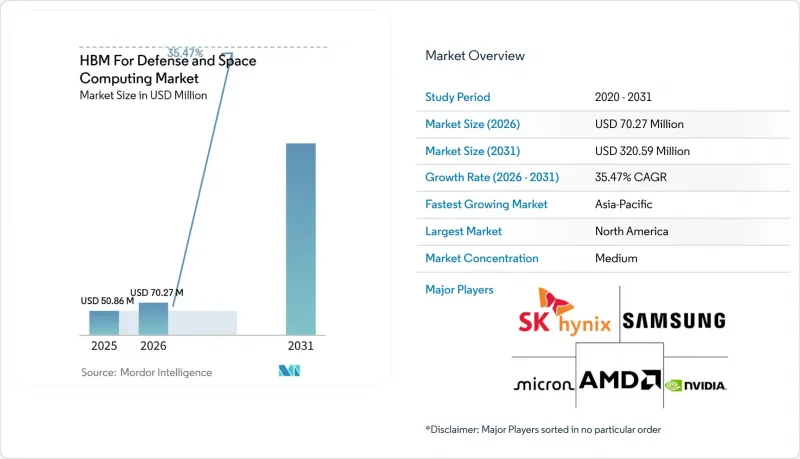
Mordor Intelligence에 의하면, 방위 및 우주 컴퓨팅용 HBM 시장은 2025년에 5,086만 달러 규모로 평가되었고, 2031년까지 3억 2,059만 달러에 이를 것으로 예측되며, 2026-2031년 CAGR 35.47%로 성장할 전망입니다.
본 보고서는 기술별(HBM2, HBM2E, HBM3, HBM3E, HBM4), 스택당 메모리 용량별(4GB 이하, 4GB-8 GB, 8 GB-16GB, 16GB-32 GB, 32 GB 이상), 프로세서 인터페이스별(CPU, GPU, FPGA, ASIC 등), 용도별(고성능 컴퓨팅, AI 및 자율 시스템, 레이더, 기타), 그리고 지역별로 분류되어 있습니다. 시장 전망은 금액(달러) 기준으로 제시되어 있습니다.
세계의 방위 및 우주 컴퓨팅용 HBM 동향 및 인사이트
우주 등급 AI 및 센서 융합 워크로드에서의 HBM 수요 증가
우주 시스템은 중계 및 관측이라는 역할을 넘어, 융합된 센서 데이터를 기내에서 직접 처리할 수 있을 것으로 점점 더 기대되고 있으며, 이에 따라 방위 및 우주 컴퓨팅용 HBM 시장의 대역폭 요구 사항이 높아지고 있습니다. 『Scientific Reports』지에 게재된 2026년 연구에서는 지속적인 지상 지원 없이 자율적인 임무 계획, 다중 위성 센서 융합 및 건전성 관리를 수행할 수 있는 기내 컴퓨팅 아키텍처가 소개되었으며, 이는 향후 우주선 설계에서 로컬 고대역폭 메모리에 대한 지속적인 수요가 있을 것임을 시사합니다. 이러한 변화는 운영상의 보안 향상으로도 이어집니다. 로컬 추론이 증가하면 보안 취약성이 높은 통신 창을 통해 원시 데이터를 정기적으로 전송해야 할 필요가 줄어들기 때문입니다. Syntiant사와 Novi Space사는 2026년 3월, 실시간 물체 감지를 목적으로 한 궤도 상의 저전력 AI 추론을 시연하며 이러한 변화를 보여주었습니다. 이를 통해 방위 및 우주 컴퓨팅용 HBM에 대해 실용적인 도입을 위한 명확한 실증 사례를 확보하게 되었습니다. 또한 Frontgrade Gaisler사도 2025년 4월 스웨덴 우주청과 체결한 우주용 뉴로모픽 AI 상용화 계약을 통해 유사한 방향성을 뒷받침했습니다. 이를 통해 탑재형 AI가 단순한 실험실 개념에 그치지 않고, 자금 지원을 받는 프로그램 활동으로 전환되었음이 입증되었습니다.
방위 분야에서의 온보드 실시간 분석으로의 주요 전환
방위 분야의 시스템 통합 업체들은 실시간 로컬 분석을 중심으로 미션 컴퓨터의 재설계를 추진하고 있으며, 이를 통해 방위 및 우주 컴퓨팅 시장을 겨냥한 HBM이 주류 플랫폼 설계에 점차 통합되고 있습니다. Parry Labs는 2025년 9월, 전술 엣지 미션 컴퓨팅을 위해 FPGA 신호 처리와 AI 가속을 결합한 최초의 3U VPX 카드 ‘Forge Boss’를 출시했습니다. 이는 고대역폭 메모리가 더 이상 독립적인 프로토타입이 아니라, 실전 배치 가능한 오픈 아키텍처 모듈에 통합되고 있음을 보여줍니다. Pacific Defense사는 2026년 3월, AMD Versal AI Edge Series Gen 2를 기반으로 한 'DSP3100VP' 모듈을 발표하며 이러한 방향성을 더욱 추진했습니다. 이 모듈은 엣지에서 데이터를 즉시 처리해야 하는 전자전, 신호 정보, 자율 추적 등의 워크로드를 대상으로 합니다. 또한 HBM은 메모리와 프로세서라는 별개의 디바이스 간 고속 신호 전송량을 줄여줍니다. 이를 통해 항공기 탑재 시스템 및 내환경성 시스템의 전자기 호환성(EMC)에 대한 부담이 경감되어, 방위 분야 주요 제조업체들이 인증을 획득하기가 용이해집니다. SOSA 및 CMOSS를 준수하는 제품이 시장에 점점 더 많이 등장함에 따라, 방위 및 우주 컴퓨팅용 HBM은 성능과 규정 준수를 동시에 평가하는 조달 모델의 혜택을 받고 있습니다.
방사선 내성 인증, 스크리닝 및 신뢰성 확보에 소요되는 비용
방사선 내성 인증은 방위 및 우주 컴퓨팅용 HBM 시장에 있어 여전히 가장 큰 장벽 중 하나입니다. 이는 각 신세대 제품이 중요한 임무에서 신뢰받을 수 있게 되기 전에, 장기간에 걸친 고비용의 검증 과정을 거쳐야 하기 때문입니다. Teledyne e2v사는 장기간에 걸친 인증 과정을 거쳐 2026년 3월에 16GB DDR4-X1 비행용 모델의 생산을 시작했으나, 이마저도 현재의 상용 HBM 세대에 비해 크게 뒤처진 메모리 아키텍처를 채택한 것이었습니다. HBM은 적층 다이와 실리콘 관통 비아(TSV)로 인해 기존 인증 기법으로는 평가할 수 없었던 방사선 거동이 발생하기 때문에 복잡성이 더욱 가중되고 있습니다. BAE 시스템즈도 2026년 6월, 고신뢰성 용도를 위한 ‘트러스트드 소스(Trusted Source)’ 규정 범위 내에서 작동시키면서 방사선 내성 플랫폼 상에서 Endura 프로세서의 실증을 수행했을 때, 이와 유사한 부담을 지적했습니다. 시험, 스크리닝 및 신뢰성 확보에 드는 비용이 여전히 고가인 한, 방위 및 우주 컴퓨팅 시장을 겨냥한 HBM은 상용 메모리 주기에 비해 차세대 제품의 인증 속도가 더딘 상태를 유지할 것입니다.
부문 분석
2025년 시점에서 HBM3는 방위 및 우주 컴퓨팅용 HBM 시장 점유율의 43.54%를 차지했으나, HBM4는 훨씬 더 작은 기반에서 출발하여 2031년까지 연평균 성장률(CAGR) 36.67%로 확대될 것으로 예측됩니다. JEDEC은 2025년 4월에 HBM4 규격을 발표했습니다. 이 규격은 2048비트 인터페이스, 최대 2 TB/s의 총 대역폭, 스택당 32개 채널을 갖추고 있으며, HBM3 컨트롤러와의 하위 호환성이 있어 이미 인증 절차에 있는 방위용 설계에 있어 전환 경로가 더욱 현실적으로 됩니다. 방위 및 우주 컴퓨팅용 HBM은 HBM4가 더 광범위한 임무 용도에 대응할 수 있게 되기까지 여전히 24-36개월의 인증 기간이 필요하기 때문에 상용화의 진전은 방위 분야에서의 채택보다 빠른 속도로 진행되고 있습니다. 삼성은 2026년 5월에 12층 HBM4E 샘플 출하를 시작했으며, 이 제품은 48GB 용량으로 3.6TB/s의 대역폭을 달성하고, 이전 세대에 비해 에너지 효율이 16% 향상되었습니다.
상용 출시와 방위 분야 실용화 준비 사이의 이러한 격차는 중요합니다. 이는 방위 및 우주 컴퓨팅용 HBM 분야에서 일회성 업그레이드가 아닌 지속적인 설계 도입 주기가 형성되기 때문입니다. 구형 HBM1이나 HBM2의 도입 사례는 제한적인 개조 기반에서 계속 활용되겠지만, 레거시 프로그램이 수명 주기의 끝자락에 다다르면서 그 중요성은 점차 줄어들고 있습니다. 다음 단계에서는 HBM4를 둘러싼 설계 작업이 스택 자체 내에서 국방 특유의 보정, 제어 또는 가속 기능을 지원할 수 있는 맞춤형 베이스 다이 로직을 지향하고 있기 때문에 더욱 전문화가 진행될 가능성이 있습니다. 이러한 방향성이 유지된다면, 방위·우주 컴퓨팅 산업용 HBM은 단순히 상용 로드맵을 뒤따르는 데 그치지 않고, 그와는 다른 길을 걷기 시작할지도 모릅니다. 다만, 상용 제품의 생산량 동향은 여전히 중요하며, 이는 방위 분야 구매자가 차세대 제품에 대한 접근권을 협상할 때 어느 정도의 영향력을 행사할 수 있는지를 결정하기 때문입니다.
2025년 시점에서 방위 및 우주 컴퓨팅용 HBM 시장 규모의 47.81%를 8GB-16GB 용량대가 차지한 반면, 16GB-32GB 용량대는 2031년까지 연평균 성장률(CAGR) 36.44%로 확대될 것으로 예측됩니다. 이러한 주요 용량 대역은 엄격한 열적·질량적 제약 조건을 충족해야 하는 미션 컴퓨터, SIGINT 프로세서 및 우주용 AI 보드의 현재 설계 요점을 반영하고 있습니다. 또한, 이 범위는 기존의 견고한 냉각 설계에 부합하면서도 HBM이 기존 메모리에 비해 뚜렷한 성능 및 전력 소비 면에서의 우위를 발휘하기 시작하는 영역이기도 합니다. 4GB 이하 및 4GB-8GB 범주는 여전히 구형 도입 사례에 의존하고 있으며, 해당 플랫폼이 업데이트됨에 따라 기회는 점차 줄어들고 있습니다. 32GB를 초과하는 옵션은 가장 까다로운 계산 부하를 위해 평가 단계에 접어들었으나, 방사선 내성 및 통합 측면에서 더 어려운 과제에 직면해 있습니다.
방위 및 우주 컴퓨팅 시장에서 HBM의 대용량화가 단순한 용량 증가 이상의 의미를 갖는 것은 높은 대역폭 밀도 때문입니다. 마이크론은 자사의 HBM4 36GB 12단 스택이 2.8TB/s를 초과하는 대역폭을 달성했으며, HBM3E에 비해 전력 효율이 20% 이상 향상되었다고 발표했습니다. 이는 더 적은 수의 스택으로 더 높은 처리량을 실현하는 설계 전환을 뒷받침하는 것입니다. 레이더나 SIGINT 시스템은 대개 공칭 연산 리소스보다 데이터 전송 속도에 의해 제약을 받기 때문에 단일의 더 높은 대역폭 스택이 아키텍처 선택의 폭 전체를 바꿀 가능성이 있습니다. 따라서 16GB에서 32GB 대역폭으로의 전환은 방위 및 우주 컴퓨팅 시장에서 HBM의 단순한 사양 향상이 아니라, 메모리 설계의 재구성을 의미합니다. 스택 수를 줄임으로써 기판 면적과 인증이 필요한 인터페이스의 수를 줄일 수 있으므로, 대용량 대역폭은 성능 측면과 프로그램 비용 측면 모두에서 더 매력적인 선택지가 됩니다.
지역별 분석
2025년, 북미는 방위 및 우주 컴퓨팅용 HBM 시장 점유율의 49.06%를 차지하며 지역별 1위를 유지했습니다. 미국은 국방용 전자기기 조달 규모가 크고, 신뢰성 높은 제조 및 첨단 반도체 기술에 대한 직접적인 지원을 통해 그 주도적 지위를 공고히 하고 있습니다. 'CHIPS for America Defense Fund'는 2027 회계연도까지 연간 4억 달러를 배정하고 있으며, 이를 통해 첨단 패키징, 신뢰성 높은 조달 및 인증 활동에 필요한 국내 기반 시설에 대한 지원이 지속되고 있습니다. 또한, ‘ATSP5’ 계약 프레임워크는 마이크로전자공학의 광범위한 수명 주기를 포괄하며, 방위 및 우주 컴퓨팅용 HBM 시장에 직접 관련된 3D 첨단 패키징 작업을 포함하고 있어 해당 지역의 기반을 강화하고 있습니다. 캐나다는 감시, 해상 초계, 우주 정보 분야에서 동맹국과의 공동 조달을 통해 지역 기반을 지원하고 있는 반면, 멕시코는 주로 지원 및 간접적인 공급망 역할에 국한된 비교적 소규모 참여자에 그치고 있습니다.
유럽은 2025년에 2위 자리를 차지했으며, NATO의 현대화 프로그램과 방위 및 우주 컴퓨팅용 HBM 분야의 차세대 항공기 및 무인 플랫폼 관련 활동에 힘입고 있습니다. 프랑스, 이탈리아, 영국, 독일은 레이더, 임무 시스템, 위성 프로그램, 전자전 관련 사업을 통해 계속해서 이 분야의 주요 기여국으로 자리매김하고 있습니다. Frontgrade Gaisler사는 2026년 5월 유럽연합 집행위원회의 COSMIC7 프로그램으로부터 자금을 지원받아 우주용 7nm RISC-V 프로세서를 개발했습니다. 이는 향후 고대역폭 메모리 구성과 더불어 해당 지역의 컴퓨팅 기반 강화를 뒷받침할 것입니다. 또한, EU의 산업 정책은 기밀성이 높은 용도에서 동맹국 및 지역 공급업체로부터의 조달을 촉진하고 있으며, 이를 통해 방위 및 우주 컴퓨팅용 HBM 분야에서 유럽의 위상은 점차 향상될 전망입니다.
아시아태평양은 2031년까지 연평균 성장률(CAGR) 36.47%를 나타낼 것으로 예측되며, 방위 및 우주 컴퓨팅용 HBM 시장에서 가장 두드러진 성장을 보일 것으로 전망됩니다. 전 세계 HBM 공급은 한국 업체에 크게 의존하고 있어 한국은 여전히 중심적인 역할을 수행하고 있으며, 삼성은 2026년 5월 주요 고객을 대상으로 12층 HBM4E 샘플을 출하함으로써 선도적 위치를 더욱 공고히 했습니다. 일본은 국방비 증가에 더해, 2026년 7월 마이크론이 히로시마에서 HBM 대규모 확장을 위한 기공식을 진행함으로써 그 역할을 강화하고 있습니다. 이는 해당 지역의 메모리 생산 능력에 대한 장기적인 투자를 보여주는 것입니다. 대만은 여전히 매우 중요한 존재이며, 광역 지역 내 첨단 패키징의 가용성은 TSMC에 크게 의존하고 있기 때문에 패키징에 대한 접근성은 상업 및 국방 프로그램 모두에 공통된 제약 요인이 되고 있습니다. 인도는 아직 초기 단계에 있지만, 국내 반도체 정책과 국방력 현대화를 통해 국방 및 우주 컴퓨팅 시장을 겨냥한 HBM 시장에 향후 진출할 수 있는 기반이 마련되기 시작했습니다. 남미, 중동 및 아프리카는 여전히 수요가 막 싹트기 시작한 지역으로, 현지 HBM 개발보다는 수입된 방위용 전자 장비의 조달이 더 중요하게 여겨지고 있습니다.
기타 혜택 :
- 엑셀 형식 시장 예측(ME) 시트
- 3개월간의 애널리스트 지원
자주 묻는 질문
목차
제1장 서론
제2장 조사 방법
제3장 주요 요약
제4장 시장 구도
제5장 시장 규모 및 성장 예측
제6장 경쟁 구도
제7장 시장 기회 및 향후 전망
AJY 26.08.07According to Mordor Intelligence, the HBM for defense and space computing market was valued at USD 50.86 million in 2025 and is projected to reach USD 320.59 million by 2031, advancing at a CAGR of 35.47% during 2026-2031.
This report is Segmented by Technology (HBM2, HBM2E, HBM3, HBM3E, and HBM4), Memory Capacity Per Stack (Up To 4 GB, 4 GB To 8 GB, 8 GB To 16 GB, 16 GB To 32 GB, and More), Processor Interface (CPU, GPU, FPGA, ASIC, and More), Application (High-Performance Computing, AI and Autonomous Systems, Radar, and More), and Geography. The Market Forecasts are Provided in Terms of Value (USD).
Global HBM For Defense and Space Computing Market Trends and Insights
Rising HBM Demand in Space-Grade AI And Sensor Fusion Workloads
Space systems are moving beyond relay and observation roles and are increasingly expected to process fused sensor data directly onboard, which raises the bandwidth bar for the HBM for defense and space computing market. A 2026 study in Scientific Reports described an onboard computing architecture that could run autonomous mission planning, multisatellite sensor fusion, and health management without constant ground support, which points to sustained demand for local high-bandwidth memory in future spacecraft designs. This change also improves operational security because more local inference means less routine transmission of raw data during vulnerable communication windows. Syntiant and Novi Space showed this shift in March 2026 when they demonstrated low-power AI inference in orbit for real-time object detection, which gave the HBM for defense and space computing market a visible proof point for practical deployment. Frontgrade Gaisler also reinforced the same direction through its April 2025 Swedish National Space Agency contract to commercialize neuromorphic AI for space, showing that onboard AI has moved into funded program activity rather than remaining a laboratory concept.
Defense Prime Shift Toward Onboard Real-Time Analytics
Defense integrators are redesigning mission computers around real-time local analytics, and that is pushing the HBM for defense and space computing market into mainstream platform design. Parry Labs launched Forge Boss in September 2025 as the first 3U VPX card to combine FPGA signal processing with AI acceleration for tactical-edge mission computing, which shows how high-bandwidth memory is now tied to deployable open-architecture modules rather than stand-alone prototypes. Pacific Defense extended that direction in March 2026 with its DSP3100VP module built on AMD Versal AI Edge Series Gen 2, aimed at electronic warfare, signal intelligence, and autonomous tracking workloads where data must be processed immediately at the edge. HBM also reduces the amount of high-speed signaling between separate memory and processor devices, which lowers electromagnetic compatibility stress in airborne and ruggedized systems and makes qualification easier for defense primes. As more SOSA- and CMOSS-aligned products come to market, the HBM for defense and space computing market is gaining from a purchasing model that rewards performance and compliance at the same time.
Radiation Qualification, Screening, and Reliability Costs
Radiation qualification remains one of the hardest barriers for the HBM for defense and space computing market because each new generation must pass a long and costly validation path before it can be trusted in critical missions. Teledyne e2v began production of its 16 GB DDR4-X1 flight models in March 2026 after an extended qualification process, and even this involved a memory architecture that sits well behind current commercial HBM generations. HBM adds further complexity because stacked dies and through-silicon vias introduce radiation behaviors that older qualification methods were not built to evaluate. BAE Systems highlighted the same burden in June 2026 when it demonstrated its Endura processor on a radiation-hardened platform while still operating within trusted-source rules for high-assurance use. As long as test, screening, and reliability costs remain heavy, the HBM for defense and space computing market will keep qualifying new generations slower than the commercial memory cycle.
Other drivers and restraints analyzed in the detailed report include:
- Transition From Discrete Memory To 3D-Stacked Memory in SWaP-Constrained Mission Computers
- Government Funding for Domestic Advanced Semiconductor Supply Chains
- Limited Supply of HBM-Qualified Advanced Packaging Capacity
For complete list of drivers and restraints, kindly check the Table Of Contents.
Segment Analysis
HBM3 held 43.54% of the HBM for defense and space computing market share in 2025, while HBM4 is projected to expand at a 36.67% CAGR through 2031 from a much smaller base. JEDEC released the HBM4 standard in April 2025 with a 2048-bit interface, up to 2 TB/s total bandwidth, 32 channels per stack, and backward compatibility with HBM3 controllers, which makes the transition path more practical for defense designs already in qualification. Commercial availability is moving faster than defense adoption because the HBM for defense and space computing market still needs a 24- to 36-month qualification window before HBM4 can support broader mission use. Samsung began shipping 12-layer HBM4E samples in May 2026, and the product reached 3.6 TB/s bandwidth with 48 GB capacity and 16% better energy efficiency than the prior generation.
That gap between commercial release and defense readiness is important because it creates a recurring design-in cycle rather than a single upgrade event in the HBM for defense and space computing market. Older HBM1 and HBM2 deployments will continue to serve a limited retrofit base, but they are losing relevance as legacy programs near end of service life. The next phase may also become more specialized because design work around HBM4 points toward customized base-die logic that could support defense-specific correction, control, or acceleration functions within the stack itself. If that direction holds, the HBM for defense and space computing industry may begin to diverge from the commercial roadmap rather than simply follow it with a delay. Commercial volume trends will still matter because they determine how much leverage defense buyers have when negotiating access to later generations.
The 8 GB to 16 GB band accounted for 47.81% of the HBM for defense and space computing market size in 2025, while the 16 GB to 32 GB band is projected to expand at a 36.44% CAGR through 2031. The leading band reflects the current design point for mission computers, SIGINT processors, and space-grade AI boards that must fit into constrained thermal and mass envelopes. It also marks the range where HBM begins to deliver a clear performance and power advantage over conventional memory while still fitting into existing rugged cooling designs. Up to 4 GB and 4 GB to 8 GB categories remain tied to older deployments and face a narrowing opportunity set as those platforms move toward replacement. Above 32 GB options are entering evaluation for the most demanding computing loads, but they face a steeper path on radiation and integration.
Bandwidth density is what makes the higher-capacity transition more meaningful for the HBM for defense and space computing market than raw capacity alone. Micron stated that its HBM4 36 GB 12-high stack reached more than 2.8 TB/s and over 20% better power efficiency than HBM3E, which supports a design shift toward fewer stacks carrying more throughput. Radar and SIGINT systems are often limited by how fast data can move rather than by nominal compute resources, so a single higher-bandwidth stack can change architecture choices across the board. That is why the move into the 16 GB to 32 GB band signals a reset in memory design rather than a simple specification increase in the HBM for defense and space computing market. Fewer stacks can also reduce board area and the number of interfaces that must be qualified, which makes the higher-capacity band more attractive from both performance and program cost perspectives.
Complete Report Scope:
- By Technology
- HBM2
- HBM2E
- HBM3
- HBM3E
- HBM4
- By Memory Capacity Per Stack
- Up To 4 GB
- 4 GB To 8 GB
- 8 GB To 16 GB
- 16 GB To 32 GB
- Above 32 GB
- By Processor Interface
- CPU
- GPU
- FPGA
- ASIC
- AI Accelerators
- Networking and Communication Processors
- By Application
- Mission Computing
- High-Performance Computing
- AI and Autonomous Systems
- Radar, EO and SIGINT Processing
- Spacecraft On-Board Processing
- Electronic Warfare and Signal Processing
- By Geography
- North America
- United States
- Canada
- Mexico
- Europe
- Germany
- United Kingdom
- France
- Italy
- Rest of Europe
- Asia-Pacific
- China
- Japan
- South Korea
- Taiwan
- India
- Rest of Asia-Pacific
- South America
- Middle East and Africa
- North America
Geography Analysis
North America held 49.06% of the HBM for defense and space computing market share in 2025, which kept it in the leading regional position. The United States anchors that lead through its scale in defense electronics procurement and through direct support for trusted manufacturing and advanced semiconductor work. The CHIPS for America Defense Fund is allocating USD 400 million per year through FY2027, and that continues to support the domestic base needed for advanced packaging, trusted sourcing, and qualification activities. The ATSP5 contract framework also strengthens the region because it covers a wide microelectronics lifecycle and includes 3D advanced packaging work that matters directly to the HBM for defense and space computing market. Canada supports the regional base through allied procurement in surveillance, maritime patrol, and space intelligence, while Mexico remains a smaller participant tied mainly to support and indirect supply chain roles.
Europe held the second-largest position in 2025, supported by NATO modernization programs and next-generation air and unmanned platform activity in the HBM for defense and space computing market. France, Italy, the United Kingdom, and Germany remain the main regional contributors through radar, mission systems, satellite programs, and electronic warfare work. Frontgrade Gaisler received European Commission funding in May 2026 under the COSMIC7 program to develop a 7 nm RISC-V processor for space applications, which supports a stronger regional computing base next to future high-bandwidth memory configurations. EU industrial policy is also nudging procurement toward allied and regional suppliers for sensitive applications, which should gradually improve Europe's position in the HBM for defense and space computing market.
Asia-Pacific is projected to advance at a 36.47% CAGR through 2031, making it the fastest-growing region in the HBM for defense and space computing market. South Korea remains central because global HBM supply depends heavily on Korean vendors, and Samsung moved further ahead in May 2026 by shipping 12-layer HBM4E samples to major customers. Japan is strengthening its role through defense spending growth and through Micron's July 2026 groundbreaking for a major HBM expansion in Hiroshima, which signals long-cycle investment in regional memory capacity. Taiwan remains critical because advanced packaging availability in the wider region depends heavily on TSMC, which makes packaging access a shared constraint across commercial and defense programs. India is still at an early stage, but domestic semiconductor policy and defense modernization are starting to create a pathway for future participation in the HBM for defense and space computing market. South America and the Middle East and Africa remain nascent demand zones where procurement of imported defense electronics matters more than local HBM development.
- Samsung Electronics Co., Ltd.
- SK hynix Inc.
- Micron Technology, Inc.
- NVIDIA Corporation
- Advanced Micro Devices, Inc.
- Intel Corporation
- Broadcom Inc.
- Marvell Technology, Inc.
- Fujitsu Limited
- IBM Corporation
- Taiwan Semiconductor Manufacturing Company Limited
- Cadence Design Systems, Inc.
- BAE Systems plc
- RTX Corporation
- Lockheed Martin Corporation
- Northrop Grumman Corporation
- Thales S.A.
- Leonardo S.p.A.
- Airbus SE
- Frontgrade Technologies
- Aitech Systems Ltd.
- Teledyne Technologies Incorporated
- Microchip Technology Incorporated
- Honeywell International Inc.
Additional Benefits:
- The market estimate (ME) sheet in Excel format
- 3 months of analyst support
TABLE OF CONTENTS
1 INTRODUCTION
- 1.1 Study Assumptions and Market Definition
- 1.2 Scope of the Study
2 RESEARCH METHODOLOGY
3 EXECUTIVE SUMMARY
4 MARKET LANDSCAPE
- 4.1 Market Overview
- 4.2 Market Drivers
- 4.2.1 Rising HBM Demand in Space-Grade AI and Sensor Fusion Workloads
- 4.2.2 Defense Prime Shift Toward On-Board Real-Time Analytics
- 4.2.3 Transition From Discrete Memory To 3D-Stacked Memory In SWaP-Constrained Mission Computers
- 4.2.4 Government Funding For Domestic Advanced Semiconductor Supply Chains
- 4.2.5 Growth In Reconfigurable Mission Processing Architectures Using GPUs, FPGAs, and AI Accelerators
- 4.2.6 Extended Lifecycle Modernization Of Legacy Military And Space Platforms
- 4.3 Market Restraints
- 4.3.1 Radiation Qualification, Screening, and Reliability Costs
- 4.3.2 Limited Supply Of HBM-Qualified Advanced Packaging Capacity
- 4.3.3 Export Controls and Trusted-Foundry Constraints
- 4.3.4 Thermal, Power, and Integration Complexity In Ruggedized Platforms
- 4.4 Supply Chain Analysis
- 4.5 Regulatory Landscape
- 4.6 Technological Outlook
- 4.7 Impact Of Macroeconomic Factors On The Market
- 4.8 Porter's Five Forces Analysis
- 4.8.1 Threat of New Entrants
- 4.8.2 Bargaining Power of Suppliers
- 4.8.3 Bargaining Power of Buyers
- 4.8.4 Threat of Substitutes
- 4.8.5 Intensity of Competitive Rivalry
5 MARKET SIZE AND GROWTH FORECASTS (VALUE)
- 5.1 By Technology
- 5.1.1 HBM2
- 5.1.2 HBM2E
- 5.1.3 HBM3
- 5.1.4 HBM3E
- 5.1.5 HBM4
- 5.2 By Memory Capacity Per Stack
- 5.2.1 Up To 4 GB
- 5.2.2 4 GB To 8 GB
- 5.2.3 8 GB To 16 GB
- 5.2.4 16 GB To 32 GB
- 5.2.5 Above 32 GB
- 5.3 By Processor Interface
- 5.3.1 CPU
- 5.3.2 GPU
- 5.3.3 FPGA
- 5.3.4 ASIC
- 5.3.5 AI Accelerators
- 5.3.6 Networking and Communication Processors
- 5.4 By Application
- 5.4.1 Mission Computing
- 5.4.2 High-Performance Computing
- 5.4.3 AI and Autonomous Systems
- 5.4.4 Radar, EO and SIGINT Processing
- 5.4.5 Spacecraft On-Board Processing
- 5.4.6 Electronic Warfare and Signal Processing
- 5.5 By Geography
- 5.5.1 North America
- 5.5.1.1 United States
- 5.5.1.2 Canada
- 5.5.1.3 Mexico
- 5.5.2 Europe
- 5.5.2.1 Germany
- 5.5.2.2 United Kingdom
- 5.5.2.3 France
- 5.5.2.4 Italy
- 5.5.2.5 Rest of Europe
- 5.5.3 Asia-Pacific
- 5.5.3.1 China
- 5.5.3.2 Japan
- 5.5.3.3 South Korea
- 5.5.3.4 Taiwan
- 5.5.3.5 India
- 5.5.3.6 Rest of Asia-Pacific
- 5.5.4 South America
- 5.5.5 Middle East and Africa
- 5.5.1 North America
6 COMPETITIVE LANDSCAPE
- 6.1 Market Concentration
- 6.2 Strategic Moves
- 6.3 Market Share Analysis
- 6.4 Company Profiles (includes Global Level Overview, Market Level Overview, Core Segments, Financials as available, Strategic Information, Market Rank/Share, Products and Services, Recent Developments)
- 6.4.1 Samsung Electronics Co., Ltd.
- 6.4.2 SK hynix Inc.
- 6.4.3 Micron Technology, Inc.
- 6.4.4 NVIDIA Corporation
- 6.4.5 Advanced Micro Devices, Inc.
- 6.4.6 Intel Corporation
- 6.4.7 Broadcom Inc.
- 6.4.8 Marvell Technology, Inc.
- 6.4.9 Fujitsu Limited
- 6.4.10 IBM Corporation
- 6.4.11 Taiwan Semiconductor Manufacturing Company Limited
- 6.4.12 Cadence Design Systems, Inc.
- 6.4.13 BAE Systems plc
- 6.4.14 RTX Corporation
- 6.4.15 Lockheed Martin Corporation
- 6.4.16 Northrop Grumman Corporation
- 6.4.17 Thales S.A.
- 6.4.18 Leonardo S.p.A.
- 6.4.19 Airbus SE
- 6.4.20 Frontgrade Technologies
- 6.4.21 Aitech Systems Ltd.
- 6.4.22 Teledyne Technologies Incorporated
- 6.4.23 Microchip Technology Incorporated
- 6.4.24 Honeywell International Inc.
7 MARKET OPPORTUNITIES AND FUTURE OUTLOOK
- 7.1 White-Space and Unmet-Need Assessment


