

|
시장보고서
상품코드
2098501
중동 및 아프리카의 AI 기반 에너지 관리 소프트웨어 시장 : 시장 점유율 분석, 업계 동향 및 통계, 성장 예측(2026-2031년)Middle East and Africa AI-powered Energy Management Software - Market Share Analysis, Industry Trends & Statistics, Growth Forecasts (2026 - 2031) |
||||||
 Mordor Intelligence
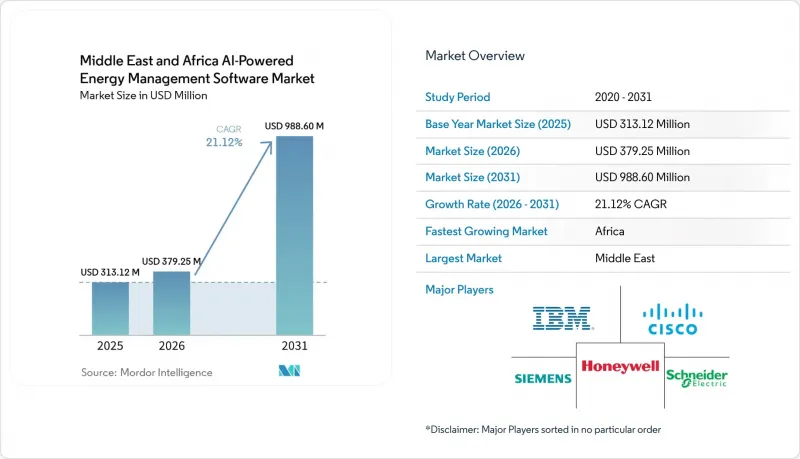
Mordor Intelligence에 의하면, 중동 및 아프리카의 AI 기반 에너지 관리 소프트웨어 시장 규모는 2025년 3억 1,312만 달러로 평가되었고, 2026년 3억 7,925만 달러에서 2031년까지 9억 8,860만 달러로 확대될 것으로 예측되며, 2026-2031년 연평균 복합 성장률(CAGR)은 21.12%를 나타낼 전망입니다.
본 보고서는 컴포넌트별(소프트웨어 및 서비스), 배포 방식별(클라우드 기반, 온프레미스형, 하이브리드형), 용도별(자산 성능 및 예측 유지보수, 재생에너지 예측 및 통합 등), 최종 사용자별(유틸리티, 산업 시설 등) 및 지역별로 분류되어 있습니다. 시장 전망은 금액(달러) 기준으로 제시되어 있습니다.
중동 및 아프리카의 AI 기반 에너지 관리 소프트웨어 시장 동향 및 인사이트
스마트 그리드 및 분산형 에너지 자원의 오케스트레이션 수요 증가
스마트 그리드 및 분산형 에너지 자원의 오케스트레이션에 대한 수요 증가는 중동 및 아프리카의 AI 기반 에너지 관리 소프트웨어 시장에서 여전히 가장 뚜렷한 수요 견인 요인으로 작용하고 있습니다. 이는 전력 회사가 확대되는 디지털 그리드 자산을 보다 적절하게 제어해야 하기 때문입니다. 사우디아라비아에서는 2025년까지 1,000만 대 이상의 스마트 계량기를 설치하고 배전망의 32%를 자동화했습니다. 이를 통해 그리드 계획 및 부하 분산에 활용 가능한 AI 소프트웨어 데이터 세트가 확대되었습니다. DEWA는 이미 스마트 그리드 프로그램에 20억 달러를 투자했으며, 이로 인해 전력 회사의 소프트웨어 조달은 단기적인 시범 운영 예산이 아닌, 수년에 걸친 인프라 투자와 연계되게 되었습니다. 지멘스는 2026년에 중동 조직의 64%가 스마트 그리드와 그리드 소프트웨어를 에너지 전환에 필수적인 요소로 간주하는 반면, 62%는 그리드의 제약이 전기화를 방해하고 있다고 응답했다고 보고했습니다. 데이터 양 증가와 눈에 띄는 송전망 제약이 맞물리면서, 발전 명령 지원, 정전 예측, 분산형 에너지 자원(DER) 조정이 가능한 소프트웨어가 조달에서 더욱 중요한 위치를 차지하게 되었습니다. 아프리카 전력 시스템의 경우, 사하라 이남 지역의 태양광 발전 용도를 위해 개발된 설명 가능한 하이브리드 AI 예측 기술의 활용 사례도, 전력 회사가 재생에너지의 변동성을 관리하면서 신뢰성을 향상시킬 수 있는 소프트웨어로 전환하고 있는 이유를 보여줍니다.
에너지 비용의 변동성 및 피크 수요 최적화 압력
에너지 비용의 변동성과 피크 수요 압력으로 인해, 중동 및 아프리카의 AI 기반 에너지 관리 소프트웨어 시장은 상업 및 산업 사용자에게 있어 일상적인 운영 예산의 일부로 자리 잡고 있습니다. 『Energy Strategy Reviews』지에 게재된 조사에 따르면, AI와 디지털 경제는 GCC(걸프협력회의) 국가들의 에너지 전환에 있어 중요한 긍정적 요인인 반면, 원유 가격 상승은 소비량이 많은 계층에 부정적인 영향을 미치고 있는 것으로 밝혀졌습니다. 이 결과는 요금 리스크와 연료 연동형 에너지 비용으로 인해 피크 가동 기간 중 자동 수요 제어의 투자 회수 기간이 단축된다는 점에서 중요합니다. 걸프 지역에서는 여름철 냉방 수요로 인해 수동적인 에너지 관리의 여지가 좁아지면서, HVAC 시스템 및 부하 스케줄링에 대한 지속적인 최적화의 가치가 높아지고 있습니다. 과거에는 소프트웨어를 단순한 효율화 부가 기능으로만 취급했던 대규모 시설에서도, 현재는 반복되는 비용 변동이나 피할 수 있는 피크 시간대 과태료에 대한 방어 수단으로 인식하고 있습니다. 이러한 요인은 상업용 포트폴리오나 산업 시설이 장시간 가동되며, 더욱 엄격한 에너지 성능 기대에 직면해 있는 지역에서 특히 두드러집니다.
레거시 OT와 빌딩 관리 시스템 통합의 복잡성
레거시 OT와 빌딩 관리 시스템 통합의 복잡성은 중동 및 아프리카의 AI 기반 에너지 관리 소프트웨어 시장에서 여전히 단기적으로 가장 큰 제약 요인으로 작용하고 있습니다. 이 지역의 많은 에너지 및 유틸리티 환경에서는 AI 통합이 설계 요건이 되기 훨씬 이전에 도입된 SCADA, DCS 및 빌딩 제어 시스템이 여전히 가동되고 있습니다. 벤더들은 단일 시설 내에서 Modbus, DNP3, IEC 61850 및 독자적인 빌딩 인터페이스가 혼재된 다중 프로토콜 환경을 처리해야 하는 경우가 많으며, 이로 인해 통합에 소요되는 시간과 테스트 작업량이 증가하고 있습니다. UAE의 OT 보안에 관한 2026년 보고서에서는 보호된 운영 환경과 로컬에서 제어되는 보안 계층에 대한 관심이 높아지고 있음을 강조하고 있으며, 이는 브라운필드 통합이 단순한 소프트웨어 도입이 아닌 고위험 프로젝트로 취급되는 이유를 반영합니다. 따라서 경쟁사가 더 강력한 알고리즘을 내세운다 하더라도 구매자는 검증된 미들웨어나 프로토콜 어댑터를 보유한 벤더를 선택하는 경향이 있습니다. 이러한 경향은 가동 중단으로 인한 비용이 높고 제어 시스템의 전면 교체를 정당화하기가 여전히 어려운 오래된 산업 시설이나 상업시설에서 특히 두드러집니다.
부문 분석
2025년 시점에서 소프트웨어는 전체 구성 요소의 67.44%를 차지했으며, 중동 및 아프리카의 AI 기반 에너지 관리 소프트웨어 시장에서 가장 확실한 수익 원천이 되었습니다. GCC 국가들의 구매자들은 하드웨어의 전면적인 교체 주기를 기다리기보다는 이미 설치된 스마트 미터, SCADA 자산, 빌딩 시스템 위에 구축할 수 있는 분석, 디지털 트윈, 예측 레이어를 선호했습니다. 이러한 접근 방식은 해당 지역의 현재 투자 패턴과 부합했습니다. 많은 사업자가 이미 부분적인 디지털 인프라를 보유하고 있었음에도 불구하고, 지속적인 최적화나 의사결정 지원은 여전히 부족했기 때문입니다. 국영 유틸리티체나 대규모 부동산 소유자가 데이터 수집을 확대하는 가운데, 소프트웨어는 처음부터 다시 구축하지 않고도 스케줄링, 예측, 장애 감지를 개선할 수 있어 가치 창출을 위한 최단 경로가 되었습니다. 따라서 이 비중은 먼저 인텔리전스를 수익화하고, 그 다음에 물리적 업데이트를 진행한다는 시장 동향을 반영한 것입니다.
2025년의 최대 수익원은 소프트웨어 분야에 있었지만, 기존 설비와의 통합 및 지속적인 모델 조정을 통해 거의 모든 도입 사례에 인적 작업이 추가됨에 따라 서비스 분야도 급속히 확대되고 있습니다. DEWA는 2026년 6월, 전력 네트워크 전반에 걸친 고장 예측 경보, 근본 원인 분석, 실시간 시나리오 시뮬레이션을 제공하는 ‘AI 가상 엔지니어’를 도입하여, 유틸리티 사업자가 소프트웨어 기능뿐만 아니라 내장형 엔지니어링 기능에 대해서도 대가를 지불하고 있음을 보여주는 사례를 제시했습니다. 재생에너지 시스템에서 AI는 측정 가능한 운영상의 이점을 가져다주며, 조정 및 모니터링이 필요한 프로젝트에서 서비스 가입률 향상을 뒷받침하고 있습니다. 이러한 변화는 플랫폼 라이선싱과 도입, 통합, 장기 지원을 단일 계약 하에 결합할 수 있는 공급업체에게 유리하게 작용합니다. 또한 이는 특히 사용자가 소프트웨어의 출력을 발전 지시, 유지보수 또는 빌딩 제어 조치로 변환하는 데 지원이 필요한 경우, 서비스 품질이 공급업체 선정의 요소로 자리 잡고 있음을 의미합니다.
2025년에는 클라우드 기반 도입이 가장 큰 점유율을 차지했으나, 중동 및 아프리카의 AI 기반 에너지 관리 소프트웨어 시장에서 하이브리드 도입 시장 규모는 2026년부터 2031년에 걸쳐 연평균 성장률(CAGR) 23.15%로 확대될 것으로 예측됩니다. 클라우드는 전용 서버 구축에 따른 초기 부담 없이 확장 가능한 분석 기능을 원하는 전력 회사나 빌딩 관리자들의 지지를 받았습니다. 또한, 통합된 대시보드와 분산된 자산 전반에 걸친 신속한 배포가 필요한 다중 거점 포트폴리오에도 적합합니다. 기밀성이 낮은 이용 사례에서는 클라우드 환경 도입으로 사내 IT 업무 부담이 경감되고, 소프트웨어 업데이트 관리도 용이해졌습니다. 이에 따라 특히 엄격한 주권 규제보다 속도와 비용 관리가 중시되는 상황에서 클라우드는 도입 대수 측면에서 1위 자리를 유지했습니다.
하이브리드 배포가 증가하고 있는 이유는 주요 에너지 사업자들이 기밀성이 낮은 분석에는 클라우드의 유연성을 활용하면서도, 데이터의 운영 관리를 자산 근처에서 유지하고 싶어 하기 때문입니다. UAE 사이버 보안 위원회와 지멘스는 2026년에 OT 보안에 관한 제휴를 공식적으로 체결하고, UAE의 클라우드 인프라에 'SINEC Guard'를 도입했습니다. 이는 운영 데이터를 현지에서 관리하는 보호된 아키텍처에 대한 노력을 강조하는 것입니다. 온프레미스 시스템은 계약상 또는 규제상 요건으로 인해 데이터의 외부 유출이 일절 허용되지 않는 해수 담수화, 석유화학 및 기타 중요 시설에서 여전히 확고한 입지를 차지하고 있습니다. 그 결과, ‘승자 독식’ 모델이 아닌 세 가지 요소로 구성된 도입 패턴이 형성되었으며, 클라우드 활용도, 로컬 호스팅, OT 통합 능력 등 각 분야에서 벤더 간의 경쟁이 활발히 이어지고 있습니다. 구매자의 결정은 이념보다는 각 워크로드의 위험, 지연 시간, 규정 준수 요건에 부합하는지에 중점을 두고 있습니다.
기타 혜택 :
- 엑셀 형식 시장 예측(ME) 시트
- 3개월간의 애널리스트 지원
자주 묻는 질문
목차
제1장 서론
제2장 조사 방법
제3장 주요 요약
제4장 시장 구도
제5장 시장 규모 및 성장 예측
제6장 경쟁 구도
제7장 시장 기회 및 향후 전망
AJY 26.08.07According to Mordor Intelligence, the Middle East and Africa AI-powered Energy Management Software Market size is projected to expand from USD 313.12 million in 2025 and USD 379.25 million in 2026 to USD 988.60 million by 2031, registering a CAGR of 21.12% between 2026 and 2031.
This report is Segmented by Component (Software, and Services), Deployment Mode (Cloud-Based, On-Premises, and Hybrid), Application (Asset Performance and Predictive Maintenance, Renewable Energy Forecasting and Integration, and More), End User (Utilities, Industrial Facilities, and More), and Geography. The Market Forecasts are Provided in Terms of Value (USD).
Middle East and Africa AI-powered Energy Management Software Market Trends and Insights
Rising Smart Grid and Distributed Energy Resource Orchestration Needs
Rising smart grid and distributed energy resource orchestration needs remain the clearest demand driver for the Middle East and Africa AI-powered Energy Management Software Market, as utilities need better control over expanding digital grid assets. Saudi Arabia had installed more than 10 million smart meters and automated 32% of its distribution network by 2025, expanding the usable data set for AI software in grid planning and load balancing. DEWA had already committed USD 2 billion to its smart grid program, which kept utility software procurement tied to multi-year infrastructure spending rather than short pilot budgets. Siemens reported in 2026 that 64% of Middle East organizations viewed smart grids and grid software as crucial to the energy transition, while 62% said grid limitations were holding back electrification. That mix of larger data volumes and visible grid constraints has made software capable of dispatch support, outage prediction, and DER coordination more central to procurement. In African power systems, explainable hybrid AI forecasting work for Sub-Saharan solar applications also showed why utilities are moving toward software that can improve reliability while managing renewable variability.
Energy Cost Volatility and Peak Demand Optimization Pressure
Energy cost volatility and peak demand pressure are pushing the Middle East and Africa AI-powered Energy Management Software Market into more routine operating budgets for commercial and industrial users. Research published in Energy Strategy Reviews found that AI and the digital economy were significant positive drivers of the GCC energy transition, while higher oil prices had a negative effect at higher consumption quantiles. That result matters because tariff exposure and fuel-linked energy costs shorten the payback period for automated demand control during peak operating periods. In the Gulf, summer cooling demand narrows the margin for manual energy management and increases the value of continuous optimization across HVAC systems and load scheduling. Large sites that once treated software as an efficiency add-on now view it as protection against recurring cost swings and avoidable peak penalties. This driver is strongest where commercial portfolios and industrial facilities operate long hours and face tighter energy performance expectations.
Legacy OT and Building Management System Integration Complexity
The complexity of legacy OT and building management system integration remains the largest near-term brake on the Middle East and Africa AI-powered Energy Management Software Market. Many energy and utility environments in the region still run SCADA, DCS, and building control systems installed long before AI integration became a design requirement. Vendors often face multi-protocol settings that combine Modbus, DNP3, IEC 61850, and proprietary building interfaces within a single facility, which extends integration time and testing effort. A 2026 report on OT security in the UAE highlighted the growing focus on protected operational environments and locally controlled security layers, which reflects why brownfield integrations are treated as high-risk projects rather than simple software rollouts. This pushes buyers toward vendors with proven middleware and protocol adapters, even when rival suppliers claim stronger algorithms. The effect is strongest in older industrial sites and commercial facilities where shutdowns are costly and full control system replacement remains hard to justify.
Other drivers and restraints analyzed in the detailed report include:
- Data Center and Commercial Real Estate Efficiency Retrofits
- Utility Demand Response and Dynamic Tariff Automation Adoption
- Limited In-Country AI and Energy Analytics Talent
For complete list of drivers and restraints, kindly check the Table Of Contents.
Segment Analysis
Software accounted for 67.44% of the component mix in 2025, making it the clearest revenue anchor in the Middle East and Africa AI-powered Energy Management Software Market. Buyers across the GCC favored analytics, digital twin, and predictive layers that could sit above installed smart meters, SCADA assets, and building systems rather than wait for full hardware renewal cycles. This approach aligned with the region's current investment pattern, as many operators already had partial digital infrastructure but still lacked continuous optimization and decision support. As sovereign utilities and large property owners expanded their data capture, software became the fastest route to value because it could improve scheduling, forecasting, and fault awareness without a ground-up rebuild. The component structure, therefore, reflected a market that is monetizing intelligence first and physical replacement second.
Services are expanding quickly, even though the largest 2025 revenue pool sat in software, because brownfield integration and ongoing model calibration add a labor layer to almost every deployment. DEWA deployed its AI Virtual Engineer in June 2026 to provide predictive failure alerts, root-cause analysis, and real-time scenario simulation across the power network, demonstrating how utilities are paying for embedded engineering capability alongside software functions. AI in renewable energy systems is delivering measurable operational gains, supporting stronger service attachment rates in projects that need tuning and oversight. This shift favors suppliers that can combine platform licensing with implementation, integration, and long-run support under a single contract. It also means that service quality is becoming part of vendor selection, especially where users need help converting software outputs into dispatch, maintenance, or building control actions.
Cloud-based deployment held the largest position in 2025, while the Middle East and Africa AI-powered Energy Management Software Market size for hybrid deployment is projected to expand at 23.15% CAGR between 2026 and 2031. Cloud appealed to utilities and building managers who wanted scalable analytics without the upfront burden of dedicated server builds. It also fits multi-site portfolios that need centralized dashboards and faster rollout across dispersed assets. In less sensitive use cases, cloud setups reduced internal IT workloads and made software updates easier to manage. That kept the cloud at the front of volume adoption, especially where speed and cost discipline mattered more than strict sovereignty rules.
Hybrid deployment is rising because critical energy operators want cloud flexibility for non-sensitive analytics while keeping operational control of data closer to the asset. The UAE Cybersecurity Council and Siemens formalized an OT security collaboration in 2026, with SINEC Guard deployed on the UAE cloud infrastructure, underscoring the push for protected architectures with local control over operational data. On-premises systems still hold a secure place in desalination, petrochemical, and other critical facilities where zero data egress is a contractual or regulatory requirement. The result is a three-part deployment pattern rather than a winner-takes-all model, and that keeps vendor competition open across cloud depth, local hosting, and OT integration capability. For buyers, the decision is less about ideology and more about matching risk, latency, and compliance needs to each workload.
Complete Report Scope:
- By Component
- Software
- Services
- By Deployment Mode
- Cloud-Based
- On-Premises
- Hybrid
- By Application
- Energy Consumption and Demand Optimization
- Asset Performance and Predictive Maintenance
- Smart Grid and Distributed Energy Resource (DER) Management
- Renewable Energy Forecasting and Integration
- Energy Trading, Pricing and Market Intelligence
- By End User
- Utilities
- Commercial Buildings
- Industrial Facilities
- Residential Buildings
- By Geography
- Middle East
- Saudi Arabia
- United Arab Emirates
- Turkey
- Rest of Middle East
- Africa
- South Africa
- Egypt
- Rest of Africa
- Middle East
List of Companies Covered in this Report:
- Schneider Electric SE
- Siemens AG
- Johnson Controls International plc
- Honeywell International Inc.
- ABB Ltd
- IBM Corporation
- Cisco Systems, Inc.
- Emerson Electric Co.
- Eaton Corporation plc
- Delta Electronics, Inc.
- Trane Technologies plc
- Carrier Global Corporation
- DNV AS
- Vertiv Holdings Co
- Planon Group B.V.
- Spacewell International N.V.
- GridPoint, Inc.
- Verdigris Technologies, Inc.
- C3.AI, Inc.
- Enel X Way S.r.l.
Additional Benefits:
- The market estimate (ME) sheet in Excel format
- 3 months of analyst support
TABLE OF CONTENTS
1 INTRODUCTION
- 1.1 Study Assumptions and Market Definition
- 1.2 Scope of the Study
2 RESEARCH METHODOLOGY
3 EXECUTIVE SUMMARY
4 MARKET LANDSCAPE
- 4.1 Market Overview
- 4.2 Market Drivers
- 4.2.1 Rising Smart Grid and Distributed Energy Resource Orchestration Needs
- 4.2.2 Energy Cost Volatility and Peak Demand Optimization Pressure
- 4.2.3 Data Center and Commercial Real Estate Efficiency Retrofits
- 4.2.4 Utility Demand Response and Dynamic Tariff Automation Adoption
- 4.2.5 Cybersecure On-Premises AI Control for Critical Energy Assets
- 4.2.6 Water-Energy Nexus Optimization in Desalination and District Cooling
- 4.3 Market Restraints
- 4.3.1 Legacy OT and Building Management System Integration Complexity
- 4.3.2 Limited In-Country AI and Energy Analytics Talent
- 4.3.3 Data Sovereignty and Cross-Border Cloud Hosting Constraints
- 4.3.4 High Upfront Retrofit and Sensorization Costs for Brownfield Sites
- 4.4 Industry Value Chain Analysis
- 4.5 Impact of Macroeconomic Factors on the Market
- 4.6 Regulatory Landscape
- 4.7 Technological Outlook
- 4.8 Porter's Five Forces Analysis
- 4.8.1 Bargaining Power of Suppliers
- 4.8.2 Bargaining Power of Buyers
- 4.8.3 Threat of New Entrants
- 4.8.4 Threat of Substitutes
- 4.8.5 Competitive Rivalry
5 MARKET SIZE AND GROWTH FORECASTS (VALUE)
- 5.1 By Component
- 5.1.1 Software
- 5.1.2 Services
- 5.2 By Deployment Mode
- 5.2.1 Cloud-Based
- 5.2.2 On-Premises
- 5.2.3 Hybrid
- 5.3 By Application
- 5.3.1 Energy Consumption and Demand Optimization
- 5.3.2 Asset Performance and Predictive Maintenance
- 5.3.3 Smart Grid and Distributed Energy Resource (DER) Management
- 5.3.4 Renewable Energy Forecasting and Integration
- 5.3.5 Energy Trading, Pricing and Market Intelligence
- 5.4 By End User
- 5.4.1 Utilities
- 5.4.2 Commercial Buildings
- 5.4.3 Industrial Facilities
- 5.4.4 Residential Buildings
- 5.5 By Geography
- 5.5.1 Middle East
- 5.5.1.1 Saudi Arabia
- 5.5.1.2 United Arab Emirates
- 5.5.1.3 Turkey
- 5.5.1.4 Rest of Middle East
- 5.5.2 Africa
- 5.5.2.1 South Africa
- 5.5.2.2 Egypt
- 5.5.2.3 Rest of Africa
- 5.5.1 Middle East
6 COMPETITIVE LANDSCAPE
- 6.1 Market Concentration
- 6.2 Strategic Moves
- 6.3 Market Share Analysis
- 6.4 Company Profiles (includes Global Level Overview, Market Level Overview, Core Segments, Financials as available, Strategic Information, Market Rank/Share, Products and Services, Recent Developments)
- 6.4.1 Schneider Electric SE
- 6.4.2 Siemens AG
- 6.4.3 Johnson Controls International plc
- 6.4.4 Honeywell International Inc.
- 6.4.5 ABB Ltd
- 6.4.6 IBM Corporation
- 6.4.7 Cisco Systems, Inc.
- 6.4.8 Emerson Electric Co.
- 6.4.9 Eaton Corporation plc
- 6.4.10 Delta Electronics, Inc.
- 6.4.11 Trane Technologies plc
- 6.4.12 Carrier Global Corporation
- 6.4.13 DNV AS
- 6.4.14 Vertiv Holdings Co
- 6.4.15 Planon Group B.V.
- 6.4.16 Spacewell International N.V.
- 6.4.17 GridPoint, Inc.
- 6.4.18 Verdigris Technologies, Inc.
- 6.4.19 C3.ai, Inc.
- 6.4.20 Enel X Way S.r.l.
7 MARKET OPPORTUNITIES AND FUTURE OUTLOOK
- 7.1 White-space and Unmet-Need Assessment


