
|
시장보고서
상품코드
2099080
BFSI 분야 인재 관리 시장 : 시장 점유율 분석, 업계 동향 및 통계, 성장 예측(2026-2031년)Talent Management In BFSI - Market Share Analysis, Industry Trends & Statistics, Growth Forecasts (2026 - 2031) |
||||||
 Mordor Intelligence
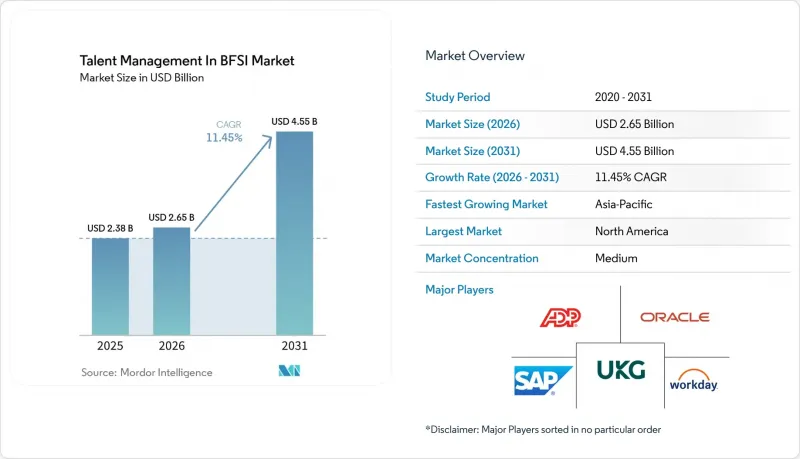
Mordor Intelligence에 의하면, BFSI 분야 인재 관리 시장 규모는 2025년에 23억 8,000만 달러로 평가되었고, 2031년까지 45억 5,000만 달러에 이를 것으로 예측되며, 2026-2031년 CAGR 11.45%로 성장할 전망입니다.
본 보고서는 컴포넌트별(소프트웨어 및 서비스(전문 서비스, 지원 및 유지보수 서비스)), 용도별(성과 관리, 기타), 배포 방식별(온프레미스, 기타), 조직 규모별(대기업, 중소기업(SME)), 최종 사용자별(은행, 보험, 기타) 및 지역별로 분류되어 있습니다. 시장 전망은 금액(달러) 기준으로 제시되어 있습니다.
세계의 BFSI 분야 인재 관리 시장 동향 및 인사이트
AI를 활용한 인재 분석 도입 확대
AI를 활용한 분석은 2026년 BFSI 분야 인재 관리 시장에서 가장 뚜렷한 차별화 요소 중 하나로 자리 잡고 있으며, 인사 부서가 정기적인 보고서 작성에서 지속적인 인재 모니터링으로 전환할 수 있도록 지원하고 있습니다. 딜로이트의 조사에 따르면, 2024년 기준에서 미국의 주요 금융 서비스 기관 고위 임원 중 인재 관리 업무에 생성형 AI를 도입한 비율은 고작 18%에 그쳤으며, 마케팅 및 영업 부문의 47%와 비교했을 때 인사 워크플로우에서의 도입 여지가 여전히 크다는 점이 부각되었습니다. 액센츄어의 보고서에 따르면, AI를 활용한 인사 프로그램을 도입한 주요 BFSI 기관에서는 인사 생산성이 45% 향상되었고, 우선순위 역량의 숙련도가 30% 향상되었으며, 내부 채용률이 40% 증가했습니다. 이러한 도구가 성숙해짐에 따라 은행과 보험사는 성과 신호, 참여도 지표, 노동 시장 변화를 단일 뷰로 통합하는 데 이를 활용하고 있으며, 이를 통해 이직 위험을 더 신속하게 감지하고 인재 계획을 수립할 수 있게 되었습니다. 이러한 변화가 중요한 이유는 금융 업계 내에서 AI 및 데이터 관련 직무가 많은 기업이 인재를 채용할 수 있는 속도보다 빠르게 확대되고 있기 때문입니다. 따라서 BFSI 업계의 인재 관리에서는 스킬 그래프, 내부 이동 도구, 증거 기반 역량 개발 워크플로우에 대한 수요가 증가하고 있습니다. 그 결과, BFSI 고용주들이 조직 내 희소 인재를 더 오랫동안 유지하려고 노력함에 따라, 후계자 계획, 보상 벤치마킹, 학습 및 직무 수행 준비 상태 추적과 같은 전반적인 분야에서 수요가 증가하고 있습니다.
확대되는 ‘디지털 퍼스트’ 채용 관행
디지털 퍼스트 채용은 BFSI 업계의 인재 관리가 채용 속도, 후보자 확보, 그리고 선발의 질을 다루는 방식을 변화시키고 있습니다. 액센츄어의 보고서에 따르면, SAP SuccessFactors와 Eightfold.ai를 기반으로 한 HSBC의 AI 기반 인재 확보 혁신을 통해 운영비가 18% 절감되어 2,850만 달러의 비용 절감을 실현했으며, 채용까지 소요되는 시간을 35% 단축했습니다. 이 모델을 통해 채용 프로세스는 이력서만을 통한 선별에서 행동 징후, 기술 경향, 직무 적합성 지표를 프로세스 초기 단계에 반영할 수 있는 워크플로우 기반 평가로 전환되고 있습니다. 또한, 모바일 우선 채용 퍼널을 통해 기존 채용 담당자의 담당 범위보다 지점, 업무, 서비스 직군 수요가 급속히 확대되고 있는 중소 도시의 후보자까지 도달할 수 있어, 주요 금융 허브 이외의 지역으로의 사업 확장을 지원합니다. 월터스 크루어는 2026년, 금융 서비스 기업의 33% 이상이 AI 도입의 주요 장벽으로 ‘인재 부족’을 꼽고 있다고 지적했습니다. 이는 채용의 효율성이 각 금융 기관의 광범위한 변혁 속도와 직결되어 있음을 보여줍니다.
분산된 레거시 인사 시스템
분산된 레거시 인사 시스템은 데이터의 일관성을 저해할 뿐만 아니라 현대화를 위한 예산을 압박하기 때문에 BFSI 업계의 인재 관리에 있어 여전히 가장 명백한 구조적 걸림돌로 남아 있습니다. 자랄리스(Zalaris)의 조사에 따르면, 대형 은행 중에는 여전히 여러 급여 계산 환경을 병행하여 운영하는 사례가 있으며, 그 결과 데이터 정의에 일관성이 부족해 처리 지연 및 오류 위험이 높아지고 있습니다. Workday의 조사에 따르면, 금융 서비스 업계 고위 경영진의 40%가 인사 데이터의 사일로화를 보고했으며, 65%는 서로 다른 시스템 간의 데이터를 통합하기 위한 더 우수한 기술이 필요하다고 응답했습니다. 이러한 분절화는 기술 매핑, 보상 거버넌스, 성과 가시화, 감사 대응을 지연시켜, 기업이 최신 AI 솔루션을 도입하더라도 그 실질적인 가치를 약화시킵니다. 베인(Bain)은 또한 금융 서비스 업계의 현대화 프로그램에는 기술, 프로세스, 문화 각 측면에서의 조화로운 변혁이 필요하며, 이러한 노력을 통합한 기업들은 금융 프로세스 전반에 걸쳐 평균 22%의 근무 시간 감축을 달성했다고 지적했습니다. 자금 조달 문제는 여전히 현실적인 과제입니다. DUNNIXER가 2026년에 보고한 바에 따르면, 많은 금융 기관에서 IT 예산의 75% 이상이 여전히 구식 시스템에 지출되고 있으며, 그 결과 BFSI 업계의 인재 관리를 위한 새로운 플랫폼에 대한 투자 여지가 좁아지고 있기 때문입니다.
부문 분석
2025년 기준, BFSI 분야 인재 관리 분야 시장 점유율 66.41%를 소프트웨어가 차지했으나, 서비스 부문은 2031년까지 연평균 성장률(CAGR) 13.92%라는 가장 높은 성장률을 기록할 전망입니다. 소프트웨어가 주도적인 위치를 차지하고 있는 이유는 구매자들이 주기마다 도입 작업을 다시 수행할 필요 없이 분석 기능, AI 에이전트, 규정 준수 도구를 지속적으로 추가할 수 있는 구독형 플랫폼을 점점 더 선호하고 있기 때문입니다. 또한 클라우드 서비스의 보급으로 인해, 이전에는 대규모 온프레미스 환경 도입을 정당화할 수 없었던 지방 은행이나 협동조합 기관도 이제 쉽게 접근할 수 있게 되었습니다. BFSI 분야의 도입에는 여전히 여러 관할 구역에 걸친 복잡한 전환, 규제 대응 설정 및 운영 모델 변경이 수반되기 때문에 서비스 부문의 성장 속도가 더 빨라지고 있습니다. 즉, BFSI 분야 인재 관리 솔루션 구매 결정에 있어 플랫폼 선정은 일부에 불과하다는 것입니다.
또한, AI를 활용한 채용 및 성과 관리 도구의 경우, 보다 엄격한 관리 기준 하에서 거버넌스 점검, 편향성 검토, 감사 추적 기록 검증을 반복적으로 수행해야 하므로 지원 및 유지보수 업무의 중요성도 높아지고 있습니다. SAP SuccessFactors는 2026년 상반기 릴리스 사이클에서 충실한 직무 아키텍처와 인증서 기반의 규정 준수 모니터링 기능을 도입했습니다. 이를 통해 소프트웨어의 초기 도입과 장기적인 서비스 계약 모두에 대한 설득력이 높아지고 있습니다. 또한 액센츄어의 조사에 따르면, AI를 활용한 공동 학습 모델을 채택한 은행은 단독 교육에 의존하는 은행에 비해 기술 습득 속도가 4배 더 빠른 것으로 나타났습니다. 이에 따라 도입에 따른 변화 지원 및 워크플로우 설계에 대한 수요가 확대되고 있습니다. 이는 BFSI 업계의 인재 관리가 지속적인 소프트웨어 수익 및 견고한 서비스 기반과 밀접하게 연결되어 있음을 보여줄 뿐만 아니라, BFSI 업계의 인재 관리가 제품의 폭과 마찬가지로 실행의 질에도 크게 의존하고 있음을 시사합니다.
2025년에는 성과 관리가 23.14%의 점유율을 차지했으나, BFSI 업계의 인재 관리 분야에서 가장 빠르게 성장하고 있는 분야는 학습 및 개발이며, 2031년까지 연평균 성장률(CAGR)이 12.77%를 나타낼 것으로 전망됩니다. 에이전트형 AI가 은행·보험 업계의 일상 업무를 혁신하고, 고용주에게 연간 교육 일정이 허용하는 속도보다 빠르게 기술을 갱신하도록 요구함에 따라 학습 수요가 증가하고 있습니다. 액센츄어는 2026년 보고서에서 학습을 일상적인 워크플로우에 통합함으로써 협업 학습 모델이 금융 기관의 기술 숙련도 향상을 4배 빠르게 하고, AI와의 협업에 대한 직원의 자신감을 2배 높였습니다고 보고했습니다. 이로 인해 학습은 단순한 지원 활동에서 생산성과 인재의 지속성을 뒷받침하는 업무 도구로 변화하고 있습니다. 성과 관리는 규제 대상 직무나 통제가 엄격한 조직에 이미 정착되어 있어 여전히 가장 큰 적용 분야로 남아 있습니다.
각 벤더들이 연례 평가 주기에서 벗어나 실시간 기여도 지표나 관리자의 지시로 전환함에 따라, 이러한 활용 방식 자체도 변화하고 있습니다. 워크데이의 ‘Talent Management Agent’는 현재의 기여도 데이터를 바탕으로 증거 기반의 평가안을 작성하고, SAP의 ‘Performance Agent’는 성과 패턴을 분석하여 다음 조치를 권장합니다. 후계자 계획의 중요성도 높아지고 있습니다. Wolters Kluwer의 보고서에 따르면, 금융 자문가의 40%가 향후 10년 이내에 은퇴할 것으로 예상되며, 현재 25% 이상이 후계자 계획을 수립하지 않은 것으로 나타났습니다. BFSI 산업을 위한 인재 관리 전반에 걸친 변동 보상 규칙의 변경, 사내 이동, 그리고 문서화 요건의 강화가 보상 관리와 인재 계획의 방식을 재구성하고 있습니다.
지역별 분석
2025년, 북미는 BFSI 분야 인재 관리 시장 점유율의 36.11%를 차지했습니다. 이 지역이 여전히 최대 규모를 유지하고 있는 이유는 대형 은행, 보험사, 자산운용사가 이미 막대한 인사 기술 예산을 확보하고 있어 다른 많은 동종 업계 기업보다 신속하게 AI 및 분석 기능을 도입할 수 있기 때문입니다. 월터스 크루어(Wolters Kluwer)의 보고서에 따르면, 미국 은행 업계에서는 35만 명의 디지털 인재가 부족하며, AI가 더 많은 정형화된 업무를 대체함에 따라 월스트리트 은행에서는 향후 3-5년 내에 20만 개의 일자리가 감축될 가능성이 있습니다. 이러한 상황으로 인해 BFSI 업계의 인재 관리 전반에 있어 기술 재교육, 사내 이동 및 후계자 계획이 계속해서 중요한 과제로 대두되고 있습니다. 델로이트는 또한 통제 기능 내 인력 배치의 적정성에 대한 감독 당국의 지속적인 관심을 강조하고 있으며, 이는 더 우수한 직원 기록 및 거버넌스와 연계된 인사 시스템에 대한 지속적인 수요를 뒷받침하고 있습니다.
아시아태평양은 BFSI 업계의 인재 관리 분야에서 가장 빠르게 성장하고 있는 지역으로, 2031년까지 연평균 성장률(CAGR)이 13.09%를 나타낼 것으로 예측됩니다. 인도, 동남아시아, 중국, 한국, 호주, 일본 등의 금융 기관들이 기존 HR 시스템으로는 감당할 수 없을 정도의 속도로 디지털 관련 직무를 늘리고 있어, 이 지역은 급속히 확장되고 있습니다. People Matters의 보고서에 따르면, 인도의 BFSI 부문에서는 2만 개가 넘는 금융 기관에서 850만 명 이상이 고용되어 있지만, 많은 기업은 여전히 직원들의 준비 상태가 변화에 대한 의욕을 따라가지 못하고 있음을 인정하고 있습니다. 이러한 준비 태세의 격차로 인해, BFSI 업계의 인재 관리 분야에서 기술 매핑, 학습 관리, 지역 맞춤형 워크플로우 지원을 가능하게 하는 클라우드 네이티브이자 모바일 퍼스트 플랫폼이 유리한 위치를 점하고 있습니다.
유럽은 규제가 엄격하고, 영국, 독일, 프랑스, 북유럽 국가들에 금융 부문 인력이 여전히 광범위하게 분포되어 있어 BFSI 분야 인재 관리 시장에서 큰 비중을 차지하고 있습니다. WTW는 영국의 변동 보상 규정 변경으로 인해 더욱 강력한 보상 관리 도구의 필요성이 높아지고 있다고 지적합니다. 한편, 독일에서는 2025년에 4만 2,000건 이상의 금융 관련 미충원 직위가 보고되고 있으며, 이는 기술 기반 채용 및 사내 이동 시스템에 대한 수요를 촉진하고 있습니다. 남미, 중동 및 아프리카는 여전히 규모는 작지만, 현지 은행과 핀테크 기업들이 인력 확충 및 현지화 목표를 지원하기 위해 디지털 채용 및 학습 플랫폼을 도입함에 따라 그 중요성이 높아지고 있습니다. 이로 인해 북미가 현재 규모를 주도하고, 아시아태평양이 성장 속도를 이끌며, 유럽이 BFSI 분야 인재 관리의 규정 준수 부담을 대부분 담당하는 등 광범위한 지역적 양상이 드러나고 있습니다.
기타 혜택 :
- 엑셀 형식 시장 예측(ME) 시트
- 3개월간의 애널리스트 지원
자주 묻는 질문
목차
제1장 서론
제2장 조사 방법
제3장 주요 요약
제4장 시장 구도
제5장 시장 규모 및 성장 예측
제6장 경쟁 구도
제7장 시장 기회 및 향후 전망
AJY 26.08.07According to Mordor Intelligence, the talent management in BFSI market size was USD 2.38 billion in 2025 and is forecast to reach USD 4.55 billion by 2031, advancing at a CAGR of 11.45% over 2026-2031.
This report is Segmented by Component (Software, and Services [Professional Services, and Support and Maintenance Services]), Application (Performance Management, and More), Deployment (On-Premise, and More), Organization Size (Large Enterprises, and Small and Medium Enterprises [SMEs]), End User (Banking, Insurance, and More), and Geography. The Market Forecasts are Provided in Terms of Value (USD).
Global Talent Management In BFSI Market Trends and Insights
Rising Adoption of AI-Driven Talent Analytics
AI-driven analytics has become one of the clearest differentiators in the talent management market in BFSI in 2026, enabling HR teams to move from periodic reporting to continuous workforce monitoring. Deloitte found that only 18% of senior executives at large U.S. financial services institutions were implementing generative AI in talent functions in 2024, compared with 47% in marketing and sales, underscoring the significant adoption room in HR workflows. Accenture reported that leading BFSI institutions using AI-supported HR programs achieved 45% gains in HR productivity, a 30% improvement in priority skills proficiency, and a 40% increase in internal fill rates. As these tools mature, banks and insurers are using them to connect performance signals, engagement indicators, and labor market changes into a single view, enabling more immediate flight-risk detection and workforce planning. That shift matters because AI and data roles are expanding inside finance faster than many firms can hire, so the talent management in BFSI market is seeing stronger demand for skills graphs, internal mobility tools, and evidence-based development workflows. The result is greater demand across succession planning, compensation benchmarking, learning, and role-readiness tracking as BFSI employers try to retain scarce talent within the organization for longer.
Growing Digital-First Hiring Practices
Digital-first hiring is changing how the talent management in BFSI market handles recruitment speed, candidate reach, and screening quality. Accenture reported that HSBC's AI-enabled talent acquisition transformation, built on SAP SuccessFactors and Eightfold.ai, reduced operating expenses by 18%, generated USD 28.5 million in savings, and improved time-to-hire by 35%. This model shifts hiring away from resume-only filters and toward workflow-based assessments that can incorporate behavioral signals, skill patterns, and job-fit indicators earlier in the process. It also supports expansion beyond major financial hubs because mobile-first funnels can reach candidates in smaller cities where branch, operations, and service roles are growing faster than traditional recruiter coverage. Wolters Kluwer noted in 2026 that more than 33% of financial services firms ranked talent scarcity as their main barrier to AI deployment, which links hiring effectiveness directly to each institution's broader transformation pace.
Fragmented Legacy HR Systems
Fragmented legacy HR systems remain the clearest structural brake on the talent management in BFSI market because they limit data consistency and consume modernization budgets at the same time. Zalaris found that large banks can still operate across multiple payroll environments, leading to inconsistent data definitions and increased risk of delayed or incorrect processing. Workday found that 40% of senior financial services executives reported siloed HR data, and 65% said they needed better technology to integrate data across separate systems. That fragmentation slows skills mapping, compensation governance, performance visibility, and audit readiness, which weakens the practical value of newer AI layers even when firms buy them. Bain also noted that modernization programs in financial services need coordinated changes across technology, processes, and culture, and that firms that integrated these efforts achieved average labor-time reductions of 22% across financial processes. The funding problem remains real because DUNNIXER reported in 2026 that more than 75% of IT budgets in many financial institutions were still being absorbed by older systems, which leaves less room for new platform investment in the talent management in BFSI market.
Other drivers and restraints analyzed in the detailed report include:
- Increasing Regulatory Pressure on Workforce Compliance
- Expansion of BFSI Operations in Emerging Markets
- Data-Privacy Concerns in Cross-Border Talent Data Flows
For complete list of drivers and restraints, kindly check the Table Of Contents.
Segment Analysis
Software held 66.41% of the talent management in BFSI market share in 2025, while services recorded the fastest 13.92% CAGR through 2031. Software leads because buyers increasingly prefer subscription platforms that keep adding analytics, AI agents, and compliance tools without restarting implementation work every cycle. The spread of cloud delivery has also widened access for regional banks and cooperative institutions that previously could not justify large on-premise setups. Services are growing faster because BFSI deployments still involve complex migration, regulatory configuration, and operating model changes across multiple jurisdictions. That means platform selection is only part of the buying decision in the talent management in BFSI market.
Support and maintenance work is also becoming more important because AI-enabled hiring and performance tools require repeated governance checks, bias reviews, and audit-trail validation under tighter control standards. SAP SuccessFactors introduced enriched job architecture and certificate-based compliance monitoring in its H1 2026 release cycle, which strengthens the case for both initial software adoption and longer service relationships. Accenture also found that banks using co-learning models with AI developed skills 4x faster than those relying on stand-alone training, which expands demand for change support and workflow design around deployments. This keeps the talent management in BFSI market tied to recurring software revenue and a strong services layer, and it also shows how the talent management in BFSI industry depends on execution quality as much as product breadth.
Performance management held a 23.14% share in 2025, while learning and development represented the fastest-growing part of the talent management in BFSI market size, at 12.77% CAGR through 2031. Learning demand is rising because agentic AI is changing daily work in banking and insurance, and forcing employers to refresh skills faster than annual training calendars allow. Accenture reported in 2026 that co-learning models helped financial institutions improve skills proficiency 4x faster and doubled employee confidence in AI collaboration when learning was embedded in daily workflows. That changes learning from a support activity into an operational tool for productivity and workforce continuity. Performance management remains the largest application because it is already embedded across regulated roles and control-heavy organizations.
The application itself is changing as vendors move away from annual review cycles and toward live contribution signals and manager prompts. Workday's Talent Management Agent now drafts evidence-based reviews from current contribution data, while SAP's Performance Agent analyzes performance patterns and recommends next actions. Succession planning is also gaining urgency, as Wolters Kluwer reported that 40% of financial advisors are expected to retire within the next decade and that more than 25% currently lack succession plans. Variable-pay rule changes, internal mobility, and stronger documentation needs across the talent management in BFSI market are reshaping compensation management and workforce planning.
Complete Report Scope:
- By Component
- Software
- Services
- Professional Services
- Support and Maintenance Services
- By Application
- Performance Management
- Learning and Development
- Succession Planning
- Compensation Management
- Recruitment and Talent Acquisition
- Workforce Planning
- Employee Engagement and Career Development
- Other Talent Management Applications
- By Deployment
- On-Premise
- Cloud
- By Organization Size
- Large Enterprises
- Small and Medium Enterprises (SMEs)
- By End User
- Banking
- Insurance
- Wealth Management and Investment Firms
- Fintech and Other Non-Bank Financial Institutions
- By Geography
- North America
- United States
- Canada
- Mexico
- South America
- Brazil
- Argentina
- Rest of South America
- Europe
- United Kingdom
- Germany
- France
- Italy
- Spain
- Russia
- Rest of Europe
- Asia-Pacific
- China
- India
- Japan
- South Korea
- Australia
- Rest of Asia-Pacific
- Middle East
- Saudi Arabia
- United Arab Emirates
- Turkey
- Rest of Middle East
- Africa
- South Africa
- Nigeria
- Rest of Africa
- North America
Geography Analysis
North America held 36.11% of the talent management in BFSI market share in 2025. The region remains the largest because major banks, insurers, and wealth managers already maintain sizable HR technology budgets and can add AI and analytics layers faster than most peers. Wolters Kluwer reported that U.S. banking faces a shortage of 350,000 digital workers and that Wall Street banks could eliminate 200,000 roles over 3 to 5 years as AI absorbs more routine work. That combination keeps reskilling, internal mobility, and succession planning high on the agenda across the talent management in BFSI market. Deloitte also highlighted continued supervisory attention on staffing adequacy in control functions, which supports ongoing demand for better workforce records and governance-linked HR systems.
Asia-Pacific represents the fastest-growing regional slice of the talent management in BFSI market size, at 13.09% CAGR through 2031. The region is expanding quickly because institutions across India, Southeast Asia, China, South Korea, Australia, and Japan are adding digital roles faster than legacy HR systems can absorb them. People Matters reported that India's BFSI sector employs more than 8.5 million people across over 20,000 institutions, while many firms still acknowledge that workforce readiness lags transformation ambition. That readiness gap favors cloud-native and mobile-first platforms that can map skills, manage learning, and support localized workflows across the talent management in BFSI market.
Europe holds a significant share of the talent management in BFSI market because regulation is dense and financial-sector workforces remain broad across the UK, Germany, France, and the Nordics. WTW noted that the UK's variable pay rule changes are increasing the need for stronger compensation management tools, while Germany reported more than 42,000 unfilled finance positions in 2025, which is driving demand for skills-based hiring and internal mobility systems. South America, the Middle East, and Africa remain smaller but are becoming more relevant as local banks and fintech firms adopt digital hiring and learning platforms to support workforce expansion and localization targets. This leaves a broad regional picture, with North America setting the current scale, Asia-Pacific setting the growth pace, and Europe setting much of the compliance burden for the talent management in BFSI market.
- Workday, Inc.
- SAP SE
- Oracle Corporation
- UKG Inc.
- ADP, Inc.
- Ceridian HCM Holding Inc.
- Cornerstone OnDemand, Inc.
- IBM Corporation
- SumTotal Systems, LLC
- Infor, Inc.
- Talentsoft S.A.S.
- PeopleFluent, Inc.
- Paycom Software, Inc.
- Paylocity Holding Corporation
- BambooHR LLC
- The Sage Group plc
- Zoho Corporation Pvt. Ltd.
- Eightfold AI Inc.
- ClearCompany, Inc.
- Darwinbox Digital Solutions Pvt. Ltd.
Additional Benefits:
- The market estimate (ME) sheet in Excel format
- 3 months of analyst support
TABLE OF CONTENTS
1 INTRODUCTION
- 1.1 Study Assumptions and Market Definition
- 1.2 Scope of the Study
2 RESEARCH METHODOLOGY
3 EXECUTIVE SUMMARY
4 MARKET LANDSCAPE
- 4.1 Market Overview
- 4.2 Market Drivers
- 4.2.1 Growing Digital-First Hiring Practices
- 4.2.2 Increasing Regulatory Pressure on Workforce Compliance
- 4.2.3 Expansion of BFSI Operations in Emerging Markets
- 4.2.4 Rising Adoption of AI-Driven Talent Analytics
- 4.2.5 Intensifying Competition for Niche Tech Talent
- 4.2.6 Shift Toward Skills-Based Internal Mobility Frameworks
- 4.3 Market Restraints
- 4.3.1 Fragmented Legacy HR Systems
- 4.3.2 Data-Privacy Concerns in Cross-Border Talent Data Flows
- 4.3.3 Limited HR Tech Budgets at Regional Banks and Insurers
- 4.3.4 Talent Data Standardization Challenges
- 4.4 Industry Value Chain Analysis
- 4.5 Regulatory Landscape
- 4.6 Technological Outlook
- 4.7 Impact of Macroeconomic Factors on the Market
- 4.8 Porter's Five Forces Analysis
- 4.8.1 Threat of New Entrants
- 4.8.2 Bargaining Power of Suppliers
- 4.8.3 Bargaining Power of Buyers
- 4.8.4 Threat of Substitutes
- 4.8.5 Competitive Rivalry
5 MARKET SIZE AND GROWTH FORECASTS (VALUE)
- 5.1 By Component
- 5.1.1 Software
- 5.1.2 Services
- 5.1.2.1 Professional Services
- 5.1.2.2 Support and Maintenance Services
- 5.2 By Application
- 5.2.1 Performance Management
- 5.2.2 Learning and Development
- 5.2.3 Succession Planning
- 5.2.4 Compensation Management
- 5.2.5 Recruitment and Talent Acquisition
- 5.2.6 Workforce Planning
- 5.2.7 Employee Engagement and Career Development
- 5.2.8 Other Talent Management Applications
- 5.3 By Deployment
- 5.3.1 On-Premise
- 5.3.2 Cloud
- 5.4 By Organization Size
- 5.4.1 Large Enterprises
- 5.4.2 Small and Medium Enterprises (SMEs)
- 5.5 By End User
- 5.5.1 Banking
- 5.5.2 Insurance
- 5.5.3 Wealth Management and Investment Firms
- 5.5.4 Fintech and Other Non-Bank Financial Institutions
- 5.6 By Geography
- 5.6.1 North America
- 5.6.1.1 United States
- 5.6.1.2 Canada
- 5.6.1.3 Mexico
- 5.6.2 South America
- 5.6.2.1 Brazil
- 5.6.2.2 Argentina
- 5.6.2.3 Rest of South America
- 5.6.3 Europe
- 5.6.3.1 United Kingdom
- 5.6.3.2 Germany
- 5.6.3.3 France
- 5.6.3.4 Italy
- 5.6.3.5 Spain
- 5.6.3.6 Russia
- 5.6.3.7 Rest of Europe
- 5.6.4 Asia-Pacific
- 5.6.4.1 China
- 5.6.4.2 India
- 5.6.4.3 Japan
- 5.6.4.4 South Korea
- 5.6.4.5 Australia
- 5.6.4.6 Rest of Asia-Pacific
- 5.6.5 Middle East
- 5.6.5.1 Saudi Arabia
- 5.6.5.2 United Arab Emirates
- 5.6.5.3 Turkey
- 5.6.5.4 Rest of Middle East
- 5.6.6 Africa
- 5.6.6.1 South Africa
- 5.6.6.2 Nigeria
- 5.6.6.3 Rest of Africa
- 5.6.1 North America
6 COMPETITIVE LANDSCAPE
- 6.1 Market Concentration
- 6.2 Strategic Moves
- 6.3 Market Share Analysis
- 6.4 Company Profiles (includes Global Level Overview, Market Level Overview, Core Segments, Financials as available, Strategic Information, Market Rank/Share, Products and Services, Recent Developments)
- 6.4.1 Workday, Inc.
- 6.4.2 SAP SE
- 6.4.3 Oracle Corporation
- 6.4.4 UKG Inc.
- 6.4.5 ADP, Inc.
- 6.4.6 Ceridian HCM Holding Inc.
- 6.4.7 Cornerstone OnDemand, Inc.
- 6.4.8 IBM Corporation
- 6.4.9 SumTotal Systems, LLC
- 6.4.10 Infor, Inc.
- 6.4.11 Talentsoft S.A.S.
- 6.4.12 PeopleFluent, Inc.
- 6.4.13 Paycom Software, Inc.
- 6.4.14 Paylocity Holding Corporation
- 6.4.15 BambooHR LLC
- 6.4.16 The Sage Group plc
- 6.4.17 Zoho Corporation Pvt. Ltd.
- 6.4.18 Eightfold AI Inc.
- 6.4.19 ClearCompany, Inc.
- 6.4.20 Darwinbox Digital Solutions Pvt. Ltd.
7 MARKET OPPORTUNITIES AND FUTURE OUTLOOK
- 7.1 White-space and Unmet-need Assessment