

|
시장보고서
상품코드
2099084
중동의 AI 기반 에너지 관리 소프트웨어 시장 : 시장 점유율 분석, 업계 동향 및 통계, 성장 예측(2026-2031년)Middle East AI-powered Energy Management Software - Market Share Analysis, Industry Trends & Statistics, Growth Forecasts (2026 - 2031) |
||||||
 Mordor Intelligence
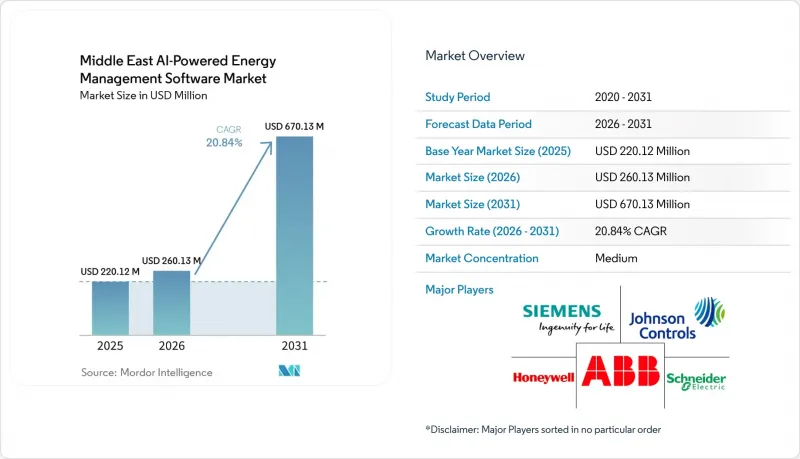
Mordor Intelligence에 의하면, 중동의 AI 기반 에너지 관리 소프트웨어 시장 규모는 2025년 2억 2,012만 달러로 평가되었고, 2026년 2억 6,013만 달러에서 2031년까지 6억 7,013만 달러로 확대될 것으로 예측되며, 2026-2031년 연평균 복합 성장률(CAGR)은 20.84%를 나타낼 전망입니다.
본 보고서는 컴포넌트별(소프트웨어 및 서비스), 도입 형태별(클라우드 기반, 온프레미스형, 하이브리드형), 용도별(에너지 소비 및 수요 최적화, 자산 성능 및 예측 유지보수 등), 최종 사용자별(상업용 건물, 산업 시설 등), 그리고 지역별로 분류되어 있습니다. 시장 전망은 금액(달러)으로 표시되어 있습니다.
중동의 AI 기반 에너지 관리 소프트웨어 시장 동향 및 인사이트
걸프협력회의(GCC) 회원국에서의 스마트 그리드 및 유틸리티 디지털화 가속화
중동의 AI 기반 에너지 관리 소프트웨어 시장은 유틸리티 사업자의 디지털화 프로그램으로부터 직접적인 지원을 받고 있습니다. 이는 송전망 운영자가 단순히 운영 데이터를 수집하는 데 그치지 않고, 고주파수 운영 데이터를 해석할 수 있는 소프트웨어를 필요로 하기 때문입니다. 사우디아라비아와 아랍에미리트(UAE)는 예측 분석, 자동화 및 디지털 운영 도구를 시험 단계의 실험이 아닌, 유틸리티의 핵심 프로세스에 더욱 밀접하게 통합하는 송전망 현대화 노력을 추진하고 있습니다. 아부다비 에너지청은 2025년 10월 Google Cloud와 협약을 체결하고, AI 및 머신러닝을 전력망 관리, 수요 예측, 예측 유지보수에 적용하기로 했습니다. 이는 전력망의 디지털화가 소프트웨어 조달과 어떻게 연결되어 있는지를 보여줍니다. 이러한 변화에 따라 AI의 역할은 백오피스 보고서 작성에서 발전소, 재생에너지 자산, 배전 시스템에 걸친 실시간 운영 지원으로 확대되고 있습니다. 전력 회사가 더 대규모의 디지털 제어 환경을 구축함에 따라, 예측, 유지보수, 에너지 최적화를 단일 운영 계층으로 통합할 수 있는 공급업체는 중동의 AI 기반 에너지 관리 소프트웨어 시장에서 우위를 점할 가능성이 높습니다. 또한 GCC 국가 전반에서 조달 범위가 확대되고 있습니다. 이는 소프트웨어에 대한 요구 사항이 시스템 가시성, 운영 복원력, 재생에너지 균형 조정 필요성에서 동시에 비롯되고 있기 때문입니다.
상업용 건물에서 AI를 활용한 부하 예측에 대한 수요 증가
중동의 AI 기반 에너지 관리 소프트웨어 시장에서는 사무실, 소매 시설, 호텔 및 레저 시설, 복합 용도 건물에서의 에너지 사용이 냉방 부하, 규정 준수 목표, 그리고 에너지 비용 관리와 점점 더 밀접하게 연관되어 있어 상업용 건물에서 수요가 증가하고 있습니다. 건물 소유주들은 더 이상 모니터링 대시보드만을 원하는 것이 아니라, 건물 시스템 전체를 교체하지 않고도 피크 수요 관리, 소비량 일정 설정 및 운영 제어 개선에 도움이 되는 예측 도구를 점점 더 많이 요구하고 있습니다. 2026년 이후, UAE가 에너지 가시화 및 배출량에 대한 책임성 강화를 추진하고 있는 만큼, 시설 수준의 성능 데이터를 활용 가능한 의사 결정으로 정리할 수 있는 디지털 에너지 플랫폼의 비즈니스적 이점이 커지고 있습니다. 슈나이더 일렉트릭은 2026년 5월, UAE 내 ‘Brands For Less’ 26개 매장에 ‘EcoStruxure Building’ 플랫폼을 도입하며, 소프트웨어 주도형 건물 최적화가 플래그십 건물에서 다중 지점 상업용 포트폴리오로 확대되고 있음을 보여주었습니다. 이는 중동의 AI 기반 에너지 관리 소프트웨어 시장에 중요한 의미를 지닙니다. 중견 부동산 운영 사업자의 경우 대규모 맞춤형 프로젝트에 비해 더 빠른 투자 회수와 업무에 미치는 영향을 최소화해야 하기 때문입니다. 그 결과, 모듈식 예측 기능, 원격 최적화, 그리고 기존 빌딩 시스템과의 손쉬운 통합을 제공하는 벤더들이 이 지역에서 더 광범위한 고객 기반을 확보해 가고 있습니다.
데이터 주권에 대한 우려가 클라우드 전환을 지연시키고 있습니다.
중동의 AI 기반 에너지 관리 소프트웨어 시장은 데이터 주권 문제로 인해 실질적인 제약에 직면해 있습니다. 많은 구매자가 기밀성이 높은 전력망 데이터, 플랜트 원격 측정 데이터, 빌딩 제어 시스템, 인프라 정보를 다루고 있기 때문입니다. 사우디아라비아의 현지화 규제로 인해 국경을 넘는 클라우드 설계 비용이 증가하고 있으며, GCC(걸프협력회의) 지역 전체에서도 국가와 용도에 따라 거주 요건이 달라 상황은 여전히 불균일한 상태입니다. 사우디아라비아의 ‘세계 AI 허브 법’ 초안은 향후 더 유연한 프레임워크가 마련될 가능성을 시사하고 있지만, 현재로서는 벤더가 지역 맞춤형 서비스를 설계할 때 규정 준수상의 불확실성을 감수해야 하는 상황이 지속되고 있습니다. 이로 인해 기업의 도입 속도가 둔화되고 있습니다. 기업들은 법적으로 안전하긴 하지만, 단일 지역 클라우드 환경에 비해 효율이 낮은 하이브리드형이나 국가별 배포를 선택하는 경우가 많기 때문입니다. 기존 대기업보다 소규모 전문 기업들이 더 큰 영향을 받고 있습니다. 이는 주권 요건을 준수하는 인프라 및 인증 계층을 구축하기 위해서는 자본, 현지 거점, 그리고 장기적인 영업 지원이 필요하기 때문입니다. 그 결과, 수요가 붕괴되는 것은 아니지만, 중동의 AI 기반 에너지 관리 소프트웨어 시장에서 완전한 클라우드 네이티브 모델로의 전환 속도는 둔화되고 있습니다.
부문 분석
2025년, 중동의 AI 기반 에너지 관리 소프트웨어 시장에서 소프트웨어가 68.22%의 점유율을 차지했습니다. 이는 구매자들이 여전히 분석, 예측, 최적화 및 제어 워크플로우를 통합할 수 있는 플랫폼을 가장 중요하게 여긴다는 사실을 뒷받침합니다. 소프트웨어가 주도적인 역할을 하고 있다는 점은 단일 사이트로의 도입에 국한되지 않고 대규모 유틸리티, 상업 포트폴리오 및 산업 네트워크를 지원할 수 있는 확장 가능한 플랫폼을 해당 지역이 선호하고 있음을 반영합니다. 중동의 AI 기반 에너지 관리 소프트웨어 업계에서 플랫폼의 광범위성이 중요시되는 이유는 고객들이 수요 관리, 유지보수 계획, 재생 에너지 균형 조정 및 보고 요건을 동시에 지원할 수 있는 단일 운영 계층을 점점 더 요구하고 있기 때문입니다. 이러한 점에서 소프트웨어 수요가 여전히 가장 강한 분야는 조달 결정이 제한적인 용도 도구가 아닌 엔터프라이즈 라이선스, 통합 대시보드, 장기적인 디지털 전환 프로그램과 연계되어 있는 분야라는 점을 설명할 수 있습니다. 또한 이는 구매자가 공급업체를 평가할 때 제품의 깊이, 통합 용이성, 규정 준수 여부가 핵심 분석 성능만큼이나 중요해지고 있음을 의미합니다.
서비스 분야는 2031년까지 연평균 성장률(CAGR) 20.91%로 확대될 것으로 예측되며, 이는 많은 도입 사례에서 통합, 모델 조정, 변경 관리 및 지속적인 최적화를 위해 여전히 외부 지원이 필요함을 보여줍니다. 이러한 성장 패턴은 중동의 AI 기반 에너지 관리 소프트웨어 시장이 소프트웨어 도입의 초기 단계를 넘어 재조정, 거점 확대, 운영 지원과 같은 보다 장기적인 주기로 전환되고 있음을 시사합니다. 동료 심사를 거친 연구를 통해 건물 부하 예측 모델 개발을 자동화하는 다중 에이전트 프레임워크의 유효성이 입증되었습니다. 이는 향후 몇 년 동안 공급업체가 소프트웨어 구독에 통합할 수 있는 서비스 집약형 이용 사례의 한 예를 시사합니다. 유사한 경향은 기업용 계약에서도 나타나고 있으며, 구매자들은 사내 팀이 데이터 수집에서 측정 가능한 운영 개선으로 전환할 수 있도록 지원하는 전문적인 지원을 점점 더 중요하게 여기고 있습니다. C3.AI가 2026년 6월 쉘(Shell)과의 계약을 확대하여 1만 3,000대 이상의 장비를 대상으로 하는 AI 에이전트 기반의 근본 원인 분석을 포함시킨 것은 플랫폼이 이미 도입된 후 장기적인 서비스 계약이 얼마나 심화될 수 있는지를 보여줍니다.
2025년 중동의 AI 기반 에너지 관리 소프트웨어 시장에서 클라우드 기반 도입이 58.14%를 차지했으며, 규제가 허용하는 한 구매자들은 여전히 확장성, 빠른 업데이트, 낮은 초기 인프라 비용을 중시하고 있음을 보여줍니다. 클라우드 도입은 조직이 여러 자산을 관리하고 광범위한 운영 거점 전반에 걸친 통합적인 가시성이 필요한 상황에서 가장 두드러집니다. 중동의 AI 기반 에너지 관리 소프트웨어 업계에서 이 모델이 매력적인 이유는 건물, 송전망, 산업 시설 및 에너지 집약적 서비스 환경에 걸친 성과 추적의 표준화에 도움이 되기 때문입니다. 또한, 기존의 온프레미스 환경에서는 일반적으로 지원되지 않는 구독 모델, 원격 관리 기능, 그리고 보다 신속한 플랫폼 업그레이드를 추구하는 기업의 조달 경향과도 부합합니다. 한편, 2025년에 클라우드 주도 상황이 된다고 해도 규제가 더 이상 장벽이 아니라는 의미는 아닙니다. 왜냐하면 도입 선택지는 여전히 운영 데이터의 저장 위치와 해당 데이터가 어느 정도 기밀로 간주되는지에 크게 좌우되기 때문입니다.
하이브리드 배포는 2031년까지 연평균 성장률(CAGR) 21.02%로 확대될 것으로 예측되며, 이는 해당 지역이 클라우드의 효율성과 주권 요건 사이의 중간 경로를 모색하고 있음을 여실히 보여줍니다. 하이브리드 설계의 매력은 기밀성이 높은 텔레메트리 데이터를 자산 근처에 보관하면서도, 더 광범위한 전사적 차원의 분석, 최적화, 포트폴리오 보고를 가능하게 한다는 점에 있습니다. 2026년 2월에 실시된 UAE 에너지·인프라부, Khazna Data Centers, Agility가 참여한 Phaidra AI의 파일럿 프로젝트에서는 순수한 해외 클라우드 환경이 아닌, 규정 준수를 충족하는 현지 운영 체제 내에서 어떻게 에너지 최적화를 추진할 수 있는지가 입증되었습니다. 구매자가 불필요한 규제 위험을 감수하지 않으면서도 유연성을 추구하는 경향이 강해지는 가운데, 이 아키텍처는 중동의 AI 기반 에너지 관리 소프트웨어 시장에서 전략적으로 점점 더 중요해지고 있습니다. 따라서 핵심 제품에 하이브리드 기능을 통합한 벤더는 현재 클라우드 우선 제품에 제한적인 온프레미스 기능을 사후에 추가하려는 벤더보다 유리한 입장에 있습니다.
기타 혜택 :
- 엑셀 형식 시장 예측(ME) 시트
- 3개월간의 애널리스트 지원
자주 묻는 질문
목차
제1장 서론
제2장 조사 방법
제3장 주요 요약
제4장 시장 구도
제5장 시장 규모 및 성장 예측
제6장 경쟁 구도
제7장 시장 기회 및 향후 전망
AJY 26.08.07According to Mordor Intelligence, the Middle East AI-powered energy management software market size is projected to expand from USD 220.12 million in 2025 and USD 260.13 million in 2026 to USD 670.13 million by 2031, registering a CAGR of 20.84% between 2026 and 2031.
This report is Segmented by Component (Software, and Services), Deployment Mode (Cloud-Based, On-Premises, and Hybrid), Application (Energy Consumption and Demand Optimization, Asset Performance and Predictive Maintenance, and More), End User (Commercial Buildings, Industrial Facilities, and More), and Geography. The Market Forecasts are Provided in Terms of Value (USD).
Middle East AI-powered Energy Management Software Market Trends and Insights
Accelerated Smart Grid and Utility Digitization in Gulf Cooperation Council States
The Middle East AI-powered Energy Management Software Market is gaining direct support from utility digitization programs because grid operators now need software that can interpret high-frequency operational data rather than simply collect it. Saudi Arabia and the UAE are moving ahead with grid modernization agendas that place predictive analytics, automation, and digital operating tools closer to core utility processes rather than in pilot-stage experimentation. Abu Dhabi's Department of Energy signed an agreement with Google Cloud in October 2025 to apply AI and machine learning to grid management, demand forecasting, and predictive maintenance, which shows how grid digitization is translating into software procurement. The same shift is expanding AI's role from back-office reporting to real-time operational support across power plants, renewable assets, and distribution systems. As utilities build larger digital control environments, vendors that can integrate forecasting, maintenance, and energy optimization into a single operating layer are likely to gain an advantage in the Middle East AI-powered Energy Management Software Market. Procurement is also becoming broader across the GCC because software requirements now come from system visibility, operating resilience, and renewable balancing needs simultaneously.
Rising Demand for AI-Driven Load Forecasting in Commercial Buildings
The Middle East AI-powered Energy Management Software Market is seeing stronger demand from commercial buildings because energy use in offices, retail sites, hospitality assets, and mixed-use properties is increasingly tied to cooling loads, compliance targets, and utility cost management. Building owners are no longer looking only for monitoring dashboards, and they increasingly want forecasting tools that can help manage peak demand, schedule consumption, and improve operational control without replacing entire building systems. The UAE's push toward broader energy visibility and emissions accountability from 2026 is strengthening the commercial case for digital energy platforms that can organize site-level performance data into usable decisions. Schneider Electric expanded its EcoStruxure Building platform across 26 Brands For Less stores in the UAE in May 2026, demonstrating that software-led building optimization is moving beyond flagship properties into multi-site commercial portfolios. This matters for the Middle East AI-powered Energy Management Software Market because mid-market property operators usually need faster payback and less disruption than large custom projects can offer. As a result, vendors that provide modular forecasting, remote optimization, and easier integration with existing building systems are gaining a wider addressable base in the region.
Data Sovereignty Concerns Slowing Cloud Migration
The Middle East AI-powered Energy Management Software Market faces a real constraint due to data sovereignty, as many buyers handle sensitive grid data, plant telemetry, building controls, and infrastructure information. Saudi Arabia's localization rules have increased the cost of cross-border cloud design, and the broader GCC environment remains uneven because residency expectations differ by country and by application. The draft Global AI Hub Law in Saudi Arabia suggests that more flexible structures may emerge over time, but the current period still leaves vendors navigating compliance uncertainty when they architect regional offerings. This slows adoption because enterprises often choose hybrid or country-specific deployments that are legally safer but less efficient than a single regional cloud environment. Smaller specialists are affected more than incumbents because building sovereign-compliant infrastructure and certification layers requires capital, local presence, and longer sales support. The result is not a collapse in demand, but a slower transition path for fully cloud-native models in the Middle East AI-powered Energy Management Software Market.
Other drivers and restraints analyzed in the detailed report include:
- Mandatory Energy Efficiency Targets Under National Decarbonization Programs
- Expansion of Cloud-Native Enterprise Energy Platforms
- Integration Complexity With Legacy Building and Industrial Control Systems
For complete list of drivers and restraints, kindly check the Table Of Contents.
Segment Analysis
Software held 68.22% of the Middle East AI-powered Energy Management Software Market share in 2025, which confirms that buyers still place the greatest value on platforms that can centralize analytics, forecasting, optimization, and control workflows. The leading role of software also reflects the region's preference for scalable platforms that can serve large utilities, commercial portfolios, and industrial networks without being confined to a single site deployment. In the Middle East AI-powered energy management software industry, platform breadth matters because customers increasingly want one operating layer that can support demand management, maintenance planning, renewable balancing, and reporting requirements at the same time. This explains why software demand remains strongest where procurement decisions are tied to enterprise licenses, integrated dashboards, and long-term digital transformation programs rather than narrow application tools. It also means that product depth, ease of integration, and compliance fit are becoming as important as core analytics performance when buyers evaluate suppliers.
Services is projected to expand at a 20.91% CAGR through 2031, which shows that many deployments still need outside support for integration, model tuning, change management, and ongoing optimization. This growth pattern suggests the Middle East AI-powered Energy Management Software Market is moving beyond first-stage software rollout and toward a longer cycle of recalibration, site expansion, and operational support. A peer-reviewed study validated a multi-agent framework for automating building load forecasting model development, which points to the kind of service-intensive use cases vendors can package around software subscriptions in coming years. The same logic is visible in enterprise contracts, where buyers increasingly value expert support that helps internal teams move from data collection to measurable operational improvement. C3.AI's June 2026 expansion of its agreement with Shell, including AI agent-based root cause analysis across more than 13,000 pieces of equipment, illustrates how long-term service engagement can deepen once the platform is already embedded.
Cloud-based deployment accounted for 58.14% of the Middle East AI-powered Energy Management Software Market in 2025, indicating that buyers still favor scalability, update speed, and lower upfront infrastructure costs where regulation allows. Cloud adoption has been strongest where organizations manage multiple assets and need centralized visibility across large operating footprints. In the Middle East AI-powered energy management software industry, this model is attractive because it helps standardize performance tracking across buildings, grids, industrial sites, and energy-intensive service environments. It also aligns with procurement preferences among enterprises that want subscription models, remote management capability, and quicker platform upgrades than older on-premises environments can usually support. At the same time, cloud leadership in 2025 does not mean regulation is no longer a barrier, because deployment choices still depend heavily on where operational data sits and how sensitive that data is deemed to be.
Hybrid deployment is projected to expand at a 21.02% CAGR through 2031, underscoring how the region is settling on a middle path between cloud efficiency and sovereignty requirements. The appeal of hybrid design lies in its ability to keep sensitive telemetry close to the asset while still enabling broader analytics, optimization, and portfolio reporting across a wider enterprise. The February 2026 Phaidra AI pilot involving the UAE Ministry of Energy and Infrastructure, Khazna Data Centers, and Agility showed how energy optimization can be advanced within a compliant local operating structure rather than through a purely offshore cloud setup. This architecture is becoming increasingly strategically important in the Middle East AI-powered Energy Management Software Market, as buyers increasingly seek flexibility without incurring unnecessary regulatory exposure. Vendors that built hybrid capability into the core product are therefore better placed than those now trying to retrofit limited on-premises features onto a cloud-first offering.
Complete Report Scope:
- By Component
- Software
- Services
- By Deployment Mode
- Cloud-Based
- On-Premises
- Hybrid
- By Application
- Energy Consumption and Demand Optimization
- Asset Performance and Predictive Maintenance
- Smart Grid and Distributed Energy Resource (DER) Management
- Renewable Energy Forecasting and Integration
- Energy Trading, Pricing and Market Intelligence
- By End User
- Utilities
- Commercial Buildings
- Industrial Facilities
- Residential Buildings
- By Geography
- Saudi Arabia
- United Arab Emirates
- Qatar
- Rest of Middle East
List of Companies Covered in this Report:
- Schneider Electric SE
- Siemens Aktiengesellschaft
- Honeywell International Inc.
- ABB Ltd
- Johnson Controls International plc
- IBM Corporation
- Cisco Systems, Inc.
- Oracle Corporation
- SAP SE
- Eaton Corporation plc
- Rockwell Automation, Inc.
- Emerson Electric Co.
- Enel X S.r.l.
- GridPoint, Inc.
- Bidgely, Inc.
- C3.AI, Inc.
- Verdigris Technologies, Inc.
- eSight Energy Ltd.
- Spacewell International N.V.
- BrainBox AI Inc.
Additional Benefits:
- The market estimate (ME) sheet in Excel format
- 3 months of analyst support
TABLE OF CONTENTS
1 INTRODUCTION
- 1.1 Study Assumptions and Market Definition
- 1.2 Scope of the Study
2 RESEARCH METHODOLOGY
3 EXECUTIVE SUMMARY
4 MARKET LANDSCAPE
- 4.1 Market Overview
- 4.2 Market Drivers
- 4.2.1 Accelerated Smart Grid and Utility Digitization in Gulf Cooperation Council States
- 4.2.2 Rising Demand For AI-Driven Load Forecasting in Commercial Buildings
- 4.2.3 Mandatory Energy Efficiency Targets Under National Decarbonization Programs
- 4.2.4 Expansion of Cloud-Native Enterprise Energy Platforms
- 4.2.5 Increasing Need For Predictive Maintenance Across Energy-Intensive Assets
- 4.2.6 Greater Deployment of Submetering and IoT Sensor Networks in Large Facilities
- 4.3 Market Restraints
- 4.3.1 Data Sovereignty Concerns Slowing Cloud Migration
- 4.3.2 Integration Complexity With Legacy Building and Industrial Control Systems
- 4.3.3 Limited AI Skills and Implementation Capacity Among End Users
- 4.3.4 Fragmented Utility Tariff and Regulatory Structures Across The Region
- 4.4 Impact of Macroeconomic Factors On The Market
- 4.5 Industry Value-Chain Analysis
- 4.6 Regulatory Landscape
- 4.7 Technological Outlook
- 4.8 Porter's Five Forces Analysis
- 4.8.1 Bargaining Power of Buyers
- 4.8.2 Bargaining Power of Suppliers
- 4.8.3 Threat of New Entrants
- 4.8.4 Threat of Substitutes
- 4.8.5 Intensity of Competitive Rivalry
5 MARKET SIZE AND GROWTH FORECASTS (VALUE)
- 5.1 By Component
- 5.1.1 Software
- 5.1.2 Services
- 5.2 By Deployment Mode
- 5.2.1 Cloud-Based
- 5.2.2 On-Premises
- 5.2.3 Hybrid
- 5.3 By Application
- 5.3.1 Energy Consumption and Demand Optimization
- 5.3.2 Asset Performance and Predictive Maintenance
- 5.3.3 Smart Grid and Distributed Energy Resource (DER) Management
- 5.3.4 Renewable Energy Forecasting and Integration
- 5.3.5 Energy Trading, Pricing and Market Intelligence
- 5.4 By End User
- 5.4.1 Utilities
- 5.4.2 Commercial Buildings
- 5.4.3 Industrial Facilities
- 5.4.4 Residential Buildings
- 5.5 By Geography
- 5.5.1 Saudi Arabia
- 5.5.2 United Arab Emirates
- 5.5.3 Qatar
- 5.5.4 Rest of Middle East
6 COMPETITIVE LANDSCAPE
- 6.1 Market Concentration
- 6.2 Strategic Moves
- 6.3 Market Share Analysis
- 6.4 Company Profiles (includes Global Level Overview, Market Level Overview, Core Segments, Financials as available, Strategic Information, Market Rank/Share, Products and Services, Recent Developments)
- 6.4.1 Schneider Electric SE
- 6.4.2 Siemens Aktiengesellschaft
- 6.4.3 Honeywell International Inc.
- 6.4.4 ABB Ltd
- 6.4.5 Johnson Controls International plc
- 6.4.6 IBM Corporation
- 6.4.7 Cisco Systems, Inc.
- 6.4.8 Oracle Corporation
- 6.4.9 SAP SE
- 6.4.10 Eaton Corporation plc
- 6.4.11 Rockwell Automation, Inc.
- 6.4.12 Emerson Electric Co.
- 6.4.13 Enel X S.r.l.
- 6.4.14 GridPoint, Inc.
- 6.4.15 Bidgely, Inc.
- 6.4.16 C3.ai, Inc.
- 6.4.17 Verdigris Technologies, Inc.
- 6.4.18 eSight Energy Ltd.
- 6.4.19 Spacewell International N.V.
- 6.4.20 BrainBox AI Inc.
7 MARKET OPPORTUNITIES AND FUTURE OUTLOOK
- 7.1 White-Space and Unmet-Need Assessment


