

|
시장보고서
상품코드
2099418
AI 추론용 HBM : 시장 점유율 분석, 업계 동향 및 통계, 성장 예측(2026-2031년)HBM For AI Inference - Market Share Analysis, Industry Trends & Statistics, Growth Forecasts (2026 - 2031) |
||||||
 Mordor Intelligence
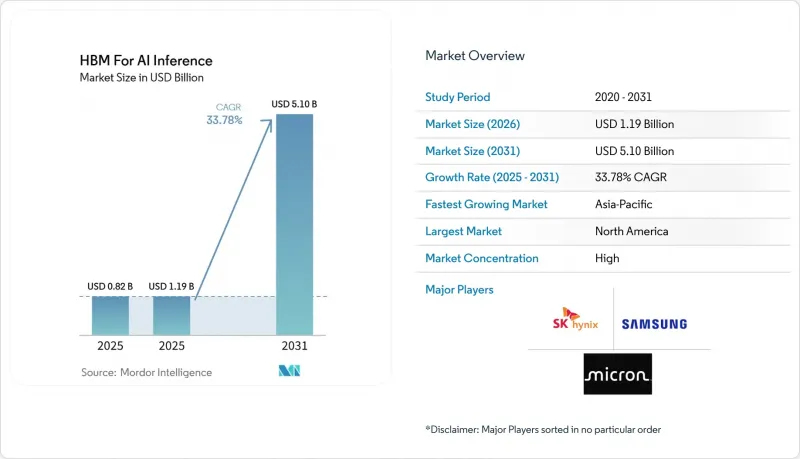
Mordor Intelligence에 의하면, AI 추론용 HBM 시장은 2025년에 8억 2,000만 달러 규모로 평가되었습니다. 2031년까지 51억 달러에 이를 것으로 예측되며, 2026년부터 2031년에 걸쳐 CAGR 33.78%로 성장할 전망입니다.
본 보고서는 HBM 세대(HBM2E, HBM3E, HBM4 등), 컴퓨팅 플랫폼(GPU, CPU, NPU, FPGA), 배포 방식(클라우드, On-Premise), 최종 사용자(클라우드 서비스 제공업체, 기업, 정부 등), 패키지 통합(2.5D, 3D, 팬아웃), 지역(북미, 유럽, 아시아태평양, 기타)별로 분류되어 있습니다. 시장 전망은 금액(달러) 기준으로 제시되어 있습니다.
세계의 AI 추론용 HBM 시장 동향 및 인사이트
생성형 AI의 워크로드 밀도 증가로 인해, 가속기 1대당 HBM 탑재량이 증가
새로운 가속기 주기가 반복될 때마다 메모리 용량과 대역폭이 향상되어, 제품 업그레이드가 AI 추론용 HBM 시장의 직접적인 확대로 이어지고 있습니다. NVIDIA에 따르면, Blackwell B200은 192 GB의 HBM3e를 탑재하여 GPU당 8.0 TB/s의 메모리 대역폭을 실현하고 있으며, 이전 세대에 비해 디바이스당 메모리 용량이 대폭 증가했습니다. 또한 NVIDIA는 훨씬 더 대규모의 HBM 대역폭을 기반으로 하는 ‘Vera Rubin’ 플랫폼의 개요도 공개하며, 차기 성능 향상은 연산 밀도와 마찬가지로 메모리 이동을 중심으로 구축되고 있음을 보여주었습니다. 마이크론은 HBM4가 에이전트형 AI 추론에서 처리량과 전력 효율을 모두 향상시키도록 설계되었다고 밝혔으며, 이는 가속기 유닛의 성장세가 고르지 않은 경우에도 HBM 탑재량 증가를 정당화할 근거를 강화합니다. Samsung Electronics는 2026년에 HBM4의 상용 출하를 시작할 예정이며, 이 제품을 ‘더 높은 성능’과 ‘뛰어난 열 특성’을 강점으로 내세워 플랫폼이 변경될 때마다 메모리 스택의 가치가 높아지고 있음을 입증했습니다. 이 추세가 중요한 이유는 가속기의 출하 대수가 같은 속도로 증가하지 않더라도 AI 추론용 HBM 시장은 계속 확대될 수 있기 때문입니다. 이는 인증된 각 패키지에서 더 많은 수익이 확보되고 있기 때문입니다.
장문 컨텍스트 모델을 활용한 메모리 바운드 추론
AI 추론용 HBM 시장은 장문 컨텍스트 추론이 이전 모델 배포에 비해 훨씬 더 적극적으로 메모리를 읽어들인다는 단순한 사실만으로도 뒷받침되고 있습니다. 마이크론은 에이전트형 AI 추론이 메모리 트래픽에 극도로 민감하다고 설명하며, 메모리 액세스가 병목 현상이 되면 병렬 처리 및 KV 캐시에 가해지는 부하로 인해 응답 시간이 크게 늘어날 수 있음을 보여주었습니다. 컨텍스트 윈도우가 확대됨에 따라 메모리 요구 사항은 모델 크기뿐만 아니라 활성 시퀀싱 처리에 따라 확장되므로, 구매자들은 계속해서 더 높은 대역폭을 가진 메모리 계층으로 밀려나고 있습니다. 마이크론의 HBM4 사양은 스택당 2.8 TB/s 이상, HBM3e보다 20% 이상 우수한 전력 효율을 목표로 하고 있으며, 이는 대규모 배포에서 토큰당 비용 절감을 직접적으로 뒷받침합니다. 실용적인 도입 관점에서 볼 때, 메모리 대역폭은 현재 추론의 서비스 품질, 클러스터 활용도 및 에너지 소비량에 동시에 영향을 미치고 있습니다. 따라서 AI 추론용 HBM 시장은 단순한 가속기 발표뿐만 아니라 모델 아키텍처 및 서빙 동작과 점점 더 밀접하게 연결되어 있습니다.
패키지 수준에서의 엄격한 열 설계 및 수율 제약
열 관리와 스택 수율은 AI 추론용 HBM 시장이 수요를 출하 수익으로 전환할 수 있는 속도 측면에서 여전히 시급한 제약 요인으로 남아 있습니다. 지멘스는 HBM4의 경우 인터페이스 밀도와 패키지 복잡성이 모두 높아지기 때문에 양산 개시 전에 열 거동이 최우선 설계 과제가 될 것이라고 지적하고 있습니다. 층 수가 증가함에 따라 스택 내의 열이 집중되어 본딩 품질, 패키지 설계 및 시스템 냉각에 대한 부담이 커집니다. 삼성이 2026년 HBM4 출시와 관련해 열 저항 개선을 강조한 것은 공급업체들이 열 및 안정성을 부차적인 최적화 과제가 아닌 핵심적인 상업적 요건으로 다루고 있음을 보여줍니다. 이러한 요인으로 인해 인증 절차가 지연되거나 실용 가능한 생산량이 감소하면, 실제 공급량은 발표된 생산 능력보다 더 완만한 속도로 증가하게 될 것입니다. 이러한 제약은 AI 추론용 HBM 시장 수요를 약화시키지는 않겠지만, 인증된 공급이 대규모 추론 프로그램에 얼마나 빠르게 도달할 수 있는지를 제한하는 요인이 될 것입니다.
부문 분석
2025년에는 HBM3가 58.31%의 점유율을 차지했으나, HBM4는 2031년까지 연평균 성장률(CAGR) 34.58%로 확대될 것으로 예측됩니다. 이러한 구성 비율은 시장이 여전히 현재의 도입량에 힘입고 있는 한편, 이미 추론 성능의 새로운 표준으로 전환되고 있음을 보여줍니다. HBM3가 여전히 지배적인 위치를 유지한 것은 2025년 도입된 가속기 수요의 대부분을 Hopper, H200 및 초기 Blackwell 시스템이 차지했기 때문입니다. HBM3e는 과도기 세대로서의 역할을 수행하여, 공급업체와 고객이 HBM4의 대규모 완전 인증을 기다리지 않고도 대역폭을 향상시킬 수 있게 했습니다. HBM2E는 주로 여전히 능동 추론 워크로드를 지원하는 구형 가속기 장비와 관련하여, 소규모의 레거시 역할에 그쳤습니다.
다음 단계는 사양 자체보다는 상용화 준비 상황에 따라 형성되고 있습니다. 삼성은 자사의 HBM4 제품이 핀당 11.7 Gbps, 스택당 3.3 TB/s를 달성했으며, 전력 효율과 내열성도 향상되었다고 발표했습니다. 마이크론은 HBM4를 스택당 2.8 TB/s 이상, HBM3e보다 20% 이상 뛰어난 전력 효율을 갖춘 것으로 평가하며, 이번 세대 교체가 추론의 경제성에 초점을 맞춘 것이라고 밝혔습니다. 각 공급업체들이 HBM4E 샘플 제공 및 인증 작업에 착수함에 따라, AI 추론용 HBM 시장에서는 기존 가속기 주기에 비해 메모리 세대 간 교체가 가속화될 전망입니다. 이러한 가속화에 따라 생산 규모를 확대하고 신속하게 성능을 검증할 수 있는 공급업체가 우위를 점할 것입니다. 이는 고객들이 메모리 선정 시 단순한 하위 호환성뿐만 아니라 토큰 처리량, 전력 소비, 패키지 밀도를 중시하는 경향이 강해지고 있기 때문입니다.
2025년 수요 중 GPU가 82.74%를 차지한 반면, NPU는 2031년까지 연평균 성장률(CAGR) 34.73%로 확대될 것으로 예측됩니다. 이러한 출발점은 최첨단 추론 워크로드가 GPU를 풍부하게 갖춘 클라우드 클러스터에 집중되어 있다는 현실을 여전히 반영하고 있습니다. 또한, GPU의 우위는 대규모 모델 서빙에서 성숙한 가속기 스택을 계속 선호하는 기존 소프트웨어 생태계도 반영하고 있습니다. CPU나 FPGA 플랫폼은 지연 시간에 민감한 좁은 범위의 작업이나 배치 크기가 작은 작업에서는 여전히 중요하지만, 현재 수요의 중심을 이루지는 않습니다. 주요 변화는 범용 가속기의 도입보다는 전용 추론 하드웨어의 성장 속도가 현재 더 빨라지고 있다는 점입니다.
이러한 변화는 AI 추론용 HBM 시장의 설계 선택과 조달 모델 양쪽에서 확인할 수 있습니다. AWS는 HBM3e를 핵심으로 한 Trainium3를 개발하여, 광범위한 훈련 성능의 동등성이 아닌 생성형 AI 추론용으로 포지셔닝했습니다. 이는 메모리 동작이 맞춤형 실리콘 설계를 어떻게 이끌고 있는지를 보여줍니다. 구글은 192GB HBM을 탑재한 TPU Ironwood를 공개하며, 전용으로 설계된 추론 플랫폼이 여전히 고도의 메모리 통합으로 수렴하고 있음을 강조했습니다. NVIDIA의 로드맵 또한 추론 지향적인 기능으로 전환되고 있으며, 이로 인해 GPU 중심 설계 우선순위와 NPU와 같은 설계 우선순위 간의 실질적인 격차가 좁혀지고 있습니다. 이러한 상황에서 AI 추론용 HBM 업계는 단일한 지배적인 연산 패턴에서 더 폭넓은 가속기 조합으로 전환되고 있습니다. 다만, 예측 기간 동안 GPU가 여전히 가장 큰 플랫폼으로 남을 가능성이 높다는 점은 변함없습니다.
지역별 분석
2025년, 북미는 전 세계 시장의 49.93%를 차지하며 AI 추론용 HBM 시장에서 가장 규모가 큰 지역 수요 거점으로 자리매김했습니다. 이 지역은 하이퍼스케일러의 집적, 사내 실리콘 프로그램, 그리고 상용 모델 서빙 인프라의 혜택을 받고 있습니다. 마이크로소프트는 미국 내 데이터센터 거점에 추론용 ‘Maia 200’을 도입했는데, 이는 사업자가 소유한 가속기 스택이 지역 수요를 어떻게 강화하고 있는지를 보여줍니다. 또한 북미는 최첨단 AI 서비스의 상용화에서 주요 거점으로 자리매김하고 있으며, 이는 고급 메모리에 대한 높은 견인력을 유지하고 있습니다. 이러한 강력한 수요에도 불구하고, 이 지역은 인증된 HBM 생산 및 첨단 패키징 분야에서 여전히 아시아공급망에 크게 의존하고 있습니다.
아시아태평양은 2031년까지 연평균 성장률(CAGR) 34.64%를 나타낼 것으로 예측되며, AI 추론용 HBM 시장의 주요 생산 거점으로 자리 잡고 있습니다. 삼성과 SK하이닉스가 최고 성능 등급의 핵심 공급업체인 만큼, 한국은 여전히 중심적인 위치를 차지하고 있습니다. 2026년으로 예정된 삼성의 HBM4 상용화는 로드맵부터 양산 출하에 이르기까지, 차세대 메모리 발전에서 이 지역이 수행하는 역할을 입증하는 것입니다. 또한 일본도 마이크론의 히로시마 확장 계획을 통해 그 위상을 강화하고 있으며, 이는 첨단 HBM 제조 거점을 확대하는 것입니다. 대만은 메모리 웨이퍼가 다른 지역에서 생산되는 경우에도 첨단 패키징 및 시스템 통합을 통해 여전히 필수적인 존재로 남아 있습니다. 일본, 인도, 한국, 대만에서 AI 인프라에 대한 투자가 증가함에 따라 아시아태평양은 AI 추론용 HBM 시장공급 측면과 수요 측면 모두를 강화하고 있습니다.
유럽, 남미, 중동 및 아프리카의 합산 점유율은 작지만, 그 역할은 점차 커지고 있습니다. 유럽에서는 데이터 주권의 우선순위와 공공 부문의 AI 프로그램이 관리된 추론 능력에 대한 현지 관심을 뒷받침하고 있습니다. 남미는 여전히 규모가 제한적이지만, 클라우드의 보급과 선별적인 데이터센터 투자를 통해 미래의 HBM 수요를 위한 보다 안정적인 기반이 구축되고 있습니다. 중동 및 아프리카는 인프라 구축 주기의 초기 단계에 있지만, 각국의 AI 프로그램과 초기 단계의 데이터센터 프로젝트가 HBM 탑재 시스템에 대한 수요로 이어지기 시작하고 있습니다. 이 지역 전체에 걸쳐 단기적인 역할은 규모 면에서 북미나 아시아태평양에 필적하는 것이 아니라, AI 추론용 HBM 시장의 지리적 범위를 확대하고 소수의 성숙한 도입 거점에 대한 의존도를 낮추는 데 있습니다.
기타 혜택 :
- 엑셀 형식 시장 예측(ME) 시트
- 3개월간의 애널리스트 지원
자주 묻는 질문
목차
제1장 서론
제2장 조사 방법
제3장 주요 요약
제4장 시장 구도
제5장 시장 규모 및 성장 예측
제6장 경쟁 구도
제7장 시장 기회 및 향후 전망
KTH 26.08.10According to Mordor Intelligence, the HBM for AI inference market was valued at USD 0.82 billion in 2025 and is forecast to reach USD 5.1 billion by 2031, growing at a CAGR of 33.78% during 2026-2031.
This report is Segmented by HBM Generation (HBM2E, HBM3E, and HBM4, and More), Compute Platform (GPU, CPU, NPU, and FPGA), Deployment (Cloud, and On-Premises), End User (Cloud Service Providers, Enterprises, Government, and More), Package Integration (2. 5D, 3D, and Fan-Out), and Geography (North America, Europe, Asia-Pacific, and More). The Market Forecasts are Provided in Terms of Value (USD).
Global HBM For AI Inference Market Trends and Insights
Generative AI Workload Density Raising HBM Per-Accelerator Content
Each new accelerator cycle delivers greater memory capacity and bandwidth, turning product upgrades into direct expansion for the HBM AI inference market. NVIDIA stated that the Blackwell B200 features 192 GB of HBM3e and delivers 8.0 TB/s of memory bandwidth per GPU, which materially increases memory capacity per device versus the prior generation. NVIDIA also outlined the Vera Rubin platform, which is built around a much larger HBM bandwidth envelope, showing that the next performance step is being built around memory movement as much as compute density. Micron said HBM4 is designed to improve both throughput and power efficiency for agentic AI inference, which strengthens the case for higher HBM content even when accelerator unit growth is uneven. Samsung began commercial HBM4 shipments in 2026 and positioned the product around higher performance and better thermal behavior, reinforcing that memory stack value is rising with every platform change. This pattern matters because the HBM for AI inference market can keep expanding even when accelerator shipments do not rise at the same pace, as more revenue is being captured in every qualified package.
Memory-Bound Inference From Long-Context Models
The HBM for AI inference market is also being lifted by the simple fact that long-context inference reads memory far more aggressively than earlier model deployments. Micron described agentic AI inference as highly sensitive to memory traffic and showed that concurrency and KV-cache pressure can sharply extend response time when memory access becomes the bottleneck. As context windows grow, the memory requirement scales with active sequence handling and not only with model size, which keeps pushing buyers toward higher-bandwidth memory tiers. Micron's HBM4 specification targets greater than 2.8 TB/s per stack and more than 20% better power efficiency than HBM3e, which directly supports lower cost per token at scale. In practical deployment terms, memory bandwidth now influences inference quality of service, cluster utilization, and energy use simultaneously. That is why the HBM for AI inference market is increasingly tied to model architecture and serving behavior, rather than just headline accelerator launches.
High Package-Level Thermal and Yield Constraints
Thermal management and stack yield remain immediate limits on how quickly the HBM for AI inference market can convert demand into shipped revenue. Siemens noted that HBM4 increases both interface density and package complexity, making thermal behavior a first-order design issue before production begins. Higher layer counts increase heat concentration within the stack, which raises the burden on bonding quality, package design, and system cooling. Samsung's 2026 HBM4 launch emphasized thermal resistance improvements, which shows that suppliers are treating heat and stability as core commercial requirements rather than secondary optimizations. When those factors slow qualification or reduce usable output, effective supply grows more slowly than announced capacity. This restraint does not weaken demand for the HBM for AI inference market, but it does cap how fast qualified supply can reach large inference programs.
Other drivers and restraints analyzed in the detailed report include:
- Cloud and Hyperscaler AI Cluster Expansion
- Edge Inference Demand for Lower Latency and Higher Energy Efficiency
- Limited Qualified Supply Base for Advanced HBM
For complete list of drivers and restraints, kindly check the Table Of Contents.
Segment Analysis
HBM3 held 58.31% share in 2025, while HBM4 is projected to expand at a 34.58% CAGR through 2031. That split shows a market still anchored in current deployment volume, but already moving toward a new standard for inference performance. HBM3 remained dominant because Hopper, H200, and early Blackwell systems accounted for the largest share of deployed accelerator demand in 2025. HBM3e served as the bridge generation, helping suppliers and customers raise bandwidth without waiting for full HBM4 qualification at scale. HBM2E remained in a smaller legacy role, primarily tied to older accelerator installations that still support active inference workloads.
The next phase is being shaped by commercial readiness rather than by specification alone. Samsung said its HBM4 product delivers 11.7 Gbps per pin and 3.3 TB/s per stack with improved power efficiency and thermal resistance. Micron positioned HBM4 at more than 2.8 TB/s per stack and with more than 20% better power efficiency than HBM3e, keeping the generation shift centered on inference economics. As suppliers move into HBM4E sampling and qualification, the HBM for AI inference market is likely to see faster turnover between memory generations than earlier accelerator cycles. That faster cadence will reward suppliers that can scale output and validate performance quickly, because customers are increasingly aligning memory selection with token throughput, power draw, and package density rather than with backward compatibility alone.
GPU accounted for 82.74% of demand in 2025, while NPU is projected to expand at a 34.73% CAGR through 2031. The starting point still reflects the reality that frontier inference workloads are concentrated in GPU-rich cloud clusters. GPU dominance also reflects the installed software ecosystem, which continues to favor mature accelerator stacks for large model serving. CPU and FPGA platforms remain relevant for narrower latency-sensitive or low-batch tasks, but they do not define the volume center of current demand. The main change is that specialized inference hardware is now growing faster than general-purpose accelerator deployment.
That change is visible in both design choices and procurement models across the HBM for the AI inference market. AWS built Trainium3 around HBM3e and positioned it for generative AI inference rather than for broad training parity, which shows how memory behavior is guiding custom silicon design. Google documented TPU Ironwood with 192 GB of HBM, underscoring that purpose-built inference platforms still converge on advanced memory integration. NVIDIA's roadmap is also moving toward more inference-oriented capabilities, which narrows the practical gap between GPU-centric and NPU-like design priorities. In that context, the HBM for AI inference industry is shifting from a single dominant compute pattern toward a broader accelerator mix, even though GPUs are likely to remain the largest platform through the forecast period.
Complete Report Scope:
- By HBM Generation
- HBM2E
- HBM3
- HBM3E
- HBM4
- By Compute Platform
- GPU
- CPU
- NPU
- FPGA
- Other Compute Platforms
- By Deployment
- Cloud
- On-Premises
- By End User
- Cloud Service Providers
- Enterprises
- Government and Public Sector
- Other End Users
- By Package Integration
- 2.5D Packaging
- 3D Packaging
- Fan-Out Packaging
- By Geography
- North America
- United States
- Canada
- Mexico
- Europe
- Germany
- United Kingdom
- France
- Italy
- Rest of Europe
- Asia-Pacific
- China
- Japan
- South Korea
- Taiwan
- India
- Rest of Asia-Pacific
- South America
- Middle East and Africa
- North America
Geography Analysis
North America held 49.93% of the global total in 2025 and remained the largest regional demand center in the HBM for AI inference market. The region benefits from the concentration of hyperscalers, internal silicon programs, and commercial model-serving infrastructure. Microsoft launched Maia 200 for inference in its U.S. data center footprint, which shows how regional demand is being reinforced by operator-owned accelerator stacks. North America also remains the main center for the commercial deployment of frontier AI services, which sustains high pull-through for advanced memory. Even with that demand strength, the region still depends heavily on Asian supply chains for qualified HBM output and advanced packaging.
Asia-Pacific is projected to grow at a 34.64% CAGR through 2031 and is the main production base for the HBM for AI inference market. South Korea remains central because Samsung and SK Hynix are core suppliers across the top performance tiers. Samsung's HBM4 commercialization in 2026 confirms the region's role in advancing next-generation memory from the roadmap to volume shipments. Japan is also strengthening its position through Micron's Hiroshima expansion plans, which support a broader manufacturing footprint for advanced HBM. Taiwan remains indispensable through advanced packaging and system integration, even when memory wafers are produced elsewhere. As AI infrastructure investment rises across Japan, India, South Korea, and Taiwan, the Asia-Pacific region is strengthening both the supply and demand sides of the HBM for AI inference market.
Europe, South America, and the Middle East and Africa together represent a smaller share, but their role is gradually improving. In Europe, data sovereignty priorities and public-sector AI programs are supporting local interest in controlled-inference capacity. South America is still limited in scale, yet cloud adoption and selective data center investment are creating a steadier base for future HBM demand. The Middle East and Africa are earlier in the buildout cycle, but national AI programs and early data center projects are beginning to translate into demand for HBM-equipped systems. Across these regions, the near-term role is not to rival North America or Asia-Pacific in scale, but to expand the geographic reach of the HBM for AI inference market and reduce its dependence on a small set of mature deployment centers.
- SK hynix Inc.
- Samsung Electronics Co., Ltd.
- Micron Technology, Inc.
Additional Benefits:
- The market estimate (ME) sheet in Excel format
- 3 months of analyst support
TABLE OF CONTENTS
1 INTRODUCTION
- 1.1 Study Assumptions and Market Definition
- 1.2 Scope of the Study
2 RESEARCH METHODOLOGY
3 EXECUTIVE SUMMARY
4 MARKET LANDSCAPE
- 4.1 Market Overview
- 4.2 Market Drivers
- 4.2.1 Generative AI Workload Density Raising HBM Per-Accelerator Content
- 4.2.2 Memory-Bound Inference From Long-Context Models
- 4.2.3 Cloud and Hyperscaler AI Cluster Expansion
- 4.2.4 Edge Inference Demand for Lower Latency and Higher Energy Efficiency
- 4.2.5 Advanced Packaging Progress Enabling Higher Stack Counts
- 4.2.6 Inference-First Custom Silicon Adoption by Hyperscalers
- 4.3 Market Restraints
- 4.3.1 High Package-Level Thermal and Yield Constraints
- 4.3.2 Limited Qualified Supply Base for Advanced HBM
- 4.3.3 Heavy Dependence on Advanced Packaging Capacity
- 4.3.4 Export Controls and Supply Chain Localization Friction
- 4.4 Industry Supply Chain Analysis
- 4.5 Regulatory Landscape
- 4.6 Technological Outlook
- 4.7 Porter's Five Forces Analysis
- 4.7.1 Bargaining Power of Buyers
- 4.7.2 Bargaining Power of Suppliers
- 4.7.3 Threat of New Entrants
- 4.7.4 Threat of Substitutes
- 4.7.5 Intensity of Competitive Rivalry
- 4.8 Impact of Macroeconomic Factors on the Market
5 MARKET SIZE AND GROWTH FORECASTS (VALUE)
- 5.1 By HBM Generation
- 5.1.1 HBM2E
- 5.1.2 HBM3
- 5.1.3 HBM3E
- 5.1.4 HBM4
- 5.2 By Compute Platform
- 5.2.1 GPU
- 5.2.2 CPU
- 5.2.3 NPU
- 5.2.4 FPGA
- 5.2.5 Other Compute Platforms
- 5.3 By Deployment
- 5.3.1 Cloud
- 5.3.2 On-Premises
- 5.4 By End User
- 5.4.1 Cloud Service Providers
- 5.4.2 Enterprises
- 5.4.3 Government and Public Sector
- 5.4.4 Other End Users
- 5.5 By Package Integration
- 5.5.1 2.5D Packaging
- 5.5.2 3D Packaging
- 5.5.3 Fan-Out Packaging
- 5.6 By Geography
- 5.6.1 North America
- 5.6.1.1 United States
- 5.6.1.2 Canada
- 5.6.1.3 Mexico
- 5.6.2 Europe
- 5.6.2.1 Germany
- 5.6.2.2 United Kingdom
- 5.6.2.3 France
- 5.6.2.4 Italy
- 5.6.2.5 Rest of Europe
- 5.6.3 Asia-Pacific
- 5.6.3.1 China
- 5.6.3.2 Japan
- 5.6.3.3 South Korea
- 5.6.3.4 Taiwan
- 5.6.3.5 India
- 5.6.3.6 Rest of Asia-Pacific
- 5.6.4 South America
- 5.6.5 Middle East and Africa
- 5.6.1 North America
6 COMPETITIVE LANDSCAPE
- 6.1 Market Concentration
- 6.2 Strategic Moves
- 6.3 Market Share Analysis
- 6.4 Company Profiles (includes Global Level Overview, Market Level Overview, Core Segments, Financials as available, Strategic Information, Products and Services, Recent Developments)
- 6.4.1 SK hynix Inc.
- 6.4.2 Samsung Electronics Co., Ltd.
- 6.4.3 Micron Technology, Inc.
- 6.5 Other Ecosystem Players
- 6.5.1 NVIDIA Corporation
- 6.5.2 Advanced Micro Devices, Inc.
- 6.5.3 Intel Corporation
- 6.5.4 Qualcomm Incorporated
- 6.5.5 Google LLC
- 6.5.6 Amazon Web Services, Inc.
- 6.5.7 Microsoft Corporation
- 6.5.8 Huawei Technologies Co., Ltd.
- 6.5.9 Broadcom Inc.
- 6.5.10 Taiwan Semiconductor Manufacturing Company Limited
- 6.5.11 Apple Inc.
- 6.5.12 Meta Platforms, Inc.
- 6.5.13 Cerebras Systems, Inc.
- 6.5.14 Groq, Inc.
- 6.5.15 SambaNova Systems, Inc.
- 6.5.16 d-Matrix, Inc.
- 6.5.17 Tenstorrent Inc.
7 MARKET OPPORTUNITIES AND FUTURE OUTLOOK
- 7.1 White-Space and Unmet-Need Assessment


