

|
시장보고서
상품코드
2099139
아시아태평양의 ITSM 시장 : 시장 점유율 분석, 업계 동향 및 통계, 성장 예측(2026-2031년)Asia-Pacific ITSM - Market Share Analysis, Industry Trends & Statistics, Growth Forecasts (2026 - 2031) |
||||||
 Mordor Intelligence
Mordor Intelligence에 의하면, 아시아태평양의 ITSM 시장 규모는 2025년에 32억 달러로 평가되었고, 2026-2031년 CAGR 19.90%로 확대될 것으로 추정되고, 2031년에는 94억 3,000만 달러에 이를 것으로 예측됩니다.
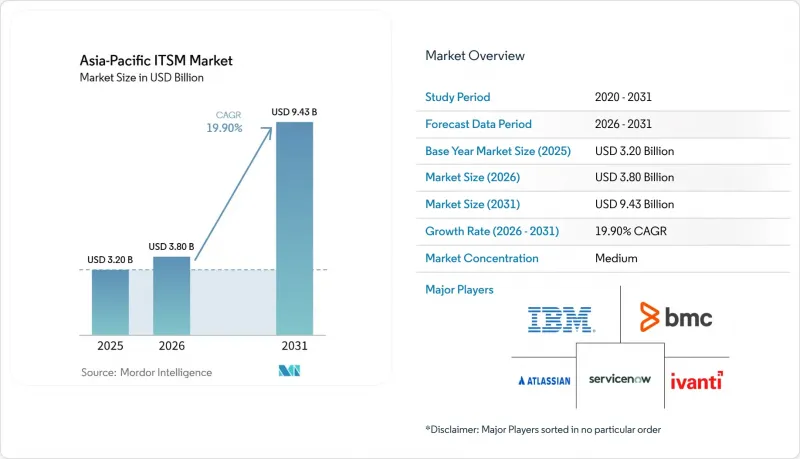
본 보고서는 컴포넌트별(솔루션 및 서비스), 배포 방식별(클라우드, 온프레미스, 하이브리드), 용도별(서비스 데스크 및 인시던트 관리, 자산 및 구성 관리 등), 최종 사용자 산업별(은행, 금융서비스 및 보험(BFSI), 제조업, 정부 기관, IT 및 통신 등), 기업 규모별(대기업, 중소기업), 국가별로 분류되어 있습니다. 시장 전망은 금액(달러) 기준으로 제시되어 있습니다.
아시아태평양의 ITSM 시장 동향 및 인사이트
공공 부문 및 민간 부문의 서비스 운영 급속한 디지털화
공공 부문의 현대화와 기업의 디지털화로 인해, 아시아태평양의 ITSM 시장에는 순전히 선택적인 소프트웨어 도입 주기가 가져오는 것보다 더 안정적인 수요 기반이 형성되고 있습니다. 정부가 서비스를 클라우드 중심 환경으로 전환함에 따라, 각 기관에서는 요청, 인시던트, 승인 및 감사 추적을 위한 공식적인 워크플로가 필요하게 되었으며, 이로 인해 서비스 관리는 단순한 선택적 도구에서 필수적인 운영 인프라로 그 위상이 변화하고 있습니다. 유사한 경향은 규제 산업 및 대기업에서도 관찰됩니다. 이러한 분야에서는 디지털 서비스 제공에 따라 표준화된 변경 관리 및 서비스 연속성 관리에 대한 수요가 증가하고 있습니다. 한국의 공공 부문 환경을 위한 클라우드 이용 및 보안 지침은 정책 프레임워크가 인프라 변경을 거버넌스상의 의무로 전환하고, 수동 프로세스보다 구조화된 플랫폼을 우선시하는 체계를 보여주는 좋은 예입니다. 이는 중요한 점입니다. 정책에 뒷받침된 도입은 순수하게 상업적인 지출보다 확실성이 높기 때문에 조달 주기가 불안정하기 쉬운 일부 지역에서 공급업체의 가시성을 높이는 결과로 이어지기 때문입니다. 인도, 중국, 동남아시아 전역에서 서비스 운영이 디지털화됨에 따라, 아시아태평양의 ITSM 시장은 단순한 소프트웨어 업데이트 결정뿐만 아니라, 규정 준수, 비즈니스 연속성 및 팀 간 협력을 통해 주도되는 수요의 혜택을 받을 가능성이 높습니다.
중견 기업에서의 클라우드 기반 ITSM 도입 확대
클라우드를 통한 제공으로 인해, 과거 많은 중견 기업을 아시아태평양의 ITSM 시장에서 멀어지게 했던 비용, 인프라 부담, 도입 장벽이 완화되고 있습니다. 이전에는 공유 받은 편지함이나 비공식 스프레드시트를 통해 지원 업무를 수행하던 기업들도 대규모 사내 관리 팀을 먼저 구축하지 않고도 구조화된 서비스 워크플로로 전환할 수 있게 되었습니다. Freshworks는 2026년 5월, Freshservice 내에 'AI Agent Studio'를 출시하여 이러한 변화를 뒷받침했습니다. 이는 조직이 장기간에 걸친 도입 주기가 아닌, 몇 주 만에 에이전트형 워크플로우를 구축하고 배포할 수 있도록 지원하는 것을 목표로 합니다. 이러한 단기간 내 도입은 가격에 민감한 고객에게 중요합니다. 이러한 고객들은 컨설팅에 의존하는 장기적인 도입에 할당되는 예산보다 구매자의 관심도가 더 높은 경우가 많기 때문입니다. 중소기업의 운영에 대한 사고방식도 변화하고 있습니다. OTRS의 보고서에 따르면, 아시아태평양 중소기업의 70%가 ITSM의 성공에 있어 AI가 중요하다고 생각하며, 이는 수요가 더 이상 기본적인 티켓 처리에 그치지 않음을 보여줍니다. 그 결과, 아시아태평양의 ITSM 시장은 대기업 대상 도입에 따르는 비용 부담 없이, 더 우수한 관리, 신속한 서비스 해결, 그리고 자동화를 향한 명확한 로드맵을 추구하는 구매자들을 끌어들이고 있습니다.
국가 및 산업별 디지털 성숙도 격차
디지털 성숙도의 편차는 아시아태평양의 ITSM 시장에 여전히 큰 걸림돌이 되고 있습니다. 이는 수요가 국가나 산업, 나아가 동일한 시장 내 도시 간에도 준비 상황에 따라 동일한 속도로 진행되지 않기 때문입니다. 고도의 워크플로우 오케스트레이션이나 AI를 활용한 지식 관리 기능을 도입한 조직이 있는 반면, 수동 티켓 처리나 파편화된 사내 지원 프로세스를 대체하는 데 아직 주력하고 있는 조직도 있습니다. OTRS의 조사에 따르면, 말레이시아 중소기업의 35%는 62%가 ITSM을 전략적 기회로 인식하고 있음에도 불구하고, 여전히 기본적인 티켓 시스템, 스프레드시트 또는 수동 대응 방식에 의존하고 있는 것으로 나타났습니다. 이러한 양극화로 인해 벤더들은 선진적인 구매자나 초기 도입자 중 어느 한쪽도 잃지 않으면서 지역 전체에 걸쳐 패키지, 가격 책정, 서비스 모델을 표준화하기가 어려워지고 있습니다. 또한 플랫폼에 대한 논의를 진행하기 전에 교육, 사내 프로세스 재설계, 워크플로우 정리가 필요한 경우가 많아 판매 주기 또한 장기화되고 있습니다. 이러한 도입 준비의 격차가 지속되는 한, 아시아태평양의 ITSM 시장은 급속히 성장하겠지만, 지역 전체 수요가 시사하는 바와 같은 균일한 성장세를 보이지는 않을 것입니다.
부문 분석
2025년, 솔루션은 아시아태평양 ITSM 시장 점유율의 62.61%를 차지했으며, 이 지역의 도입 현 단계에서는 플랫폼에 대한 지출이 여전히 서비스에 대한 지출을 상회하고 있음을 알 수 있습니다. 티켓 가시성, 워크플로우 관리, 승인, 서비스 카탈로그, 감사 추적은 모두 도입 초기 단계에서 선택된 플랫폼에 의존하기 때문에 구매자들은 계속해서 핵심 시스템을 최우선으로 여기고 있습니다. 이러한 초기 결정은 이후의 통합 옵션, 데이터 구조, 사용자 경험 및 관련 기능의 도입 속도에도 영향을 미칩니다. 아시아태평양의 ITSM 업계에서는 도입 지원이 중요하더라도, 이러한 이유로 소프트웨어가 조달의 중심에 계속 자리 잡고 있습니다. 또한 이는 모듀얼 포트폴리오가 풍부한 벤더가 대규모 거래에서 여전히 우위를 점하고 있는 이유를 설명해 줍니다. 이러한 거래에서 고객은 사고 대응부터 향후 더 광범위한 운영 거버넌스에 이르기까지 대응할 수 있는 플랫폼을 원하기 때문입니다.
아시아태평양의 ITSM 시장에서 서비스는 가장 빠르게 성장하는 부문으로서 중요성이 커지고 있으며, 연평균 성장률(CAGR)은 21.12%에 달할 전망입니다. 이는 클라우드 전환, 워크플로우 재설계, AI 도입, 지식 기반 정리, 지속적인 거버넌스 등을 포함하는 도입 프로젝트가 증가하고 있기 때문입니다. 플랫폼이 운영 모델의 중심이 됨에 따라, 많은 조직은 구성 설정이 업무의 ‘시작’일 뿐 ‘끝’이 아니라는 사실을 깨닫고 있습니다. 따라서 특히 사내 ITSM 운영 역량이 제한적인 국가에서는 도입, 컨설팅 및 매니지드 지원의 중요성이 구조적으로 높아지고 있습니다. 또한, AI를 활용한 서비스 운영에는 기존의 헬프데스크 도입 시보다 더 엄격한 데이터 관리, 명확한 책임 소재, 그리고 지속적인 플랫폼 유지보수가 요구되기 때문에 그 균형도 변화하고 있습니다. 실무적인 관점에서 볼 때, 아시아태평양 ITSM 업계의 소프트웨어 주도 구조는 앞으로도 유지될 전망이지만, 도입이 심화됨에 따라 서비스 계층은 계속 확대될 것입니다. 예측 기간 동안 플랫폼의 가치와 실행 위험 감소를 연계할 수 있는 벤더나 파트너가 이러한 서비스 구성의 변화로부터 가장 큰 혜택을 누릴 것으로 보입니다.
2025년, 클라우드는 아시아태평양 ITSM 시장에서 59.62%의 점유율을 차지한 것으로 평가되었으며, SaaS를 통한 제공이 많은 신규 도입 사례에서 선호되는 방식임이 확인되었습니다. 구매자가 클라우드를 선호하는 이유는 인프라 관리 부담을 줄이고, 업데이트를 신속하게 처리하며, 대규모 초기 아키텍처 작업 없이도 분산된 팀 전체에 걸쳐 서비스 워크플로를 쉽게 배포할 수 있기 때문입니다. 이 모델은 더 신속한 도입과 자동화를 위한 명확한 로드맵을 원하면서도, 레거시 시스템이 다수 존재하는 환경으로 인한 긴 도입 주기를 피하고자 하는 조직의 요구에도 부합합니다. 공공 부문의 규정 준수 프레임워크가 이러한 전환을 뒷받침하고 있으며, 한국 정부의 클라우드 이용 및 보안에 관한 지침은 클라우드의 보다 광범위한 도입을 위한 통제 환경 구축에 기여하고 있습니다. 또한, 클라우드가 주도적인 위치를 차지하고 있는 배경에는 남아시아 및 동남아시아의 많은 신규 도입 기업들이 기존 기업 환경에서 볼 수 있는 레거시 스택으로 인한 부담을 안지 않고, 직접적으로 최신 환경으로 전환할 수 있다는 사실도 반영되어 있습니다.
아시아태평양의 ITSM 시장에서 하이브리드 및 온프레미스에 대한 수요가 여전히 중요하게 여겨지는 이유는 모든 조직이 동일한 속도로 서비스 운영을 전적으로 클라우드로 전환할 수 있는 것은 아니기 때문입니다. BFSI(은행 및 금융 및 보험) 기관, 공공기관 및 레거시 제조업체 그룹의 경우, 보다 엄격한 데이터 관리, 복잡한 통합 요구 사항, 혹은 단계적 전환을 선호하는 국가별 인프라 정책이 유지되는 경우가 많습니다. 이러한 고객들의 경우, ITSM 도입이 저해되는 이유는 관심 부족이 아니라 워크플로우 시스템을 데이터 저장 위치, 보안 및 비즈니스 연속성 요구 사항에 부합시켜야 할 필요성 때문입니다. 따라서 특히 서비스 관리가 최신 용도과 기존의 로컬 시스템 모두와 연동되어야 하는 경우, 하이브리드 모델은 여전히 가교 역할로 유용합니다. 향후에는 클라우드의 비중이 계속 높아지겠지만, 레거시 시스템이 여전히 아키텍처 결정에 영향을 미치는 국가에서는 도입 형태의 다양성이 유지될 것입니다. 이를 통해 신중한 구매자에게 일괄 전환을 강요하지 않으면서도 ‘클라우드 퍼스트’ 성장을 지원할 수 있는 벤더에게는 경쟁 우위가 생깁니다.
기타 혜택 :
- 엑셀 형식 시장 예측(ME) 시트
- 3개월간의 애널리스트 지원
자주 묻는 질문
목차
제1장 서론
제2장 조사 방법
제3장 주요 요약
제4장 시장 구도
제5장 시장 규모 및 성장 예측
제6장 경쟁 구도
제7장 시장 기회 및 향후 전망
AJY 26.08.07According to Mordor Intelligence, the Asia-Pacific iT service management market size was USD 3.20 billion in 2025 and is projected to reach USD 9.43 billion by 2031, at a CAGR of 19.90% over 2026-2031.
This report is Segmented by Component (Solutions, and Services), Deployment (Cloud, On-Premise, and Hybrid), Application (Service Desk and Incident Management, Asset and Configuration Management, and More), End-User Industry (BFSI, Manufacturing, Government, IT and Telecom, and More), Enterprise Size (Large Enterprises, SME), and Country. The Market Forecasts are Provided in Terms of Value (USD).
Asia-Pacific ITSM Market Trends and Insights
Rapid Digitization of Public and Private Sector Service Operations
Public-sector modernization and enterprise digitization are giving the Asia-Pacific IT service management market a steadier demand base than a purely discretionary software cycle would provide. When governments move services to cloud-oriented environments, agencies also need formal workflows for requests, incidents, approvals, and audit trails, which pushes service management from an optional tool into required operational infrastructure. The same pattern appears in regulated industries and large enterprises, where digital service delivery creates a higher need for standardized change control and service continuity management. South Korea's cloud use and security guidelines for public-sector environments demonstrate how policy frameworks can turn infrastructure changes into governance obligations that favor structured platforms over manual processes. This matters because policy-backed adoption tends to be more certain than purely commercial spending, which improves vendor visibility in parts of the region where procurement cycles are otherwise uneven. As more service operations are digitized across India, China, and Southeast Asia, the Asia-Pacific IT service management market is likely to benefit from demand driven by compliance, continuity, and cross-team coordination, rather than solely by software refresh decisions.
Increasing Adoption of Cloud-Based ITSM Among Mid-Market Enterprises
Cloud delivery is reducing the costs, infrastructure burden, and deployment friction that once kept many mid-market organizations out of the Asia-Pacific IT service management market. Companies that previously ran support operations through shared inboxes or informal spreadsheets can now move to structured service workflows without first building large in-house administration teams. Freshworks reinforced this shift in May 2026 when it launched AI Agent Studio within Freshservice, aimed at helping organizations build and deploy agentic workflows in weeks rather than in long implementation cycles. That shorter path matters in price-sensitive accounts, where buyer interest is often stronger than the budget available for long consulting-heavy rollouts. The operational mindset of smaller firms is also changing, as OTRS reported that 70% of Asia-Pacific SMBs consider AI important to ITSM success, indicating demand is no longer limited to basic ticket handling. As a result, the Asia-Pacific IT service management market is attracting buyers seeking better control, faster service resolution, and a clearer path to automation without the cost profile of large enterprise deployments.
Uneven Digital Maturity Across Countries and Industry Verticals
Uneven digital maturity remains a real brake on the Asia-Pacific IT service management market because demand does not move at the same level of readiness across countries, sectors, or even cities within the same market. Some organizations are buying advanced workflow orchestration and AI-enabled knowledge functions, while others are still trying to replace manual ticket handling and fragmented internal support processes. OTRS found that 35% of Malaysian SMBs still relied on basic ticketing systems, spreadsheets, or manual workarounds, even though 62% recognized ITSM as a strategic opportunity. This split makes it harder for vendors to standardize packaging, pricing, and service models across the region without losing either advanced buyers or first-stage adopters. It also extends sales cycles because education, internal process redesign, and workflow cleanup often need to occur before the platform discussion can move forward. As long as these readiness gaps persist, the Asia-Pacific IT service management market will grow quickly, but not as evenly as headline regional demand might suggest.
Other drivers and restraints analyzed in the detailed report include:
- Expansion of Managed Services and Outsourced IT Operations
- Strong Demand for Low-Code Workflow Design in IT Service Delivery
- Price Sensitivity Among Small and Mid-Size Enterprises
For complete list of drivers and restraints, kindly check the Table Of Contents.
Segment Analysis
Solutions accounted for 62.61% of the Asia-Pacific IT service management market share in 2025, which shows that platform spending still leads services spending at this stage of regional adoption. Buyers continue to prioritize the core system first, because ticket visibility, workflow control, approvals, service catalogs, and audit trails all depend on the platform chosen at the start of the journey. That first decision also shapes later integration choices, data structures, user experience, and the pace at which adjacent functions can be activated. In the Asia-Pacific IT service management industry, this keeps software at the center of procurement even when deployment support is important. It also explains why vendors with deep module portfolios still hold an advantage in larger deals, where clients want a platform that can stretch from incident handling to broader operational governance over time.
Services are gaining importance in the Asia-Pacific IT service management market as the fastest-growing segment, with a 21.12% CAGR, as more deployments now involve cloud migration, workflow redesign, AI enablement, knowledge base cleanup, and ongoing governance. As platforms become more central to operating models, many organizations find that configuration is only the starting point, not the end of the work. That makes implementation, consulting, and managed support structurally more relevant, especially in countries where internal ITSM administration skills are limited. The balance is also shifting because AI-enabled service operations require better data discipline, clearer ownership, and more sustained platform maintenance than earlier helpdesk rollouts. In practical terms, that means the software-led structure of the Asia-Pacific IT service management industry is likely to remain intact, but the services layer should keep expanding as deployments deepen. Over the forecast period, vendors and partners that can connect platform value with lower execution risk should benefit most from this component mix.
Cloud held a 59.62% share of the Asia-Pacific IT service management market in 2025, confirming that SaaS delivery has become the preferred route for many new implementations. Buyers favor the cloud because it reduces infrastructure management burdens, speeds updates, and makes it easier to roll out service workflows across distributed teams without the large upfront architecture work. This model also fits the needs of organizations that want faster onboarding and a clearer route to automation, but do not want the long deployment cycles associated with legacy-heavy environments. Public-sector compliance frameworks have supported this shift, and South Korea's government cloud-use and security guidelines have helped formalize the control environment for wider cloud adoption. The cloud lead also reflects the fact that many newer adopters in South and Southeast Asia can move directly into modern environments without carrying the same legacy stack burden seen in older enterprise estates.
Hybrid and on-premises demand still matters in the Asia-Pacific IT service management market because not every organization can move all service operations to the cloud at the same pace. BFSI institutions, public-sector bodies, and legacy manufacturing groups often maintain stricter data controls, complex integration needs, or country-specific infrastructure policies that favor a more gradual transition. In those accounts, ITSM adoption is not held back by lack of interest, but by the need to align workflow systems with residency, security, and operational continuity requirements. That is why hybrid models remain useful as a bridge, especially where service management must connect with both modern applications and older local systems. Over time, cloud should continue to gain weight, but the deployment mix will stay more diverse in countries where legacy estates still shape architecture decisions. This gives vendors an advantage when they can support cloud-first growth without forcing an all-at-once migration path on cautious buyers.
Complete Report Scope:
- By Component
- Solutions
- Services
- By Deployment
- Cloud
- On-Premise
- Hybrid
- By Application
- Service Desk and Incident Management
- Asset and Configuration Management
- Change and Release Management
- Service Request Management
- Knowledge Management
- Other ITSM Applications
- By End-User Industry
- BFSI
- Manufacturing
- Government and Public Sector
- IT and Telecommunications
- Retail and E-Commerce
- Healthcare
- Travel and Hospitality
- Other End-User Industries
- By Enterprise Size
- Large Enterprises
- Small and Mid-Size Enterprises (SME)
- By Country
- China
- Japan
- India
- South Korea
- Southeast Asia
- Rest of Asia-Pacific
List of Companies Covered in this Report:
- ServiceNow, Inc.
- IBM Corporation
- BMC Software, Inc.
- Atlassian Corporation Plc
- Ivanti, Inc.
- Freshworks Inc.
- ManageEngine, a division of Zoho Corporation Pvt. Ltd.
- Broadcom Inc.
- Open Text Corporation
- Micro Focus International plc
- ASG Technologies Group, Inc.
- SysAid Technologies Ltd.
- Cherwell Software, LLC
- TOPdesk B.V.
- Hornbill Service Management Ltd.
- SymphonyAI Summit
- EasyVista S.A.
- SolarWinds Corporation
- Atlassian Corporation Plc
- Axelos Limited
Additional Benefits:
- The market estimate (ME) sheet in Excel format
- 3 months of analyst support
TABLE OF CONTENTS
1 INTRODUCTION
- 1.1 Study Assumptions and Market Definition
- 1.2 Scope of the Study
2 RESEARCH METHODOLOGY
3 EXECUTIVE SUMMARY
4 MARKET LANDSCAPE
- 4.1 Market Overview
- 4.2 Market Drivers
- 4.2.1 Rapid Digitization of Public and Private Sector Service Operations
- 4.2.2 Increasing Adoption of Cloud-Based ITSM Among Mid-Market Enterprises
- 4.2.3 Expansion of Managed Services and Outsourced IT Operations
- 4.2.4 Strong Demand for Low Code Workflow Design in IT Service Delivery
- 4.2.5 Large-Scale Modernization of Telecom, BFSI, and Manufacturing IT Operations
- 4.2.6 Growth of Mobile-First and Multi-Language Service Portals
- 4.3 Market Restraints
- 4.3.1 Uneven Digital Maturity Across Countries and Industry Verticals
- 4.3.2 Price Sensitivity Among Small and Mid-Size Enterprises
- 4.3.3 Shortage of Skilled ITSM Administrators and Process Consultants
- 4.3.4 Integration Complexity Across Hybrid Infrastructure and Local Systems
- 4.4 Industry Value Chain Analysis
- 4.5 Impact of Macroeconomic Factors
- 4.6 Regulatory Landscape
- 4.7 Technological Outlook
- 4.8 Porter's Five Forces Analysis
- 4.8.1 Bargaining Power of Suppliers
- 4.8.2 Bargaining Power of Buyers
- 4.8.3 Threat of New Entrants
- 4.8.4 Threat of Substitutes
- 4.8.5 Intensity of Competitive Rivalry
5 MARKET SIZE AND GROWTH FORECASTS (VALUE)
- 5.1 By Component
- 5.1.1 Solutions
- 5.1.2 Services
- 5.2 By Deployment
- 5.2.1 Cloud
- 5.2.2 On-Premise
- 5.2.3 Hybrid
- 5.3 By Application
- 5.3.1 Service Desk and Incident Management
- 5.3.2 Asset and Configuration Management
- 5.3.3 Change and Release Management
- 5.3.4 Service Request Management
- 5.3.5 Knowledge Management
- 5.3.6 Other ITSM Applications
- 5.4 By End-User Industry
- 5.4.1 BFSI
- 5.4.2 Manufacturing
- 5.4.3 Government and Public Sector
- 5.4.4 IT and Telecommunications
- 5.4.5 Retail and E-Commerce
- 5.4.6 Healthcare
- 5.4.7 Travel and Hospitality
- 5.4.8 Other End-User Industries
- 5.5 By Enterprise Size
- 5.5.1 Large Enterprises
- 5.5.2 Small and Mid-Size Enterprises (SME)
- 5.6 By Country
- 5.6.1 China
- 5.6.2 Japan
- 5.6.3 India
- 5.6.4 South Korea
- 5.6.5 Southeast Asia
- 5.6.6 Rest of Asia-Pacific
6 COMPETITIVE LANDSCAPE
- 6.1 Market Concentration
- 6.2 Strategic Moves
- 6.3 Market Share Analysis
- 6.4 Company Profiles (includes Global Level Overview, Market Level Overview, Core Segments, Financials as available, Strategic Information, Market Rank/Share, Products and Services, Recent Developments)
- 6.4.1 ServiceNow, Inc.
- 6.4.2 IBM Corporation
- 6.4.3 BMC Software, Inc.
- 6.4.4 Atlassian Corporation Plc
- 6.4.5 Ivanti, Inc.
- 6.4.6 Freshworks Inc.
- 6.4.7 ManageEngine, a division of Zoho Corporation Pvt. Ltd.
- 6.4.8 Broadcom Inc.
- 6.4.9 Open Text Corporation
- 6.4.10 Micro Focus International plc
- 6.4.11 ASG Technologies Group, Inc.
- 6.4.12 SysAid Technologies Ltd.
- 6.4.13 Cherwell Software, LLC
- 6.4.14 TOPdesk B.V.
- 6.4.15 Hornbill Service Management Ltd.
- 6.4.16 SymphonyAI Summit
- 6.4.17 EasyVista S.A.
- 6.4.18 SolarWinds Corporation
- 6.4.19 Atlassian Corporation Plc
- 6.4.20 Axelos Limited
7 MARKET OPPORTUNITIES AND FUTURE OUTLOOK
- 7.1 White-space and Unmet-Need Assessment


