

|
시장보고서
상품코드
2099180
비디오 스트리밍 인프라 시장 : 점유율 분석, 업계 동향 및 통계, 성장 예측(2026-2031년)Video Streaming Infrastructure - Market Share Analysis, Industry Trends & Statistics, Growth Forecasts (2026 - 2031) |
||||||
 Mordor Intelligence
Mordor Intelligence에 의하면, 비디오 스트리밍 인프라 시장 규모는 2025년에 433억 2,000만 달러로 평가되었고 2026년 488억 6,000만 달러에서 2031년까지 916억 6,000만 달러에 이를 것으로 예측되며, 예측 기간(2026-2031년) CAGR은 13.41%를 나타낼 전망입니다.
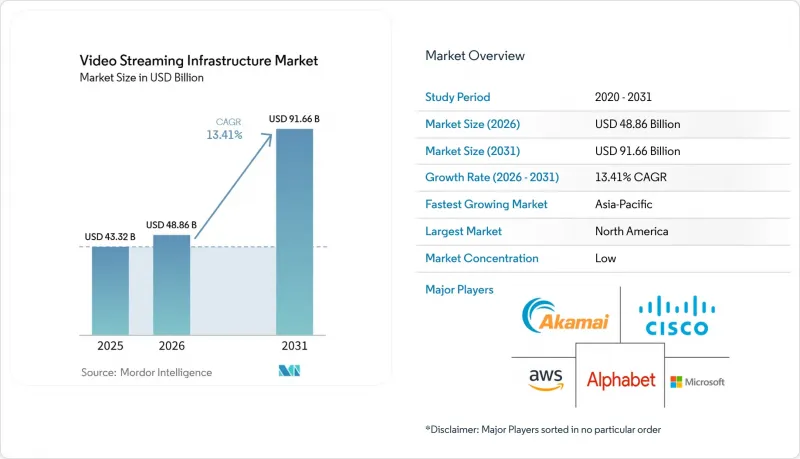
본 보고서는 스트리밍 유형(라이브 동영상, 비선형/VOD), 구성 요소(소프트웨어(미디어 워크플로우 오케스트레이션 등), 서비스, 하드웨어), 도입 형태(클라우드 기반, On-Premise, 하이브리드), 최종 사용자(미디어 및 엔터테인먼트, 스포츠·라이브 이벤트, 통신, 기업 등) 및 지역별로 분류되어 있습니다. 시장 예측은 금액(달러) 기준으로 제시되어 있습니다.
세계 비디오 스트리밍 인프라 시장 동향 및 인사이트
저지연 라이브 이벤트에 대한 수요 증가
스포츠 생중계 및 프리미엄 이벤트 전송은 비디오 스트리밍 인프라 시장에서 새로운 인프라 투자의 가장 시급한 동인으로 계속되고 있습니다. 권리 보유자들은 현재 화질을 안정적으로 유지하고 지연을 엄격하게 제어하면서, 매우 대규모의 동시 시청자 수를 지원할 수 있는 시스템을 필요로 하고 있습니다. 레노버는 2026년 FIFA 월드컵 중계에서 클라우드 기반 전송만으로는 방송 등급의 지연 요건을 충족할 수 없었기 때문에 거의 실시간에 가까운 AI 기반 인프라와 On-Premise 엣지 컴퓨팅을 도입했다고 밝혔습니다. 또한 MainStreaming은 2025년 FIFA 클럽 월드컵을 앞두고 DAZN Edge의 배포 범위를 확대했습니다. 이는 주요 스포츠 플랫폼이 타사 CDN의 커버리지에만 의존하지 않고, 프라이빗 엣지 용량에 투자하고 있음을 보여줍니다. 게다가 Akamai Media Services Live 5는 저지연 HLS 전송의 기준을 5-7초로 높였습니다. 이에 따라 향후 스포츠 중계권 계약에서 더 높은 성능이 요구되는 것은 피할 수 없게 되었습니다.
AI를 활용한 동영상 워크플로우 자동화 및 현지화
AI 주도 자동화를 통해 동영상의 대규모 준비, 라벨링, 현지화, 공개에 필요한 시간과 노력이 절감되고 있으며, 이로 인해 비디오 스트리밍 인프라 시장의 운영 범위가 확대되고 있습니다. 이는 컨텐츠 소유자가 현재 언어, 플랫폼, 포맷, 수익화 모델을 아우르며 동일한 자산의 더 많은 버전을 필요로 하고 있기 때문에 중요한 의미를 지닙니다. Brightcove는 2025년 7월 플랫폼 업데이트를 통해 메타데이터 자동 생성, 자막 생성, AI 번역, 더빙 및 지연 시간이 불과 8초인 4K UHD 라이브 스트리밍 기능을 추가했습니다. Wowza는 2026년 4월 ‘Video Intelligence Framework’를 출시했습니다. 이는 라이브 스트리밍 워크플로우 내에서 실시간 메타데이터, 클립, 알림 및 기계 판독 가능한 이벤트 신호를 생성하여, 스트리밍 후 처리 지연이나 수작업에 의한 인계 과정을 줄여줍니다. 이러한 도구가 표준화됨에 따라 소규모 방송 사업자들도 다국어 카탈로그로의 확장을 더 신속하게 진행할 수 있게 될 것입니다. 이는 현지화 및 메타데이터 작업에 있어, 과거 국제적인 사업 확장을 제한했던 수작업의 부담이 더 이상 필요하지 않게 되었기 때문입니다.
대역폭 및 트랜스코딩 비용 부담 증가
비디오 스트리밍 인프라 시장에서 비용 측면의 부담이 증가하고 있습니다. 이는 압축 기술의 발전에 따라 더 무거운 연산 요구 사항과 더 복잡한 전송 스택이 필요해졌기 때문입니다. 사업자들은 현재 더 많은 포맷과 고해상도를 지원해야 하며, 동시 접속 수의 피크가 빈번하게 발생하는 상황에 대응해야 하지만, 한편으로는 수익화 모델은 여전히 변화하고 있습니다. Meta Engineering은 2026년 6월, AV1 코덱이 대역폭 효율을 향상시켰습니다고는 하지만, 대규모 실시간 통신에 AV1을 도입하려면 막대한 컴퓨팅 리소스에 대한 투자가 필요하다고 밝혔습니다. Bitmovin사의 MUBI와의 협력도 이러한 압박을 반영하고 있습니다. AVC, HEVC, AV1을 지원하기 위해 자사 소유의 인코딩 하드웨어를 업데이트하는 것보다 클라우드 기반의 멀티 코덱 워크플로우가 확장성이 더 뛰어나기 때문입니다. 이러한 비용 측면의 압박은 중견 사업자들에게 가장 크게 가중되고 있습니다. 중견 사업자들은 최상위 플랫폼과 동등한 해상도나 코덱에 대한 기대에 부응해야 하는 한편, 가격 책정에서의 협상력이나 기존 규모 면에서는 그들에 미치지 못하기 때문입니다.
부문 분석
2025년에는 비선형 및 VOD 스트리밍이 52.47%의 점유율을 차지하고, 이는 온디맨드 시청이 비디오 스트리밍 인프라 시장에서 여전히 가장 큰 이용 사례임을 뒷받침합니다. VOD 수요의 경우, 시청자가 방대한 컨텐츠 카탈로그와 반복적인 시청 세션을 통해 일관된 성능을 기대하기 때문에 딥 캐싱, 효율적인 인코딩, 안정적인 적응형 비트레이트 전송이 중요시됩니다. 이 부문에서 규모 확대는 일시적인 트래픽 급증에 기인하기보다는 플랫폼이 방대한 컨텐츠 라이브러리를 얼마나 많은 기기와 액세스 네트워크에 효율적으로 전달할 수 있는지에 좌우됩니다. 따라서 VOD를 많이 사용하는 많은 도입 환경에서는 초저지연보다 비용 관리와 재생의 일관성이 더 중요해집니다. 따라서 새로운 워크로드가 성장의 주목을 받고 있음에도 불구하고, VOD는 계속해서 인프라 투자의 기반을 지탱하고 있습니다.
라이브 비디오 스트리밍은 이 부문 중에서도 특히 빠르게 성장하고 있는 분야로, 2026년부터 2031년까지 연평균 성장률(CAGR) 17.33%로 확대될 것으로 예측됩니다. 이러한 성장은 스포츠 중계권 이전, 가상 이벤트 개최 증가, 그리고 직접 과금이나 광고 제휴를 원하는 컨텐츠 소유자들의 DTC(Direct-to-Consumer) 전략 강화와 밀접한 관련이 있습니다. 라이브 스트리밍에는 VOD 모델에서 일반적으로 요구되는 것보다 실시간 인코딩, 보다 엄격한 지연 제어, 신속한 동시 접속자 수 확장, 그리고 더 강력한 가시성이 요구됩니다. 또한, 많은 사업자들은 라이브와 온디맨드 워크플로우를 연계하여 녹화된 스트림을 몇 분 이내에 재방송용 자산으로 활용할 수 있도록 하고 있으며, 이를 통해 별도의 파이프라인 설계 필요성이 줄어들고 있습니다. 이러한 포맷의 융합으로 인해 비디오 스트리밍 인프라 업계에서는 VOD와 라이브 시스템을 분리하는 대신, 통합된 운영을 기반으로 한 구축이 점점 더 활발히 진행되고 있습니다.
2025년에는 소프트웨어가 51.87%의 점유율을 차지하고, 소프트웨어 하위 부문 중 인코딩 및 트랜스코딩이 31.13%를 차지하고 있어, 계산 부하가 높은 처리가 플랫폼의 경제성 측면에서 여전히 핵심적인 역할을 하고 있음을 보여줍니다. 이에 따라 인코딩 로직, 오케스트레이션, 재생 인텔리전스 및 모니터링이 모두 일상 업무와 밀접하게 연관되어 있어, 소프트웨어는 비디오 스트리밍 인프라 시장에서 지속적인 관리의 핵심 요소로 자리 잡고 있습니다. 또한, 사업자들이 사후 대응형 문제 해결에서 예측형 성능 관리로 전환함에 따라, 동영상 분석 및 경험 품질(QoE) 모니터링도 2031년까지 연평균 성장률(CAGR) 15.89%를 나타낼 것으로 예측됩니다. 이러한 변화가 중요한 이유는 시청자 이탈, 광고 전달 실패, 지연의 급증 등이 구독 모델과 광고 지원 모델 모두에서 이제 수익에 직접적인 영향을 미치게 되었기 때문입니다. 따라서 뛰어난 가시성과 워크플로우 자동화 기능을 갖춘 소프트웨어 공급업체는 구매 결정에 대한 영향력을 점점 더 강화하고 있습니다.
'서비스'는 가장 빠르게 성장하는 최상위 구성 요소로, 2026년부터 2031년까지 연평균 성장률(CAGR) 15.24%로 확대될 것으로 예측됩니다. 컴캐스트 테크놀로지 솔루션즈(Comcast Technology Solutions)는 2025년 4월, 동영상 관리, OTT 배포, 소셜 미디어 배포를 단일 운영 모델로 통합한 매니지드 서비스인 ‘Comcast Media360’을 출시했습니다. 이러한 서비스 주도적 경향은 운영상의 유연성을 중시하는 광범위한 추세를 반영하고 있습니다. 이는 구매자들이 자사 소유 하드웨어의 증설보다는 성과와 가동 시간을 점점 더 중요시하게 되었기 때문입니다. 하드웨어는 여전히 특수한 환경에서 일정한 역할을 수행하고 있지만, 더 많은 기능이 소프트웨어 정의형 또는 매니지드 환경으로 전환됨에 따라 그 상대적 위상은 약화되고 있습니다. 비디오 스트리밍 인프라 업계 전반에 걸쳐, 가치의 중심은 사내 운영 부담을 줄이면서도 미디어 운영을 유지할 수 있는 플랫폼 및 서비스 계층으로 이동하고 있습니다.
지역별 분석
2025년, 북미는 비디오 스트리밍 인프라 시장 점유율의 36.63%를 차지하며, 지역별 매출에서 가장 큰 기여를 하는 지역으로서의 위상을 유지했습니다. 이 지역은 확고히 자리 잡은 구독 이용 습관, 두터운 디지털 광고 시장, 밀집된 데이터센터 네트워크, 그리고 풍부한 프리미엄 동영상 서비스 기반과 같은 강점을 활용하고 있습니다. 미국은 스포츠, 미디어, 기업, 플랫폼의 규모가 하나 시장에 집약되어 있어 여전히 주요 수요 거점으로 자리 잡고 있습니다. 캐나다와 멕시코도 이중 언어 지원 및 국경을 초월한 컨텐츠 수요를 통해 수요를 견인하고 있으며, 이로 인해 현지화와 워크플로우의 유연성이 더욱 중요해지고 있습니다. 성숙한 기반이 있음에도 불구하고, 북미 비디오 스트리밍 인프라 시장에는 하이브리드 운영, 이벤트 스트리밍, 그리고 AI를 활용한 보다 광범위한 미디어 워크플로우를 통해 여전히 성장 여지가 있습니다.
유럽은 스트리밍으로의 전환이 컨텐츠의 경제성과 규제 준수의 두 가지 요인에 의해 형성되고 있기 때문에 비디오 스트리밍 인프라 시장에서 여전히 중요한 지역입니다. 각국의 방송 시스템, 권리 구조, 수익화 모델은 여전히 국가마다 크게 다르기 때문에 수요 패턴은 지역 전체에 걸쳐 세분화되어 있습니다. 이로 인해 여러 국가에 걸친 확장은 더욱 복잡해지고 있으며, 공급업체들은 보다 모듈화된 도입 및 워크플로우 옵션을 제공하도록 요구받고 있습니다. 데이터 거주지 요건 및 데이터 전송 요건 또한 인프라 토폴로지에 영향을 미치고 있어, 지역별 처리 노드 및 현지화된 전송 설계에 대한 수요가 지속적으로 뒷받침되고 있습니다. 중동 및 아프리카에서는 걸프 국가들이 디지털 미디어 시스템에 대한 투자를 적극적으로 추진하고 있는 반면, 사하라 이남 아프리카의 일부 시장에서는 모바일 동영상 수요가 계속 증가하고 있음에도 불구하고 네트워크 품질의 제약으로 인해 단기적인 도입이 지연될 가능성이 있습니다.
아시아태평양은 2026년부터 2031년까지 연평균 성장률(CAGR) 15.98%로 확대될 것으로 예측되며, 비디오 스트리밍 인프라 시장에서 가장 두드러진 성장을 보일 것으로 전망됩니다. 이 지역은 모바일 우선 시청 습관, 현지 프리미엄 컨텐츠에 대한 활발한 수요, 그리고 대규모 사용자 기반에 걸친 방대한 라이브 스트리밍 트래픽에 의해 주도되고 있습니다. AVIA의 보고서에 따르면, 이 지역의 온라인 동영상 부문 매출은 2025년 말까지 700억 달러에 달할 것으로 예상되며, 이는 이미 새로운 전송 인프라 투자를 뒷받침하고 있는 시장 규모를 여실히 보여줍니다. 또한 AVIA는 인도를 ‘모바일 퍼스트’ 라이브 스트리밍 아키텍처의 세계 기준점으로 자리매김하며, 이 지역이 향후 확장을 위한 중요한 성과 지표를 확립하고 있는 이유를 강조하고 있습니다.
기타 혜택:
- 엑셀 형식 시장 예측(ME) 시트
- 3개월간의 애널리스트 지원
자주 묻는 질문
목차
제1장 서론
제2장 조사 방법
제3장 주요 요약
제4장 시장 구도
제5장 시장 규모와 성장 예측
제6장 경쟁 구도
제7장 시장 기회와 향후 전망
JHS 26.08.05According to Mordor Intelligence, the video streaming infrastructure market size was valued at USD 43.32 billion in 2025 and estimated to grow from USD 48.86 billion in 2026 to reach USD 91.66 billion by 2031, at a CAGR of 13.41% during the forecast period (2026-2031).
This report is Segmented by Streaming Type (Live Video, and Non-Linear / VOD), Component (Software [Media Workflow Orchestration, and More], Services, and Hardware), Deployment (Cloud-Based, On-Premises, and Hybrid), End User (Media and Entertainment, Sports and Live Events, Telecommunications, Enterprises, and More), and Geography. The Market Forecasts are Provided in Terms of Value (USD).
Global Video Streaming Infrastructure Market Trends and Insights
Rising Demand for Low-Latency Live Events
Live sports and premium event delivery remain the most immediate reason for new infrastructure spending across the Video streaming infrastructure market. Rights holders now need systems that can support very large concurrent audiences while keeping picture quality stable and delay tightly controlled. Lenovo said its FIFA World Cup 2026 deployment used near real-time AI-powered infrastructure and on-premise edge computing because cloud-only delivery did not meet broadcast-grade latency needs. MainStreaming also expanded the DAZN Edge footprint ahead of the FIFA Club World Cup 2025, showing that leading sports platforms are investing in private edge capacity rather than relying only on third-party CDN coverage. Akamai Media Services Live 5 then pushed low-latency HLS delivery toward a 5 to 7 second baseline, which makes higher performance expectations harder to avoid in future sports rights contracts.
AI-Based Video Workflow Automation and Localization
AI-led automation is lowering the time and labor needed to prepare, label, localize, and publish video at scale, which is raising the operating range of the Video streaming infrastructure market. That matters because content owners now need more versions of the same asset across languages, platforms, formats, and monetization models. Brightcove added automated metadata creation, caption generation, AI translation, audio dubbing, and 4K UHD live streaming with delays as low as 8 seconds in its July 2025 platform update. Wowza launched its Video Intelligence Framework in April 2026 to generate real-time metadata, clips, alerts, and machine-readable event signals inside live workflows, which reduces post-stream processing delays and manual handoffs. As these tools become standard, smaller broadcasters can expand into multi-language catalogues faster because localization and metadata work no longer require the same manual overhead that once limited international scaling.
Escalating Bandwidth and Transcoding Cost Burden
The cost side of the Video streaming infrastructure market is rising because better compression is coming with heavier compute requirements and more complex delivery stacks. Operators now need to support more formats, higher resolutions, and more frequent concurrency peaks at the same time that monetization models are still shifting. Meta Engineering said in June 2026 that adopting AV1 for real-time communication at scale required significant computational investment, even though the codec improved bandwidth efficiency. Bitmovin's work with MUBI also reflected this pressure, because a cloud-based multi-codec workflow can be easier to scale than refreshing owned encoding hardware for AVC, HEVC, and AV1 support. These cost pressures weigh most heavily on mid-tier operators, which face the same resolution and codec expectations as top-tier platforms but do not have the same pricing leverage or installed scale.
Other drivers and restraints analyzed in the detailed report include:
- Expanding CDN And Edge Compute Capacity for Peak Traffic Delivery
- Cloud-Native Streaming Operations Reducing Capex Burden
- Fragmented Device, Codec, And Player Compatibility
For complete list of drivers and restraints, kindly check the Table Of Contents.
Segment Analysis
Non-Linear and VOD streaming held 52.47% share in 2025, which confirms that on-demand viewing remained the largest current use case inside the Video streaming infrastructure market. VOD demand favors deep caching, efficient encoding, and stable adaptive bitrate delivery because viewers expect consistent performance across large catalogues and repeated sessions. In this segment, scale comes less from one-time traffic bursts and more from how efficiently platforms can serve a wide content library across many devices and access networks. That makes cost control and playback consistency more important than ultra-low delay in many VOD-heavy deployments. VOD therefore keeps anchoring baseline infrastructure spending even as newer workloads attract more growth attention.
Live video streaming was the faster-moving side of this segment and is projected to expand at 17.33% CAGR from 2026 to 2031. The growth is tied to sports rights migration, larger virtual event calendars, and stronger direct-to-consumer ambitions from content owners that want a direct billing and advertising relationship. Live delivery needs real-time encoding, tighter latency control, rapid concurrency scaling, and stronger observability than the VOD model usually requires. Many operators are also linking live and on-demand workflows so recorded streams become replay assets within minutes, which reduces the need for separate pipeline designs. That blending of formats means the video streaming infrastructure industry is increasingly building around unified operations rather than isolated VOD and live systems.
Software accounted for 51.87% share in 2025 and encoding and transcoding represented 31.13% of the software sub-segment, showing how central compute-heavy processing remained to platform economics. This made software the anchor of recurring control in the Video streaming infrastructure market because encoding logic, orchestration, playback intelligence, and monitoring all sites close to daily operations. Video analytics and quality-of-experience monitoring is also projected to grow at 15.89% CAGR by 2031, as operators move from reactive troubleshooting toward predictive performance management. That shift matters because viewer churn, ad delivery failure, and latency spikes now have direct revenue consequences in both subscription and ad-supported models. Software vendors with strong observability and workflow automation are therefore gaining more influence over buying decisions.
Services is the fastest-growing top-level component and is projected to expand at 15.24% CAGR from 2026 to 2031. Comcast Technology Solutions launched Comcast Media360 in April 2025 as a managed service that combines video management, OTT delivery, and social media distribution in one operating model. This service-led pattern reflects a broader preference for operating flexibility, because buyers increasingly want outcomes and uptime rather than more owned hardware. Hardware still has a role in specialized environments, but its relative position is weakening as more functions move into software-defined or managed environments. Across the video streaming infrastructure industry, the center of value is shifting toward platforms and service layers that can keep media operations running with less internal operational strain.
Complete Report Scope:
- By Streaming Type
- Live Video Streaming
- Non-Linear / VOD Streaming
- By Component
- Software
- Encoding and Transcoding Solutions
- Video Player Solutions
- Video Analytics and QoE Monitoring
- Media Workflow Orchestration
- Other Software Components
- Services
- Hardware
- Software
- By Deployment
- Cloud-based
- On-Premises
- Hybrid
- By End User
- Media and Entertainment
- Sports and Live Events
- Telecommunications
- Enterprises
- Education
- Government and Public Sector
- Other End Users
- By Geography
- North America
- United States
- Canada
- Mexico
- South America
- Brazil
- Argentina
- Rest of South America
- Europe
- United Kingdom
- Germany
- France
- Italy
- Spain
- Rest of Europe
- Asia-Pacific
- China
- India
- Japan
- South Korea
- Australia and New Zealand
- Rest of Asia-Pacific
- Middle East and Africa
- Middle East
- Saudi Arabia
- United Arab Emirates
- Qatar
- Turkey
- Rest of the Middle East
- Africa
- South Africa
- Nigeria
- Rest of Africa
- Middle East
- North America
Geography Analysis
North America held 36.63% of the video streaming infrastructure market share in 2025, maintaining its position as the largest regional revenue contributor. The region benefits from mature subscription habits, strong digital advertising depth, dense data center coverage, and a large base of premium video services. The United States remains the main demand center because it combines sports, media, enterprise, and platform scale in one market. Canada and Mexico also contribute demand through bilingual and cross-border content needs, which increase the importance of localization and workflow flexibility. Even with a mature base, the video streaming infrastructure market in North America still has room to expand through hybrid operations, event streaming, and broader AI-driven media workflows.
Europe remains an important region in the video streaming infrastructure market because its streaming transition is shaped by both content economics and regulatory compliance. Demand patterns are fragmented across the region because national broadcast systems, rights structures, and monetization models still vary widely by country. This makes multi-country rollout more complex and encourages vendors to offer more modular deployment and workflow options. Data residency and data transfer requirements also influence infrastructure topology, supporting continued demand for regional processing nodes and localized delivery design. In the Middle East and Africa, Gulf markets are investing more actively in digital media systems, while several Sub-Saharan markets still face network quality limitations that can slow near-term deployment, even as mobile video demand continues to rise.
Asia-Pacific is projected to expand at a 15.98% CAGR from 2026 to 2031, making it the fastest-growing geography in the video streaming infrastructure market. The region is being driven by mobile-first consumption habits, strong demand for local premium content, and heavy live-streaming traffic across large user bases. AVIA reports that the regional online video sector reached USD 70 billion in revenue by the end of 2025, highlighting the scale already supporting new delivery investments. AVIA also identifies India as a global reference point for mobile-first live delivery architecture, underscoring why the region is setting important performance benchmarks for future deployments.
- Amazon Web Services, Inc.
- Akamai Technologies, Inc.
- Microsoft Corporation
- Alphabet Inc.
- Cisco Systems, Inc.
- International Business Machines Corporation
- Kaltura, Inc.
- Wowza Media Systems, LLC
- Brightcove Inc.
- Synamedia Limited
- Harmonic Inc.
- Haivision Inc.
- Bitmovin Inc.
- Comcast Technology Solutions, Inc.
- Vimeo.com, Inc.
- MediaKind
- Edgio, Inc.
- Dacast Inc.
- JWP, Inc. (JWX)
- Panopto, Inc.
Additional Benefits:
- The market estimate (ME) sheet in Excel format
- 3 months of analyst support
TABLE OF CONTENTS
1 INTRODUCTION
- 1.1 Study Assumptions and Market Definition
- 1.2 Scope of the Study
2 RESEARCH METHODOLOGY
3 EXECUTIVE SUMMARY
4 MARKET LANDSCAPE
- 4.1 Market Overview
- 4.2 Market Drivers
- 4.2.1 Rising Demand for Low-Latency Live Events
- 4.2.2 Expanding CDN and Edge Compute Capacity for Peak Traffic Delivery
- 4.2.3 Cloud-Native Streaming Operations Reducing Capex Burden
- 4.2.4 AI-Based Video Workflow Automation and Localization
- 4.2.5 Ad-Supported and Hybrid Monetization Expanding Delivery Volumes
- 4.2.6 5G Multicast and Broadcast Streaming Use Cases
- 4.3 Market Restraints
- 4.3.1 Escalating Bandwidth and Transcoding Cost Burden
- 4.3.2 Fragmented Device, Codec, and Player Compatibility
- 4.3.3 Privacy, Rights, and Data Residency Constraints
- 4.3.4 Peak-Time Quality of Service Instability in Emerging Networks
- 4.4 Value Chain Analysis
- 4.5 Regulatory Landscape
- 4.6 Technological Outlook
- 4.7 Porter's Five Forces Analysis
- 4.7.1 Bargaining Power of Suppliers
- 4.7.2 Bargaining Power of Buyers/Consumers
- 4.7.3 Threat of New Entrants
- 4.7.4 Threat of Substitutes
- 4.7.5 Competitive Rivalry
- 4.8 Investment Analysis
- 4.9 Assessment of the Impact of Macroeconomic Factors on the Market
5 MARKET SIZE AND GROWTH FORECASTS (VALUE)
- 5.1 By Streaming Type
- 5.1.1 Live Video Streaming
- 5.1.2 Non-Linear / VOD Streaming
- 5.2 By Component
- 5.2.1 Software
- 5.2.1.1 Encoding and Transcoding Solutions
- 5.2.1.2 Video Player Solutions
- 5.2.1.3 Video Analytics and QoE Monitoring
- 5.2.1.4 Media Workflow Orchestration
- 5.2.1.5 Other Software Components
- 5.2.2 Services
- 5.2.3 Hardware
- 5.2.1 Software
- 5.3 By Deployment
- 5.3.1 Cloud-based
- 5.3.2 On-Premises
- 5.3.3 Hybrid
- 5.4 By End User
- 5.4.1 Media and Entertainment
- 5.4.2 Sports and Live Events
- 5.4.3 Telecommunications
- 5.4.4 Enterprises
- 5.4.5 Education
- 5.4.6 Government and Public Sector
- 5.4.7 Other End Users
- 5.5 By Geography
- 5.5.1 North America
- 5.5.1.1 United States
- 5.5.1.2 Canada
- 5.5.1.3 Mexico
- 5.5.2 South America
- 5.5.2.1 Brazil
- 5.5.2.2 Argentina
- 5.5.2.3 Rest of South America
- 5.5.3 Europe
- 5.5.3.1 United Kingdom
- 5.5.3.2 Germany
- 5.5.3.3 France
- 5.5.3.4 Italy
- 5.5.3.5 Spain
- 5.5.3.6 Rest of Europe
- 5.5.4 Asia-Pacific
- 5.5.4.1 China
- 5.5.4.2 India
- 5.5.4.3 Japan
- 5.5.4.4 South Korea
- 5.5.4.5 Australia and New Zealand
- 5.5.4.6 Rest of Asia-Pacific
- 5.5.5 Middle East and Africa
- 5.5.5.1 Middle East
- 5.5.5.1.1 Saudi Arabia
- 5.5.5.1.2 United Arab Emirates
- 5.5.5.1.3 Qatar
- 5.5.5.1.4 Turkey
- 5.5.5.1.5 Rest of the Middle East
- 5.5.5.2 Africa
- 5.5.5.2.1 South Africa
- 5.5.5.2.2 Nigeria
- 5.5.5.2.3 Rest of Africa
- 5.5.5.1 Middle East
- 5.5.1 North America
6 COMPETITIVE LANDSCAPE
- 6.1 Market Concentration
- 6.2 Strategic Moves (Merger and Acquisitions, Partnerships, Investment, Logistics Build-out)
- 6.3 Vendor Positioning Analysis
- 6.4 Company Profiles (includes Market level overview, Core Segments, Financials as available, Strategic Information, Products and Services, and Recent Developments)
- 6.4.1 Amazon Web Services, Inc.
- 6.4.2 Akamai Technologies, Inc.
- 6.4.3 Microsoft Corporation
- 6.4.4 Alphabet Inc.
- 6.4.5 Cisco Systems, Inc.
- 6.4.6 International Business Machines Corporation
- 6.4.7 Kaltura, Inc.
- 6.4.8 Wowza Media Systems, LLC
- 6.4.9 Brightcove Inc.
- 6.4.10 Synamedia Limited
- 6.4.11 Harmonic Inc.
- 6.4.12 Haivision Inc.
- 6.4.13 Bitmovin Inc.
- 6.4.14 Comcast Technology Solutions, Inc.
- 6.4.15 Vimeo.com, Inc.
- 6.4.16 MediaKind
- 6.4.17 Edgio, Inc.
- 6.4.18 Dacast Inc.
- 6.4.19 JWP, Inc. (JWX)
- 6.4.20 Panopto, Inc.
7 MARKET OPPORTUNITIES AND FUTURE OUTLOOK
- 7.1 White-space and Unmet-Need Assessment


