

|
시장보고서
상품코드
2099899
축구 스트리밍 시장 : 시장 점유율 분석, 업계 동향 및 통계, 성장 예측(2026-2031년)Football Streaming - Market Share Analysis, Industry Trends & Statistics, Growth Forecasts (2026 - 2031) |
||||||
 Mordor Intelligence
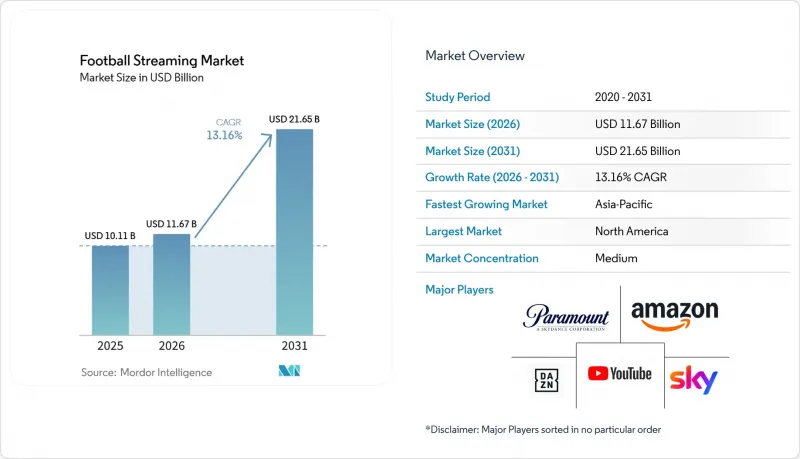
Mordor Intelligence에 의하면, 축구 스트리밍 시장 규모는 2025년 101억 1,000만 달러로 평가되었고, 2026년에는 116억 7,000만 달러로 확대될 것으로 추정되고, 2031년까지 216억 5,000만 달러에 이를 것으로 예상되며, 2026-2031년 CAGR 13.16%로 성장할 전망입니다.
본 보고서는 기기 유형별(스마트폰·태블릿, 스마트 TV, 노트북·데스크톱 PC), 컨텐츠 유형별(국제 경기, 국내 경기), 스트리밍 유형별(라이브 스트리밍, 온디맨드 스트리밍) 및 지역별(북미, 남미, 유럽, 아시아태평양, 중동 및 아프리카)로 분류되어 있습니다. 시장 전망은 금액(달러) 기준으로 제시되어 있습니다.
세계의 축구 스트리밍 시장 동향 및 인사이트
스트리밍 사업자의 프리미엄 축구 중계권 지출 증가
축구 스트리밍 시장은 권리 주도형 모델로 더욱 깊이 전환되고 있습니다. 이 모델에서 프리미엄 대회 중계권을 확보했는지 여부는 어떤 플랫폼이 주목을 받고, 가입자를 유지하며, 일년내내 팬들의 시청 습관을 형성할 수 있는지를 결정하는 요인으로 점점 더 중요해지고 있습니다. 이러한 경향은 DAZN이 국내 및 국제 방송망 강화에 주력하고 있는 점에서도 명확히 드러납니다. 구체적으로는 프랑스 내 세리에 A, 코파 이탈리아, 수페르코파 이탈리아나의 독점 중계권 갱신, 이탈리아에서 열리는 2026년 FIFA 월드컵 전 104경기의 단독 중계권 획득 등을 들 수 있습니다. 이러한 움직임이 중요한 이유는 중계권의 충실도가 더 이상 생중계 그 자체를 넘어 플랫폼의 가치에 영향을 미치게 되었기 때문입니다. 더 광범위한 중계권을 보유한 서비스는 해지 위험을 줄이고, 축구 팬들을 하나의 환경에 머물게 함으로써 더 많은 대회를 연중 더 긴 기간에 걸쳐 시청하게 할 수 있기 때문입니다. 따라서 축구 스트리밍 시장은 소규모 서비스의 진입이 점점 더 어려워지고 있습니다. 방송권 가격의 급등은 획득 비용을 끌어올릴 뿐만 아니라, 주요 축구 시장에서 입지를 유지하기 위해 필요한 최소 규모도 높이고 있기 때문입니다. 또한, 프리미엄 중계권은 리그 경기 접근권, 토너먼트 중계, 아카이브 컨텐츠를 결합할 수 있는 플랫폼에 집중되고 있으며, 이로 인해 새로운 계약 하나하나가 단순한 컨텐츠 확충 이상의 전략적 중요성을 갖게 되었습니다. 그 결과, 축구 스트리밍 시장에서는 여러 창구와 지역에 걸쳐 고부가가치 축구 컨텐츠를 집약할 수 있는 사업자가 혜택을 보는 반면, 경쟁력이 약한 사업자는 더 제한적인 패키지, 특정 지역, 혹은 2류 대회로 밀려나고 있습니다.
유료 TV에서 DTC(Direct-to-Consumer) 방식의 축구 시청으로의 급속한 전환
축구 스트리밍 시장은 기존의 배포 모델에서 꾸준히 전환되고 있으며, 가격 책정, 패키지 구성, 팬과의 관계를 플랫폼 측이 보다 완벽하게 통제할 수 있는 직접적인 디지털 접근 방식으로 향하는 움직임에 힘입어 탄력을 받고 있습니다. 이러한 변화는 FIFA와 DAZN이 라이브 이벤트, 아카이브 영상, 오리지널 프로그램을 통합한 세계 플랫폼으로서 ‘FIFA+ on DAZN’을 론칭한 사례 등에서 볼 수 있듯이, 관리 단체와 권리 보유자들이 ‘스트리밍 우선’ 계약을 뒷받침하고 있음을 보여줍니다. 또한, 축구 스트리밍 시장은 지역 특화 배포 전략을 통해 발전하고 있습니다. 예를 들어, 라 리가가 파키스탄, 방글라데시, 스리랑카에서 Begin사와 맺은 독점 제휴는 불법 복제가 만연한 지역에서 합법적이면서도 상업적으로 실현 가능한 디지털 배포 옵션을 구축하는 것을 목적으로 한 것입니다. 북미에서는 2026년 월드컵을 통해 주요 축구 시청자층에서 스트리밍이 기존 TV 방송과 어깨를 나란히 하고, 경우에 따라서는 이를 능가할 가능성도 이미 드러났습니다. 특히 스페인어 방송의 경우, Peacock이 처음으로 기존 TV 방송의 시청자 수를 넘어섰습니다. 축구 스트리밍 시장은 이러한 전환의 혜택을 누리고 있습니다. 직접 접근을 통해 플랫폼은 사용자 데이터를 수집하고, 가격대를 조정하며, 기존 TV 방송의 도매 배포로는 불가능했던 수준으로 정교하게 축구를 다른 디지털 서비스와 묶어 제공할 수 있게 되기 때문입니다. 앞으로 축구 스트리밍 시장에서는 이러한 직접 모델이 더욱 심화될 것으로 보입니다. 특히 기존 유료 TV 구조에서는 가격 면에서 접근성이 제한적이거나, 유연성이 부족하거나, 젊은 층에 대한 도달이 불충분한 국가들에서 이러한 경향이 두드러질 것입니다.
방송권료의 급등과 권리 보유자 및 플랫폼의 이익률에 가해지는 압박
축구 스트리밍 시장은 프리미엄 방송권 비용이 계속 상승하는 한편, 많은 서비스가 여전히 그 투자를 회수하기 위해 월정액 구독 모델에 크게 의존하고 있어 지속적인 압박에 직면해 있습니다. 이러한 상황은 독점적인 다중 대회 패키지의 중요성이 높아지고 있다는 점에서 명확히 드러납니다. 사업자 입장에서는 비용 부담이 증가하고 이익률의 유연성이 좁아지더라도, 시장 내 입지를 유지하기 위해 충분한 축구 컨텐츠의 폭을 확보해야 합니다. DAZN의 프랑스 중계권 갱신, 이탈리아에서의 2026년 월드컵 전 경기 중계권 확보, 그리고 FIFA+를 통한 축구 컨텐츠의 지속적인 확충은 경쟁사들이 일회성 이벤트 중계가 아닌, 더 대규모의 종합적인 중계권 포트폴리오로 전환하고 있음을 보여줍니다. 대규모 디지털 생태계는 광고, 커머스, 게임 및 기타 번들 서비스를 통해 축구 관련 비용을 분산시킬 수 있지만, 사업 범위가 좁은 사업자는 이를 할 수 없는 경우가 많기 때문에 축구 스트리밍 시장은 전문 사업자에게 특히 어려운 환경이 되고 있습니다. 이러한 불균형으로 인해 중계권 가격의 급등은 단순히 이익을 압박할 뿐만 아니라, 향후 계약 주기에서 누가 계속 입찰에 참여할 수 있고, 누가 더 소규모이거나 지역 한정적인 기회로 물러설 수밖에 없는지를 결정짓는 요인이 됩니다. 장기적으로는 축구 스트리밍 시장이 성장을 지속할 가능성이 있지만, 중계권 비용의 상승은 여전히 플랫폼의 수익성을 약화시키고, 제품 투자 여지를 축소시키며, 경쟁 우위를 유지하는 것을 어렵게 만들 우려가 있습니다.
부문 분석
2025년, 축구 스트리밍 시장의 55.22%를 스마트폰 및 태블릿이 차지했으며, 이로 인해 고정형 광대역보다 모바일 연결이 우월하고, 고급 가정용 하드웨어보다 화면의 유연성이 중시되는 시장에서 이 카테고리는 팬들에게 주요 접근 수단으로 자리매김했습니다. 축구 스트리밍 시장이 여전히 모바일 기기에 크게 의존하고 있는 이유는 특히 클립이나 해설, 경기 반응이 메신저 앱이나 소셜 플랫폼에서 끊임없이 확산되는 상황에서 축구 시청이 휴대성, 실시간 알림, 소셜 미디어로의 파급 효과에서 시작되는 경우가 많기 때문입니다. 이러한 경향은 저렴한 모바일 데이터 요금, 스마트폰의 보급, 신규 사용자에 대한 진입 장벽이 낮다는 점 덕분에 축구 스트리밍 산업이 지속적으로 확대되고 있는 남아시아, 동남아시아, 아프리카, 남미에서 여전히 두드러집니다. 실용적인 관점에서 볼 때, 스마트폰 및 태블릿은 축구 스트리밍 시장을 팬들의 일상 루틴에 밀착시키고 있습니다. 사용자는 특정 장소에 얽매이지 않고 출근 전이나 이동 중, 혹은 틈틈이 시청할 수 있기 때문입니다. 이러한 폭넓은 접근 용이성이, 더욱 프리미엄한 커넥티드 홈 경험이 지속적으로 발전하고 있음에도 불구하고 이 기기 부문이 최대 점유율을 유지하고 있는 이유를 설명해 줍니다.
스마트 TV는 2026-2031년 연평균 성장률(CAGR) 13.42%를 나타낼 것으로 예측되며, 기존의 유료 TV 패키지로 되돌아가지 않고 시청을 거실로 되돌리는 가구가 늘어나는 가운데, 프리미엄 축구 시청 수단으로서 가장 빠르게 성장하고 있는 대형 화면 기기가 되고 있습니다. 스마트 TV는 더 높은 화질, 더 몰입감 있는 경기 경험, 그리고 팬들이 여전히 대형 화면 시청을 선호하는 주요 경기에서의 공동 시청 행동을 촉진함으로써 이러한 변화의 혜택을 누리고 있습니다. Fox, FS1, Tubi에서 월드컵 시청자 수가 급증한 것도 대규모 축구 이벤트 시청이 기존 TV 채널뿐만 아니라 현대의 커넥티드 환경 전반으로 확대되고 있다는 관점을 뒷받침합니다. 같은 기간 동안 텔레문드와 피콕은 스트리밍이 전국적 규모의 이벤트 수준에서 축구에 대한 대규모 수요를 충족시킬 수 있음을 보여주었으며, 이는 축구 스트리밍 시장에서 가정용 프리미엄 디지털 시청의 장기적인 잠재력을 뒷받침합니다. 노트북과 데스크톱 PC는 사무실이나 공부, 멀티태스킹 상황에서 여전히 유용하며, 게임기나 세컨드 스크린 형식도 참여도를 높이는 데 기여하고 있지만, 축구 스트리밍 시장의 주요 방향성은 커넥티드 TV의 급속한 성장과 더불어 견고한 모바일 기반의 확립으로 향하고 있습니다.
지역별 분석
2025년, 유럽은 축구 스트리밍 시장의 38.42%를 차지했으며, 이 지역은 세계 최대의 점유율을 기록했습니다. 이는 유럽의 국내 리그가 상업적으로 성숙해 있으며, 주요 축구 지역에서 권리 환경이 여러 경쟁 플랫폼의 공존을 가능하게 하고 있기 때문입니다. 유럽 축구 스트리밍 시장은 다층적인 경쟁 구도가 특징이며, Sky, DAZN, Amazon Prime Video, Canal+, beIN Sports 등 각사는 단순한 ‘승자 독식’ 모델이 아닌, 서로 다른 중계권 패키지, 국가, 경기 수준을 통해 사업을 전개하고 있습니다. DAZN이 2028-29 시즌까지 프랑스 내 세리에 A의 독점 중계권을 갱신한 것은 각 플랫폼 업체들이 하나의 구독으로 더 오랜 기간 팬들을 붙잡아 둘 수 있는 다중 리그 포트폴리오를 통해 장기적인 입지를 확립하려 하고 있음을 보여줍니다. 이탈리아에서는 DAZN이 2026년 FIFA 월드컵 전체 104경기의 독점 중계권을 획득한 것이, 축구 스트리밍 시장에서 국내 및 국제적 도달 범위를 결합할 수 있는 ‘디지털 퍼스트’형 애그리게이터를 중심으로 프리미엄 노출이 집중되고 있음을 보여주는 또 다른 사례가 되고 있습니다. 유럽은 여전히 강력한 수익화 잠재력을 지니고 있지만, 중계권 분할, 규제 당국의 감독, 불법 스트리밍 문제가 모두 동시에 플랫폼의 경제성에 영향을 미치고 있어, 이 지역의 축구 스트리밍 시장은 운영 측면에서 여전히 복잡한 상황에 놓여 있습니다.
북미에서는 2026-2031년 연평균 성장률(CAGR) 13.91%를 나타낼 것으로 예측되며, 2026년 월드컵을 계기로 시청자 인지도, 플랫폼 보급, 그리고 상업적 신뢰도가 높아짐에 따라 축구 스트리밍 시장에서 가장 빠르게 성장하는 지역 블록이 될 전망입니다. 폭스 스포츠는 2026년 월드컵 조별리그에서 호조인 시청 실적을 보고했습니다. 영어 방송의 경기당 평균 시청자 수는 505만 명으로, 2022년 대회와 비교해 92% 증가했으며, 이는 이 지역에서 축구에 대한 수요가 주류로 확산되고 있음을 여실히 보여줍니다. 또한 컴캐스트는 텔레문도와 피콕이 대회 기간 동안 사상 최고 시청자 수를 기록했으며, 피콕이 해당 대회에서 처음으로 리니어 방송 시청자 수를 넘어섰다고 발표했습니다. 이는 다국어 환경이나 스트리밍을 주로 이용하는 가구에서 축구 스트리밍 시장에 있어 중요한 신호라고 할 수 있습니다. 북미 축구 스트리밍 시장은 여전히 여러 구독 서비스에 분산되어 있지만, 축구가 더욱 일상적인 소비 카테고리가 됨에 따라 이러한 분산 구조는 번들링, 통합, 그리고 크로스 플랫폼에서의 업셀링 여지도 창출하고 있습니다. 미국, 캐나다, 멕시코가 모두 2026년 대회 주기에 참여하고 있는 만큼, 북미 축구 스트리밍 시장은 과거 대회 기간에 비해 지속적인 확장을 위한 더욱 견고한 기반을 다지고 있습니다.
아시아태평양, 남미, 중동 및 아프리카 각 지역은 축구 스트리밍 시장에서 가장 긴 성장 잠재력을 지니고 있지만, 수익화는 여전히 방송권 가격의 적정성, 현지 배포 형태의 적합성, 모바일 접근성, 그리고 합법적인 편의성을 통해 불법 복제를 줄일 수 있는 능력에 달려 있습니다. 아시아태평양에서는 파키스탄, 방글라데시, 스리랑카에서 라 리가와 Begin 사 간의 다년 계약은 축구 수요는 높으나 기존 프리미엄 스트리밍 체계가 불균일했던 가격에 민감한 지역에서 축구 스트리밍 시장이 지역적 디지털 파트너십을 활용해 합법적인 접근성을 개선하고 있는 실제 사례를 보여주고 있습니다. 남미에서는 축구 스트리밍 시장이 뿌리 깊은 축구 문화와 이벤트에 대한 열광적인 분위기 덕분에 계속해서 혜택을 보고 있으며, 플랫폼이 가격 책정 및 접근성을 현지 현실에 맞출 수 있다면 상업적 성장 여지가 크다고 할 수 있습니다. 아프리카 전역 및 중동 일부 지역에서 축구 스트리밍 시장은 방대한 시청자층의 잠재력을 지니고 있지만, 그 성장은 여전히 ‘모바일 우선’ 스트리밍 모델과 실질적으로 저렴한 가격에 크게 의존하고 있습니다. 왜냐하면 이러한 요소들이 세계 최상위 리그의 이론적 인기보다 더 중요해지는 경우가 많기 때문입니다.
기타 혜택 :
- 엑셀 형식 시장 예측(ME) 시트
- 3개월간의 애널리스트 지원
자주 묻는 질문
목차
제1장 서론
제2장 조사 방법
제3장 주요 요약
제4장 시장 구도
제5장 시장 규모 및 성장 예측
제6장 경쟁 구도
제7장 시장 기회 및 향후 전망
AJY 26.08.07According to Mordor Intelligence, the football streaming market size is expected to increase from USD 10.11 billion in 2025 to USD 11.67 billion in 2026 and reach USD 21.65 billion by 2031, growing at a CAGR of 13.16% over 2026-2031.
This report is Segmented by Device Type (Smartphones and Tablets, Smart TVs, and Laptops and Desktops), Content Type (International Matches, and Domestic Matches), Streaming Type (Live Streaming, and On-Demand Streaming), and Geography (North America, South America, Europe, Asia-Pacific, Middle East, and Africa). The Market Forecasts are Provided in Terms of Value (USD).
Global Football Streaming Market Trends and Insights
Rising Premium Football Rights Spending by Streamers
The football streaming market is moving deeper into a rights-led model, where control of premium competitions increasingly determines which platforms can win attention, hold subscribers, and shape wider fan habits across the year. The football streaming market is showing this pattern clearly through DAZN's push to strengthen both domestic and international coverage, including its renewal of exclusive Serie A, Coppa Italia, and Supercoppa Italiana rights in France and its position as the sole broadcaster of all 104 FIFA World Cup 2026 matches in Italy. These moves matter because rights depth now influences platform value beyond the live match itself, since a service with broader coverage can reduce cancellation risk and keep football fans inside one environment for more competitions and more months of the year. The football streaming market is therefore becoming harder for smaller services to navigate, because rights inflation does not only raise acquisition costs, it also raises the minimum scale needed to remain relevant in top football territories. Premium rights are also concentrating around platforms that can combine league access, tournament coverage, and archived content, which makes each new deal more strategically important than a simple inventory expansion. As a result, the football streaming market is rewarding players that can aggregate high-value football properties across multiple windows and geographies, while weaker operators are pushed toward narrower packages, selective territories, or secondary competitions.
Rapid Shift From Pay TV to Direct-to-Consumer Football Viewing
The football streaming market is gaining momentum from the steady move away from legacy distribution models and toward direct digital access that gives platforms fuller control over pricing, packaging, and the fan relationship. This shift is visible in the way governing bodies and rights holders are backing streaming-first arrangements, including FIFA and DAZN's launch of FIFA+ on DAZN as a consolidated global destination for live events, archive footage, and original programming. The football streaming market is also moving forward through region-specific distribution choices, such as LaLiga's exclusive partnership with Begin in Pakistan, Bangladesh, and Sri Lanka, which was designed to create a legal and more commercially workable digital option in a piracy-affected region. In North America, the 2026 World Cup has already shown that streaming can stand beside, and in some cases outperform, linear viewing for major football audiences, especially in Spanish-language coverage where Peacock passed linear delivery for the first time. The football streaming market benefits from this transition because direct access lets platforms collect user data, adjust price tiers, and bundle football with other digital services more precisely than traditional wholesale television distribution allowed. Over time, the football streaming market is likely to deepen this direct model further, especially in countries where old pay TV structures had limited affordability, weak flexibility, or poor reach among younger users.
Rights Inflation and Margin Pressure on Rights Holders and Platforms
The football streaming market faces persistent pressure because premium rights costs keep rising while many services still depend heavily on monthly subscription economics to recover those investments. The football streaming market shows this clearly in the growing importance of exclusive, multi-competition packages, where operators must secure enough football breadth to remain relevant, even when that breadth raises cost exposure and narrows margin flexibility. DAZN's rights renewals in France, its full World Cup 2026 position in Italy, and its continued expansion of football inventory through FIFA+ all show how competition is moving toward larger, more comprehensive rights stacks rather than isolated event coverage. The football streaming market is especially challenging for specialists because larger digital ecosystems can spread football costs across advertising, commerce, gaming, or other bundled services, while narrower operators often cannot. This imbalance means rights inflation does more than squeeze profits; it also shapes who can keep bidding in future cycles and who must step back into smaller or more local opportunities. Over time, the football streaming market may continue to grow, but rising rights costs can still weaken platform economics, reduce room for product investment, and make competitive positions harder to defend.
Other drivers and restraints analyzed in the detailed report include:
- Fan Data Monetization Through First-Party Streaming Ecosystems
- Rising Use of Football Streaming for Cross-Sell Into Betting, Commerce, and Memberships
- Piracy, Illegal Restreaming, and Credential Sharing
For complete list of drivers and restraints, kindly check the Table Of Contents.
Segment Analysis
Smartphones and tablets accounted for 55.22% of the football streaming market in 2025, which kept this category as the main access point for fans in markets where mobile connectivity is stronger than fixed broadband and where screen flexibility matters more than premium home hardware. The football streaming market still leans heavily on handheld devices because football consumption often starts with portability, instant notifications, and social spillover, especially when clips, commentary, and match reactions circulate continuously across messaging and social platforms. This pattern remains strong in South Asia, Southeast Asia, Africa, and South America, where the football streaming industry continues to expand through affordable mobile data, wide smartphone availability, and lower entry barriers for new users. In practical terms, smartphones and tablets keep the football streaming market close to day-to-day fan routines, because users can watch before work, during travel, and around fragmented schedules without depending on a fixed location. That broad accessibility helps explain why this device segment held the largest position even as more premium connected-home experiences continue to develop.
Smart TVs are projected to grow at a 13.42% CAGR from 2026 to 2031, which makes them the fastest-rising large-screen route for premium football access as households shift viewing back into the living room without returning to traditional pay TV bundles. The football streaming market is benefiting from that shift because smart TVs support better picture quality, more immersive match sessions, and stronger co-viewing behavior for marquee fixtures that fans still prefer to watch on a bigger screen. The World Cup audience surge across Fox, FS1, and Tubi also supports the idea that large-event football viewing is scaling across modern connected environments rather than only through legacy television channels. In the same period, Telemundo and Peacock showed that streaming can carry mass football demand at national-event level, which strengthens the long-term case for premium home-based digital viewing in the football streaming market. Laptops and desktops remain useful for office, study, and multitasking situations, while consoles and second-screen formats add incremental engagement value, but the core direction of the football streaming market points to a durable mobile base alongside faster connected-TV growth.
Complete Report Scope:
- By Device Type
- Smartphones and Tablets
- Smart TVs
- Laptops and Desktops
- Other Device Type
- By Content Type
- International Matches
- Domestic Matches
- Other Content Type
- By Streaming Type
- Live Streaming
- On-demand Streaming
- Other Streaming Type
- By Geography
- North America
- United States
- Canada
- Mexico
- South America
- Brazil
- Argentina
- Chile
- Rest of South America
- Europe
- Germany
- United Kingdom
- France
- Italy
- Spain
- Rest of Europe
- Asia-Pacific
- China
- Japan
- India
- South Korea
- Australia
- Rest of Asia-Pacific
- Middle East
- Saudi Arabia
- United Arab Emirates
- Qatar
- Rest of Middle East
- Africa
- South Africa
- Egypt
- Nigeria
- Rest of Africa
- North America
Geography Analysis
Europe accounted for 38.42% of the football streaming market in 2025, giving the region the largest position globally because its domestic leagues are commercially dense and its rights environment supports multiple competing platforms across major football territories. The football streaming market in Europe is defined by layered competition, where Sky, DAZN, Amazon Prime Video, Canal+, and beIN Sports operate through different rights bundles, different countries, and different competition tiers rather than through one simple winner-take-all model. DAZN's renewal of exclusive Serie A rights in France through the 2028-29 season shows how platforms are trying to build long-term relevance through multi-league portfolios that can hold fans inside one subscription for more of the calendar. In Italy, DAZN's exclusive control of all 104 FIFA World Cup 2026 matches adds another example of how the football streaming market is consolidating premium visibility around digital-first aggregators that can combine domestic and international reach. Europe still offers strong monetization potential, but the football streaming market here remains operationally complex because rights fragmentation, regulatory oversight, and piracy all affect platform economics at the same time.
North America is projected to grow at a 13.91% CAGR from 2026 to 2031, making it the fastest-growing regional bloc in the football streaming market as the 2026 World Cup expands audience familiarity, platform adoption, and commercial confidence. Fox Sports reported strong World Cup 2026 group-stage results, with average English-language viewership of 5.05 million viewers per match and a 92% increase versus the 2022 tournament, which highlights how mainstream football demand is broadening in the region. Comcast also stated that Telemundo and Peacock reached record viewership during the tournament, and that Peacock exceeded linear audience for the first time in this context, which is a major signal for the football streaming market in multilingual and streaming-first households. The football streaming market in North America is still fragmented across several subscription services, but that fragmentation also leaves room for bundling, aggregation, and cross-platform upsell as football becomes a more regular consumer category. With the United States, Canada, and Mexico all tied to the 2026 event cycle, the football streaming market in North America now has stronger foundations for sustained expansion than it had in earlier tournament periods.
Asia-Pacific, South America, the Middle East, and Africa together hold the longest runway for the football streaming market, although monetization still depends on rights affordability, local distribution fit, mobile access, and the ability to reduce piracy through legal convenience. In Asia-Pacific, LaLiga's multi-year Begin deal in Pakistan, Bangladesh, and Sri Lanka shows how the football streaming market is using regional digital partnerships to improve legal access in price-sensitive territories where football demand is high but traditional premium distribution has been uneven. In South America, the football streaming market continues to benefit from deep football culture and strong event intensity, which means the commercial upside is significant when platforms can match pricing and access with local realities. Across Africa and parts of the Middle East, the football streaming market has strong audience potential, but growth still depends heavily on mobile-first distribution models and practical affordability because those factors often matter more than the theoretical popularity of elite global leagues.
- Amazon.com, Inc.
- Apple Inc.
- AT&T Inc.
- beIN Media Group LLC
- DAZN Group Limited
- DISH Network L.L.C.
- Fox Corporation
- fuboTV Inc.
- Hulu, LLC
- NBCUniversal Media, LLC
- Paramount Global
- Peacock TV LLC
- Sky Limited
- Sony Pictures Networks India Private Limited
- Star India Private Limited
- Tencent Holdings Limited
- Viaplay Group AB
- Warner Bros. Discovery, Inc.
- YouTube LLC
- Zee Entertainment Enterprises Limited
Additional Benefits:
- The market estimate (ME) sheet in Excel format
- 3 months of analyst support
TABLE OF CONTENTS
1 INTRODUCTION
- 1.1 Study Assumptions and Market Definition
- 1.2 Scope of the Study
2 RESEARCH METHODOLOGY
3 EXECUTIVE SUMMARY
4 MARKET LANDSCAPE
- 4.1 Market Overview
- 4.2 Market Drivers
- 4.2.1 Rising Premium Football Rights Spending by Streamers
- 4.2.2 Rapid Shift From Pay TV to Direct-to-Consumer Football Viewing
- 4.2.3 5G, Low Latency, and Multi-Angle Viewing Expectations
- 4.2.4 Fan Data Monetization Through First-Party Streaming Ecosystems
- 4.2.5 Localized League and Club Streaming in Underserved Markets
- 4.2.6 Rising Use of Football Streaming for Cross-Sell Into Betting, Commerce, and Memberships
- 4.3 Market Restraints
- 4.3.1 Rights Inflation and Margin Pressure on Rights Holders and Platforms
- 4.3.2 Fragmented Rights Across Leagues, Countries, and Devices
- 4.3.3 Piracy, Illegal Restreaming, and Credential Sharing
- 4.3.4 Event-Scale Latency and Peak Traffic Reliability Risks
- 4.4 Industry Value Chain Analysis
- 4.5 Impact of Macroeconomic Factors on the Market
- 4.6 Regulatory Landscape
- 4.7 Technological Outlook
- 4.8 Porter's Five Forces Analysis
- 4.8.1 Bargaining Power of Suppliers
- 4.8.2 Bargaining Power of Buyers
- 4.8.3 Threat of New Entrants
- 4.8.4 Threat of Substitutes
- 4.8.5 Competitive Rivalry
5 MARKET SIZE AND GROWTH FORECASTS (VALUE)
- 5.1 By Device Type
- 5.1.1 Smartphones and Tablets
- 5.1.2 Smart TVs
- 5.1.3 Laptops and Desktops
- 5.1.4 Other Device Type
- 5.2 By Content Type
- 5.2.1 International Matches
- 5.2.2 Domestic Matches
- 5.2.3 Other Content Type
- 5.3 By Streaming Type
- 5.3.1 Live Streaming
- 5.3.2 On-demand Streaming
- 5.3.3 Other Streaming Type
- 5.4 By Geography
- 5.4.1 North America
- 5.4.1.1 United States
- 5.4.1.2 Canada
- 5.4.1.3 Mexico
- 5.4.2 South America
- 5.4.2.1 Brazil
- 5.4.2.2 Argentina
- 5.4.2.3 Chile
- 5.4.2.4 Rest of South America
- 5.4.3 Europe
- 5.4.3.1 Germany
- 5.4.3.2 United Kingdom
- 5.4.3.3 France
- 5.4.3.4 Italy
- 5.4.3.5 Spain
- 5.4.3.6 Rest of Europe
- 5.4.4 Asia-Pacific
- 5.4.4.1 China
- 5.4.4.2 Japan
- 5.4.4.3 India
- 5.4.4.4 South Korea
- 5.4.4.5 Australia
- 5.4.4.6 Rest of Asia-Pacific
- 5.4.5 Middle East
- 5.4.5.1 Saudi Arabia
- 5.4.5.2 United Arab Emirates
- 5.4.5.3 Qatar
- 5.4.5.4 Rest of Middle East
- 5.4.6 Africa
- 5.4.6.1 South Africa
- 5.4.6.2 Egypt
- 5.4.6.3 Nigeria
- 5.4.6.4 Rest of Africa
- 5.4.1 North America
6 COMPETITIVE LANDSCAPE
- 6.1 Market Concentration
- 6.2 Strategic Moves
- 6.3 Vendor Positioning Analysis
- 6.4 Company Profiles (includes Global Level Overview, Market Level Overview, Core Segments, Financials as available, Strategic Information, Market Rank/Share, Products and Services, Recent Developments)
- 6.4.1 Amazon.com, Inc.
- 6.4.2 Apple Inc.
- 6.4.3 AT&T Inc.
- 6.4.4 beIN Media Group LLC
- 6.4.5 DAZN Group Limited
- 6.4.6 DISH Network L.L.C.
- 6.4.7 Fox Corporation
- 6.4.8 fuboTV Inc.
- 6.4.9 Hulu, LLC
- 6.4.10 NBCUniversal Media, LLC
- 6.4.11 Paramount Global
- 6.4.12 Peacock TV LLC
- 6.4.13 Sky Limited
- 6.4.14 Sony Pictures Networks India Private Limited
- 6.4.15 Star India Private Limited
- 6.4.16 Tencent Holdings Limited
- 6.4.17 Viaplay Group AB
- 6.4.18 Warner Bros. Discovery, Inc.
- 6.4.19 YouTube LLC
- 6.4.20 Zee Entertainment Enterprises Limited
7 MARKET OPPORTUNITIES AND FUTURE OUTLOOK
- 7.1 White-Space and Unmet-Need Assessment


